
Multi Agent Systems Market Size, & Growth Analysis Report, 2026-2034
REPORT DETAILS
Multi Agent Systems Market Summary
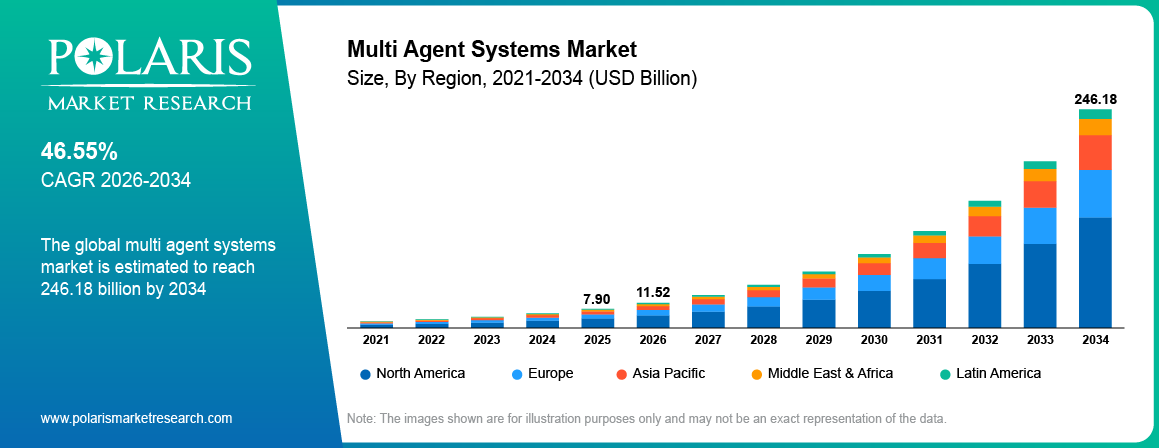
The global multi agent systems market was valued at around USD 7.90 billion in 2025 and is projected to reach USD 246.18 billion by 2034, registering a CAGR of 46.55% during the forecast period. The market is growing due to increasing enterprise adoption of autonomous AI workflows, rising investments in agent orchestration platforms, and rapid development of technologies that enable multiple AI agents to work together across business operations.
Market Statistics
Multi Agent Systems Market Key Takeaways 2025
- North America held the largest market share of 40.72% in 2025 owing to early adoption of multi agent systems and strong cloud AI infrastructure.
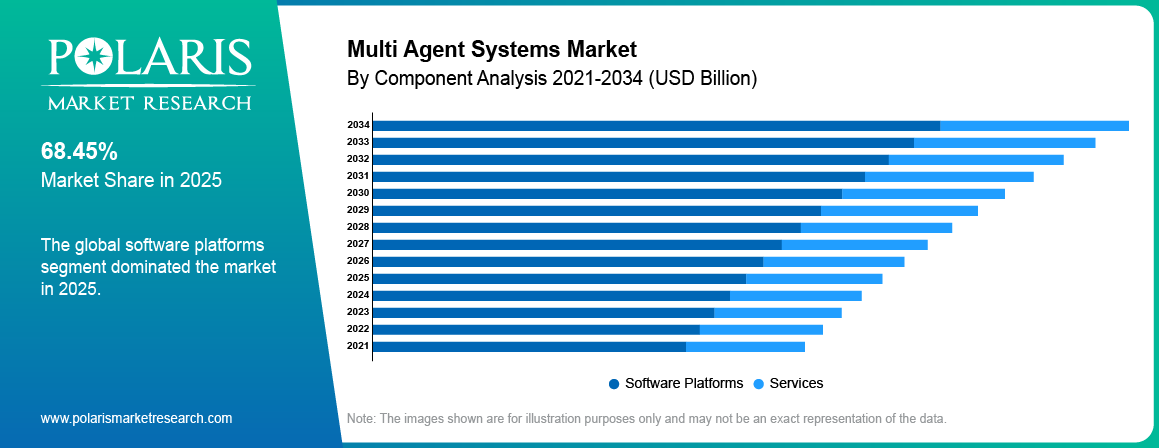
- The software platforms segment accounted for the largest share of 68.45% in 2025 due to growing deployment of agent orchestration platforms and AI agent fleet management solutions.
- Cloud deployment dominated the market with a 56.83% share in 2025 owing to rising demand for autonomous workflow execution across enterprises.
- The hybrid deployment segment is projected to grow at the fastest CAGR of 34.76% during 2026–2034 due to increasing enterprise data security requirements.
- Enterprise workflow automation held the largest application share of 29.64% in 2025 owing to growing adoption of LLM-based agent coordination across business operations.
Note: Figures and projections outlined in this report are the result of Polaris Market Research’s proprietary analytical processes, grounded in the latest available datasets and market observation
What is multi agent systems market?
A multi agent system is a group of intelligent AI agents that work together to complete a common task. Each agent performs a specific function while communicating with other agents through an agent-to-agent protocol. These systems combine reasoning, planning, memory, and execution capabilities to automate workflows that are difficult for a single AI assistant to manage independently.
Unlike standalone AI copilots, multi agent systems depend on an agentic control plane that coordinates task allocation, communication, and decision-making across multiple agents. Growing adoption of agent interoperability standards is allowing organizations to connect agents developed on different AI frameworks, making enterprise deployment faster and reducing integration challenges.
The market includes software platforms, orchestration solutions, governance tools, and managed services that coordinate two or more autonomous AI agents for enterprise applications. It excludes standalone chatbots, single-agent copilots, and traditional workflow automation software that do not support LLM-based agent coordination between multiple intelligent agents.
Source: Polaris Market Research Analysis
Market Impact Analysis
The multi agent systems market is expected to witness strong growth during the forecast period as enterprises move from deploying individual AI assistants to managing coordinated AI ecosystems. Organizations are investing in platforms that allow multiple intelligent agents to communicate, share information, and complete complex business processes with limited human intervention. In January 2026, Mitsubishi Electric developed a multi-agent AI system that uses adversarial debates among expert AI agents to automate complex enterprise decision-making with transparent reasoning (Source: www.mitsubishielectric.com).
Growing adoption of agent-to-agent protocol technologies is reducing interoperability challenges between AI agents developed on different frameworks. At the same time, enterprises are increasing investments in agentic control plane solutions that provide centralized governance, monitoring, and policy management across expanding AI deployments. These developments are strengthening demand for enterprise-grade multi agent systems across industries.
| Market Driver | Est. CAGR Impact | Geographic Relevance | Impact Timeline |
| Agent interoperability standard (A2A) adoption | +2.4% | Global | Short to Medium Term |
| Enterprise AI agent fleet management | +2.0% | Global | Medium Term |
| Multi-agent governance and regulatory compliance | +1.6% | North America, Europe | Long Term |
| Agent washing and vendor verification | +1.2% | Global | Medium Term |
| Protocol-level agent discovery | +1.4% | Global | Long Term |
* Indicative estimates based on market context and analyst judgment. Figures reflect relative driver weight, not additive CAGR contributions. Source: Polaris Market Research Analysis.
Multi Agent Systems Market Industry Dynamics
- Increasing adoption of enterprise AI automation is driving demand for coordinated AI agent ecosystems.
- Growing implementation of agent interoperability standards is improving communication between AI agents developed on different platforms.
- Increasing spending on multi agent governance and AI security in enterprises provides market opportunities in the long run.
- The development of an agent orchestration platform has helped organizations become efficient at handling complicated AI workflow management processes.
- Concerns regarding agent washing, governance, and regulatory compliance remain key implementation challenges.
- Increasing adoption of AI agent fleet management solutions is supporting enterprise-scale deployment of multi agent systems.
Multi Agent Systems Market -Drivers, Restraints and Opportunities
How is Agent Interoperability Driving the Multi Agent Systems Market?
Growing adoption of agent-to-agent protocol standards is reducing one of the biggest challenges in enterprise AI deployment, which is interoperability between agents built on different platforms. In June 2025, the Linux Foundation launched the Agent2Agent (A2A) Protocol Project to enable secure, interoperable communication and collaboration across enterprise multi-agent systems (Source: www.linuxfoundation.org). This agent has attracted widespread support in the industry, allowing different AI agents from different providers to interact using one common interface. The interoperability standard known as the Agent2Agent (A2A) protocol offered by the Linux Foundation makes multi agent system adoption easier for organizations.
How is Enterprise AI Governance Supporting Market Growth?
Companies are shifting from using single AI agents to having larger ecosystems where there is a need for governance and coordination. Such a shift is bringing about more need for agentic control plane tools that will help to coordinate the fleets of AI agents, enforce policies, and monitor workflows among many AI agents. In April 2026, Airship launched an additional AI Agent named the Campaigns AI Agent to boost the capabilities of the AI Agent Fleet for autonomous campaign orchestration and goal optimization (Source: www.airship.com) The increasing investment in multi-agent governance by enterprises is helping them enhance efficiency without compromising on security and compliance.
What Challenges Limit Multi Agent Systems Adoption?
The issues associated with agent washing are still plaguing market development, as there are a lot of companies who offer traditional chatbots or workflow automation services posing as multi-agent platforms. This makes it difficult for companies to determine the strengths of platforms and the solutions that truly support agent coordination, governance, and autonomous decision-making via LLM. Vendor verification, implementation difficulty, and governance requirements continue to be critical factors prior to any wide adoption.
What Opportunities Exist in the Multi Agent Systems Market?
The growing need for AI-enabled enterprises is generating immense business opportunities for vendors with cutting-edge AI agent orchestration and centralized governance platforms. The United States Department of State has launched its first-ever Enterprise AI Strategy (FY 2024-2025) (Source: U.S. Department of State), which has laid out the ground for the responsible usage, governance, and implementation of AI technologies in the department. Companies are focusing on agent discovery, auditability, and policy management at the protocol level for the secure execution of workflows by multiple AI agents. Growing regulatory requirements and enterprise digital transformation initiatives are expected to accelerate adoption of these platforms during the forecast period.
Source: Polaris Market Research Analysis
Multi Agent Systems Market Segmentation Analysis
The report provides a comprehensive analysis of the multi agent systems market by component, application, and deployment mode to identify the leading revenue-generating segments and high-growth opportunities across the industry.
Market by Component
Software Platforms Segment Dominated the Market by Component in 2025
The software platforms segment accounted for the largest share of 68.45% in 2025 due to increasing enterprise adoption of agent orchestration platforms, orchestration engines, and agentic control plane solutions. The organizations are adopting platforms where multiple AI agents can be integrated, increase workflow efficiencies, and help in improving multi-agent governance. Increasing need for scalable AI infrastructure has also contributed to the growth of the market.
Services Segment Projected to Register the Fastest CAGR
The services segment is projected to grow at the fastest CAGR of 46.98% during the forecast period due to rising demand for consulting, implementation, integration, and managed services. Enterprises require expert support to deploy AI agent fleet management solutions, establish governance frameworks, and integrate multi agent systems with existing enterprise infrastructure.
Market by Application
Enterprise Workflow Automation Held the Largest Application Share in 2025
Enterprise workflow automation held the largest application share of 29.64% in 2025 owing to increasing adoption of LLM-based agent coordination across finance, customer service, IT operations, software engineering, and supply chain management. Organizations have started using coordinated AI agents to enhance their efficiency and cut down on manual workload and process automation.
Cross-Vendor Agent Coordination Projected to Grow at the Fastest CAGR
The cross-vendor agent coordination segment is expected to witness the fastest CAGR of 47.60% during the forecast period due to growing adoption of the agent-to-agent protocol and agent interoperability standard technologies. Enterprises are increasingly connecting AI agents developed on different platforms to improve collaboration, operational flexibility, and enterprise-wide automation.
Market by Deployment
Cloud Deployment Dominated the Market with a 56.83% Share in 2025
Cloud deployment dominated the market with a 56.83% share in 2025 due to increasing adoption of cloud-native AI platforms and enterprise infrastructure. The use of the cloud allows the organization to enable autonomous workflows and implement coordinated AI agents without spending much on infrastructure.
Hybrid Deployment Projected to Register the Fastest CAGR
The hybrid segment is projected to grow at the fastest CAGR of 34.76% during the forecast period owing to increasing demand for secure enterprise AI environments. Hybrid deployment allows organizations to combine cloud scalability with on-premises infrastructure while supporting protocol-level agent discovery, regulatory compliance, and enterprise data security.
Segment Summary Table
| Segment | Category | 2025 Status | Forecast CAGR | Key Driver |
| Software Platforms | Component | Largest Share | High | Agent orchestration platform adoption |
| Services | Component | Fastest Growing | Highest | AI agent fleet management implementation |
| Enterprise Workflow Automation | Application | Largest Share | High | LLM-based agent coordination |
| Cross-Vendor Agent Coordination | Application | Fastest Growing | Highest | Agent interoperability standard adoption |
| Cloud | Deployment | Largest Share | High | Autonomous workflow execution |
| Hybrid | Deployment | Fastest Growing | Highest | Multi-agent governance and enterprise security |
Source: Polaris Market Research Analysis. Segment share and CAGR reflect Polaris proprietary sizing methodology.
Source: Polaris Market Research Analysis
Multi Agent Systems Market Regional Analysis
North America Multi Agent Systems Market
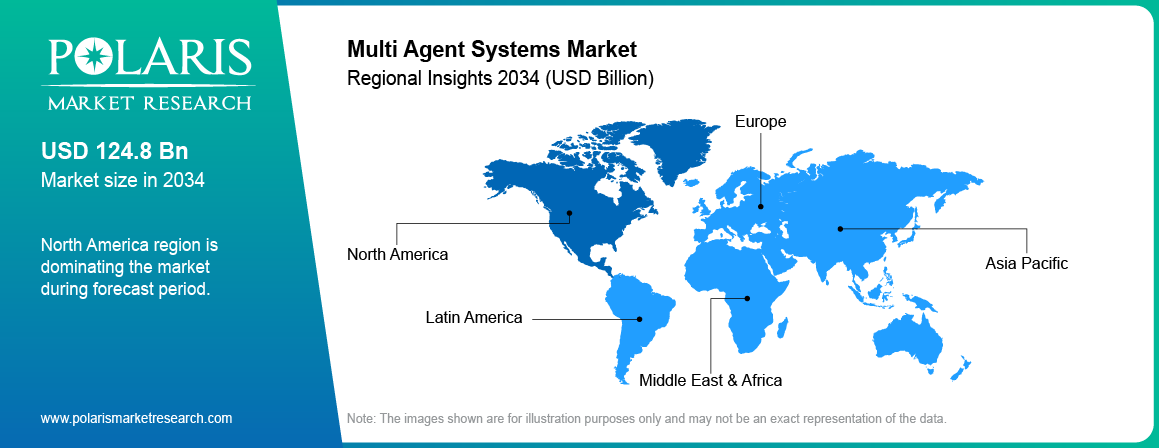
North America held the largest market share of 40.72% in 2025 owing to early adoption of enterprise AI, advanced cloud infrastructure, and the presence of major technology companies. Growing investments in agent orchestration platforms, enterprise AI infrastructure, and AI agent fleet management solutions are supporting market growth across the region.
The US leads the regional market due to increasing deployment of multi agent systems across financial services, healthcare, manufacturing, and IT operations. In May 2026, IBM unveiled the next-gen watsonx Orchestrate, offering unified orchestration and governance for multi-agent systems within IBM, OpenAI, Anthropic, and custom AI agents(Source: newsroom.ibm.com). The growing usage of the agent-to-agent protocol and enterprise multi-agent systems is driving market growth.
Europe Multi Agent Systems Market
The European region had a significant market share in of 21.8% 2025 due to rising investment in enterprise AI as well as increasing emphasis on responsible AI deployment. Many nations, including Germany, the UK, and France, are increasingly implementing MAS for automating business processes as well as enhancing governance and compliance aspects. Siemens' Fuse EDA AI Agent was launched in March 2026, which enables autonomous orchestration of MAS in semiconductor and PCB design applications(Source: news.siemens.com).
The implementation of the EU AI Act is encouraging organizations to invest in agentic control plane technologies capable of improving auditability, transparency, and LLM-based agent coordination across enterprise AI environments. Growing regulatory requirements continue to support regional market growth.
Asia Pacific Multi Agent Systems Market
Asia Pacific is projected to register the fastest CAGR of more than 45% during the forecast period due to rapid digital transformation and increasing enterprise AI investments. China, Japan, India, South Korea, and Singapore are witnessing growing adoption of multi agent systems across manufacturing, banking, telecommunications, and software development. The Chinese Ministry of Industry and Information Technology reported that the country's digital industry recorded USD 1.18 trillion in revenue during the first quarter of 2025, reflecting a 9.4% year-over-year increase(Source: english.www.gov.cn).
Growth opportunities are immense in the region owing to increasing standardization in terms of agent interoperability, rising cloud computing capabilities, and the increasing need for autonomous workflows. Rising investments in AI from government organizations and companies are also fueling market growth.
Latin America Multi Agent Systems Market
Latin America continues to show consistent growth due to cloud adoption and enterprise digitalization efforts. Brazil and Mexico are leading regional demand as organizations invest in AI-driven business automation and enterprise software modernization.
Growing awareness of AI agent fleet management and enterprise agent orchestration platforms is encouraging businesses to deploy coordinated AI systems across customer service, financial operations, and supply chain management.
Middle East & Africa Multi Agent Systems Market
The Middle East & Africa market is expected to grow steadily during the forecast period owing to increasing investments in digital transformation and national AI strategies. Saudi Arabia and the UAE are expanding enterprise AI adoption across government, banking, healthcare, and energy sectors.
Growing deployment of protocol-level agent discovery, enterprise multi-agent governance, and cloud AI infrastructure is creating new opportunities for market participants. Increasing public and private investments in AI technologies are expected to support long-term regional growth.
Source: Polaris Market Research Analysis
Multi Agent Systems Market Regulatory Heatmap
| Country | Policy Environment | Key Regulations | Market Implication | Trend |
| US | Developing | AI governance frameworks | Supports responsible enterprise AI adoption | Expanding |
| European Union | Favorable | EU AI Act | Strengthens multi-agent governance and compliance | Expanding |
| UK | Developing | AI governance framework | Encourages secure enterprise AI deployment | Stable |
| China | Developing | AI service regulations | Supports regulated AI commercialization | Growing |
| India | Favorable | IndiaAI Mission | Accelerates enterprise AI ecosystem development | Expanding |
| Japan | Favorable | AI Governance Guidelines | Encourages enterprise AI adoption | Growing |
| UAE & Saudi Arabia | Favorable | National AI strategies | Supports enterprise AI investments | Expanding |
Source: Polaris Market Research Analysis; European Commission (EU AI Act), Linux Foundation (Agent2Agent Protocol), IndiaAI Mission, UK Government, METI Japan, and national AI strategy publications
Technology and Innovation Landscape 2025-2026
The multi agent systems market is evolving through continuous advancements in agent coordination, interoperability, and enterprise governance. Organizations are focusing on technologies that enable multiple AI agents to collaborate securely while improving operational efficiency. Rapid adoption of agent-to-agent protocol standards and agent orchestration systems is helping enterprises implement AI systems in a coherent manner within various departments.
The enterprises are also leveraging technologies that facilitate an agentic control plane that offers centralized governance, policy, and monitoring of AI ecosystems. Increasing requirements for AI agent fleet management, protocol-level agent discovery, and LLM-based coordination of agents will likely help enterprises deploy AI solutions on a large scale by increasing autonomous AI operations.
| Technology | Adoption Stage | Key Development | Market Impact |
| Agent to Agent Protocol (A2A) | Growing | Enterprise adoption of standardized agent communication | Improves agent interoperability |
| Agentic Control Plane | Early Commercial | Centralized governance and policy management | Strengthens enterprise AI deployment |
| Agent Orchestration Platform | Growing | Cross-platform workflow coordination | Improves autonomous workflow execution |
| AI Agent Fleet Management | Early Commercial | Enterprise monitoring and lifecycle management | Enhances operational efficiency |
| Protocol-Level Agent Discovery | Emerging | Automated agent identification and communication | Reduces deployment complexity |
| Multi-Agent Governance | Mainstream | Enterprise compliance and audit capabilities | Improves AI transparency and security |
| LLM-Based Agent Coordination | Growing | Multi-agent reasoning across enterprise applications | Supports intelligent workflow automation |
Source: Polaris Market Research Analysis, press release, and IP & patent filings
Multi Agent Systems Buyer Use Cases and Market Entry Barriers
Who Buys Multi Agent Systems and Why?
Multi agent systems have been widely embraced by IT professionals within enterprises, cloud vendors, system integration firms, banks and financial institutions, health-care organizations, and manufacturers. Companies invest in such solutions to automate business processes, increase operational efficiency, and provide for multi-agent governance within their enterprise AI landscape.
The growing use of enterprise systems is also boosting the number of consultants and managed services providers offering help with the implementation of agent orchestration platforms, the integration of artificial intelligence agents, fleet management solutions, and governance strategy.
Buyer Decision Framework
| Buyer / Investor Type | Primary Use Case | Key Insight Sought | Decision Horizon |
| Enterprise IT Teams | AI workflow automation | Agent orchestration platform capabilities | 1–3 Years |
| System Integrators | Enterprise AI deployment | Agent interoperability standard support | 2–5 Years |
| Technology Providers | Product development | Multi-agent governance | 2–5 Years |
| Financial Institutions | Compliance and automation | AI agent fleet management | 1–3 Years |
| Government Organizations | Secure AI deployment | Regulatory compliance | 3–5 Years |
Source: Polaris Market Research Analysis
What are the Barriers to Entering the Market?
Integration Complexity
Integration of multi agent systems is quite complex and involves enterprise applications, cloud, and AI frameworks. Enterprises may need some special knowledge in order to implement secure intercommunication among multiple AI agents.
Governance and Regulatory Compliance
Enterprises need robust multi-agent governance, policy management, and auditing before implementing self-managing AI. Compliance with regulations on AI becomes more stringent and adds up to the list of requirements for solution vendors.
Agent Washing
The increasing issues of agent washing are making the enterprises careful when choosing their vendor. Vendors are now being selected on the basis of their orchestration abilities, governance characteristics, and experience with enterprise deployment and not by the promises made through marketing strategies.
Shortage of AI Talent
The deployment of an enterprise multi agent system requires professional AI engineers, data scientists, and cloud experts. Limited availability of experienced professionals continues to slow adoption across several industries.
Premium Insights and Forward Outlook
Enterprise AI is rapidly evolving from isolated automation tools toward coordinated AI ecosystems capable of managing complex business operations. Organizations are expected to increase investments in agent orchestration platforms, agentic control plane technologies, and AI agent fleet management solutions as enterprise AI deployments continue to expand.
Growing adoption of agent interoperability standards, increasing focus on protocol-level agent discovery, and stronger regulatory requirements are expected to shape future market growth. Vendors offering secure multi-agent governance capabilities and scalable LLM-based agent coordination platforms are likely to strengthen their competitive position throughout the forecast period.
Competitive Landscape
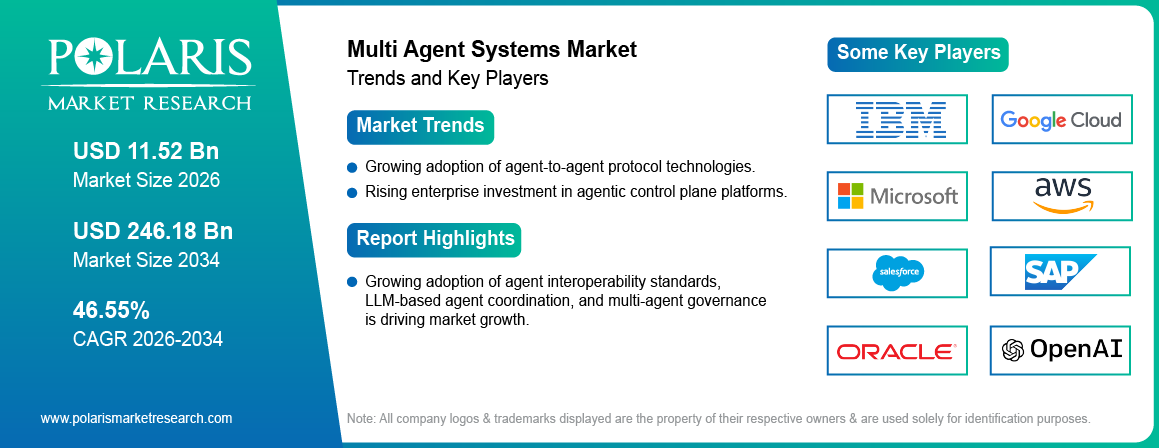
The multi agent systems market is moderately fragmented with competition among cloud providers, enterprise software companies, AI platform vendors, and emerging orchestration solution providers. Companies are focusing on developing agent orchestration platforms, agentic control plane technologies, and multi-agent governance capabilities to improve enterprise AI deployment across different business environments.
Leading vendors are investing in open agent interoperability standards, enterprise security, and AI agent fleet management solutions to strengthen their competitive position. Strategic partnerships, technology collaborations, and continuous product innovation remain the primary strategies adopted to expand enterprise adoption and support large-scale autonomous workflow execution.
Competitive Positioning Table
| Company | Est. Market Position | Primary Focus | Geographic Focus |
| IBM Corporation | Top Tier | Agentic control plane | Global |
| Google Cloud | Top Tier | Agent-to-agent protocol | Global |
| Microsoft Corporation | Top Tier | Enterprise AI platforms | Global |
| Amazon Web Services | Top Tier | Cloud AI infrastructure | Global |
| Salesforce Inc. | Leading Player | Agent orchestration platform | Global |
| ServiceNow Inc. | Strong Player | Enterprise workflow automation | Global |
Source: Company filings and press release
Multi Agent Systems Market Key Players
- IBM Corporation
- Google Cloud
- Microsoft Corporation
- Amazon Web Services
- Salesforce Inc.
- ServiceNow Inc.
- SAP SE
- Oracle Corporation
- NVIDIA Corporation
- OpenAI
- Anthropic
- Cisco Systems, Inc.
- UiPath Inc.
- C3 AI
- Deloitte
Industry Developments
- August 2026: Phenom launched WorkOps, a multi-agent platform that enables enterprises to orchestrate collaborative AI agents for autonomous HR workflow automation. (source: www.phenom.com)
- June 2026: Cognizant expanded its Neuro AI Multi-Agent Accelerator to enable interoperable multi-agent orchestration across ServiceNow, custom, and third-party AI agents. (source: investors.cognizant.com)
- April 2026: Google Cloud announced the Gemini Enterprise Agent Platform at Google Cloud Next '26, replacing Vertex AI with a unified platform to build, scale, govern, and optimize enterprise AI agents, including an Agent Registry, Agent Gateway, and access to over 200 models through Model Garden. (source: thejournal.com)
Multi Agent Systems Market Segmentation
By Component Outlook (Revenue, USD Billion, 2021–2034)
- Software Platforms
- Services
By Application Outlook (Revenue, USD Billion, 2021–2034)
- Enterprise Workflow Automation
- Cross-Vendor Agent Coordination
- Customer Service
- Software Development
- IT Operations
- Supply Chain Management
- Others
By Deployment Outlook (Revenue, USD Billion, 2021–2034)
- Cloud
- On-Premises
- Hybrid
By Regional Outlook (Revenue, USD Billion, 2021-2034)
- North America
- US
- Canada
- Europe
- Germany
- France
- UK
- Italy
- Spain
- Netherlands
- Russia
- Rest of Europe
- Asia Pacific
- China
- Japan
- India
- Malaysia
- South Korea
- Indonesia
- Australia
- Vietnam
- Rest of Asia Pacific
- Middle East & Africa
- Saudi Arabia
- UAE
- Israel
- South Africa
- Rest of Middle East & Africa
- Latin America
- Mexico
- Brazil
- Argentina
- Rest of Latin America
Multi Agent Systems Market Report Scope
| Report Attributes | Details |
| Market Size in 2025 | USD 7.90 Billion |
| Market Size in 2026 | USD 11.52 Billion |
| Revenue Forecast by 2034 | USD 246.18 Billion |
| CAGR | 46.55% from 2026 to 2034 |
| Base Year | 2025 |
| Historical Data | 2021–2024 |
| Forecast Period | 2026–2034 |
| Quantitative Units | Revenue in USD Billion and CAGR from 2026 to 2034 |
| Report Coverage | Revenue Forecast, Competitive Landscape, Growth Factors, and Industry Trends |
| Segments Covered |
|
| Regional Scope |
|
| Competitive Landscape |
|
| Report Format |
|
| Customization | Report customization as per your requirements with respect to countries, regions, and segmentation. |
Multi Agent Systems Market FAQ's
The global market size was valued at USD 7.90 Billion in 2025 and is projected to grow to USD 246.18 Billion by 2034.
Growing adoption of agent orchestration platforms, autonomous workflow execution, and agent interoperability standards is driving market growth.
North America held the largest market share of 40.72% in 2025 owing to its earlier adoption of AI technology and cloud infrastructure.
A protocol for agent-to-agent communication allows several AI agents to interact and collaborate to complete tasks.
An agentic control plane manages AI agent coordination, governance, and policy enforcement across enterprise environments.
By deployment, the hybrid segment is projected to grow the fastest, at a CAGR of 34.76% during the forecast period, driven by increasing demand for secure enterprise AI environments.
Major companies include IBM Corporation, Google Cloud, Microsoft Corporation, Amazon Web Services, Salesforce Inc., ServiceNow Inc., SAP SE, Oracle Corporation, NVIDIA Corporation, OpenAI, Anthropic, Cisco Systems Inc., UiPath Inc., C3 AI, and Deloitte.
Implementation complexity, agent washing, governance requirements, and data security concerns remain the key challenges.
Download Sample Report of Multi Agent Systems Market
Please fill out the form to request a customized copy of the research report.


