
Space Infrastructure Market Size, Share, Trends & Forecast, 2026–2034
REPORT DETAILS
Space Infrastructure Market Summary
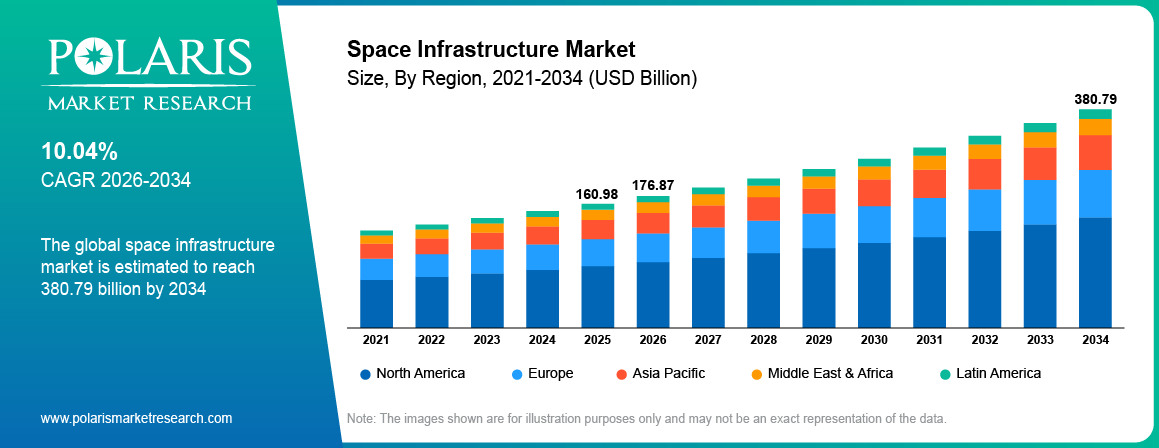
The global space infrastructure market was valued at around USD 160.98 billion in 2025 and is projected to reach USD 380.79 billion by 2034, registering a CAGR of 10.04% during the forecast period. The global space infrastructure market is projected to grow considerably during the forecast period, driven by increasing satellite deployments, commercial launch activity, and investment in orbital infrastructure.
Market Statistics
Space Infrastructure Market Key Takeaways
- North America holds the largest market share, accounting for 40.0% of global revenue.
- Asia Pacific is expected to register the fastest growth witnessing 11.88% CAGR during 2026-2034, due to increasing satellite deployments in China and growing private-sector participation in India's space industry.
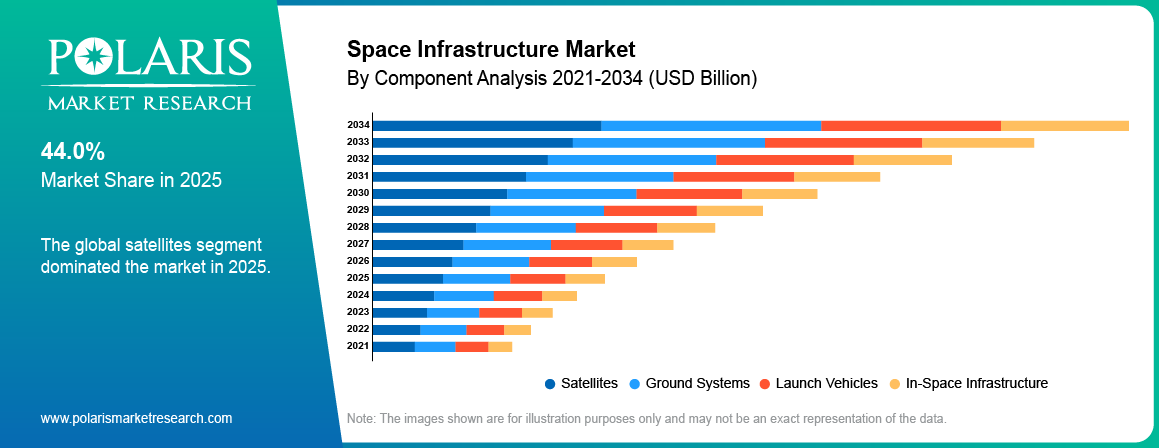
- Satellites held the largest component share of 44.0% in 2025, supported by communication, Earth observation, navigation, and defense applications.
- In-space infrastructure is projected to grow at the fastest rate of 16.47% during the forecast period owing to increasing development of orbital servicing, refueling, and commercial station technologies.
Note: Figures and projections outlined in this report are the result of Polaris Market Research’s proprietary analytical processes, grounded in the latest available datasets and market observations.
What Does the Space Infrastructure Market Cover?
The market covers launch vehicles, satellites, ground systems, and in-space infrastructure used for communication, Earth observation, navigation, defense, and exploration. North America is projected to continue as a strong market on account of existing space commercial infrastructure, public expenditures, and increasing activities in space services.
The market value chain consists of launch providers, satellite producers, suppliers of ground systems, aerospace firms, government organizations, telecommunications operators, and space logistics firms. Launch vehicles and satellites still constitute a significant part of the market, while orbital refueling, robotics servicing, space tugs, and space stations represent emerging market opportunities.
Declining launch costs are also supporting wider deployment of orbital assets. Falcon 9 reused-booster launch costs are approximately USD 2,700–3,000 per kg to low Earth orbit. In-space servicing is gaining momentum as operators seek to extend satellite lifecycles. In July 2026, Northrop Grumman launched its Mission Robotic Vehicle with three Mission Extension Pods, supporting satellite servicing and life-extension operations (Source: northropgrumman.com ).
Source: Polaris Market Research Analysis
Space Infrastructure Market Drivers, Restraints, and Opportunities
Space Infrastructure Market Driver Impact Analysis
| Market Driver | Est. CAGR Impact | Geographic Relevance | Impact Timeline |
| FAA Part 450 licensing reform | +1.2% | US | Short term, ongoing |
| In-orbit servicing commercialization | +1.6% | US, global GEO fleet | Short to medium term |
| Commercial space station construction | +1.1% | US, Europe | Medium term, 2–4 years |
| China megaconstellation buildout | +0.9% | Asia Pacific, export markets | Short to medium term |
| India space-sector liberalization | +0.5% | Asia Pacific | Medium to long term |
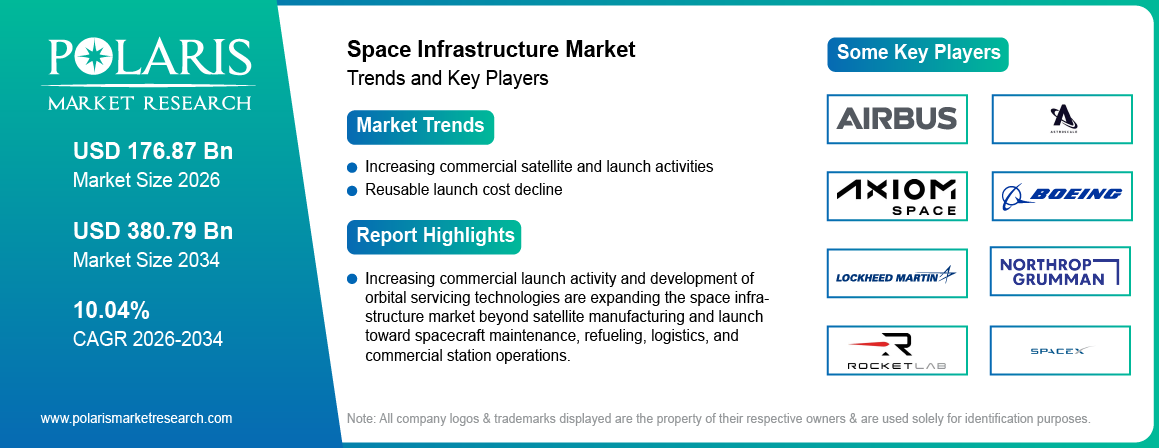
| Reusable launch cost decline | +1.8% | Global | Long-term structural |
Source: Polaris Market Research Analysis
The space infrastructure market is expected to witness considerable growth during the forecast period due to increasing satellite launches, declining launch costs, commercialization of in-orbit services, and investments in commercial space stations. Growing investment across spacecraft manufacturing and launch activities is supporting the development of the wider space infrastructure ecosystem.
Reusable launch technologies are also improving the economics of satellite deployment. Pricing for Falcon 9 is currently USD 69.75 million per launch and USD 2,700-3,000 per kg to LEO, whereas the price of Rocket Lab's Electron is approximately USD 7.5 million for a dedicated mission of up to 300 kg to LEO (Source: orbitalradar.com). The variety of possible launch options enables satellite owners to choose among different services based on payload capability, schedule, and mission needs.
The development of infrastructure beyond launch is further supporting market expansion. Commercial station programs, large satellite constellations, and increasing private-sector participation in Asia Pacific are also creating demand for ground infrastructure, docking systems, orbital logistics, and servicing technologies.
What is Driving Space Infrastructure Market Growth?
Increasing commercial launch activity is driving the demand for space infrastructure across satellites, ground stations, communication systems, and related services. The Part 450 licensing process developed by the FAA created a performance-based licensing system for commercial launches and reentries. Existing licensees were required to transition to the new framework (Source: www.faa.gov). There was an increase in the number of launches due to increased commercial activities. As per the Space Foundation report published in July 2025, the global space economy in 2024 amounted to a record-breaking USD 613 billion. The commercial sector accounted for 78% of total market activity, while the space launch industry recorded 149 launches in the first half of the year (Source: spacefoundation.org). Increasing launch frequency is expected to support demand for spacecraft manufacturing, ground infrastructure, communication networks, and other supporting systems.
How is In-Orbit Servicing Reshaping Space Infrastructure?
The increasing commercialization of in-orbit servicing is creating opportunities for satellite maintenance, refueling, relocation, and life-extension services. In May 2025, Revolv Space gained entry into the in-orbit servicing segment through an alliance with Infinite Orbits to incorporate state-of-the-art satellite mobility and servicing technologies into its future missions (Source: www.revolvspace.com).The partnership will help advance the capabilities of in-orbit servicing by providing more commercial solutions for satellite life extension, maintenance, and orbital activities. Increasing focus on repairing rather than disposing of valuable spacecraft is likely to boost the growth of the in-orbit servicing market.
What Challenges Could Restrict Space Infrastructure Market Expansion?
Non-uniformity in technical standards is still one of the key problems of orbital services and fueling technologies. Each service provider uses its own docking and fueling interface, which causes problems for satellite developers and operators. Lack of a standardized interface limits the number of spacecraft for which a single servicing platform can provide its services. In addition, launchers, satellites, ground facilities, and business stations need large investments before revenues from commercial activities start coming in. Large development times and continuous reliance on demonstration projects financed by governments increase risks of commercialization for new infrastructure providers.
What Opportunities Exist in the Space Infrastructure Market?
The development of commercial space stations is creating opportunities for launch providers, station manufacturers, communication companies, and space logistics operators. NASA reported that Axiom Space remained on schedule to attach its Hab One module to the International Space Station in 2026 (Source: www.nasa.gov). Increasing development of commercial stations is expected to generate demand for module transportation, docking systems, communication infrastructure, logistics, and servicing capabilities.
Source: Polaris Market Research Analysis
Segmentation Analysis
The report provides a comprehensive analysis of the space infrastructure market by component, end use, application, orbit type, and region to identify key revenue-generating and high-growth segments.
Market by Component
Which Component Leads the Space Infrastructure Market?
The satellites segment accounted for the largest space infrastructure market share of 44.0% in 2025. Satellites are extensively used for communication, Earth observation, navigation, defense, and government applications. Increasing deployment of large satellite constellations is further supporting segment demand. China's Guowang satellite constellation had approximately 177 satellites in orbit as of late July 2026, against a state-owned operator target of 310 by year-end, with the constellation planned to eventually reach roughly 13,000 satellites (Source: techtimes.com). Qianfan reached 218 satellites in orbit following a launch on July 4, 2026.
Which Component is Growing Fastest?
In-space infrastructure is projected to grow at the fastest CAGR of 16.47% during the forecast period. Increasing development of orbital servicing, satellite refueling, space tugs, and commercial space stations is supporting segment expansion. Increasing commercialization of satellite life-extension services is expected to strengthen demand for in-space infrastructure.
Market by End Use
Which End-Use Segment Leads the Market?
The commercial segment accounted for the largest market share of 54.0% in 2025. Increasing private satellite deployments, commercial launch services, broadband constellations, and development of private space stations are supporting segment dominance. Lower launch costs are also making it possible for private companies to launch more spacecraft into space.
Government and military users continue to generate substantial demand for satellite propulsion systems and emerging orbital servicing technologies. High-value defense and government spacecraft can benefit from life-extension, inspection, relocation, and refueling services. Increasing government interest in maintaining existing orbital assets is therefore creating additional opportunities for servicing providers.
Market by Application
Which Application Holds the Largest Share?
The communication segment dominated the space infrastructure market with 42.0% share in 2025. Increasing deployment of broadband satellite constellations is supporting demand for satellites, launch services, satellite ground stations, and network infrastructure. Expansion of large communication constellations is expected to maintain demand for supporting infrastructure.
Earth observation and navigation also represent important application areas due to their use across government and commercial operations. Exploration and space logistics currently account for a smaller market base but are expected to expand with the development of commercial stations and orbital servicing systems. These activities require transportation, rendezvous, docking, communication, and maintenance infrastructure.
Market by Orbit Type
Low Earth orbit accounts for a substantial share of spacecraft deployment accounting for 52.0% share in 2025 owing to the increasing number of communication and Earth observation constellations. High launch frequency and growing commercial satellite activity are increasing the need for LEO satellite networks, ground systems, and associated infrastructure.
Geostationary orbit represents an important market for satellite servicing witnessing 8.98% CAGR due to the high value and long operating life of GEO spacecraft. Refueling and life-extension services can enable operators to extend the useful life of existing satellites rather than undertake immediate replacement. Cislunar infrastructure remains at an earlier stage of development but is expected to create long-term opportunities for transportation, communication, and space logistics systems.
Segment Performance Summary
| Segment Category | Segment | Base-Year Status | Forecast CAGR | Key Driver |
| Component | Satellites | Largest share | 9.8% | Constellation buildout |
| Component | In-Space Infrastructure | Fastest growing | 16.47% | Orbital servicing |
| End Use | Commercial | Largest share | 10.9% | Commercial infrastructure deployment |
| End Use | Government/Military | High-value demand | 9.4% | Satellite life extension |
| Application | Communication | Largest share | 10.1% | Megaconstellation deployment |
| Application | Exploration/Logistics | Fastest growing | 14.2% | Station module delivery |
| Orbit | GEO | Largest value per satellite | 8.98% | Refueling economics |
| Orbit | Cislunar | Fastest growing, low base | 15.1% | Emerging space logistics |
Source: Polaris Market Research Analysis.
Source: Polaris Market Research Analysis
Regional Analysis
North America Space Infrastructure Market Size and Share
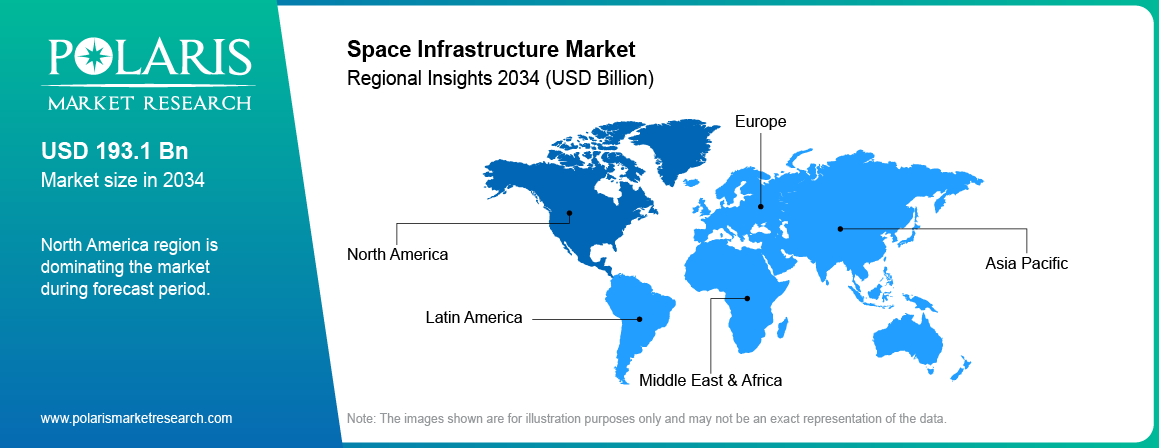
North America dominated the space infrastructure market in 2025 with 40.0% of global revenue. The region benefits from strong commercial launch capabilities, established spacecraft manufacturers, government procurement, and increasing investment in orbital servicing and commercial station technologies. The US is continually expanding the launch services market, while changes in the licensing regulations of the FAA are helping the emergence of the commercial space industry in the regio ( Source: www.nasa.gov).
The US represents the largest market within North America, capturing 78.0% share in 2025, owing to its extensive launch, satellite manufacturing, defense, and commercial space capabilities. In July 2026, NASA supported the launch of a robotic satellite servicing mission to demonstrate autonomous in-orbit maintenance technologies (Source: nasa.gov). The mission strengthens launch, satellite manufacturing, defense, and commercial space capabilities by advancing satellite servicing and mission resilience. Increasing development of orbital servicing and commercial station infrastructure is supporting regional market growth.
Canada maintains capabilities across satellite technologies and ground infrastructure and participates in the wider North American aerospace supply chain. Increasing demand for satellite communication and Earth observation systems is expected to support infrastructure requirements in the country.
Europe Space Infrastructure Market Size and Share
In 2025, Europe accounted for 24.0% share of the global space infrastructure market, due to its established satellite manufacturing, aerospace engineering, and ground-system capabilities. European companies are also participating in international commercial station programs. Airbus is involved in the Starlab commercial station initiative alongside Voyager Technologies, providing the region with exposure to the development of commercial low Earth orbit infrastructure.
Cross-border cooperation remains an important feature of the European market as infrastructure programs often involve companies and agencies across multiple countries. Growing development of satellite systems, station technologies, and ground infrastructure is expected to support the regional market during the forecast period.
Asia Pacific Space Infrastructure Market Size and Share
Asia Pacific is projected to register the fastest CAGR of 11.88% during the forecast period due to increasing satellite deployments, government investment, and growing participation of private space companies. China is expanding its satellite infrastructure through the Guowang and Qianfan constellations. Increasing constellation deployment is supporting demand for spacecraft manufacturing, launch systems, satellite ground stations, and network infrastructure.
India is also developing its commercial space ecosystem through government-supported private-sector participation. The government of India launched the Technology Adoption Fund (TAF) with a total allocation of approximately USD 57 million to accelerate the commercialization of space technologies (Source: www.inspace.gov.in) The program provides partial funding for startups, MSMEs, and industry players, with support of up to USD 2.9 million per project to help advance early-stage technologies toward commercial deployment. Increasing commercialization is expected to create opportunities for domestic satellite, launch, and supporting infrastructure providers.
Latin America Space Infrastructure Market Size and Share
Latin America represents an emerging market for satellite communication, Earth observation, and supporting ground infrastructure. The region remains dependent on international launch and satellite suppliers for a significant portion of its infrastructure requirements. Brazil represents an important regional market owing to demand for satellite connectivity and Earth observation services.
Increasing expansion of international satellite networks into Latin America is expected to support demand for ground systems and communication infrastructure. However, development of domestic orbital servicing and commercial station capabilities remains limited compared with North America, Europe, and Asia Pacific.
Middle East and Africa Space Infrastructure Market Size and Share
The Middle East and Africa space infrastructure market is developing primarily through satellite communication, Earth observation, and ground infrastructure requirements. Demand for connectivity and satellite-based services is supporting investment in ground systems and related infrastructure across the region.
The development of advanced in-space infrastructure remains at an earlier stage compared with North America and Asia Pacific. No regional orbital servicing or commercial station program comparable to those in the US has been identified. Near-term market growth is therefore expected to remain concentrated around satellite and ground-system infrastructure.
Regulatory Environment Heatmap
| Region/Country | Policy Environment | Key Regulations/Programs | Market Implication | Trend |
| US | Favorable | FAA Part 450 (14 CFR); OBBBA launch user fee | Faster licensing, new per-launch fee from 2026 | Expanding |
| US | Favorable | Proposed NEPA/environmental waiver rule | Further licensing timeline compression if finalized | Developing |
| US | Favorable | NASA Commercial LEO Destinations program | Station demand shifts from subsidy to purchase | Expanding |
| India | Favorable | Indian Space Policy 2023; IN-SPACe single-window authorization | Rising private-sector entry, tech transfer | Expanding |
| India | Favorable | IN-SPACe Technology Adoption Fund | Startup/SME funding up to 60% of project cost | Early stage |
| China | Neutral | State-directed constellation licensing (Guowang, Qianfan) | High cadence, limited Western market access | Expanding |
| China | Neutral | Mandatory deorbit rule for spent rocket stages | Raises compliance cost, improves debris outlook | Developing |
| Europe | Neutral | ESA-coordinated programs; no single EU launch regulator | Slower unified policy movement vs US | Stable |
Source: Polaris Market Research Analysis
Source: Polaris Market Research Analysis
Competitive Landscape
The global space infrastructure market includes established aerospace companies, commercial launch providers, satellite manufacturers, station developers, and specialized orbital servicing companies. Competition is based on launch capabilities, mission reliability, spacecraft technology, manufacturing capacity, government contracts, and the ability to provide advanced in-space services.
Competitive Landscape Snapshot
| Company | Estimated Market Position | Primary Strength | Geographic Focus | In Report |
| Northrop Grumman | Top 5 | In-orbit servicing | US | Yes |
| SpaceX | Top 3 | Launch cost and cadence | Global | Yes |
| Axiom Space | Regional leader | Commercial station development | US | Yes |
| Astroscale | Niche leader | GEO refueling and servicing | US/Japan | Yes |
| Rocket Lab | Regional leader | Dedicated small-satellite launch | US/New Zealand | Yes |
| China SatNet / Shanghai Spacesail | State-directed major participant | Megaconstellation deployment | China/export markets | Yes |
Source: Company publications and approved sources
Industry participants have indicated that sustained government programs can be important for supporting the commercialization of servicing technologies beyond individual demonstration missions. The transition from demonstration programs toward recurring operational procurement is therefore expected to influence the competitive position of emerging market participants.
Technology and Innovation Landscape
The space infrastructure industry is advancing through developments in robotic servicing, orbital refueling, reusable launch systems, commercial station technologies, and large-scale satellite manufacturing. Robotic servicing is moving toward early commercial deployment, enabling operators to inspect, relocate, maintain, and extend the operating life of spacecraft.
| Technology | Adoption Stage | Key Development | Market Impact |
| Robotic in-orbit servicing | Early commercial deployment | Northrop Grumman MRV launch, July 2026 | Supports asset servicing and life extension |
| Orbital refueling interfaces | Early commercial deployment | Astroscale APS-R targeted demonstration | Supports satellite life extension |
| Reusable launch vehicles | Mainstream adoption | Falcon 9 reused-booster operations | Lower deployment cost |
| Modular habitats | Growing deployment | Sierra Space LIFE testing | Supports commercial station development |
| Megaconstellation manufacturing | Mainstream adoption | Guowang/Qianfan deployment | Expands satellite and ground-system demand |
Source: Approved company and trade sources
Who Buys Space Infrastructure Market Research and Why?
Growing commercialization across satellite manufacturing, launch services, commercial stations, and orbital servicing is increasing demand for space infrastructure market research. Market Intelligence is employed by institutional investors, aerospace manufacturers, government entities, telecom operators, and infrastructure providers to detect growth areas, analyze technology trends, understand their competitive position, and make investment and procurement decisions.
| Buyer / Investor Type | Primary Use Case | Key Insight Sought | Decision Horizon |
| Institutional investors | Investment screening | Growth, commercialization, competitive position | 2–5 years |
| Aerospace companies | Partnership/M&A planning | Supplier and technology positioning | 3–7 years |
| Government program offices | Procurement benchmarking | Cost and technical maturity | 1–3 years |
| Telecom carriers | Connectivity partnerships | Regional constellation coverage | 2–5 years |
| Infrastructure suppliers | Market-entry planning | Component and regional demand | 3–7 years |
Source: Polaris Market Research Analysis.
What are the Barriers to Entering the Market?
- Capital Requirements: Launch vehicles, satellites, orbital platforms, and commercial stations require substantial investment in development, testing, manufacturing, and deployment.
- Regulatory Requirements: Commercial launch providers are required to comply with licensing frameworks such as FAA Part 450 in the US.
- Technical Complexity: Orbital rendezvous, docking, robotic servicing, refueling, and human-rated infrastructure require specialized engineering capabilities.
- Interface Standardization: Different docking and refueling systems can create compatibility issues and increase technology-selection risks.
- Long Commercialization Timelines: Commercial stations and advanced servicing technologies can require several years of development before generating recurring commercial revenue.
- Government Dependency: Early-stage orbital servicing and commercial station projects remain significantly dependent on government procurement and demonstration programs.
Premium Insights and Forward Outlook
Orbital Refueling and Servicing Ecosystem
The development of standardized orbital refueling interfaces is expected to influence the commercialization of satellite servicing. Standardized systems could enable a larger number of spacecraft to use common servicing and refueling platforms, reducing compatibility concerns for satellite manufacturers.
Commercial Space Station Development
Commercial space stations are emerging as an important area of infrastructure development. NASA's Commercial LEO Destinations program is supporting private station initiatives and creating opportunities across station modules, launch services, docking systems, communication, and logistics. Increasing progress toward privately operated low Earth orbit destinations is expected to expand the commercial space station market during the forecast period.
Cost and Pricing Benchmarking
| Product/Service Type | Estimated Price Range | Key Cost Driver | Complexity Tier |
| Dedicated small launch, Electron-class | Approx. USD 7.5M per mission | Dedicated orbit and payload processing | Tier 2 |
| Falcon 9 dedicated launch | Approx. USD 69.75M | Booster reuse and launch cadence | Tier 2 |
| Falcon 9 LEO transport | Approx. USD 2,700–3,000/kg | Payload mass and mission configuration | Tier 2 |
| Commercial station module, CLD-class | USD 125.6M–160M Phase 1 award reference | Habitat and station development | Tier 3 |
| GEO life-extension/refueling services | Vendor/project pricing | Rendezvous, docking, fuel transfer | Tier 3 |
Source: Pricing sources and Polaris Market Research Analysis.
Key Players in the Space Infrastructure Market
- Airbus SE
- Astroscale Holdings Inc.
- Axiom Space, Inc.
- Blue Origin, LLC
- The Boeing Company
- China Satellite Network Group Co., Ltd.
- Lockheed Martin Corporation
- Northrop Grumman Corporation
- Rocket Lab USA, Inc.
- Shanghai Spacesail Technology Co., Ltd.
- Sierra Space Corporation
- Space Exploration Technologies Corp.
- Voyager Technologies, Inc.
Industry Developments
- July 21, 2026: Northrop Grumman's Mission Robotic Vehicle and three Mission Extension Pods launched aboard a SpaceX Falcon 9 from Cape Canaveral, carrying the U.S. Naval Research Laboratory's Robotic Servicing of Geosynchronous Satellites payload, advancing commercial satellite life-extension capability. (Source: spaceflightnow.com)
- July 4, 2026: China's Qianfan constellation reached 218 satellites in orbit following a Long March 6A launch from Taiyuan Satellite Launch Center. (Source: friendsofnasa.org)
- March 24, 2026: NASA unveiled its "Ignition" strategy, restructuring the Commercial LEO Destinations program away from fully independent free-flying stations toward a government-owned core module with privately supplied add-on modules, a shift the agency says reflects doubts that a standalone commercial station business case exists yet. (Source: spacepolicyonline.com)
- January 2026: The U.S. Space Force confirmed four commercial on-orbit satellite servicing and refueling missions for 2026, including an Astroscale U.S. refueling program funded by Space Systems Command, aimed at extending the operational life of military GEO satellites. (Source: airandspaceforces.com)
Space Infrastructure Market Segmentation
By Component Outlook (Revenue, USD Billion, 2021–2034)
- Satellites
- Ground Systems
- Launch Vehicles
- In-Space Infrastructure
By End Use Outlook (Revenue, USD Billion, 2021–2034)
- Commercial
- Government
- Military
By Application Outlook (Revenue, USD Billion, 2021–2034)
- Communication
- Earth Observation
- Navigation
- Exploration/Logistics
By Orbit Type Outlook (Revenue, USD Billion, 2021–2034)
- Low Earth Orbit (LEO)
- Medium Earth Orbit (MEO)
- Geostationary Orbit (GEO)
- Cislunar/Deep Space
By Regional Outlook (Revenue, USD Billion, 2021–2034)
- North America
- US
- Canada
- Europe
- Germany
- France
- UK
- Italy
- Spain
- Netherlands
- Rest of Europe
- Asia Pacific
- China
- Japan
- India
- South Korea
- Taiwan
- Australia
- Rest of Asia Pacific
- Latin America
- Brazil
- Mexico
- Argentina
- Rest of Latin America
- Middle East & Africa
- Saudi Arabia
- UAE
- South Africa
- Rest of Middle East & Africa
Space Infrastructure Market Report Scope
| Report Attributes | Details |
| Market Size in 2025 | USD 160.98 Billion |
| Market Size in 2026 | USD 176.87 Billion |
| Revenue Forecast by 2034 | USD 380.79 Billion |
| CAGR | 10.04% from 2026–2034 |
| Base Year | 2025 |
| Historical Data | 2021–2024 |
| Forecast Period | 2026–2034 |
| Quantitative Units | Revenue in USD Billion and CAGR |
| Report Coverage | Revenue Forecast, Growth Factors, Competitive Landscape, Industry Trends, and Strategic Analysis |
| Segments Covered | By Component, End Use, Application, Orbit Type, and Region |
| Regional Scope | North America, Europe, Asia Pacific, Latin America, Middle East & Africa |
| Competitive Landscape | Company Profiling, Product Benchmarking, Financial Analysis, Market Developments, and Strategic Initiatives |
| Report Format | PDF + Excel |
| Customization | Available by Country, Region, and Segment |
Source: Polaris Market Research Analysis
Space Infrastructure Market – Research Methodology Overview
The research methodology for the space infrastructure market combines primary and secondary research techniques with quantitative and qualitative analysis to ensure accuracy and reliability of the findings. The study evaluates satellite deployment trends, launch activity, orbital servicing developments, and regulatory changes across the value chain to identify key revenue-generating and high-growth segments.
Secondary research involved the review of regulatory filings, launch manifests, government space agency publications, and company disclosures to establish market fundamentals and industry trends. Primary research included interviews with executives across launch providers, satellite manufacturers, orbital servicing companies, and government program offices to validate assumptions and understand demand-side dynamics. Market sizing was conducted using a combination of top-down and bottom-up approaches, with data triangulation applied to improve estimation accuracy across components, end uses, applications, orbit types, and regions.
Forecasting incorporated assessment of policy developments, technology adoption trends, and investment activity to project market behavior through 2034. Data validation was performed through cross-verification of primary and secondary findings to ensure consistency across segments and datasets.
| Research Phase | Key Activities | Data Sources | Purpose |
| Secondary research | Review of regulatory filings, launch manifests, and company disclosures | Government agencies, industry associations, company reports | Establish market fundamentals and industry trends |
| Primary research | Interviews with launch providers, satellite operators, and program offices | Industry executives and government stakeholders | Validate market assumptions and demand trends |
| Market sizing | Top-down and bottom-up estimation with data triangulation | Spending data, contract activity, company revenues | Estimate market size and segment share |
| Forecasting | Assessment of policy, technology, and investment trends | Regulatory developments, technology adoption programs | Develop long-term market forecast |
| Data validation | Cross-verification of quantitative and qualitative findings | Primary interviews and secondary sources | Improve accuracy and consistency |
Source: Polaris Market Research Analysis
Space Infrastructure Market FAQ's
The market includes launch vehicles, satellites, ground systems, commercial space stations, space tugs, orbital refueling platforms, and servicing spacecraft.
The global space infrastructure market was valued at USD 160.98 billion in the base year and is projected to reach USD 380.79 billion by the forecast year, growing at a CAGR of 10.04%.
North America dominated the market with 40.0% share in the base year, supported by strong commercial launch activity and government investment.
Asia Pacific is projected to grow at the fastest CAGR of 11.88%, driven by expanding satellite deployments and increasing commercialization of space activities.
Satellites held the largest market share of 44.0% in 2025, supported by rising demand for communication, Earth observation, and navigation applications.
In-space infrastructure is projected to register the fastest CAGR of 16.47%, driven by growing investment in satellite servicing and orbital refueling technologies.
The commercial segment accounted for the largest market share of 54.0% in 2025, driven by increasing private satellite deployments, commercial launch services, and the development of private space stations.
Low Earth orbit (LEO) accounted for the largest share of spacecraft deployment, at 52.0% in 2025, driven by the growing number of communication and Earth observation constellations.
Major players in this market include Airbus SE, Astroscale Holdings Inc., Axiom Space, Inc., Blue Origin, LLC, The Boeing Company, China Satellite Network Group Co., Ltd., Lockheed Martin Corporation, Northrop Grumman Corporation, Rocket Lab USA, Inc., Shanghai Spacesail Technology Co., Ltd., Sierra Space Corporation, Space Exploration Technologies Corp., Voyager Technologies, Inc.
Growth is driven by commercial launch activity, reusable launch technologies, satellite constellation deployment, orbital servicing, and commercial space station development.
Key barriers include high capital requirements for launch vehicles and orbital platforms, complex regulatory frameworks such as FAA Part 450, technical complexity in servicing and docking operations, lack of standardized interfaces, long commercialization timelines, and dependency on government demonstration programs.
Recent developments include Northrop Grumman's Mission Robotic Vehicle launch in July 2026, Qianfan's constellation reaching 218 satellites the same month, NASA's March 2026 Ignition strategy reshaping its Commercial LEO Destinations program, and the U.S. Space Force's confirmation of four commercial satellite servicing missions for 2026.
Download Sample Report of Space Infrastructure Market
Please fill out the form to request a customized copy of the research report.


