
Data Center Transformation Market Size, Share, Trends & Forecast, 2026–2034
REPORT DETAILS
Data Center Transformation Market Summary
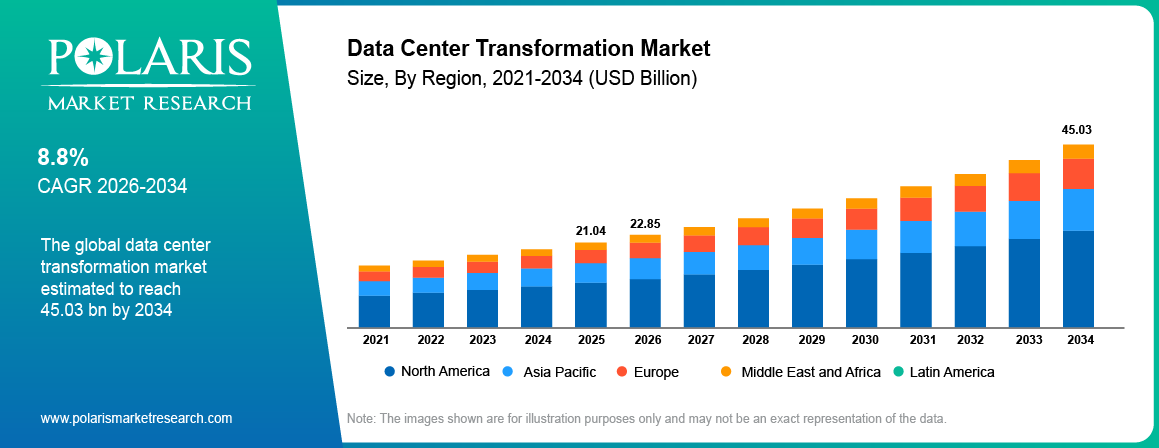
Data center transformation market size was valued at USD 21.04 billion in 2025 and is expected to grow at a CAGR of 8.8% from 2026 to 2034. Market growth is driven by rising data center electricity consumption, server consolidation, and sovereign cloud transformation.
Market Statistics
Data Center Transformation Market Key Takeaways
- The North America data center transformation market accounted for 41.36% of the global share in 2025. The dominance is driven by the presence of a high enterprise installed base, a well-entrenched hyperscale ecosystem, and high demand for AI-enabled data centers.
- The market in Asia Pacific is expected to exhibit a 11.32% CAGR during the forecast period. The growth is attributed to the rapid deployment of data centers and increasing enterprise modernization.
- Consolidation & migration segment accounted for a major market share of 35.84% in 2025. The leading share is fueled by the growing need to reduce infrastructure sprawl, migrate workloads across on-premises, and hybrid environments.
- The AI-ready high-density infrastructure is projected to record a 12.48% CAGR during the projected period, owing to growing AI workloads and higher rack-density requirements.
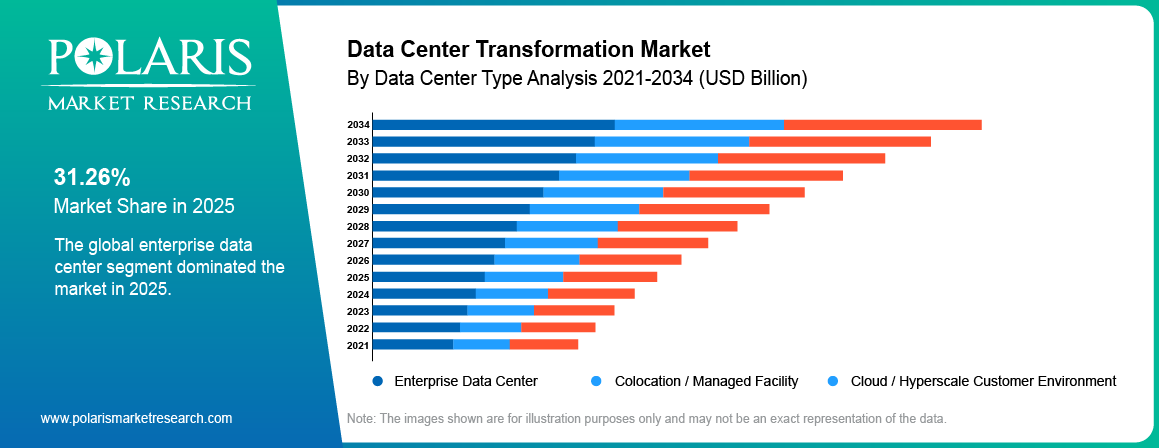
- Enterprise data centers dominated with a market share of 31.26% in the base year driven by the need to modernize legacy infrastructure, improve operational efficiency, and support changing workload requirements.
Note: Figures and projections outlined in this report are the result of Polaris Market Research’s proprietary analytical processes, grounded in the latest available datasets and market observations
Market Definition and Growth Analysis
The data center transformation market comprises coordinated programs that materially change the architecture, infrastructure, operating model, efficiency, and workload role of existing data center environments. Key activities include data center consolidation, infrastructure modernization, private cloud, hybrid cloud, HCI, cyber resilience, and managed transformation services. Routine maintenance, like-for-like replacement, and unrelated greenfield construction are excluded.
The growth in the data center infrastructure transformation market is attributed to the increase in the AI workloads, increasing rack densities, aging infrastructure, and increasing operational complexity. Data intensive workloads are forcing enterprises to upgrade servers, storage, networks, power, cooling, monitoring and automation. These upgrades also support data center consolidation by enabling enterprises to optimize infrastructure capacity and improve resource utilization across existing facilities.
Data center transformation and data center consolidation markets also play an important role in transformation, where organizations aim at reducing the sprawl of their infrastructure and optimizing the location of the workloads. This process includes shutting down underutilized sites, workload migration, virtualization, and centralized management of the whole infrastructure. Hybrid cloud modernization further supports this transformation by enabling organizations to integrate on-premises infrastructure with cloud environments while improving workload flexibility and resource utilization.
The market also includes operational modifications that are directly related to transformation activities, such as DCIM, infrastructure monitoring, automated provisioning, cybersecurity, governance, and infrastructure standardization. Transformation spending includes migration services, automation engineering, cloud integration, security, architectural services, infrastructure enhancements, and transition management, while consulting services and IT services are out of consideration.
Legacy infrastructure is a growing constraint on this modernization. The Uptime Institute's 2025 survey found that aging equipment limits how much operators can improve power usage effectiveness, pushing more organizations toward planned refresh cycles rather than incremental fixes. This is pairing with rising AI density requirements to accelerate transformation timelines, since facilities built for earlier generations of compute often cannot support current rack power and cooling needs without significant upgrade.
Market Dynamics
Driver: Rising Data Center Electricity Consumption is Accelerating Transformation Demand
The rapid expansion of AI and data center computing capacity is increasing overall electricity consumption, driving greater demand for data center transformation across existing and expanding facilities. For instance, in 2026, IEA reported that global data center electricity consumption increased by around 17% in 2025, reflecting the continued growth of AI hardware and accelerated computing (Source: iea.org).
The result is an increasing need for AI ready data centers and efficient data centers regarding energy consumption in the existing infrastructure. The companies consider the availability of power, cooling readiness, PUE, network capacity, workload migration, data center consolidation, hybrid cloud transformation, private cloud, virtualization, and infrastructure transformation. The requirements mentioned above are the factors behind the increasing demand for data center transformation.
Driver: Server Consolidation is Accelerating Data Center Transformation
The increasing adoption of server consolidation is reducing infrastructure sprawl, driving greater demand for data center transformation across existing data center environments. For instance, in 2026, Dell Technologies introduced its 18th generation PowerEdge servers that deliver up to 70% better performance and 13:1 server consolidation using advanced air-and liquid-cooling designs (Source: dell.com)
Such developments are leading to a situation where under-utilized servers, distributed storage systems, old virtualization technology, and duplicate solutions need to be replaced by a smaller number of more standardized platforms. The process of consolidation is also enabling data center automation and modernizing the hybrid cloud via infrastructure as code, automatic patching, telemetry, automated backup management, and lifecycle management.
Restraint: High Transformation Costs Limit Data Center Modernization
High price of transformation is one of the factor for the slow progress in the modernization of data centers. Companies have to invest in computing, storage, networking, software, services, cooling, power infrastructure, and training of the workforce before being able to dispose of the old infrastructure.
This constraint is also applicable to operational risks of workload migration. The application dependencies for databases, ERP, industrial applications, regulated workloads, and appliances tend to be complicated, hence increasing the challenges of workload migration. It is important for an organization to conduct discovery, dependency mapping, proof of concept, and decommissioning prior to workload migration into private cloud environment.
Opportunity: Sovereign Cloud Transformation Expands Modernization Demand
Sovereign cloud computing infrastructure and private cloud providers opens up opportunities for data center transformation since regulatory agencies require cloud operational models without giving away jurisdictional control of critical workloads. For instance, in 2026, Microsoft announced that Azure Local now supports deployments of up to thousands of servers in one sovereign environment. This enables government, defense, financial services, healthcare, and critical-infrastructure organizations to modernize virtualization and infrastructure management while strengthening cyber resilience (Source: microsoft.com).
Moreover, hybrid cloud modernization is creating demand for integrated identity, monitoring, backup, security, policy, network connectivity, and workload placement. Consistent APIs, automation, governance, and operational practices allow local and cloud resources to operate through a common management framework. It offers business opportunities in software, professional services, operations, and data center automation.
Opportunity: Consumption-Based Infrastructure Expands Transformation Opportunities
The data center transformation market is witnessing opportunities, especially through consumption-based modernization, with the increasing demand for a flexible and affordable infrastructure. For instance, Dell APEX Infrastructure offers a pay-per-use model with buffer capacity and monthly billing based on usage, enabling organizations to leverage modern infrastructure without the need to buy peak capacity upfront. This infrastructure as a service consumption model can help to enable transformation by matching infrastructure spend to the real workload requirements (Source: dell.com).
Such models also support data center optimization services by using utilization and workload data to identify consolidation opportunities, manage capacity, and improve infrastructure efficiency. This is relevant as enterprises prepare for uncertain AI workloads and evaluate power availability, cooling capacity, migration requirements, security, and operating models. Data center energy efficiency, liquid cooling retrofit, cyber resilience, and workload migration can therefore be incorporated into broader transformation programs.
Market Segmentation Analysis
The report provides a comprehensive analysis of the Data center transformation market by service type, target architecture, data center type, operating model, transformation layer, end use industry, and region to identify the leading revenue-generating segments and emerging growth opportunities.
Service Type Insights
Consolidation & migration segment dominated with 35.84% market share in 2025 due to the growing need to reduce infrastructure sprawl, migrate workloads across on-premises, and hybrid environments. Rising AI workloads and data center modernization are further supporting demand for these services. These services help organizations simplify complex IT environments and improve existing infrastructure use. Migration support helps move applications to modern platforms with less disruption to business operations. As enterprises upgrade older facilities, service demand is supported by better capacity planning and stronger infrastructure utilization. Consolidation also reduces duplicate systems and creates a more manageable operating environment overall needs.
The automation & orchestration segment is projected to record the highest CAGR of 11.24% during the forecast period due to the growing need for automated provisioning, workload placement, infrastructure as code, monitoring, and lifecycle management. Increasing hybrid cloud adoption and AI workload deployment will further drive segment growth. These capabilities enable IT teams to manage complex infrastructure quickly and consistently. Automation cuts down on manual work and speeds up the redeployment of resources as demand moves. Orchestration allows to manage workloads between multiple environments and still keep control. As architectures become more dynamic, organizations are looking to centralized automation tools. This allows for improved operations and quicker changes.
Target Architecture Insights
Hybrid cloud accounted for the highest market share of 34.72% in 2025, owing to its high adoption rate to combine on-premises infrastructure and private and public cloud environments. Demand is also being supported by increased workload migration and hybrid cloud modernization. Organizations can use this architecture to gain cloud flexibility and control over core systems and sensitive workloads. This technology will also make phased modernization possible without having to migrate into fully functional public cloud environments. This need is driven by enterprises that require scalable infrastructure but still want to ensure their current investment. Hybrid cloud is being chosen for data center transformation projects to maximize the use of resources and adapt to changing workload demands.
The AI-ready high density infrastructure is expected to grow at the highest CAGR of 12.48% during the forecast period due to increasing AI workloads and higher rack density requirements. Rising demand for advanced power, cooling, networking and hyperconverged infrastructure is also driving growth. Such environments require infrastructure capable of supporting higher compute intensity in a limited physical space. These data center transformation programs are therefore targeting higher power availability, more robust cooling capabilities. Organizations are also improving network performance to help move data between compute resources. Need to prepare facilities for AI deployments drives investments in modernized infrastructure that enables expansion and efficient operations.
Sovereign cloud is gaining momentum with a 18.41% market share in 2025 as organizations seek more control over data, infrastructure and regulatory compliance. Deployments in regulated industries and government workloads are also being driven by growing demand for data residency, security and digital sovereignty. This architecture is particularly relevant where organizations have to comply with local data storage requirements and have more oversight of their digital infrastructure. Data center transformation programs are embedding sovereign cloud designs to support workloads that require stronger governance. Demand is also related to public sector modernization and regulated applications. Organizations are thinking about where to locate infrastructure, and what operating models to use in line with national data rules and security requirements.
Data Center Type Insights
The enterprise data centers segment held 31.26% share in 2025, due to the need to modernize legacy infrastructure, improve operational efficiency and meet evolving workload needs. With a large installed base, there is a significant demand for data center transformation services. They are also investing in infrastructure improvements to improve system performance and increase reliability. The need to deal with ever increasing volumes of data is also pushing enterprises toward embracing modern technologies. These factors are driving the ongoing transformation of existing enterprise data center facilities.
The cloud environment segment is expected to grow at the highest CAGR of 10.84% during the forecast period. The growth of this segment is attributed to the increasing AI workloads, rapid infrastructure growth, and increasing demand for scalable and automated data center environment. Cloud providers are increasing their infrastructure to meet the rising demand for computing power and digital services. Businesses are also moving workloads to cloud platforms to increase agility and optimize resource usage.
Operating Model Insights
The hybrid cloud segment accounted for the market share of 32.86% in 2025 due to the increasing adoption of integrated on-premise and cloud environments. The model provides flexibility to migrate workloads and upgrade infrastructure and utilize the resources efficiently. It also allows organizations to retain control of mission-critical workloads by leveraging the cloud when they need to add capacity. This strategy boosts business continuity and use of infrastructure across data centers.
The consumption-based infrastructure is expected to grow the fastest at 11.73% CAGR from 2026 to 2034, as enterprises look for flexible infrastructure spend and scalable capacity. Pay-as-you-go model enables data center optimization with limited infrastructure spend. This allows companies to align infrastructure costs with actual usage, avoiding large upfront investments. This model is attracting attention as businesses look for greater cost control across evolving infrastructure needs.
Transformation Layer Insights
Compute & virtualization segment dominated with a market share of 25.63% in 2025 owing to the growing need to modernize legacy servers, and support workload migration across data center environments. Rising adoption of virtualization and hybrid cloud infrastructure is further supporting demand. Organizations are also using these technologies to increase infrastructure flexibility and decrease hardware dependence. This layer assists businesses to handle changing workloads more efficiently while supporting scalable data center operations.
The automation, & security segment is projected to witness the highest CAGR of 11.36% over the forecast period owing to the increasing demand for automation, and improved cybersecurity. The adoption of automation and security tools in infrastructure is on the rise, this is driving the transformation in data center environments. Organizations are looking at operational visibility and faster response to infrastructure issues, this is further driving market growth.
End Use Industry Insights
The IT & telecommunication segment accounted for the largest market share of 31.86% in 2025 due to the usage of cloud computing, AI, big data analytics, and other technologies. Rising investment in the modernization of IT systems is thereby leading to the demand for transformation services. Organizations are upgrading legacy platforms to support enterprise data center transformation. This improves performance and provides flexibility to manage growing workloads across core business operations.
The BFSI segment is expected to grow at the significant growth rate of 8.32% during the forecast period, owing to the increasing trend of digital banking, and UPI payments. For example, annual UPI transaction value in India rose from roughly USD 0.8 billion in FY17 to an estimated USD 3.5 trillion in FY26, a more than 4,000 fold increase, leading to rising demand for secure, scalable, and modern data center infrastructure in the BFSI sector (Source: outlookbusiness.com).
The healthcare sector has a market share of 9.26% in 2025 and is transforming data centers in order to provide support to electronic health records, medical imaging, and AI-based applications. Healthcare providers are also upgrading legacy systems to improve data availability and efficiency of operations. Stronger requirements for data protection are further supporting investments in modern infrastructure that can deal with growing workloads. This is driving demand for data center transformation services as well.
The manufacturing segment is scaling-up data center transformation to support industrial automation, digital twins and AI based operations with a market share of 10.18% in 2025. There is a need of high-performance, resilient infrastructure to handle the growing use of real-time data. They are also upgrading legacy systems in order to have a clear insight into their manufacturing processes and operational efficiencies. These developments are creating a demand for hybrid cloud modernization as companies strive for flexible infrastructure for evolving and continuous operations.
The retail & e-commerce segment held a substantial share in the data center transformation market. This segment is fueling the growth of data center transformation to enable customer analytics, inventory systems and personalized digital services. The growth of digital commerce is fueling a greater need for infrastructure that is both flexible and scalable. Retailers also are upgrading their technology environments to cater to changing customer demand and faster digital operations. Modern infrastructure enables companies to handle growing data volumes and offer reliable service during peak times on the Internet.
The government & defense segment accounted for 8.16% market share in 2025. The segment is taking up data center transformation to allow for secure data processing, cybersecurity and mission-critical applications. Resilient and sovereign infrastructure is being targeted to support modernization initiatives. Government organizations are also upgrading their legacy infrastructure to improve service delivery and boost data control. The rise in the use of AI-enabled data centers is making it possible for agencies to meet increasing data requirements in their public services and defense operations.
The energy & utilities segment is driving data centers transformation to handle smart grids, operational data and renewable energy integration, with a substantial market share in 2025. As energy infrastructure continues to move to a digital state, the need for reliable and efficient data center environments is increasing. Utilities also are upgrading technology infrastructure to improve system visibility and to make operational decisions faster. Data center automation is helping organizations improve resource use and manage growing workloads while maintaining reliable performance across critical energy operations.
Regional Insights
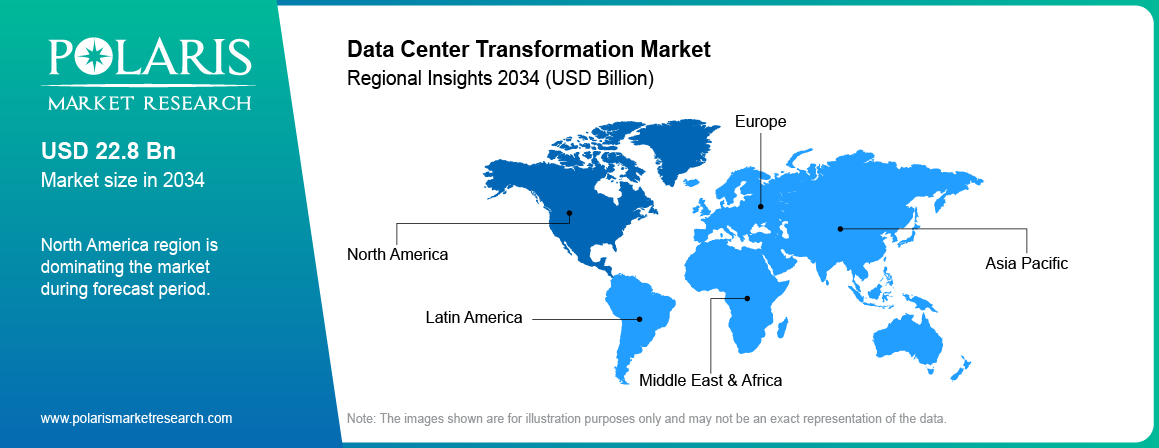
The data center transformation market regional analysis comprises North America, Europe, Asia Pacific, Latin America, and Middle East and Africa. This segmentation is done based on the need for modernization of digital infrastructure, cloud and AI usage, cybersecurity, energy-efficient policies, and the availability of technology providers and transformation services network in these regions.
North America Data Center Transformation Market Trends
North America dominated the data center transformation market with a market share of 41.36% in 2025 due to the presence of a high enterprise installed base, a well-entrenched hyperscale ecosystem, and high demand for AI-enabled data centers. The US continues to lead the market with a share of 66.47% driven by the fast adoption of AI and hybrid cloud modernization. For example, in 2026, the International Energy Agency (IEA) pointed out that the energy usage of data centers in the US is expected to rise by 130% by 2030 when compared to its 2024 figure, underscoring the rising necessity for infrastructure upgrades to support AI tasks (Source: brookings.edu).
It is expected that the region will retain its leading position during the forecast period due to further investment in AI, cloud computing, and cybersecurity. Growing workloads of AI and modernization of existing infrastructure have been driving the demand for virtualization, automation, and hybrid cloud modernization.
Europe Data Center Transformation Market Trends
Europe is an important market for the data center transformation and it accounted for a market share of 24.18% in 2025. This is driven by established enterprise infrastructures and increasing demand for data center transformation. Nations such as Germany, the UK, France, and the Netherlands are focusing on energy efficiency of data centers, and data sovereignty which is further driving the demand of data center transformation market.
It is projected that this region will continue to grow due to the firms that are adopting private cloud infrastructure and modernizing their legacy data centers. For example, in 2025, Microsoft committed to invest USD 30 billion in the UK between 2025 and 2028, which includes USD 15 billion in capital expenditures on cloud and AI infrastructure, aimed at cloud migration and data center modernization. There is an increasing need for organizations to become more energy efficient and to optimize their infrastructure, as well as running AI workloads (Source: cnbc.com).
Asia Pacific Data Center Transformation Market Trends
Asia Pacific is projected to record the highest CAGR of 11.32% during the forecast period due to the rapid deployment of data centers and increasing enterprise modernization. Nations such as China, Japan, South Korea, and India are witnessing rapid development in digital infrastructure leading to increasing demand for data center automation and modernized infrastructure. For example, in 2026, as per the Government of India, India’s data center sector is attracting nearly USD 70 billion in ongoing investments, with an additional USD 90 billion in announced projects. Such large investment in cloud and digital infrastructure is anticipated to drive the market growth of data center modernization (Source: pib.gov.in).
In addition, the region will benefit from continued cloud adoption and expansion of colocation and hyperscale facilities. The coexistence of legacy infrastructure, private cloud, public cloud, and edge facilities is expected to accelerate workload migration and increase demand for integrated transformation and management solutions.
Latin America Data Center Transformation Market Trends
Latin America data center transformation market is growing with a rate of 9.14% in 2025, owing to increasing cloud adoption, digitization, and modernization of enterprise infrastructure. Brazil and Mexico remain key enterprise technology markets, while financial services, telecom, retail, energy, and government are driving modernization. Growing requirements for flexible infrastructure models and software-defined data centers will also drive the change in the region.
Further development of digitalization and cloud computing will lead to growing demand for data center transformation solutions in the region. Companies upgrade their legacy systems and use flexible infrastructure models in order to cope with capital spending and changing workloads.
Middle East and Africa Data Center Transformation Market Trends
The Middle East and Africa holds a comparatively lower share in the data center transformation market in the base year due to the developing state of digital infrastructure and inconsistent power and connectivity. However, growing digitization, AI, cloud computing, and digital infrastructure in countries such as UAE, Saudi Arabia, and South Africa are driving market demand. For instance, in 2025 as per the International Energy Agency (IEA), data center electricity consumption in South Africa will rise to more than 25 kWh per capita by 2030, reflecting strong regional infrastructure expansion. This supports the data center transformation industry forecast for the region (Source: africanreview.com).
The development of the regional market is estimated to be driven by investments in hyperscale data centers, cloud computing, cybersecurity, and optimization services in data centers. It is projected that greater usage of automation, hybrid cloud migration, and energy-efficient IT infrastructure will bring more transformation service opportunities.
Data Center Transformation Market Competitive Landscape
Competition in the Data Center Transformation Market mainly revolves around modernization skills, migration skills, automation, cyber security, and integration through complex IT infrastructure. Leading firms are moving away from traditional products towards diversified products such as modernization of servers and storage, hybrid cloud, private cloud, HCI, network infrastructure, artificial intelligence infrastructure, and managed services.
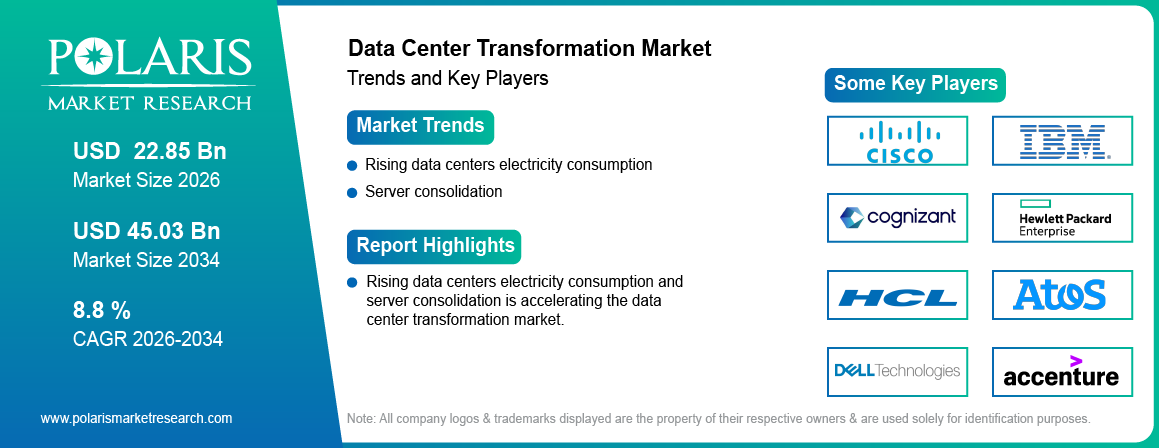
Differentiation for businesses involves discovery and advisory, migration tools, infrastructure transformation, automation, cyber resiliency, financing, managed services, and geographical delivery. Prominent firms operating in this industry include Dell Technologies, Hewlett Packard Enterprise Development LP, Cisco Systems, Inc., IBM Corporation, Microsoft Corporation, Schneider Electric SE, Accenture plc, HCL Technologies Limited, Wipro Limited, Cognizant Technology Solutions Corporation, NetApp, Inc. and Atos Group.
A critical differentiation factor is operational continuity throughout the transformation process. Phased migration, parallel processing, replication, testing, rollback, and stabilization after cut-over are some of the ways by which vendors try to keep disruptions to business-critical workload to a minimum. Integration providers of technology and data center transformation services can limit coordination needs, whereas independent integrators have flexibility in technology platforms.
Competitive landscape Snapshot
| Company | Representative Capability | Positioning |
| Dell Technologies | PowerEdge, PowerStore, APEX, cyber resilience, services | Integrated refresh and consumption model |
| Microsoft Corporation | Azure Local, Azure Migrate, Azure Arc | Hybrid/private cloud and migration automation |
| Hewlett Packard Enterprise Development LP | GreenLake and private cloud | Consumption-based hybrid/private cloud |
| Cisco Systems, Inc. | Networking, observability, automation, security | Network and operational transformation |
| IBM Corporation | Hybrid cloud, infrastructure, consulting | Regulated enterprise modernization |
| Schneider Electric SE | Power, cooling, DCIM, sustainability | Facility and energy transformation |
| Accenture/HCLTech/Wipro/Cognizant/Atos | Advisory, migration, integration, managed services | Multi-vendor execution |
Source: Company filings and Polaris Market Research Analysis
Competitive positioning depends on how vendors define and deliver transformation outcomes. Migration and hybrid management are key priorities for cloud services, technology refresh and private cloud for infrastructure companies, power and cooling issues for facility firms, and application-driven transformation for systems integration companies. Customers are becoming more interested in flexibility across multiple vendors and a neutral architecture. Data center transformation vendor benchmarking therefore focuses on ecosystem breadth, integration capabilities, delivery expertise, and end-to-end transformation outcomes.
Technology and Innovation Landscape
Liquid cooling retrofit is becoming an important innovation for data center transformation as increasing rack densities create higher thermal loads in existing facilities. Direct-to-chip cooling, rear-door heat exchangers, higher-temperature water loops, containment, and hybrid air/liquid systems can increase usable compute density while requiring integration with racks, piping, leak detection, controls, and maintenance systems.
The adoption of software-based infrastructure management is also gaining relevance across modern data centers A software defined data center helps in achieving compute, storage, networking, policy, and lifecycle management via software control from a central point. Concepts such as infrastructure as code, APIs, automated remediation, policy-driven placement, and telemetry can improve operational consistency.
Cyber resilience is an essential aspect of the transformation of the data center as organizations are ensuring that they protect themselves from ransomware, downtime, and infrastructure disruption. Transformation processes have included immutable backups, recovery orchestration, zero trust segmentation, management planes, identity, and automated recovery tests.
The application of digital twin technology and capacity analysis is becoming an effective technology that can be applied in the modernization of brownfield data centers. This technology uses information related to rack density, power, cooling, air flow, networking capability, and workload growth in order to determine available capacity and needed infrastructural changes.
Use Case Analysis
Cloud and Hyperscale Providers: Retrofitting for AI Density
The transformation solution is based on high-density zoning, liquid cooling retrofit, power increase, telemetry, and workload placement for higher density of computing. This allows an AI ready data center and eliminates thermal and electrical constraints during retrofits.
BFSI: Modernizing Regulated Core Infrastructure
Banks are upgrading their old virtualization and storage solutions via private cloud, automation, migration, and cyber initiatives while keeping mission-critical applications on-premises. This facilitates consolidation of the data centers and infrastructure management standards.
Manufacturing: Consolidating Plant and Corporate Infrastructure
The manufacturers can integrate fragmented servers in various plants and corporate locations by leveraging standard cluster computing, HCI, central monitoring, and backup, while maintaining necessary edge computing capabilities.
Healthcare: Migrating Without Disrupting Clinical Systems
Dependency discovery, replication, automated validation, staged cutover, and advanced data security can be used by healthcare organizations to migrate clinical workloads with minimum disruption. It ensures that workload migration becomes consistent while retaining control of local sensitive data.
Buyer Analysis and Market Entry Barriers
Key participants in the process data center transformation include CIOs, data center managers, facilities personnel, security personnel, and the finance department. They each have their own set of objectives, such that IT staff concentrate on applications and operations, while facilities personnel look at power and cooling capacity, and security personnel look at resilience. However, data center energy efficiency, reliability, scalability, and cost-effectiveness are important criteria for buyers.
Automation is becoming an important buyer requirement as large data center environments become more complex to transform. Buyers are looking at discovery automation, dependency mapping, infrastructure-as-code, monitoring, policy management and rollback functionality. Strong data center automation can increase repeatability and decrease the risk of manual implementation in large-scale modernization initiatives.
Flexibility for commercial purposes is becoming an important consideration in the selection of data center transformation services. These include comparisons based on initial investment, consumption-based costing, scope of managed services, licensing, support, commitment to capacity, and exit clauses. The long-term considerations rely on usage and structure of contracts, making scenario-based cost analysis an important part of procurement.
The significant entry barriers in this market include high execution standards, security requirements, cross-vendor compatibility, and references from successful implementations in enterprises. New vendors have to prove their ability to migrate, roll back, certification and 24x7 support. In addition, infrastructure compatibility will make infrastructure as a service consumption model more difficult to implement.
Power and cooling capabilities also creates a barrier as AI transformation is becoming more integrated with the connection of IT and facility needs. The need to understand electrical capacity, cooling solutions, rack densities, workload migration, and automation all go hand-in-hand. It is important to form partnerships within the technology vendors and facilities professionals to stay relevant in the market.
Buyer Decision Framework
| Buyer Type | Primary Objective | Critical KPI | Main Barrier |
| CIO / Infrastructure | Modernize without disruption | Availability, migration time, TCO | Legacy dependencies |
| Facilities | Support density safely | kW/rack, cooling, PUE, headroom | Power/physical constraints |
| Security / Risk | Improve resilience | Recovery time, segmentation, auditability | Mixed estate complexity |
| Finance / Procurement | Align cost with demand | Cost/workload, utilization, retired spend | Transition cost |
| Operations | Simplify management | Automation coverage, incident rate, admin hours | Skills/tool fragmentation |
Source: Polaris Market Research Analysis
Organizational ownership can also slow data center transformation projects. These projects involve multiple teams, so clear responsibilities and common goals are important. A shared framework helps align decisions on migration, capacity, resilience, decommissioning, and cost. Data center transformation services can support this coordination and help organizations implement transformation plans effectively.
Premium Insights and Forward Outlook
The data center transformation market is moving beyond one-time infrastructure upgrades toward integrated modernization driven by AI, capacity constraints, and infrastructure optimization. As technology companies continue increasing capital spending, AI ready data center transformation will increasingly focus on power reallocation, density optimization, liquid cooling, network upgrades, and consolidation to unlock capacity from existing facilities.
It seems that the private cloud infrastructure will start another cycle of growth due to the factors such as data sovereignty, AI, virtualization economics, and need for local cloud. It is possible that enterprises will keep having a mix of different types of infrastructures, including public cloud, private cloud infrastructure, colocation, edge, and others.
The data center modernization industry forecast is likely to indicate a move from project-driven transformation to continuous transformation. Software-defined infrastructure, automation, consumption model, cloud-connected management, and lifecycle optimization is going to support continuous demand for managed services, telemetry, and infrastructure upgrades.
Optimization is also expected to become increasingly important as power, cooling, GPUs, and utility capacity remain constrained. Additional AI ready data center capacity can be generated without the need for new facilities by consolidating workloads, improving energy efficiency, bringing back stranded capacity and optimizing workload placement.
Cost and Pricing Benchmarking Analysis
Pricing benchmarks vary by transformation model, including virtualization, migration, infrastructure upgrades and multi-site modernization. Vendor pricing is always a good reference point, with Microsoft offering a 60-day Azure Local trial and Windows Server subscription at $23.3 per physical core per month. Dell APEX and HPE GreenLake also support usage-based models. This supports a structured data center transformation market report.
| Benchmark | Public Price/ Model | Unit | Interpretation |
| Azure Local trial | Free for first 60 days | registered system | Evaluation before recurring fees |
| Windows Server subscription on Azure Local | $23.3 | physical core/month | Guest licensing benchmark; hardware excluded |
| Azure Local host service | Per physical core; exact displayed rate varies/quote | core/month | Cloud-managed local infrastructure |
| Dell APEX Infrastructure | Negotiated pay-per-use | monthly usage | Hardware, software, services package |
| Hewlett Packard Enterprise Development LP GreenLake Dedicated Software | Quote-based term entitlement | 1-7 year term | sPrivate cloud software commercial model |
Source: Polaris Market Research Analysis
Key Players in the Data Center Transformation Market
- Accenture plc
- Atos Group
- Cisco Systems, Inc.
- Cognizant Technology Solutions Corporation
- Dell Technologies
- HCL Technologies Limited
- Hewlett Packard Enterprise Development LP
- IBM Corporation
- Microsoft Corporation
- Schneider Electric SE
- Wipro Limited
Industry Developments
- September 2026: Hitachi launched HMAX Data Center, an integrated solution combining energy, IT, and cooling infrastructure with AI-powered autonomous operations and optimization. (Source: hitachi.com)
- July 2026: Uptime Institute released its 16th Annual Global Data Center Survey, highlighting rising high-density rack deployment, cost pressures, power availability concerns, and supply-chain disruptions. (Source: uptimeinstitute.com)
- June 2026: HPE introduced its GreenLake Flex Solutions with pay-as-you-go consumption models for hybrid infrastructure and private cloud, supporting the shift toward flexible, service-based data center modernization. (Source: hpe.com)
- April 2026: IEA reported that AWS, Google, Meta, Microsoft, and Equinix recorded combined data center capital expenditure of more than $400 billion in 2025, reflecting continued investment in data center infrastructure. (Source: iea.org)
- April 2026: Nutanix and NetApp announced a strategic alliance to integrate NetApp's Intelligent Data Infrastructure with the Nutanix Cloud Platform and AHV hypervisor, aimed at modernizing customers' virtualization layer with built-in cyber resilience across hybrid environments. (Source: netapp.com)
- September 2025: Equinix opened its first AI ready data center in Chennai with an initial investment of USD 69 Billion to help boost India’s growth as a leading technology hub. (Source: equinix.com)
Data Center Transformation Market Segmentation
By Service Type (Revenue, USD Billion, 2021–2034)
- Consolidation & Migration
- Optimization
- Automation & Orchestration
- Infrastructure Management & Managed Transformation
By Target Architecture (Revenue, USD Billion, 2021–2034)
- Hybrid Cloud
- Private / Sovereign Cloud
- Software-Defined / HCI
- AI-Ready High-Density Infrastructure
- Edge / Distributed Infrastructure
By Data Center Type (Revenue, USD Billion, 2021–2034)
- Enterprise Data Center
- Colocation / Managed Facility
- Cloud / Hyperscale Customer Environment
By Deployment / Operating Model (Revenue, USD Billion, 2021–2034)
- On-Premises Private
- Hybrid Cloud
- Colocation Hosted
- Consumption-Based Infrastructure
By Transformation Layer (Revenue, USD Billion, 2021–2034)
- Compute & Virtualization
- Storage & Data Protection
- Networking & Connectivity
- Power & Cooling
- Management
- Automation & Security
By End Use Industry (Revenue, USD Billion, 2021–2034)
- IT & Telecommunications
- BFSI
- Healthcare
- Manufacturing
- Retail & E-Commerce
- Government & Defense
- Energy & Utilities
- Other Enterprises
By Regional Outlook (Revenue, USD Billion, 2021-2034)
- North America
- US
- Canada
- Europe
- Germany
- France
- UK
- Italy
- Spain
- Netherlands
- Russia
- Rest of Europe
- Asia Pacific
- China
- Japan
- India
- Malaysia
- South Korea
- Indonesia
- Australia
- Vietnam
- Rest of Asia Pacific
- Middle East & Africa
- Saudi Arabia
- UAE
- Israel
- South Africa
- Rest of Middle East & Africa
- Latin America
- Mexico
- Brazil
- Argentina
- Rest of Latin America
Report Scope
| Report Attributes | Details |
| Market Size in 2025 | USD 21.04 Billion |
| Market Size in 2026 | USD 22.85 Billion |
| Revenue Forecast by 2034 | USD 45.03 Billion |
| CAGR | 8.8% from 2026 to 2034 |
| Base Year | 2025 |
| Historical Data | 2021–2024 |
| Forecast Period | 2026–2034 |
| Quantitative Units | Revenue in USD Billion and CAGR from 2026 to 2034 |
| Report Coverage | Revenue Forecast, Competitive Landscape, Growth Factors, and Industry Trends |
| Companies Profiled | Accenture plc, Atos Group, Cisco Systems, Inc., Cognizant Technology Solutions Corporation, Dell Technologies, HCL Technologies Limited, Hewlett Packard Enterprise Development LP, IBM Corporation, Microsoft Corporation, Schneider Electric SE, Wipro Limited |
| Segments Covered |
|
| Regional Scope |
|
| Competitive Landscape |
|
| Report Format |
|
| Customization | Report customization as per your requirements with respect to countries, regions, and segmentation. |
Source: Polaris Market Research Analysis
Why Choose Polaris Market Research
Polaris Market Research & Consulting, Inc. applies a transformation-specific methodology using vendor announcements, infrastructure pricing, Uptime Institute evidence, IEA power data, and buyer insights to distinguish data center transformation from routine hardware refresh and ongoing operations. The approach supports accurate data center transformation market analysis across modernization and migration programs.
Clients can request customized analysis by service type, target architecture, data center type, AI readiness, geography, end-use industry, or transformation vendor. Additional modules can assess consolidation, migration automation, liquid cooling retrofit, power constraints, private cloud infrastructure, consumption models, cyber resilience, and site-exit strategies, with data center transformation vendor benchmarking.
The framework also separates one-time project revenue from recurring transformation revenue, covering managed services, optimization, cloud-connected management, and consumption-based infrastructure to provide a clearer view of the data center transformation market.
Research Methodology
The research uses three phases: scope definition, secondary evidence collection, and primary validation with quantitative modeling and senior review. Secondary research prioritizes official vendor announcements, IEA energy data, Uptime Institute surveys, cloud and hybrid infrastructure documentation, and technical releases. The methodology focuses on data center modernization that changes architecture, efficiency, resilience, workload placement, or facility capability.
Primary research includes CIOs, infrastructure leaders, facilities engineers, colocation operators, cloud architects, systems integrators, managed-service providers, technology vendors, security teams, and procurement leaders. Interviews validate data center transformation services assumptions covering service mix, migration duration, decommissioning, target architecture, facility retrofit costs, utilization, outsourcing, and consumption models.
The final model is reviewed by specialists in data centers, cloud infrastructure, enterprise IT services, power and cooling, cybersecurity, and quantitative forecasting. Market estimates take a top-down and bottom-up approach with data triangulation from legacy infrastructure, type of data center, service portfolio, adoption of private cloud and hybrid cloud, AI density, cooling limitations, vendor revenues, pipeline projects, and geographic deployment. Workload migration is analyzed as one of many steps within the entire transformation process.
Five Phase Research Methodology
| Phase | Activity | Output |
| 1. Scope Definition | Separate transformation from routine refresh, operations and greenfield | Market boundary |
| 2. Secondary Research | Vendor, energy, survey, pricing and technical evidence | Source log and fact base |
| 3. Primary Research | Buyer, operator, vendor and integrator interviews | Assumption validation |
| 4. Modeling | Service, architecture, region, end-use and program economics | Polaris internal model |
| 5. Review | Senior analyst source and consistency check | Final RD and forecast |
Source: Polaris Market Research Analysis
Primary interviews assess buyer spending and the additional investment linked to power, cooling, and automation upgrades. Analysts compare vendor revenue with buyer budgets, project scope, hardware, and services to ensure accurate market estimates. Regional forecasts are validated using data center capacity, cloud and colocation availability, IT spending, and local integration capabilities. This approach supports reliable data center transformation services analysis and helps avoid double counting.
Data Center Transformation Market FAQ's
Data center transformation market size was valued at USD 21.04 billion in 2025 and is projected to reach USD 45.03 billion by 2034, growing at a CAGR of 8.8% from 2026 to 2034. Growth is driven by rising data center electricity consumption, server consolidation, and sovereign cloud transformation.
Data center transformation covers coordinated programs that materially change the architecture, infrastructure, operating model, and efficiency of an existing data center estate, including consolidation, modernization, private and hybrid cloud, and cyber resilience. Routine maintenance and greenfield construction fall outside this scope unless they are part of a larger transformation program.
North America held the largest share of the data center transformation market in 2025, a 41.36% share, supported by a high enterprise installed base, an entrenched hyperscale ecosystem, and strong demand for AI ready data centers. Asia Pacific is projected to record the fastest growth, at a CAGR of 11.32%, driven by rapid data center deployment and enterprise modernization.
Data center modernization means upgrading the systems, infrastructure, and operating model of an existing facility, while cloud migration means moving applications and data into a cloud environment. A single transformation program often includes both, since modernized on premises infrastructure is frequently paired with a hybrid cloud target architecture.
Consolidation and migration services held the largest share of the market in 2025, a 35.84% share, due to enterprises reducing infrastructure sprawl and moving workloads across on premises, private cloud, and hybrid environments. Automation and orchestration services are projected to grow fastest, at a CAGR of 11.24%, as organizations adopt infrastructure as code and automated workload placement.
AI workloads are raising rack density and forcing upgrades to power, cooling, and networking capacity in existing facilities. Dell's 18th generation PowerEdge servers, for example, deliver up to 13 to 1 server consolidation using advanced air and liquid cooling designs, illustrating how vendors are redesigning hardware specifically for AI density.
A software defined data center manages compute, storage, networking, and policy through software rather than hardware, using a central point of control. This approach, combined with infrastructure as code and automated policy driven placement, is becoming a core target architecture for enterprises modernizing legacy facilities.
AI ready high density infrastructure is projected to record the highest CAGR during the forecast period, at 12.48%, driven by rising AI workloads and higher rack density requirements. Hybrid cloud held the largest share in 2025, at 34.72%, as organizations combine on premises infrastructure with private and public cloud environments.
Yes, but it typically needs upgrades to power delivery, cooling infrastructure, and rack systems before it can support liquid cooling retrofits. Direct to chip cooling, rear door heat exchangers, and hybrid air and liquid systems are the most common approaches used to add liquid cooling to an existing facility.
Consolidation reduces infrastructure sprawl, lowers operating costs, and improves resource utilization by replacing underused servers and duplicate systems with a smaller number of standardized platforms. It also supports data center automation, since a simplified environment is easier to manage through infrastructure as code and centralized monitoring.
The main barriers are high transformation costs, the complexity of migrating regulated or dependency heavy workloads, cybersecurity requirements, a shortage of skilled labor, and the risk of disruption during cutover. Power and cooling constraints are an additional barrier as AI transformation increasingly requires coordination between IT and facilities teams.
Major players include Dell Technologies, Microsoft Corporation, Hewlett Packard Enterprise Development LP, Cisco Systems, Inc., IBM Corporation, Hitachi, Ltd., NetApp, Inc., and Schneider Electric SE, alongside systems integrators such as Accenture, HCLTech, Wipro, Cognizant, and Atos. Vendors compete on modernization skills, migration tooling, automation, and cyber resilience across complex IT infrastructure.
Companies limit downtime through phased migration, parallel processing, replication, and staged cutover, with rollback plans in place before any workload moves. Dependency discovery and proof of concept testing ahead of migration are what allow organizations to move complex, regulated, or mission critical workloads with minimal disruption.
Download Sample Report of Data Center Transformation Market
Please fill out the form to request a customized copy of the research report.


