
AI Data Center Water & Cooling Compliance Market Size, Share, Trends & Forecast, 2026–2034
REPORT DETAILS
AI Data Center Water & Cooling Compliance Market Summary
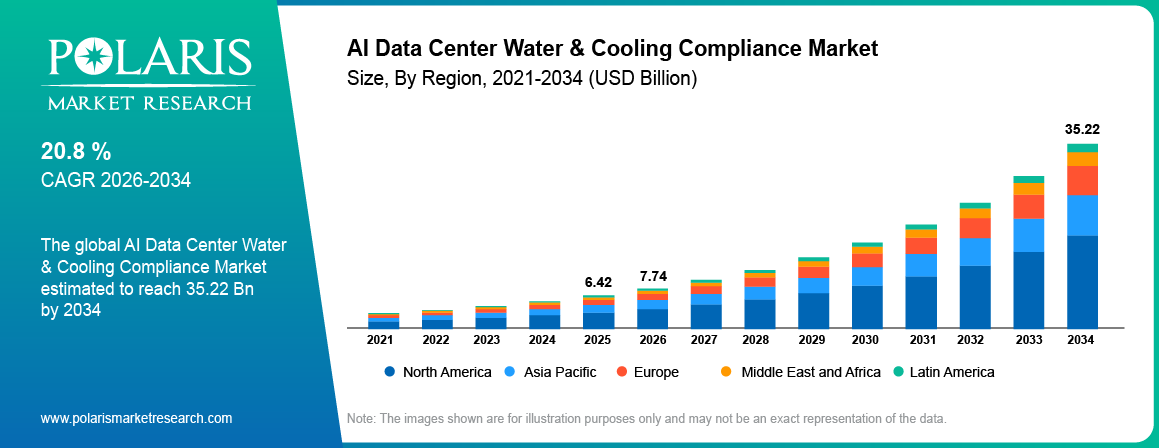
AI Data Center Water & Cooling Compliance Market size was valued at USD 6.42 billion in 2025. The market is expected to grow at a CAGR of 20.8% from 2026 to 2034. The market is growing with the expansion of AI infrastructure and demand for efficient cooling and water-management systems.
Market Statistics
AI Data Center Water & Cooling Compliance Market Key Takeaways
- North America accounted for 39.27% of the global data center water consumption and cooling compliance market share in 2025. The dominance is driven by rapid hyperscale and AI infrastructure expansion, and tightening environmental scrutiny.
- The US held an 72.47% revenue share in North America in 2025. This is due to the major investments in AI data centers and growing demand for advanced cooling systems, and water-use monitoring.
- The market in the Asia Pacific is expected to exhibit a 23.79% CAGR during the forecast period. The growth is attributed to rapid data center investments and a growing emphasis on water conservation.
- The cooling and heat-rejection equipment segment accounted for a major market share of 47.36% in 2025. The leading share is fueled by its direct role in managing the high thermal loads generated by AI data centers.
- The zero-water/dry cooling segment is expected to record a 24.63% CAGR during the projected period, due to rising freshwater scarcity and water conservation policies.
Note: Figures and projections outlined in this report are the result of Polaris Market Research’s proprietary analytical processes, grounded in the latest available datasets and market observations.
What is AI Data Center Water & Cooling Compliance?
The AI Data Center Water & Cooling Compliance Market covers the commercial ecosystem that helps AI and high-density data centers control, measure, reduce, treat, disclose, and manage water use associated with thermal management. The market is narrower than the overall advanced data center cooling systems market but broader than direct liquid cooling infrastructure alone. It includes both cooling technologies and water-management and compliance solutions.
The market includes cooling and heat-rejection systems where water strategy is a purchasing consideration, coolant distribution units, WUE monitoring and analytics, reclaimed-water integration, water treatment, engineering and consulting services, reporting systems, and compliance solutions. Hyperscale, colocation, enterprise, edge, and AI infrastructure data centers use these solutions to manage thermal loads while still meeting water-use and operational requirements.
Data center liquid cooling doesn’t necessarily mean high or low water consumption. So, the market is at the facility level on the water and compliance decision. A direct-to-chip server loop remains closed, while water for facility heat rejection can be used. Dry heat-rejection systems and liquid-to-air CDUs can support high-density liquid cooling with minimal or no usage of facility water.
Demand is growing with higher thermal loads in fewer racks from AI accelerators, pushing data center operators to balance chip and rack temperatures against cooling energy and site water limitations. This necessitates the development of solutions that address the trade-off between cooling performance and resource consumption, especially in locations where availability of water or infrastructure is a constraint.
Water measurement and reporting is also increasing in importance due to regulatory and sustainability requirements. The EU framework includes WUE alongside other data center efficiency indicators, while frameworks in Malaysia and Singapore establish water-efficiency expectations and reporting pathways, supporting demand for WUE monitoring, compliance services, water optimization, retrofits, and alternative water-source integration.
Market Dynamics
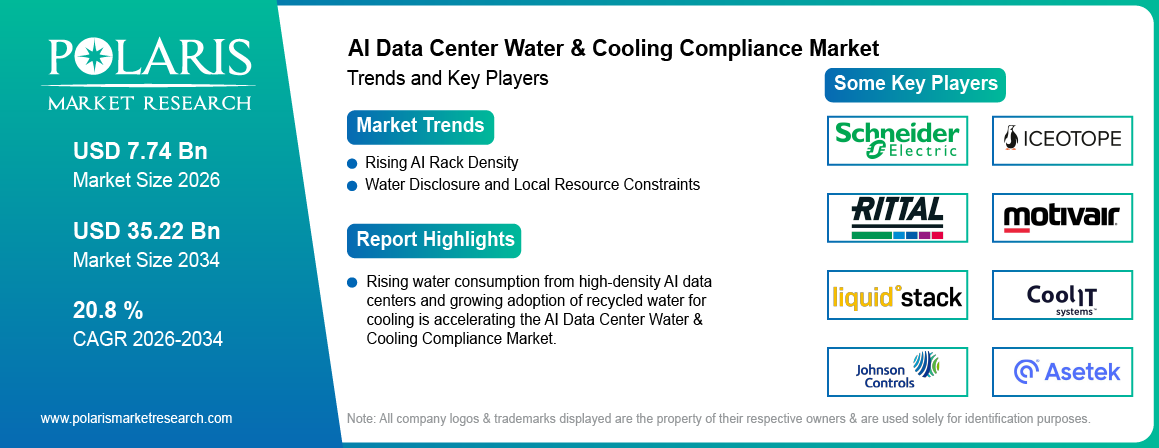
Driver: Rising AI Rack Density to Force Redesign of Thermal and Water Management
The increase in AI computing density is boosting the demand for advanced cooling driven by higher heat generation by AI servers than average data center workloads. Also, as per University of California, Riverside, with the rising number of new AI-focused data centers, water consumption is rising alongside energy usage and carbon emissions. Scientists at the University of California, Riverside, estimate that a 100-word AI prompt uses one bottle of water, or 519 milliliters (Source: eesi.org).
AI accelerators concentrate power into racks, which exceeds the practical envelope of traditional room cooling. Thus, operators move heat capture closer to chips and racks. This transition propels the demand for CDUs, manifolds, cold plates, fluid quality controls, leak detection, pumps, heat exchangers, controls, commissioning, and facilities-side heat rejection engineering.
High-density liquid cooling does not eliminate the water usage; it relocates and changes it. Operators are required to decide whether a secondary coolant loop rejects heat to dry coolers, chilled water, hybrid coolers, cooling towers, or another thermal sink. Every option alters water draw, electricity consumption, climatic sensitivity, operating temperature, treatment chemistry, maintenance burden, and compliance evidence. As a result, cooling architecture selection increasingly includes WUE modeling and local water-risk screening before final design approval.
The growing thermal intensity of AI workloads is making cooling architecture, liquid cooling water consumption, and site WUE critical in data center design and operations. Owing to rising AI cooling water demand, operators adopt efficient thermal-management technologies. It helps them regulate water consumption while enabling higher rack densities, driving market growth.
Driver: Water Disclosure and Local Resource Constraints are Becoming Operating Requirements
Water availability is becoming an increasingly important consideration in site selection and operations as data centers demand more cooling and put pressure on local water resources. This is encouraging operators to evaluate the water consumption, cooling efficiency and alternative water sources with tools such as the water stress index. According to the EU data center reporting framework, operators with an installed IT capacity of 500 kW and more are required to annually submit energy and sustainability data to the European Database on Data Centres under the recast Energy Efficiency Directive (EED). WUE calculation help track water-use efficiency.
For solution providers in the market, regulatory diversity turns compliance into a services market. Operators require region-specific interpretation, auditable data definitions, instrumentation mapping, and annual reporting support. They also need engineering changes when water usage diverges from design targets. A global hyperscale operator may standardize server hardware. However, cooling and water systems remain highly location-dependent as climate, water quality, utility capacity, local permits, and community expectations differ materially by site.
The increasing focus on water conservation is also leading to the use of recycled and reclaimed water for data center cooling. Such systems may relieve pressure on local drinking-water supplies, while supporting a sustainable data center guideline framework, especially in water-stressed regions. This is also driving the demand for data center water compliance services to support water monitoring, reporting, and regulatory requirements. For example, AWS had 24 recycled water-cooled data centers in 2024 and plans to quadruple that number by 2030. The shift is expected to save more than 530 million gallons of drinking-water supply per year across the U.S. communities, demonstrating how recycled-water systems can improve water efficiency and enhance cooling sustainability (Source: aboutamazon.com).
Restraint: High Capital Cost
The high capital costs of implementing advanced liquid cooling and water recycling systems hinder the adoption of current cooling solutions, especially for data centers looking to retrofit their cooling systems. Direct-to-chip liquid cooling and dedicated cooling distribution units require high investment up-front. Dry cooling and other alternatives also need infrastructure upgrades, and a zero water cooling tradeoff can require additional investments in efficient cooling technologies.
Existing facilities add another restraint. Legacy chilled-water and evaporative plants are designed with different rack densities and supply temperatures. To retrofit direct-to-chip cooling systems, new CDUs, pipework, leak detection, filtration, controls, secondary loops, and revised heat-rejection capacity are required. Water treatment and reclaimed-water conversion can cause corrosion, scaling, biological growth, and quality-control requirements. It can vary by local water source. Such issues limit one-size-fits-all deployment and lengthens engineering and commissioning cycles. It leads to high capital expenditure, restraining the market expansion
Opportunity: Zero-Water Cooling Architectures
Cooling architectures are focusing on reducing or eliminating water consumption while maintaining thermal performance in AI data centers. High-density AI workloads are possible without evaporative water use through facility water free CDU systems, liquid-to-air cooling, liquid-to-liquid heat exchangers, and other closed-loop technologies. This is creating demand for zero-water AI data center design, particularly in areas with high local water risk.
Reducing water consumption can also support data center permitting in areas where authorities are tightening requirements for water use and resource management. For instance, the U.S. Department of Energy’s COOLERCHIPS 1.5 program supports the development and validation of advanced water-free cooling systems for high-power AI data centers. It is indicating growing institutional and technology investments in zero-water cooling solutions (Source: US department of energy). Hence, the rising emphasis on zero-water cooling architectures is expected to create lucrative market opportunities in the coming years.
Opportunity: Reclaimed Water and Digital WUE Optimization
Reclaimed water systems and WUE optimization software are creating opportunities. These systems help reduce freshwater dependence and improve cooling efficiency. Operators are increasingly adopting reclaimed water cooling and cooling tower water treatment solutions to manage water consumption and improve cooling performance. Reclaimed water integration help them reduce potable-water demand. It retains the energy-efficiency benefits of evaporative heat rejection. They must match treatment chemistry, concentration cycles, corrosion control, biological control, filtration, and discharge limits. It will help maintain local water quality and cooling-system metallurgy. That creates demand for water-treatment specialists, controls vendors and managed-service providers alongside traditional data center cooling companies. Digital tools such as WUE monitoring and data center compliance analytics enable continuous assessment of water-use patterns and cooling-system performance. These technologies help operators identify inefficiencies, optimize consumption, support regulatory compliance, and reduce water-related operating pressures.
Market Segmentation Analysis
The report provides a comprehensive analysis of the AI Data Center Water & Cooling Compliance Market by solution layer, cooling architecture, water management strategy, data center type, compliance intensity and region to identify the leading revenue-generating segments and emerging growth opportunities.
By Solution Layer
The cooling and heat-rejection equipment segment accounted for 47.36% of the market in 2025, supported by its direct role in managing the high thermal loads generated by AI data centers. This segment includes liquid cooling systems, cooling distribution units, chillers, heat exchangers and other heat-rejection equipment used for AI data center water management. Increasing AI rack densities are boosting cooling demand. Operators are also considering water use and energy efficiency when choosing their cooling systems. As per our study, the demand is driven by the adoption of closed-loop cooling and water-efficient heat-rejection technologies. With operators deploying more AI workloads, the existing data center infrastructure must be upgraded to support the cooling systems. It provides an opportunity for equipment suppliers to be part of the facility modernization and new-build projects.
The metering, sensors, and analytics segment is projected to witness the highest CAGR of 22.85% during the forecast period. Rising need to measure water consumption, assess cooling efficiency, and compute Water Usage Effectiveness (WUE) propels the segment growth. These solutions give facility operators visibility into water flows, cooling-system performance, leaks, and operating conditions throughout data center infrastructure. Regulatory reporting requirements are also driving the increasing need for reliable, auditable water-use data. Integration with data center infrastructure management platforms enables automated monitoring and analytics. Predictive capabilities can help identify abnormal consumption and optimize cooling operations. Higher density of AI workloads is anticipated to further boost demand for real-time measurement and smart water management.
By Cooling Architecture
Conventional air and chilled water cooling held 43.28% of the market in 2025, benefiting from its widespread use in existing data center infrastructure and compatibility with existing cooling systems. These architectures are widely adopted because they can support a variety of computing workloads and fit into existing facility designs, especially within enterprise and colocation environments. Operators can also integrate existing cooling infrastructure with efficiency upgrades, controls, heat exchangers, and water management measures to enhance resource performance. Although high-density AI workloads are increasing interest in liquid cooling, conventional systems remain important across facilities that continue to operate mixed workloads. Their installed base therefore provides a substantial replacement, retrofit, and optimization opportunity during the forecast period.
Direct-to-chip liquid cooling is expected to register the highest CAGR of 26.35% during the forecast period. It is supported by the increasing deployment of high-density AI servers and the need to remove heat directly from high-performance processors. The architecture can support higher thermal loads at the rack level and can provide more effective heat transfer than conventional air cooling for increasingly dense computing environments. In 2025, Panduit introduced a direct-to-chip cooling system that uses FlexFusion cabinets and rack manifolds to deliver liquid cooling directly to chips. The development is a sign of increasing vendor interest in integrated liquid cooling infrastructure as AI workloads grow and data center operators demand better thermal performance and more control over heat rejection (Source: panduit.com).
By Water Management Strategy
Potable-water optimized systems accounted for 34.27% of the market in 2025, driven by compatibility with existing data center cooling infrastructure and established water supply networks. Operators are driving efficiency through cooling-tower optimization, higher cycles of concentration, leak control, temperature management, and automated monitoring. These measures can reduce water use without replacing existing cooling systems. Potable water remains important where other sources are unavailable or expensive. Resource constraints are driving operators to consider reclaimed water, dry cooling, and other alternatives.
The zero-water/dry cooling segment is expected to record the highest CAGR of 24.63% during the forecast period. This is owing to freshwater scarcity and rising focus on reducing evaporative cooling requirements. These systems can reduce reliance on water-hungry heat rejection, especially in water-stressed locations. Air-based heat rejection and liquid cooling systems attached to dry heat exchangers are gaining interest as alternatives to conventional cooling towers. Water-efficient cooling architectures are driven by increasing WUE target requirements and are dependent on ambient conditions, energy needs, equipment configuration, and site economics.
By Data Center Type
In 2025, the hyperscale AI data centers held 41.83% market share. The growth of hyperscale AI data centers is supported by large computing capacity, high-density AI workloads, and significant cooling and water-management needs. The facilities are distributed in large campuses with extensive computing infrastructure. This drives the need for reliable thermal management and resource monitoring. To control how much of these resources they use, hyperscale operators are using water-reduction strategies, monitoring WUE, reclaimed-water systems, and advanced cooling technologies. Their scale also allows investment in specialized cooling infrastructure and digital monitoring platforms, further driving demand for integrated water-management and compliance solutions.
The edge/modular facilities segment is expected to witness the highest CAGR of 24.65% over the forecast period due to flexible deployment requirements, less site space, water availability constraints, and less on-site facilities expertise. Standardized designs for modular facilities enable integrated systems for cooling, water monitoring, and compliance to be incorporated into the facility to make deployment easier where conventional infrastructure may not be practical. Their repeatable configurations can speed up AI and edge computing deployments. Operators can select cooling architectures based on local climate, water availability, and workload requirements, enabling adoption across distributed and constrained data center sites.
By Compliance Intensity
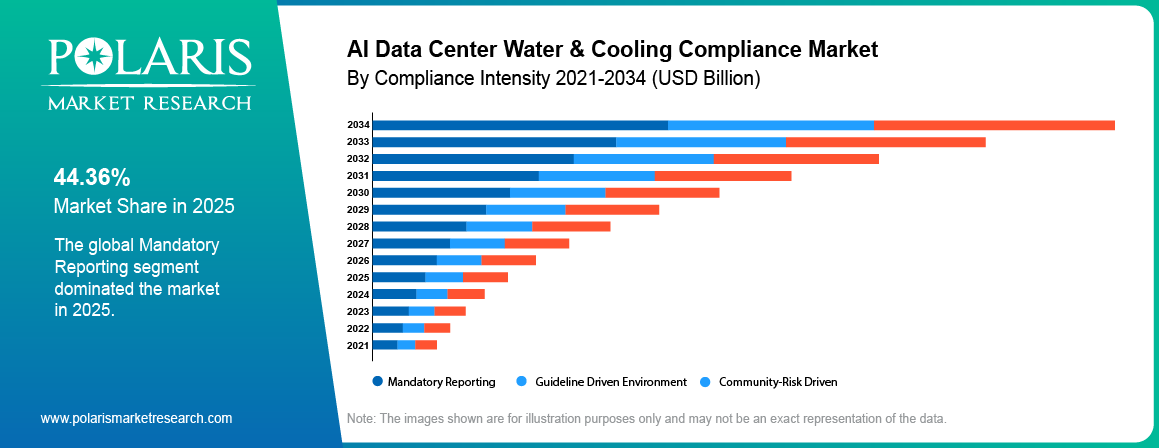
The mandatory reporting segment accounted for 44.36% of the market in 2025, due to water-use reporting, efficiency standards, and environmental requirements affecting data center operations. Operators in regulated markets face increasing pressure to measure water consumption, maintain reliable WUE data, and demonstrate compliance with sustainability requirements. These requirements create demand for metering systems, monitoring software, data management platforms and advisory services. As AI workloads increase, so can the scrutiny where cooling demand affects local water resources. This means that operators are incorporating compliance requirements into facility design, cooling-system selection and operational management.
The guideline-driven environment segment is expected to witness the significant CAGR of 18.35% during the forecast period due to the increasing linkage of data center incentives, permitting, and sustainability programs to water-efficiency objectives by governments and local authorities. These frameworks incentivize operators to adopt water monitoring and cooling efficiency technologies even in the absence of mandatory requirements. Guidelines can set expectations for WUE, water reuse, cooling efficiency, and resource disclosure. With ISO 30134-9 and standardized WUE measurement practices, operators can reduce potable water inputs, enhance cooling controls, and utilize alternative water sources.
Segment Summary Table
| Segment | Category | 2025 Status | Forecast CAGR | Key Driver |
| By Solution Layer | Cooling and heat-rejection equipment | Dominant | Steady growth | Direct role in managing the high thermal loads generated by AI data centers |
| By Solution Layer | Metering, sensors and analytics | Fastest growing | Highest CAGR | Growing need to track water consumption, monitor cooling performance, detect leaks, and measure Water Usage Effectiveness (WUE) |
| By Cooling Architecture | Conventional air and chilled-water cooling | Dominant | Strong growth | Widespread deployment across existing data center infrastructure |
| By Cooling Architecture | Direct-to-chip liquid cooling | Fastest growing | Highest CAGR | The increasing deployment of high-density AI servers |
| By Water Management Strategy | Potable-water optimized systems | Dominant | Strong growth | Compatibility with existing data center cooling infrastructure and established water-supply networks |
| By Water Management Strategy | Dry-cooling designs | Fastest growing | Highest CAGR | Growing concerns over freshwater availability and stricter water-use requirements |
| By Data Center Type | Hyperscale AI campuses | Fastest growing | Highest CAGR | Large-scale computing capacity, high-density AI workloads, and substantial cooling and water requirements. |
| By Data Center Type | Modular data center | Fastest growing | Highest CAGR | Limited space, water availability, and on-site facilities expertise |
| By Compliance Intensity | Mandatory reporting | Fastest growing | Highest CAGR | Growing implementation of water-use reporting, efficiency standards, and environmental requirements for data centers. |
| By Compliance Intensity | Guideline-driven environments | Fastest growing | Highest CAGR | Governments and local authorities are linking data center incentives, approvals, and sustainability programs with water-efficiency targets and responsible resource management |
Source: Polaris Market Research Analysis. Segment share and CAGR reflect Polaris proprietary sizing methodology.
Regional Insights
The AI Data Center Water & Cooling Compliance Market regional analysis comprises North America, Europe, Asia Pacific, Latin America, and Middle East and Africa. This segmentation is based on AI and high-density data center deployment, cooling infrastructure, water availability, regulatory requirements, and advanced water-management technologies across these regions.
North America
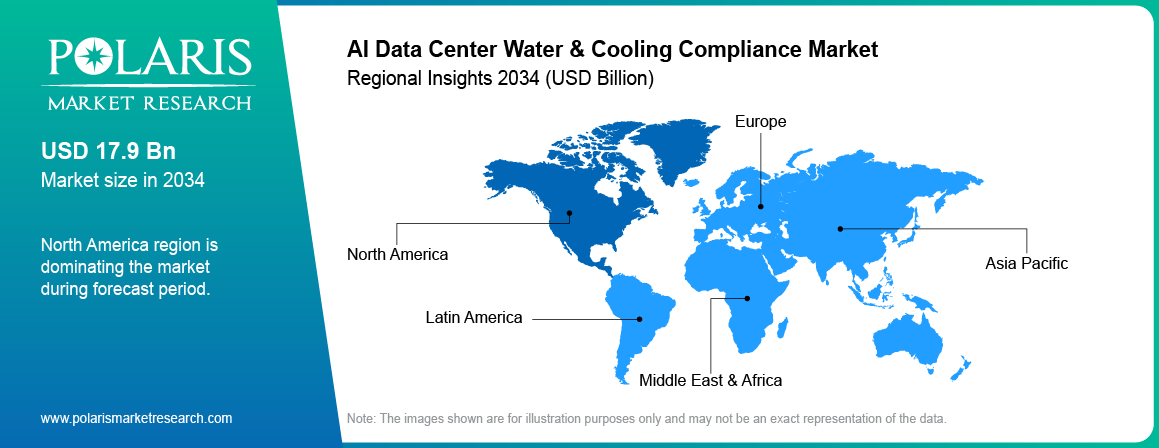
North America dominated the AI data center consumption and cooling compliance market share by holding 39.27% in 2025. This is due to rapid hyperscale and AI infrastructure expansion and stringent environmental norms. The region is expected to remain the leader during the forecast period, due to increasing water availability constraints and permitting requirements. Regulatory attention at federal and state levels is growing, with requirements and proposals for cooling-water withdrawals, water-use reporting, and cooling-system efficiency. Virginia data center water use has also gained attention as data center expansion increases pressure on regional water resources, and local utility impact becomes a key consideration for new projects.
The U.S. led the regional market with 72.47% share in 2025. The dominance is supported by large investments in AI data centers and increasing demand for advanced cooling systems. For instance, the U.S. Department of Energy is investing in water-free cooling technologies for high-power AI data centers. These systems can manage heat loads of up to 1 MW per rack, under its COOLERCHIPS 1.5 program (Source: US Department of Energy). Such initiatives boost the growth of the U.S. AI data center consumption and cooling compliance market
Europe
Europe held a significant share of 24.18% in 2025. The regional market growth is fueled by stringent sustainability and water-reporting requirements. Germany, the UK, France, and the Netherlands are installing advanced cooling systems and upgrading energy-efficient infrastructure to meet regulatory requirements. For example, Commission Delegated Regulation (EU) 2024/1364 requires data centers to report on water usage, including water usage effectiveness (WUE) (Source: EUR-Lex).
The region is expected to see steady growth as data center operators improve water-efficiency tracking and sustainability reporting. The EU data center database and increasing water reporting requirements are driving the need for compliance-focused cooling solutions. Rising AI workloads and scrutiny around resource consumption related to cooling are expected to further support demand.
Asia Pacific
The market in Asia Pacific is projected to record the highest CAGR of 23.79% during the forecast period. It is due to rapid data center investments and heightened focus on water conservation. Countries such as Singapore and Malaysia are increasing resource efficiency requirements for data centers. They are supporting Asia Pacific data center water efficiency through water-use monitoring, optimized cooling systems, and hybrid heat-rejection technologies. Moreover, the region will benefit from rising investments in AI data centers and stricter environmental requirements. For instance, the Singapore WUE benchmark of 2.0 m³/MWh or lower and the emerging Malaysia WUE target are encouraging operators to improve cooling-water efficiency and adopt advanced cooling solutions. (Source: IMDA)
Latin America
The Latin America market is expected to exhibit a CAGR of 20.61% during the projected period. The region is constantly improving its data center infrastructure with rising cloud investments, renewable power availability, and demand for digital services. With the region’s growing data center capacity and varying levels of water availability and utility infrastructure, Latin America data center water management, efficient cooling, and resource optimization have become critical. Increasing investments in hyperscale and colocation data centers and rising adoption of hybrid cooling technologies boost the market expansion. The water-energy cost tradeoff is also becoming important as operators balance water consumption, cooling efficiency, and electricity costs. The absence of a region-wide WUE regulation comparable to the EU framework is increasing the importance of hyperscaler sustainability standards, utility requirements, and project financing criteria.
Middle East and Africa
The Middle East and Africa accounted for a relatively smaller share of 3.14% in 2025. This is due to limited data center infrastructure and high cooling technology costs. However, hot ambient temperatures and rapid AI infrastructure expansion propel the demand for efficient cooling and water-use management across the UAE, Saudi Arabia, and South Africa. As per the United Nations International Children’s Emergency Fund (UNICEF), the Middle East and North Africa is home to 6% of the world’s population. It receives only 2% of the world’s renewable fresh water. This severe water scarcity in this region further drives the demand for zero-water cooling technologies (Source: UNICEF).
Investments in direct-to-chip cooling, dry or hybrid heat rejection, treated wastewater, and advanced cooling controls propel the regional market growth. Increasing focus on water-use monitoring and zero-water cooling designs is likely to create new opportunities for cooling compliance solutions during the forecast period.
Technology and Innovation Landscape
Technology development is focused on improving cooling efficiency and reducing water consumption. Direct-to-chip liquid cooling is advancing with higher coolant supply temperatures and larger cooling capacities. Immersion cooling is supporting high-density AI workloads with less reliance on air cooling. Advanced CDUs and manifolds are improving coolant management, while hybrid heat rejection helps balance energy use and water constraints.
Digital technologies are playing a crucial role in AI data center cooling systems. Vendors are improving thermal management with AI-enabled cooling optimization and automated controls. Leak detection and fluid-quality analytics are further improving real-time monitoring in AI factory cooling. Operators are employing digital twins to assess cooling performance and water usage.
The innovation is also spreading to zero water and reclaimed water cooling systems. Zero-water designs reduce the use of fresh water and reclaimed-water systems reduce dependence on potable water. Integrated WUE and PUE optimization is further supporting efficient cooling and compliance management.
The evolving data center liquid cooling fluids market supports the adoption of advanced cooling solutions. This is due to the rising demand for high-performance dielectric and water-based fluids to enhance thermal management. It also helps in energy efficiency and operational reliability in AI-intensive data centers.
Competitive Landscape
Competition in the AI Data Center Water & Cooling Compliance Market is centered on improving cooling efficiency, water-use monitoring, and regulatory compliance rather than competing on a single cooling technology. Leading firms are expanding their product portfolios through new cooling systems, monitoring solutions, efficiency improvements, and partnerships with data center operators and technology providers. Firms are differentiating themselves through direct-to-chip liquid cooling, hybrid cooling systems, and real-time water-use monitoring, while integrated solutions help data center operators monitor and report cooling-related water consumption.
Competitive differentiation is shifting from cooling capacity toward verified outcomes across water use, climate conditions, energy efficiency, and compliance requirements. Vendors are increasingly competing through water-efficient cooling solutions and measurable WUE improvements. This makes data center cooling competitive differentiation more focused on site-specific performance and sustainability outcomes.
Key Players
- AECOM
- Amazon Web Services
- Arup
- Asetek Inc.
- CoolIT Systems
- Daikin Industries Ltd.
- Ecolab (Nalco Water)
- Iceotope Technologies Limited
- Jacobs
- Johnson Controls
- LiquidStack Holding B.V.
- Microsoft
- Munters Group AB
- Rittal LLC
- Schneider Electric SE (Motivair)
- STULZ Air Technology Systems, Inc.
- Submer Group Ltd.
- Trane
- Veolia
- Vertiv Group Corp.
- Xylem
Competitive Landscape Snapshot
| Value-Chain Category | Representative Participants | Competitive Emphasis |
| Thermal management and CDUs | Vertiv; Schneider Electric (Motivair); STULZ; Rittal; Johnson Controls; Trane | High-density cooling capacity, heat rejection, controls, retrofitability |
| Liquid cooling specialists | CoolIT Systems; LiquidStack; Submer; Iceotope | Direct-to-chip and immersion architectures, AI rack density |
| Water treatment and management | Veolia; Ecolab / Nalco Water; Xylem | Reuse, treatment chemistry, water quality, monitoring |
| Hyperscale reference operators | Microsoft; Amazon Web Services; Google | Water-positive targets, zero-water designs, WUE disclosure, reclaimed water |
| Engineering and advisory | AECOM; Arup; Jacobs; specialist data-center engineering firms | Site studies, water-energy modeling, compliance, design and commissioning |
Source: Polaris Market Research Analysis
Industry Developments
- September 2026: The Pacific Institute published a report on the local water impacts of data centers, particularly in water-scarce areas, and emphasized the need for standardized water-use reporting. (Source: pacinst.org)
- March 2026: Google reported 165 water stewardship projects in its portfolio as of the end of 2025, expanding the operational ecosystem around water restoration and local watershed projects. (Source: sustainability.google)
- May 2026: Vertiv launched CoolChip CDU 2300 and CoolChip Fluid Network Row Manifolds, supporting high-density AI infrastructure and next-generation computing deployments. (Source: vertiv.com)
- September 2025: Amazon announced partnership with researchers, water utilities, and a nonprofit to leverage AI to tackle water challenges and cultivate sustainable water practices for AI data centers across the world. (Source: esgdive.com)
- May 2025: Microsoft reported a new data center design optimized for AI workloads that consumes zero water for cooling, avoiding an estimated 125,000 cubic meters of water use annually per facility. (Source: microsoft.com)
Buyer Analysis and Market Entry Barriers
Data center operators, cloud service providers, and AI infrastructure companies are the main buyers of AI data center water & cooling compliance solutions. The solutions are used by these buyers to improve cooling performance, monitor water consumption, and improve Water Usage Effectiveness (WUE). AI data center developers also use advanced cooling and monitoring systems to support high-density workloads while meeting water, energy and compliance requirements. Auditable WUE and water saving are becoming important for buyer confidence. Vendors that offer integrated cooling and monitoring solutions can address these requirements more effectively. Advanced controls and clear performance data can also support buyers in managing cooling efficiency and compliance.
Mission-critical reliability and integration complexity remain key data center market entry barriers. Limited standardized site-level water data also makes market entry difficult. Vendors need to ensure reliable integration between IT and facility cooling systems. They also need to provide strong controls and monitoring capabilities.
Buyer Decision Framework
| Buyer | Primary Need | Key Procurement Metric | Typical Constraint |
| Hyperscale cloud / AI operator | Scale high-density compute with predictable resource use | WUE, PUE, water source, MW cooling capacity, reliability | Water permits, grid capacity, community scrutiny |
| Colocation operator | Support mixed customer densities and sustainability commitments | Rack density, SLA, WUE reporting, retrofit flexibility | Legacy plant, tenant variability |
| Enterprise / sovereign operator | Modernize constrained facilities | Capex, downtime, water availability, maintainability | Limited engineering staff, retrofit risk |
| Data center developer / EPC | Secure permits and deliver bankable design | Site water balance, heat rejection, redundancy, compliance | Schedule, utility approvals, climate |
Source: Polaris Market Research Analysis
Premium Insights and Forward Outlook
Integrated water and cooling management will shape future data center planning
The AI Data Center Water & Cooling Compliance Market is moving beyond basic water-efficiency management toward integrated data center planning and sustainability operations. Future competition will increasingly focus on solutions that combine liquid cooling, water monitoring, advanced controls, compliance software, and analytics.
Vendors that help operators balance cooling performance with water availability, energy consumption, and regulatory requirements are positioned to capture opportunities as AI infrastructure expands. This change will increase demand for integrated water and cooling management in new and existing data centers.
Advanced cooling and continuous monitoring will drive adoption
Data center development will be increasingly influenced by water availability, compliance requirements, and advanced cooling technologies. Direct-to-chip liquid cooling, zero-water cooling, reclaimed-water systems and hybrid heat rejection will provide opportunities beyond traditional cooling infrastructure.
Continuous WUE monitoring, automated compliance reporting, and AI-enabled cooling optimization will help integrated solutions. These capabilities will strengthen the role of water and cooling management systems throughout the forecast period.
Cost and Pricing Benchmarking Analysis
The data center cooling equipment pricing benchmark focuses on publicly available capacity, procurement models, and supplier pricing information for hyperscale CDUs, data-center chillers, and large heat-rejection systems. The analysis uses verified pricing data and distinguishes confirmed benchmarks from equipment costs obtained through supplier quotations.
Cost and Pricing Benchmarking
| Item/Service | Publicly Verifiable Benchmark | Price/ Commercial Model |
| Vertiv CoolChip CDU family | Liquid-to-air up to 70 kW; liquid-to-liquid portfolio up to 2,300 kW | Quote-based |
| Schneider Electric / Motivair liquid cooling | CDUs, manifolds, direct-to-chip accessories and AI reference designs | Quote-based / project engineered |
| WUE monitoring and compliance analytics | Metering + software + advisory scope varies by site count and integration depth | Quote-based |
| Reclaimed-water conversion / treatment | Treatment scope depends on source-water chemistry, cycles of concentration and discharge requirements | Project-based |
Source: Polaris Market Research Analysis
Market Segmentation
By Solution Layer (Revenue, USD Billion, 2021–2034)
- Cooling & Heat-Rejection Equipment
- Water Treatment & Reuse Systems
- Metering, Sensors & Analytics
- Engineering, Design & Retrofit Services
- Compliance, Reporting & Advisory Services
By Cooling Architecture (Revenue, USD Billion, 2021–2034)
- Conventional Air & Chilled-Water Cooling
- Evaporative / Adiabatic Heat Rejection
- Direct-to-Chip Liquid Cooling
- Immersion & Other Advanced Liquid Cooling
By Water Management Strategy (Revenue, USD Billion, 2021–2034)
- Potable-Water Optimized
- Reclaimed/Non-Potable Water
- Closed-Loop Low-Makeup
- Zero-Water/Dry Cooling
By Data Center Type (Revenue, USD Billion, 2021–2034)
- Hyperscale AI Campuses
- Colocation Facilities
- Enterprise/Sovereign Data Centers
- Edge/Modular Facilities
By Compliance Intensity (Revenue, USD Billion, 2021–2034)
- Mandatory Reporting
- Guideline Driven Environment
- Community-Risk Driven
By Regional Outlook (Revenue, USD Billion, 2021-2034)
- North America
- U.S.
- Canada
- Europe
- Germany
- France
- UK
- Italy
- Spain
- Netherlands
- Russia
- Rest of Europe
- Asia Pacific
- China
- Japan
- India
- Malaysia
- South Korea
- Indonesia
- Australia
- Vietnam
- Rest of Asia Pacific
- Middle East & Africa
- Saudi Arabia
- UAE
- Israel
- South Africa
- Rest of Middle East & Africa
- Latin America
- Mexico
- Brazil
- Argentina
- Rest of Latin America
Report Scope
| Report Attributes | Details |
| Market Size in 2025 | USD 6.42 Billion |
| Market Size in 2026 | USD 7.74 Billion |
| Revenue Forecast by 2034 | USD 35.22 Billion |
| CAGR | 20.8% from 2026 to 2034 |
| Base Year | 2025 |
| Historical Data | 2021–2024 |
| Forecast Period | 2026–2034 |
| Quantitative Units | Revenue in USD Billion and CAGR from 2026 to 2034 |
| Report Coverage | Revenue Forecast, Competitive Landscape, Growth Factors, and Industry Trends |
| Segments Covered |
|
| Regional Scope |
|
| Competitive Landscape |
|
| Report Format |
|
| Customization | Report customization as per your requirements with respect to countries, regions, and segmentation. |
Source: Polaris Market Research Analysis
Why Choose Polaris Market Research
Polaris Market Research & Consulting, Inc. combines market modeling with source-level validation of regulations, technical standards, operator disclosures, and regional operating conditions. The proprietary estimates in the AI data center water & cooling compliance market report are presented separately from independently sourced WUE metrics, policy thresholds, and technology benchmarks, offering a focused view of data center cooling compliance market analysis.
Research includes water usage, energy efficiency, cooling technologies, and regulatory requirements to meet real buyer needs. This supports data center WUE compliance solutions and allows for custom assessments of water risk, WUE compliance, cooling architecture, and regional opportunities.
Research Methodology
The study employs primary and secondary research to analyze the AI Data Center Water & Cooling Compliance Market. Research sources include government regulations, company disclosures, product documentation, technical publications, and industry interviews. The analysis assesses cooling technologies, water consumption, WUE, water management, and regulatory requirements to support the AI cooling water management industry forecast and validate industry patterns.
Five-Phase Research Methodology
| Research Phase | Primary Work | Evidence Used |
| Scope Definition | Define included solutions, exclusions, adjacent markets, and buyer problem | Polaris adjacent pages; competitor structures; technical sources |
| Source Validation | Build source log and claim-level evidence base | EU regulation; LBNL; national policy; operator disclosures; OEM documentation |
| Segmentation & Demand Mapping | Map solution layer, cooling architecture, water strategy, data center type, and compliance intensity | Buyer architecture; policy requirements; technology pathways |
| Market Modeling | Estimate revenue, shares, and forecast growth | Polaris proprietary modeling and analyst triangulation |
| QC & Review | Check source lineage, segmentation consistency, keyword mapping, and publication readiness | 32-item master checklist |
Source: Polaris Market Research Analysis
The data center research team includes market research analysts, SEO specialists, and senior reviewers. The team focuses on source validation, segmentation, and data quality using regulatory documents, sustainability disclosures, and OEM product information.
AI Data Center Water & Cooling Compliance Market FAQ's
The market was worth USD 6.42 billion in 2025 and is projected to reach USD 35.22 billion by 2034 due to rising focus on water conservation.
The market is projected to register a 20.8% CAGR from 2026 to 2034. Expansion of AI infrastructure and growing cooling and water-management requirements are expected to drive the market.
North America dominated the market with 39.27% share in 2025, due to rapid growth in AI and hyperscale data centers.
Cooling and heat-rejection equipment accounted for the largest market share of 47.36% in 2025 due to high thermal loads of AI workloads.
Water use depends on IT load, climate, cooling architecture, and heat-rejection technology. Thus, water use at the facility level can vary dramatically.
Water is an effective and efficient medium for absorbing and rejecting heat from computing equipment, especially in cooling towers and other water-based heat rejection systems.
WUE measures the water a data center uses relative to the energy consumed by its IT equipment. It helps operators track and improve water efficiency.
Not automatically. Immersion/Direct-to-chip cooling improves heat capture. However, the facility can still reject heat through water-cooled chillers or water-consuming towers. Facility-water-free liquid-to-air CDUs and dry heat rejection can lower on-site water use, so the evaluation of the full thermal chain becomes necessary.
Water-use and WUE reporting is required by EU regulations for data centers. Also, there are frameworks in markets such as Malaysia promote water-efficiency monitoring.
Reclaimed water, dry cooling, closed-loop systems, cooling-tower optimization, leak detection, and WUE monitoring can help data centers reduce potable water consumption.
Zero-water cooling incorporates architectures such as dry heat rejection and liquid-to-air cooling to minimize or eliminate water use for cooling.
Download Sample Report of AI Data Center Water & Cooling Compliance Market
Please fill out the form to request a customized copy of the research report.


