
Data Center Liquid Cooling Fluids Market Size, Share & Trends Report, 2026-2034
REPORT DETAILS
Data Center Liquid Cooling Fluids Market Summary
The global data center liquid cooling fluids market was valued at around USD 206.19 million in 2025 and is projected to reach USD 2,558.98 million by 2034, registering a CAGR of 32.3% during the forecast period. The growth in the market is driven by the increasing use of AI workloads, growth in the number of hyperscale data centers, and growing demand for energy-efficient cooling technology. The increase in power density per rack and advancements in computing infrastructure are driving data center operators to adopt the use of liquid cooling technologies.
Market Statistics
Key Takeaways
- North America held the dominant position with a 40.10% market share in 2025, due to the presence of large cloud service providers, artificial intelligence infrastructure, and advanced data center facilities.
- Asia Pacific is projected to register the fastest CAGR of 22.80% during the forecast period due to increasing hyperscale construction, digital transformation initiatives, and rising AI adoption.
- Glycols held the largest product segment with a 46.70% market share in 2025, owing to their efficient thermal performance, cost-effectiveness, and widespread use in conventional liquid cooling systems.
- Direct-to-Chip Cooling dominated with a 54.30% market share in 2025, propelled by its superior ability to efficiently cool high-performance processors while minimizing power consumption.
- Hyperscale Data Centers represented the largest data center type with a 58.90% market share in 2025, driven by rapid expansion of AI computing infrastructure and continued investments by global cloud service providers.
Note: Figures and projections outlined in this report are the result of Polaris Market Research’s proprietary analytical processes, grounded in the latest available datasets and market observation
What is Data Center Liquid Cooling Fluids?
Data Center Liquid Cooling Fluids are the heat transfer fluids that are used to extract heat from computing systems. The purpose of the liquid cooling fluids is to help maintain constant operational temperature and to provide for higher computing density and lower power consumption. They are extensively used in hyperscale data centers, enterprise data centers, co-location sites, and edge computing locations.
Value chain components include the supplier of raw materials, specialty chemicals manufacturer, cooling fluid producer, cooling equipment manufacturer, system integrator, data center operator, cloud service provider, and enterprise customer. Coordination between the above-listed participants helps to enhance performance, compatibility, and reliability of the products.
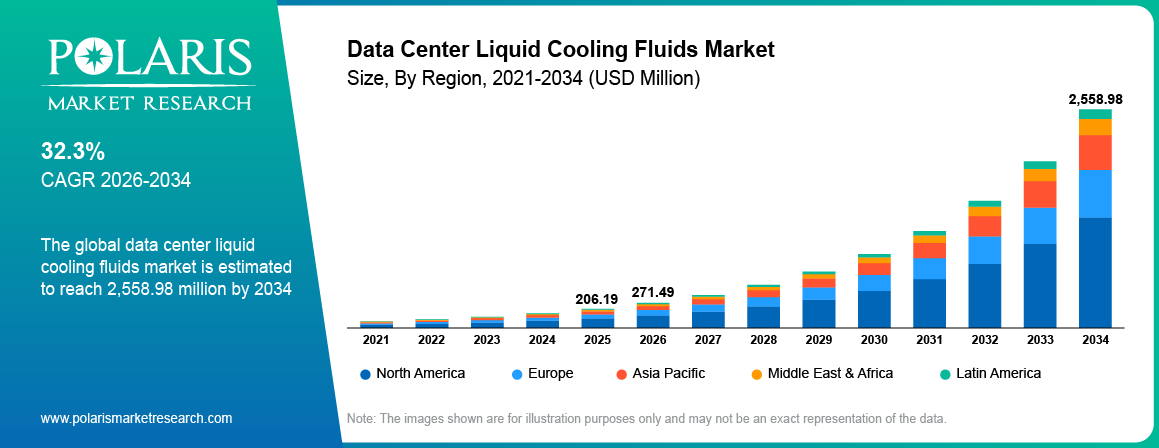
Data Center Liquid Cooling Fluids Market Size and Growth Analysis 2026–2034
The data center liquid cooling fluids market is expected to witness steady growth throughout the forecast period due to increasing deployment of AI infrastructure, high-performance computing systems, and cloud-based services. Modern processors generate significantly more heat than conventional computing equipment, creating greater demand for advanced thermal management solutions.
| Market Driver | Est. CAGR Impact | Geographic Relevance | Impact Timeline |
| AI server rack heat density | 25.80% | Global | Short to medium term |
| Expansion of hyperscale data centers | 24.90% | North America, Europe, Asia Pacific | Medium term |
| Rising adoption of direct liquid cooling | 27.40% | Global | Ongoing |
| Growth of AI and HPC workloads | 26.80% | Global | Medium to long term |
| Focus on energy-efficient infrastructure. | 23.90% | Global | Long term |
* Indicative estimates based on market context and analyst judgment. Figures reflect relative driver weight, not additive CAGR contributions. Source: Polaris Market Research Analysis.
The growing use of AI and machine learning platforms is driving the demand for efficient liquid cooling technology. Operators of data centers are adopting advanced cooling fluids in order to enhance their efficiency and lower costs. Advanced fluid chemistry and immersion cooling technologies are contributing towards market growth.
Industry Dynamics
- Rising deployment of AI servers and high-performance computing systems is increasing demand for advanced liquid cooling fluids.
- Growing investments in hyperscale cloud infrastructure continue to support market expansion across major regions.
- High installation costs and compatibility requirements remain important challenges for wider adoption.
- Continuous innovation in immersion cooling technologies and environmentally safer fluid chemistries is creating new growth opportunities.
Data Center Liquid Cooling Fluids Market Dynamics: Drivers, Restraints, and Opportunities
How Is AI Infrastructure Growth Driving Demand for Data Center Liquid Cooling Fluids?
AI infrastructure growth is a major driver of the data center liquid cooling fluids market. AI, generative AI, and machine learning workloads run on dense GPU clusters that generate far more heat than traditional servers. The energy numbers show how fast this is scaling. According to the International Energy Agency, global data center electricity demand is set to more than double to around 945 TWh by 2030, slightly more than Japan's entire power consumption today. AI is the biggest driver, with demand from AI-optimized data centers projected to more than quadruple. For context, data centers used about 415 TWh in 2024, or roughly 1.5% of global electricity (Source: IEA, Energy and AI). More power per rack means more heat to remove, and air cooling struggles to keep up at these densities. Liquid cooling fluids carry heat away far more efficiently, helping GPU clusters stay at stable temperatures, avoid thermal throttling, and use less energy for cooling. This efficiency is becoming even more important as operators face closer scrutiny over energy and water use, a trend that is shaping the AI data center water and cooling compliance landscape.
All that extra power ends up as heat, and air cooling can only do so much at high rack densities. Liquids carry heat away far more effectively. That keeps GPUs at stable temperatures, prevents them from throttling performance, and cuts the energy spent on cooling.
Why Are Hyperscale Data Center Investments Boosting the Liquid Cooling Fluids Market?
Demand for cloud, AI, and digital services keeps pushing operators to add hyperscale capacity, and every new facility is a potential customer for liquid cooling. One recent deal shows how much money is moving into this space. In June 2026, Digital Realty agreed to buy a stake in three fully leased Northern Virginia data centers from Blackstone-affiliated funds. Together, the sites hold 288 MW of IT capacity and carry a gross value of USD 7.8 billion (Source: Blackstone). All three are leased to investment-grade hyperscale customers. Northern Virginia is the world's largest data center market, and demand for capacity there has surged on the back of cloud computing and AI.
Facilities like these run dense server loads 24/7. They need cooling that can handle sustained heat without driving up energy bills, and that's where liquid coolants come in.
What Are the Key Challenges Restraining the Data Center Liquid Cooling Fluids Market?
Cost and compatibility are the two biggest hurdles. Switching to liquid cooling means paying for specialized equipment, the fluids themselves, and servers built to work with them. Most data centers operating today were designed around air, so adopting liquid cooling usually means a retrofit. Even companies actively testing new approaches face this. Keppel, for example, has said its data centers are mostly built for air cooling and non-immersion liquid cooling (Source: Keppel). keppel
Then there's compatibility. Fluids have to work with seals, connectors, and server materials without causing damage, and that takes testing. For smaller and mid-sized operators especially, these costs and integration risks slow things down.
What Growth Opportunities Does Immersion Cooling Create for Cooling Fluid Suppliers?
Immersion cooling is where fluid suppliers stand to gain the most, since the entire system depends on the fluid. Servers sit fully submerged in a non-conductive liquid, which absorbs and removes heat more efficiently than air. The technology is now moving from concept to real-world trials. In April 2026, Keppel's Connectivity Division and Shell Singapore announced plans to test an immersion cooling setup at one of Keppel's operating data centers, with an eye on using it in future facilities built for AI and high-performance computing. The pilot was set to go live by May 2026 and run for 12 months, using Shell's Gas-to-Liquids (GTL)-based cooling fluid. Shell's own benchmarks suggest the fluid can raise energy efficiency by up to 48% over air cooling, lift computing performance by up to 40%, and cut capital and operating costs by up to 40% (Source: Keppel; Shell Singapore).
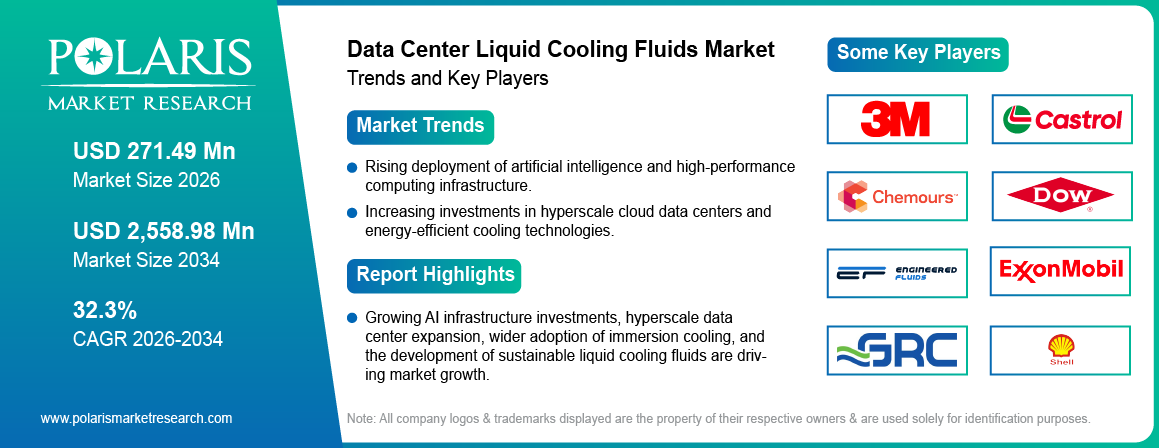
Segment and Regional Leaders at a Glance
According to Polaris Market Research, North America leads the market while Asia Pacific the fastest-growing region.
- Dominant Region: North America
- Fastest-Growing Region: Asia Pacific
- Largest Fluid Type Segment: Glycol-based Fluids
- Fastest-Growing Fluid Type Segment: Dielectric Fluids
- Largest Cooling Method Segment: Direct-to-chip Cooling
- Fastest-Growing Cooling Method Segment: Single-phase Immersion
- Largest Data Center Type Segment: Hyperscale Data Centers
- Fastest-Growing Data Center Type Segment: Colocation Data Centers
Segmentation Analysis
The report breaks down the global data center liquid cooling fluids market by fluid type, cooling method, and data center type. This helps pinpoint where the biggest revenue opportunities are today and which segments are set to grow fastest.
Fluid Type:
Glycol-Based Fluids Held the Largest Share in 2025
Glycol-based fluids led the market in 2025. They're affordable, move heat efficiently, and work well with direct liquid cooling systems, which makes them the default choice for many operators. They also keep temperatures stable and protect cooling loops from corrosion and freezing, so the system lasts longer with less maintenance.
Dielectric Fluids to Record the Fastest Growth
Dielectric fluids are expected to grow at the highest CAGR over the forecast period. Because they don't conduct electricity, servers can sit fully submerged in them, which makes them a natural fit for immersion-cooled AI servers and supercomputers. As more operators adopt immersion cooling, rack power densities climb, and investment in energy-efficient facilities picks up, demand for these fluids should rise with it.
Cooling Method Type:
Direct-to-Chip Cooling Led the Market in 2025
Direct-to-chip cooling held the largest share in 2025. Instead of cooling the air around a server, it pulls heat straight off processors and other high-performance components. That makes it far more efficient than air cooling. Servers use less power for cooling and can run at higher performance without overheating.
Single-Phase Immersion Cooling Set for Rapid Expansion
Single-phase immersion cooling is projected to grow at the fastest CAGR. Here, the hardware is fully immersed in a dielectric fluid that stays liquid throughout the process, which keeps the setup relatively simple and cost-effective. Rising demand for high-density computing and the spread of AI applications are the main forces behind its growth.
Data Center Type:
Hyperscale Facilities Accounted for the Largest Share
Hyperscale data centers dominated the market in 2025, backed by heavy spending from global cloud providers and technology companies. These facilities run enormous numbers of high-performance servers, so managing heat efficiently isn't optional. As AI, cloud computing, and machine learning workloads keep growing, so does the use of liquid coolants in hyperscale sites.
Colocation Facilities to Grow at the Highest CAGR
Colocation data centers are expected to post the highest CAGR during the forecast period. They let businesses tap into advanced cooling and scalable computing capacity without building and running their own infrastructure, which keeps costs down. Growing demand for AI-ready infrastructure, ongoing digital transformation, and wider use of cloud services are all pushing this segment forward.
Segment Summary Table
| Segment | Category | 2025 Status | Forecast CAGR | Key Driver |
| Glycol-based Fluids | Fluid Type | Largest Share, | 22.10% | High compatibility and cost-effective cooling performance |
| Dielectric Fluids | Fluid Type | Fastest Growing | 25.80% | Rising adoption of immersion cooling technologies |
| Direct-to-chip Cooling | Cooling Method | Largest Share, | 22.90% | Growing deployment of AI and high-performance processors |
| Single-phase Immersion | Cooling Method | Fastest Growing | 26.40% | Expansion of high-density AI computing infrastructure |
| Hyperscale Data Centers | Data Center Type | Largest Share, | 22.50% | Continuous investments by global hyperscale cloud providers |
| Colocation Data Centers | Data Center Type | Fastest Growing | 24.70% | Increasing enterprise outsourcing of data center infrastructure |
Source: Polaris Market Research Analysis
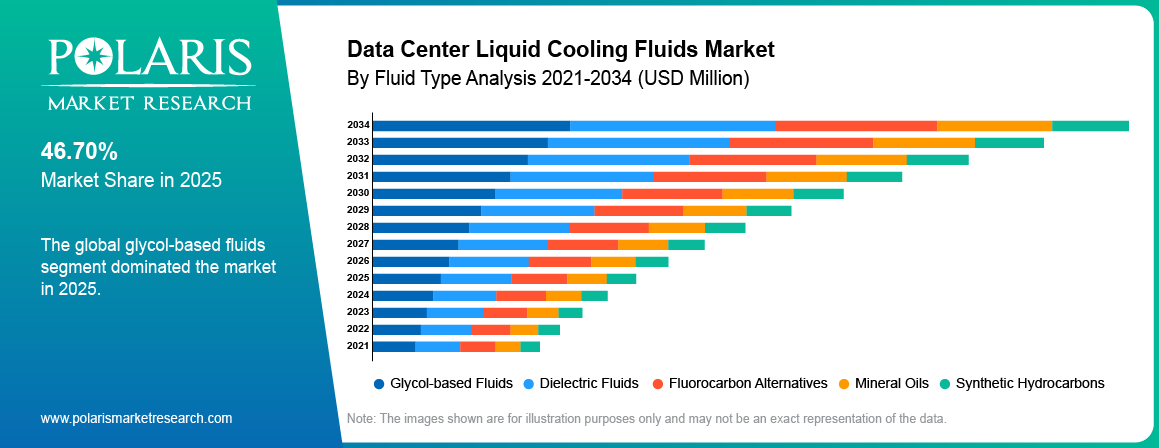
Regional Analysis
North America Data Center Liquid Cooling Fluids Market Size and Share
North America held dominating market share in the global data center liquid cooling market, owing to the substantial investment made in artificial intelligence computing capabilities, hyperscale cloud infrastructure, and high performance computing capabilities. For instance, in June 2026, Digital Realty purchased the stake of Blackstone in three data centers located in Northern Virginia, which is an indication of investment in one of the biggest hyperscale cloud infrastructure in the US. The transaction highlights continued U.S. investment in hyperscale cloud facilities to support growing demand for AI computing, cloud services, and large-scale digital infrastructure.
Europe Data Center Liquid Cooling Fluids Market Analysis
Europe held significant market share due to increasing investments made in green data centers and energy-efficient solutions. For example, the European Commission at Mobile World Congress 2026 announced EURO-3C, which is an initiative worth nearly USD 88 million funded under Horizon Europe(Source:digital-strategy.ec.europa.eu).The aim of the initiative was to build Europe’s first federation Telco-Edge-Cloud infrastructure. This will involve energy-efficient digital infrastructure. Growing regulatory requirements along with reduction of carbon emissions are driving the demand for liquid cooling fluids.
Asia Pacific Data Center Liquid Cooling Fluids Market Growth Rate and Forecast
Asia Pacific is projected to register the fastest CAGR during the forecast period due to rapid expansion of hyperscale data centers, increasing AI adoption, and growing cloud computing investments. China, Japan, India, South Korea, Singapore, and Australia are continuously developing large-scale digital infrastructure to support growing computing demand. For instance, Microsoft invested USD 17.5 billion in India in December 2025 to strengthen its AI and cloud infrastructure in order to transform digitally on a larger scale. Rising government support for digital transformation and increasing deployment of AI workloads are expected to strengthen market growth throughout the region.
Latin America Data Center Liquid Cooling Fluids Market
Latin America is gradually emerging as a promising market for liquid cooling technologies due to increasing investments in cloud infrastructure and digital services. Tecto made a USD 36 million investment in a data center in Porto Alegre, which is linked with V.tal submarine cable system, in January 2026. The investment strengthens cloud infrastructure in Brazil by expanding high-capacity digital infrastructure to support growing demand for cloud services, AI workloads, and enterprise data processing.
Middle East & Africa Data Center Liquid Cooling Fluids Market
The Middle East and Africa market is expected to witness steady growth during the forecast period due to increasing investments in smart cities, digital infrastructure, and hyperscale data centers. The UAE, Saudi Arabia, South Africa, and Israel are building cloud computing capabilities while making their data centers more efficient. The increasing interest in energy-efficient cooling technology and need for AI infrastructure will drive market growth in the future.
Regulatory Heatmap
| Country | Policy Environment | Key Regulations | Market Implication | Trend |
| US | Favorable | Energy efficiency initiatives and PFAS regulations | Supports sustainable cooling technology adoption | Expanding |
| Canada | Favorable | Data center efficiency and environmental standards | Encourages advanced cooling infrastructure | Developing |
| European Union | Favorable | Environmental regulations and PFAS restrictions | Accelerates adoption of alternative cooling fluids | Expanding |
| United Kingdom | Neutral | Data infrastructure and sustainability policies | Supports efficient data center operations | Stable |
| Japan | Favorable | Green digital transformation initiatives | Promotes advanced cooling technologies | Developing |
| China | Favorable | AI infrastructure and cloud computing programs | Supports hyperscale facility expansion | Expanding |
| India | Developing | Digital infrastructure and semiconductor initiatives | Creates long-term growth opportunities | Developing |
| Australia | Favorable | Critical infrastructure and energy efficiency policies | Encourages sustainable data center investments | Developing |
Source: Polaris Market Research Analysis
Competitive Landscape & Positioning Table
The market for liquid cooling fluids for global data centers is highly competitive. The competition is provided by various specialty chemical producers, cooling technology providers, and energy firms that compete based on innovations and strategic partnerships in the production of liquid cooling fluids. Factors that influence competition include the thermal efficiency of the product, its stability, environmental safety, and compatibility with modern cooling systems.
| Company | Est. Market Position | Primary Focus | Geographic Focus | In Report |
| 3M | Top 10 | Dielectric cooling fluids | Global | Yes |
| Castrol Limited | Top 10 | Thermal management fluids | Global | Yes |
| Chemours Company | Top 10 | Advanced dielectric fluids | Global | Yes |
| Dow Inc. | Top 10 | Heat transfer fluid technologies | Global | Yes |
| Engineered Fluids | Top 10 | Immersion cooling fluids | North America | Yes |
| ExxonMobil Corporation | Top 10 | Synthetic cooling fluids | Global | Yes |
| Green Revolution Cooling | Regional Leader | Immersion cooling solutions | North America | Yes |
| LiquidStack | Regional Leader | Liquid cooling technologies | Global | Yes |
| Shell plc | Top 10 | Industrial cooling fluids | Global | Yes |
| Submer Technologies | Top 10 | Immersion cooling infrastructure | Global | Yes |
Source: Polaris Market Research Analysis
Technology and Innovation Landscape 2026–2027
The data center liquid cooling fluids market is undergoing constant evolution due to advancements in immersion cooling technology, dielectric fluids, and energy-efficient thermal management solutions. Companies are concentrating on enhancing fluid stability, increasing its life cycle, and minimizing its impact on the environment in addition to high-density rack deployment.
| Technology | Adoption Stage | Key Development (2025–2026) | Market Impact |
| Advanced Dielectric Fluids | Growing Deployment | Improved non-conductive cooling formulations | Better immersion cooling performance |
| Direct-to-Chip Cooling | Growing Deployment | Higher cooling capacity for AI processors | Improved thermal efficiency |
| Single-phase Immersion Cooling | Early Commercial Deployment | Wider deployment across hyperscale facilities | Lower operating costs |
| Synthetic Heat Transfer Fluids | Growing Deployment | Longer operational life and improved stability | Reduced maintenance requirements |
| AI-enabled Thermal Monitoring | Growing Deployment | Intelligent cooling optimization systems | Higher infrastructure efficiency |
| Environmentally Safer Cooling Fluids | Early Commercial Deployment | Development of PFAS-free formulations | Improved regulatory compliance |
Source: Polaris Market Research Analysis
Increasing usage of AI infrastructure along with the rising requirement for efficient energy usage will drive innovations within the field of cooling fluids chemistry in the coming years. The manufacturers are working on environmentally friendly formulations and innovative immersion cooling systems to cater to the future requirements of the data centers.
Who Buys Data Center Liquid Cooling Fluids Market Research and Why?
This report aid specialty chemicals firms, cooling technology vendors, hyperscale clouds, colocation service providers, institutional investors, government entities, and corporate strategy departments in assessing their position in terms of market opportunities, technological innovations, competitive positioning, and investment trends geographically.
| Buyer / Investor Type | Primary Use Case | Key Insight Sought | Decision Horizon |
| Cloud Service Providers | Infrastructure expansion | Cooling technology selection | 2–5 years |
| Data Center Operators | Capacity planning | Thermal management solutions | 2–5 years |
| Chemical Manufacturers | Product development | Future demand trends | 3–7 years |
| Institutional Investors | Investment evaluation | Market growth opportunities | 3–7 years |
| Government Agencies | Digital infrastructure planning | Energy-efficient technologies | 3–7 years |
| Engineering Companies | Project development | Cooling system integration | 2–5 years |
Source: Polaris Market Research Analysis
What are the barriers to entering the market?
- High initial investment needed to develop the products.
- Stringent standards of environmental and chemical regulations.
- Compatibility issues with current cooling systems.
- Lengthy qualification period for critical data centers.
- Constant need for innovations and research on products.
- Intense competition from already existing global manufacturers.
- Low adoption rate by customers for new products.
Premium Insights and Forward Outlook
Growing Requirement for AI Computing Driving Long-Term Growth Opportunities
The growing use of artificial intelligence, cloud computing, and high-performance computing will drive the need for next-generation liquid cooling fluids. The use of effective cooling solutions that enhance the durability of servers and reduce energy use are projected to boost demand. The consistent development of hyperscale data centers are anticipated to drive future market growth.
Environmental Sustainability Gaining Importance
Environmentally sustainable solutions are emerging as a key focus area for cooling fluid producers and data center companies. Manufacturers are using environmentally friendly dielectric fluids and are working on increasing the recyclability of products. Growing regulatory attention and corporate sustainability initiatives are expected to encourage wider adoption of advanced cooling fluids during the forecast period.
Cost Benchmarking Table
| Product / Service Type | Est. Price Range (USD) | Key Cost Driver | Complexity Tier |
| Glycol-based Fluids | USD 6–15 per liter | Chemical formulation and additives | Standard |
| Dielectric Fluids | USD 35–120 per liter | Purity and electrical insulation properties | Premium |
| Fluorocarbon Alternatives | USD 80–250 per liter | Advanced chemical processing | Premium |
| Mineral Oils | USD 4–12 per liter | Base oil quality and refinement | Mid |
| Synthetic Hydrocarbons | USD 25–80 per liter | Manufacturing complexity | Premium |
Source: Polaris Market Research Analysis.
List Of Key Players
- 3M
- Castrol Limited
- Chemours Company
- Dow Inc.
- Engineered Fluids
- ExxonMobil Corporation
- Green Revolution Cooling
- LiquidStack
- Shell plc
- Submer Technologies
- TotalEnergies SE
- Valvoline Global Operations
Industry Developments
- July 2026: WACKER released an innovative silicone-based immersion cooling fluid specifically targeted at dense data centers, that optimize cooling processes in AI and high-performance computing applications(source: www.wacker.com).
- March 2025: Shell launched its direct liquid cooling (DLC) fluid for future data centers to aid heat dissipation in AI and cloud computing facilities. The launch strengthens innovation in data center liquid cooling fluids by enabling higher computing density and reducing cooling-related energy consumption (source: www.shell.com).
Market Segmentation
By Fluid Type Outlook (Revenue, USD Million, 2021–2034)
- Glycol-based Fluids
- Dielectric Fluids
- Fluorocarbon Alternatives
- Mineral Oils
- Synthetic Hydrocarbons
By Cooling Method Outlook (Revenue, USD Million, 2021–2034)
- Direct-to-chip Cooling
- Single-phase Immersion
- Two-phase Immersion
- Rear-door Heat Exchangers
- Hybrid Liquid-Air Systems
By Data Center Type Outlook (Revenue, USD Million, 2021–2034)
- Hyperscale Data Centers
- Colocation Data Centers
- Enterprise Data Centers
- Edge Data Centers
By Regional Outlook (Revenue, USD Million, 2021–2034)
- North America
- US
- Canada
- Europe
- Germany
- France
- UK
- Italy
- Spain
- Netherlands
- Russia
- Rest of Europe
- Asia Pacific
- China
- Japan
- India
- Malaysia
- South Korea
- Indonesia
- Australia
- Vietnam
- Rest of Asia Pacific
- Middle East & Africa
- Saudi Arabia
- UAE
- Israel
- South Africa
- Rest of Middle East & Africa
- Latin America
- Mexico
- Brazil
- Argentina
- Rest of Latin America
Report Scope
| Report Attributes | Details |
| Market Size in 2025 | USD 206.19 Million |
| Market Size in 2026 | USD 271.49 Million |
| Revenue Forecast by 2034 | USD 2,558.98 Million |
| CAGR | 32.3% from 2026 to 2034 |
| Base Year | 2025 |
| Historical Data | 2021–2024 |
| Forecast Period | 2026–2034 |
| Quantitative Units | Revenue in USD Million and CAGR from 2026 to 2034 |
| Report Coverage | Revenue Forecast, Competitive Landscape, Growth Factors, Clinical Pipeline, Technology, and Industry Trends |
| Segments Covered | By Fluid Type, By Cooling Method, By Data Center Type, and By Region |
| Regional Scope | North America, Europe, Asia Pacific, Latin America, Middle East & Africa; country detail for US, Canada, Germany, UK, France, China, Japan, India, South Korea, Australia |
| Competitive Landscape | Company Profiles including platform overview, clinical pipeline, partnerships, and recent developments |
| Report Format | PDF + Excel |
| Customization | Report customization available as per requirements with respect to countries, regions, modalities, and therapeutic areas. |
Data Center Liquid Cooling Fluids Market FAQ's
• The global data center liquid cooling fluids market was valued at USD 206.19 million in 2025 and is projected to reach USD 2,558.98 million by 2034.
• The market is projected to grow at a CAGR of approximately 32.3% during the forecast period from 2026 to 2034.
• Glycols held the largest product segment with a 46.70% market share in 2025 due to their high thermal efficiency, cost-effectiveness, and broad compatibility with liquid cooling systems used in modern data centers.
• North America held the dominant position with a 40.10% market share in 2025 during the forecast period due to massive investments in hyperscale cloud computing and AI computing technologies.
• Some of the leading companies in this market are 3M, Castrol Limited, Chemours Company, Dow Inc., Engineered Fluids, ExxonMobil Corporation, Green Revolution Cooling, LiquidStack, Shell plc, Submer Technologies, TotalEnergies SE, and Valvoline Global Operations.
• Increasing usage of AI servers, development of hyperscale data centers, need for efficient cooling systems, rising rack power densities, and innovations in immersion cooling technology are driving the market.
Download Sample Report of Data Center Liquid Cooling Fluids Market
Please fill out the form to request a customized copy of the research report.


