
AI Data Center Switchgear Market Size, Share, Trends & Forecast, 2026–2034
REPORT DETAILS
AI Data Center Switchgear Market Summary
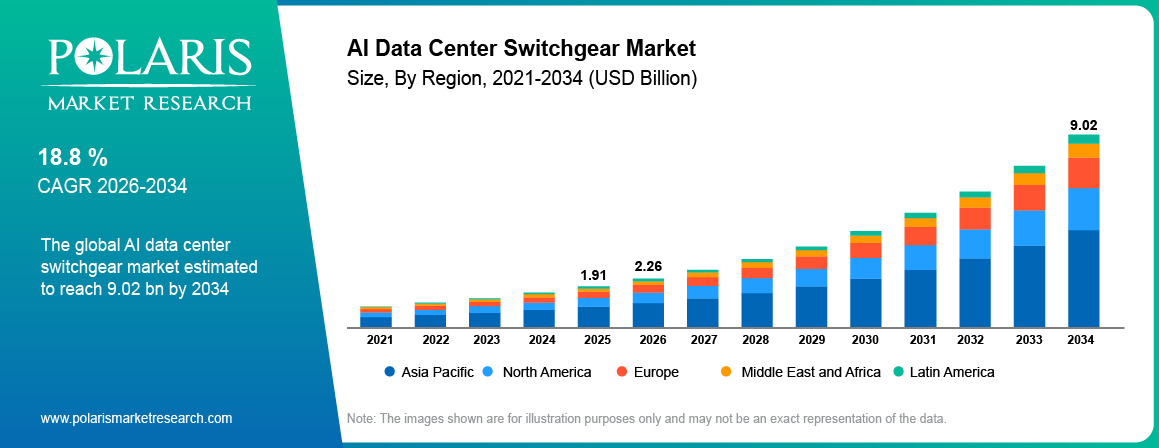
AI data center switchgear market size was valued at USD 1.91 billion in 2025. The market is expected to register a CAGR of 18.8% from 2026 to 2034. Market growth is driven by rising AI data center capacity and increasing rack densities. Also, growing adoption of advanced switchgear technologies for reliable power distribution and protection fuels the market expansion.
Market Statistics
AI Data Center Switchgear Market Key Takeaways
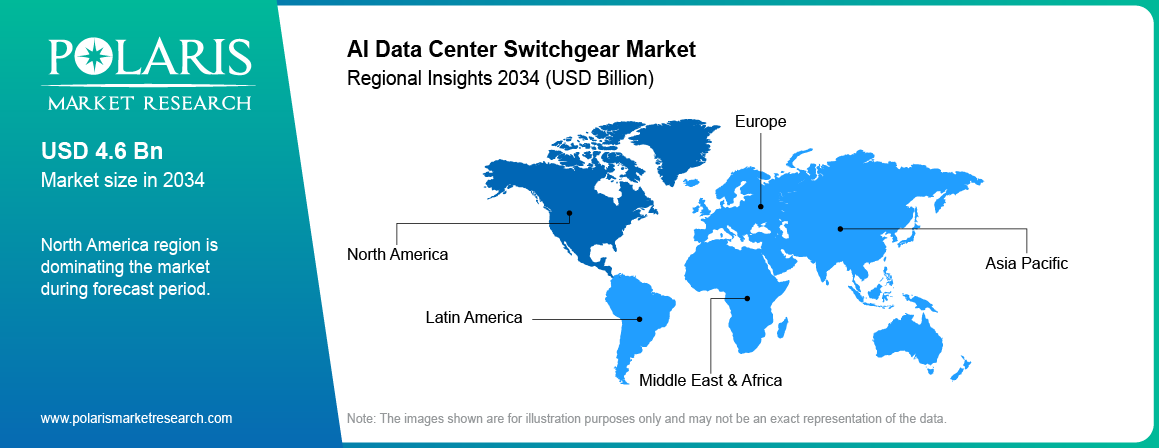
- North America accounted for 40.83% of the global share in 2025. The dominance is driven by the rapid AI and hyperscale data center expansion, rising power demand, and investments in AI-ready switchgear.
- The market in Asia Pacific is expected to exhibit a 20.73% CAGR during the forecast period. The growth is attributed to the rising data center investments and increasing AI workloads.
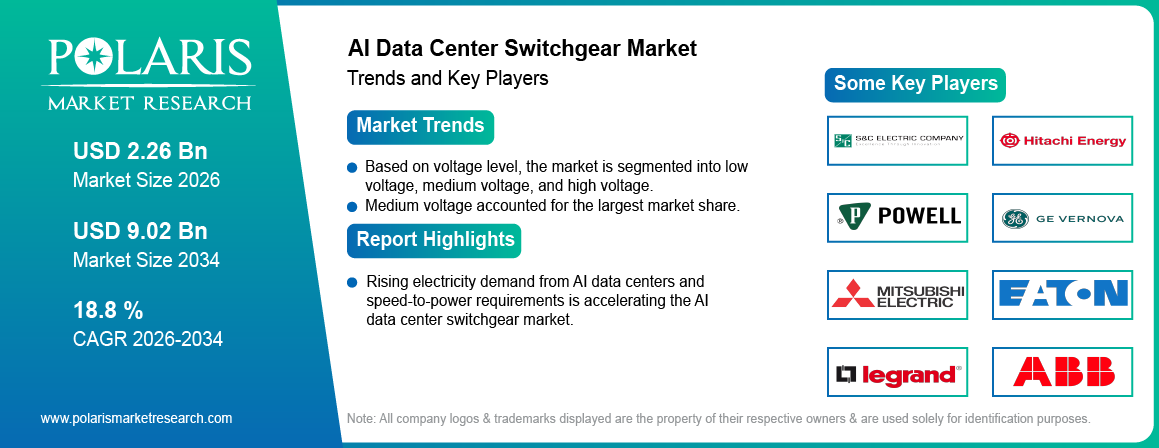
- The medium voltage segment accounted for a major market share of 52.37% in 2025. The leading share is fueled by its widespread use in distributing power from utility substations to data center facilities.
- The SF6-free segment is projected to record a 25.12% CAGR during the projected period, owing to rising environmental concerns regarding SF6 emissions and stringent regulations and rising sustainability targets of data centers.
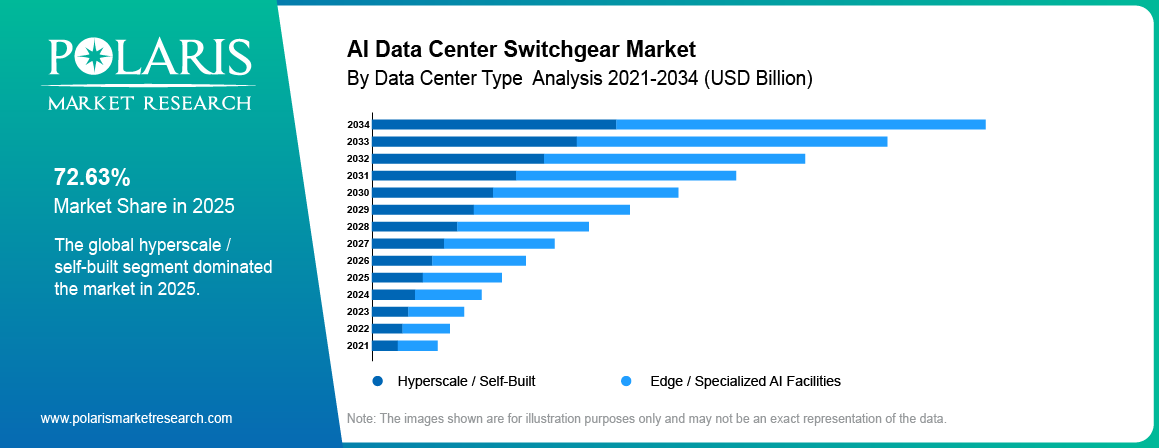
- The hyperscale data centers segment dominated the market with a share of 72.63% in 2025, owing to their huge AI workloads and high power requirements.
Note: Figures and projections outlined in this report are the result of Polaris Market Research’s proprietary analytical processes, grounded in the latest available datasets and market observations.
What is AI Data Center Switchgear Market?
The AI data center switchgear market covers electrical distribution and protection solutions used to manage, control, isolate, and monitor power across AI data center infrastructure. The market supports reliable power delivery for high-density AI computing environments, where increasing power loads require robust and flexible electrical distribution systems.
The market includes medium and low-voltage switchgear, circuit breakers, protective relays, transfer switches, busway-integrated systems, and intelligent power monitoring and control solutions. Its applications include power distribution, electrical protection, fault isolation, load switching, backup power transfer, and real-time power monitoring across utility connections, electrical rooms, power distribution networks, and backup power infrastructure.
The market growth is driven by the rising power density of AI infrastructure and rapid expansion of AI data centers. Higher rack power requirements are increasing electrical loads and the need for reliable protection and distribution systems. Demand is also fueled by the need for quick installation through modular and pre-engineered switchgear systems. Expanding data center power distribution fuels the market expansion.
Digital and integrated switchgears are becoming increasingly popular in the market. Manufacturers are adding sensors, remote monitoring, predictive maintenance and power quality analysis to bring visibility and reliability to the equipment. These developments are expected to support sustained growth in the AI data center switchgear market.
Market Dynamics
Driver: Rising Electricity Demand from AI Data Centers is Forcing Larger and More Resilient Electrical Distribution Systems
The increase in AI workloads are increasing power consumption, driving higher power requirements for data centers. For instance, the International Energy Agency (IEA) estimates that global data center electricity consumption is projected to double to reach around 945 TWh by 2030. It would be driven largely by AI and other high-performance computing workloads (Source: iea.org).
Increasing power requirements are causing the need for increased electrical distribution capacity and infrastructure. Such power requirements are demanding the installation of electrical infrastructure such as medium voltage switchgear and circuit breakers. Rising infrastructure requirements are leading to the adoption of high-capacity switchgear in AI facilities.
Driver: Speed-to-Power Requirements are Accelerating Prefabricated, Standardized, and Digitally Engineered Switchgear
The quick expansion in AI data centers is creating a need for faster delivery of power infrastructure. This is increasing demand for prefabricated switchgear, prefabricated power modules, standardized products, and factory-made systems that reduce installation and commissioning time on-site.
Modular and digital designs of the switchgear help increase efficiency in the deployment process as well. Standardizing the platform and digitally validating the power system can reduce engineering complexity, commissioning risk, and time. For instance, in 2026, the UK Government announced plans to build four data center buildings (41,000 m2 GIA each). These data center consist of prefabricated electrical buildings, including e-houses housing equipment such as switchgear and transformers, to support the increasing adoption of prefabricated electrical infrastructure (Source: assets.publishing.service.gov.uk). Such initiatives also propel the industry growth.
Restraint: Procurement Delays and Grid Bottlenecks
Lead times for data center electrical switchgear and interconnection challenges are delaying AI data center switchgear installation. The acquisition of switchgear is highly dependent on the specific utilities, fault level, redundancy, protection coordination, and local codes required. Delays in any component will delay installation of the entire system.
Interconnection challenges are also delaying the installation of the switchgear, and the requirement that the switchgear is engineered to order makes changing suppliers expensive due to redesigning and re-approval. The supply chain and installation of switchgear are expected to become easier slowly.
Grid bottlenecks is on of the major market restraints. An AI building without an energized utility connection limits the demand for switchgear on the original schedule. This uncertainty drives fluctuations in order timing and pressures adoption of bridge-to-grid or onsite generation architectures. Those alternatives can cause incremental switching requirements. They also add controls complexity and permitting dependencies.
Opportunity: SF6-free and Lower-Footprint Medium-Voltage Systems to Gain Market Opportunity
The push for SF6-free switchgears has created an opportunity due to stringent regulations regarding the use of fluorinated gases in medium-voltage equipment. Vacuum interruption, clean-air insulation, and other alternatives to traditional SF6 designs are creating opportunities for more efficient power systems in AI data centers. For example, GE Vernova introduced a new 170 kV SF6-free gas-insulated switchgear in 2026 to help reduce the carbon footprint of high-voltage power infrastructure (Source: gevernova.com).
This shift also drives demand for gas insulated switchgear and switchgear lifecycle services. This creates additional opportunities for manufacturers and service providers, to replace legacy equipment, manage compliance, and monitor installed systems. It also helps integrate new technologies without disrupting critical operations.
Opportunity: 800 VDC and Microgrid-Integrated Power Architectures to Expand the Switchgear Value Pool
The move to 800 VDC architecture for high power AI racks is creating a need for DC capable protection, switching, metering and coordinated AC/DC systems. At the same time, the rising use of onsite generation and energy storage is driving the need for microgrid switchgear that can handle multiple sources of power and critical AI loads. For example, Texas Instruments (TI) announced a complete 800VDC power architecture for next generation AI data centers with the NVIDIA 800VDC reference design in 2026. This highlights the industry’s transition toward higher voltage DC power systems for AI infrastructures (Source: ti.com).
The opportunity extends to behind-the-meter power systems, where switchgear can integrate utility supply, generators, batteries, and other distributed sources. This is also creating opportunities for vendors to offer intelligent controls, protection coordination, digital monitoring, commissioning, and lifecycle services alongside traditional switchgear equipment.
Segmentation Analysis
The report provides a comprehensive analysis of the AI data center switchgear market by voltage level, insulation technology, data center type, and deployment architecture to identify the leading revenue-generating segments and emerging growth opportunities.
By Voltage Level
The medium voltage segment dominated the AI data center switchgear market share with 52.37% in 2025, owing to its widespread use in distributing power from utility substations to data center facilities. Medium voltage switchgear provides reliable power distribution, fault protection, and operational flexibility for high-density AI data centers. The expansion of large-scale data center campuses further supports segment demand. The increasing adoption of AI computing infrastructure is driving the need for resilient medium-voltage distribution systems throughout hyperscale and colocation facilities. These systems support higher power loads and offer efficient power management for large data center campuses.
The high voltage segment is expected to witness the highest CAGR of 19.45% during the forecast period. Growth is driven by rising power requirements for AI data centers, along with the development of hyperscale AI facilities. Higher investments in dedicated substations and higher capacity power infrastructures are likely to increase the use of high voltage systems. The large and sustained power loads of AI workloads are pushing data center operators to implement higher capacity power infrastructure for new facilities and campus expansions. High voltage switchgear is utilized at the incoming utility and substation level for power management to manage rising electrical loads. The construction of AI-ready data centers, utility interconnections, and dedicated power infrastructure would drive demand for high-voltage switchgear across large-scale facilities.
The low-voltage switchgear segment accounted for a 17.65% market share in 2025, supported by its role in distributing power from medium-voltage systems to IT equipment and other facility loads. The deployment of high-density servers and the demand for reliable low-voltage switchgear are increasing. Low-voltage systems are playing an important role in AI data centers for power distribution to server rooms, auxiliary equipment, cooling systems, and other critical facility loads. Increasingly dense computing environments are creating a need for reliable protection, isolation, and switching at the downstream power distribution points. Growing deployment of AI servers and supporting electrical infrastructure is therefore boosting the adoption of low voltage switchgear across modern data center facilities.
By Insulation Technology
The air insulated switchgears segment dominated with a share of 51.36% in 2025, due to their proven technologies, low costs, and large application in the power distribution of data centers. Its simple design and ease of maintenance propel its adoption. These systems support dependable power distribution to critical computing loads in the AI data center switchgear market. The proven design lets operators continue using tried-and-tested installation and maintenance routines. Growing AI workloads are driving demand for electricity and reliable electrical protection. Air-insulated switchgear provides a practical option for facilities expanding power infrastructure. It also supports routine servicing and upgrades.
The SF6-free segment is expected to register the highest CAGR of 25.12% during the forecast period. The growth is attributed to rising environmental concerns regarding SF6 emissions and stringent regulations. Increasing sustainability targets of data centers also boost the segment growth. SF6-free switchgear employs alternative insulation technologies to reduce greenhouse gas emissions while maintaining reliable power distribution and protection in AI data centers. Operators in the market are focused on equipment that will support environmental goals and compliance. This is making suppliers to suggest sustainable power distribution solutions for new facilities. SF6-free switchgear delivers reliable electrical protection for high-density computing environments.
The gas insulated switchgear segment is expected to record a 17.85% CAGR during the forecast period. The design of the enclosure reduces the installation footprint and offers high protection from environmental conditions, allowing its installation in facilities with high requirements for reliability. Space efficiency is becoming a factor in the AI data center switchgear market as facilities add high-density computing systems and expand electrical infrastructure. Gas-insulated switchgear with its compact construction and closed design satisfies these requirements. It is well suited to applications where floor space is at a premium and reliable operation is critical. The equipment provides a practical solution for facilities requiring protected power distribution.
By Data Center Type
Hyperscale data centers held a larger share of 72.63% in 2025, owing to their huge AI workloads and high power requirements. Reliable switchgear is critical for the efficient distribution of power, load management, and redundancy for these facilities. Continued investments in large AI data center campuses are projected to support growth in the segment. Higher rack power density also increases demand for reliable power protection and distribution equipment across these facilities.
The specialized AI facilities segment is expected to register the highest CAGR of 19.85% during the forecast period. The growing use of AI inference and latency-sensitive workloads is driving the need for distributed AI infrastructure. This factor propels the demand for compact, reliable, and high-performance switchgear solutions. Such facilities require a stable power supply to support intensive computing loads and ensure operations continue. Switchgear also aids in isolating faults and restoring power more quickly. As more distributed AI sites are rolled out, the demand for advanced power equipment could increase further.
By Deployment Architecture
Site-built lineups accounted for a leading market share of 56.22% in 2025, primarily due to their high scalability and customization flexibility. Their established use in large-scale data center power distribution also boosts segment growth. They are being adopted due to their support for complex power demands and site-specific configurations. The approach also lets operators align switchgear layouts with changes in AI workloads and facility layouts. It supports reliable power delivery as rack densities and electrical demand continue to increase.
The prefabricated skids segment is expected to exhibit the highest CAGR of 20.80% during the forecast period. The growth is attributed to growing demand for faster data center deployment, modular power infrastructure, and reduced on-site installation time. For instance, in 2025, Vertiv introduced gigawatt-scale reference architectures for NVIDIA’s Omniverse DSX Blueprint. It includes fully prefabricated deployment models that support prefabricated skids for AI data center power infrastructure. Their design also improves deployment consistency and speeds the scaling of AI data center capacity (Source: datacentrenews.uk).
Hybrid architectures accounted for 12.30% share in 2025, as it combines site-built and prefabricated infrastructure, which are gaining popularity in data centers. They can be deployed flexibly and phased in to increase capacity, making them ideal for facilities with variable power requirements and mixed deployment needs. This approach allows gradual deployment of dense power systems and preserves existing electrical infrastructure in the AI data center switchgear market. It also lets operators balance deployment speed with site-specific needs and supports upgrades as AI workloads grow over time.
Regional Insights
Regional analysis of the data center switchgear market focuses on North America, Europe, Asia Pacific, Latin America, and the Middle East and Africa. The analysis is based on regional switchgear demand from data center construction, power infrastructure development, energy efficiency requirements, and the presence of local manufacturing and service networks.
North America
North America dominated the AI data center switchgear market with a share of 40.83% in 2025, driven by rapid AI and hyperscale data center expansion, rising power demand, and investments in reliable electrical infrastructure. The regional growth is also supported by the increasing scalability of AI infrastructure, rising power demand in data centers, and growing emphasis on electricity reliability and grid resiliency. For instance, in 2025, Meta committed to investing over USD 600 billion by 2028 in AI technology, infrastructure, and workforce expansion. Growing adoption of modular power systems, digital monitoring, and advanced protection technologies is also expected to support switchgear deployment across new and expanding AI data center facilities (Source: about.fb.com).
The U.S. dominated with a market share of 67.48% in North America in 2025. The growth is fueled by increasing usage of high density AI facilities and efficient power distribution network.
Europe
Europe held a significant AI data center switchgear market share by holding 22.14% in 2025. It is owing to the strict environmental regulations, availability of colocation facilities, and limited available space. The EU F-gas Regulation is fueling the demand for SF6-free switchgear, vacuum interruption, and clean air insulation.
Increasing AI workloads will continue to drive demand for reliable, dense power distribution infrastructure across the region. European data center electrical infrastructure is also supported by investments in switchgear manufacturing and data centers. In 2026, Siemens AG announced a USD 348.06 million investment in Germany to expand high-efficiency power distribution and switchgear production for AI data centers by 2030 (Source: press.siemens.com).
Asia Pacific
The Asia Pacific data center switchgear market is projected to record the highest CAGR of 20.73% during the forecast period, due to the rapid growth of data center investments and increasing AI workloads in China, India, Japan, and others. The growth of APAC AI infrastructure and new hyperscale and greenfield facilities present opportunities for modern switchgear architectures such as compact and modular systems.
The region’s diverse data center landscape will also influence deployments, with dense urban hubs favoring compact switchgear and modular electrical rooms. For instance, in 2026, HyperVault is planning to invest USD 7.32 billion to develop large-scale AI data center campus in Hyderabad, delivering up to 1GW capacity, which will further drive the regional market (Source: tcs.com).
Latin America
The Latin America data center switchgear market is expected to exhibit a CAGR of 18.35% during the projected period. This growth is driven by growing cloud and colocation investments, particularly in Brazil and selected secondary markets. Varying project scales and utility conditions are increasing demand for reliable medium-voltage distribution, redundancy, remote monitoring, and service support across Latin America data center power infrastructure.
The increasing adoption of modular systems is also driving modular data center switchgear, as factory-built electrical blocks can help reduce the onsite engineering needs and improve deployment times. The competitiveness of the suppliers will be determined by local assembly, lead time for imports and meeting the requirements of utilities and certifications.
Middle East and Africa
The Middle East & Africa had a relatively smaller share of 3.30% in 2025. However, there is the expansion of Middle East AI data centers and government investments in digital infrastructure. This is driving demand for high-capacity medium-voltage switchgear, prefabricated electrical houses, and integrated control systems in the region. Demand for sealed equipment, thermal resilience, and remote diagnostics is on the rise due to harsh environmental conditions.
Growth in the regional market is expected to be supported by investments in distributed and edge data centers, compact switching systems, and AI infrastructure. For example, in 2026, Vodafone partnered with Cassava Technologies to develop and enable advanced sovereign AI infrastructure in Egypt, using NVIDIA’s computing technology. Improvements in grid reliability, project financing, and local service capabilities are likely to create new opportunities in the MEA switchgear market during the forecast period (Source: cassavatechnologies.com).
Technology and Innovation Landscape
Technology development in the AI data center switchgear market is trending toward higher voltage DC distribution network, modular architectures and advanced power conversion. The shift to 800 VDC data center power is fueling innovation in medium-voltage distribution, solid-state power electronics, protection, metering and safety systems for high-density AI workloads.
Digital engineering is becoming significant with simulation-ready systems and digital twin switchgears that enable operators to check their ability to handle fault, capacity, and interface testing before actual deployment. At the same time, clean air switchgears and other alternatives without SF6 are increasingly being adopted in data centers.
Environmental performance is also becoming an important area of switchgear innovation. SF6-free technologies are gaining attention as data center operators seek lower-emission power distribution solutions. This trend is strengthening demand for clean air switchgear in new data center projects and replacement applications.
| Technology | Adoption Stage | Market Impact |
| Digital / intelligent switchgear | Commercial and scaling | Remote monitoring, predictive maintenance, event capture, protection coordination and integration with DCIM/EPMS. |
| Prefabricated modular switchgear | Commercial and scaling rapidly | Moves assembly and testing offsite, improves repeatability and speed-to-power. |
| SF6-free MV switchgear | Commercial, regulation-driven adoption | Reduces fluorinated-gas exposure and supports European regulatory compliance. |
| 800 VDC distribution | Early commercial / pre-scale transition | Reduces current and conversion burden for future very-high-density AI racks; changes DC protection requirements. |
| Solid-state protection and switching | Emerging | Potential faster fault clearing and more flexible control in hybrid AC/DC architectures. |
| Digital twins / simulation-ready assets | Scaling | Validates source-to-rack electrical design before procurement and supports repeatable AI factory blueprints. |
Source: Polaris Market Research Analysis
Competitive Landscape
Competition in the AI data center switchgear market is focused on manufacturing capacity, delivery reliability, and support for conventional AC, emerging DC, and microgrid architectures. The AI infrastructure switchgear competitive landscape is also shaped by the ability to provide integrated power solutions for high-density data centers. Leading companies are expanding their portfolios by combining switchgear with transformers, busway, UPS, power control, and power management systems.
Eaton Corporation plc, Siemens AG, ABB Ltd., Schneider Electric SE, and Vertiv are reinforcing their market position through production efficiency, customized solutions, digitalization, modularity, and power density architectures. These trends influence the market dynamics, as the vendors continue to develop integrated solutions for AI-based data centers.
Small specialist companies are competing based on customization, regional specialization, size reduction, and good service support. However, growing AI data center requirements are increasing the importance of financial scale, manufacturing capacity, global supply chains, and lifecycle support among data center switchgear vendors.
Key Players
- ABB Ltd.
- Eaton Corporation plc
- GE Vernova
- Hitachi Energy Ltd.
- Legrand SA
- Mitsubishi Electric Corporation
- Powell Industries
- S&C Electric Company
- Schneider Electric SE
- Siemens AG
- Vertiv
AI Data Center Switchgear Market Positioning
| # | Company | Switchgear Scope | Market Positioning | Competitive Signal |
| 1 | Schneider Electric SE | MV/LV switchgear, transfer switches, protection, power distribution | Broadest end-to-end AI power narrative in the peer set, spanning utility interface to rack. Switchgear is positioned as one layer of a bundled architecture rather than a standalone product. | Grid-to-chip AI power portfolio and 800 VDC architecture. |
| 2 | Eaton Corporation plc | MV/LV switchgear, breakers, prefabricated power systems | Most explicit U.S. capacity commitment tied to AI data center demand. Prefabricated power systems fit hyperscaler speed-to-power requirements. | U.S. capacity expansion tied directly to AI data center demand. |
| 3 | Siemens AG | MV/LV switchgear, protection, busway, modular power | Balanced portfolio across switchgear, protection and busway with modular delivery. Strong dual-region (U.S. and Germany) manufacturing footprint. | Large 2026 U.S. and German manufacturing investments. |
| 4 | ABB Ltd. | MV/LV switchgear, breakers, e-houses, digital distribution | Differentiates on digital distribution and early DC-architecture positioning through GPU-ecosystem engagement, alongside a conventional e-house and switchgear base. | NVIDIA collaboration, 800 VDC R&D, DSX digital assets. |
| 5 | GE Vernova | Electrification segment: switchgear, transformers, AC substations, grid software; Prolec GE acquired (Feb 2026) | Fastest-rising order momentum in the peer set, strongest at the utility interface and substation layer, and increasingly scaled through transformers plus switchgear. | Electrification booked $2.4B of data center equipment orders in Q1 2026 (above all of 2025); data center orders exceeded $5B in H1 2026; Q2 segment book-to-bill ~1.7. |
| 6 | Vertiv | Switchgear, busway, modular infrastructure, controls | Native data center brand with strong in-hall relationships. Moving up the power chain toward grid-adjacent and onsite generation equipment. | Expansion upstream into microgrid-specific switchgear and onsite power. |
| 7 | Hitachi Energy Ltd. | HV GIS 72.5-1,200 kV (incl. SF6-free EconiQ); modular prefabricated GIS (IGA) 72-420 kV; breakers | Positioned on high-voltage grid connection for large campuses, with compact prefabricated GIS and SF6-free technology as differentiators. | About $1B U.S. grid manufacturing investment (Mar 2026), including expanded breaker and switchgear operations near Pittsburgh. |
| 8 | Mitsubishi Electric Corporation | MV AIS, LV switchgear, vacuum circuit breakers (SF6-free MV to 24 kV / 4,000 A), UPS, transformers | UPS heritage broadening into a wider data center power and cooling portfolio, framed as a chip-to-grid architecture aligned to higher-voltage DC distribution. | Chip-to-grid strategy for NVIDIA-based AI factories; $86M advanced switchgear factory in Western Pennsylvania (announced Oct 2024). |
| 9 | Powell Industries | LV/MV switchgear (480 V-38 kV), power control rooms, proprietary MV breakers | Custom-engineered, project-based supplier for large and behind-the-meter campuses, with net-cash balance sheet funding capacity growth. | Record $2.4B backlog (Jun 2026); a single >$400M data center award is about one-third of backlog, running through FY2028; 335,000 sq ft yard expansion. |
| 10 | Legrand SA | Busway (Starline), PDUs, racks, digital power monitoring; MV switchgear via Kratos; Anord Mardix | Data centers now a major share of group sales, with switchgear an adjacent, M&A-built extension of an in-hall distribution franchise. | Data centers 32% of H1 2026 group revenue, up over 30%; 2026 sales growth guidance raised to 16-19%; Kratos MV acquisition (early 2026). |
| 11 | S&C Electric Company | Medium-voltage switching, custom metal-enclosed gear | Niche positioning on uptime: fault isolation and continuous-operation designs suited to mission-critical feeds. | Fault isolation and continuous-operation focus. |
Source: Polaris Market Research Analysis
Market Entry Barriers
Key market entry barriers in the AI data center switchgear market include:
- Switchgear certification: Compliance with voltage-class standards, fault withstand, arc-flash requirements, utility rules, and protective coordination makes switchgear certification a major entry barrier.
- Switchgear manufacturing scale: Large AI data center projects require multiple switchgear lineups within tight delivery schedules, making switchgear manufacturing scale an important competitive requirement.
- Mission-critical supplier qualification: Past implementations, global services network, ability to deliver spare parts, and financial health are crucial factors for mission-critical suppliers' criticality assessment in big data center projects.
- Electrical system integration: Integrating switchgear with transformers, UPS, generators, busways, and controls is important for the electrical systems integration in the project acceptance.
- Local switchgear supply chain: The transport lead time, trade barriers, localization, and regional electric code regulations make it very important for localizing the switchgear supply chain.
- AI power architecture transition: The suppliers will have to consider their current AC systems in relation to the SF6-free insulating system, digital system, solid-state protection system, and the 800 VDC system.
Buyer Analysis
| Buyer | Primary Need | Purchase Criteria |
| Hyperscale / AI platform operator | Speed to power, repeatability, high fault duty, global service | Delivery slots, reference designs, validated modular blocks, lifecycle support |
| Colocation operator | Tenant flexibility, uptime, phased expansion | Modularity, maintainability, metering, service response |
| EPC / electrical contractor | Constructability, code compliance, schedule certainty | Engineering support, drawings, FAT, logistics |
| Utility / microgrid partner | Protection coordination, interconnection, source control | Relay expertise, grid compliance, communications |
| Developer / infrastructure investor | Schedule risk, lifecycle cost, bankability | Supplier scale, warranty, installed base, delivery confidence |
Source: Polaris Market Research Analysis
Industry Developments
- April 2026: Eaton Corporation plc announced an investment of over USD 30 million to expand U.S. production of its medium-voltage switchgear for data centers, utilities, and industrial power systems. (Source: eaton.com)
- June 2026: ABB Ltd. expanded its NVIDIA collaboration by bringing switchgear and power distribution hardware into NVIDIA Omniverse, enabling operators to model and optimize source-to-rack power distribution before construction. (Source: new.abb.com)
- August 2026: Siemens AG announced U.S. manufacturing investments of over USD 200 million including new plants in Georgia and Texas to boost production of electrical infrastructure and switchgear. (Source: news.siemens.com)
- September 2026: Vertiv announced to acquire UtilityInnovation Group in USD 1.45 billion to expand its data center power portfolio with microgrid controls, onsite generation orchestration, microgrid-specific switchgear, and behind-the-meter power architecture. (Source: vertiv.com)
Premium Insights and Forward Outlook
Power architecture will become a primary competitive layer in AI infrastructure
The AI data center switchgear market is moving beyond individual electrical components toward integrated AI infrastructure power architecture. With higher rack densities and faster deployment requirements, switchgear for AI data centers is becoming increasingly important to connect power sources, isolate faults, and distribute capacity across high-density AI facilities. Rising energy demand from data centers boost the microgrid deployment, which will boost the industry expansion.
The market is expected to move toward integrated source-to-rack power solutions that will combine switchgear with transformers, UPS, busway, microgrid controls and emerging 800 VDC architectures. Suppliers that can deliver complete, deployable electrical architectures are likely to capture greater project value.
Switchgear procurement will shift toward capacity reservation and lifecycle partnerships
As manufacturing lead times and project schedules remain critical, data center operators are likely to prioritize reserved production capacity, standardized configurations, digital twins, remote diagnostics, and regional service networks. This will increase the importance of switchgear lifecycle partnership models beyond one-time equipment sales.
Cost and Pricing Benchmarking Analysis
AI data center switchgear pricing is shaped by system capacity, voltage class, fault rating, protection requirements, and project configuration. The quote-based model allows suppliers to tailor switchgear solutions to specific data center power needs. These cost factors provide a useful basis for comparing equipment requirements and overall power distribution investments.
| Item/Service | Public Pricing Status | Benchmark / Cost Driver |
| Low-voltage switchgear lineup | Quote based | Bus rating, breaker count, fault rating, metering, redundancy, arc-flash features, controls |
| Medium-voltage switchgear lineup | Quote based | Voltage, insulation, breaker technology, fault duty, relay package, lineup length, utility requirements |
| Prefabricated electrical skid / e-house | Quote based | Included transformer/switchgear scope, enclosure, factory integration, FAT, logistics |
| SF6-free technology premium | Project based | Premium varies by platform, region, voltage class and supplier |
| Digital monitoring / controls attach | Quote based | Depends on sensors, relays, communications, software integration and service scope |
Source: Polaris Market Research Analysis
Market Segmentation
By Voltage Level (Revenue, USD Billion, 2021–2034)
- Low Voltage
- Medium Voltage
- High Voltage
By Insulation Technology (Revenue, USD Billion, 2021–2034)
- Air Insulated
- Gas Insulated
- SF6-Free / Solid Dielectric
- Others
By Data Center Type (Revenue, USD Billion, 2021–2034)
- Hyperscale / Self-Built
- Edge / Specialized AI Facilities
By Deployment Architecture (Revenue, USD Billion, 2021–2034)
- Site-Built Lineups
- Prefabricated Skids / Modular Electrical Systems
- Microgrid-Integrated / Hybrid Architectures
By Regional Outlook (Revenue, USD Billion, 2021-2034)
- North America
- U.S.
- Canada
- Europe
- Germany
- France
- UK
- Italy
- Spain
- Netherlands
- Russia
- Rest of Europe
- Asia Pacific
- China
- Japan
- India
- Malaysia
- South Korea
- Indonesia
- Australia
- Vietnam
- Rest of Asia Pacific
- Middle East & Africa
- Saudi Arabia
- UAE
- Israel
- South Africa
- Rest of Middle East & Africa
- Latin America
- Mexico
- Brazil
- Argentina
- Rest of Latin America
Report Scope
| Report Attributes | Details |
| Market Size in 2025 | USD 1.91 Billion |
| Market Size in 2026 | USD 2.26 Billion |
| Revenue Forecast by 2034 | USD 9.02 Billion |
| CAGR | 18.8% from 2026 to 2034 |
| Base Year | 2025 |
| Historical Data | 2021–2024 |
| Forecast Period | 2026–2034 |
| Quantitative Units | Revenue in USD Billion and CAGR from 2026 to 2034 |
| Report Coverage | Revenue Forecast, Competitive Landscape, Growth Factors, and Industry Trends |
| Segments Covered |
|
| |
| Competitive Landscape |
|
| Report Format |
|
| Customization | Report customization as per your requirements with respect to countries, regions, and segmentation. |
Source: Polaris Market Research Analysis
Why Choose Polaris Market Research
Polaris Market Research & Consulting, Inc. applies a combination of primary research, secondary sources, and bottom-up market assessment to develop a reliable AI data center switchgear market report. The study assesses switchgear across voltage levels, insulation methods, facility types, and deployment approaches. Its scope emphasizes other electrical systems, including UPS, transformers, substations, and busway.
The research also takes into account the fast-evolving power needs of AI data centers, including high-density loads, digital switchgear, microgrids, and new 800 VDC systems. Using supplier advances, product specifications, regulations, and deployment trends, Polaris provides detailed AI data center switchgear market analysis and engineering-based insights.
This research is customizable on the basis of geography, voltage level, type of facility, deployment model, vendor, production capability, or new energy technology. Such customization facilitates tailor-made market research relevant to certain investment, purchasing, partnering, or market entry needs.
Research Methodology
This study follows a structured market research methodology covering market definition, supplier mapping, demand assessment, and market sizing. Secondary and primary research is used to evaluate technology adoption, procurement trends, and regional demand. These inputs also assist in supporting the data center switchgear industry forecast. Market estimation is based on data from various sources and by applying both top-down and bottom-up approaches. The data is triangulated by studying various factors and trends from the demand and supply side in the data center switchgear industry. The data has also been validated by the technique of data triangulation across company, project and regional indicators.
Five-Phase Research Methodology
| Research Phase | Method |
| 1. Scope Definition | Define switchgear inclusions/exclusions and avoid overlap with substations, UPS, transformers and busway. |
| 2. Supply Mapping | Identify OEMs, product families, voltage/insulation technologies, manufacturing capacity, and project participation. |
| 3. Demand Triangulation | Assess AI data center power growth, project pipelines, grid constraints, redundancy needs and architecture shifts. |
| 4. Market Modeling | Estimate revenue by segment and region using Polaris proprietary assumptions and internal data. |
| 5. Validation | Cross-check with source disclosures, primary interviews, product mix, capacity additions and analyst review. |
Source: Polaris Market Research Analysis
Our team of market experts and technical analysts analyze trends across regions, suppliers, voltage classes and AI data center architectures. This team composition allows for targeted analysis for specific market requirements and investment needs.
An analyst consultation helps clients discuss the findings with our experts and to decide if they relate to particular business decisions. Clients can use these findings to assess procurement strategies, supplier opportunities and regional market conditions.
AI Data Center Switchgear Market FAQ's
• The AI data center switchgear market was valued at USD 1.91 billion in 2025 and is projected to reach USD 9.02 billion by 2034. Rising electricity demand from AI data centers is driving the market growth.
• The market is expected to grow at a CAGR of 18.8% from 2026 to 2034. The growth will be driven by the adoption of SF6-free and lower-footprint medium-voltage systems.
• The medium voltage segment held the highest share of 52.37% in 2025, due to the widespread use of medium voltage in the distribution of power from utility substations to data center facilities.
• Switchgear in a data center is electrical equipment used to control, protect, isolate and distribute power to critical systems and IT equipment.
• Medium-voltage switchgear is critical for AI data centers to handle high power loads, protect electrical systems, isolate faults, and provide reliable power distribution for mission-critical AI infrastructure.
• North America dominated with 40.83% in 2025 due to rapid growth of AI and hyperscale data centers, increasing demand for power, and investments in reliable electrical infrastructure.
• ABB Ltd., Eaton Corporation plc, Schneider Electric SE, Siemens AG, and Vertiv are a few key market players..
• SF6-free switchgear is becoming increasingly important as concern about SF6 emissions grows. It also helps data centers focus on greater sustainability and low impact infrastructure.
• Lower distribution levels in data centers use low voltage (LV) switchgear, while medium voltage (MV) switchgear is used for higher voltage power supplied from utility connections and primary distribution networks.
• AI data centers use multiple AC voltage levels, from utility service to low-voltage distribution, while newer high-density AI racks are moving toward higher-voltage DC systems such as 800 VDC.
• Prefabricated power modules provide faster deployment, lower onsite work, and scalable power infrastructure to support high-density AI workloads.
• The 800 VDC allows for higher voltage power distribution to reduce current, conversion losses, cabling needs, and power system footprint in high-density AI data centers.
• Switchgear improves data center uptime by isolating faults, protecting critical power equipment, and providing for quick power switching for continuous operations.
Download Sample Report of AI Data Center Switchgear Market
Please fill out the form to request a customized copy of the research report.


