
Software Defined Data Center Market Size, Share, Trends and Forecast, 2026-2034
REPORT DETAILS
Software Defined Data Center Market Summary and Key Insights
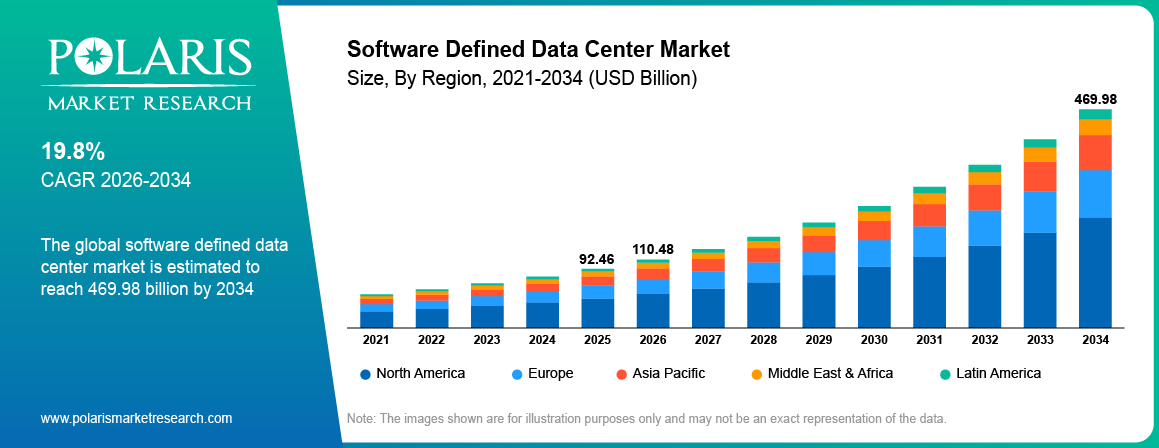
The software defined data center market size was valued at USD 92.46 billion in 2025, and it is estimated to reach USD 469.98 billion by 2034, exhibiting a CAGR of 19.8% from 2026–2034. Businesses are adopting them to improve flexibility and control over IT resources.
Market Statistics
Software Defined Data Center Market Key Insights
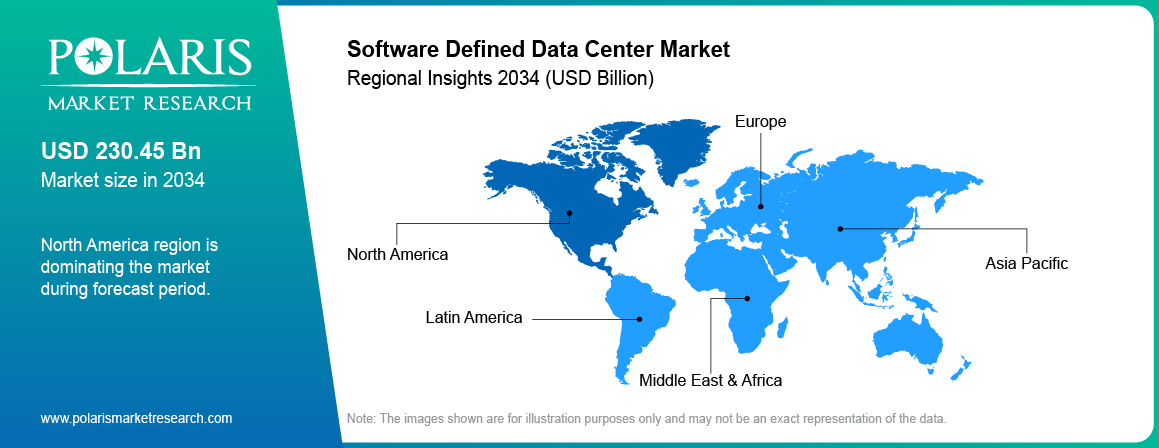
- In 2025, North America led the global market with 39.90% revenue share. It is due to the presence of major players and the early adoption of data automation and cloud computing technologies.
- The Asia Pacific market is projected to register a substantial CAGR of 20.7% during the forecast period. This is driven by rising investments from end users across various industries, particularly in cloud services, IT infrastructure, and data center modernization.
- The market in India is expected to experience a substantial CAGR of 21.4% during the forecast period. This is attributed to surging investments in technology adoption.
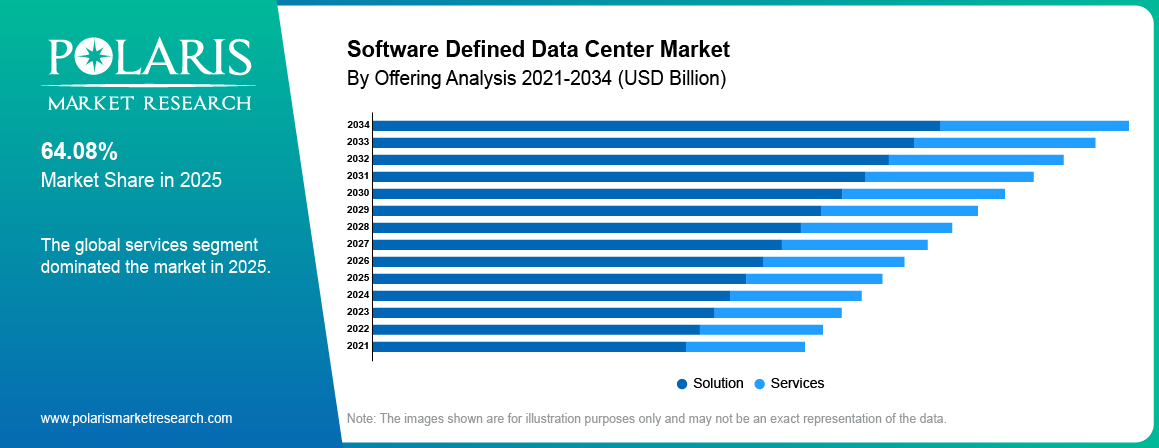
- The services segment is expected to experience the highest CAGR of 20.2% during the forecast period. This growth is fueled by the surging demand for managed services, cloud integration, and support solutions.
- The software-defined computing segment dominated with 38.9% revenue share in 2025. It is due to the rising need for efficient resource management and improved performance in IT environments.
Note: Figures and projections outlined in this report are the result of Polaris Market Research’s proprietary analytical processes, grounded in the latest available datasets and market observations.
Software Defined Data Center Market Dynamics
- Rising adoption of cloud computing and virtualization propels demand for flexible and scalable software-defined infrastructure.
- Increasing need for automated data center management boosts the deployment of software-defined networking, storage, and computing solutions.
- High implementation costs and complex migration from traditional data centers restrict the adoption among small and medium enterprises.
- Growing investments in hybrid cloud environments and edge computing will create new market opportunities.
- Integration of AI-driven automation and analytics is expected to drive the market expansion.
Impact of Artificial Intelligence on Software Defined Data Centers
- AI-based automation improves data center operations through intelligent resource allocation, workload optimization, and automated infrastructure management.
- AI-enabled predictive analytics is used to identify potential failures. It enables proactive maintenance and reducing downtime.
- Machine learning algorithms improve network performance. They optimize traffic flow and improve software-defined networking efficiency.
- Intelligent energy management using AI helps lower power consumption. It improves data center sustainability.
- AI integration with cloud and edge platforms will accelerate the adoption of flexible and scalable software-defined infrastructure
The SDDCs market growth can be attributed to the rising demand for virtualization to simplify business operations. Virtualization helps organizations make the most of their computing, storage, and network resources, improving operational efficiency. Businesses are looking to cut hardware costs and enhance their skills, and virtualization technologies allow for seamless resource allocation, quick application deployment, and centralized management. This shift simplifies IT operations and aligns with the increasing trend toward hybrid and multi-cloud strategies. By converting physical infrastructure into a flexible, software-driven environment, organizations can easily adjust to changing demands and streamline processes.
Source: Polaris Market Research Analysis
To Understand More About this Research: Download Sample Report
Organizations are increasingly adopting these solutions as they help cut operational costs by optimizing resource usage and reducing hardware investments. This approach allows businesses to adjust resources based on demand, enabling rapid growth without significant capital expenditure. The flexibility of these solutions makes it easier to manage workloads, supports hybrid cloud strategies, and improves overall operational efficiency. Thus, as companies look for greater skill and efficiency in their IT environments and focus on cost cutting measures, the adoption of SDDC solutions is significantly accelerating, fueling the software defined data center market expansion.
Traditional Data Centers vs. Software Defined Data Centers
| Parameter | Traditional Data Center | Software Defined Data Center (SDDC) |
| Infrastructure Approach | Hardware-centric architecture with dedicated physical resources | Software-driven architecture with virtualized and abstracted resources |
| Hardware Dependency | Highly dependent on physical servers, storage, and networking hardware | Infrastructure abstracted from hardware through virtualization |
| Provisioning Method | Manual configuration and deployment processes | Automated provisioning and orchestration through software |
| Scalability | Fixed and slower to scale due to hardware limitations | Highly scalable with dynamic resource allocation |
| Resource Utilization | Often underutilized due to static resource allocation | Optimized resource pooling and utilization |
| Management Style | Siloed management of compute, storage, and networking | Unified centralized management platform |
| Flexibility | Limited flexibility and slower workload migration | Agile and flexible workload deployment |
| Operational Efficiency | Requires significant manual intervention and maintenance | Automation reduces operational complexity and downtime |
| Cost Structure | High capital expenditure (CapEx) for hardware investments | Lower operational costs through virtualization and automation |
| Deployment Speed | Slower infrastructure deployment cycles | Rapid deployment and configuration of services |
| Cloud Integration | Limited hybrid cloud compatibility | Seamless integration with private and public cloud environments |
| Disaster Recovery | Hardware-dependent backup and recovery processes | Faster recovery through virtualized environments and automation |
Source: Polaris Market Research Analysis
Software Defined Data Center Market Drivers and Opportunities
Cloud Computing and Hybrid IT Adoption
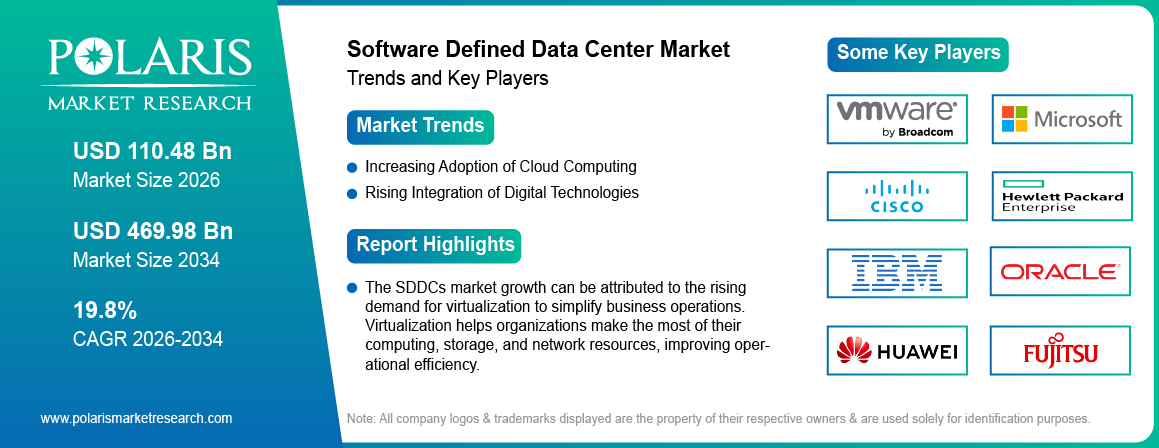
The use of cloud computing has transformed the way organizations manage their IT infrastructure. Businesses are increasingly adopting cloud solutions, for which they seek integrated environments that allow seamless resource management across public, private, and hybrid clouds. According to the India Brand Equity Foundation, in India, end-user spending on cloud services increased to USD 7.1 billion in 2022 from USD 5.6 billion in 2021, highlighting the growing reliance on cloud technologies. This shift enhances flexibility and scalability, as well as encourages organizations to streamline operations and reduce costs. Thus, the rise in adoption of cloud computing is significantly driving the market growth.
Digital Transformation and Data Center Modernization
Companies across various industries integrate a variety of digital technologies in their business operations. According to the United Nations, digital technologies have advanced more rapidly than any innovation, reaching around 50% of the developing world’s population in just two decades. This increase necessitates flexible and scalable IT infrastructure to support diverse applications and data workloads. Software defined data center solutions offer the agility and efficiency required to manage this digital transformation, enabling businesses to respond quickly to market demands and enhance operational efficiency. Therefore, the increasing use of digital technologies is positively impacting the market demand.
Source: Polaris Market Research Analysis
Software Defined Data Center Market Segment Analysis
Software Defined Data Center Market, by Offering
The services segment is expected to experience a higher CAGR in the global market during the forecast period. This growth is attributed to the increasing demand for managed services, cloud integration, and support solutions as organizations seek to streamline their IT operations. As businesses adopt these solutions, they will increasingly rely on expert services for implementation, optimization, and ongoing management, driving the segment's growth in the global market.
Software Defined Data Center Market, by Model
The software-defined computing segment is expected to dominate the market during the forecast period due to the growing need for efficient resource management and improved performance in IT environments. As organizations increasingly virtualize their computing resources, they benefit from enhanced scalability, flexibility, and reduced operational costs. The rise of cloud computing and digital transformation initiatives further boost the adoption of software-defined computing solutions, impacting the segmental growth in the global market.
Source: Polaris Market Research Analysis
Software Defined Data Center Market Regional Analysis
In 2024, North America software defined data center market held the largest revenue share of the market due to the presence of major players and the early adoption of data automation and cloud computing technologies. The region benefits from a well-established IT infrastructure and a strong ecosystem that encourages innovation and investments in advanced solutions. Organizations across the region are increasingly leveraging SDDCs to enhance operational efficiency, scalability, and flexibility, leading to the software-defined market development in North America.
Source: Polaris Market Research Analysis
Asia Pacific is projected to register a substantial CAGR during the forecast period, driven by increasing investments from end users across various industries, particularly in IT infrastructure, cloud services, and data center modernization. As organizations in the region recognize the importance of digital transformation, they are allocating significant resources to adopt advanced IT solutions. The need for enhanced operational efficiency, scalability, and cost-effectiveness is fueling this trend. Additionally, the growing demand for cloud services and modernization of data centers are key factors contributing to the market expansion in Asia Pacific.
The market in India is expected to experience substantial growth due to increasing investments in technology adoption. According to the India Brand Equity Foundation, by 2047, the country aims for a USD 26 trillion GDP, driven by a growing digital economy and significant cloud computing investments. This environment fosters innovation and strengthens infrastructure, making these solutions essential for enterprises seeking agility, scalability, and efficiency in their operations.
Software Defined Data Center Market Competitive Landscape
The SDDC market is constantly evolving, with numerous companies striving to innovate and distinguish themselves. Leading global corporations dominate the market by leveraging extensive research and development, advanced software technologies, and significant capital to maintain a competitive edge. These companies pursue strategic initiatives such as mergers and acquisitions, partnerships, and collaborations to enhance their product offerings and expand into new markets.
New companies are impacting the industry by introducing innovative medical devices and meeting the needs of specific sectors. This competitive environment is amplified by continuous progress in product offerings and new components, greater emphasis on sustainability, and the rising requirement for tailor-made products in diverse industries. A few major players in the market are VMware, Microsoft Corporation, Cisco, HPE, IBM, Oracle, Huawei, Fujitsu, Dell Technologies, Nutanix, and Hewlett Packard Enterprise Development LP.
Microsoft is a multinational technology company headquartered in Redmond, Washington. The company offers a wide range of products and services, including operating systems, productivity software, gaming consoles, and cloud-based solutions. Its most well-known product is Microsoft Windows, which is the most widely used operating system in the world. Other popular products include Microsoft Office, Skype, and the Xbox gaming console. In recent years, Microsoft has heavily invested in artificial intelligence (AI) and machine learning technologies. The company has been using AI to enhance its products and services, as well as developing new AI-based applications. For example, Microsoft's Cortana virtual assistant utilizes machine learning to provide personalized recommendations and insights to users. Additionally, the company has created various AI-based products and services, such as the Azure Machine Learning platform, which enables developers to build, deploy, and manage machine learning models at scale. The company has also developed AI tools for healthcare, such as the Microsoft Healthcare Bot, which assists patients in getting answers to their health-related questions. In December 2023, Windows Server 2019 was released with advanced features such as Storage Spaces Direct and Software Defined Networking. Users were advised to deploy on WSSD-certified hardware for optimal performance and support. An update was recommended for seamless integration.
IBM, the International Business Machines Corporation, is an American multinational technology company that operates in over 75 countries. It is the largest technology firm across the world and the second most valuable global brand. The company primarily sells software, which accounts for 29% of its revenue. Infrastructure deployments make up 37%, while the hardware segment constitutes 8%, and IT Deployments represent 23%. IBM has a vast network of 80,000 business associates who assist in serving 5,200 clients, including 95% of the Fortune 500. Despite being a B2B (business-to-business) firm, IBM has significant external influence. It is responsible for 50% of all wireless and 90% of all credit card transactions.
Key Companies
- VMware
- Microsoft Corporation
- Cisco
- HPE
- IBM
- Oracle
- Huawei
- Fujitsu
- Dell Technologies
- Nutanix
- Hewlett Packard Enterprise Development LP
Industry Developments
- March 2026: Wipro Limited launched its Wipro AI-Data Center (DC) solution. It is a standardized and secure stack. The solution can be used to boost enterprise‑scale AI adoption. It would modernize core data center environments and transform customer experience operations. (Source: wipro.com)
- May 2025: Hewlett-Packard Enterprise expanded its HPE Aruba Networking portfolio with the Aruba CX 10K distributed services switches. With integrated AMD Pensando DPUs, these switches offload network and security tasks from CPUs, freeing compute resources for demanding AI workloads. This upgrade aims to enhance efficiency and scalability in modern data center infrastructures. (Source: hpe.com)
- April 2025: Dell Inc. launched its PowerFlex software-defined storage solution integrated with the Nutanix Cloud Platform and Nutanix Cloud Infrastructure through a strategic collaboration. Announced last year, the joint solution is now commercially available, supporting NCP and Nutanix’s native hypervisor AHV in a scalable two-tier architecture, offering improved flexibility and performance for enterprise hybrid cloud deployments. (Source:dell.com )
- August 2024: Broadcom unveiled VMware Cloud Foundation 9, a streamlined private cloud platform designed for enterprises. New features were highlighted to enhance management and simplify the deployment of virtualized workloads. (Source:broadcom.com )
What is the Future of Software Defined Data Center?
The SDDC market is expected to witness strong growth during the forecast period. This would be driven by rapid cloud migration and the rising adoption of hybrid and multi-cloud environments across enterprises. Increasing AI and machine learning (ML) workloads will accelerate demand for scalable, automated, and high-performance infrastructure management solutions. There is a growing adoption of edge computing and real-time data processing. This will encourage organizations to deploy flexible software-defined architectures. Additionally, increasing enterprise emphasis on automation, operational efficiency, and reduced infrastructure complexity would support the transition toward fully autonomous data centers. As digital transformation initiatives expand globally, SDDCs will play a critical role in enabling agile, scalable, and cost-efficient digital ecosystems.
Software Defined Data Center Market Segmentation and Forecast
By Offering Outlook (USD Billion, 2021–2034)
- Solution
- Services
By Model Outlook (USD Billion, 2021–2034)
- Software-Defined Computing
- Software-Defined Storage
- Software-Defined Networking
- Software-Defined Operations
Software Defined Data Center Market, by Enterprise Size
- Small and Medium Enterprise
- Large Enterprise
Software Defined Data Center Market, by End User
- Cloud Service Provider
- Managed Service Provider
- Telecom Service Providers
By Regional Outlook (USD Billion, 2021–2034)
- North America
- US
- Canada
- Europe
- Germany
- France
- UK
- Italy
- Spain
- Netherlands
- Russia
- Rest of Europe
- Asia Pacific
- China
- Japan
- India
- Malaysia
- South Korea
- Indonesia
- Australia
- Rest of Asia Pacific
- Middle East & Africa
- Saudi Arabia
- UAE
- Israel
- South Africa
- Rest of Middle East & Africa
- Latin America
- Mexico
- Brazil
- Argentina
- Rest of Latin America
Software Defined Data Center Market Report Scope and Methodology
| Report Attributes | Details |
| Market size value in 2025 | USD 92.46 billion |
| Market size value in 2026 | USD 110.48 billion |
| Revenue Forecast by 2034 | USD 469.98 billion |
| CAGR | 19.8% from 2026–2034 |
| Base Year | 2025 |
| Historical Data | 2021–2024 |
| Forecast Period | 2026–2034 |
| Quantitative Units | Revenue in USD billion and CAGR from 2026–2034 |
| Report Coverage | Revenue Forecast, Market Competitive Landscape, Growth Factors, and Trends |
| Segments Covered |
|
| Regional Scope |
|
| Competitive Landscape |
|
| Report End-User |
|
| Customization | Report customization as per your requirements with respect to countries, region, and segmentation. |
Source: Polaris Market Research Analysis
Software Defined Data Center Market Frequently Asked Questions
The software-defined data center market value reached USD 92.46 billion in 2025 and is projected to grow to USD 469.98 billion by 2034
The global market is projected to record a CAGR of 19.8% during 2026–2034.
In 2025, North America led the global market with 39.90% revenue share
A few key players in the market are VMware, Microsoft Corporation, Cisco, HPE, IBM, Oracle, Huawei, Fujitsu, Dell Technologies, Nutanix, and Hewlett Packard Enterprise Development LP.
The services segment is expected to experience the highest CAGR of 20.2% during the forecast period. This growth is attributed to the increasing demand for consulting and implementation.
The software-defined computing segment dominated with 38.9% revenue share in 2025 due to rising demands for efficient resource management, scalability, and cost reduction amid increasing virtualization and cloud adoption.
Download Sample Report of Software Defined Data Center Market
Please fill out the form to request a customized copy of the research report.


