
EV Solar Modules Market Growth & Industry Trend 2026-2034
REPORT DETAILS
EV Solar Modules Market Summary
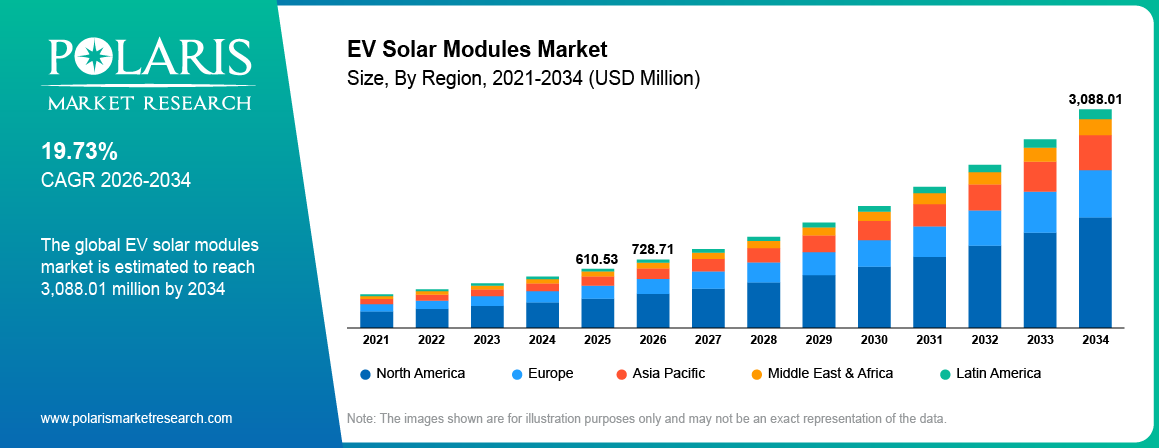
The global EV solar modules market was valued at USD 610.53 million in 2025 and is projected to reach USD 3,088.01 million by 2034, registering a CAGR of 19.73% during the forecast period. The growth in market is propelled by the rise in use of electric vehicles, investments made in clean mobility, and rise in solar charging solutions.
Market Statistics
EV Solar Modules Market Key Takeaways 2025
- Asia Pacific dominated the market with a 46.2% revenue share in 2025, driven by high electric vehicle production, expanding solar module manufacturing capacity, and supportive government policies promoting clean mobility.
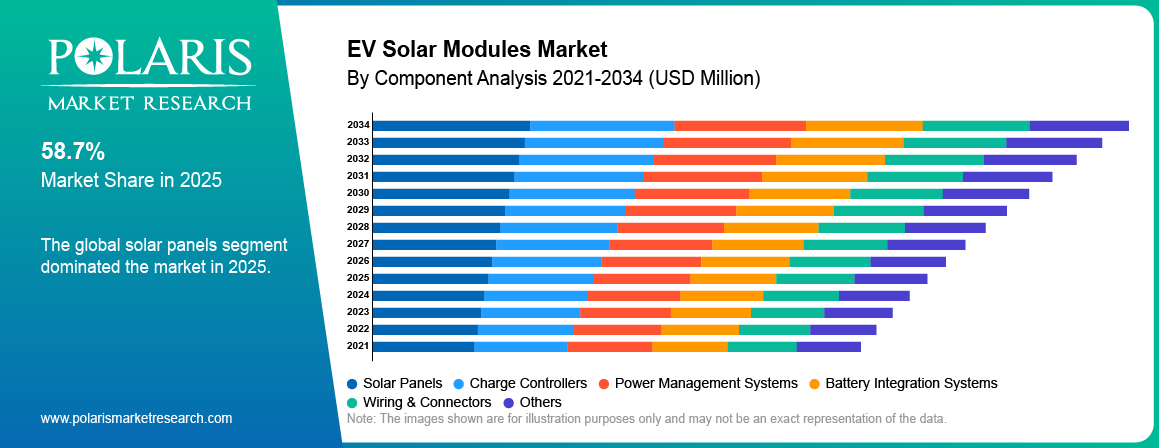
- Solar Panels accounted for the largest component market share of 58.7% in 2025, owing to their essential role in generating solar energy and improving vehicle energy efficiency.
- Passenger Electric Vehicles held the largest application market share of 51.4% in 2025, supported by the rapid adoption of EVs globally and increasing consumer preference for sustainable transportation.
- Thin-Film Solar Modules are projected to register the highest CAGR of 22.8% during 2026–2034, driven by their lightweight structure, flexibility, and superior suitability for vehicle-integrated photovoltaic (VIPV) applications.
Note: Figures and projections outlined in this report are the result of Polaris Market Research’s proprietary analytical processes, grounded in the latest available datasets and market observation
What is EV Solar Modules?
The EV solar modules are the panels made up of photovoltaics that is develop for incorporation into electric vehicles to harness the power of the sun. The modules assist in powering the vehicle systems and extending their range without needing to depend on charging stations. The solar modules are incorporated in vehicles, buses, and other specialized mobility solutions.
The solar modules value chain for EVs involves suppliers of raw materials, manufacturers of photovoltaic cells, manufacturers of modules, EV manufacturers, integrators, distributors, and end consumers. The raw material manufacturers supply the wafers of silicon, glass, encapsulants, and electrical parts, while the module manufacturer makes lightweight and durable solar modules which are then incorporated into the vehicle roofs and hoods among others.
Source: Polaris Market Research Analysis
EV Solar Modules Market Driver Impact Analysis
The EV solar modules market is expected to witness steady growth during the forecast period due to increasing production of electric vehicles and rising emphasis on improving vehicle energy efficiency. Car manufacturers are exploring integrated solar technologies which will help to charge batteries, perform auxiliary functions within the vehicle, and help lower overall energy usage. These innovations are encouraging greater use of vehicle-integrated photovoltaic technologies.
| Market Driver | Est. CAGR Impact | Geographic Relevance | Impact Timeline |
| Growing electric vehicle production | +5.2% | Asia Pacific, Europe, North America | Short to medium term |
| Rising investments in renewable mobility | +4.4% | Global | Medium term |
| Advancements in solar module efficiency | +3.8% | Global | Ongoing |
| Government incentives for clean transportation | +3.1% | Asia Pacific, Europe | Medium to long term |
| Development of vehicle-integrated photovoltaic technologies | +2.7% | Global | Long term |
* Indicative estimates based on market context and analyst judgment. Figures reflect relative driver weight, not additive CAGR contributions. Source: Polaris Market Research Analysis.
EV Solar Modules Market Industry Dynamics
- Increasing manufacture of electric vehicles is leading to greater use of integrated solar charging systems.
- Improvements in photovoltaic efficiency continue to help encourage commercial use.
- Expensive integration and insufficient power generation are major market barriers.
- Growing investments in sustainable mobility solutions are creating new business opportunities.
EV Solar Modules Market Drivers, Restraints and Opportunities
How Is Growing Electric Vehicle Adoption Driving the Market?
The rise of electric vehicles are increasing the need for improved technology that enhances vehicle efficiency and reduce the rate of charging. In the Global EV Outlook 2025, the global sales of electric vehicles exceeded 20 million in 2025, indicating an increase of 20% compared to 2024(Source:www.iea.org).The incorporation of solar modules to aid the auxiliary systems and driving distance is gaining importance in vehicles and extend driving range under favorable conditions.
How Are Advancements in Solar Module Technology Supporting Market Expansion?
Advancements in photovoltaic efficiency, lighter components, and the flexible nature of the solar modules have increased the possibilities of applications in electric vehicles. The production of solar modules of lighter weights which easily be installed in vehicles' roof and hood, among other exterior parts of the vehicle without adding much weight to it is undertaken by the manufacturers. In February 2026, Fraunhofer ISE came up with solar modules with efficiencies of 34.2% and 31.3% in III-V germanium and III-V silicon. These innovations are improving product performance while supporting broader commercialization.
What Challenges Limit Growth of the Market?
High Integration Cost and Limited Power Output
The incorporation of solar modules in electric vehicles requires technical expertise, special materials, and an extra production process, leading to increased production costs. The solar technology currently in use produces less power than the batteries, making them unable to act as a primary power source. These aspects continue to hinder the adoption of such technology by many manufacturers.
What Opportunities Exist in the Market?
Expansion of Vehicle-Integrated Solar Technology
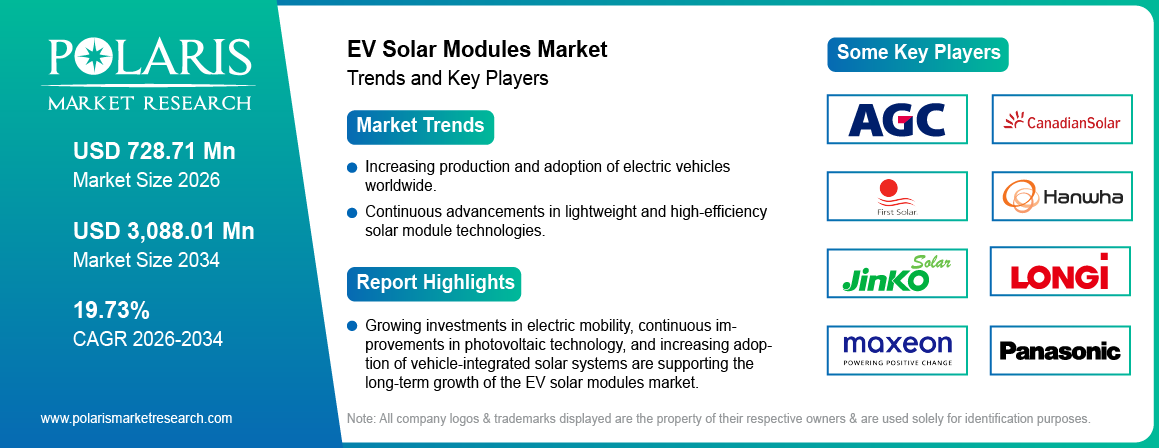
The growing investments into vehicle integrated photovoltaics present considerable opportunities for producers. The Nissan company implemented a concept of an AI-powered vehicle integrated photovoltaic (VIPV) program in July 2026, which consists of installing onboard solar panels and efficient energy management that help to increase the mileage of electric vehicles and reduce their charging costs. The rise in demand for energy-saving vehicles, further development of flexible solar materials, and increasing number of renewable transport programs are encouraging automobile manufacturers to offer VIPV systems in different types of vehicles.
Source: Polaris Market Research Analysis
Segment and Regional Leaders at a Glance
According to Polaris Market Research, Asia Pacific leads the market while North America the fastest-growing region.
- Dominant Region: Asia Pacific
- Largest Component Segment: Solar Panels
- Fastest-Growing Technology Segment: Thin-Film Solar Modules
- Largest Vehicle Type Segment: Passenger Electric Vehicles
Segmentation Analysis
This report offers an exhaustive analysis of the EV solar modules market by component, vehicle type, and technology that will help to determine the most lucrative components in this industry and future growth avenues in the automotive industry and renewable energy sector globally.
EV Solar Modules Market by Component
Which Component Segment Dominates the Market?
Solar panels were the leading segment of the market in 2025 owing to its ability to capture solar power directly and convert it into electric energy. Manufacturers have been increasingly incorporating highly efficient solar panels in vehicles to utilize more energy and reduce reliance on batteries.
Which Component Segment Is Expected to Register the Fastest Growth?
Power management systems are projected to grow at the fastest CAGR during the forecast period. They play an important role in the regulation of the energy produced by solar modules, battery charging, and overall energy management of the vehicle.
EV Solar Modules Market by Vehicle Type
Which Vehicle Type Holds the Largest Share of the Market?
Passenger electric vehicles held the highest share of the market in 2025. The growing demand for electric mobility, production of battery electric vehicles, and efforts towards increasing the efficiency of vehicles is driving the manufacturers to introduce solar modules in passenger vehicles.
Which Vehicle Type Is Growing at the Fastest Rate?
The commercial electric vehicles are projected to exhibit the highest CAGR throughout the forecast period. The usage of solar-powered electric vehicles by fleet managers has been on the rise owing to their efficiencies. Increasing investment in electric buses, vans, and logistics is further driving the adoption of solar integration in vehicles.
EV Solar Modules Market by Technology
Which Technology Segment Leads the Market?
The use of crystalline silicon-based solar modules in electric vehicles dominated the market in 2025 due to the efficiency in energy conversion, durability of the product, and fully developed production process. These attributes have ensured that the solar modules have become the choice of many manufacturers of electric vehicles in different applications.
Which Technology Segment Is Expected to Grow the Fastest?
It is anticipated that thin-film solar panels to have the highest CAGR during the forecast period due to their light weight and flexibility, making them ideal for new-age EV designs. Thin-film technology continues to evolve with each passing day, making it even more efficient and light weight. Continuous advancements in thin-film technology are expected to improve efficiency while reducing overall system weight.
Segment Summary Table
| Segment | Category | 2025 Status | Forecast CAGR | Key Driver |
| Solar Panels | Component | Largest Share | 19.2% | Growing integration of photovoltaic systems |
| Power Management Systems | Component | Fastest Growing | 21.6% | Increasing adoption of intelligent energy management |
| Passenger Electric Vehicles | Vehicle Type | Largest Share | 18.9% | Rising global electric vehicle production |
| Commercial Electric Vehicles | Vehicle Type | Fastest Growing | 20.8% | Fleet electrification and lower operating costs |
| Crystalline Silicon Solar Modules | Technology | Largest Share | 18.5% | High efficiency and commercial maturity |
| Thin-Film Solar Modules | Technology | Fastest Growing | 22.8% | Flexible design and lightweight construction |
Source: Polaris Market Research Analysis
Source: Polaris Market Research Analysis
Regional Analysis
Asia Pacific EV Solar Modules Market Size and Share
Asia Pacific accounted for a dominant share of the global EV solar modules market in 2025 owing to high production capacity of electric vehicles, large production of photovoltaics, and government initiatives related to renewable transport. As per International Energy Agency, the global production of electric vehicles (EV) stood at 17.3 million in 2024, representing an increase of around 25% from the previous year 2023. China was at the forefront in terms of global EV production, with producing 12.4 million EVs, accounting for the majority of the increase(Source: www.iea.org).Countries across the region are investing in electric mobility and advanced solar technologies, while the presence of leading battery, solar, and automobile manufacturers strengthens regional market growth.
North America EV Solar Modules Market Analysis
North America is expected to grow at a significant rate during the forecast period due to increasing investments in production of electric vehicles, renewable energy, and automobile technology. According to the figures from SEIA and Wood Mackenzie, the US added 43 GW of solar installations in 2025, making it the fifth consecutive year where solar added more new power than any other source of energy. Solar and energy storage constituted 79% of newly installed capacity last year(Source: www.renewableinstitute.org).Such an increase in the investments in clean energy fosters the usage of solar-powered mobility solutions, such as solar EV modules.
Europe EV Solar Modules Market Growth Rate and Forecast
Europe is projected to see consistent growth owing to strict emission rules, rising usage of electric vehicles, and commitment to achieving carbon neutrality. In March 2025, the European Commission initiated the Net-Zero Europe Platform for the execution of Net-Zero Industry Act (NZIA)(Source: transition-pathways.europa.eu).This initiative intends to expedite deployment and manufacturing of net-zero technology in the EU in support of its long-term climate and industrial objectives.
Latin America EV Solar Modules Market
The Latin American region is expected to see gradual market growth in the forecasted period. Growing investments in renewable energy projects, improvement in electric mobility infrastructures, and government initiatives have been boosting the use of electric cars in countries such as Brazil, Mexico, and Chile. In March 2026, ANEEL introduced the Public Consultation CP42/2025 with the objective of streamlining the connection process for EV chargers to the grid, increase network capacity, and facilitate the deployment of charging infrastructure throughout the country(Source: www.trade.gov).
Middle East & Africa EV Solar Modules Market
The Middle East & Africa market is expected to record steady growth supported by increasing investments in renewable energy, smart mobility projects, and sustainable transportation infrastructure. According to Energy Industries Council (EIC), the Middle East region is anticipated to witness an investment of over USD 75 billion in renewables until 2030, highlighting a promising outlook for renewable energy development in the region(Source: www.renewableinstitute.org).

Source: Polaris Market Research Analysis
Regulatory Heatmap
| Country | Policy Environment | Key Regulations | Market Implication | Trend |
| US | Favorable | Clean transportation incentives and renewable energy programs | Supports domestic EV and solar technology adoption | Expanding |
| European Union | Favorable | Carbon reduction targets and vehicle emission regulations | Encourages EV production and solar integration | Expanding |
| China | Favorable | Electric vehicle manufacturing incentives and renewable energy policies | Strengthens domestic production and technology deployment | Expanding |
| Japan | Favorable | Clean mobility and advanced energy technology initiatives | Supports innovation in vehicle-integrated solar technologies | Stable |
| India | Developing | EV manufacturing incentives and renewable energy programs | Creates opportunities for local manufacturing | Developing |
| Middle East | Developing | Renewable energy diversification strategies | Supports clean transportation investments | Early Stage |
| Latin America | Neutral | Renewable energy and sustainable mobility initiatives | Encourages gradual market adoption | Developing |
Source: Polaris Market Research Analysis
EV Solar Modules Market Competitive Landscape and Key Players
The market for EV solar modules has moderate competition due to the presence of solar module producers, automakers, and technologically proficient players. Competition is primarily based on module efficiency, product reliability, lightweight design, integration capabilities, and manufacturing capacity.
Competitive Positioning Table
| Company | Est. Market Position | Primary Focus | Geographic Focus | In Report |
| First Solar, Inc. | Major Market Participant | Thin-film solar technology | Global | Yes |
| Hanwha Solutions Corporation (Qcells) | Major Market Participant | High-efficiency solar modules | Global | Yes |
| JinkoSolar Holding Co., Ltd. | Top Market Participant | Photovoltaic module manufacturing | Global | Yes |
| LONGi Green Energy Technology Co., Ltd. | Top Market Participant | Monocrystalline solar modules | Global | Yes |
| Maxeon Solar Technologies Ltd. | Major Market Participant | High-efficiency solar solutions | Global | Yes |
| Trina Solar Co., Ltd. | Top Market Participant | Integrated photovoltaic solutions | Global | Yes |
Source: Polaris Market Research Analysis
EV Solar Modules Market Technology and Innovation Landscape 2025–2026
Technological developments continue to improve the commercial viability of EV solar modules through higher energy conversion efficiency, lightweight materials, flexible photovoltaic designs, and advanced power management systems. Manufacturers are concentrating on making their modules durable, lightweight, and capable of producing more energy without compromising aesthetics.
| Technology | Adoption Stage | Key Development (2025–2026) | Market Impact |
| Flexible Solar Modules | Growing Deployment | Lightweight modules designed for curved vehicle surfaces | Improves vehicle integration and design flexibility |
| High-Efficiency Photovoltaic Cells | Early Commercial Deployment | Enhanced energy conversion efficiency | Increases solar power generation |
| Smart Energy Management Systems | Growing Deployment | Intelligent power optimization and battery charging | Improves vehicle energy efficiency |
| Lightweight Composite Materials | Growing Deployment | Advanced materials for module weight reduction | Enhances vehicle performance |
| Vehicle-Integrated Photovoltaics (VIPV) | Early Commercial Stage | Direct integration of solar modules into vehicle body panels | Expands commercial adoption |
| AI-Based Energy Monitoring | Pilot to Early Commercial Stage | Intelligent monitoring of solar energy generation and battery performance | Improves operational efficiency |
Source: Polaris Market Research Analysis
The consistent development of innovative materials for photovoltaics, smart electronics, and improved module technology is predicted to increase product performance in the years to come. Scalable production technology is also one of the key areas of focus in terms of lowering production costs.
Buyer Use Cases and Market Entry Barriers
There is an increasing demand for solar modules in EVs from automakers, commercial fleet operators, renewable energy firms, public transport companies, and technologists. Consumers usually evaluate supplier on the performance of the modules, quality of the modules, durability of the modules, production capacity, etc., before purchasing.
| Buyer / Investor Type | Primary Use Case | Key Insight Sought | Decision Horizon |
| Automotive Manufacturers | Vehicle-integrated solar systems | Module efficiency and integration capability | 3–8 years |
| Fleet Operators | Commercial electric vehicles | Energy savings and operational efficiency | 3–7 years |
| Renewable Energy Developers | Clean mobility solutions | Technology performance and scalability | 4–10 years |
| Government Agencies | Sustainable transportation projects | Long-term environmental benefits | 5–15 years |
| Institutional Investors | Renewable technology investments | Market growth and commercialization potential | 5–12 years |
Source: Polaris Market Research Analysis
What are the Barriers to Entering the Market?
- High initial investment needed in order to manufacture high-tech solar modules.
- Constant research and development activities to increase the efficiency of solar modules.
- Difficulty in integrating them with electric vehicle platforms.
- Small amount of electricity generated in relation to total battery storage capacity.
- Strict automotive quality and safety requirements.
- Reliance on advanced photovoltaic materials.
- Lengthy period for product testing and commercialization.
Companies that prioritize innovation, strategic collaboration, mass production, and cost reduction are set to become increasingly competitive amid the growing demand for sustainable transport solutions.
Premium Insights and Future Prospects of EV Solar Modules Market
The future trend of the market for EV solar modules is expected to be positive owing to rising investments in the electric mobility and renewable energy technology applications. Rising production of electric vehicles along with growing efficiency of photovoltaic panels and government initiatives towards clean mobility solutions will favor the future growth prospects of the industry during the forecast period.
The future growth in the market will be driven by innovative developments such as flexible solar technologies, lightweight photovoltaics, energy management systems, and solar integrated vehicle design. Increasing efficiency and declining costs associated with the production of the products will favor their future applications in improving the energy efficiency of the vehicles.
Cost Benchmarking Table
| Product / Service Type | Est. Price Range (USD) | Key Cost Driver | Complexity Tier |
| Crystalline Silicon EV Solar Modules | USD 200–600 per module | Photovoltaic cell efficiency and manufacturing | Premium |
| Thin-Film EV Solar Modules | USD 150–500 per module | Advanced material processing | Mid to Premium |
| Vehicle-Integrated Solar Systems | USD 2,000–10,000 per system | System integration and customization | Project Based |
| Smart Power Management Systems | USD 300–1,500 per unit | Software and electronic components | Premium |
| Solar Charging Integration Services | USD 1,000–15,000 per project | Installation complexity and engineering requirements | Project Based |
Source: Polaris Market Research Analysis.
Key Players
- AGC Inc.
- Canadian Solar Inc.
- First Solar, Inc.
- Hanwha Solutions Corporation (Qcells)
- JinkoSolar Holding Co., Ltd.
- LONGi Green Energy Technology Co., Ltd.
- Maxeon Solar Technologies Ltd.
- Panasonic Holdings Corporation
- Sharp Corporation
- SunPower Corporation
- Tesla, Inc.
- Trina Solar Co., Ltd.
EV Solar Modules Market Industry Developments
- February 2026: LONGi & NIO collaborated on an integrated photovoltaic and EV charging station, using high-efficiency photovoltaic cells along with advanced charging technology in order to provide sustainable electric vehicles(source: eu.longi.com).
- January 2026: Nissan introduced its ARIYA concept car with built-in photovoltaic capability for supplementary battery charging through solar power. The development strengthens EV solar module innovation by demonstrating the potential of vehicle-integrated solar power to improve driving range and energy efficiency(source: europe.nissannews.com).
Market Segmentation
By Component Outlook (Revenue, USD Million, 2021–2034)
- Solar Panels
- Charge Controllers
- Power Management Systems
- Battery Integration Systems
- Wiring & Connectors
- Others
By Vehicle Type Outlook (Revenue, USD Million, 2021–2034)
- Passenger Electric Vehicles
- Commercial Electric Vehicles
- Electric Buses
- Electric Utility Vehicles
- Others
By Technology Outlook (Revenue, USD Million, 2021–2034)
- Crystalline Silicon Solar Modules
- Thin-Film Solar Modules
- Perovskite Solar Modules
- Multi-Junction Solar Modules
- Others
By Regional Outlook (Revenue, USD Million, 2021–2034)
- North America
- US
- Canada
- Europe
- Germany
- France
- UK
- Italy
- Spain
- Netherlands
- Russia
- Rest of Europe
- Asia Pacific
- China
- Japan
- India
- Malaysia
- South Korea
- Indonesia
- Australia
- Vietnam
- Rest of Asia Pacific
- Middle East & Africa
- Saudi Arabia
- UAE
- Israel
- South Africa
- Rest of Middle East & Africa
- Latin America
- Mexico
- Brazil
- Argentina
- Rest of Latin America
Report Scope
| Report Attributes | Details |
| Market Size in 2025 | USD 610.53 Million |
| Market Size in 2026 | USD 728.71 Million |
| Revenue Forecast by 2034 | USD 3,088.01 Million |
| CAGR | 19.73% from 2026 to 2034 |
| Base Year | 2025 |
| Historical Data | 2021–2024 |
| Forecast Period | 2026–2034 |
| Quantitative Units | Revenue in USD Million and CAGR from 2026 to 2034 |
| Report Coverage | Revenue Forecast, Competitive Landscape, Growth Factors, Clinical Pipeline, Technology, and Industry Trends |
| Segments Covered | By Component, By Vehicle Type, By Technology, and By Region |
| Regional Scope | North America, Europe, Asia Pacific, Latin America, Middle East & Africa; country detail for US, Canada, Germany, UK, France, China, Japan, India, South Korea, Australia |
| Competitive Landscape | Company Profiles including platform overview, clinical pipeline, partnerships, and recent developments |
| Report Format | PDF + Excel |
| Customization | Report customization available as per requirements with respect to countries, regions, modalities, and therapeutic areas. |
EV Solar Modules Market FAQ's
• The EV solar modules market was valued at USD 610.53 million in 2025 and is projected to reach USD 3,088.01 million by 2034, growing steadily during the forecast period.
• The market is projected to grow at a CAGR of 19.73% from 2026 to 2034.
• The growing production of electric vehicles, high adoption of renewable technologies, improvements in photovoltaic technology, investments made in sustainable transport solutions, and supportive government policies are some of the factors driving the growth of the market.
• Solar Panels accounted for the largest component market share of 58.7% in 2025, owing to their crucial part in transforming solar power into electricity.
• Passenger Electric Vehicles held the largest application market share of 51.4% in 2025 owing to growing adoption of electric vehicles worldwide.
• Asia Pacific dominated the market with a 46.2% revenue share in 2025 owing to its dominant presence in electric vehicle production, vast production capability for photovoltaics, and positive government policies.
• Key players are AGC Inc., Canadian Solar Inc., First Solar, Inc., Hanwha Solutions Corporation (Qcells), JinkoSolar Holding Co., Ltd., LONGi Green Energy Technology Co., Ltd., Maxeon Solar Technologies Ltd., Panasonic Holdings Corporation, Sharp Corporation, SunPower Corporation, Tesla, Inc., and Trina Solar Co., Ltd.
Download Sample Report of EV Solar Modules Market
Please fill out the form to request a customized copy of the research report.


