
Iron Air Battery Market Size, Share & Industry Report 2026-2034
REPORT DETAILS
Iron Air Battery Market Summary
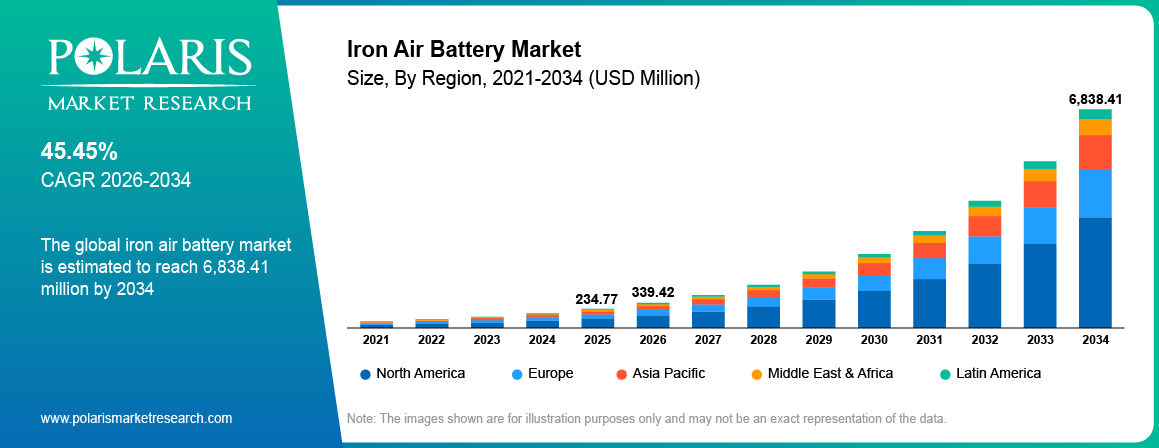
The global iron air battery market was valued at USD 234.77 million in 2025 and is projected to reach USD 6,838.41 million by 2034, registering a CAGR of 45.45% during the forecast period. Market growth is fueled by growing requirement for long-duration energy storage, increasing investments towards renewable energy infrastructure, and growing interest in cost-effective battery technology solutions. Continuous innovation, favorable government policies, and increasing grid modernization programs are further contributing to the growth of the market.
Market Statistics
Key Takeaways
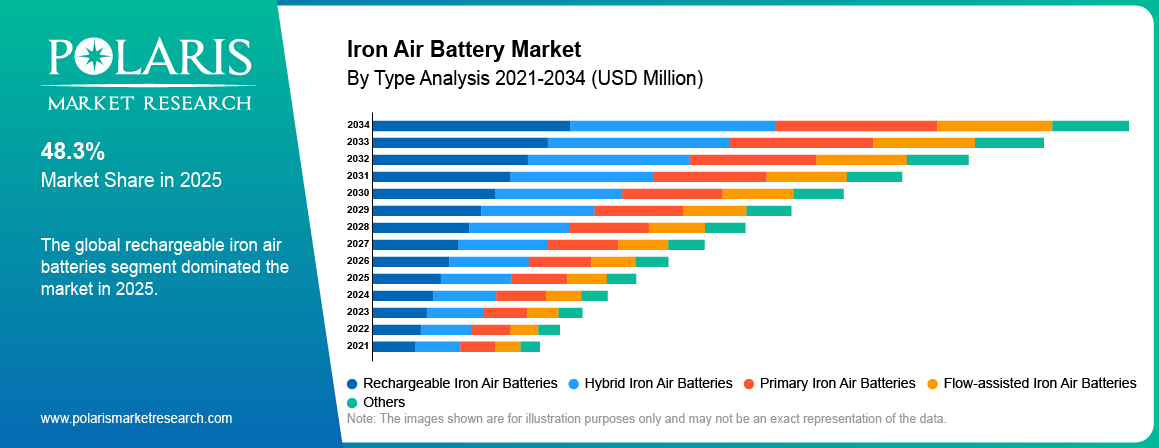
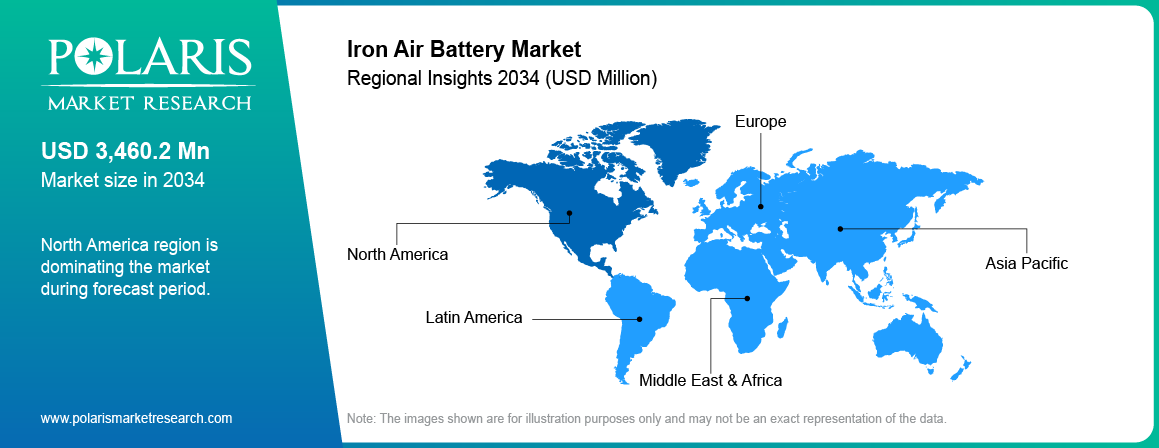
- North America accounted for the largest market share of 41.6% in 2025, driven by strong investments in grid modernization, long-duration energy storage projects, and supportive government initiatives.
- Rechargeable Iron Air Batteries dominated the type segment with a 48.3% market share in 2025, owing to increasing commercial development and growing deployment in stationary energy storage systems.
- Grid Energy Storage accounted for the largest application segment with a 44.7% market share in 2025, driven by the increasing integration of renewable energy sources and the need for long-duration energy storage solutions.
- Utilities held the largest end-user segment with a 46.9% market share in 2025, supported by continued investments in grid resilience, renewable integration, and utility-scale energy storage infrastructure.
Note: Figures and projections outlined in this report are the result of Polaris Market Research’s proprietary analytical processes, grounded in the latest available datasets and market observation
What is Iron Air Battery?
An iron air battery is a rechargeable battery that produces power by means of a reversible reaction between iron and oxygen. The battery is primarily used in long-term energy storage applications, and it provides an affordable alternative to lithium-ion batteries for stationary purposes. Iron air batteries have become an emerging choice in renewable energy systems due to the abundance and relative low cost of iron.
Some of the main participants involved in the iron air battery value chain include raw materials suppliers, battery material producers, battery developers, battery packers and assemblers, utilities, renewable energy developers, distributors, and end users. Battery producers collaborate with technology developers, research institutes, and energy companies in order to enhance battery efficiency and reduce manufacturing costs.
Iron Air Battery Market Driver Impact Analysis
The iron air battery market is expected to witness steady growth throughout the forecast period owing to rising investments in renewable energy storage, increasing demand for long-duration battery technologies, and expanding utility-scale storage projects. There is support from governments and private organizations to commercialize new types of batteries to enhance energy security and decrease reliance on critical metals.
| Market Driver | Est. CAGR Impact | Geographic Relevance | Impact Timeline |
| Expansion of long-duration energy storage projects | +8.5% | North America, Europe, Asia Pacific | Short to medium term |
| Government support for clean energy storage | +7.2% | Global | Medium term |
| Increasing renewable energy deployment | +6.8% | Global | Medium to long term |
| Advancements in iron air battery technology | +6.1% | Global | Ongoing |
| Grid modernization investments | +5.4% | North America, Europe | Long term |
* Indicative estimates based on market context and analyst judgment. Figures reflect relative driver weight, not additive CAGR contributions. Source: Polaris Market Research Analysis.
Iron Air Battery Market Industry Dynamics
- Increasing renewable energy production is resulting in an growing need for batteries that store energy for extended periods.
- Research work is constantly going on to improve the performance and efficiency of batteries.
- Limited commercial production capacity remains one of the major challenges for market expansion.
- Rising investments in grid modernization and domestic battery manufacturing are creating new business opportunities.
Iron Air Battery Market Drivers, Restraints and Opportunities
How Is Growing Renewable Energy Deployment Driving the Iron Air Battery Market?
The increasing number of renewable energy facilities is generating high demand for long-duration battery storage solutions to keep the supply of energy constant even if the energy produced from solar and wind sources is irregular. According to statistics from the International Energy Agency (IEA), global renewable energy production capacity is projected to increase by around 4,600 gigawatts during the period from 2025 to 2030, due to the continued investments in clean energy (Source: www.iea.org).Iron air batteries are attracting attention as they provide cost-effective energy storage using abundant raw materials.
How Are Technology Advancements Supporting Market Expansion?
Battery producers keep making innovations in their research efforts to enhance the efficiency, charging capability, lifespan, and scalability of the production process. The improvements in terms of material, cell structure, and production process continue to make iron air batteries more appropriate for large scale energy storage initiatives. In February 2026, CATL and CHANGAN introduced the world's first mass-produced sodium-ion passenger car that is equipped with CATL's latest generation of Naxtra batteries. This is enabling producers to improve their product performance and promote commercialization in industrial and utility sectors.
What Challenges Limit Growth of the Iron Air Battery Market?
Limited Commercial Manufacturing Capacity
Despite the great potential that iron air batteries present for the future, their commercial production is still at an early stage compared to lithium-ion products. Manufacturers are still making investments in pilot production sites, product validation, and large scale production capacity. This is delaying the commercialization process due to long development times and production process.
What Opportunities Exist in the Iron Air Battery Market?
Expansion of Grid-Scale Energy Storage Projects
The growing development of utility scale battery storage projects offers immense potential for iron air battery manufacturing companies. In June 2026, ABB released an innovative line of efficient power converters for utility scale solar projects and battery energy storage. These solutions help to enhance power converters' efficiency in utility scale battery storage projects, along with providing stability in the grid and renewable energy integration. Governments and electricity companies have increased their spending on long duration storage technologies in order to increase renewable energy integration and stability in the grid.
Segment and Regional Leaders at a Glance
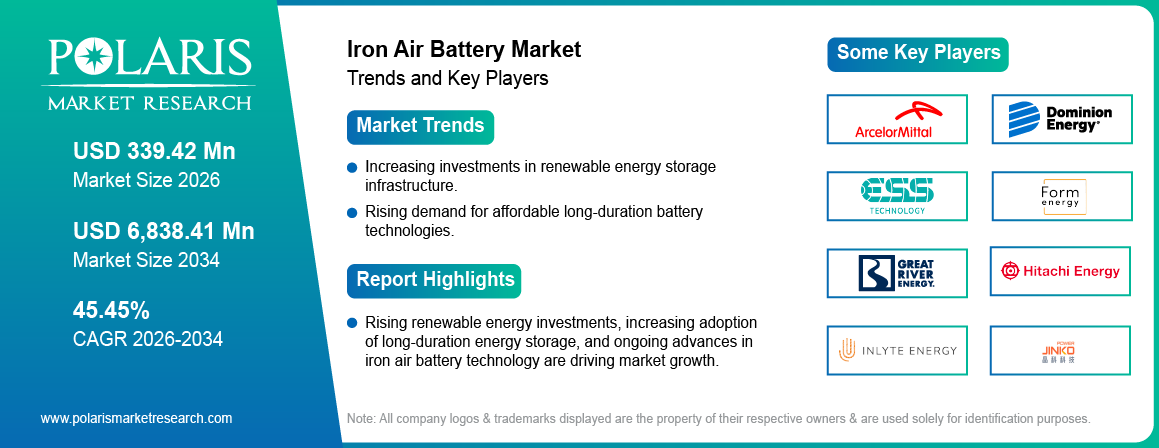
According to Polaris Market Research, North America leads the market while Asia Pacific the fastest-growing region.
- Dominant Region: North America
- Fastest Growing Region: Asia Pacific
- Largest Type Segment: Rechargeable Iron Air Batteries
- Fastest Growing Type Segment: Hybrid Iron Air Batteries
- Largest Application Segment: Grid Energy Storage
- Largest End User Segment: Utilities
Iron Air Battery Market Segmentation Analysis
The report provides a comprehensive analysis of the iron air battery market by type, application, and end user to identify major revenue-generating segments and emerging growth opportunities across the global energy storage industry.
Iron Air Battery Market by Type
Which Type Segment Dominates the Market?
Rechargeable iron air batteries accounted for the largest market share in 2025. These types of batteries are increasingly getting accepted due to its long duration energy storage at lower cost compared to various other conventional types of batteries. Increasing investments in renewable energy projects, advancement in battery chemistry and commercial deployment are driving this segment.
Which Type Segment Is Expected to Register the Fastest Growth?
Hybrid iron air batteries are projected to register the fastest CAGR during the forecast period. The growing number of activities in research to boost charging efficiencies, energy densities, and operational flexibilities is helping drive hybrid battery systems. The growing number of investments in advanced storage technology, along with the growing interest in next generation batteries, is anticipated to drive the growth of hybrid battery systems across various commercial and industrial sectors in the coming years.
Iron Air Battery Market by Application
Which Application Segment Holds the Largest Share of the Market?
Grid energy storage was the leading segment in 2025. Utilities and grid companies have been using long-duration energy storage systems to store renewable energy and provide reliable electricity. Continued investments in grid infrastructure, modernization of grids, and renewable energy production have driven the demand for iron air battery systems.
Which Application Segment Is Growing at the Fastest Rate?
Renewable energy integration is predicted to experience the highest growth rate during the forecast period. Long duration energy storage is used by solar and wind power companies to enhance energy production during times when generation is minimal. Growing renewable energy capacity, favorable government initiatives, and increasing investments in sustainable energy infrastructure are driving the use of iron air batteries.
Iron Air Battery Market by End User
Which End User Leads the Market?
Utilities accounted for the largest share of the iron air battery market in 2025. Battery storage systems for utility applications remain an area of investment by utility providers in order to enhance grid reliability, manage peak electricity demand, and optimize renewable energy production. Increasing investments in sustainable energy infrastructure and emphasis on consistent electricity supply are aiding this market segment.
Which End User Segment Is Expected to Grow the Fastest?
Renewable energy developers are expected to register the fastest CAGR during the forecast period. The growing construction of solar and wind energy generation projects are creating high demand for long duration energy storage solutions that help to enhance system efficiency and availability of power. Iron air batteries have become a favorable choice due to cost-effective and fit for use in renewable energy storage purposes at a large scale.
Segment Summary Table
| Segment | Category | 2025 Status | Forecast CAGR | Key Driver |
| Rechargeable Iron Air Batteries | Type | Largest Share | 32.6% | Growing commercial deployment and long-duration storage demand |
| Hybrid Iron Air Batteries | Type | Fastest Growing | 35.8% | Advancements in battery chemistry and system efficiency |
| Grid Energy Storage | Application | Largest Share | 33.4% | Expansion of renewable energy infrastructure |
| Renewable Energy Integration | Application | Fastest Growing | 36.2% | Rising deployment of solar and wind projects |
| Utilities | End User | Largest Share | 32.1% | Increasing investments in grid-scale energy storage |
| Renewable Energy Developers | End User | Fastest Growing | 35.5% | Growing adoption of long-duration storage technologies |
Source: Polaris Market Research Analysis
Iron Air Battery Market Regional Analysis
North America Iron Air Battery Market Size and Share
North America held the largest share of the iron air battery market in 2025 owing to the presence of strong investments in clean energy infrastructure, grid modernization initiatives, and long duration energy storage facilities. In July 2026, Nuveen Energy Infrastructure Credit made a USD 546 million preferred equity investment in SunZia project which is the largest clean energy infrastructure project in the history of US. The investment strengthens clean energy infrastructure in the US by supporting large-scale renewable power generation and transmission development.
Europe Iron Air Battery Market Analysis
Europe is expected to witness steady growth during the forecast period due to increasing investments in renewable energy, carbon reduction initiatives, and energy storage infrastructure. According to International Energy Agency (IEA), clean energy investment from European Union (EU) amounted to nearly USD 390 billion in 2025, showing the commitment of the EU towards accelerating the transition into clean energy (Source: www.iea.org).Increasing concern for energy security and flexibility in electricity grids is encouraging the deployment of long-duration battery storage systems.
Asia Pacific Iron Air Battery Market Growth Rate and Forecast
Asia Pacific is projected to register the fastest CAGR during the forecast period. Rapid renewable energy deployment, expanding battery manufacturing activities, and increasing investments in electricity infrastructure are supporting market growth. According to the International Energy Agency (IEA), China manufactures more than three-quarters of the batteries sold worldwide. The cost of batteries in the country reduced by almost 30% in 2024, which was the steepest reduction in battery costs anywhere in the world (Source: www.iea.org).China, Japan, South Korea, India, and Australia are increasing investments in advanced battery technologies to strengthen energy storage capacity and support renewable energy integration.
Latin America Iron Air Battery Market
Latin America is expected to experience gradual market growth during the forecast period. Rising renewable energy installations, modernization of electricity infrastructure, and growing investments in utility-scale energy storage projects are creating opportunities for iron air battery manufacturers.
Middle East & Africa Iron Air Battery Market
The Middle East and Africa market is expected to grow steadily during the forecast period. Growing deployment of renewable energy facilities and increasing focus on improving grid reliability are expected to support the adoption of iron air battery systems in several countries. According to Energy Industries Council (EIC), the Middle East region is set to receive over USD 75 billion in investments in renewable energy by 2030 due to the increasing shift towards clean energy in the region(Source: www.renewableinstitute.org).
Regulatory Heatmap
| Country | Policy Environment | Key Regulations | Market Implication | Trend |
| United States | Favorable | Federal clean energy and battery manufacturing programs | Supports domestic battery production and commercialization | Expanding |
| European Union | Favorable | Battery sustainability regulations and renewable energy policies | Encourages battery innovation and local manufacturing | Expanding |
| China | Favorable | National battery manufacturing and clean energy initiatives | Supports large-scale manufacturing capacity | Expanding |
| Japan | Favorable | Advanced battery research and energy transition programs | Strengthens technology development | Stable |
| India | Developing | Battery manufacturing incentives and renewable energy policies | Creates long-term opportunities for domestic manufacturers | Developing |
| Middle East | Developing | Renewable energy diversification programs | Encourages utility-scale energy storage deployment | Early Stage |
| Latin America | Neutral | Renewable energy expansion initiatives | Supports gradual investment in battery storage systems | Developing |
Source: Polaris Market Research Analysis
Iron Air Battery Market Competitive Landscape and Key Players
The iron air battery market is at an early stage of commercialization, with competition driven by technology developers, battery manufacturers, utility companies, and energy storage solution providers. Companies are competing based on battery performance, storage duration, production scalability, product reliability, and commercialization capabilities.
Competitive Positioning Table
| Company | Est. Market Position | Primary Focus | Geographic Focus | In Report |
| Form Energy | Top Market Participant | Long-duration iron air battery technology | North America | Yes |
| ESS Tech Inc. | Major Market Participant | Utility-scale energy storage solutions | North America | Yes |
| ArcelorMittal | Major Market Participant | Iron supply and advanced material solutions | Global | Yes |
| Dominion Energy | Major Market Participant | Grid-scale energy storage deployment | North America | Yes |
| Great River Energy | Regional Participant | Renewable energy storage projects | North America | Yes |
| Xcel Energy | Regional Participant | Utility-scale battery deployment | North America | Yes |
Source: Polaris Market Research Analysis
Technology and Innovation Landscape 2025–2026
Continuous research is improving the commercial potential of iron air batteries through better cell design, improved battery materials, advanced monitoring systems, and scalable manufacturing processes. The emphasis now is on enhancing battery life span, efficiency, reducing production costs, and reliability.
| Technology | Adoption Stage | Key Development (2025–2026) | Market Impact |
| AI-enabled Battery Monitoring | Growing Deployment | Advanced monitoring and predictive maintenance systems | Improves operational efficiency and battery reliability |
| Advanced Electrode Materials | Early Commercial Deployment | Development of high-performance iron electrode materials | Enhances battery efficiency and operational life |
| Modular Battery Systems | Growing Deployment | Standardized battery modules for utility-scale projects | Reduces manufacturing and installation costs |
| Digital Twin Technology | Pilot to Early Commercial Stage | Virtual simulation of battery performance and project planning | Improves system optimization and project management |
| Smart Energy Management Systems | Growing Deployment | Intelligent charging and energy optimization platforms | Supports efficient grid integration |
Source: Polaris Market Research Analysis
Growing use of advanced manufacturing technologies and automation is allowing manufacturers to make improvements in production efficiency without compromising on the quality of products. Future developments in battery technology, system integration, and mass manufacturing processes will ensure commercial acceptance of iron air batteries in the forecast period.
Buyer Use Cases and Market Entry Barriers
Iron air batteries demand is rising among electric utilities, renewable energy companies, industry, energy storage companies, and infrastructure organizations. In general, buyers analyze potential suppliers of batteries on the basis of storage life, operating performance, manufacturing abilities, project experience, reliability, and long term technical support.
| Buyer / Investor Type | Primary Use Case | Key Insight Sought | Decision Horizon |
| Utility Companies | Grid-scale energy storage | Battery performance and lifecycle cost | 5–15 years |
| Renewable Energy Developers | Renewable energy integration | Storage duration and project economics | 3–10 years |
| Industrial Companies | Backup power and energy storage | Reliability and maintenance requirements | 3–8 years |
| Infrastructure Investors | Battery manufacturing investments | Commercial scalability and return potential | 5–12 years |
| Government Agencies | Clean energy programs | Technology maturity and energy security | 5–10 years |
Source: Polaris Market Research Analysis
What are the Barriers to Entering the Market?
- High level of investment needed for battery production facility setup.
- Low production capacity in the market.
- Time-consuming development process of the product and technology.
- Continuous need for research and improvement of the product.
- Conventional technologies used in lithium-ion batteries.
- Regulations and certification requirements.
- Supply chain development needs for large scale production.
The companies investing in innovation in technology, strategic alliances, production, and long term relations with customers are anticipated to have an improved competitive advantage in the coming future.
Premium Insights and Future Prospects of Market
The iron air battery market is anticipated to have a bright future due to growing investment in the renewable energy infrastructure, rising interest in grid scale battery storage projects, and increasing demand for affordable long duration batteries. Growing interest in the commercialization of alternative batteries that will increase energy security without depending on critical minerals is anticipated in the coming years.
Constant improvements in battery technology, production process, and implementation will provide further opportunities for growth in the future. Increasing collaboration between the battery producers, utilities companies, renewable energy sources, and research centers will contribute to rising commercialization.
Cost Benchmarking Table
| Product / Service Type | Est. Price Range (USD) | Key Cost Driver | Complexity Tier |
| Rechargeable Iron Air Batteries | USD 20–80 per kWh | Battery materials, manufacturing process, storage duration | Premium |
| Hybrid Iron Air Batteries | USD 50–120 per kWh | Advanced cell design, technology development, production scale | Mid to Premium |
| Battery Modules and Packs | USD 5,000–250,000+ per system | Battery capacity, module configuration, system integration | Project Based |
| Battery Management Systems | USD 500–10,000 per unit | Software capabilities, monitoring functions, control hardware | Premium |
| Utility-scale Energy Storage Systems | USD 500,000–100,000,000+ per project | Project size, installation scope, engineering, grid integration | Project Based |
Source: Polaris Market Research Analysis.
Key Players
- ArcelorMittal
- Dominion Energy
- ESS Tech Inc.
- Form Energy
- Great River Energy
- Hitachi Energy Ltd.
- Inlyte Energy
- Jinko Power Technology Co., Ltd.
- RWE AG
- Sumitomo Electric Industries, Ltd.
- Vattenfall AB
- Xcel Energy
Industry Developments
- February 2026: Google signed a definitive agreement with Xcel Energy to deploy a 300 MW/30 GWh iron-air battery system in Pine Island, Minnesota. The development of iron-air battery technologies is promoted through the provision of long-duration energy storage options for large-scale clean energy and data center services(source: co.my.xcelenergy.com).
- January 2026: The Chinese government introduced a low-cost all-iron battery developed for large-scale energy storage from renewable energy sources, providing a low-cost option for long-duration energy storage(source: www.scmp.com).
Market Segmentation
By Type Outlook (Revenue, USD Million, 2021–2034)
- Rechargeable Iron Air Batteries
- Hybrid Iron Air Batteries
- Primary Iron Air Batteries
- Flow-assisted Iron Air Batteries
- Others
By Application Outlook (Revenue, USD Million, 2021–2034)
- Grid Energy Storage
- Renewable Energy Integration
- Backup Power Systems
- Industrial Energy Storage
- Microgrids
- Others
By End User Outlook (Revenue, USD Million, 2021–2034)
- Utilities
- Renewable Energy Developers
- Industrial Companies
- Commercial Sector
- Government & Public Infrastructure
- Others
By Regional Outlook (Revenue, USD Million, 2021–2034)
- North America
- US
- Canada
- Europe
- Germany
- France
- UK
- Italy
- Spain
- Netherlands
- Russia
- Rest of Europe
- Asia Pacific
- China
- Japan
- India
- Malaysia
- South Korea
- Indonesia
- Australia
- Vietnam
- Rest of Asia Pacific
- Middle East & Africa
- Saudi Arabia
- UAE
- Israel
- South Africa
- Rest of Middle East & Africa
- Latin America
- Mexico
- Brazil
- Argentina
- Rest of Latin America
Report Scope
| Report Attributes | Details |
| Market Size in 2025 | USD 234.77 Million |
| Market Size in 2026 | USD 339.42 Million |
| Revenue Forecast by 2034 | USD 6,838.41 Million |
| CAGR | 45.45% from 2026 to 2034 |
| Base Year | 2025 |
| Historical Data | 2021–2024 |
| Forecast Period | 2026–2034 |
| Quantitative Units | Revenue in USD Million and CAGR from 2026 to 2034 |
| Report Coverage | Revenue Forecast, Competitive Landscape, Growth Factors, Clinical Pipeline, Technology, and Industry Trends |
| Segments Covered | By Type, By Application, By End User, and By Region |
| Regional Scope | North America, Europe, Asia Pacific, Latin America, Middle East & Africa; country detail for US, Canada, Germany, UK, France, China, Japan, India, South Korea, Australia |
| Competitive Landscape | Company Profiles including platform overview, clinical pipeline, partnerships, and recent developments |
| Report Format | PDF + Excel |
| Customization | Report customization available as per requirements with respect to countries, regions, modalities, and therapeutic areas. |
Iron Air Battery Market FAQ's
• The iron air battery market was valued at USD 234.77 million in 2025 and is projected to reach USD 6,838.41 million by 2034.
• The market is expected to register a CAGR of 45.45% during the forecast period from 2026 to 2034.
• Renewable energy projects, high demands for long-duration energy storage systems, increasing grid modernization activities, technological advancements in battery development, and governmental support for clean energy drive the growth of the market.
• Rechargeable Iron Air Batteries dominated the type segment with a 48.3% market share in 2025 owing to their commercial use, lower material cost, and application in long-duration energy storage.
• Grid Energy Storage accounted for the largest application segment with a 44.7% market share in 2025 due to the rise in investments in battery storage and renewable energy integration.
• North America accounted for the largest market share of 41.6% in 2025 due to investments in advanced batteries and renewable energy infrastructure.
• Some of the major players in the industry include ArcelorMittal, Dominion Energy, ESS Tech Inc., Form Energy, Great River Energy, Hitachi Energy Ltd., Inlyte Energy, Jinko Power Technology Co., Ltd., RWE AG, Sumitomo Electric Industries, Ltd., Vattenfall AB, and Xcel Energy.
Download Sample Report of Iron Air Battery Market
Please fill out the form to request a customized copy of the research report.


