
High-Purity Boehmite Market Size, Share, and Forecast 2026 to 2034
REPORT DETAILS
High-Purity Boehmite Market Summary
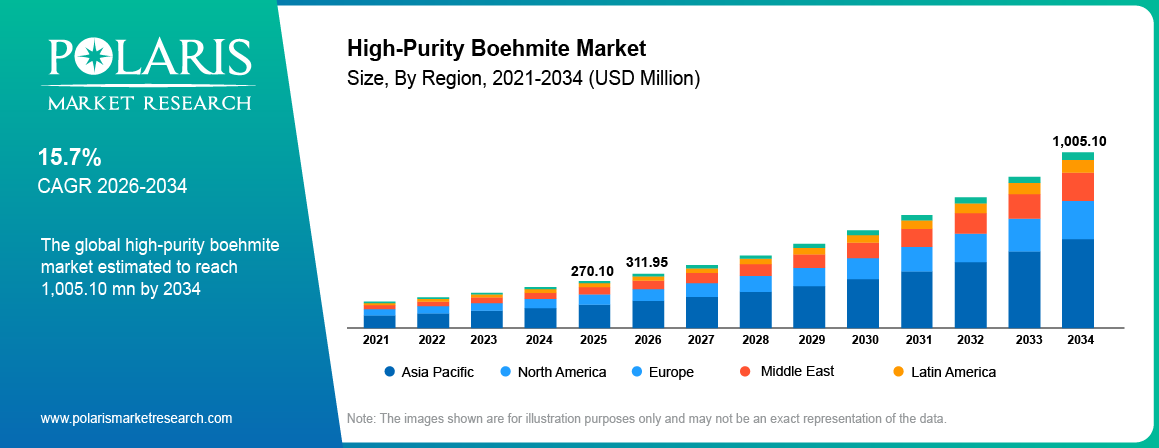
High-purity boehmite market size was valued at USD 270.10 million in 2025. The market is expected to exhibit a CAGR of 15.7% from 2026 to 2034. Growth is driven by battery capacity expansion, separator demand, strict purity requirements, and supply localization.
Market Statistics
High-Purity Boehmite Market Key Takeaways 2025
- Asia Pacific dominated the high-purity boehmite market share with 40.47% in 2025, driven by strong lithium-ion battery and separator manufacturing base.
- The market in North America is expected to register a 17.04% CAGR during 2026–2034. The growth is supported by battery material localization and growing demand for high-purity materials.
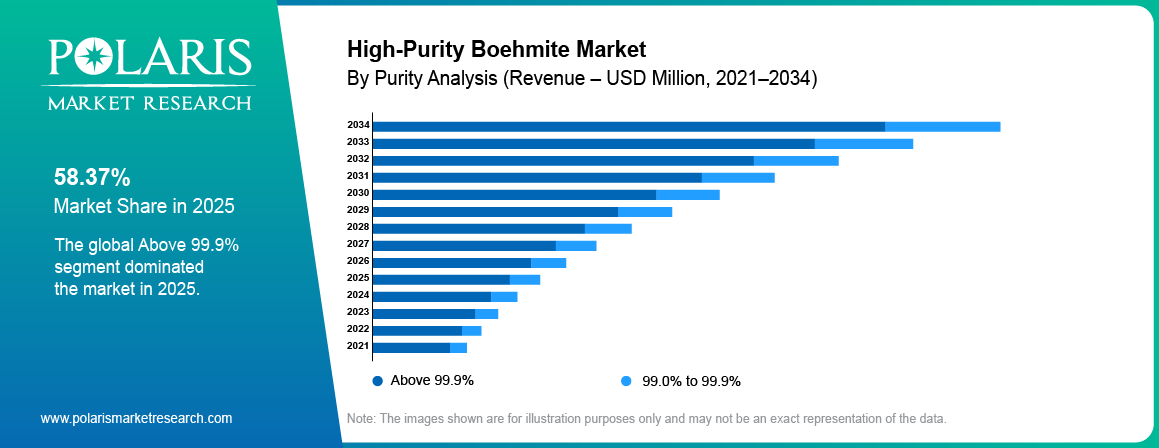
- The Above 99.9% segment led with 58.37% in 2025, due to its established commercial applications.
- The powder segment dominated with 41.63% in 2025 because dry boehmite offers greater formulation flexibility, established transportation and storage infrastructure, and broad use across battery coatings, ceramics, catalysts, and flame-retardant applications.
- The lithium-ion battery separator and edge coatings segments dominated with 49.52% in 2025. Growing manufacturing capacity for batteries propels the demand for battery grade boehmite.
Note: Figures and projections outlined in this report are the result of Polaris Market Research’s proprietary analytical processes, grounded in the latest available datasets and market observations
What is High-Purity Boehmite Market?
The high-purity boehmite market covers engineered aluminum oxyhydroxide [AlO(OH)] grades produced under controlled purity, particle size distribution, morphology, surface area, moisture, dispersibility, and trace metal impurities. The market includes materials used in lithium-ion battery separators and edge coatings, catalyst carriers, electronics and technical ceramics, halogen-free flame-retardant systems, engineered coatings, polishing formulations, and specialty dispersions. Ordinary-grade boehmite and generic aluminum hydroxide without application-specific purity or performance requirements are excluded in the market scope.
Boehmite is an aluminum oxyhydroxide material that can function as a ceramic filler, catalyst carrier, flame-retardant component, rheology modifier, polishing material, or specialty precursor. Product value depends on controlling physical and chemical properties for a downstream process. Suppliers like Nabaltec, Sasol, TOR Minerals, PIDC, Sinocera, and others offer grades suitable for different purity, particle, and dispersibility needs.
Expanding battery applications are one of the major drivers of market growth. Ceramic-coated separators use boehmite to improve dimensional stability and thermal performance and to meet requirements for porosity, electrolyte transport, adhesion, and coating uniformity. Switching costs can also arise from qualification, as separator makers need to validate slurry behavior, coating quality, cell performance, and batch consistency before changing material suppliers.
Market Dynamics
Driver Impact Analysis
| Market Driver | Geographic Relevance | Impact Timeline |
| Battery and Separator Capacity Expansion | Global, led by Asia Pacific | Ongoing through 2034 |
| Regional Battery Material Localization | Europe, North America | Active, scaling through forecast period |
| Ready Dispersions and Surface-Modified Grades | Global | Widening through forecast period |
| China Battery Market Growth | Asia Pacific (China) | Long-term, to 2035 |
| Europe Battery Market Expansion | Europe | Medium-term, to 2030 |
Source: Company filings, IEA, Roland Berger, Eurobat, and Polaris Market Research Analysis
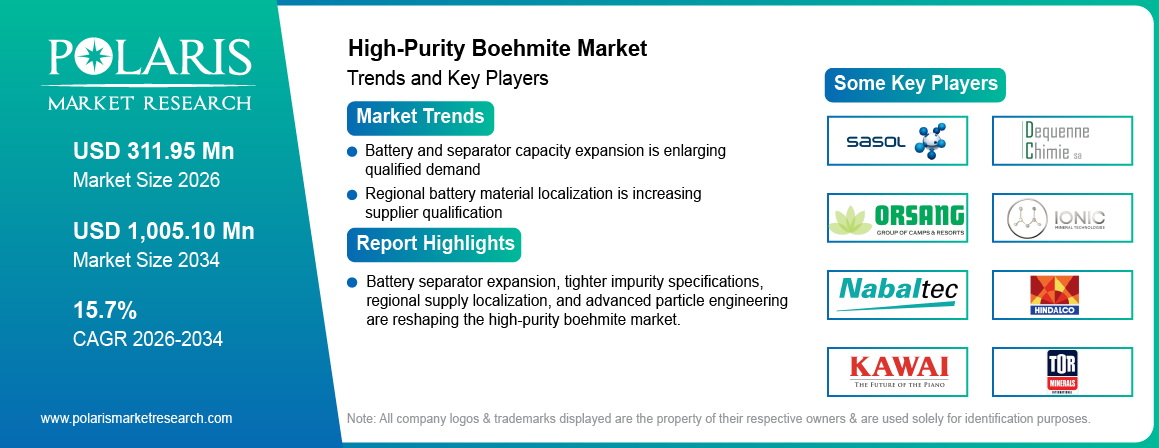
Driver: Battery and Separator Capacity Expansion Is Enlarging Qualified Demand
Increasing production of batteries is raising the demand for high-purity boehmite used in ceramic separator coatings. Boehmite may improve the thermal stability and thermal runaway resistance of lithium-ion battery separators. This makes it an important material for applications requiring improved safety performance. Consequently, high-purity grades are drawing attention from battery and separator makers as cell production ramps up. The IEA said global EV battery deployment reached 1.2 TWh in 2025, an increase of almost 30% from 2024 and more than seven times the level in 2020. The continued expansion of EV battery production is increasing the requirement for ceramic-coated separators. This factor is creating additional qualified demand for boehmite in lithium-ion battery applications (Source: iea.org).
Driver: Regional Battery Material Localization Is Increasing Supplier Qualification
Regional sourcing can help manufacturers reduce transportation lead times and improve supply continuity. It helps them reduce exposure to concentrated supply networks. As a result, boehmite suppliers are building production, technical support, and distribution capabilities near battery manufacturing clusters. For instance, in May 2026, TOR Minerals announced the start of specialty boehmite supply from the Netherlands to Automotive Cells Company for lithium-ion battery applications (Source: torminerals.com). Penghui Energy’s energy-storage products were reported to be operating at full capacity in September 2026, and Estone Technology planned to expand production capacity of lithium-battery materials (Source: metal.com). Such localization efforts could incentivize battery and separator makers to qualify other regional suppliers. It helps high-purity boehmite producers serving lithium-ion battery materials expand their business.
Restraint: Strict Qualification Requirements and Cost Pressure Can Delay Commercial Volume
Battery-grade boehmite must comply with stringent specifications for trace metal impurities, magnetic particles, particle size, morphology, specific surface area, and moisture. To achieve consistent performance in separator coatings, producers must maintain these characteristics through the manufacturing, classification, drying, packaging, and transportation processes. So qualification might have to be extended in terms of testing and customer approval before commercial volumes. These requirements add to development costs and can delay supplier conversion, particularly when battery manufacturers already have qualified material sources. Price pressure is also still a constraint as suppliers are required to demonstrate measurable value through improved dispersion, coating uniformity, processing efficiency, or reduced coating thickness. Hence, meeting performance specifications while keeping competitive prices can hinder market expansion.
Opportunity: Ready Dispersions and Surface-Modified Grades Can Increase Supplier Value
Ready-to-use dispersions and surface-modified boehmite grades can open opportunities for suppliers to add value beyond supplying dry powder. Ready dispersions can simplify downstream processing by reducing the wetting, deagglomeration, stabilization, and filtration requirements during separator coating slurry preparation. TOR Minerals offers surface-treated products and water-based slurry products. Sasol offers boehmite grades for different processing conditions. Surface modification may improve compatibility with binders, solvents, and polymer matrices, while specific surface area can influence dispersion behavior, coating performance, and formulation requirements. These differentiated products can also enable supplier opportunities across battery separators, coatings, technical ceramics, polymers, and flame-retardant applications, while enabling more application-specific material qualification.
High-Purity Boehmite Market Segmentation Analysis
The report provides a comprehensive analysis of the high-purity boehmite market by purity, product type/dispersibility, form, application, end-use industry, and region to identify established market segments and high-growth opportunities.
Purity Insights
The 99.0%-99.9% segment significant market share by holding 41.63% in 2025. The leading position is attributed to its rising use in well-established applications such as battery separator coatings, technical ceramics, catalyst support materials, flame-retardant systems, and other industrial formulations. The broad applicability of the material allows suppliers to target multiple downstream industries without the additional production and qualification burdens of ultrahigh-purity grades. For battery applications, impurity levels still need to be controlled and particle characteristics have to be consistent, but many commercial processes are feasible within this defined purity region. Manufacturing experience, established customer qualification, and availability across multiple applications further strengthen demand. The segment therefore represents the existing commercial base of the high-purity boehmite industry.
The above 99.9% purity segment is expected to register a higher CAGR of 17.28% during 2026–2034, driven by tighter contamination requirements in battery and advanced electronics applications. Ultra-high-purity boehmite offers lower trace metallic impurity levels and better control of material properties. Battery separator makers require strict limits for contaminants such as sodium, iron, copper, zinc, calcium, and silicon. Advanced electronics and technical applications also need consistent material inputs, where consistency can affect product reliability. Thus, growth in this segment depends on suppliers’ ability to maintain purity, particle distribution, morphology, moisture, and surface characteristics at commercial scale.
Product Type / Dispersibility Insights
The water-dispersible segment accounted for the largest share of 46.63% in 2025. Water-dispersible boehmite is widely employed in aqueous coating processes such as ceramic-coated separators for lithium-ion batteries. Present water-based processing systems require materials that disperse uniformly and maintain adequate slurry behavior during coating. Material suppliers must control particle size, surface area, morphology, and agglomeration, as these factors affect viscosity, coating uniformity, and defect formation. Besides battery separators, water-dispersible grades are used in coatings, technical ceramics, and selected polymer formulations. Water dispersible boehmite is built on a solid commercial foundation from the current customer qualification and the established aqueous processing infrastructure.
The surface-modified segment is expected to register the fastest growth with 16.58% CAGR over the forecast period. It is attributed to the demand for application-specific dispersion and compatibility characteristics. Surface treatment may improve wetting, binder interaction, dispersion stability, and compatibility with selected polymer or solvent systems. These properties matter in applications that require consistent coating performance or need to incorporate boehmite into complex formulations. Slurry behavior can be improved in ways that benefit battery separator coatings. Tailored surface chemistry can be necessary for technical ceramics, polymers, flame retardant systems, and specialty coatings. Surface-modified boehmite also allows differentiation beyond purity and particle size.
Form Insights
The powder segment accounted for 71.84% of the market share in 2025, making it the leading form segment. Powdered boehmite is used in battery coatings, technical ceramics, catalyst supports, flame-retardant formulations, and other industrial applications. Dry powder gives customers flexibility in slurry preparation, formulation, and processing. Current handling, packaging, transportation, and storage methods also support widespread commercial use. By varying solids loading, binders, solvents, and dispersion conditions, battery and ceramic manufacturers can formulate application-specific coating systems. “The segment is favored by its wide use across multiple sectors and the already established downstream processing infrastructure.
The dispersion/slurry segment is expected to grow at the highest CAGR of 17.34% during 2026-2034, driven by demand for seamless downstream processing and uniform coating performance. Ready-to-use dispersions can reduce the need for wetting, deagglomeration, stabilization, and filtration during coating preparation. This can reduce process variability and reduce formulation steps for high-volume separator coating operations. Slurry products can also allow for higher control of solids loading, viscosity, and dispersion stability when supplied to defined customer specifications. Battery separator manufacturers may therefore want ready-made formulations as production scale and coating line consistency become more important. Growth can also come from specialty coatings, technical ceramics, and other applications where formulation complexity creates additional processing needs.
Application Insights
The lithium-ion battery separator and edge coatings segment accounted for the largest share of 49.52% in 2025. Boehmite-based ceramic coatings can improve separator dimensional stability and thermal performance. They also satisfy requirements for porosity, electrolyte transport, adhesion and coating uniformity. As battery manufacturing capacity increases, demand for ceramic-coated separators is growing across electric vehicles and energy storage systems. Battery customers also require controlled particle size, morphology, surface area, moisture, and low contamination, as these properties influence slurry behavior and separator performance. Qualification requirements can create switching barriers because material changes must be validated through coating trials and cell-level testing.
The electronic and technical ceramics segment is anticipated to record 15.47% CAGR during 2026-2034, driven by demand for engineered ceramic materials with controlled purity and particle characteristics. Thermal behavior, particle distribution, surface area, and processing consistency are important factors for the final ceramic performance, and high-purity boehmite can be used as a material input for these cases. Electronics applications generally require a tighter specification for impurity control as metallic contaminants can impact the reliability of the material and downstream processing. Technical ceramic manufacturers can also select particular particle sizes and morphologies depending on the forming, sintering, or surface requirements. This means that growth in advanced electronic materials can create demand for boehmite grades with higher purity and specific application requirements.
The flame retardants and polymer additives segment is expected to grow at a 14.83% CAGR in the forecast period. It is attributed to the use of boehmite as a halogen-free flame retardant filler and functional polymer additive. Manufacturers can choose boehmite based on particle size, dispersion behavior, purity, and thermal properties to satisfy formulation needs. Demand can be created from polymer systems for electronic materials, industrial components, and specialty formulations where thermal performance and material consistency are critical. Boehmite also offers an alternative material path for formulations seeking additive systems that are halogen-free. The application base is wider than batteries and ceramics, providing suppliers with opportunities to reach customers with different procurement and qualification requirements.
End-Use Industry Insights
The automotive and mobility segment held revenue share of 27.46% in 2025. High-purity boehmite is used in ceramic-coated separators and edge coatings. Thus, demand is closely linked to lithium-ion battery production, particularly electric-vehicle battery manufacturing. Automotive battery manufacturers require consistent coating materials for the separator to ensure separator performance, thermal stability, dimensional control, and cell reliability. Expansion of EV production therefore increases demand for qualified battery-grade boehmite across separator supply chains. Material qualification can also create longer-term supplier relationships as battery producers must validate changes in particle size, purity, morphology, surface area, and impurity levels before commercial adoption.
The electronics and electrical segment is anticipated to register the highest CAGR of 14.92% during 2026–2034. It is fueled by the increasing demand for advanced electronic materials and high-performance ceramics. Impurities can affect downstream material performance, so electronics manufacturers demand materials with controlled purity, moisture, particle characteristics, and thermal properties. High-purity boehmite can be used in specialty ceramic and thermal-management formulations where consistent particle morphology and surface characteristics are important. The segment can also benefit from increased use of engineered materials in electronic components and electrical systems.
The energy storage segment held 20.58% of the market in 2025 and is expected to rise due to demand from expanding lithium-ion battery deployment. High-purity boehmite is used in ceramic separator coatings where thermal stability, controlled particle characteristics and low levels of impurities are required. Growth in energy-storage installations increases demand for battery cells and related separator materials, creating an additional downstream requirement for qualified boehmite grades. Energy-storage manufacturers can also require stable supply as separator material changes may require testing and production validation. Suppliers therefore need to maintain consistent particle size, morphology, moisture, surface area, and impurity specifications across production batches.
High-Purity Boehmite Market Regional Analysis
Asia Pacific High-Purity Boehmite Market Trends
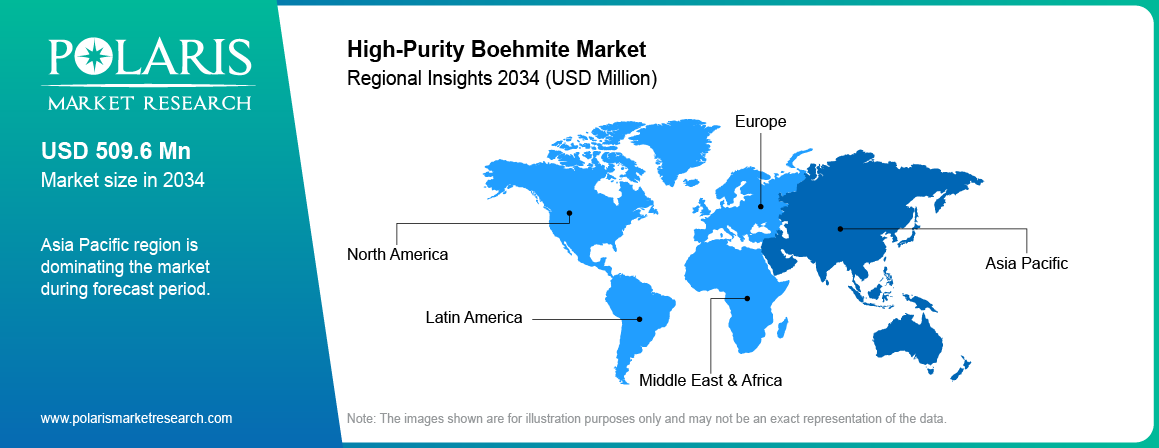
Asia Pacific accounted for 40.47% of the global high-purity boehmite market in 2025, making it the leading regional market. The region has a robust lithium-ion battery and separator manufacturing ecosystem, particularly across China, Japan, South Korea, and other key battery producing economies. Roland Berger forecasts that China’s battery market will grow to 2.5 TWh by 2035, with light vehicles accounting for almost two thirds of demand. Higher battery output increases the requirement for ceramic-coated separators and edge-coating materials. These factors create a broad customer base for high-purity boehmite suppliers while increasing opportunities for application-specific grades designed around separator coating, electronics, and specialty industrial requirements (Source: rolandberger.com).
North America High-Purity Boehmite Market Trends
The market in North America is expected to register 17.04% CAGR during 2026–2034, driven by focus on battery-material localization and demand from advanced industrial applications. The region is developing domestic supply capabilities for high-purity boehmite as battery manufacturers and material producers seek shorter supply chains. In July 2025, Ionic Mineral Technologies raised USD 29 million to scale IonAl high-purity boehmite production to 5,000 metric tons annually at its U.S. facility. Battery materials remain an important demand source, while catalysts, coatings, electronics, and flame-retardant applications provide additional consumption channels. Regional production can also reduce dependence on overseas supply and improve technical support for customers requiring application-specific grades (Source: businesswire.com).
Europe High-Purity Boehmite Market Trends
The European market is expected to register the highest CAGR of 14.76% during the forecast period. Europe’s high-purity boehmite demand is driven by electric vehicle production, battery manufacturing, energy storage, electronics, and industrial chemicals. Eurobat stated Europe holds 17% of the global battery market, valued at USD 95 billion. Its share is expected to reach 26% by 2030, as the global market reaches USD 158 billion. Growing EV and lithium-ion battery production is increasing demand for boehmite used in ceramic-coated battery separators and edge coatings. Rising adoption of stationary energy storage is creating additional battery material demand. Further, Europe’s electronics and technical ceramics industries support consumption in high-performance applications (Source: eurobat.org).
Latin America High-Purity Boehmite Market Trends
The market in Latin America is projected to exhibit a CAGR of 13.68% during the projected period. Latin America is developing demand for high-purity boehmite through battery, electronics, and industrial chemical applications. The region relies significantly on imported specialty materials as local production of advanced boehmite grades remains limited. Market development can build on existing supply chains for alumina and industrial chemicals. Further, growing interest in energy storage and advanced manufacturing could increase demand for high-purity grades. Battery-related applications represent an emerging opportunity as regional energy-storage requirements increase.
Middle East & Africa High-Purity Boehmite Market Trends
The Middle East & Africa market is expected to record a CAGR of 14.32% during the forecast period. Middle East & Africa demand is linked to catalyst supports, petrochemical applications, flame retardants, specialty ceramics, and other industrial uses. The region’s established refining and petrochemical activities underpin demand for high-performance alumina-based materials. Emerging advanced manufacturing and energy-storage initiatives may broaden application opportunities. Battery separator production remains limited compared with Asia Pacific, Europe, and North America. Emerging advanced manufacturing and energy-storage initiatives are expected to broaden the regional application base over the forecast period.
Export and Import Data Analysis
Public customs data do not provide a dedicated HS code for high-purity boehmite. HS 281830, aluminum hydroxide, therefore, serves only as a broad trade proxy. The category includes commodity and specialty aluminum hydroxide products and cannot provide direct high-purity boehmite market volume.
Export and Import Data Analysis Snapshot
| Trade Reference | 2024 Value (UN Comtrade, Tier A) | 2024 Volume | Description |
| Germany exports HS 281830 | US$376.4M | 509.5M kg | Large aluminum hydroxide export base; not boehmite specific |
| Brazil exports HS 281830 | US$258.7M | 1.020bn kg | Large hydrate export base |
| China exports HS 281830 | US$217.0M | 354.6M kg | Relevant to Asia supply concentration but broader than boehmite |
| United States exports HS 281830 | US$205.0M | 110.4M kg | Broad specialty and industrial hydrate trade |
| India imports from Germany HS 281830 | US$21.9M | 18.6M kg | Illustrates broader import dependence |
(Source: Polaris Market Research Analysis)
TTM, June 2024–May 2025, shipment counts
| Country | Rank by Shipment Volume | Analysis |
| China | 1st (2,373 shipments) | China, the United States, and Germany together account for 65% of global HS 281830 shipments |
| United States | 2nd (2,017 shipments) | |
| Germany | 3rd (1,523 shipments) | |
| Brazil | 4th (766 shipments) | |
| India | 5th (530 shipments) |
(Source: volza.com and Polaris Market Research Analysis)
High-Purity Boehmite Market Competitive Landscape
Competitive Landscape Snapshot
| Company | Headquarters | Market Position | Analysis |
| Sasol Chemicals | South Africa | Market Leader | Global DISPAL/DISPERAL platform |
| Nabaltec AG | Germany | Market Leader | APYRAL AOH, ACTILOX grades |
| Chalco Shandong Advanced Material | China | Market Leader (volume) | Vertically integrated, low-cost supply |
| TOR Minerals International | United States | Established | ACC (Netherlands) supply deal, May 2026 |
| Hindalco Industries | India | Established | Low-soda, hydrothermal boehmite |
| Shandong Sinocera | China | Established | Battery-grade, trace-impurity control |
| PIDC | United States | Established | 20+ boehmite variants, up to 99.98% purity |
| Ionic Mineral Technologies | United States | Emerging Challenger | USD 29M raise, IonAl scale-up |
| Anhui Estone | China | Emerging Challenger | Strong morphology patent activity |
| Silkem, TAIMEI, Dequenne, Tianjin Boyuan, Xuancheng Jingrui, KAWAI LIME, Osang Group | Slovenia, Japan, Belgium, China (x2), Japan, South Korea | Niche Specialist | Regional ceramics, catalyst, coating grades |
Source: Company filings and Polaris Market Research Analysis
The high-purity boehmite industry is competitive on purity, trace impurity control, particle engineering, dispersibility, application qualification, production consistency, and regional supply. Nabaltec, Sasol, TOR Minerals, PIDC, Sinocera, Hindalco, and Ionic Mineral Technologies represent visible suppliers across established and emerging regional supply models. In batteries, the winning proposition combines low contamination, repeatable dispersion, predictable coating behavior, technical service, and supply assurance.
Supplier benchmarking increasingly focuses on D10 through D99 particle distribution, BET surface area, morphology, trace metals, magnetic contamination, surface treatment, slurry availability, plant location, and customer qualification rather than nominal purity alone. Battery-grade boehmite competition is becoming more regional. These moves suggest that future market share will depend on proximity to customers and qualification depth as much as on nominal production capacity.
High-Purity Boehmite Competitive Benchmarking
| Company | Boehmite / Product Platform | Particle / Surface Engineering | Other Key Applications | Geographic Positioning |
| Nabaltec AG | APYRAL AOH, ACTILOX | High-purity / low-residue grades | Flame retardants, technical ceramics | Europe / global |
| Sasol Chemicals | DISPAL / DISPERAL | High-purity, low-metal-contaminant materials | Technical ceramics, catalysts | Global |
| TOR Minerals | Specialty boehmite / ALUPREM | Submicron / surface treatment | Coatings, plastics, specialty minerals | US / Europe |
| Hindalco Industries | Low-soda / battery boehmite | Hydrothermal synthesis; low-soda focus | Thermal fillers, catalysts, flame retardants | India |
| Shandong Sinocera | High-purity battery boehmite | PSD and trace-impurity control | Battery coatings, specialty materials | China / Asia |
| PIDC | Alumax PB series | Custom crystal size, pore volume, particle size | Catalyst supports, coatings, binders, refractories | US / global |
| Ionic Mineral Technologies | IonAl™ | High-purity domestic platform | Advanced ceramics, alumina applications | US |
| Anhui Estone | Boehmite / BG grades | Strong patent activity in morphology/particle control | Electronics, flame retardants, composites | China / Global |
| Silkem | Specialty boehmite | Specialty material grades | Ceramics, fillers, catalysts | Europe |
| TAIMEI Chemicals | Specialty boehmite | High-purity specialty materials | Ceramics, catalysts | Japan / Asia |
| DEQUENNE CHIMIE | Boehmite / alumina materials | Specialty alumina capability | Catalysts, ceramics, chemicals | Europe |
| Tianjin Boyuan | Nano/dispersible boehmite | High-SSA / nano materials | Catalysts, coatings, specialty materials | China |
| Xuancheng Jingrui | JR-series boehmite | Boehmite morphology/material development | Ceramics / sintering applications | China |
| KAWAI LIME INDUSTRY | Functional alumina-related materials | Functional filler capability | Industrial / functional fillers | Japan |
| Osang Group | Boehmite-related materials | Evidence limited | Specialty materials | Asia |
Source: Polaris Market Research Analysis
Buyer Analysis and Barriers to Market Entry
Buyer decisions are driven by technical performance and supply reliability. The particle size distribution, BET surface area, impurities, viscosity, dispersion stability, and coating behavior are determined by the separator producers. Battery cell manufacturers consider safety, uniformity, adhesion, shrinkage, and cell performance. Electronics buyers care about purity, moisture, thermal behavior, and compatibility. Catalyst producers focus on surface chemistry, porosity, BET, and peptization.
Buyer Decision Framework
| Buyer | Primary need | Qualification metrics | Commercial concern |
| Separator Producer | Stable coating slurry | PSD, BET, impurities, viscosity, coatability | Yield and line throughput |
| Battery Cell Producer | Safety and consistency | Shrinkage, adhesion, cell cycling | Approved vendor stability |
| Electronics / PCB | Thermal and flame performance | Purity, moisture, compatibility | Halogen free cost |
| Catalyst Producer | Surface chemistry | BET, porosity, peptization | Batch reproducibility |
| Coatings / Composites | Dispersion and compatibility | Surface treatment, particle shape | Processing efficiency |
Source: Polaris Market Research Analysis
Barriers to Market Entry
- Trace metal impurity control: Fe, Cu, Zn, Na, Si, Ca, and magnetic contamination require tight analytical control.
- Particle engineering: D10, D50, D90, D99, morphology, top cut, and surface area influence downstream performance.
- Customer qualification: Battery customers can require laboratory testing and production-line validation.
- Grade uniformity: When talking about new entrants, the grade specifications must be consistent throughout each batch in commercial production.
- Technical assistance: Application laboratories can minimize the time required for formulation and qualification.
- Supply uniformity: Buyers have become more interested in dual sourcing, local stocking, and contingency planning.
Cost and Pricing Benchmarking Analysis
Public list prices for battery-grade high-purity boehmite remain limited as commercial pricing depends on purity, particle engineering, annual volume, packaging, qualification status, surface treatment, logistics, and product form. The high-purity boehmite market report therefore focuses on supplier quotations, annual contracts, grade specifications, and total coating costs rather than headline price per kilogram. Specialty battery-separator and nano-boehmite products can have substantially higher list prices, mostly for small-volume purchases. Battery-grade boehmite carries a premium compared with conventional grades. This is because of stringent impurity control, particle engineering, qualification requirements, and application-specific performance specifications.
High-Purity Boehmite Market Technology and Innovation Landscape
Technology and Innovation Landscape Snapshot
| Technology | Leading Developer(s) | Capability | Status |
| Particle Size Distribution Control | Nabaltec, Sasol | Submicron coating grades | Established |
| Surface Modification | TOR Minerals | Binder, solvent compatibility | Deployed |
| Ready-to-Use Dispersions | TOR Minerals, Sasol | Pre-dispersed slurries | Available |
| Low-Soda Hydrothermal Synthesis | Hindalco | Low-soda battery boehmite | In development |
| Trace-Impurity Control | Shandong Sinocera | Na, Fe, Cu, Zn, Ca, Si limits | Deployed |
| Domestic Scale-Up | Ionic Mineral Technologies | 5,000 MT/year, US | Scaling |
Source: Company filings and Polaris Market Research Analysis
Particle size distribution represents a major technology variable as separator coatings require thin, uniform layers with controlled pore structures and limited agglomeration. Suppliers therefore offer submicron grades and controlled particle distributions designed around coating thickness, solids loading, binder systems, and line speed. Research also indicates that particle morphology can influence separator pore structure, electrolyte uptake, mechanical strength, and electrochemical performance.
Surface modification represents another development path. Treatment can improve wetting, binder interaction, dispersion stability, and compatibility with polymer or solvent systems. Other factors that determine whether producers can achieve battery-grade quality at a commercial scale are hydrothermal synthesis, purification, milling, classification, and contamination control. Future developments will include tighter control of the morphology, better batch-to-batch reproducibility, and lower energy processing and application-specific grades.
High-Purity Boehmite Market Premium Insights and Forward Outlook
Ceramic-Coated Battery Separators Will Remain the Main Strategic Demand Variable
Battery separator demand provides the clearest connection between boehmite consumption and lithium-ion battery production. Future demand should be evaluated through coated separator area, boehmite loading, coating thickness, and market penetration rather than battery GWh alone. Separator design changes and substitution can alter material intensity even when battery output rises.
Ultra-High-Purity Grades Will Compete on More Than Purity
Above 99.9% purity will become less distinctive as more suppliers develop ultra-high-purity boehmite grades. Competitive differentiation will increasingly depend on trace metal stability, magnetic contamination, narrow particle distribution, controlled morphology, surface chemistry, moisture, and predictable dispersion.
Supplier Benchmarking Will Shift Toward Qualification and Regional Redundancy
Battery customers increasingly value qualified supply capacity, lot consistency, local technical support, and regional redundancy. The relationship between TOR Minerals and European ACC, Hindalco’s development program in India, and Ionic Mineral Technologies’ US investment highlights the growing importance of localized supply. These trends are also shaping boehmite supplier benchmarking across qualification, capacity, technical support, and regional coverage.
Key Players in the High-Purity Boehmite Market
- Anhui Estone Material Technology
- Almatis GmbH
- Chalco Shandong Advanced Material Co., Ltd.
- Dequenne Chimie SA
- Hindalco Industries Ltd.
- Ionic Mineral Technologies
- KAWAI LIME INDUSTRY CO., LTD.
- Nabaltec AG
- Osang Group
- PIDC
- Sasol Chemicals
- Shandong Sinocera Functional Materials Co., Ltd.
- Silkem d.o.o.
- TAIMEI CHEMICALS CO., LTD.
- Tianjin Boyuan New Materials
- TOR Minerals International, Inc.
- Xuancheng Jingrui New Materials
Industry Developments
- September 2026: Canadian Energy Metals achieved proof-of-concept for producing smelter-grade alumina from boehmite at its Thor Project, highlighting its potential as a non-bauxite alumina feedstock. (Source: newswire.ca)
- June 2026: UBE MAXELL announced a plan to expand lithium-ion battery separator base-film production capacity by approximately 50% from the current level. (Source: ube.com)
- May 2026: TOR Minerals International, Inc. announced boehmite supply agreement with Automotive Cells Company SE (ACC) for its Li-ion battery business. (Source: torminerals.com)
- August 2025: Vinacomin, Daejoo KC Group of South Korea, announced that it will study super-fine boehmite production in Vietnam for the lithium-ion battery industry, strengthening regional battery-material supply. (Source: theinvestor.vn)
- July 2025: Ionic Mineral Technologies closed a USD 29 million Series B financing to scale advanced battery materials including high-purity boehmite alumina. (Source: chargedevs.com)
High-Purity Boehmite Market Report Segmentation
By Purity Outlook (Revenue, USD Million, 2021–2034)
- 99.0% to 99.9%
- Above 99.9%
By Product Type / Dispersibility Outlook (Revenue, USD Million, 2021–2034)
- Water Dispersible
- Acid Dispersible
- Surface Modified
By Form Outlook (Revenue, USD Million, 2021–2034)
- Powder
- Dispersion / Slurry
By Application Outlook (Revenue, USD Million, 2021–2034)
- Lithium-Ion Battery Separator and Edge Coatings
- Electronic and Technical Ceramics
- Flame Retardants and Polymer Additives
- Catalyst Supports
- Coatings and Surface Treatment
- Other Specialty Applications
By End-Use Industry Outlook (Revenue, USD Million, 2021–2034)
- Automotive and Mobility
- Electronics and Electrical
- Energy Storage
- Chemicals and Refining
- Construction and Industrial Materials
By Regional Outlook (Revenue, USD Million, 2021–2034)
- North America
- U.S.
- Canada
- Europe
- Germany
- France
- UK
- Italy
- Spain
- Netherlands
- Rest of Europe
- Asia Pacific
- China
- Japan
- India
- South Korea
- Taiwan
- Australia
- Rest of Asia Pacific
- Latin America
- Brazil
- Mexico
- Argentina
- Rest of Latin America
- Middle East & Africa
- Saudi Arabia
- UAE
- South Africa
- Rest of Middle East & Africa
High-Purity Boehmite Market Report Scope
| Report Attributes | Details |
| Market Size in 2025 | USD 270.10 Million |
| Market Size in 2026 | USD 311.95 Million |
| Revenue Forecast by 2034 | USD 1,005.10 Million |
| CAGR | 15.7% from 2026–2034 |
| Base Year | 2025 |
| Historical Data | 2021–2024 |
| Forecast Period | 2026–2034 |
| Quantitative Units | Revenue in USD Million and CAGR |
| Report Coverage | Revenue Forecast, Growth Factors, Competitive Landscape, Industry Trends, and Strategic Analysis |
| Segments Covered |
|
| Regional Scope | North America, Europe, Asia Pacific, Latin America, Middle East & Africa |
| Competitive Landscape | Company Profiling, Product Benchmarking, Financial Analysis, Market Developments, and Strategic Initiatives |
| Report Format | PDF + Excel |
| Customization | Available by Country, Region, and Segment |
Source: Polaris Market Research Analysis
Why Choose Polaris Market Research
Polaris Market Research & Consulting, Inc. applies a specification-led approach to advanced materials rather than treating specialty chemicals as undifferentiated volume. The high-purity boehmite market analysis connects supplier capacity, purity, particle engineering, battery separator qualification, application mix, regional sourcing, and trade evidence.
Clients can request customized analysis by purity, particle size, application, battery separator qualification, region, or supplier. The battery grade boehmite industry forecast can also benchmark producer capacity, grade portfolios, trace impurity specifications, morphology, local supply, customer announcements, and exposure to battery versus non-battery applications.
High-Purity Boehmite Market Research Methodology
The research process begins by defining high-purity boehmite based on purity thresholds, application qualification, particle characteristics, and exclusions. Secondary sources consist of manufacturer technical literature, company filings, data from the battery industry, trade statistics, patents, journal papers, and press releases regarding separator capacity downstream.
Primary research can include specialty alumina producers, separator manufacturers, battery cell companies, distributors, catalyst producers, coating formulators, and technical experts. Questions focus on grade specifications, qualification timelines, substitution with high-purity alumina, powder versus slurry procurement, annual contracts, capacity utilization, loading assumptions, and regional sourcing.
Research Methodology Phases
| Phase | Method | Output |
| Scope | Define high-purity thresholds, applications and exclusions | Market boundary |
| Secondary | Company, technical, trade, patent and journal evidence | Fact base |
| Primary | Supplier, buyer and expert interviews | Assumption validation |
| Modeling | Revenue, volume, application and regional triangulation | Internal Polaris model |
| Review | Senior analyst QC | Final forecast and RD |
Source: Polaris Market Research Analysis.
The attached research framework explicitly reserves proprietary high-purity boehmite market size, CAGR, segment share, and regional share figures for confirmed internal validation rather than substituting third-party syndicated estimates.
High-Purity Boehmite Market FAQ's
The global high-purity boehmite market size was valued at USD 270.10 billion in 2025 and is projected to reach USD 1,005.10 billion by 2034, growing at a CAGR of 15.7%.
Boehmite is an aluminum oxyhydroxide material used as a ceramic filler, catalyst carrier, flame-retardant component, rheology modifier, polishing material, or specialty precursor, with lithium-ion battery separator coatings as its fastest-growing application.
Asia Pacific dominated with 40.47% share in 2025, driven by a robust lithium-ion battery and separator manufacturing ecosystem across China, Japan, and South Korea.
Boehmite [AlO(OH)] is an aluminum oxyhydroxide, while high-purity alumina (Al?O?) is produced by calcining aluminum hydroxide at high temperatures; the two differ in processing route and are often used in adjacent but distinct applications.
The Above 99.9% segment held the largest share in 2025, supported by established commercial applications across battery coatings, ceramics, and flame retardants, while the above-99.9% segment is projected to grow fastest as battery and electronics applications tighten contamination limits.
Boehmite-based ceramic coatings improve separator thermal stability and dimensional control, helping prevent thermal runaway, a safety property that has made it increasingly important as EV battery production scales.
Key manufacturers include Nabaltec AG, Sasol Chemicals, TOR Minerals International, Chalco Shandong Advanced Material, PIDC, and Shandong Sinocera Functional Materials, with suppliers increasingly competing on regional proximity to battery manufacturing clusters.
Particle size distribution affects coating thickness, pore structure, slurry rheology, packing density, and defect risk, with submicron grades specifically engineered for thin, uniform separator layers
The market is expected to grow at a CAGR of 15.7% from 2026 to 2034, driven by battery capacity expansion and tightening purity requirements.
It's produced through controlled hydrothermal synthesis or conversion processes, followed by purification, milling, classification, and drying to meet trace-impurity and particle-size specifications.
Regional sourcing reduces transportation lead times and supply-chain risk; TOR Minerals' May 2026 supply agreement with Automotive Cells Company in the Netherlands and Ionic Mineral Technologies' USD 29 million US production scale-up both reflect this shift toward battery-material localization.
Battery-grade boehmite typically requires high to ultra-high purity, with strict limits on trace contaminants such as sodium, iron, copper, zinc, calcium, and silicon that can affect cell performance.
Download Sample Report of High-Purity Boehmite Market
Please fill out the form to request a customized copy of the research report.


