
LEO Satellite Market Size, Share, Trends & Forecast, 2026–2034
REPORT DETAILS
LEO Satellite Market Summary
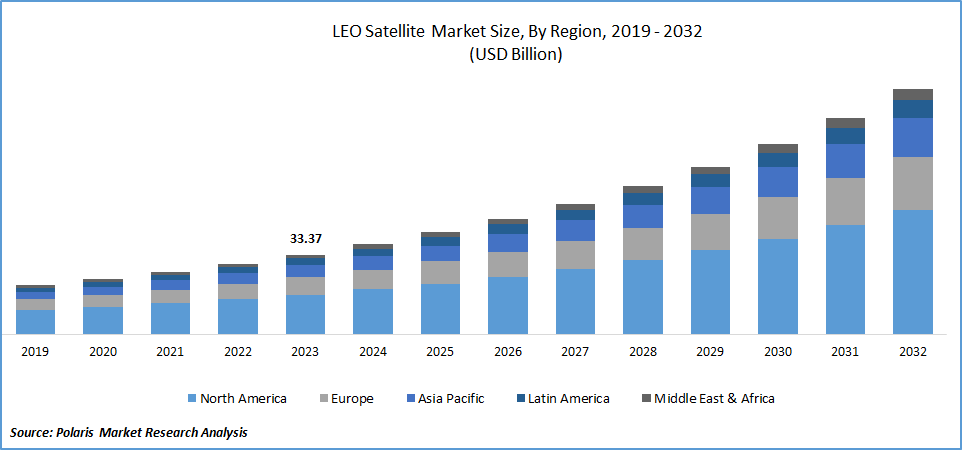
LEO satellite market size was valued at USD 11.97 billion in 2025. The market is expected to record a CAGR of 11.8% from 2026 to 2034. The market growth is attributed to the increasing government and commercial investments in space infrastructure. Several benefits of these satellites, such as low latency and high data transfer rates, also boost the market expansion.
Market Statistics
LEO Satellite Market Key Takeaways 2025
- North America led the low earth orbit satellite market with 38.6% share in 2025. The dominance is driven by robust satellite communication network infrastructure and rising investments in space and constellations.
- The Asia Pacific market is expected to register the highest CAGR of 13.7% during the forecast period. The growth is attributed to a strong emphasis on advancing technologies for laser- and optics-based satellites.
- The small satellites held the largest share of 67.4% in 2025. This is due to the lower cost of development, flexibility in launching, and constellation formation.
- The commercial segment dominated the market with 72.8% revenue share in 2025. The growth is attributed to higher demand for satellite broadband, communication, and commercial Earth observation.
- The defense segment is expected to record the highest CAGR of 11.83% during the forecast period, This is owing to an increase in demand for robust communication, surveillance, and situational awareness.
Note: Figures and projections outlined in this report are the result of Polaris Market Research’s proprietary analytical processes, grounded in the latest available datasets and market observations
What are LEO Satellites?
The low earth orbit (LEO) satellites revolve around the earth and generally stay at a distance of less than 2,000 kilometers above the Surface of the earth. Because of their close proximity to Earth, these satellites can provide lower latency and better data-transfer performance. On the other hand, the smaller footprint of an individual satellite in such an orbit requires more satellites to provide consistent service in a given area.
The low earth orbit satellite market consists of satellite makers, satellite subsystems and payload makers, satellite launchers, satellite operators, satellite ground infrastructure providers, satellite connectivity firms, and satellite application firms. The satellites find various uses, including communications, broadband internet, satellite Internet of Things connectivity, earth observation, research and technology demonstration, and defense/security.
The LEO satellite systems have become increasingly linked with satellite constellations. Rather than using a single spacecraft for providing coverage over a wide region of interest, satellite constellations involve the use of several satellites placed on various planes. While satellites continue orbiting the Earth, the network traffic can be switched from one spacecraft to another or to ground facilities.
As a result, a wide variety of satellite masses, subsystems, frequency bands, propulsion systems, applications, end-use industries, and geographic regions define the scope of this market. LEO satellites are suitable for high-capacity communication. Therefore, demand for small satellites, CubeSats, microsatellites, and nanosatellites is rising for commercial missions and technology demonstrations.
How LEO Satellite Networks Work
A LEO satellite network generally consists of satellites operating in one or more orbital planes, ground stations, user terminals, network-management infrastructure, and application systems. A user terminal communicates with a satellite passing within its coverage area. Depending on the architecture, traffic can then move through ground stations or between satellites using inter-satellite links before reaching the destination network.
LEO satellites travel rapidly relative to a point on Earth. Thus, user terminals and network systems must manage frequent satellite handoffs. Large constellations consist of satellites distributed across different orbital planes. Modern architectures increasingly combine radio-frequency links with optical inter-satellite links, cloud-based network management, advanced antennas, and automated routing technologies.
LEO vs GEO vs MEO Satellites
LEO, medium Earth orbit (MEO), and geostationary Earth orbit (GEO) satellites differ substantially in altitude, latency, coverage footprint, and typical applications.
| Parameter | LEO | MEO | GEO |
| Approximate altitude | Below 2,000 km | 2,000–36,000 km | About 35,786 km |
| Relative latency | Lowest | Moderate | Highest |
| Individual coverage footprint | Smaller | Larger | Very large |
| Constellation requirement | Generally high | Moderate | Low |
| Common applications | Broadband, Earth observation, IoT, defense, D2D | Navigation, communications | Broadcasting, communications, weather |
| Handoffs | Frequent | Less frequent | Generally fixed relative to Earth |
| Key advantage | Low latency and high data rates | Balance of coverage and latency | Wide-area coverage |
Source: Polaris Market Research Analysis
LEO systems are therefore particularly attractive where low latency, high throughput, frequent data collection, or rapid revisit capability is important. However, GEO remains advantageous for wide-area fixed coverage.
Source: Polaris Market Research Analysis
The use of smaller ground stations further contributes to cost reduction. Moreover, the shorter transmission distances associated with LEO orbits enable higher data rates, making them well-suited for data communication in support of the Internet of Things (IoT). Another advantage of communicating with LEO satellites is that it can be achieved using smaller and more energy-efficient hardware. Companies are also interested in developing satellite capabilities for collecting diverse types of imaging and sensing data. These applications range from monitoring weather conditions at a street level, conducting detailed observations of assets such as oilfields and shipping lanes, facilitating traffic monitoring for autonomous vehicles, to gathering valuable scientific data.
The advancement in technology has led to the development of the LEO Nanosatellite network, which is designed with the capability of high-speed satellite crosslinks in RF and high-speed downlinks with RF and Optical systems. Each relay satellite is equipped with a high-gain dual-band antenna and a high-speed laser downlink. Key performance metrics consist of high-speed satellite RF crosslink and high-speed optical downlink. The objectives of this network encompass achieving high satellite crosslink data capacity, ensuring successful data relay through multiple satellite nodes, and maintaining low latency data relay throughout the network.
Market Dynamics
Driver: Rising Integration of IoT in LEO Satellites
The rise of the Internet of Things (IoT) in LEO satellites has made it possible to directly collect data from sensors on land through small but effective means. However, advancements in technology have made it easier to access cloud-based services that offer shared ground station networks and advanced computing capabilities for data processing. 5G satellite-based IoT technologies play crucial role in emergency communications. During natural disasters such as wildfires, hurricanes, flooding, and crop failures, they can remain operational even in the absence of power. Increasing use of technological products such as AI, ML, and cloud computing has led to the need for the use of IoT on LEO satellites.
Driver: Rise in Demand for Satellite Internet Services
Demand for satellite internet is growing due to the rising requirement for low-cost and fast broadband internet with better data transmission capability from the corporate and government sectors. In addition, interest in affordable internet connections is rising among individuals in rural areas and developing countries where Internet connectivity may be limited. The need to deliver Internet services effectively and at high speeds is driving the development of LEO constellations.
Driver: Increasing Defense & Security Investments
The use of LEO satellite constellations as resilient communication systems for government and defense, Earth observation and intelligence, surveillance and reconnaissance purposes becomes increasingly attractive. In March 2026, the UK invested USD 52.14 million in satellite communications. LEO satellite constellations compared to single satellites offer more resilience and connectivity in distant or contested regions. These benefits propel their demand across defense and security operations (Source: gov.uk).
Driver: Declining Launch Costs and Reusable Launch Vehicles
Rapid development of reusable launch vehicles and increasing number of launches have a positive impact on economics of the deployment of LEO satellite constellations. In February 2026, Vanu, Inc. signed a strategic agreement with Amazon’s low Earth orbit satellite network, Project Kuiper. The deal aims to expand low-cost, high-quality mobile connectivity across underserved and rural regions in Africa. The collaboration will initially focus on southern Africa. Reduced launch costs and an increased number of rideshare and dedicated launch services boost the deployment of small satellites and spacecraft for larger constellations. These developments are helping satellite operators scale deployments and replace spacecraft as they approach the end of their operational lives (Source: vanu.com).
Restraint: Concerns Regarding Growing Space Debris
The presence of LEO satellites may be considered a threat to the space environment, as these satellites are located in highly crowded orbits. With the increasing number of satellites and other objects in LEO, there is a growing threat of conjunctions and collisions. In addition, microsatellites and nanosatellites should have enough tracking, collision-avoidance, and end-of-life options to operate effectively in increasingly crowded orbital regimes. Space debris increases the threat of collisions or malfunctioning of low-Earth orbit (LEO) satellites, hindering the market expansion.
Restraint: Spectrum, Regulatory, and Orbital Coordination Constraints
The rapid deployment of LEO constellations makes aspects such as spectrum coordination, orbital-slot and frequency allocation, licensing, debris mitigation, and international regulatory approvals more important than ever. Satellite companies that cater to several nations would require compliance with different regulatory authorities. It influences their costs related to deployment and operations.
Restraint: High Capital Requirements and Satellite Replacement Cycles
The deployment of a Low Earth Orbit network requires massive funds for manufacturing satellites and launching them into orbit. Establishing ground station facilities, user terminals, spectrum allocation, administration, and maintenance of all the equipment also requires high capital. Low Earth Orbit satellites tend to operate for a shorter period compared to GEO satellites. It requires plans to replace them periodically. Thus, high capital needs and replacement cycles restrain the market growth.
Opportunity: Expansion of Direct-to-Device Connectivity
The growing use of LEO satellites for broadband internet, IoT connectivity, Earth observations, and defense-related services offers strong opportunities for providers of LEO constellations and satellite technologies. Growing demand for low-latency, efficient propulsion systems, and space infrastructure development is expected to drive future opportunities.
Source: Polaris Market Research Analysis
LEO Satellite Market Report Segmentation
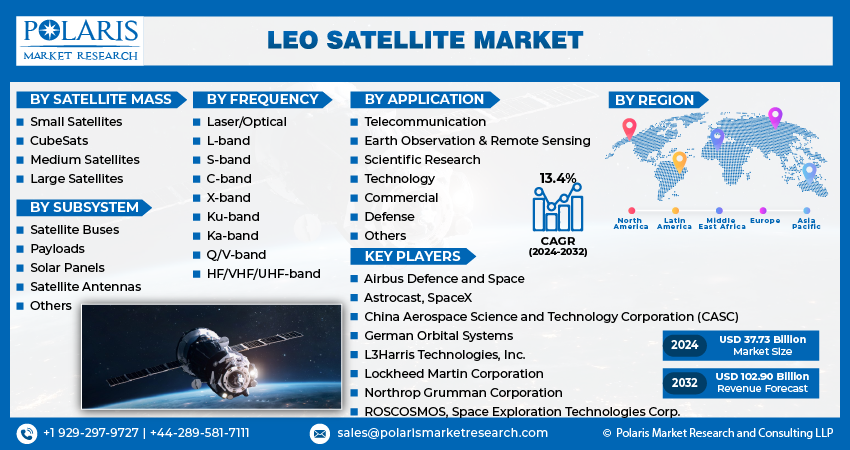
The market is primarily segmented based on satellite mass, subsystem, frequency, application, propulsion type, end use, and region.
By Satellite Mass Analysis
The small satellites segment dominated the market with 67.4% in 2025. Small satellites, referred to as smallsats or miniature satellites, are satellites that weigh less than 500 kg (1100 lb). This dominance in the marketplace comes from the satellites being small in size, ease in manufacturing, and more launch opportunities, and this type of satellite proves to be affordable for a number of companies and institutions. By making use of such satellites, the benefits like reduced costs for development and launch, faster deployment, and ability to operate in huge constellations are made possible. There are numerous applications, including navigation, research, and remote sensing, which require the use of such small satellites.
The medium satellites segment is anticipated to register a CAGR of 12.4% over the forecast period. This is due to their ideal balance of latency, transmission speed, and coverage. Medium Earth Orbit systems orbit around 2,000-36,000km, which makes them a different category from the Low Earth Orbit satellites. Medium Earth Orbit systems can cover more ground than Low Earth Orbit satellites, but with higher latency. Their characteristics make them relevant for applications such as navigation and selected communications services.
By Frequency Band Analysis
The Ku-band segments dominated with largest share of 34.6% in 2025. These frequency bands are widely used for high-throughput satellite communications and broadband connectivity applications. The increasing deployment of LEO broadband constellations is supporting demand for higher-capacity communication links.
The laser/optical segment is expected to grow at the fastest CAGR of 15.8% over the next coming years. Increasing utilization of laser/optical technology for inter-satellite communication drives the segment growth. Inter-satellite communication offers a viable solution due to the short distances between satellites and the absence of atmospheric interference in space. In an Optical Intersatellite Link (OISL), data is transmitted through a near-infrared laser beam via small telescopes on both sending and receiving satellites. Laser inter-satellite link consumes less energy for transmitting data at high speeds over large distances, which is important for an efficient operation of the satellites.
By Propulsion Type Analysis
The liquid fuel segment held the largest LEO satellites market share by holding 58.3% of total revenue in 2025. Liquid propellants are capable of delivering large amounts of thrust with good maneuverability and controllability. Thus, the use of liquid fuels is appropriate for missions in the LEO segment where maneuverability and controllability are necessary.
The electric segment is projected to record a CAGR of 13.6% during the forecast period. Electric propulsion systems provide high propellant efficiency and help reduce spacecraft mass. These features make them increasingly suitable for small satellites and large LEO constellation deployments. Their growing use for station keeping, orbit raising, and long-duration operations is supporting segment expansion.
By Application Analysis
The telecommunication segment dominated with largest share of 54.7% in 2025 driven by the need for high-speed communication. The low earth orbit satellites can fulfill the needs of customers who require more reliable communication. The increasing demand for high-speed internet access is expected to propel the growth. The growing need for satellite-based mobile connectivity is further driving the growth. Moreover, telecommunications companies are investing in satellite-based networks to ensure improved services, thereby driving the segment growth.
The earth observation and remote sensing segment is expected to witness growth of CAGR 12.9% during the forecast period driven by the need for frequent imaging of the earth’s surface. The LEO satellites offer more frequent imaging and faster data acquisition, thus meeting customer demands. The growing need in the agricultural, weather forecast, disaster management, and climate sectors has increased the demand for earth observation and remote sensing satellites. Governments and private entities have invested in using space-based systems to monitor and manage their respective domains. Additionally, the demand for climate observation and prediction has fueled the need for earth observation and remote sensing, thereby driving the segment growth.
By End Use Analysis
The commercial segment accounted for the largest share of 72.8% in the global low earth orbit satellite market. Rising investments in satellite broadband, communication, Earth observation, and satellite IoT connectivity will be creating demand among commercial satellite operators and providers. In August 2026, Globalstar completed the launch of all 8 HIBLEO-4 replacement LEO satellites on SpaceX Falcon 9, enhancing its satellite connectivity network. The growing presence of private LEO constellations is expected to further boost the commercial segment (Source: globalstar.com).
The government & defense segment is expected to grow at the fastest CAGR of 11.83% during the forecast period. Rising demand for secure satellite communications, surveillance, reconnaissance, intelligence, and space-based situational awareness is supporting government and defense adoption. Increasing investments in resilient space infrastructure are also contributing to segment growth.
Source: Polaris Market Research Analysis
LEO Satellite Market Regional Insights
North America
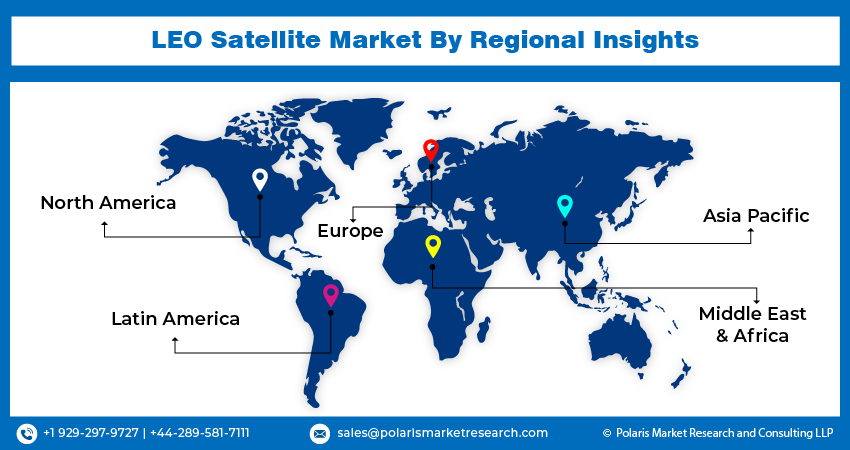
North America dominated the global LEO satellite market share by holding 38.6% of total revenue. The leading position is attributed to the growing need for LEO satellites to improve satellite navigation and communication, which is expected to drive market expansion. In 2026, SpaceX secured a USD 2.29 billion U.S. Space Force contract to support a military data network using its Starshield satellite communications capabilities. Moreover, the existence of established research facilities, strong network infrastructure, and growing investments in space exploration and research initiatives are predicted to accelerate the North America LEO satellite market expansion (Source: spacenews.com).
Asia Pacific
The Asia Pacific LEO satellite market is expected to record a CAGR of 13.7% during the prejected period. This is owing to a strong emphasis on advancing technologies for laser- and optics-based satellites. LEO satellites are highly essential in gathering Earth observation and scientific data and help in the monitoring of climate conditions, agricultural planning, protecting the soil, and border surveillance. For example, in 2025, Japan revealed its plans to select a proposal for its J-LEO direct-to-device satellite network. The initiative is supported by around $1 billion in government subsidies, along with matching private investments. It brings total costs to about $2 billion (Source: gsma.com).
Europe
The Europe LEO satellite market is expected to exhibit a CAGR of 10.6% during the forecast period. Europe has become an increasingly crucial market for LEO satellites. This is due to rising investments in secure connectivity and space capability by governments, telecommunication firms, satellite firms, and aerospace firms in Europe. The project has evolved from the planning phase to implementation and will ensure secure and resilient connectivity.
Europe is further bolstered by the presence of satellite manufacturing capability and growth of the Amazon Leo satellite company. In February 2026, Amazon Leo was successful in launching 32 LEO satellites using Arianespace’s Ariane 64 rocket, thus bringing the total constellation above 200 satellites (Source: aboutamazon.eu).
Latin America and the Middle East & Africa
Latin America and the Middle East & Africa are expected to witness growth of CAGR 10.2% and 9.4% respectively during the forecast period due to the existence of remote settlements, scattered infrastructure, sea lanes, and regions where there is no adequate terrestrial broadband access. Satellite broadband, connectivity projects, disaster recovery communications, and enterprise connectivity will help to further develop LEO satellites in these regions.
Source: Polaris Market Research Analysis
Rise of Mega-Constellations
The formation of mega constellations is among the main structural trends influencing the LEO satellite market. Instead of depending on individual spacecraft, operators are deploying large fleets of satellites to deliver continuous broadband, Earth observation, IoT, and other services. This model is increasing demand across satellite manufacturing, propulsion, payloads, antennas, optical links, launch services, ground infrastructure, and network-management technologies.
The competitive landscape is increasingly characterized by a LEO satellite constellation race, with established aerospace companies, telecommunications providers, technology companies, and governments pursuing different approaches to scale. SpaceX Starlink continues to be one of the largest running LEO broadband constellations, while Eutelsat OneWeb, Amazon Leo, and state-funded programs like IRIS² of Europe continue to build the competitive landscape.
Constellation architecture also provides possibilities outside broadband. Earth observation providers are using constellations to improve revisit rate, while satellite IoT providers are using a constellation of satellites to enable communication among low-power devices over vast geographic areas.
Real-World LEO Satellite Use Cases & Applications
| Company / Program | LEO Application | Example Use Case |
| SpaceX (Starlink) | Satellite broadband | High-speed connectivity for residential, enterprise, maritime, aviation, and remote users |
| Planet Labs | Earth observation | Frequent Earth imaging and monitoring |
| ICEYE | Synthetic aperture radar (SAR) | Persistent monitoring of land, infrastructure, disasters, and other changes |
| Spire | Satellite data and analytics | Weather, maritime, aviation, and asset-monitoring applications |
| Astrocast | Satellite IoT | Connecting low-power devices and assets outside terrestrial network coverage |
| Amazon Leo (formerly Project Kuiper) | Satellite broadband | High-speed connectivity for consumer, enterprise, government, and remote users |
Source: Polaris Market Research Analysis
Amazon's program was renamed Amazon Leo from Project Kuiper in November 2025. Amazon reported in July 2026 that the constellation had surpassed 375 satellites in orbit following 14 missions and had more than 100 launches secured.
Integration with 5G and Non-Terrestrial Networks
LEO satellites' integration into 5G and non-terrestrial networks (NTN) is setting out a path for satellite connectivity to be used as an addition to terrestrial mobile networks. Satellite NTN architectures can extend communications coverage into rural areas, oceans, aviation corridors, disaster zones, and other locations where terrestrial networks are unavailable or uneconomical.
Direct-to-device satellite is an emerging extension of this trend. In April 2026, Amazon signed up an agreement with Globalstar with the aim to build on Amazon Leo to enable the ability of providing direct-to-device (D2D) services such as extending connectivity for mobile devices out of terrestrial cellular coverage.
Technological Advancements
The evolution in technology in satellite systems has resulted in better performance and lower costs of LEO satellites. Areas that have improved include high-throughput payloads, electronically steered antennas, electric propulsion, optical inter-satellite links, processing on board, artificial intelligence network management, and miniaturization of equipment.
Optical inter-satellite links are particularly relevant for constellation architectures because they can enable high-capacity communication between satellites and reduce reliance on ground relay infrastructure in some network configurations. Continued improvements in satellite manufacturing automation and launch integration are also supporting larger-scale constellation deployment.
Competitive Landscape
The LEO satellite industry is fragmented and is anticipated to witness competition due to several players' presence. Key players are focusing on product development, range refinement, frequency band optimization, and weight reduction of the satellites. They are constantly upgrading the existing technology to provide accurate and optimized outputs serving a wide range of industries. This enables various industries to adopt LEO satellites into their operations by focusing on partnerships, product upgrades, and collaboration to gain a competitive edge over their peers and capture a significant market share.
The competitive environment is increasingly influenced by constellation scale, satellite manufacturing capacity, launch access, spectrum resources, ground infrastructure, propulsion technology, payload capabilities, and the ability to establish partnerships across telecommunications, aviation, maritime, government, and enterprise markets.
List of LEO Satellite Market Key Players 2026
- Airbus Defence and Space
- Amazon
- Astrocast
- China Aerospace Science and Technology Corporation (CASC)
- German Orbital Systems
- Kongsberg NanoAvionics
- L3Harris Technologies, Inc.
- Lockheed Martin Corporation
- Northrop Grumman Corporation
- OneWeb / Eutelsat Group
- Planet Labs
- ROSCOSMOS
- SpaceX (Starlink)
- Telesat
- Thales Alenia Space
Vendor Positioning
| Company / Program | Indicative Positioning |
| SpaceX (Starlink) | Large-scale LEO broadband constellation and vertically integrated launch ecosystem |
| Airbus Defence and Space | Satellite manufacturing and LEO constellation spacecraft supply |
| Lockheed Martin | Government, defense, satellite systems, and space communications |
| Northrop Grumman | Defense and government satellite systems, payloads, and space infrastructure |
| L3Harris Technologies | Space payloads, communications, sensing, and defense-oriented capabilities |
| Thales Alenia Space | Satellite manufacturing and communications infrastructure |
| Eutelsat OneWeb | Global LEO connectivity and enterprise/government services |
| Telesat | LEO broadband through the Lightspeed constellation program |
| Amazon Leo | LEO broadband constellation with consumer, enterprise, and government applications |
| Astrocast / NanoAvionics | Small-satellite and satellite IoT ecosystem |
Source: Polaris Market Research Analysis
Recent Developments
- In August 2026, the European Commission and SpaceRISE signed an IRIS² agreement adding 66 LEO satellites, bringing the main constellation to 348 satellites to strengthen secure and resilient connectivity. (Source: commission.europa.eu)
- In July 2026, Amazon Leo has proposed a constellation of up to 5,105 LEO satellites to provide direct-to-device voice, messaging, data, and emergency connectivity, with deployment planned to begin in 2028. (Source: reuters.com)
- In April 2026, Amazon announced plans to acquire Globalstar and expand Amazon Leo with direct-to-device satellite services, while partnering with Apple to support satellite features on compatible iPhone and Apple Watch models. (Source: iotbusinessnews.com)
- In February 2026, Eutelsat secured nearly USD 1.16 billion in export credit agency financing to procure 340 additional OneWeb LEO satellites from Airbus Defence and Space. (Source: eutelsat.com)
- In January 2026, Eutelsat signed a multi-launch agreement with MaiaSpace for the future deployment of LEO satellites starting in 2027, strengthening launch access for its constellation. (Source: maia-space.com)
Future Outlook
As per our LEO satellite market forecast, the market is expected to witness rapid expansion in the coming years. Continued investments in broadband constellations, Earth observation, satellite IoT, defense communications, and emerging direct-to-device services will drive the market growth. The increasing integration of LEO networks with terrestrial 5G and NTN infrastructure can expand the addressable connectivity market beyond traditional satellite users.
At the same time, constellation operators will need to address launch availability, satellite replacement requirements, spectrum coordination, orbital congestion, space debris, cybersecurity, and the economics of user terminals. The ability to combine lower-cost satellite manufacturing with efficient launch systems, advanced propulsion, optical links, and scalable network management is expected to remain important to long-term LEO satellite market growth.
Research Methodology
The LEO satellite market analysis combines secondary research, primary industry inputs, and quantitative market estimation. Secondary sources include company annual reports, investor presentations, regulatory filings, space-agency publications, government documents, trade associations, technical publications, industry databases, and company press releases.
Primary research includes discussions with satellite manufacturers, launch providers, payload and subsystem suppliers, satellite operators, telecommunications companies, and government and defense stakeholders. Market sizing makes use of the top-down and bottom-up approach in order to estimate relevant aerospace and satellite revenue pools, satellite program, constellations deployments, vendor revenues, manufacturing, and application level demand.
The forecast considers segment specific considerations like satellite constellation deployment timelines, launch economics, satellite replacement schedule, application demand, government investments, connectivity needs, and technology adoption. Segment and regional estimates are cross-checked against available primary and secondary evidence, while the market boundary is reviewed to ensure the final estimates remain consistent with the defined Polaris Market Research scope.
LEO Satellite Market Segmentation
By Satellite Mass Outlook (Revenue, USD Billion, 2021–2034)
- Small Satellites
- Minisatellites
- Microsatellites
- Nanosatellites
- CubeSats
- 0.25-5U
- 1U
- 2U
- 3U
- 6U
- >12U
- Medium Satellites
- Large Satellites
By Subsystem Outlook (Revenue, USD Billion, 2021–2034)
- Satellite Buses
- Payloads
- Solar Panels
- Satellite Antennas
- Others
By Frequency Outlook (Revenue, USD Billion, 2021–2034)
- Laser/Optical
- L-band
- S-band
- C-band
- X-band
- Ku-band
- Ka-band
- Q/V-band
- HF/VHF/UHF-band
By Propulsion Type Outlook (Revenue, USD Billion, 2021–2034)
- Electric
- Gas based
- Liquid Fuel
By Application Outlook (Revenue, USD Billion, 2021–2034)
- Telecommunication
- Earth Observation & Remote Sensing
- Scientific Research
- Technology
- Others
By End Use Outlook (Revenue, USD Billion, 2021–2034)
- Commercial
- Government & Defense
- Others
By Regional Outlook (Revenue, USD Billion, 2021-2034)
- North America
- U.S.
- Canada
- Europe
- Germany
- France
- UK
- Italy
- Spain
- Netherlands
- Russia
- Rest of Europe
- Asia Pacific
- China
- Japan
- India
- Malaysia
- South Korea
- Indonesia
- Australia
- Vietnam
- Rest of Asia Pacific
- Middle East & Africa
- Saudi Arabia
- UAE
- Israel
- South Africa
- Rest of Middle East & Africa
- Latin America
- Mexico
- Brazil
- Argentina
- Rest of Latin America
LEO Satellite Market Report Scope
| Report Attributes | Details |
| Market Size in 2025 | USD 11.97 Billion |
| Market Size in 2026 | USD 13.37 Billion |
| Revenue Forecast by 2034 | USD 32.74 Billion |
| CAGR | 11.8% from 2026 to 2034 |
| Base Year | 2025 |
| Historical Data | 2021–2024 |
| Forecast Period | 2026–2034 |
| Quantitative Units | Revenue in USD Billion and CAGR from 2026 to 2034 |
| Report Coverage | Revenue Forecast, Competitive Landscape, Growth Factors, and Industry Trends |
| Segments Covered |
|
| Regional Scope |
|
| Competitive Landscape |
|
| Report Format |
|
| Customization | Report customization as per your requirements with respect to countries, regions, and segmentation. |
Source: Polaris Market Research Analysis
Report Coverage
The LEO satellite market report emphasizes on key regions across the globe to provide better understanding of the product to the users. Also, the report provides market insights into recent developments, trends and analyzes the technologies that are gaining traction around the globe. Furthermore, the report covers in-depth qualitative analysis pertaining to various paradigm shifts associated with the transformation of these solutions.
The report provides detailed analysis of the market while focusing on various key aspects such as competitive analysis, satellite mass, subsystem, frequency, application, propulsion type, end use, and their futuristic growth opportunities.
The report also evaluates the expanding role of mega-constellations, satellite broadband, satellite IoT, Earth observation, non-terrestrial networks, optical inter-satellite links, and direct-to-device connectivity in shaping the LEO satellite ecosystem.
LEO Satellite Market FAQ's
The global market size was valued at USD 11.97 billion in 2025 and is projected to grow to USD 32.74 Billion by 2034.
North America has led the market, aided by good space infrastructure, investments, and constellations deployment.
Major players include SpaceX, Airbus Defence and Space, Lockheed Martin, Northrop Grumman, L3Harris, Eutelsat OneWeb, Telesat, and Amazon Leo.
A LEO satellite is a satellite that flies below 2,000 km and enables low-latency connectivity for communication, earth observation, and defense applications.
LEO satellites provide low latency but need more satellites for round-the-clock coverage than GEO satellites.
Some applications include communications, broadband internet, Earth observations, Internet of Things (IoT), scientific studies, and defense.
Some of the most prominent restraints include high costs, launching limitations, spectrum policies, space debris, and complications in operations.
Electric propulsion is expected to have the highest CAGR due to its efficient use of fuel and increasing number of constellations.
Download Sample Report of LEO Satellite Market
Please fill out the form to request a customized copy of the research report.


