
Multiomics Data Analytics Market Size, & Trend Analysis Report, 2026-2034
REPORT DETAILS
Multiomics Data Analytics Market Summary
The global multiomics data analytics market was valued at around USD 1.85 billion in 2025 and is projected to reach USD 6.14 billion by 2034, registering a CAGR of 14.26% during the forecast period. Multiomics data analytics have become popular within the life sciences industry due to the integration of several molecular databases by various companies to analyze the disease pathogenesis, identify biomarkers, and expedite the process of drug discovery.
Market Statistics
Multiomics Data Analytics Market Key Takeaways 2025
- North America is projected to hold the largest market share of 43.1% in 2025, owing to its strong research infrastructure and advanced bioinformatics ecosystem.
- By component, software platforms accounted for the largest market share of 68.2% in 2025, while services are expected to witness the fastest growth.
- Deployment of cloud technology occupied the largest market share of 72.1% in 2025
- On-premise deployment is also expected to register the fastest growth witnessing 11.24% CAGR during forecast period.
- Drug discovery and biomarker identification accounted for the largest market share of 28.3% in 2025
- Clinical diagnostics is likely to register the highest growth rate of 13.44% over the forecast period.
Note: Figures and projections outlined in this report are the result of Polaris Market Research’s proprietary analytical processes, grounded in the latest available datasets and market observations.
What is included in multiomics data analytics market?
The market consists of software platforms, cloud-based analytical suites, data integration applications, and analytical services that merge at least two omics datasets into a single pipeline. Such tools allow users to process high volumes of biological data, interpret the results better, automate the analytical process, and engage in collaborative research activities among pharmaceutical companies, biotechnology firms, academic institutions, healthcare organizations, and research laboratories. The market does not cover sequencing systems, mass spectrometers, laboratory reagents, and software used for single omics analysis only. For coverage of instruments, consumables, and the broader omics technology landscape, see Polaris Multiomics Market report.
The rise in the volume of data generation due to advancements in sequencing technologies has made it essential to have an efficient platform for analyzing such complex biological information. Companies are looking towards more scalable computing architecture and multiomics data analytics through the cloud, as well as AI-powered analytical workflows that enable efficient processing and decrease the time required for analysis. Such needs encourage further investments in analytical platforms that will support growing research.
The continuous adoption of precision medicine, translational research, and biomarker discovery is further creating a need for multiomics data analysis solutions. Research organizations are seeking platforms that improve collaboration, simplify multiomics workflow automation, and strengthen cross-omics association analysis while maintaining data quality across large research projects. As biological datasets continue to grow in size and complexity, demand for flexible analytical environments is expected to create long-term opportunities for software providers and analytical service companies.
Multiomics Data Analytics Market Drivers, Restraints and Opportunities
| Market Driver | Est. CAGR Impact | Geographic Relevance | Impact Timeline |
| Rising adoption of integrated multiomics research | +2.5% | Global | Short to medium term |
| Growing use of cloud-based multiomics integration | +2.2% | North America, Europe, Asia Pacific | Medium term |
| Increasing adoption of AI-enabled analytical platforms | +1.9% | Global | Long-term |
| Expanding precision medicine research | +1.6% | Global | Long-term |
| Complex data integration and harmonization | -1.4% | Global | Long-term |
Source: Polaris Market Research Analysis. CAGR reflect Polaris proprietary sizing methodology.
Multiomics Data Analytics Market Driver Impact Analysis
The multiomics data analytics market is expected to witness steady growth during the forecast period due to increasing demand for integrated analysis of genomic, transcriptomic, proteomic, metabolomic, and other omics datasets. Research organizations are adopting advanced analytics platforms to improve biological data interpretation, accelerate biomarker discovery, and support precision medicine research. The growing volume and complexity of multiomics data continue to increase demand for scalable analytical solutions.
The market is moving away from traditional bioinformatics solutions towards an integrated solution that encompasses data management, visualization, artificial intelligence-driven analytics, and multi-omics analysis using cloud computing. The solution enhances research efficiency through multi-omics workflows, multiomics associations, and collaboration among multidisciplinary research teams. This change is opening up new opportunities for software vendors and analytics service providers.
Increasing spending on drug discovery research, development of innovative biotech solutions, and translational medicine drives the growth of the market. Organizations are increasingly focusing on multiomics data interoperability, enterprise data platform licensing, and secure data sharing to improve research productivity and enable long-term collaboration across life sciences and healthcare institutions.
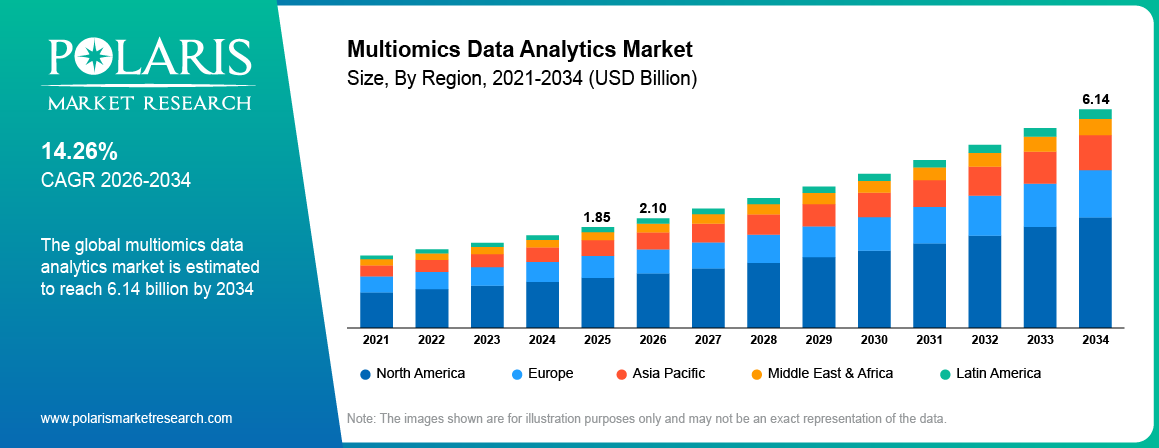
Source: Polaris Market Research Analysis
How is integrated multiomics analysis driving market growth?
Research institutes are now leveraging combinations of genomic, transcriptomic, proteomic, metabolomics, and epigenomic data sets to gain an in-depth insight into biology. Multiomics data analysis platforms make it possible to analyze the different data sets at once through one system to increase research efficiency and accelerate scientific discoveries. As an example, EASI-OMICS recently announced its integrated multiomics and data analytics offerings through a project worth USD 5.8 million under the Horizon Europe framework for a period of November 2026 to October 2030 (Source: eatris.eu).
The trend towards using analytical integrated platforms has resulted in less dependency on several independent bioinformatics tools while ensuring consistency of data in various research projects. The current trend is making the organizations shift towards acquiring scalable software tools that automate the multiomics workflow and biological data analysis.
How are artificial intelligence and cloud platforms transforming the market?
Artificial intelligence is enhancing the analysis of biological data by recognizing complicated connections within multiple omics datasets and minimizing manual interpretation processes. AI-assisted variant annotation and improved analytical algorithms have contributed towards biologically relevant data analysis as well as more accurate analytical procedures. In February 2026, Illumina introduced v1.1 of the already launched Connected Multiomics with AI-driven suggestions in workflows to help with the effective analysis of genomics, transcriptomics, epigenomics, and proteomics data (Source: developer.illumina.com).
Cloud computing has further contributed towards market growth by virtue of its scalability and infrastructure that helps store, process, and share biological data. Multiomics data integration using cloud computing allows collaboration among researchers from various institutions and also enhances access to computational resources.
What restrains the multiomics data analytics market?
Complex data integration and standardization
Data integration from different omics databases has been one of the main problems that research organizations face. There are some instances where the differences in the data format, approach, and experimentations become even harder when trying to integrate data before undertaking any analysis, something that makes the project take longer periods of time and necessitates the need for bioinformatics experts.
What opportunities exist in the multiomics data analytics market?
Growing adoption of precision medicine
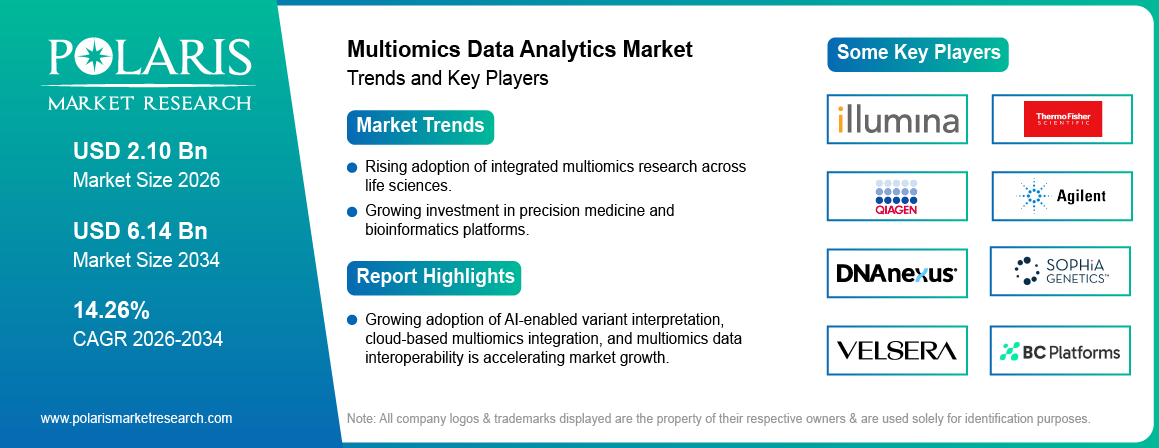
Increasing usage of precision medicine is creating immense opportunities for companies dealing in data analytics in the field of multiomics. As stated by the World Economic Forum (WEF), the precision medicine field is expected to create an investment worth USD 450 billion and create about 1.2 million jobs in the Asia Pacific region over the next ten years (Source: www.weforum.org). The integration of analytical platforms is growing in popularity in healthcare settings and research institutions, as it helps in patient stratification, discovery of biomarkers, and personalized medicine. There will be sustained investments in translational research and computational biology.
Source: Polaris Market Research Analysis
Multiomics Data Analytics Market Segmentation Analysis
The report provides a comprehensive analysis of the multiomics data analytics market by component, deployment mode, application, and region to identify the leading revenue-generating segments and emerging growth opportunities.
Multiomics Data Analytics Market by Component
Which component dominated the multiomics data analytics market?
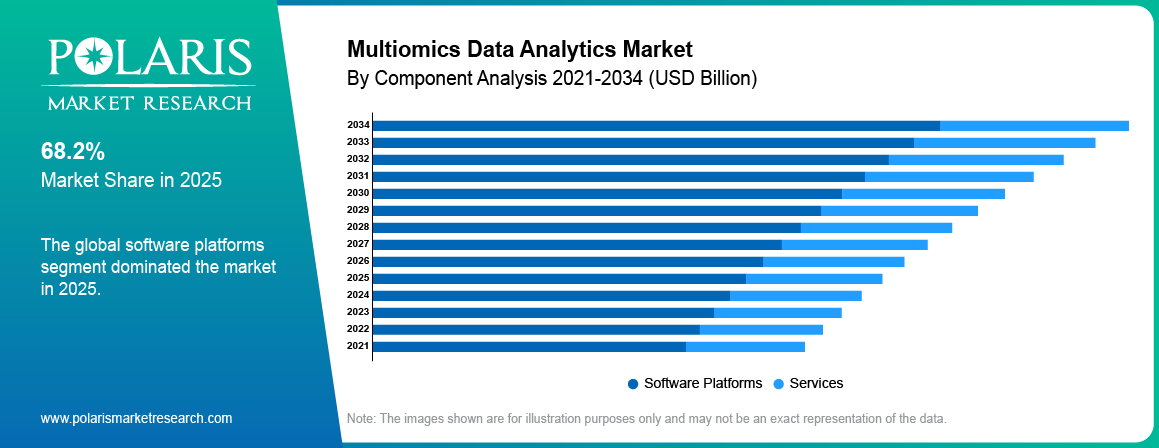
The software platforms occupied a major share of 68.2% in 2025 owing to increased needs for integrated systems that can provide a combination of data management, visualization, automation of workflows, and analytics into one system. In January 2026, Illumina launched the Connected Multiomics, an integrated system that provides multimodal data analysis, statistics, and visualization at multiple omics levels. Research institutions use the full-featured analytical platforms for ensuring the quality of data, conducting analysis of associations at the cross-omics level, and speeding up the process of research.
Which component is projected to grow at the fastest CAGR?
Services are projected to witness the fastest growth witnessing 16.12% CAGR during the forecast period. Growing implementation of multiomics platforms is increasing demand for consulting, system integration, data harmonization, training, technical support, and managed analytical services. Organizations continue to rely on specialized expertise to maximize the value of multiomics data analytics platforms.
Multiomics Data Analytics Market by Deployment Mode
Which deployment mode dominated the market?
Cloud segment occupied the largest market share of 72.1% in 2025 due to scalability, flexibility, and the potential to conduct research collaboratively among geographically scattered researchers. Cloud computing facilities make it easy to store, process, and share large data sets relating to biology.
Which deployment mode is projected to grow at the fastest CAGR?
On-premise is expected to register the fastest growth witnessing 11.24% CAGR during the forecast period. The growth is attributed to increasing need for enhanced data security, regulatory compliance, customization, and direct control over enterprise systems in the organizations dealing with sensitive operational and customer information.
Multiomics Data Analytics Market by Application
Which application dominated the multiomics data analytics market?
Drug discovery and biomarker identification accounted for the largest market share of 28.3% in 2025 due to increasing investment in precision medicine and pharmaceutical research. Multiomics data analytics allows scientists to uncover disease mechanisms, find drug targets, and enhance the results of clinical research thanks to the integration of biological data.
Which application is projected to grow at the fastest CAGR?
Clinical diagnostics is likely to register the highest growth rate of 13.44% over the forecast period. Increasing use of multiomics tools in the diagnosis, stratification of patients, and personalized treatment has stimulated investments from healthcare institutions in more advanced analytical solutions capable of performing complex molecular analyses.
Segment Summary Table
| Segment | Category | 2025 Status | Forecast CAGR | Key Driver |
| Software platforms | Component | Largest share | High | Integrated analytical capabilities |
| Services | Component | Fastest growing | Highest | Rising implementation and consulting demand |
| Cloud | Deployment | Largest share | Highest | Scalable research infrastructure |
| On-premise | Deployment | Stable | Moderate | Data security requirements |
| Drug discovery & biomarker identification | Application | Largest share | High | Precision medicine research |
| Clinical diagnostics | Application | Fastest growing | Highest | Personalized healthcare adoption |
Source: Polaris Market Research Analysis. Segment share and CAGR reflect Polaris proprietary sizing methodology.
Source: Polaris Market Research Analysis
Multiomics Data Analytics Market Regional Analysis
North America Multiomics Data Analytics Market
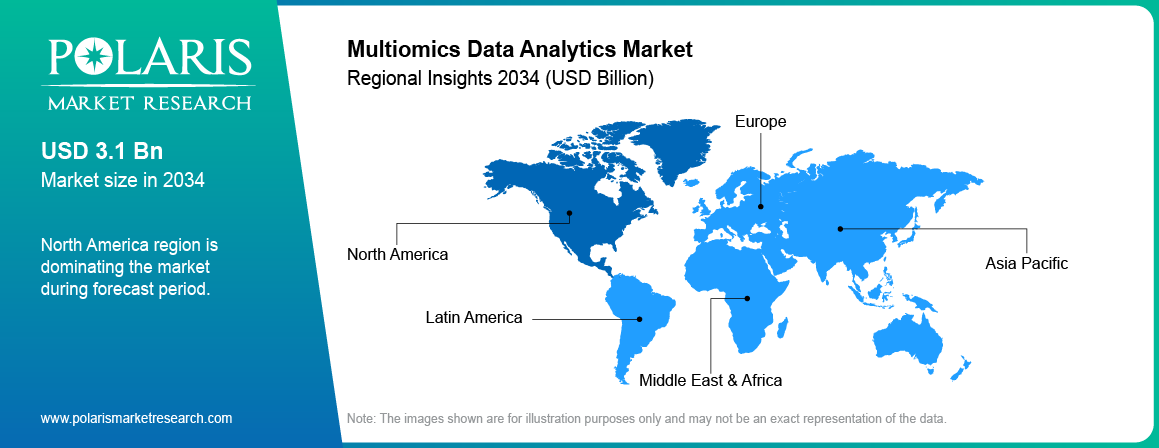
North America commands a dominant position in the market for multiomics data analytics capturing 43.1% share in 2025 owing to its developed life science environment, advanced bioinformatics solutions, and substantial investments in precision medicine studies. In February 2026, Vizgen launched its spatial multiomics roadmap by developing MERSCOPE Ultra for applications such as organoid analysis, protein co-detection, 3D spatial biology, and advanced bioinformatics (Source: vizgen.com). The cluster comprises biotech firms, pharmaceutical producers, research universities, and healthcare organizations, which produce a significant amount of multiomics data, thus sustaining the need for integrated analysis platforms. The high density of research operations in the region will continue to boost the application of cloud-enabled multiomics analysis and computing workflows.
The US continues to be the most significant contributor to the growth of the regional market with 86.0% share in 2025 due to ongoing investments in genomics, proteomics, and translational medicine. There are many organizations implementing AI-driven variant analysis, interoperability of multiomics data, and enterprise-grade analytics in order to improve biological data analysis and collaboration within research among different organizations.
Europe Multiomics Data Analytics Market
Europe held 25.0% share in 2025 due to its extensive network of academic research and increasing utilization of multiomics technologies in the pharma and biotech industries. In July 2026, Novogene Europe launched its untargeted metabolomics service in its Cambridge Omics Center to aid in metabolomics profiling and omics research (Source: eu.novogene.com). This region is constantly working on the implementation of precision medicine programs along with promoting cooperation among research institutions and healthcare providers. Such initiatives are raising the need for advanced platforms to analyze complex biological data.
The countries like Germany, the UK, France, and Switzerland act as some of the key research centers due to their highly advanced biotechnology sector and rising investments in computational biology. The increasing focus on secure data management and international scientific collaborations is further leading to the adoption of multiomics data analytics tools that can scale with time.
The United Kingdom Multiomics Data Analytics Market
This is attributed to the presence of well-developed genomics research capacities and academic institutions and an increasing number of precision medicine initiatives within the UK. In May 2026, the United Kingdom Research and Innovation Organization (UKRI) invested USD 283.41 million in health data analytics, genomics, and diagnostics to enable early diagnosis and precision medicine (Source: www.ukri.org). There is a significant amount of interest from research organizations to leverage the existing genomics capabilities and perform multiomics studies.
There is increasing cooperation between universities, hospitals, and biotech firms that is leading to the adoption of multiomics data analytics services. There is increasing need for data security and advanced analytics capabilities that will drive the market growth over the next few years.
Asia Pacific Multiomics Data Analytics Market
Asia Pacific is set to experience the fastest growth rate of 17.82% during the forecast period due to the increased research, development of new technologies in biotechnology, and advancement in national genomics programs. The governments and research institutions are putting in place advanced computing systems to enable biological data analysis and the implementation of precision medicine. In August 2026, Ooredoo invested an estimated USD 800 million in Zankore for AI computing infrastructure in Southeast Asia aimed at providing 1 GW of NVIDIA AI Factory capacity (Source: www.ooredoo.com). The investments have resulted in the creation of considerable demand for multiomics data analytics platforms.
China, Japan, India, and South Korea are some of the countries that are spearheading the regional market through increasing their life sciences research and implementing the use of digital research infrastructure. Other organizations are embracing multiomics workflows, automation, and cloud-based analytics environments as a means of improving their research process and handling large biological data sets.
Middle East and Africa Multiomics Data Analytics Market
The Middle East and Africa present a developing market that will be driven by the growing investments in biomedical research, innovation in the healthcare sector, and the development of the life sciences industry. Countries within this region are investing in their research facilities to improve genomics, precision medicine, and digital health initiatives.
The UAE, Saudi Arabia, Israel, and South Africa are driving regional adoption by making higher investments in biotech research and advanced computing systems. Although the adoption of the industry is still at its initial stages in many regions, continuous advancements in terms of research and digital health are anticipated to drive steady market growth.
Source: Polaris Market Research Analysis
Regulatory Heatmap
| Country | Policy Environment | Key Regulations | Market Implication | Trend |
| US | Favorable | Data management and sharing initiatives | Encourages secure data sharing and interoperability | Expanding |
| Europe | Favorable | Data privacy and research data governance | Supports responsible multiomics research | Expanding |
| UK | Favorable | National genomics and health data initiatives | Strengthens precision medicine research | Growing |
| Japan | Favorable | National life sciences research programs | Accelerates adoption of analytical platforms | Growing |
| China | Developing | Genomics and biotechnology development programs | Expands research infrastructure | Developing |
| India | Developing | Digital health and biotechnology initiatives | Increases investment in bioinformatics | Developing |
Source: Polaris Market Research Analysis; National Institutes of Health (NIH), European Commission, UK Government, NHS England, Ministry of Health, Labour and Welfare (Japan), National Health Commission of China, Department of Biotechnology (India)
Multiomics Data Analytics Market Competitive Landscape
The multiomics data analytics market is moderately competitive, with software providers, cloud platform vendors, bioinformatics companies, and life sciences technology providers focusing on expanding integrated analytical capabilities. Firms compete with each other by providing holistic platforms that integrate data integration, visualization, artificial intelligence, and cloud computing capabilities for enhanced interpretation of biological data from a number of omics.
The market players are focusing on enhancing their platform capabilities, developing partnerships, innovating their products, and automating their analysis process to build a competitive edge. The rising need for interoperable multiomics data, enterprise data platforms, and automated analysis through AI is driving vendors to provide scalable solutions for pharma research and precision medicine programs.
Competition is also rising among organizations that have been expanding their multiomics cloud integration capabilities and providing collaborative research environments. Vendors that provide flexible deployment options, automated workflows, and advanced biological data analysis are expected to strengthen their market position during the forecast period.
Competitive Positioning Matrix
| Company | Est. Market Position | Primary Focus | Geographic Focus |
| Illumina | Leading player | Multiomics analytics platform | Global |
| Thermo Fisher Scientific | Leading player | Bioinformatics solutions | Global |
| QIAGEN N.V. | Leading player | Omics data analysis software | Global |
| Agilent Technologies, Inc. | Strong player | Multiomics analytical solutions | Global |
| DNAnexus, Inc. | Strong player | Cloud multi-omics data platform | Global |
| Velsera | Strong player | Cloud multi-omics analytics | North America, Europe |
| SOPHiA GENETICS SA | Emerging player | AI-driven genomic analytics | Europe, North America |
| BC Platforms | Emerging player | Multi-omics and real-world data integration | Global |
| Partek Incorporated | Emerging player | Multi-omics analytics software | North America |
| Rancho BioSciences | Emerging player | Multi-omics data curation and services | North America |
| Pythia BioSciences | Emerging player | Multi-omics data curation and analytics | North America |
Source: Polaris Market Research Analysis, Company filings and press release
Technology and Innovation Landscape
Technology development in the multiomics data analytics market is focused on improving data integration, analytical accuracy, and research efficiency across multiple omics datasets. Organizations are increasingly adopting AI-enabled analytical models, cloud-native computing environments, and automated workflows to process growing volumes of biological data. These technological advances are helping in developing full biological insights with less complexity in the analysis process.
Multiomics integration in a cloud environment is emerging as one of the important technology trends as researchers look for scalable platforms that can be used for collaborative work at different organizations and research teams. An integrated analytics environment allows researchers to integrate genomics, transcriptomics, proteomics, metabolomics, and epigenomics data within one platform.
Greater investments in multiomics data interoperability, enterprise data platform licensing, and cross-omics associations have continued to boost innovations in the market. The software vendors have continued to improve the functionalities of their platforms by incorporating functionalities such as data harmonization, advanced visualizations, and workflow automation for multiomics research.
| Technology | Adoption Stage | Key Development | Market Impact |
| AI-enabled variant interpretation | Growing | AI-assisted biological data analysis | Improves analytical accuracy and reduces interpretation time |
| Cloud-based multiomics integration | Growing | Cloud-native analytical platforms | Enhances scalability and research collaboration |
| Multiomics workflow automation | Early commercial | Automated analytical workflows | Improves research efficiency and productivity |
| Multiomics data interoperability | Growing | Integrated data exchange capabilities | Simplifies cross-platform biological analysis |
| Cross-omics association analysis | Early commercial | Advanced multiomics correlation tools | Generates deeper biological insights |
Source: Polaris Market Research Analysis, press release, and IP & patent filings
Buyer Use Cases
Multiomics data analytics platforms are adopted by organizations to enhance biological data analysis, speed up drug discovery, and facilitate precision medicine studies. In pharmaceutical firms, such platforms are used in the identification of biomarkers and therapeutic targets, as well as increasing the efficiency of conducting clinical research. Biotech companies and research organizations depend on the use of an integrated analytics platform to ease the management of biological data sets.
There are relatively high entry barriers in the market because of the technical difficulty involved in integrating multiple omics datasets, computing power, and demand for scalable computational infrastructure. For new market entrants, it is necessary to have platforms that can accommodate multiomics data integration on cloud technology, artificial intelligence, data storage, and multiomics data interoperability, all while ensuring the accuracy of analyses.
Buyer Decision Framework
| Buyer / Investor Type | Primary Use Case | Key Insight Sought | Decision Horizon |
| Pharmaceutical companies | Drug discovery and biomarker identification | Integrated analytical capabilities | 2–5 years |
| Biotechnology companies | Multiomics research | Platform scalability and automation | 2–4 years |
| Academic & research institutions | Biological data integration | Data interoperability and collaboration | 1–3 years |
| Healthcare organizations | Precision medicine research | Clinical research support | 3–5 years |
| Investors | Market expansion opportunities | Technology adoption and competitive landscape | 3–7 years |
Source: Polaris Market Research Analysis
Premium Insights and Forward Outlook
The multiomics data analytics market is poised to witness continuous growth due to rising adoption of integrated analytics tools by research organizations for advancing precision medicine, translational research, and biological discovery. Increased use of cloud-based analytics solutions, artificial intelligence, and automation solutions is likely to increase the efficiency of research while allowing researchers to conduct an elaborate analysis of biological systems.
Future market growth will be supported by increasing adoption of multiomics data interoperability, enterprise data platform licensing, and advanced computational biology across pharmaceutical companies, biotechnology firms, healthcare organizations, and academic institutions. Companies that continue investing in scalable analytical platforms, workflow automation, and integrated biological data management are expected to strengthen their competitive position throughout the forecast period.
Key Players in the Multiomics Data Analytics Market
- Illumina, Inc.
- Thermo Fisher Scientific Inc.
- QIAGEN N.V.
- Agilent Technologies, Inc.
- DNAnexus, Inc.
- SOPHiA GENETICS SA
- Velsera
- BC Platforms
- Partek Incorporated
- Rancho BioSciences
- Pythia BioSciences
Recent Developments
- July 2026: Pythia BioSciences and Lexogen partnered to unify multi-omics data curation and analytics, combining Lexogen's RNA sequencing capabilities with Pythia's data curation and analytics platform to support drug discovery cohort building. (Source: bio-itworld.com)
- May 2026: Rancho BioSciences introduced its OmicsHQ platform, which provides a standardized analysis for multiomics data for drug discovery and AI/ML. (Source: prnewswire.com)
- February 2026: BC Platforms partnered with OmicsBank to add real-world multi-omics data from India and the UAE to its network, expanding its global patient catchment to more than 187 million lives across 35-plus countries. (Source: prnewswire.com)
- January 2026: Illumina launched the Connected Multiomics platform that utilizes AI analytics for processing of large-scale omics datasets including genomics, transcriptomics, proteomics, and epigenomics in a cloud-based environment. (Source: www.illumina.com)
Market Segmentation
By Component Outlook (Revenue, USD Billion, 2021–2034)
- Software Platforms
- Services
By Deployment Mode Outlook (Revenue, USD Billion, 2021–2034)
- Cloud
- On-premise
By Application Outlook (Revenue, USD Billion, 2021–2034)
- Drug Discovery & Biomarker Identification
- Clinical Diagnostics
- Precision Medicine
- Translational Research
- Academic & Life Sciences Research
- Others
By Regional Outlook (Revenue, USD Billion, 2021-2034)
- North America
- US
- Canada
- Europe
- Germany
- France
- UK
- Italy
- Spain
- Netherlands
- Russia
- Rest of Europe
- Asia Pacific
- China
- Japan
- India
- Malaysia
- South Korea
- Indonesia
- Australia
- Vietnam
- Rest of Asia Pacific
- Middle East & Africa
- Saudi Arabia
- UAE
- Israel
- South Africa
- Rest of Middle East & Africa
- Latin America
- Mexico
- Brazil
- Argentina
- Rest of Latin America
Multiomics Data Analytics Market Report Scope
This report provides a comprehensive assessment of the global multiomics data analytics market across component, deployment mode, application, and region. It evaluates market trends, growth drivers, competitive landscapes, technology advancements, and future opportunities influencing adoption of multiomics data analytics solutions across pharmaceutical companies, biotechnology firms, academic research institutions, and healthcare organizations.
| Report Attributes | Details |
| Market Size in 2025 | USD 1.85 Billion |
| Market Size in 2026 | USD 2.10 Billion |
| Revenue Forecast by 2034 | USD 6.14 Billion |
| CAGR | 14.26% from 2026 to 2034 |
| Base Year | 2025 |
| Historical Data | 2021–2024 |
| Forecast Period | 2026–2034 |
| Quantitative Units | Revenue in USD Billion and CAGR from 2026 to 2034 |
| Report Coverage | Revenue Forecast, Competitive Landscape, Growth Factors, and Industry Trends |
| Segments Covered |
|
| Regional Scope |
|
| Competitive Landscape |
|
| Report Format |
|
| Customization | Report customization as per your requirements with respect to countries, regions, and segmentation. |
Multiomics Data Analytics Market Research Methodology
This report combines secondary research with primary industry validation to assess technology adoption, competitive developments, and investment trends across the multiomics data analytics market. Secondary research includes publications from the National Institutes of Health (NIH), National Human Genome Research Institute (NHGRI), European Medicines Agency (EMA), European Bioinformatics Institute (EMBL-EBI), Global Alliance for Genomics and Health (GA4GH), company annual reports, investor presentations, regulatory publications, scientific journals, and industry associations. Company disclosures from Illumina, Thermo Fisher Scientific, QIAGEN, Agilent Technologies, Bruker Corporation, SOPHiA GENETICS, and other leading participants were reviewed to evaluate product innovation and market strategies.
The sources of primary research comprise interviews with the CEOs of biotechnology and pharma companies, bioinformatics platform suppliers, research institutes, healthcare facilities, and industry experts to verify the market assumptions and measure the extent of technology adoption, customer requirements, deployment, and future investments.
Both the top-down and bottom-up approaches are used for market sizing. The top-down approach comprises analysis of spending on bioinformatics software, life sciences analytics, precision medicine, and computational biology, whereas the bottom-up approach includes assessment of revenue, software installations, analytical services requirements, and customer adoption in major geographical regions. Both the top-down and bottom-up approaches are verified with data triangulation of the primary research results with government documents, regulatory bodies, company filings, scientific literature, and industry databases.
Multiomics Data Analytics Market – Research Methodology Overview
| Research Phase | Key Activities | Data Sources | Purpose |
| Secondary research | Review of market trends, company strategies, and regulations | NIH, NHGRI, EMA, EMBL-EBI, GA4GH, company reports, scientific journals, and industry associations | Establish market trends and competitive landscape |
| Primary research | Interviews with industry experts and stakeholders | Biotechnology companies, pharmaceutical firms, research institutions, healthcare organizations, and consultants | Validate market assumptions and demand trends |
| Market sizing & forecasting | Top-down, bottom-up estimation, and data triangulation | Company revenues, technology adoption, government publications, and industry databases | Estimate market size and forecast growth |
| Data validation | Cross-verification of research findings | Primary interviews and secondary sources | Ensure data accuracy and consistency |
| Secondary research | Review of market trends, company strategies, and regulations | NIH, NHGRI, EMA, EMBL-EBI, GA4GH, company reports, scientific journals, and industry associations | Establish market trends and competitive landscape |
Source: Polaris Market Research Analysis
Multiomics Data Analytics Market FAQ's
The multiomics data analytics market is expected to grow at 14.26% CAGR, driven by increasing adoption of integrated omics analysis.
Market growth is being fueled by the increased demand for analytics-integrated systems, artificial intelligence platforms, and precision medicine.
North America has dominated the market with 43.1% share in 2025 due to the presence of advanced research infrastructure and biotechnology industry.
Software platforms held the largest market share of 68.2% in 2025.
On-premise has been forecasted to witness rapid growth at a CAGR of 11.24% during the forecast period.
Drug discovery and biomarker identification segments occupied the largest market share of 28.3% in 2025.
The complexity of data integration and its non-standardization remain major issues.
Precision medicine, AI-enabled analytics, and cloud-based multiomics integration are creating new growth opportunities.
The major players in the market include Illumina, Thermo Fisher Scientific, QIAGEN, Agilent Technologies, DNAnexus, SOPHiA GENETICS, Velsera, BC Platforms, Partek Incorporated, Rancho BioSciences, and Pythia BioSciences.
In July 2026, Pythia BioSciences and Lexogen partnered to unify multi-omics data curation and analytics. Other recent developments include Rancho BioSciences' OmicsHQ platform launch, BC Platforms' partnership with OmicsBank, and Illumina's Connected Multiomics platform release.
Download Sample Report of Multiomics Data Analytics Market
Please fill out the form to request a customized copy of the research report.


