
Multiomics Market Size, Share, Trends and Forecast, 2026-2034
REPORT DETAILS
Multiomics Market Summary
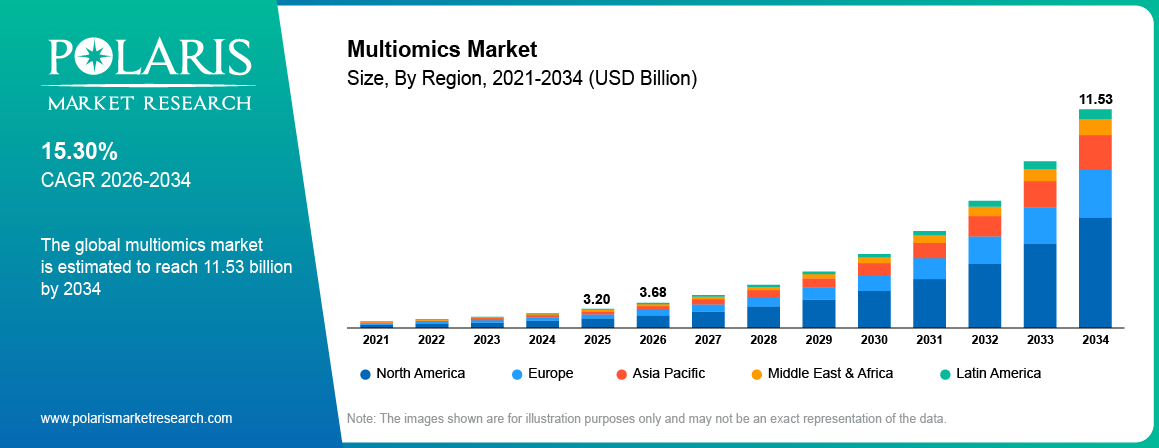
Multiomics Market size was valued at USD 3.20 Billion in 2025. The multi-omics industry is anticipated to grow from USD 3.68 Billion in 2026 to USD 11.53 Billion by 2034, exhibiting a CAGR of 15.30% during the forecast period.
Market Statistics
Key Takeaways
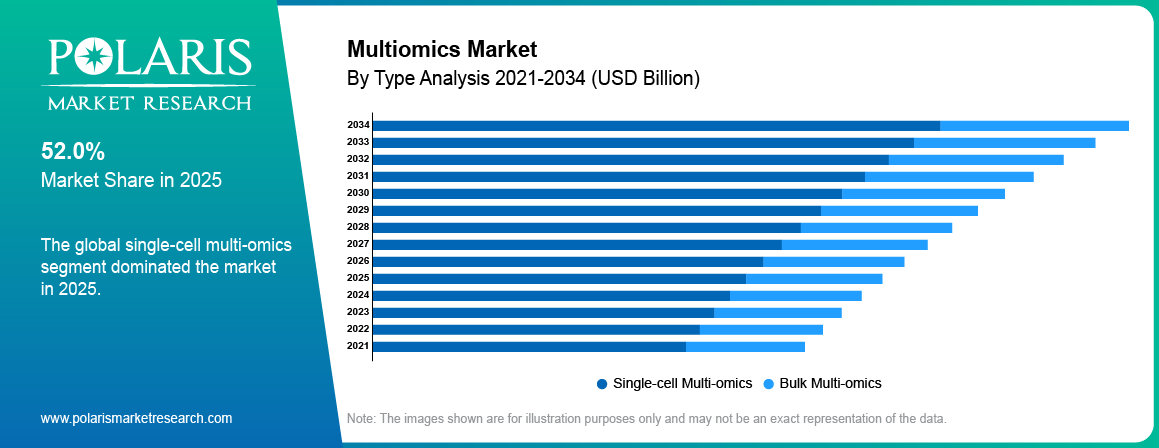
- North America held the largest share of the multiomics market in 2025, accounting for 38.0% of revenue. The region is growing because of strong research, more industry partnerships, and increasing cases of chronic diseases.
- Europe is expected to grow at the fastest CAGR of 14.9% during 2026–2034. Government help for genomics research and more healthcare research projects are helping the market grow.
- The Product & Service segment had the largest share of 76.0% in 2025. Large demand for instruments, consumables, and multiomics products is driving the segment.
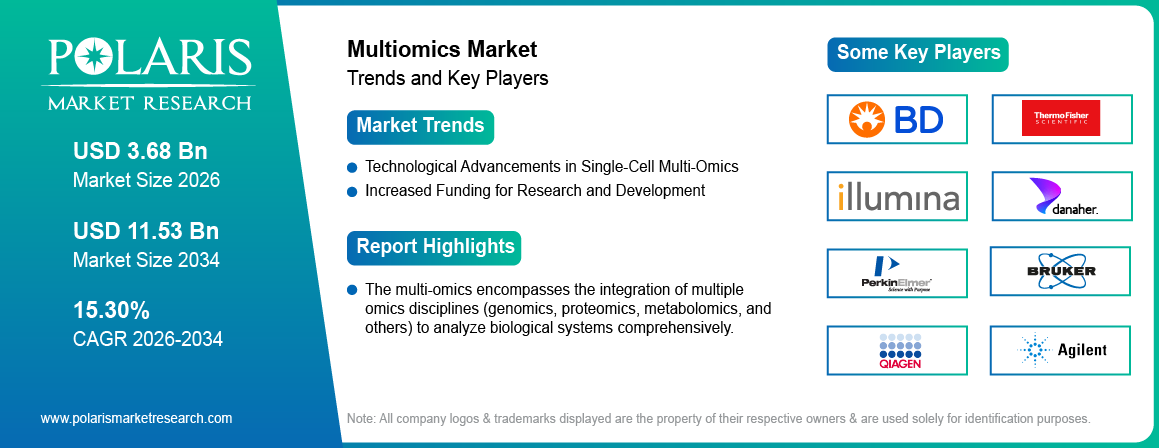
- The Single-Cell Multi-Omics segment accounted for the largest revenue share of 52.0% in 2025. The market growth is being driven by the increasing application in cancer research, gene therapy and single-cell studies.
- The Metabolomics platform is projected to grow at the fastest CAGR of 14.8% from 2026 to 2034. This is due to its growing application in customized healthcare and drug discovery.
- The Genomics platform was the largest revenue contributor in 2025 with 32.0%. The segment’s growth being supported by advances in sequencing technology and declining sequencing costs.
Note: Figures and projections outlined in this report are the result of Polaris Market Research’s proprietary analytical processes, grounded in the latest available datasets and market observations.
AI Impact on Multiomics Data Integration, Biomarker Discovery and Drug Research
- AI helps in analyzing multi-omics data by processing complex and voluminous datasets at a faster pace.
- AI helps in identifying biomarkers and disease patterns, which helps precision medicine.
- By improving target identification and research efficiency AI accelerates drug discovery.
- AI supports in automating data integration and interpretation. It reduces analysis time and improves accuracy.
What Is Multiomics?
Multiomics uses data from genes, proteins, metabolites and cells to provide a more complete picture of biological processes. It looks at these different layers together rather than separately using omics technologies. This allows investigators to better understand diseases, discover treatment targets, improve diagnosis and support personalized healthcare research for better patient care.
Multiomics in Simple Terms
Multiomics means studying different types of biological data together, such as genes, RNA, proteins, and metabolites. This combined approach helps researchers better understand diseases, identify biomarkers, support drug discovery, and develop more personalized treatments.
How Multiomics Analysis Works
Multiomics starts with collecting biological samples. These samples include blood or tissue. For molecular profiling scientists analyze DNA, RNA, proteins, and metabolites. Advanced omics technologies generate data from each analysis. Then computational biology and bioinformatics tools integrate all datasets. Machine learning and artificial intelligence analyze the integrated data. This is critical to detect trends, biomarkers and disease related changes. To better understand diseases, researchers apply these findings. The results contribute to improve diagnosis, support drug discovery and guide personalized healthcare.
To Understand More About this Research: Download Sample Report
Market Dynamics
Market Driver – Rising Adoption of Single-Cell and Spatial Multiomics
Technological advancements play an important role in driving the growth of the multiomics market. Single-cell multi-omics integrated with advanced technology such as AI and data analytics enable in-depth analysis of individual cells and provide insights into proteomics, metabolomics, genomics, & transcriptomics. These advances among players have formed strategic partnerships and collaborations to cater to the demand for single-cell multi-omics-based software. For instance, in January 2025, Illumina collaborated with NVIDIA to advance the analysis and interpretation of multiomic data using AI. The collaboration combines Illumina’s sequencing and multiomics analysis capabilities with NVIDIA’s AI and accelerated computing technologies to support drug discovery, clinical research, and precision health(Source: www.illumina.com).
Market Driver – Rising Research Funding and Pharmaceutical R&D Investment
Increased funding for research and development plays a significant role in driving the multiomics market. Various government agencies and market players invested to increase advancement in human health and disease. Industry academia collaboration focuses on the new technology development for multi-omics applications, paves the importance for personalized medicine in early disease diagnosis. For instance, in June 2026, the National Institutes of Health’s All of Us Research Program added multiomics data from nearly 10,000 participants with proteomics data and nearly 9,000 with RNA sequencing data. The program now provides researchers with data from more than 747,000 participants, supporting research on human health and precision medicine(Source: www.nih.gov).
Market Opportunity – Proteogenomics and Proteomics in Multiomics Research
Proteomics is an important part of multiomics because it focuses on proteins, which perform most functions inside cells. It is used for identification of proteins, functional biology studies, biomarker discovery, drug response monitoring and disease pathway analysis. The integration of proteomics with molecular profiling and computational biology provides more in depth understanding of disease development and treatment response. Data of the protein level provide information beyond that of the genome data alone and this is what makes the multiomics to be more beneficial for research and clinical use.
Market Opportunity – Multiomics in Precision Medicine and Precision Oncology
Multiomics is changing the way precision medicine is developed and used. By combining different types of biological data, it allows researchers and healthcare professionals to select more personalized treatments, group patients based on their disease profiles, predict disease risk, and improve precision oncology. It also plays an important role in precision healthcare and personalized medicine research. As research continues to grow, multiomics is becoming an important part of next-generation healthcare systems.
Market Restraint – High Instrument, Sequencing and Data-Analysis Costs
The higher investment in advanced technology, such as data analytics, artificial intelligence, machine learning, and others, due to the complexity of data integration, hinders the market's growth. High expenses may restrict innovation and impede the pace of technological advancement in the multi-omics industry, potentially hindering market demand in the coming years.
Multiomics Market Size, Scope and Growth Outlook
The multi-omics encompasses the integration of multiple omics disciplines (genomics, proteomics, metabolomics, and others) to analyze biological systems comprehensively. It enables holistic insights into complex biological phenomena, driving advancements in personalized medicine and precision agriculture. The multiomics market growth is driven by advancements in technology such as cloud-based and single-cell technology, increased investment in R&D, and rising demand for better diagnostic tests. For instance, in June 2025, SCIEX offers the OneOmics Suite, a cloud-based platform designed to process and analyze large and complex datasets across proteomics, metabolomics, genomics, and multiomics applications. The platform supports data management, quantification, visualization, statistical analysis, and pathway analysis, helping researchers integrate different omics datasets and derive biological insights (Source: https://sciex.com).
Furthermore, the rising chronic diseases such as diabetes, cancer, heart disease, and others facilitate the need for multi-omics software or solutions to understand complex molecular data. This increasing prevalence of chronic diseases drives the multiomics market during the forecast period. According to the World Health Organization’s Cardiovascular Diseases fact sheet, updated on July 31, 2025, cardiovascular diseases remain the leading cause of death globally. The report states that 19.8 million people died from cardiovascular diseases in 2022 (Source: https://www.who.int).
Moreover, increasing collaboration and partnership among key players such as Thermo Fisher Scientific, Lunaphore, & Bruker facilitates multiomics market growth. For instance, in April 2023, Bio-Techne & Lunaphore partnered to develop an automated same-slide spatial multi-omics solution(Source: https://lunaphore.com). This collaboration aims to create advanced technology that enables the detection of protein and RNA biomarkers on the same slide and the understanding of disease mechanisms for improved therapeutics and diagnostics.
Multiomics vs. Single-Omics Approaches
| Feature | Multiomics | Single-Omics |
| Data Source | Integrates multiple biological layers (genomic, transcriptomic, proteomic, metabolomic) | Uses one type of biological data |
| Biological Insights | Gives a comprehensive, systems-level understanding | Provides limited, layer-specific insights |
| Precision Medicine | Better supports personalized treatment selection | Offers moderate support |
| Biomarker Discovery | Identifies biomarkers more effectively across layers | Identifies fewer, less cross-validated biomarkers |
| Cost & Complexity | Higher cost; more complex to perform and analyze | Lower cost; simpler to perform and analyze |
| Typical Use Case | Cancer subtyping, drug target validation, rare disease research | Routine genetic screening, single-marker diagnostics |
Source: Polaris Market Research Analysis
Role of Genomics in Multiomics
Genomics provides foundational genetic data for multiomics research. It helps researchers identify genetic variations, study disease-related genes, and understand biological processes. When combined with transcriptomics, proteomics, and metabolomics, genomic data provides a broader view of disease mechanisms and biological functions. This integration supports biomarker discovery, drug development, and precision medicine. The growing use of advanced sequencing technologies and data analysis tools is also expanding the role of genomics in multiomics research. As pharmaceutical companies, biotechnology firms, and research institutions increasingly adopt integrated omics approaches, genomics is becoming an important part of research and development workflows. These applications are expected to support demand for sequencing platforms, consumables, software, and related multiomics services.
Transcriptomics and Gene Expression Analysis
Transcriptomics and gene expression analysis are important components of multiomics research. Transcriptomics helps researchers study RNA molecules and understand how genes are expressed under different biological conditions. When combined with genomic, proteomic, and metabolomic data, it provides deeper insights into disease mechanisms, cellular functions, and treatment responses. These applications support biomarker discovery, drug development, and precision medicine. Growing demand for advanced sequencing technologies and data analysis tools is also increasing the use of transcriptomics in pharmaceutical, biotechnology, and academic research.
Importance of Proteomics in Multiomics
Proteomics plays an important role in multiomics by providing detailed information about proteins and their functions. It helps researchers study protein expression, interactions, and changes associated with diseases and biological processes. When integrated with genomic, transcriptomic, and metabolomic data, proteomics provides a broader understanding of disease mechanisms and treatment responses. These applications support biomarker discovery, drug development, and precision medicine. Growing demand for advanced protein analysis technologies is also increasing the use of proteomics across pharmaceutical, biotechnology, and academic research.
Metabolomics and Cellular Function Analysis
Metabolomics provides insights into the small molecules and metabolic changes within cells. It helps researchers understand cellular functions, metabolic pathways, and biological responses. When combined with genomics, transcriptomics, and proteomics, metabolomics supports a more comprehensive view of biological systems. These applications are increasing demand for advanced metabolomics platforms, analytical tools, and data analysis solutions across pharmaceutical, biotechnology, and academic research. Metabolomics also supports drug discovery, biomarker identification, and personalized medicine, creating further opportunities for market growth.
Multiomics Market Segment Analysis
Multiomics Market Segmentation by Product, Type, Platform, Technology, Application and End User
| By Product & Service | By Type | By Platform | By Application | By Region |
|
|
|
|
|
Source: Polaris Market Research Analysis
Multiomics Market by Product and Service: Instruments, Consumables, Software and Services
The Product & Service segment held the largest revenue share of 76.0% in 2025, driven by strong demand for instruments, consumables, and multiomics products. Moreover, the growing adoption of single-cell multi-omics with the integration of advanced technology further boosts the segment’s growth in the multiomics market. For instance, For instance, in January 2025, BD and Hamilton collaborated to standardize single-cell multi-omics applications using robotics (Source: investors.bd.com). This collaboration aims to enable greater standardization and reduce human error while conducting large-scale single-cell multi-omics experiments.
Multiomics Market Size by Product & Service
| Segment | 2025 (USD Bn) | 2026E (USD Bn) | Share, 2025 |
| Instruments | 1.35 | 1.53 | 42% |
| Consumables | 0.74 | 0.85 | 23% |
| Software | 0.35 | 0.40 | 11% |
| Services | 0.76 | 0.90 | 24% |
| Total | 3.20 | 3.68 | 100% |
Source: Polaris Market Research Analysis
By Type Analysis
The Single-Cell Multi-Omics segment held the largest market share of 52.0% in 2025, driven by its increasing applications in cancer research, gene therapy, and single-cell studies. Also, market players are introducing products integrated with AI, leading to a growing demand for single-cell multi-omics products. For example, in April 2025, 1Cell.Ai partnered with BioSkryb Genomics to advance single-cell multiomics research. The collaboration combines BioSkryb’s single-cell amplification technology with 1Cell.Ai’s OncoIncytes platform to support cancer research and accelerate drug discovery(Source: 1cell.ai)
Single-cell multi-omics technologies enable the simultaneous profiling of multiple molecular layers, such as the genome, epigenome, transcriptome, and proteome, within individual cells. This provides unprecedented opportunities to explore cellular diversity and heterogeneity by revealing regulatory connections between different omics layers.
The Bulk Multi-Omics segment is projected to grow at a significant CAGR of 12.30% during the forecast period. This growth is primarily due to advantages such as the simplicity of the process, the ability to dissect large-scale samples, and cost-effectiveness. Moreover, expanding applications in personalized medicine and drug discovery also drive the segment’s growth in the multiomics market.
Multiomics Market Size by Type
| Type | 2025 (USD Bn) | 2026E (USD Bn) | CAGR Signal |
| Single-Cell Multiomics | 1.66 | 1.95 | Fastest-growing (cancer, gene therapy demand) |
| Bulk Multiomics | 1.54 | 1.73 | Larger base; steady growth |
| Total | 3.20 | 3.68 | — |
Source: Polaris Market Research Analysis
Multiomics Market by Platform: Genomics, Transcriptomics, Proteomics and Metabolomics
Multiomics Market by Application: Cell biology, oncology, neurology, and immunology
Multiomics is gaining adoption across cell biology, oncology, neurology, and immunology, creating demand for advanced sequencing, analytical platforms, software, and research services. Oncology remains an important application area due to the growing need for biomarker discovery and precision cancer treatment. Neurology and immunology are also expanding areas as pharmaceutical companies and research institutions use multiomics to understand complex diseases and identify potential therapeutic targets. Cell biology applications further support demand for integrated tools that analyze multiple biological data types.
The Metabolomics Segment is Expected to Witness the Highest Growth
The metabolomics segment is projected to grow at the highest CAGR of 14.8% from 2026 to 2034, driven by technological advancements in metabolomics platforms and expanding applications in personalized medicine and drug discovery.For instance, in May 2025, Bruker launched the timsMetabo mass spectrometer for 4D metabolomics and 4D lipidomics. The platform uses advanced mass spectrometry technology to improve sensitivity, molecular separation, and metabolite identification, supporting research in drug discovery and precision medicine (Source: www.bruker.com).
The Genomics segment held the largest revenue share of 32.0% in 2025. The advancements in genomic data analysis tools and decreasing costs of sequencing technologies drive the segment growth. Market players like Biomodal are introducing new products and solutions for new epigenetic and pedigree analysis. For instance, in October 2025, Biomodal launched its Certified Service Provider program for duet multiomics 5-base and 6-base sequencing solutions. The solutions provide genetic and epigenetic information from a single low-input DNA sample, supporting advanced genomic and epigenetic analysis (Source: biomodal.com).
Multiomics Market Size by Platform (illustrative template)
| Platform | 2025 (USD Bn) | 2026E (USD Bn) | Note |
| Genomics | 1.02 | 1.14 | Largest revenue share (32%, 2025) |
| Transcriptomics | 0.64 | 0.70 | — |
| Proteomics | 0.58 | 0.66 | — |
| Metabolomics | 0.51 | 0.63 | Fastest CAGR (14.8%) |
| Integrated Omics Platforms | 0.45 | 0.55 | — |
| Total | 3.20 | 3.68 | — |
Source: Polaris Market Research Analysis
Common Applications of Multiomics
| Use Case | Used In |
| Cancer biomarker discovery | Used in early cancer detection and treatment planning. |
| Precision medicine development | Used in developing personalized treatments. |
| Drug target identification | Used in finding new drug targets. |
| Rare disease research | Used in studying rare genetic disorders. |
| Clinical diagnostics | Used in improving disease diagnosis. |
| Immunology studies | Used in studying immune system responses. |
| Neurological disease research | Used in researching brain and nervous system disorders. |
| Microbiome analysis | Used in studying the role of microorganisms in health. |
| Agricultural biotechnology | Used in improving crop quality and disease resistance. |
| Personalized treatment planning | Used in selecting the most suitable treatment for patients. |
Source: Polaris Market Research Analysis
Multiomics Market Regional Analysis
The North American Region Registered the Largest Share of the Global Market in 2025
The North America multiomics market held the dominant share of 38.0% in 2025, owing to the presence of key players, collaborations among the industry and research community, and investments in multiomics applications. Further, the rising chronic diseases in the region also boost the multiomics market growth. According to the Canadian Cancer Society’s Canadian Cancer Statistics 2025, an estimated 254,800 new cancer cases and 87,400 cancer deaths were expected in Canada in 2025. The high cancer burden is increasing the need for advanced genomic and multiomics technologies for disease research, biomarker discovery, and precision medicine (Source: https://cdn.cancer.ca) For instance, in February 2025, Illumina and Broad Clinical Labs announced a collaboration to scale single-cell research and support the development of a 5-billion-cell atlas within three years. The collaboration combines single-cell technologies and research capabilities to advance disease research and precision health (Source: https://emea.illumina.com).
The Europe multiomics market is expected to grow at the fastest CAGR of 14.9% during 2026–2034, driven by government support for genomics research and growing healthcare research projects.For instance, France's government launched the France Genomic Medicine Plan 2025. The objective of this plan is to leverage the French healthcare system with closer integration of research, training, and innovation to enhance healthcare services and improve quality of life.
Asia Pacific Multiomics Market
The Asia Pacific multiomics market is supported by growing investments in genomics and life sciences research. Increasing research activities, healthcare development, and adoption of advanced sequencing technologies are creating opportunities for multiomics solutions across the region. Pharmaceutical companies, biotechnology firms, and research institutions are increasingly using multiomics for drug discovery, biomarker research, and precision medicine. Government support for genomics research and expanding healthcare infrastructure are also contributing to market growth. Countries such as China, Japan, and India are strengthening their research capabilities, which is expected to increase demand for multiomics platforms, instruments, consumables, software, and related services.
Latin America Multiomics Market
The Latin America multiomics market is supported by growing investments in healthcare research and life sciences. Increasing adoption of advanced genomic technologies and research activities is creating opportunities for multiomics solutions. Pharmaceutical companies, biotechnology firms, and research institutions are using multiomics for drug discovery, biomarker research, and disease analysis. Growing healthcare needs and improving research infrastructure are also expected to support market growth across the region.
Middle East & Africa Multiomics Market
The Middle East & Africa multiomics market is supported by growing investments in healthcare and life sciences research. Increasing adoption of advanced genomic technologies and improving research infrastructure are creating opportunities for multiomics solutions. Pharmaceutical companies, biotechnology firms, and research institutions are exploring multiomics for drug discovery, biomarker research, and disease analysis.
Multiomics Market Competitive Landscape and Strategic Partnerships
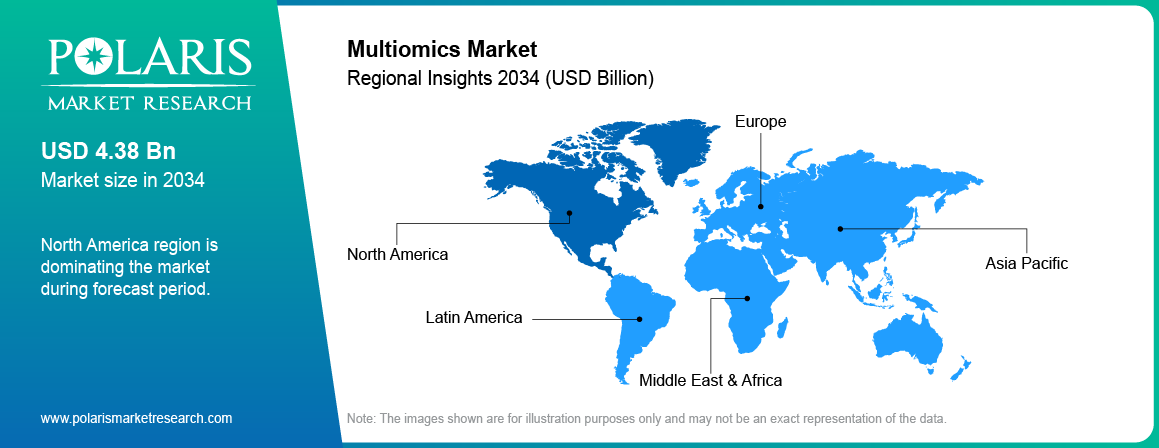
The growing investments in R&D for drug discovery and new technology are positively impacting the global multiomics market. The ongoing expansion initiatives, including partnerships, acquisitions, and collaborations, are fueling competition in the marketplace. For instance, in January 2025, Thermo Fisher Scientific partnered with the UK Biobank Pharma Proteomics Project to support a large-scale human proteomics study. The project uses the Olink Explore platform to analyze more than 5,400 proteins from 600,000 samples, supporting biomarker discovery and disease research (Source: https://ir.thermofisher.com).
Illumina, Inc. is a leading player in the multiomics market, offering sequencing, single-cell, spatial, proteomic, and multiomics analysis solutions. The company continues to expand its multiomics capabilities through new technologies and partnerships. In February 2025, Illumina introduced new multiomics and single-cell solutions designed to support large-scale biological research, drug screening, and disease studies.
Thermo Fisher Scientific Inc. is another major player with a broad portfolio covering proteomics, metabolomics, mass spectrometry, and multiomics research. The company continues to invest in advanced analytical technologies for complex biological studies. In June 2025, Thermo Fisher launched the Orbitrap Astral Zoom and Orbitrap Excedion Pro mass spectrometers to improve the speed and sensitivity of omics research and support applications in precision medicine and complex diseases.
Leading Companies in the Multiomics Market
- BD
- Thermo Fisher Scientific Inc.
- Illumina, Inc.
- Beckman Coulter Life Sciences
- Revvity, Inc.
- Shimadzu Corporation
- Bruker
- QIAGEN N.V.
- Agilent Technologies, Inc.
- BGI Genomics Co., Ltd.
- 10x Genomics, Inc.
- Bio-Rad Laboratories, Inc.
- Mission Bio, Inc.
- Standard BioTools Inc.
- Takara Bio Inc.
Competitive Benchmarking (Established vs. Emerging Players)
| Category | Operating Strategy | Competitive Edge | Weakness |
| Established Players (Thermo Fisher Scientific, Illumina, Agilent, QIAGEN, BD, Beckman Coulter Life Sciences, Revvity, Shimadzu, Bruker, BGI Genomics) | Build integrated multiomics ecosystems across genomics, transcriptomics, proteomics, metabolomics, and related analytical workflows; expand through technology development, partnerships, and platform integration. | Broad product portfolios, global distribution networks, strong research and pharmaceutical customer bases, and integrated hardware, software, and services. | High capital requirements, complex product portfolios, and slower adaptation to highly specialized emerging applications. |
| Emerging / Specialist Players (10x Genomics, Bio-Rad Laboratories, Mission Bio, Standard BioTools, Takara Bio) | Focus on specialized single-cell, spatial, multiomics, sequencing, and advanced analytical workflows for research and precision medicine applications. | Specialized technologies, strong expertise in single-cell and high-resolution analysis, and greater focus on emerging research applications. | Smaller scale and distribution networks compared with established players; greater dependence on specialized research markets and technology adoption. |
Source: Polaris Market Research Analysis
Future Outlook for the Multiomics Market
Multiomics market is expected to grow at a steady pace owing to the expansion of precision healthcare and advanced molecular research. Increasing application of multiomics in cancer research, rare disease research and drug discovery will drive the demand. Advancements in sequencing technology, single cell omics and data analysis will make multiomics more efficient and accessible. With continuous research, multiomics is expected to have an increasing role in healthcare and life sciences.
Recent Developments
- June 2026: Illumina launched its StrataMap Spatial Solution for spatial transcriptomics, integrating transcriptomic, genomic, epigenomic, and proteomic data on a single platform to advance disease research and precision medicine.(Source: www.illumina.com)
- January 2026: Illumina introduced Illumina Connected Multiomics, a cloud-based platform for multiomics data analysis. It brings different omics data together and uses AI to make analysis faster and simpler. (Source: investor.illumina.com)
- In June 2025: Bruker acquired Austria-based Biocrates, a specialist in mass spectrometry-driven quantitative metabolomics, to broaden its clinical and translational research capabilities across Europe and global markets. The acquisition reinforces Bruker’s role in precision medicine, expands its metabolomics portfolio, and supports biomarker discovery, diagnostics advancement, and systems biology research worldwide.
- In May 2025: Illumina released DRAGEN v4.4, strengthening clinical oncology and multiomics research capabilities. The update introduces enhanced algorithms for better variant detection and improved data analysis efficiency. It also enables expanded somatic and germline workflows, speeds up whole-genome processing, and delivers greater accuracy in detecting low-frequency variants across diverse datasets.
Data Standardization, Interoperability, Privacy and Skills Challenges
Despite the rapid growth of the multiomics market, there are some challenges. The high cost of technology can be prohibitive for some organizations. Integrating data from various sources can be complex. Many laboratories still do not have standardized workflows. Multiomics generates large volumes of data that require efficient storage and management solutions. The shortage of skilled professionals with bioinformatics expertise poses a challenge. Regulatory requirements and data privacy issues need to be addressed thoughtfully. These challenges may hinder the broader application of multiomics, even as interest in this field continues to grow.
Report Coverage
The Multiomics Market report emphasizes key regions across the globe to provide a better understanding of the product to the users. Also, the report provides market insights into recent developments and trends and analyzes the technologies that are gaining traction around the globe. Furthermore, the report covers an in-depth qualitative analysis pertaining to various paradigm shifts associated with the transformation of these solutions.
The report provides a detailed analysis of the market while focusing on various key aspects such as competitive analysis, product & services, type, platform, application, end-user, and their futuristic growth opportunities.
Report Scope
| Report Attributes | Details |
| Market size value in 2025 | USD 3.20 Billion |
| Market size value in 2026 | USD 3.68 Billion |
| Revenue Forecast in 2034 | USD 11.53 Billion |
| CAGR | 15.30% from 2026 – 2034 |
| Base year | 2025 |
| Historical data | 2021 – 2024 |
| Forecast period | 2026 – 2034 |
| Quantitative Units | Revenue in USD million and CAGR from 2026 to 2034 |
| Segments Covered |
|
| Regional Scope |
|
| Competitive Landscape |
|
| Report Format |
|
| Customization | Report customization as per your requirements with respect to countries, regions, and segmentation. |
Source: Polaris Market Research Analysis
Multiomics Market FAQ's
The global Multiomics Market size was valued at USD 3.20 Billion in 2025 and is projected to grow to USD 11.53 Billion by 2034.
The global market is projected to grow at a CAGR of 15.30% during the forecast period, 2026-2034.
North America had the largest share of the global market.
The key players in the market are BD (U.S), Thermo Fisher Scientific, Inc. (U.S.), Illumina, Inc. (U.S.), Danaher (Beckman Coulter) (U.S.), PerkinElmer, Inc. (U.S.), Shimadzu Corporation (Japan), Bruker (U.S.), QIAGEN (Germany), Agilent Technologies, Inc. (U.S.), and BGI Genomics (China).
The Single-cell multi-omics segment category held the highest share of the market in 2025.
The metabolomics segment is expected to witness the highest growth during the forecast period
Multiomics combines different types of biological data in one study. It gives a better understanding of health and disease.
It analyzes DNA, RNA, proteins and other molecules together. The combined data provides a more complete picture of biological processes.
Common omics technologies are genomics, transcriptomics, proteomics, metabolomics and epigenomics. They study different biological layers.
Multiomics gives a better understanding of each patient's condition. This helps in selecting more suitable treatments.
Download Sample Report of Multiomics Market
Please fill out the form to request a customized copy of the research report.


