
Positive Displacement Pumps Market Size, Share, Trends & Forecast, 2026–2034
REPORT DETAILS
What is the positive displacement pumps market size?
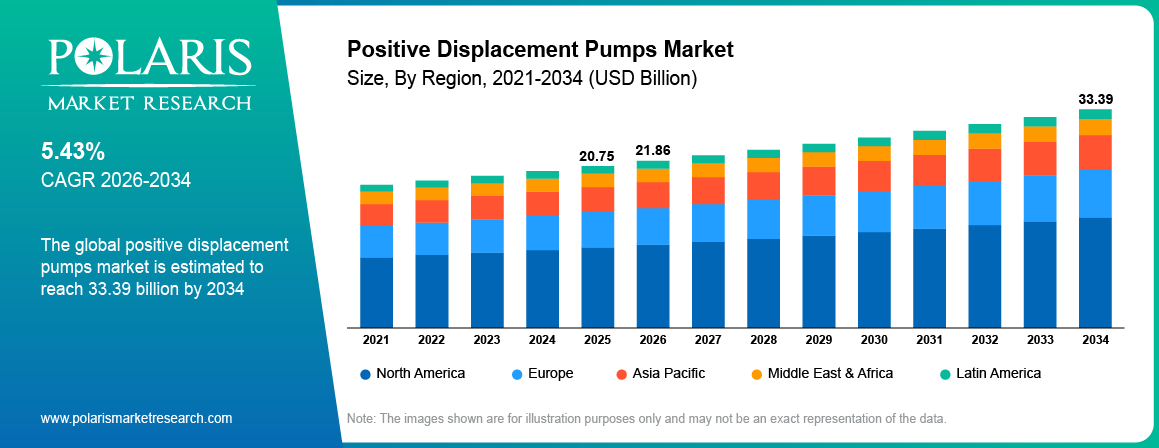
The global positive displacement pumps market size was valued at USD 20.75 billion in 2025, growing at a CAGR of 5.43% from 2026 to 2034. Increase in investments in wastewater management and infrastructural upgradation as well as encouraging government policies favoring water reuse and sustainability is leading to the market's growth.
Market Statistics
Positive Displacement Pumps Market Key Takeaways
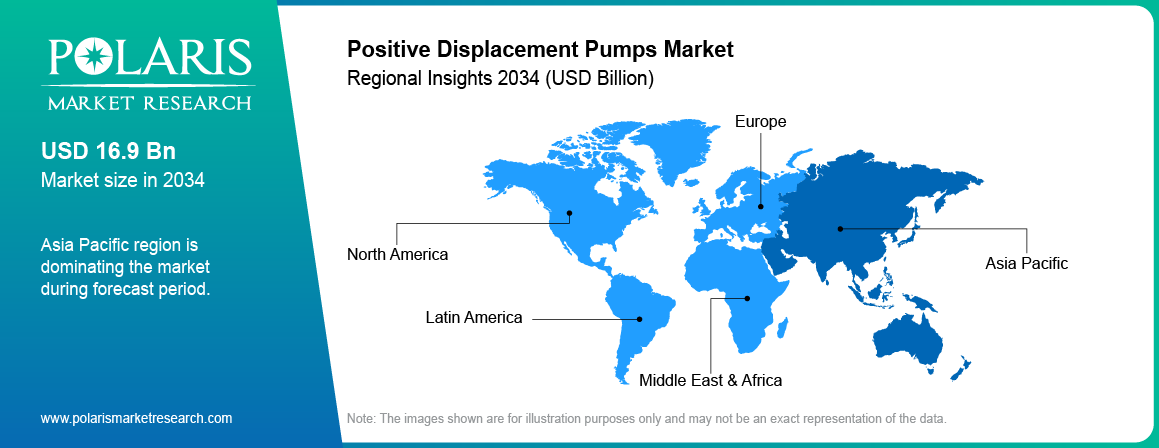
- Asia Pacific held the largest market share of 40.0% in 2025, led by rapid industrialization at high speeds, expansion of manufacturing hubs, and urban infrastructure development in China, India, and Southeast Asia.
- India dominated the market in Asia Pacific, capturing 30.0% regional share in 2025, fueled by the growing wastewater treatment sector and rising uptake of new pumping technologies.
- North America is anticipated to grow rapidly, witnessing a 4.63% CAGR during 2026–2034, driven by rising adoption of intelligent, networked pump systems in industrial and municipal applications.
- The U.S. dominated the North American market, capturing 70.0% share in 2025. This is due to the upgradation of old water and wastewater plants and government programs encouraging infrastructure modernization.
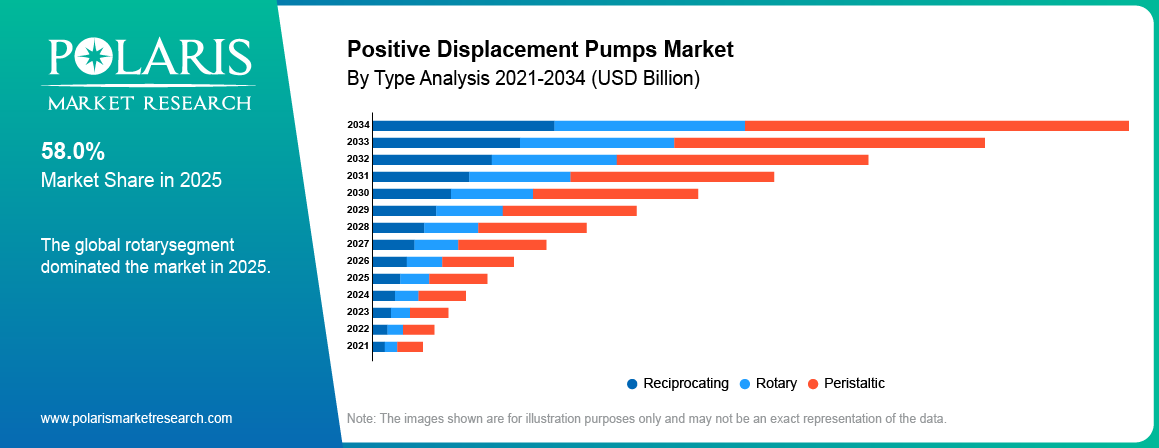
- Rotary pumps controlled the market with 58.0% share in 2025, due to efficiency in conveying high-viscosity fluids and ensuring a constant flow, hence being suitable for chemical processing, food, and lubrication industries.
- The 51–150 bar pressure rating category is anticipated to witness 6.23% CAGR during the forecast period, driven by uses in power generation, mining, and midstream oil & gas activities requiring moderate pressure control.
Note: Figures and projections outlined in this report are the result of Polaris Market Research’s proprietary analytical processes, grounded in the latest available datasets and market observations.
What Are Positive Displacement Pumps?
Positive displacement pumps are industrial fluid-processing pumps that transfer a specific volume of liquid through the system in each operating cycle. They operate by confining the fluid in a cavity and moving it to the discharge port. Popular categories include rotary positive displacement pumps and reciprocating pumps. They are very well adapted to high-viscosity fluids, to metering, to chemical processing, to oil and gas transfer, and to applications where the flow must be stable and consistent under variable pressure.
The positive displacement pumps industry includes precision-designed systems that are optimized to transfer fluids at a fixed flow rate irrespective of pressure fluctuations. These pumps are widely utilized across various industries like oil and gas, chemicals, food and beverages, water treatment, and pharmaceuticals for precise fluid handling and dosing purposes. In May 2025, Roto Pumps introduced its versatile P-Range of positive displacement pumps in applications such as oil & gas, mining, wastewater treatment, and food processing. This move is likely to propel double-digit growth and contribute immensely towards the company's anticipated revenue of USD 100 million by 2028 (Source: rotopumps.com).
Advancements in pump design, such as magnetically driven and seal-less designs, are enhancing the reliability, energy efficiency, and lifespan of positive displacement pumps. These developments enable pumps to process abrasive, viscous, and corrosive fluids with lower maintenance requirements, meeting the changing needs of new industrial processes. Ongoing developments in materials and engineering design are allowing manufacturers to provide reliable solutions for demanding operating conditions.
How Do Positive Displacement Pumps Work?
Positive displacement pumps work by performing suction, fluid collection, and discharge multiple times. The pump forms a cavity that expands during suction, decreasing its pressure, and the fluid is sucked into the pump body. A precise quantity of fluid is then trapped in the chamber between the moving parts, such as rotating gears or lobes or reciprocating pistons or diaphragms. As the elements continue to travel, the volume of the chamber available diminishes, pushing the liquid enclosed towards the outlet.
This is why this type of pump can deliver a fairly uniform flow irrespective of changes in pressure in the system. Rotary positive displacement pumps, rotary elements (i.e., rotors) between the inlet and outlet continuously pump fluids, while reciprocating elements (e.g., pistons) move fluids in discrete quantities. Valves or seals stop the flow from reversing while running. The incremental flow of liquid also contributes to the effectiveness of these pumps in high-viscosity fluid handling, chemical process pumps, metering pumps, and wherever there is a demand for precision and repeatable fluid transfer.
Positive Displacement Pumps vs. Centrifugal Pumps
| Aspect | Positive Displacement Pumps | Centrifugal Pumps |
| Flow characteristic | Constant flow rate regardless of pressure/head | Flow varies with system pressure/head. |
| Viscosity handling | Excellent for high-viscosity, shear-sensitive fluids | Efficiency drops sharply as viscosity rises. |
| Pressure output | High-pressure capable (metering, hydraulics) | Best suited to low-to-moderate pressure, high-volume duty |
| Self-priming | Generally self-priming | Typically requires priming |
| Dosing/metering accuracy | High — suited to precise chemical dosing | Low — not designed for precision metering |
| Maintenance profile | Higher — more wear parts, seals, valves | Lower — simpler design, fewer moving parts |
| Typical industries | Oil & gas, chemicals, pharma, food dosing | Water supply, HVAC, general bulk transfer |
Source: Polaris Market Research Analysis
Source: Polaris Market Research Analysis
Positive Displacement Pumps Market Dynamics
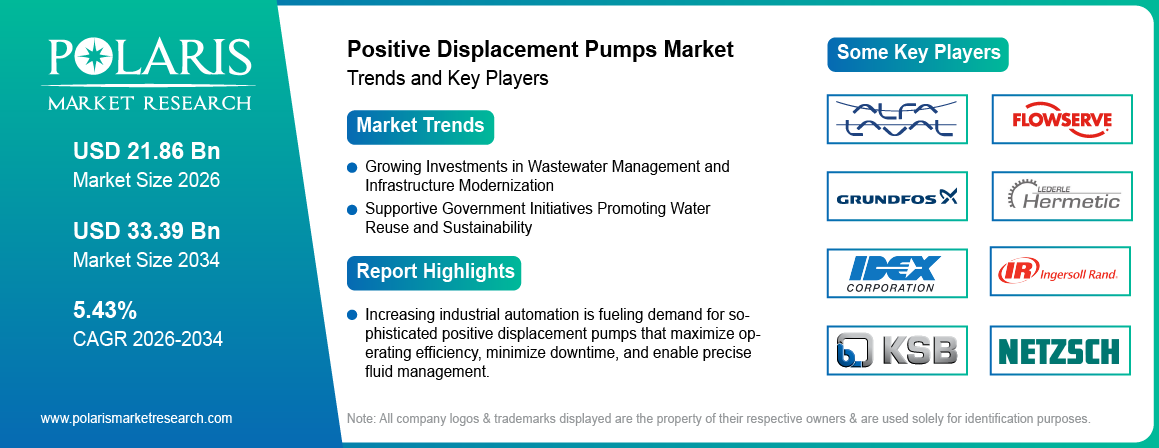
Driver: Growing Investments in Wastewater Management and Infrastructure Modernization
The positive displacement pumps market is propelled by the growing emphasis on sustainable wastewater management and industrial infrastructure development. In July 2025, Hydroleap, a water technology startup from Singapore, raised USD 4.75 million from strategic investors, including government-backed and private venture capital funds, bringing its total funding to nearly USD 12 million. This reflects a broader investment trend in technology that makes wastewater treatment faster and more dependable. The treatment plant modernization is driving the need for industrial fluid-handling pumps, which move sludge, chemicals, and flows of wastewater in its multiple forms. Effectiveness of Energy, Dosing, and Maintenance Operators are also urged to consider energy efficiency, fewer dosing and lower maintenance due to increasing application of advanced water and wastewater treatment technologies. Integration with the Industrial Internet of Things (IIoT) and predictive maintenance platforms is providing greater insight into pump performance and asset reliability in municipal and industrial treatment applications (Source: hydroleap.com).
Driver: Supportive Government Initiatives Promoting Water Reuse and Sustainability
Supportive government policies toward water reuse and sustainability are driving positive displacement pump market growth in municipal and industrial water infrastructure. Water reuse policies aim to promote wastewater recycling, conserve resources, and decrease dependence on fresh water. They are driving expenditures in advanced treatment and reuse technologies. These systems need to be robust for reliable transfer of sludges, chemical dosing, filtration assistance, and processing of fluids with variable viscosity. In July 2025, Veolia, with a French intermunicipal authority, began construction in Argelès-sur-Mer of a treated wastewater reuse plant that will treat 1.3 million cubic meters of wastewater each year to irrigate some 700 hectares of farmland. Rising demand for packaged system wastewater treatment is opening up further application potentials for industrial fluid handling pumps in small (decentralized) platforms. Stricter efficiency and discharge standards around the world are encouraging end users to upgrade their old pumping equipment, which means increasing demand for rugged, precision-controlled pump products (Source: veoliawatertechnologies.com).
Restraints: High Initial Cost of Advanced Systems
The substantial upfront cost for high-end positive displacement pump systems remains a challenge, especially for small and medium users. Pumps are today equipped with precision controls, made from corrosion-resistant materials, integrated with variable speed drives, and exhibit monitoring capabilities, but require a considerable initial money investment. Application fees could be increased because of the need to modify existing piping, control scheme, or process equipment. High-purity positive displacement and specialized chemical processing pumps also have unique materials and compliance-related costs. These financial pressures have the potential to lengthen equipment replacement cycles, meaning operators will run their older equipment for longer periods of time. As such, capital-intensive investments may have an even harder time embracing higher efficiency, reliability, and life-cycle performance.
Restraints: Leakage Risks
Risks for leakage continue to be a challenge for positive displacement pumps, as seal wear, pressure pulsations, and the processing of corrosive and/or abrasive fluids may cause fluid escape over time. Leakage might add to maintenance, generate safety issues, and result in product loss or environmental pollution. This is particularly true in chemical processing, petrochemical, and hazardous fluid handling applications.
| Challenge | Impact on Market |
| High Maintenance Cost | Regular servicing of seals, valves, gears, and other moving parts increases operational and lifecycle costs |
| Leakage Risks | Seal and component failures may lead to fluid loss, contamination concerns, and reduced system reliability |
| Wear from Abrasive Fluids | Slurries and particle-filled fluids can cause internal erosion, lowering efficiency and shortening equipment life |
| Higher Upfront Installation Expenses | Advanced designs, precision components, and control systems increase initial investment compared with simpler pump technologies |
Source: Polaris Market Research Analysis
Opportunity: IoT and Smart Sensor Convergence
Convergence of IoT with smart sensors provides opportunity for positive displacement pump market growth, with end users capitalizing on real-time monitoring and data-driven maintenance. Connected-only pressure, temperature, vibration, flow, and equipment condition sensors enable customers to discover deviations in performance before unplanned downtime occurs. Industrial Internet of Things (IIoT) platform integration also enables predictive maintenance and remote diagnostics for distributed pumping assets. This is especially useful in oil and gas, chemical processing, wastewater treatment, and other continuous industrial processes. Increased compatibility with industrial automated systems and control systems for further pump speed, energy, and process accuracy optimization could help intelligent pumping solutions deliver significant value.
Source: Polaris Market Research Analysis
What is the impact of e-commerce on the positive displacement pumps market?
E-commerce helps vendors expand reach and improve price transparency. Online platforms facilitate product comparisons and enable faster procurement. Consumers prefer online platforms for a broader product selection and faster, at-home delivery. Rising preference toward Direct to Consumer (D2C) strategy helps industry players stay ahead in the competition. The following table provides various aspects of e-commerce and its impact on the market.
| Aspect | Impact | Implications for Market Players |
| Market Reach and Accessibility | TradeIndia, IndiaMART, IndustryBuying, and other platforms expanded access to PD pumps across regions. | Access to wider customer base, increased cross-regional sales, and faster order cycles |
| Pricing Transparency | Availability to compare specifications and prices of products offered by different brands. | Owing to the rising price competition, manufacturers must focus on product quality and service differentiation. |
| Aftermarket & Spare Parts Sales | Easy procurement of spares, seals, and accessories using online platforms. | Creation of recurring revenue streams. It helps strengthen consumer retention and loyalty. |
| Customer Experience and Digital Tools | Information on product configurators, CAD downloads, and online demos create consumer confidence. | By offering detailed documentation and digital support tools, vendors can gain competitive advantages. |
| Supply Chain Efficiency | E-commerce enables faster logistics and order fulfillment | Minimizes lead times and boosts adoption of just-in-time inventory. |
Source: Polaris Market Research Analysis
Positive Displacement Pumps Market Segment Analysis
Heavy-duty and custom-engineered industrial PD pumps rely on traditional offline sales and engineering consultation. However, hybrid models combining e-commerce and on-site physical strategies are expected to gain traction in the coming years.
By Type
- The rotary pumps segment accounted for the largest share of 58.0% in 2025, attributed to the high applicability of rotary pump types in continuous fluid transfer in various industrial processes. The processing equipment seen in oil and gas, petrochemical, chemical processing and food production applications can be very sluggish, and the good pumpability of viscous fluids with a smooth and uniform flow makes these applications very common. Rotary positive displacement pumps also provide compact configurations, low-to-medium pulsation and good efficiency over a wide range of viscosities. Their proven performance in transporting oils, fuels, polymers, syrups, and process chemicals makes them even more enticing. Increasing demand for accurate and reliable industrial fluid delivery has solidified their standing in both mature and emerging markets for industrial plants.
- Reciprocating pumps are expected to grow significantly, witnessing 5.94% CAGR, as high-pressure pumping and precision fluid delivery is finding growing demand from industries for such tightly specified processes. Because of their high pressure capability and controlled flow, they are ideal for chemical injection, oil and gas, water treatment, and process manufacturing. Growing metering pump demand in precise dosing applications is further propelling the segment growth. These pumps also work well when low flow rates need to be pumped against high system pressures. Moreover, growing investment in industrial facilities and processes is anticipated to drive their adoption at an accelerating rate, especially in areas in which pressure capability, dosing precision, and process control are paramount.
| Type | Sub-Types | Best-Fit Fluids / Use | Leading Industries |
| Rotary | Gear, Screw, Vane, Lobe | Continuous flow, viscous, shear-sensitive fluids | Chemical processing, food & beverage, lubrication |
| Reciprocating | Piston, Plunger, Diaphragm | High-pressure, precise metering | Oil & gas, power generation, hydraulics |
| Peristaltic | Hose/tube-based | Sterile, contamination-free, abrasive/corrosive fluids | Pharmaceutical, biotech, water/wastewater dosing |
Source: Polaris Market Research Analysis
By Pressure Rating -
- Up to 50 bar segment held a dominant share of 55.0% in the market in 2025, owing to their wide applicability in conventional industrial fluid transfer and processing applications. Such systems are often used for lubricants, chemicals, food ingredients, wastewater streams, and other medium-pressure fluids. Their lower complexity of installation, moderate energy demand, and fit to conventional process utilities are conducive to their broad applicability. Made for use with rotary pumps and other positive displacement pumps in continuous-duty applications, they are ideal. Robust demand from feed and food processing, chemical production, and water treatment applications also drives their strong position. Their combination of performance, reliability, and operating cost means that they are the first choice for a large proportion of the world’s industrial pump needs.
- The quick development of the 51 to 150 bar pressure level segment witnessing 6.23% CAGR during 2026-2034, particularly in the end users is attributed to the growing preference for pumping systems with ability to perform under increasingly aggressive process environments in industries. These are suitable for high-pressure chemical dosing, hydraulic applications, oil and gas, and specialized process applications that require a constant flow in the face of high discharge pressures. Demand is also driven by the increasing use of sophisticated industrial automation and control systems, which require pressure-rated pumps that can deliver precise performance. Expansion of petrochemical, specialty chemical, and energy-related processing plants is driving increasing demand for rugged pump equipment. The potential to combine pressure capability with metered fluid delivery is anticipated to further drive adoption in high-value industrial applications.
| Pressure Rating | 2025 Position | Growth Outlook | Primary Applications |
| Up to 50 bar | Largest share — dominant in low-pressure transfer | Steady growth | Water & wastewater treatment, food processing |
| 51–150 bar | Fastest-growing tier | Strong growth | Power generation, mining, midstream oil & gas |
| Above 150 bar | Smallest but specialized share | Niche, high-value growth | Waterjet cutting, subsea/high-pressure injection, specialty machining |
Source: Polaris Market Research Analysis
By End User Industry
- Positive displacement pumps are heavily used in upstream, midstream, and downstream operations, and so the oil and gas industry held the largest share of 30.0% in 2025. These pumps are used extensively in crude oil transportation, fuel processing, lubrication, chemical injection, and application of high-pressure fluids. Production processes that are challenging can be achieved with these pumps, as they keep a consistent flow even when working with viscous and variable-density liquids. Oil and gas transfer pumps are prized for their dependable performance in varying pressure environments. Pipeline transport, refinery processing, and field operation demands have always been constant, which encourages adoption. The demand for robust machinery that can be utilized in extreme environments has buttressed the dominance of the segment.
- The petrochemical and chemical machinery is also expected to witness a strong growth at 6.35% CAGR, attributed to the fact that the processing industries are in need of precise, corrosion-resistant, and reliable pumping solutions. Chemical processing pumps are used to handle acids, solvents, polymers, additives, catalysts, and other volatile or highly viscous chemicals. Increasing complexity of production is driving the need for metering pumps with accuracy in flow delivery on dosing and formulating processes. K-Line improved its premium customer offering by adding dual sealing systems to the raising demand for enhanced process safety and leak tightness, especially in food applications. Further, automation of chemical plants is also positively impacting the demand for digitally operated pumping systems. These trends positively impact the application of positive displacement pumps in both petrochemical and specialty chemical processes.
By Industry-Specific Applications
Positive displacement pumps are extensively used in process industries due to their ability to accurately control flow, maintain constant pressure, convey viscous fluids, and dependably handle difficult media.
- Dominance of the Oil & Gas Industry: The oil & gas industry serves as a prominent end-use of the positive displacement pumps market, contributing to the requirement for dependable fluid transfer with varying pressure and viscosity. These pumps have wide application in crude oil, transfer drilling fluid circulation, lubricating oil, produced water, and pipeline operation and in drilling mud application. Their flow is less affected by changing pressure, which makes these pumps ideal for upstream and midstream use. Rotary and reciprocating positive displacement pumps are also suitable for the transportation of heavy crude, viscous hydrocarbons, and multiphase fluids. Investment in pipeline infrastructure, enhanced oil recovery (EOR), offshore exploration, and refinery upgrading are fueling the demand for high-capacity, rugged pumps.
- Role in Chemical Processing: Positive displacement pumps are significant in the chemical processing industry, as that industry often requires dosing, transfer, or pumping of aggressive, corrosive, viscous, or hazardous chemicals that must be done accurately and under control. Because of the predictable displacement behavior, a full range of acids, solvents, polymers, additives, resins, and other specialty chemicals can be metered with accuracy in both continuous and batch production. Designs featuring corrosion-resistant materials and advanced sealing systems also provide added protection against leaks when working with hazardous fluids. Reliability in pumping technology, process accuracy for chemical manufacturers, worker safety, and reduction in material wastage are the most important aspects of the chemical industry. As a result, utilization of the positive displacement pumps in chemical injection, blending, reactor feeding, unloading, and transfer application requires consistent performance, even in the most challenging conditions.
- Food & Beverage Applications: The food and beverage sector is increasingly turning toward positive displacement pumps for the transfer of products of different viscosities and sensitive physical characteristics for sanitary and hygienic applications. These pumps are also widely used for dairy products, syrups, chocolate, edible oils, sauces, concentrates, and other processed foods. In addition, their gentle operation helps maintain product texture and quality during the transfer, and designs of these pumps comply with strict hygiene and CIP requirements. Constant volumetric flow further allows for the precise dosing of ingredients and control of the processing. A surge in production of packaged foods, dairy products, beverages, and specialty food ingredients is aiding the demand for hygienic pumping systems that ensure dependable and contamination-free fluid handling.
- Pharmaceutical & Biotech Use: Industry contamination is a constant concern with pharmaceutical and biotechnology product manufacturing and positive displacement pumps are now more commonly seen in these applications where sterilization and precision fluid transfer is paramount. Applications include the delivery of active pharmaceutical ingredients, buffer solutions, culture media, biologics formulations, vaccines and a variety of other high-value process fluids. The resulting flow accuracy enables accurate dosing and process repeatability without the loss of product. Sanitary designs with smooth internal surfaces, materials of construction compatibility, and clean-in-place (CIP) or sterilize-in-place (SIP) capabilities are used within the industry to assist in meeting regulatory challenges. Growth in biologics, vaccine production, personalized medicines, and advanced therapy manufacture is driving the need for pumps that ensure product integrity while providing reliable, contamination-free fluid handling.
- Wastewater and Water Treatment Application: Positive displacement pumps are critical to operations throughout the water and wastewater treatment equipment industry and especially in applications involving high solids concentrations or precise chemical dosing of fluids. They are also used extensively in sludge transfer, polymer dosing, disinfectant injection, chemical feeding, dewatering, and filtration. In addition, progressive cavity, diaphragm, and peristaltic pumps are suitable for dosing abrasive sludges, viscous streams of waste water or critical treatment chemicals at constant flow rates. Evolving municipal wastewaters, industrial effluent legislation, water reuse schemes, and treatment infrastructure development are driving the need for more equipment. Their dependable performance under challenging fluid conditions makes positive displacement pumps an important component of modern water and wastewater treatment facilities.
Technology & Innovation Trends
Technological advancement and innovation being witnessed in positive displacement pumps, including smarter connectivity, energy-efficient design, advanced automation, and enhanced monitoring capabilities, enabling better reliability, operational control, predictive maintenance, and full lifecycle performance are positively influencing market growth.
Smart Pump & IoT Integration
The management and operation of positive displacement pumps is being transformed by the integration of smart pump technology. Pressure, temperature, vibration, flow, and running conditions are monitored in real time by embedded sensors, which also help detect equipment abnormalities in an earlier stage. IIoT platforms take these individual data points and link them with centralized monitoring platforms so that operators may remotely monitor these pumps at multiple locations. Predictive maintenance applications also predict component wear and help to prevent unplanned shutdowns. Faster troubleshooting and more efficient maintenance scheduling are also facilitated by remote diagnostics. These attributes are especially significant in chemical processing, oil and gas, and wastewater applications, where the reliability of equipment has a direct bearing on the continuity of production and the operating costs.
Energy-Efficient Pumping Systems
Energy-saving pumps are becoming more important, with plant operators now more focused on cutting electricity use and the total cost of ownership. Variable-speed drives enable the pump output to follow the process demand in real time rather than running at constant speed in fixed working points. As a result, energy is better utilized and less mechanical stress is applied to the machines. In addition, energy losses are reduced by improving hydraulic efficiency, motor efficiency, and internal clearances. Enhanced control algorithms allow for additional flow and pressure optimization under dynamic conditions of operation. This energy revolution is fuelling the replacement of traditional industrial positive displacement pumps by high-performance systems, especially in chemical processing, water treatment, and food processing, among other industries with high energy use.
Industry 4.0 & Automation Impact
The positive displacement pump with industrial automation and control in the new industry era is developed by Industry 4.0. System pump speed and flow rate, pressure, and dosing requirements are also adjusted to the general process conditions, leading to a more homogeneous process. Real-time communication between pumping devices, programmable controllers, and supervisory systems results in rapid process changes and decreases reliance on manual intervention. Preventive maintenance and automated alarms contribute also to enhanced equipment availability and maintenance scheduling. This type of connectivity is particularly beneficial in petrochemical, pharmaceutical, food processing, and water treatment applications where precise fluid handling is a must. More automation is driving the need for digitally enabled pump systems that can be remotely managed.
Technological Advancements
Technological developments are enhancing durability, safety, and life cycle performance for all types of positive displacement pump systems. Magnetic-drive and seal-less configurations are becoming more important in the applications that require no leakage and containment of hazardous fluids. The compatibility of corrosion-resistant alloys, engineered polymers, and coatings is increasing service pump life in aggressive chemical environments. Enhancements in rotors and seals are bringing similar benefits. AI-powered predictive maintenance solutions are increasingly being employed for processing real-time operational data to detect emerging issues prior to failure. These developments are enabling enhanced pump reliability in chemical process pumps, high-viscosity fluid pumps, and other stalled industrial fluid handling applications.
Maintenance & Reliability Benefits
Stable flow performance makes it possible for positive displacement pumps to provide stable process conditions in the case of varying pressure, viscosity, and/or operating conditions. Their rugged design provides dependable operation in the most demanding environments, including oil and gas, petrochemical, chemical processing, and wastewater treatment. Minimizing flow pulsation may also reduce system interruptions and increase equipment throughput. The addition of smart sensors and predictive maintenance solutions once again increases reliability and captures abnormalities related to vibration, temperature, pressure, and wear before failures occur. Therefore, this enables operators to better plan for maintenance, minimize unexpected downtime, maximize component life, and enhance overall asset availability.
Source: Polaris Market Research Analysis
Real-World Use Cases & Applications
- Crude Oil Transfer: Positive displacement pumps are the preferred choice for the oil and gas transfer pump market to transfer crude oil, heavy fuel oil, lubricants, and a myriad of high-viscosity petroleum products. Their flow control is stable enough for pipelines, terminals, refineries, and petrochemical plants.
- Chemicals Dosing: Processing and metering pumps can be employed to dose acids, alkalis, additives, catalysts, treatment chemicals, and others at a certain flow. The precision of dosing enables uniform process quality within chemical production or treatment processes.
- Dairy and Syrup Processing: Milk, cream, yogurt, syrups, sauces, and concentrated food elements are all handled by sanitary positive displacement pumps without imparting excessive harm to the product. These food and beverage pumps are designed for hygienic, cleanable, and compliant handling of viscous foods.
- Pharma Fluid Transfer: Sanitary rotary and peristaltic pumps serve the pharmaceutical industry for keeping sensitive liquids, formulations, sterile solutions, and active pharmaceutical ingredients. Flow control and low contamination risk are an essential part of the regulated production.
- Sludge Handling in Wastewater: For handling highly viscous sludge, biosolids, slurry, and waste streams in water and wastewater process equipment, positive displacement pumps are the preferred option. Positive displacement pumps are utilized to dewater, digest, and treat packaged wastewater, as these pumps are able to handle liquids with solids and high viscosities.
- Oils: Industrial displacement pumps generate high-pressure hydraulic fluid for industrial machinery, presses, hoists, pneumatic automation, and motion control systems; these systems rely on oil-based fluid’s dependable ability to transmit power and facilitate precise equipment motion.
Positive Displacement Pumps Market Segment Analysis Regional Analysis
Regional Market Trends Snapshot
| Region | 2025 Position | Growth Outlook | Key Driver |
| Asia Pacific | Largest market (India leads regionally) | Fastest-growing region | Industrialization, wastewater treatment expansion |
| North America | Second-largest, mature market | Steady growth | Aging water infrastructure upgrades, smart pump adoption |
| Europe | Established, regulation-driven market | Moderate growth | Energy-efficiency and emissions standards |
| Latin America | Emerging market | Moderate growth | Oil & gas and mining investment (Brazil, Argentina) |
| Middle East & Africa | Niche, high-durability demand | Moderate growth | Desalination and oil & gas exploration |
Source: Polaris Market Research Analysis
Asia Pacific
In 2025, Asia Pacific held the largest share of the market capturing 40.0% share, owing to the presence of a large number of manufacturers in the region, growing chemical and petrochemical industry, and continuous support and investment for water and wastewater treatment. Increasing demand for dependable industrial fluid handling pumps in process-intensive applications is growing owing to burgeoning industrialization across major countries. In Asia Pacific, for instance, KSB recorded a 5.9% growth in order intake and 5.8% growth in revenues from sales for in the first half of 2025, while the pumps business posted an 8.2% rise in order intake, driven by water as well as petrochemical and chemical applications. Moreover, an expanding use of pumps in food and beverage production, pharmaceuticals, mining, and oil and gas is further promoting growth, and greater automation with predictive maintenance is helping to keep equipment up to date (Source: ksb.com).
The India market is anticipated to grow, witnessing 7.15% CAGR during 2026-2034, due to the growing chemical processing, oil & gas, food & beverage production, and water treatment industries. Increasing industrial automation, stringent requirements on wastewater reuse, and the need for sustainable and reliable industrial fluid handling pumps are also promoting the adoption in new plants as well as in refurbishment works. For example, as of March 2025, the Ministry of Housing & Urban Affairs, the Government of India, reported that the AMRUT 2.0 projects accounted for 6,739 MLD of sanctioned sewage treatment capacity, covering 2,093 MLD of such capacity linked to recycling and reuse uses. The development of the sewage treatment plant and water-reuse plant leads to an upsurge in demand of sludge transfer, chemical dosing, metering pumps, and other positive displacement pumping products (Source: pib.gov.in).
North America
The North America market is projected to develop strongly, owing to the implementation of smart, connected pump systems throughout the region, as industrial and municipal operators look for energy-saving solutions and predictive maintenance opportunities. Growing investment in public drinking water infrastructure is further fueling demand for advanced positive displacement pumps. In August 2025, the U.S. Environmental Protection Agency (EPA) announced a grant of over $9 million for midsize and large water systems. It will help protect drinking water from cybersecurity threats. This will also improve resiliency for extreme weather events. This reflects the government's push for upgrading vital water infrastructure, thus driving the growth of the market (Source: epa.gov).
U.S.
The U.S. market is witnessing strong growth due to the upgradation of aged water and wastewater facilities across the country. In October 2025, Pennsylvania American Water made a USD 30 million investment to upgrade Kane Borough's wastewater treatment plants in Pennsylvania. The program is aimed at increasing infrastructure capacity, efficiency, and reliability to meet the growing demand for clean water (Source: amwater.com).
Europe
The growth of the market in Europe at 4.83% CAGR during the forecast period is attributed to high energy-efficiency and low-carbon policies, which are driving pump system modernization. Increases in renewable energy, biofuel production, and chemical manufacturing have been driving the need for accurate fluid transfer solutions. Industrial customers are also beginning to use variable-speed drives, intelligent controls, and digitally enabled pumping systems more extensively to achieve greater energy savings and operational efficiencies. Growing demand is further attributed to modernization of water, wastewater, and process industries, along with predictive maintenance-related enhancements leading to greater equipment reliability. For example, in August 2025, Grundfos launched new intelligent and energy-efficient pump solutions that focus on maximizing pump usage and minimizing energy consumption, i.e., the TPE3 and ALPHA GO series. Therefore, a focus on increased automation and predictive maintenance is driving increased growth of sophisticated pumping technologies throughout the region (Source: grundfos.com).
Latin America
Growth in Latin America at 5.63% CAGR during the forecast period is being driven by continued investments in oil and gas, mining, chemicals, food processing, and water infrastructure. Increasing industrialization is driving the need for dependable fluid transfer systems for viscous, abrasive, and chemically aggressive fluids. Demand for positive displacement pumps used in sludge transfer and chemical dosing is also being boosted by renovation of municipal and industrial wastewater systems. Growing petrochemical processing and refinery activities are also leading to potential opportunities in oil and gas transfer pumps. Concurrently, increasing penetration of automation and predictive maintenance is driving replacement of older equipment’s.
Middle East & Africa
Growth in the Middle East and Africa is attributed to increasing oil and gas production, petrochemical capacity, desalination, and water treatment facilities. They become essential when dealing with energy-intensive processes like crude transfer, chemical injection, metering, and transportation of high-viscosity fluids. Growing investments for water reuse and sewage treatment is also bolstering the demand for reliable industrial fluid handler pumps. The region’s water-scarcity concerns are further driving the use of sophisticated pumping equipment in wastewater treatment and water collection and distribution systems. The range of industrial applications is being extended due to diversification into chemicals, food processing, and general manufacturing. Also, the need for process plant upgrades is fostering demand for pumping solutions that are efficient, robust, and compatible with automation.
Source: Polaris Market Research Analysis
Competitive Landscape
The global positive displacement pumps market is competitive and influenced by innovation, precise engineering, and growing industrial applications. Key players are concentrating on enhancing pump efficiency, reliability, and performance to satisfy the growing demand in industries like oil and gas, water and wastewater, organic food and beverage, and chemicals.
Alfa Laval’s leadership in the positive displacement pump segment is solid, especially due to its positive displacement pump range, which is sanitary and hygienic and widely used in food and beverage, pharmaceutical, and process applications. Flowserve is well established in the high end of many process industries with its diverse array of positive displacement pumping technologies for challenging chemical, energy, and high-pressure applications. IDEX Corporation is mapped to specialized fluid and metering solutions in line with market needs for precision dosing, chemical handling, and metering pumps. Ingersoll Rand has bolstered its position with brands like SEEPEX and Albin Pump, achieving a greater foothold in progressing cavity and peristaltic pumps in wastewater, chemicals, and many other industry applications.
Vendor Positioning
| Company | Headquarters | Positioning / Focus |
| Flowserve Corporation | USA | Broad industrial flow-control portfolio |
| Grundfos Holding A/S | Denmark | Water, wastewater, and industrial pumping; expanding U.S. (Texas) manufacturing |
| Alfa Laval AB | Sweden | Hygienic/cost-effective pumps for food, dairy, beverage, and home and personal care industries |
| Ingersoll Rand Inc. | USA | Hydraulics and fluid-handling; pumps for petrochemicals, power generation, and paint manufacturing |
| SPX Flow, Inc. | USA | U1, U2, and U3 PD Pumps. These pumps are engineered for superior performance for food, chemical, and pharma dosing |
Source: Polaris Market Research Analysis
Key Players
- Alfa Laval AB
- Flowserve Corporation
- Grundfos Holding A/S
- HERMETIC-Pumpen GmbH
- IDEX Corporation
- Ingersoll Rand Inc.
- ITT Inc.
- KSB SE & Co. KGaA
- NETZSCH Pumpen & Systeme GmbH
- NOV Inc.
- PCM
- SLB
Sustainability & Environmental Compliance
Sustainability is becoming a key focus in the positive displacement pumps industry. Industries seek to reduce energy consumption, emissions, and operational waste. High-efficiency motors, variable frequency drives (VFDs), and optimized pump designs lower electricity usage. They reduce carbon emissions across industrial operations. Advanced sealing technologies and precision flow control minimize fluid leakage and product loss. It supports water conservation and reduces hazardous chemical waste. Predictive maintenance systems further improve efficiency by preventing unnecessary energy consumption caused by worn components. Compliance with environmental regulations and energy-efficiency standards is encouraging manufacturers to develop durable, recyclable, and low-emission pumping solutions for sustainable industrial processes.
Future Outlook
The positive displacement pumps market is anticipated to progress with a steady growth rate as industries would be most gauged toward dependable fluid handling, energy efficiency, and automation of processes. Demand would increasingly transition to smart pumps with Industrial Internet of Things connectivity, remote monitoring, and predictive maintenance. Use of corrosion-resistant materials, seal-less designs, and variable-speed operation will further enhance lifecycle performance. Growing demand will continue to be strong in water treatment, petrochemicals, chemicals, food processing, and other process-intensive industries.
Industry Development
- August 2026: Xylem Inc. acquired Cornell Pump and Roper Pump businesses from Indicor for $1.46 billion. This deal will expand Xylem's ability to serve a broader range of mission-critical industrial applications. (Source: BUSINESS WIRE)
- June 2026: Grundfos announced a production expansion at its Brookshire campus located west of Houston. This expansion will reinforce the company’s long‑term commitment to growth in the U.S. and the Americas. (Source: grundfos.com)
- February 2026: Felipe Calvo announced the acquisition of Axiflow Technologies, Inc. Axiflow Technologies is a developer of the AXIFLOW pump. The AXIFLOW pump is a twin-screw positive displacement pump engineered for sanitary applications. (Source: trysignalbase.com)
- July 2025: Sulzer opened a third facility in Argentina to expand its Latin American presence, strengthen regional manufacturing and service capabilities, and better serve pump markets. (Source: sulzer.com)
- June 2025: Chart Industries and Flowserve agreed to an all-stock merger worth around USD 19 billion with a focus on delivering USD 300 million of annual cost synergies. The merged entity will be well-positioned to enhance its global presence and enhance capabilities in industrial and energy markets.
- June 2025: Honeywell finalized the acquisition of Sundyne in USD 2.16 billion, adding engineered pumps and compressors for the renewable fuel industry. The acquisition is part of Honeywell's strategy to expand its product offerings and propel growth in sustainable process solutions and clean energy. (Source: investor.honeywell.com)
Positive Displacement Pumps Market Segmentation Outlook
By Type Outlook (Revenue, USD Billion, 2021–2034)
-
Reciprocating
-
Rotary
-
Peristaltic
By Pressure Rating Outlook (Revenue, USD Billion, 2021–2034)
-
Up to 50 bar
-
51 to 150 bar
-
Above 150 bar
By End-User Industry Outlook (Revenue, USD Billion, 2021–2034)
-
Oil and Gas
-
Power Generation
-
Water and Wastewater
-
Chemical and Petrochemical
-
Food and Beverage
-
Pharmaceutical and Biotechnology
-
Mining and Minerals
-
Pulp and Paper
-
Others
By Regional Outlook (Revenue, USD Billion, 2021–2034)
-
North America
- U.S.
- Canada
- Europe
- Germany
- France
- UK
- Italy
- Spain
- Netherlands
- Russia
- Rest of Europe
- Asia Pacific
- China
- Japan
- India
- Malaysia
- South Korea
- Indonesia
- Australia
- Vietnam
- Rest of Asia Pacific
- Middle East & Africa
- Saudi Arabia
- UAE
- Israel
- South Africa
- Rest of Middle East & Africa
- Latin America
- Mexico
- Brazil
- Argentina
- Rest of Latin America
Positive Displacement Pumps Market Report Scope
| Report Attributes | Details |
| Market Size in 2025 | USD 20.75 Billion |
| Market Size in 2026 | USD 21.86 Billion |
| Revenue Forecast by 2034 | USD 33.39 Billion |
| CAGR | 5.43% from 2026 to 2034 |
| Base Year | 2025 |
| Historical Data | 2021–2024 |
| Forecast Period | 2026–2034 |
| Quantitative Units | Revenue in USD Billion, Volume in Kilotons and CAGR from 2026 to 2034 |
| Report Coverage | Revenue Forecast, Competitive Landscape, Growth Factors, and Industry Trends |
| Segments Covered |
|
| Regional Scope |
|
| Competitive Landscape |
|
| Report Format |
|
| Customization | Report customization as per your requirements with respect to countries, regions, and segmentation. |
Source: Polaris Market Research Analysis
Positive Displacement Pumps Market FAQ's
The global market size was valued at USD 20.75 billion in 2025 and is projected to grow to USD 33.39 billion by 2034.
The global market is projected to register a CAGR of 5.43% during the forecast period.
Asia Pacific dominated the market with a 40.0% share in 2025. Rising demand for effective water treatment and desalination facilities boosts adoption of durable positive displacement pumps.
A few of the key players in the market are Alfa Laval AB; Flowserve Corporation; Grundfos Holding A/S; HERMETIC-Pumpen GmbH; IDEX Corporation; Ingersoll Rand Inc.; ITT Inc.; KSB SE & Co. KGaA; NETZSCH Pumpen & Systeme GmbH; NOV Inc.; PCM S.A.; and SLB.
The rotary pumps segment dominated the market revenue with a 58.0% share in 2025. This is attributed to its efficient handling of high-viscosity fluids and constant flow rate.
The 51 to 150 bar pressure segment is projected to witness the fastest growth at 6.23% CAGR during 2026-2034. Growing demand from power generation, mining, and midstream oil & gas operations fuels the segment growth.
Positive displacement pumps maintain steadier flow under pressure and handle viscous fluids better, while centrifugal pumps are generally preferred for high-volume, low-viscosity fluid transfer.
Main types include rotary, reciprocating, and peristaltic pumps, with common designs such as gear, screw, lobe, piston, plunger, and diaphragm pumps.
They are widely used for crude oil transfer, chemical dosing, wastewater sludge handling, food processing, pharmaceutical fluid transfer, lubrication, and hydraulic systems.
Download Sample Report of Positive Displacement Pumps Market
Please fill out the form to request a customized copy of the research report.


