
Artificial Intelligence for Healthcare Payer Market Share, Price, and Upcoming Trends, 2026-2034
REPORT DETAILS
Artificial Intelligence for Healthcare Payer Market Summary and Key Insights
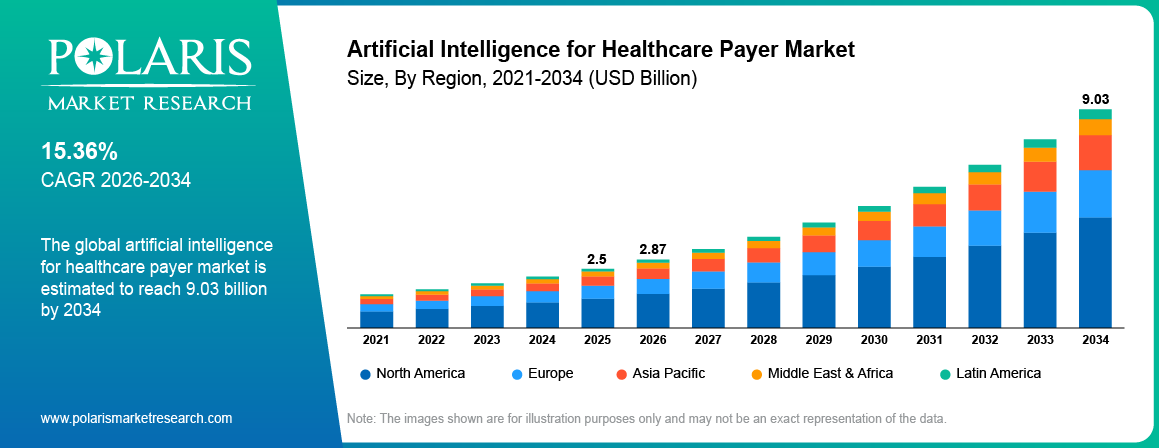
The global artificial intelligence for healthcare payer market size was valued at USD 2.50 billion in 2025, growing at a CAGR of 15.36% from 2026 to 2034. Key factors driving demand for artificial intelligence for healthcare payer include the increasing automation in healthcare payer operations and growing health insurance coverage worldwide.
Market Statistics
Artificial Intelligence for Healthcare Payer Market Key Takeaways
- North America dominated the global market, by holding 42.4% of total revenue in 2025. The leading position is attributed to strong healthcare infrastructure and high digitalization.
- The U.S. led the North America market with 71.6% revenue share in 2025. Increased healthcare spending on AI-driven claims management and fraud detection support the growth.
- The Asia Pacific Artificial Intelligence for Healthcare Payer market would exhibit the highest CAGR of 25.7% from 2025 to 2034. This is propelled by rapid adoption of AI technologies.
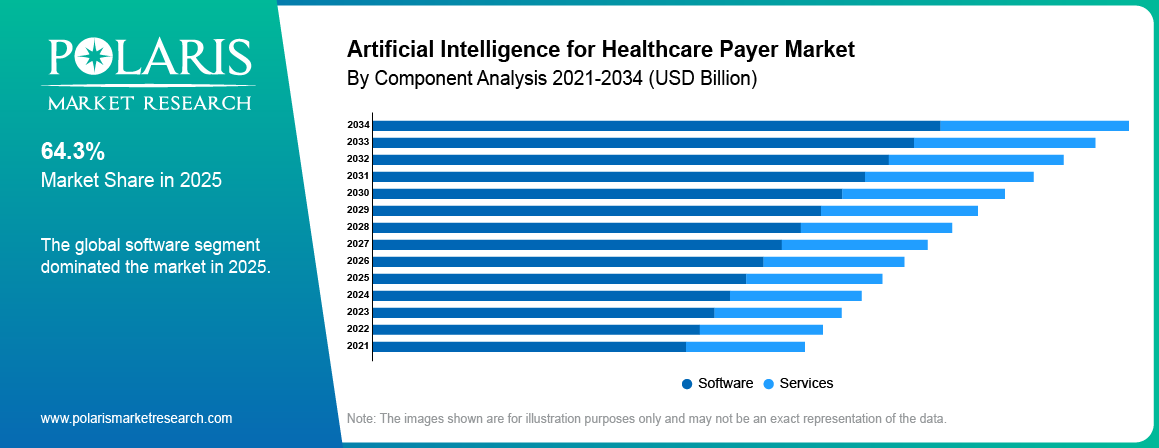
- The Software segment dominated the market share in 2025. It held 64.3% of total revenue share. It is attributed to its rising applications in claims automation and better fraud detection.
- The Cloud segment led with 61.8% share in 2025. Its flexibility, scalability, and capacity to handle real-time data in large networks bolster the growth.
Note: Figures and projections outlined in this report are the result of Polaris Market Research’s proprietary analytical processes, grounded in the latest available datasets and market observations.
Artificial Intelligence for Healthcare Payer Market Dynamics
- Increasing automation in healthcare payer operations is boosting market growth by reducing costs and improving efficiency.
- Growing health insurance coverage worldwide is driving demand due to higher need for claims management and fraud detection.
- The integration with telemedicine platforms is expected to create lucrative opportunities during the forecast period.
- Data privacy and regulatory compliance challenges is anticipated to restrain market growth.
What Is Artificial Intelligence for Healthcare Payers?
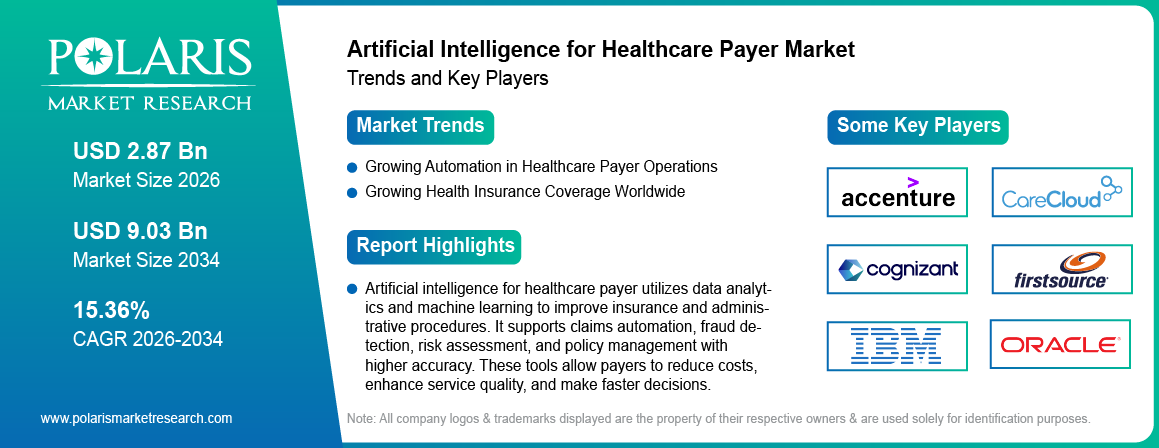
Artificial intelligence for healthcare payer utilizes data analytics and machine learning to improve insurance and administrative procedures. It supports claims automation, fraud detection, risk assessment, and policy management with higher accuracy. These tools allow payers to reduce costs, enhance service quality, and make faster decisions. Growing digital adoption and data expansion are driving the use of AI in healthcare payer worldwide.
Rising government healthcare spending is boosting the AI for healthcare payer market through investments in claim management systems and patient care improvement. As per the World Health Organization, overall world health expenditure stood at about USD 9 trillion in 2021. In addition, government expenditure in 2023 on health accounted for 10.1% of German GDP and 9.5% of that of Japan, driving demand for AI-based solutions.
How AI Works in Healthcare Payer Operations
- How AI Works in Healthcare Payer Operations
- Healthcare data is collected from claims, electronic health records, and insurance systems.
- These AI tools analyze big data to detect trends and anomalies.
- ML algorithms predict the potential risk, costs, and member outcomes.
- Intelligent automation streamlines claims process management. It also detects fraud and suspicious billings.
- Insights generated by AI help make quick decisions.
Source: Polaris Market Research Analysis
Growing cases of false claims and billing errors are driving the AI for healthcare payers market where payers employ AI to identify anomalies and automate claim validation. The urge to reduce financial losses and inefficiencies is pushing its adoption across the world.
AI vs. Traditional Healthcare Payer Operations
| Feature | AI-Based Payer Operations | Traditional Operations |
| Claims Processing | Automated and faster | Manual, review-intensive |
| Fraud Detection | Predictive analytics-based | Rule-based methods |
| Decision Making | Data-driven and predictive | Human-dependent |
| Customer Service | AI-powered virtual assistants | Call-based support |
| Scalability | High and easily scalable | Limited scalability |
Source: Polaris Market Research Analysis
Artificial Intelligence for Healthcare Payer Market Drivers and Opportunities
Key Market Drivers and Challenges
| Market Drivers | Market Challenges |
| Increasing healthcare insurance coverage worldwide | Data privacy and security concerns |
| Rising healthcare administrative costs | Regulatory compliance requirements |
| Growing demand for claims and workflow automation | Integration with legacy insurance systems |
| Increasing healthcare fraud cases | High implementation costs |
| Expansion of digital health platforms | Limited availability of skilled AI professionals |
| Growing adoption of predictive analytics | Data quality challenges |
Source: Polaris Market Research Analysis
What Factors Are Driving AI Adoption Among Healthcare Payers?
Growing Automation in Healthcare Payer Operations: The AI for healthcare payer market is growing with increasing automation in payer operations that reduces costs, decreases claim denials, and enhances coordination between payers and providers. For instance, Oracle recently released AI-based applications to automate prior authorizations and streamline value-based care programs, boosting the adoption of AI to simplify healthcare payer operations.
Growing Health Insurance Coverage Worldwide: Increasing health insurance coverage is propelling the artificial intelligence for healthcare payers market with the increasing number of insured patients. This increases the number of claims and administrative complexity, which encourages payers to implement AI solutions to manage claims in a streamlined manner, cost containment, and improved patient care coordination.
Artificial Intelligence for Healthcare Payer Market Trends
The healthcare payer industry is witnessing rapid digital transformation. Insurers are shifting toward value-based care, consumer-centric engagement models, and automation-driven operations. AI, predictive analytics, GenAI-enabled automation and interoperability standards assist in boosting workflow efficiencies. These technologies drive clinical and financial decision making and enhance member experiences. Increasing specialty drug costs, imposition of stringent regulations, and rising competition from tech-enabled entrants push payers to modernize data infrastructure. They also focus on adopting real-time, intelligence-driven care management. The following table contains key emerging trends in the payer market.
| Trends | What’s Changing | Impact |
| GenAI for administrative automation | GenAI copilots & AI-based intake for claims, appeals, member queries, and prior auth | 30–50% reduction in admin burden, improved accuracy & turnaround |
| Value-based & outcomes-driven contracts | Shift from fee-for-service to value models, shared-risk programs, outcomes-linked specialty drug payments | Reduces total cost of care, improves population outcomes |
| AI-enabled fraud, waste, and abuse analytics | ML and pattern recognition for real-time suspicious claims detection | Faster fraud prevention, millions saved annually |
| Virtual-first health plan models | Plans made with telehealth, digital therapeutics, and remote monitoring | Lower care cost and higher patient engagement |
| Interoperability & healthcare data exchange | FHIR standards, payer-provider data workflow integration, NCQA digital quality measurement | Improved quality scoring, real-time clinical and claims visibility |
| Rise of payvider (payer + provider) models | Vertical integration by insurers with provider networks | Coordinated care, improved outcomes, lower leakage |
| Specialty & rare-disease drug cost management | Advanced analytics, outcomes-based coverage, and biosimilar adoption strategies | Controlling fastest-growing cost category |
| Regulatory push on transparency and equity | CMS rule updates, price transparency laws, and prior-auth automation mandates | Compliance-driven digital investments |
| Mental health and chronic care benefit expansion | Behavioral health coverage, digital mental health, chronic care bundles | Support for high-need populations |
Source: Polaris Market Research Analysis
Generative AI in Healthcare Payer Transformation
Generative AI (GenAI) is reshaping how healthcare payers manage administrative and member-facing workflows. Insurers deploy large language model-based tools. It helps them cut manual effort in documentation-heavy processes. These tools improve response accuracy for members and providers.
Following are a few key GenAI applications in the market:
- Automated member communication: The technology drafts personalized responses to coverage and claims queries
- AI-enabled virtual assistants: These assistants handle routine member and provider inquiries in real time
- Claims documentation support: The AI tools generate and summarize claims notes from unstructured inputs
Market players focus on these trends to stay ahead in the competitive market landscape. It boosts industry expansion.
Source: Polaris Market Research Analysis
Artificial Intelligence for Healthcare Payer Market Segment Analysis
Artificial Intelligence for Healthcare Payer Market, by Component
By component, the market is divided into software and services. The software segment led the market in 2025 due to its increasing application in claims automation, better fraud detection, and improved operational efficiency. Integration with predictive analytics and cloud systems boosts its position among major healthcare payers.
The services segment is expected to grow the fastest as payers look to AI system installation, integration, and data management for assistance. Increasing demand for tailored solutions, compliance administration, and technical support is driving this segment's growth.
Artificial Intelligence for Healthcare Payer Market, by Deployment
By deployment, the market is divided into cloud and on-premises. The cloud segment led in 2025 due to its scalability, flexibility, and capacity to handle real-time data in large networks. It minimizes infrastructure costs and maximizes the convenience of data access for healthcare payers.
The on-premises segment is expected to develop steadily as payers prioritize closer data control and compliance. It offers better customization and security in handling sensitive claims and patient information making it suitable for larger organizations.
Artificial Intelligence for Healthcare Payer Market, by Technology
By technology, the market includes machine learning (ML), natural language processing (NLP), predictive analytics, and others. The ML segment dominated in 2024 as it helps in automating claims, identifying fraud and enhances the accuracy of cost prediction. Its capability to learn from massive datasets ensures more efficient and accurate decisions for payers.
The NLP segment is set to grow the fastest due to its application in processing unstructured data from patient records and claims. It enhances documentation accuracy, automates communication, and raises member satisfaction.
NLP Applications in Healthcare Payer Operations
It has been proven that conventional methods fail to process the huge volumes of unstructured data available in the medical field. But Natural Language Processing (NLP) helps payers extract information from unstructured data. NLP is utilized to analyze medical documents and clinical notes.
The NLP system is responsible for handling all forms of patient communication. It also answers any questions raised. The system analyzes claim and adjuster notes. It improves provider documentation and communication and hence reduces customer support response time.
AI and Healthcare Data Management
AI technology allows healthcare payers to gather and examine large amounts of data from claims data, electronic health records, and member interaction records. By combining data from different sources, AI technology helps healthcare payers improve their operational insight, speed up claims processing, and understand member risk and usage patterns.
Artificial Intelligence for Healthcare Payer Market, by Application
By application, the market includes claims processing optimization, fraud detection and prevention, revenue management and billing, administrative workflow automation, and others. The claims processing optimization segment dominated the market in 2025 as AI improves claim accuracy, reduced costs, and shortenes approval times. In February 2025, VoiceCare AI partnered with Mayo Clinic to test a voice AI system that automates healthcare calls and simplifies benefit verification, authorizations, and claim processing.
The fraud detection and prevention market is anticipated to expand the most with growing cases of fraud and the need for better financial protection. Systems based on AI detect suspicious activity in real-time and minimize false alarms enhancing payer confidence and compliance.
Real-World Use Cases of AI in Healthcare Payer Operations
| Use Case | Application |
| Automating insurance claim approvals | AI accelerates claims adjudication by verifying eligibility, policy coverage, and documentation. |
| Detecting fraudulent healthcare claims | The technology identifies suspicious billing patterns and potential fraud. It reduces financial losses. |
| Predicting high-risk patient populations | Predictive analytics is used to identify members at risk for chronic conditions or costly interventions. |
| Improving insurance policy recommendations | AI analyzes member profiles to recommend personalized health plans and coverage options. |
| Automating customer service chatbots | AI-powered virtual assistants handle policy inquiries, claims status, and member support 24/7. |
Source: Polaris Market Research Analysis
Source: Polaris Market Research Analysis
Artificial Intelligence for Healthcare Payer Market Regional Analysis
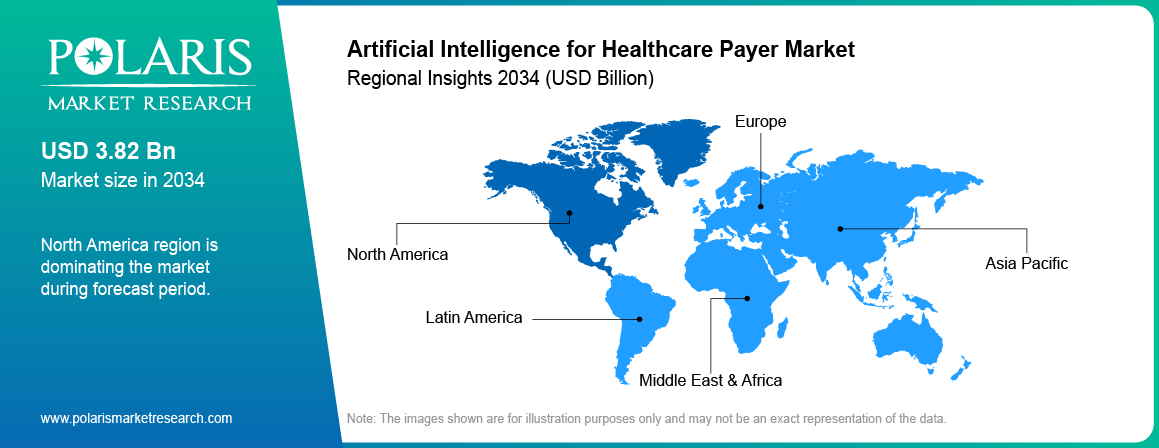
North America led the AI for healthcare payers market in 2025 due to its extensive use by payers in managing claims, risk assessment, as well as detecting fraud. Strong healthcare infrastructure, high digitalization, and government initiatives for value-based care are accelerating AI adoption across insurance providers.
The U.S. Artificial Intelligence for Healthcare Payer Market Insights
Rising healthcare expenditure in the U.S. is driving growth in the AI for healthcare payers market through increasing investment in AI-driven claims management and fraud detection. The Centers for Medicare & Medicaid Services estimated that U.S. health spending hit about USD 4.9 trillion in 2023, up from USD 4.1 trillion in 2020. This growth is opening up greater access to advanced AI tools for greater operational efficiency and overall improved payer-provider coordination.
Europe Artificial Intelligence for Healthcare Market Assessments
The Europe market is expected to account for a significant revenue share in 2034 driven by mature healthcare systems, stringent rules, and investments in AI platforms for claim handling and predictive modeling. EU digital health programs and reimbursement policies are also urging AI implementation in payer functions.
Asia Pacific Artificial Intelligence for Healthcare Payer Market Trends
Asia Pacific is expected to grow fastest driven by increasing healthcare expenditures and private insurance growth that enhance administrative effectiveness. Investments in digital health platforms, telehealth expansion and government digitization initiatives are driving AI adoption among payers.
India Artificial Intelligence for Healthcare Payer Market Overview
The increasing demand for customized health insurance options is contributing to growth in the AI for healthcare payers market as it helps in efficient policy choice, precise coverage determination and increasing customer interaction. For instance, Future Generali India introduced in April 2025 an AI-enabled platform that simplifies and personalizes the selection of the correct health insurance coverage for a person enabling quicker, better and more personalized policy selection.
Source: Polaris Market Research Analysis
Key Players & Competitive Analysis
The market for healthcare payers is extremely competitive, with major players including Nuance Communications (Microsoft), IBM Corporation, Oracle Corporation, Accenture and Cognizant. These firms develop AI products for claims handling, fraud detection, risk assessment, and personalized care to improve the payers' efficiency and reduce their expenses. Competition also arises from collaboration and launches to extend AI capabilities and accelerate deployment of solutions.
Who are the major players in artificial intelligence for healthcare payer market?
A few major companies operating in the artificial intelligence for healthcare payer industry include Nuance Communications (Microsoft), IBM Corporation, Oracle Corporation, Accenture, Cognizant, Milliman MedInsight, Firstsource Solutions, Sword Health, Inc., CareCloud, Inc., MST Solutions, L.L.C., Innovaccer, Inc., and Codoxo.
Leading Artificial Intelligence for Healthcare Payer Companies
- Accenture
- CareCloud, Inc.
- Cognizant
- Codoxo
- Firstsource Solutions
- IBM Corporation
- Innovaccer, Inc.
- Milliman MedInsight
- MST Solutions, L.L.C.
- Nuance Communications (Microsoft)
- Oracle Corporation
- Sword Health, Inc.
Artificial Intelligence for Healthcare Payer Market Recent Developments
- July 2026: Arbital Health announced the launch of Arbital Flex. Arbital Flex is a self-serve analytics solution for payors and providers. Teams can use this solution to manage their VBC performance.(Source: PRNewswire)
- September 2025: Milliman MedInsight launched the MedInsight Innovation Portal, a next-generation, AI-powered cloud analytics platform designed to empower healthcare organizations. It offers payers with advanced AI capabilities, seamless data integration, and automated analytics to improve decision-making and operational efficiency.
- August 2025: Firstsource Solutions partnered with Guidehealth to speed up value-based care powered by AI for health plans. The partnership is designed to enhance models of care, maximize claims handling, and grow member participation, resulting in better health outcomes and operating effectiveness.
- July 2025: Sword Health launched Sword Intelligence with AI-powered care manager agents designed to help payers, providers, and governments fight healthcare's operational problems.
Future Outlook of Artificial Intelligence for Healthcare Payer Market
The AI for healthcare payer industry is expected to grow significantly in the coming years. The growth will be attributed to rapid healthcare digitization and rising insurance complexity. Also, growing demand for automated decision-making is projected to boost market expansion. Future growth will also be fueled by surging adoption of generative AI (GenAI) and predictive analytics. Increasing demand for cloud-based platforms and fraud detection technologies would accelerate the market penetration. Personalized healthcare insurance solutions would become a key market trend in the coming years.
Artificial Intelligence for Healthcare Payer Market Segmentation and Forecast
By Component Outlook (Revenue, USD Billion, 2021–2034)
- Software
- Services
By Deployment Outlook (Revenue, USD Billion, 2021–2034)
- Cloud
- On-Premises
By Technology (Revenue, USD Billion, 2021–2034)
- Machine Learning (ML)
- Natural Language Processing (NLP)
- Predictive Analytics
- Others
By Application Outlook (Revenue, USD Billion, 2021–2034)
- Claims Processing Optimization
- Fraud Detection and Prevention
- Revenue Management and Billing
- Administrative Workflow Automation
- Others
By Regional Outlook (Revenue, USD Billion, 2021–2034)
- North America
- U.S.
- Canada
- Europe
- Germany
- France
- UK
- Italy
- Spain
- Netherlands
- Russia
- Rest of Europe
- Asia Pacific
- China
- Japan
- India
- Malaysia
- South Korea
- Indonesia
- Australia
- Vietnam
- Rest of Asia Pacific
- Middle East & Africa
- Saudi Arabia
- UAE
- Israel
- South Africa
- Rest of Middle East & Africa
- Latin America
- Mexico
- Brazil
- Argentina
- Rest of Latin America
Artificial Intelligence for Healthcare Payer Market Report Scope and Methodology
| Report Attributes | Details |
| Market Size in 2025 | USD 2.50 Billion |
| Market Size in 2026 | USD 2.87 Billion |
| Revenue Forecast by 2034 | USD 9.03 Billion |
| CAGR | 15.36% from 2026 to 2034 |
| Base Year | 2025 |
| Historical Data | 2021–2024 |
| Forecast Period | 2026–2034 |
| Quantitative Units | Revenue in USD Billion and CAGR from 2026 to 2034 |
| Report Coverage | Revenue Forecast, Competitive Landscape, Growth Factors, and Industry Trends |
| Segments Covered |
|
| Regional Scope |
|
| Competitive Landscape |
|
| Report Format |
|
| Customization | Report customization as per your requirements with respect to countries, regions, and segmentation. |
Source: Polaris Market Research Analysis
Artificial Intelligence for Healthcare Payer Market Frequently Asked Questions
The global market size was valued at USD 2.50 billion in 2025 and is projected to grow to USD 9.03 billion by 2034.
The global market is projected to register a CAGR of 15.36% during the forecast period.
North America dominated the market in 2025 driven by early adoption of AI and advanced analytics in payer operations.
A few of the key players in the market are Nuance Communications (Microsoft), IBM Corporation, Oracle Corporation, Accenture, Cognizant, Milliman MedInsight, Firstsource Solutions, Sword Health, Inc., CareCloud, Inc., MST Solutions, L.L.C., Innovaccer, Inc., and Codoxo.
The cloud segment dominated the market revenue share in 2025 due to scalability, flexibility, and faster deployment.
The fraud detection and prevention segment is projected to witness the fastest growth during the forecast period due to rising healthcare fraud cases.
AI for healthcare payers uses machine learning, predictive analytics, and automation. AI systems are used to improve claims management and fraud detection. They help in risk assessment and member engagement. AI adoption is enhancing the operational efficiency.
AI is used in automating the claims processing, fraud detection, and member risk assessment. AI also helps in personalizing the insurance policies and optimizing the payment process. AI can also be used in enhancing customer services through intelligent virtual assistants.
AI tools enhance the claim process. They automate documentation and verification of policy eligibility. AI detects errors or fraud within the system. It eleminates the requirement for manual reviews. Thus, AI adoption leads to fast and efficient claim processing.
Download Sample Report of Artificial Intelligence for Healthcare Payer Market
Please fill out the form to request a customized copy of the research report.


