
Multiomics in Drug Discovery Market Size, Share Report 2026-2034
REPORT DETAILS
Multiomics in Drug Discovery Market Summary
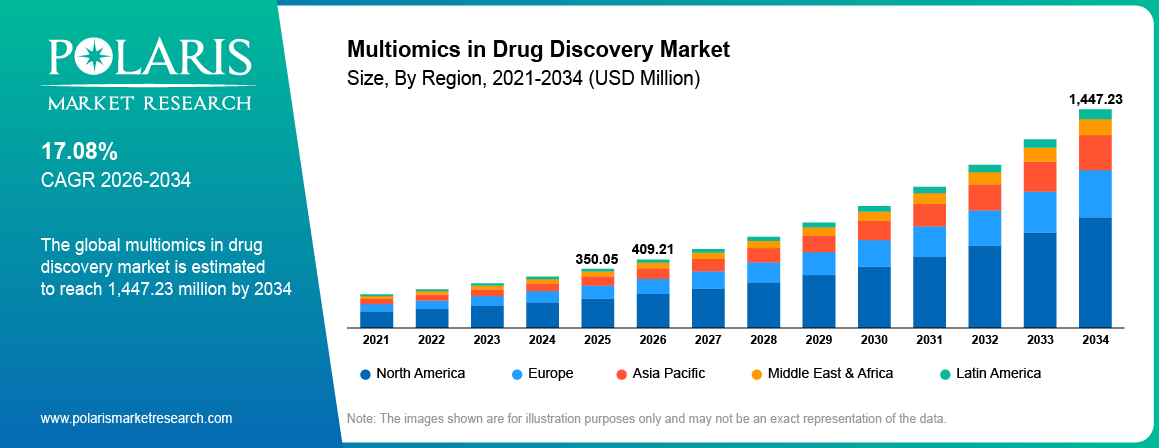
The global multiomics in drug discovery market was valued at around USD 350.05 million in 2025 and is projected to reach USD 1,447.23 million by 2034, registering a CAGR of 17.08%during the forecast period. The market is witnessing growth owing to the growing utilization of multiomics for target identification, rising investment in precision medicine, growing use of artificial intelligence-powered drug discovery tools, and increasing need for integration of biological data to enhance research outcomes. Significant growth is expected to be observed in the precision medicine, regenerative medicine, and organoids markets.
Market Statistics
Multiomics in Drug Discovery Market Key Takeaways 2025
- North America dominated the market in 2025 with a 41.36% market share owing to strong pharmaceutical research activities, advanced sequencing infrastructure, and high investments in precision medicine.
- The products segment accounted for the largest market share of 45.82% in 2025 due to growing adoption of sequencing instruments, analytical platforms, and laboratory consumables.
- The genomics segment dominated the market with a 34.67% share in 2025 owing to its widespread use in drug target validation and disease research.
- The single-cell multiomics and spatial omics segment is projected to grow at the fastest CAGR of 18.94% during 2026–2034.
- The target discovery application segment held the largest market share of 38.25% in 2025 due to increasing demand for efficient target identification across pharmaceutical research.
Note: Figures and projections outlined in this report are the result of Polaris Market Research’s proprietary analytical processes, grounded in the latest available datasets and market observation
What is multiomics in drug discovery?
The term multiomics in drug discovery is used to describe a scientific study where biological information coming from more than one biological layer, such as genomics, transcriptomics, proteomics, and metabolomics, is combined to learn about disease biology and new targets for treatment. This method provides a deeper understanding of biological systems than single omics experiments.
The market value chain includes reagent and instrument manufacturers, sequencing platform providers, bioinformatics software developers, contract research organizations, cloud platform providers, pharmaceutical companies, biotechnology firms, and research institutes. These participants work together to generate, analyze, and interpret complex biological datasets for drug development. Increasing adoption of proteogenomics, single-cell multiomics, and advanced analytics platforms is improving research efficiency across the value chain.
Growing investments in pharmaceutical research, advances in next-generation sequencing, expansion of AI-powered biological analysis, and increasing availability of large-scale molecular datasets are supporting market expansion. The adoption of biological foundation models and federated genomic data platforms is further improving collaborative research while enabling secure data sharing across institutions. These developments are helping pharmaceutical companies accelerate drug discovery and improve clinical success rates.
Source: Polaris Market Research Analysis
Multiomics in Drug Discovery Market Impact Analysis
The multiomics in drug discovery market is expected to witness strong growth during the forecast period due to increasing demand for precision therapeutics and integrated molecular analysis. Pharmaceutical companies are combining genomics, proteomics, transcriptomics, and metabolomics data to improve target identification, reduce development risks, and accelerate early-stage drug research. Investment into drug discovery platforms leveraging AI technologies is another factor driving the growth of the market.
The rising adoption of cloud computing, high-throughput sequencing, and computational biology is boosting the capability of analyzing complicated biological data sets. Patient stratification and biomarker prediction platforms are other efforts being made by pharmaceutical companies in order to increase the success rate of clinical trials. These factors are driving the demand for multiomics technology in the drug discovery process.
Research bodies have continued to produce massive data sets in biology, which help in improving the knowledge of diseases and developing effective therapies. For example, NIH allocated USD 50.3 million to form the Multi-Omics for Health and Disease Consortium in 2023(Source: www.nih.gov), promoting the multiomics research process for discovering biomarkers and precision medicine. With the increased use of perturb-seq, spatial omics, and proteogenomics technology, there is increased precision in studying cellular processes. These innovations are expected to create new opportunities for solution providers during the forecast period.
| Market Driver | Est. CAGR Impact | Geographic Relevance | Impact Timeline |
| Growth of precision medicine | +2.4% | Global | Short to Medium Term |
| AI-powered multiomics analytics | +2.0% | North America, Europe | Medium Term |
| Expansion of single-cell multiomics | +1.8% | Global | Medium Term |
| Increasing biomarker-driven drug development | +1.5% | North America, Asia Pacific | Long Term |
| Growth of federated genomic data platforms | +1.2% | Europe, North America | Long Term |
* Indicative estimates based on market context and analyst judgment. Figures reflect relative driver weight, not additive CAGR contributions. Source: Polaris Market Research Analysis.
Multiomics in Drug Discovery Market Dynamics.
Drivers - Increasing adoption of integrated omics technologies for target identification.
The widespread use of precision medicine is leading to an increase in the application of multiomics tools in pharmaceutical drug discovery efforts. Drug companies are using genomics, transcriptomics, proteogenomics, and metabolomics to better identify their targets and understand disease biology. In April 2025, the Signios Bio company developed a multiomics platform that leverages the power of AI and bioinformatics to speed up the process of precision medicine, biomarker discovery, and drug discovery (Source: www.signiosbio.com) Multiomics data can be useful in biomarker discovery and patient stratification, which can help businesses create drugs for well-defined patient populations. Increased funding for personalized medicine and targeted therapies is fueling the growing need for multiomics technologies.
Drivers - AI and Advanced Multiomics Technologies Supporting Market Growth
The rapid developments in the fields of artificial intelligence, cloud computing, and high-throughput sequencing are enhancing the efficiency of multiomics analysis. Scientists are using single-cell multiomics, spatial omics, and perturb-seq methods to analyze cellular interactions and progression of diseases with enhanced accuracy. The emergence of biologic foundation models is aiding pharma firms in processing massive datasets and coming up with new targets for therapies. In May 2026, QIAGEN collaborated with NVIDIA to use graph-based artificial intelligence and curated biological information to aid in the discovery of new drug targets and biomarkers.This advancement is aiding in making drug discovery more efficient.
Restraints - Complex Data Integration and High Research Costs
The multiomics approach involves generating large amounts of biological information from various analytical systems, which presents difficulties for the integration and interpretation of the data. Such companies need to have high bioinformatics capacities and adequate computing power to analyze the large amounts of data. High demands for investment and non-standardized procedures for analysis prevent the use of multiomics, especially by smaller biotechnology firms and academic institutions.
Opportunities -Expansion of Collaborative Research and Large-Scale Biological Databases
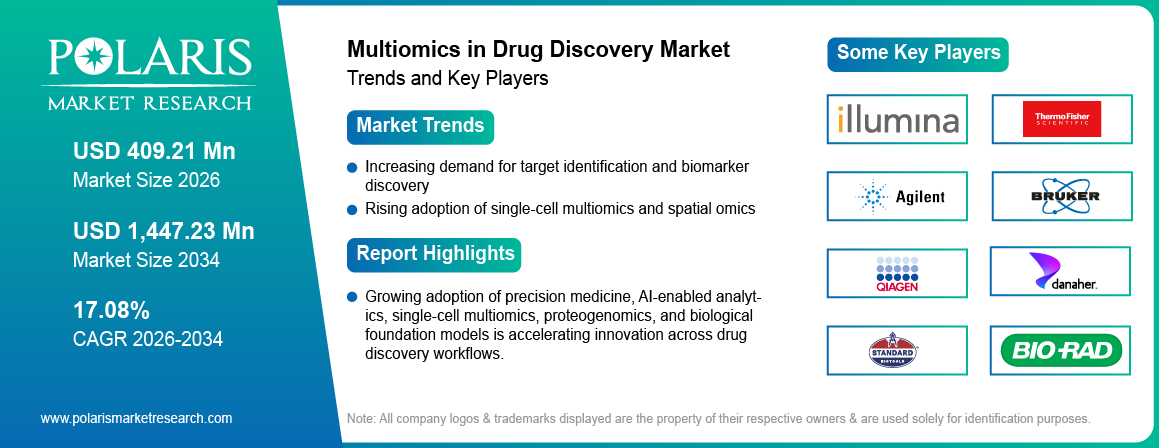
The increasing availability of biological data from the entire population is presenting more possibilities for the market. There are collaborations between research firms, health organizations, and pharmaceutical firms in developing a genomic data platform that allows data sharing without breaching patients' privacy. Illumina partnered with Ovation.io in May 2025 to introduce StrataMap Spatial Solution to allow single-cell spatial transcriptomics for high-resolution tissue mapping and drug discovery(Source: emea.illumina.com) These initiatives help advance disease research, fast-track biomarker discovery, and enable AI-driven drug development. Increasing investments in collaborative research programs are expected to create significant growth opportunities during the forecast period.
Source: Polaris Market Research Analysis
Multiomics in Drug Discovery Market Segmentation Analysis
The report provides a comprehensive analysis of the market by offering, omics modality, and application to identify key revenue-generating and high-growth segments.
Market by Offering
Products Segment Dominated the Market by Offering in 2025
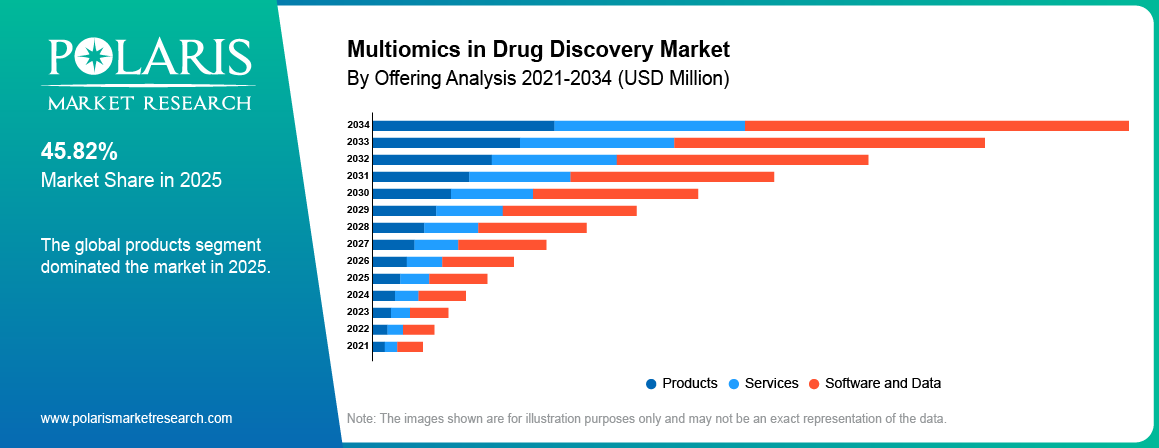
The products segment accounted for the largest market share of 45.82% in 2025 due to increasing demand for sequencing instruments, mass spectrometry platforms, laboratory reagents, consumables, and sample preparation systems. The pharmaceutical sector is constantly investing in state-of-the-art laboratory tools for enhancing target identification, molecular profiling, and drug validation. The increasing focus on research in genomics and proteomics is expected to drive the need for high-performance analytical tools in drug discovery laboratories.
Software and Data Segment to Register the Fastest Growth
The software and data segment is projected to grow at the fastest CAGR of 18.97% during the forecast period. The pharmaceutical sector has become increasingly engaged in using cloud-based bioinformatics platforms to consolidate genomics, proteogenomics, metabolomics, and clinical data sets into a unified workflow. Analytical software that utilizes artificial intelligence (AI) is enabling faster biomarker identification and improved molecular analysis. Growing adoption of predictive analytics and digital research platforms is expected to drive segment growth throughout the forecast period.
Market by Omics Modality
Genomics Segment Held the Largest Market Share in 2025
The genomics segment dominated the market with a 34.67% share in 2025 due to its widespread applications in disease study, genetic variant identification, and target identification. Genome sequencing helps in identifying genes associated with disease and validating the targets before progressing into the preclinical development process. Advancements in next-generation sequencing technologies have increased the application of genomics in the drug discovery pipeline.
Single-Cell Multiomics and Spatial Omics to Grow at the Fastest CAGR
The single-cell multiomics and spatial omics segment is projected to grow at the fastest CAGR of 18.94% through the forecast period due to increased use of single-cell multiomics and spatial omics technologies, which help scientists study the behavior of individual cells and tissue structures. In July 2026, Illumina extended its Billion Cell Atlas initiative to develop AI-driven single-cell technology for drug discovery and precision medicine (Source:www.prnewswire.com) This kind of technology enhances disease classification and stratification and allows better understanding of biology than traditional bulk technology. Rising investments in high-resolution molecular profiling are expected to accelerate segment growth.
Market by Application
Target Discovery Segment Led the Market by Application in 2025
The target discovery application segment held the largest market share of 38.25% in 2025 due to increasing use of integrated molecular analysis to identify novel therapeutic targets. Pharmaceutical companies have been utilizing genomics, transcriptomics, proteogenomics, and metabolomics technologies in order to ensure proper identification of targets and reduce the risk associated with the drug development process. Utilization of multiomics technology platforms helps researchers to develop a better understanding of disease biology, thus increasing their confidence in their early-stage work.
Biomarkers Discovery Segment Projected to Record the Fastest Growth
The biomarkers discovery segment is anticipated to show the highest CAGR of 17.80% during the forecast period. The increasing focus on precision medicine is resulting in an increasing demand for predictive biomarkers to increase accuracy in therapy selection and clinical trial results. Multiomics technology helps in gaining a comprehensive understanding of biological systems. Increasing adoption of AI-driven analytical tools is further improving biomarker validation across pharmaceutical research.
Segment Summary Table
| Segment | Category | 2025 Status | Forecast CAGR | Key Driver |
| Products | Offering | Largest Share | High | Increasing demand for sequencing instruments |
| Software & Data | Offering | Fastest Growing | Highest | AI-driven bioinformatics platforms |
| Genomics | Omics Modality | Largest Share | High | Growing target identification activities |
| Single-cell & Spatial | Omics Modality | Fastest Growing | Highest | High-resolution molecular profiling |
| Target Discovery | Application | Largest Share | High | Rising pharmaceutical R&D |
| Biomarker Discovery | Application | Fastest Growing | Highest | Precision medicine adoption |
Source: Polaris Market Research Analysis. Segment share and CAGR reflect Polaris proprietary sizing methodology.
Source: Polaris Market Research Analysis
Regional Analysis
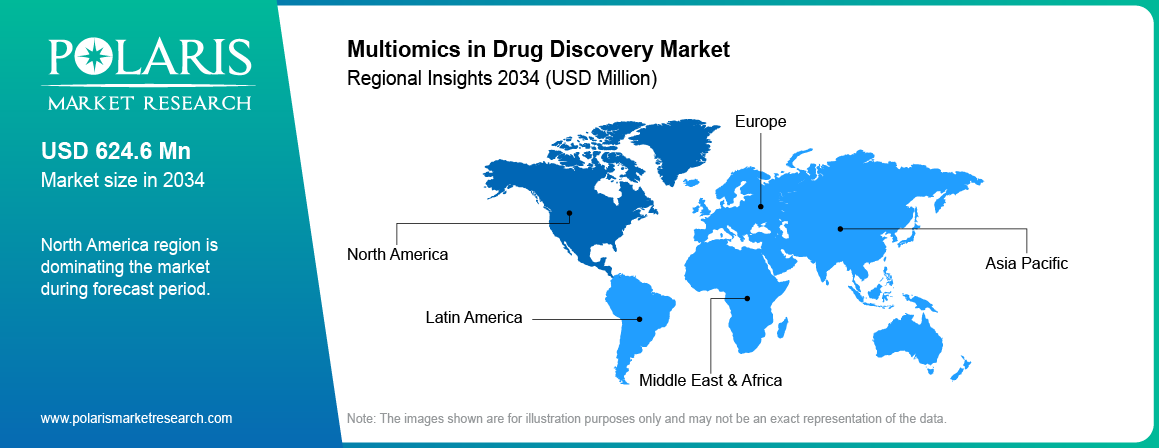
North America Multiomics in Drug Discovery Market
North America dominated the multiomics in drug discovery market in 2025 owing to strong investments in pharmaceutical research, advanced sequencing infrastructure, and the presence of leading biotechnology companies. The US accounted for the largest regional share due to increasing adoption of AI-driven drug discovery platforms, expanding precision medicine programs, and rising use of single-cell multiomics across pharmaceutical research. In June 2025, Lisata Therapeutics' collaboration with GATC Health was extended to utilize the Multiomics Advanced Technology (MAT) platform, driven by artificial intelligence, for drug discovery and development processes (Source: ir.lisata.com). Increasing cooperation between research institutions and biotech firms continues to drive target identification, biomarker discovery, and translational research efforts in the area.
Europe Multiomics in Drug Discovery Market
Europe possessed a considerable market share in 2025 owing to rising investments in genomics research, rising pharmaceutical innovations, and regulatory initiatives. Several countries such as Germany, the UK, France, and the Netherlands are enhancing their efforts in multiomics research through genomics programs and drug discovery collaborations. In July 2026, Novogene Europe introduced an untargeted metabolomics offering in order to enhance multiomics studies for drug discovery and biomarker development (Source: www.drugdiscoverynews.com). Growing adoption of federated genomic data platforms and increasing use of patient stratification approaches are improving clinical research efficiency and supporting regional market growth.
Asia Pacific Multiomics in Drug Discovery Market
Asia Pacific is projected to grow at the fastest CAGR during the forecast period due to increasing pharmaceutical R&D expenditure, rapid expansion of biotechnology companies, and improving healthcare research infrastructure. China, Japan, India, South Korea, and Singapore are investing heavily in precision medicine, sequencing technologies, and computational biology. In May 2026, Strand Life Sciences launched South Asia’s first Olink Explore HT proteomics service to enable large-scale multiomics research for biomarker discovery and drug development (Source: strandls.com). Growing adoption of spatial omics, proteogenomics, and AI-enabled analytics is improving drug development capabilities and creating new opportunities for market participants across the region.
Latin America Multiomics in Drug Discovery Market
Latin America is witnessing steady growth owing to expanding clinical research activities and increasing investments in biotechnology infrastructure. Brazil and Mexico remain the leading markets due to growing pharmaceutical research, improving laboratory capabilities, and rising collaborations with global biotechnology companies. Increasing adoption of integrated omics technologies is supporting disease research and creating new opportunities for drug discovery service providers.
Middle East & Africa Multiomics in Drug Discovery Market
The Middle East & Africa market is expected to grow steadily during the forecast period due to increasing investments in precision healthcare, genomics research, and biotechnology innovation. Saudi Arabia, the UAE, and South Africa are strengthening research capabilities through national healthcare modernization programs and academic collaborations. The increasing popularity of personalized medicine and molecular diagnostics is likely to encourage the use of multiomics techniques in pharmaceutical research.
Source: Polaris Market Research Analysis
Regulatory Heatmap
| Country | Policy Environment | Key Regulations | Market Implication | Trend |
| US | Favorable | FDA Biomarker Qualification Program | Supports biomarker-driven drug discovery | Expanding |
| Canada | Developing | National Genomics Initiatives | Encourages precision medicine research | Growing |
| Germany | Favorable | EU Genomic Data Infrastructure | Supports collaborative research | Expanding |
| UK | Favorable | UK Genomics Programme | Accelerates pharmaceutical innovation | Stable |
| China | Developing | National Precision Medicine Initiative | Expands genomic research | Growing |
| Japan | Favorable | National Genomic Medicine Program | Supports translational research | Expanding |
| India | Developing | National Biotechnology Mission | Encourages genomics research | Growing |
| Singapore | Favorable | National Precision Health Program | Promotes AI-enabled drug discovery | Growing |
Source: U.S. Food and Drug Administration (FDA), National Institutes of Health (NIH), European Commission, UK Government, National Health Commission of China, Ministry of Health, Labour and Welfare (Japan), Department of Biotechnology (DBT), Government of India, and Precision Health Research Singapore (PRECISE)
Competitive Landscape
The multiomics in drug discovery market is moderately fragmented due to the presence of global life science companies, sequencing technology providers, bioinformatics software developers, and specialized biotechnology firms. Companies compete through technological innovation, integrated research platforms, AI-enabled analytical capabilities, and strategic collaborations with pharmaceutical organizations. Partnerships, product launches, acquisitions, and investments in single-cell multiomics, biological foundation models, and cloud-based analytical platforms remain the primary growth strategies adopted by market participants.
Competitive Positioning Table
| Company | Est. Market Position | Primary Focus | Geographic Focus | In Report |
| Illumina Inc. | Top Tier | Sequencing & Multiomics | Global | Yes |
| Thermo Fisher Scientific Inc. | Top Tier | Life Science Instruments | Global | Yes |
| Agilent Technologies Inc. | Strong Player | Analytical Technologies | Global | Yes |
| Bruker Corporation | Strong Player | Proteomics & Spatial Biology | Global | Yes |
| QIAGEN N.V. | Major Player | Molecular Diagnostics & Bioinformatics | Global | Yes |
| Standard BioTools Inc. | Strong Player | Single-cell Technologies | North America & Europe | Yes |
| Revvity Inc. | Major Player | Life Science Solutions | Global | Yes |
Source: Company filings and press release
Technology and Innovation Landscape 2025-2026
The multiomics landscape is evolving rapidly with continuous advancements in sequencing technologies, AI-powered bioinformatics, and integrated molecular analysis platforms. Pharmaceutical companies are increasingly combining genomics, proteogenomics, transcriptomics, metabolomics, and single-cell multiomics to generate deeper biological insights throughout drug development. Multiomics techniques have facilitated better target discovery, shorter research times, and more accurate disease modeling.
The implementation of perturb-seq, spatial omics, and biological foundation models is revolutionizing drug discovery through enhanced cell analyses and predictions. Scientists have employed these techniques for studying the mechanism of diseases, assessing therapeutic responses, and discovering new biomarkers for many diseases. The rising spending on cloud computing and AI is also contributing to better data integration and analysis.
| Technology | Adoption Stage | Key Development | Market Impact |
| Single-cell Multiomics | Growing | High-resolution cellular analysis | Improves target validation |
| Spatial Omics | Growing | Tissue-level molecular profiling | Enhances disease understanding |
| Biological Foundation Models | Early Commercial | AI-enabled biological prediction | Accelerates drug discovery |
| Proteogenomics | Mainstream | Multi-layer molecular analysis | Improves target identification |
| Perturb-seq | Early Commercial | Functional genomics screening | Supports mechanism studies |
| Federated Genomic Data | Growing | Secure collaborative research | Expands data accessibility |
Source: Polaris Market Research Analysis, press release, and IP & patent filings
Buyer Use Cases and Entry Barriers
Market research enables pharmaceuticals, biotechnology companies, CROs, investors, and research organizations to assess new technologies, competitive activity, and opportunities in the multiomics marketplace. The report will assist organizations in making strategic business decisions by providing data on market size, trends, geographical demand, competitive analysis, and growth opportunities.
The results of research have great value for any organization that plans to introduce new products, develop business partnerships, make investments, and implement technology. In addition, the report can be very helpful in identifying fast-growing application areas, analyzing competitive products, and understanding the role of patient stratification, biomarkers, and target identification in the process of modern drug discovery.
| Buyer / Investor Type | Primary Use Case | Key Insight Sought | Decision Horizon |
| Pharmaceutical Companies | Drug target discovery | Target identification | Long Term |
| Biotechnology Companies | Therapeutic development | Biomarker discovery | Medium Term |
| Contract Research Organizations (CROs) | Research outsourcing | Multiomics capabilities | Short to Medium Term |
| Academic & Research Institutes | Disease research | Molecular mechanisms | Long Term |
| Investors | Opportunity assessment | Market attractiveness | Medium to Long Term |
Source: Polaris Market Research Analysis
High Capital Investment
The deployment of multiomics technology requires considerable expenses to be made on sequencers, mass spectrometers, laboratory robotics equipment, cloud infrastructure, and supercomputers. The companies must make ongoing investments in software development and data storage facilities to handle big biological datasets. High costs of the infrastructure create barriers to entry into the market for new firms.
Complex Data Integration
Multiomics research entails the use of genomic, transcriptomic, proteogenomic, and metabolomic datasets obtained through various analytical technologies. Combining all this information together while preserving accuracy and reproducibility is a technical challenge. It requires expertise in bioinformatics and standard protocols, which adds to the difficulty.
Regulatory and Data Governance Challenges
The drug discovery projects have access to sensitive genomic and clinical data, which should conform to regional data privacy laws. There is a need for strong governance models, cloud storage systems, and analysis workflows for data before analyzing or sharing it. Adoption of the federated genomics data platforms has greatly helped, but there still needs to be considerable investment in compliance with the law.
Shortage of Skilled Professionals
Effective utilization of multiomics technologies requires experienced molecular biologists, bioinformaticians, computer scientists, AI experts, and clinical researchers. The shortage of multidisciplinary expertise leads to increased recruitment expenditures and slower implementation of such technologies, especially by young biotechnology firms.
Premium Insights and Forward Outlook
Multiomics is Transforming Drug Discovery Workflows
In the transition to molecular integration from single-omics studies, pharmaceutical firms are hoping to increase the efficiency of research and lower the risks in the development of new drugs. In combination with genomics, single-cell multiomics, spatial omics, proteogenomics, and metabolomics, there is increasing insight into the biology of disease. Through such an integration process, there is better accuracy of target identification, faster biomarker discovery, and a better choice of treatment.
AI and Multiomics Will Shape Future Innovation
The use of artificial intelligence is anticipated to be an integral part of multiomics research in the future. The application of biological foundation models, predictive analytics, and automatic data interpretation makes the process of molecular interaction analysis easier. Growing investment in AI-powered research platforms and collaborative biological databases will continue to accelerate innovation during the forecast period.
Key Players
- Illumina Inc.
- Thermo Fisher Scientific Inc.
- Agilent Technologies Inc.
- Bruker Corporation
- Danaher Corporation
- QIAGEN N.V.
- Standard BioTools Inc.
- Revvity Inc.
- Bio-Rad Laboratories Inc.
- Pacific Biosciences of California Inc.
- Oxford Nanopore Technologies plc
- 10x Genomics Inc.
- NVIDIA Corporation
- Tempus AI, Inc.
- Charles River Laboratories
Industry Developments
- July 2026: Illumina expanded its Billion Cell Atlas program, adding new AI drug discovery partners to advance single-cell multiomics research for drug development and precision medicine.(source: www.prnewswire.com)
- May 2026: QIAGEN collaborated with NVIDIA to integrate graph-based AI and curated bioinformatics knowledge, aimed at accelerating drug target and biomarker discovery. (Source: www.qiagen.com)
- November 2025: Athos Therapeutics collaborated with Xeptiva Therapeutics by using its AthosOmics. AI multiomics platform in AI-based biomarker discovery and vaccine development programs.(source: athostx.com)
- October 2025: Illumina launched BioInsight, a dedicated AI informatics business built specifically for multi-omic drug discovery, targeting large-scale sequencing data integration and perturb-seq analysis for drug developers (Source: www.fiercebiotech.com)
- September 2025: Biognosys expanded its multiomics portfolio by introducing services in metabolomics and lipidomics, thereby facilitating drug discovery and research.(source: biognosys.com)
- September 2025: Illumina introduced SomaSeq Discovery, which is a next-generation sequencing (NGS)-based proteomics test for augmenting multiomics analysis through integration of proteomic and genomic data for drug discovery, biomarker discovery, and therapy development. (source: sapac.illumina.com)
Market Segmentation
By Offering Outlook (Revenue, USD Million, 2021–2034)
- Products
- Services
- Software and Data
By Omics Modality Outlook (Revenue, USD Million, 2021–2034)
- Genomics
- Transcriptomics
- Proteomics
- Metabolomics
- Single-cell and Spatial
By Application Outlook (Revenue, USD Million, 2021–2034)
- Target Discovery
- Biomarker Discovery
- Mechanism of Action (MoA) & Drug Repurposing
- Patient Stratification
By Regional Outlook (Revenue, USD Million, 2021-2034)
- North America
- US
- Canada
- Europe
- Germany
- France
- UK
- Italy
- Spain
- Netherlands
- Russia
- Rest of Europe
- Asia Pacific
- China
- Japan
- India
- Malaysia
- South Korea
- Indonesia
- Australia
- Vietnam
- Rest of Asia Pacific
- Middle East & Africa
- Saudi Arabia
- UAE
- Israel
- South Africa
- Rest of Middle East & Africa
- Latin America
- Mexico
- Brazil
- Argentina
- Rest of Latin America
Multiomics in Drug Discovery Market Report Scope
| Report Attributes | Details |
| Market Size in 2025 | USD 350.05 Million |
| Market Size in 2026 | USD 409.21 Million |
| Revenue Forecast by 2034 | USD 1,447.23 Million |
| CAGR | 17.08% from 2026 to 2034 |
| Base Year | 2025 |
| Historical Data | 2021–2024 |
| Forecast Period | 2026–2034 |
| Quantitative Units | Revenue in USD Million and CAGR from 2026 to 2034 |
| Report Coverage | Revenue Forecast, Competitive Landscape, Growth Factors, and Industry Trends |
| Segments Covered |
|
| Regional Scope |
|
| Competitive Landscape |
|
| Report Format |
|
| Customization | Report customization as per your requirements with respect to countries, regions, and segmentation. |
Multiomics in Drug Discovery Market FAQ's
The global market size was valued at USD 350.05 million in 2025 and is projected to grow to USD 1,447.23 million by 2034.
Growth is enabled by precision medicine, analytics powered by artificial intelligence, and increased demand for target and biomarker identification.
North America dominated the market in 2025 with a 41.36% market share due to strong pharmaceutical R&D and advanced research infrastructure.
The target discovery segment dominated the market in 2025 due to increasing pharmaceutical research activities.
The single-cell and spatial segment is projected to grow at the fastest CAGR during the forecast period.
Major players include Illumina Inc., Thermo Fisher Scientific Inc., Agilent Technologies Inc., Bruker Corporation, Danaher Corporation, QIAGEN N.V., Standard BioTools Inc., Revvity Inc., Bio-Rad Laboratories Inc., Pacific Biosciences of California Inc., Oxford Nanopore Technologies plc, 10x Genomics Inc., NVIDIA Corporation, Tempus AI, Inc., Charles River Laboratories.
Artificial intelligence is revolutionizing biomarker discovery, patient stratification, and drug target validation through enhanced data analytics.
Download Sample Report of Multiomics in Drug Discovery Market
Please fill out the form to request a customized copy of the research report.


