
Switchgear Market Size, Share, Trends & Forecast, 2026–2034
REPORT DETAILS
Switchgear Market Summary
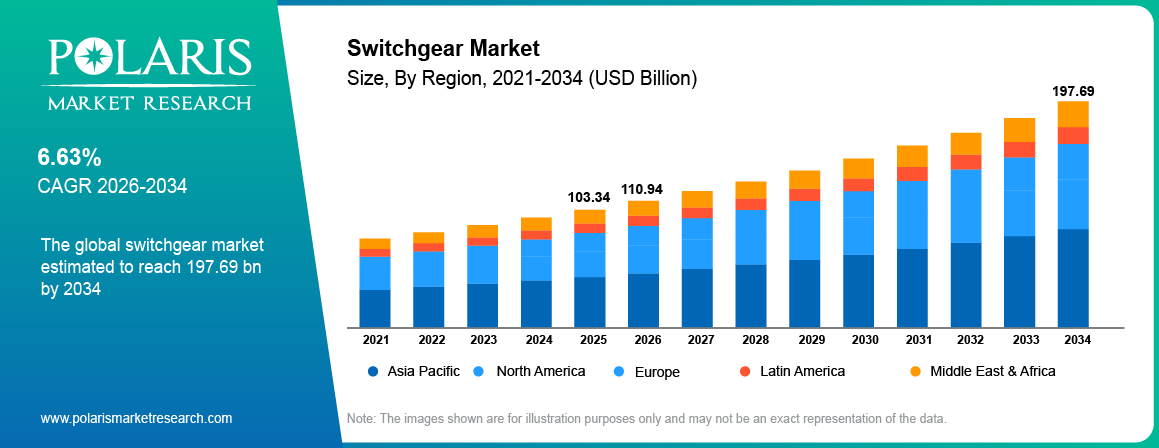
The global switchgear market size was valued at USD 103.34 billion in 2025. The market is expected to exhibit a CAGR of 6.63% from 2026 to 2034. The market is shaped by grid modernization, industrial electrification, renewable energy integration, and the expansion of hyperscale and AI data centers. Demand for reliable power distribution, fault protection, and compact substation equipment is also influencing product selection.
Market Statistics
Key Takeaways
- Asia Pacific led the global switchgear market share by holding 43.12% in 2025. The region’s growth is being driven by rapid industrialization and urbanization, rising electricity consumption, and investments in transmission and distribution infrastructure.
- The North America market is predicted to experience a 6.18% CAGR during the forecast period. This is due to grid modernization, integration of renewable energy, replacement of obsolete infrastructure, and rising power demand from AI and hyperscale data centers.
- Air-insulated switchgear (AIS) accounted for 51.84% of the overall market revenue share in 2025. It has been used for a long time in utility substations, industrial facilities, and electricity distribution networks where space constraints are not a problem.
- Gas-insulated switchgear (GIS) is expected to witness the highest 12.74% CAGR during the projected period. The segment’s growth is driven by rising demand for small substations, space-efficient electrical infrastructure, and reliable switching equipment in urban and industrial settings.
- The high-voltage switchgear segment accounted for a 20.08% share of the market in 2025, supported by investments in transmission networks, substation upgrades, and the integration of renewable energy sources into the power grid.
- Transmission and distribution utilities captured 38.26% of the market share in 2025, owing to grid expansion, rising electricity consumption, smart grid deployment, and the requirement to enhance the reliability of power networks.
Note: Figures and projections outlined in this report are the result of Polaris Market Research’s proprietary analytical processes, grounded in the latest available datasets and market observations.
What is Switchgear?
Switchgear is an assembly of electrical switching, protection, isolation, measurement, and control equipment used to de-energize, energize, protect, and sectionalize electrical circuits. It comprises components such as circuit breakers, disconnectors, fuses, relays, busbars and metering devices. The market for switchgear covers equipment and systems used in electricity generation, transmission and distribution, industrial facilities, commercial and residential buildings, and data centers. Switchgear is a set of electrical protection and control functions working together, not just one circuit breaker.
The market includes air-insulated switchgear (AIS), SF6-based gas-insulated switchgear (GIS), SF6-free gas-insulated switchgear, solid-insulated switchgear, and other qualifying designs. According to the proposed market taxonomy, equipment is also classified by voltage, including low voltage switchgear up to 1 kV, medium voltage above 1 kV to 52 kV, and high voltage above 52 kV. The technology choice is dictated by voltage rating, fault-current requirements, installation footprint, operating environment, maintenance requirements, and total cost of ownership. Vacuum circuit breakers are an interruption technology and not a separate insulation category.
Trends in the switchgear market are linked to grid modernization, replacement of aging infrastructure, integration of renewable energy, industrial electrification, and proliferation of AI and hyperscale data centers. Modernization of substations and electrical networks is driven by growing demand for electricity and need for reliable power distribution among utilities and industrial operators. To handle high-density computing loads, data center power distribution needs dependable switching, fault protection, redundancy and arc-resistant equipment that’s appropriate for the application.
The switchgear market forecast 2034 is driven by investments in transmission and distribution networks, renewable energy connections, battery energy storage systems (BESS), microgrids, and digital substations. Technology selection is also being influenced by environmental regulation. EU Regulation 2024/573 introduces phased restrictions on certain new switchgear containing fluorinated greenhouse gasses, raising the significance of SF₆-free switchgear technologies. Manufacturers are working on alternative insulation systems, such as clean-air and vacuum-based designs. Equipment qualification, manufacturing capacity, switchgear lead times, maintenance requirements, and lifecycle costs will continue to drive adoption for utility, industrial, commercial, and data center applications.
Switchgear vs Switchboard vs Circuit Breaker
Switchgear, switchboards, and circuit breakers perform related but distinct roles in electrical power systems. Switchgear is an assembly of equipment used for switching, protection, isolation, and control. Switchboards are used in low voltage applications to distribute electrical power to a number of circuits. A circuit breaker is a protective device which disconnects the current flow when an overload or a short circuit occurs. Switchgear may include circuit breakers, disconnectors, relays, busbars and monitoring equipment. Understanding the differences helps buyers evaluate equipment specifications, protection needs, installation requirements and costs for industrial facilities, commercial buildings, utilities and data centers.
| Attribute | Switchgear | Switchboard | Circuit breaker |
| What it is | Assembly of breakers, switches, protection, busbars, isolators, metering and control | Panel assembly that distributes power to branch circuits | A single device that interrupts fault current; one component inside switchgear |
| Construction | Compartmentalized, typically metal-enclosed lineup | Less compartmentalized panel, often fixed | Standalone device or draw-out module |
| Breaker type | Power circuit breakers (vacuum or air), usually draw-out | Molded-case or insulated-case breakers, usually fixed | Not applicable (it is the breaker) |
| Short-time withstand | Rated to carry fault current for a defined time, enabling selective coordination | Generally not rated for short-time withstand | Has an interrupting rating, not an enclosure withstand rating |
| Service access | Draw-out breakers allow maintenance with less downtime | Maintenance often needs the section de-energized | Removable if draw-out |
| Safety | Barriers, interlocks, optional arc-resistant design | Fewer barriers | Safety depends on the enclosure it sits in |
| Typical applications | Utilities, data centers, hospitals, heavy industry | Commercial buildings, light industrial | Used in both |
Source: Polaris Market Research Analysis
Market Dynamics
Driver: Aging Grid Replacement and Substation Modernization
Grid modernization is increasing the need for reliable switching, circuit protection, and substation equipment. Utilities are upgrading transmission and distribution switchgear networks to accommodate changing load patterns, new generation sources, and rising electricity consumption. Aging switchgear also needs to be inspected, replaced, or modernized to maintain network reliability and meet current operating requirements. In April 2025, the NC Clean Energy Technology Center reported 362 grid modernization actions in Q1 2025 in 47 U.S. states, Washington, D.C., and Puerto Rico. Most activity focused on energy storage, interconnection rules, and smart grid deployment (Source: nccleantech.ncsu.edu).
Circuit breakers, protection systems, busbars, monitoring equipment, and coordinated switching assemblies are replaced or upgraded in substation modernization. Medium voltage switchgear is used in distribution networks and industrial power systems, and high-voltage switchgear is used in transmission infrastructure and major substations. The selection of equipment depends upon fault levels, operating voltage, conditions of installation and maintenance. These factors tie demand for switchgear to capital spending by utilities and to long-term electricity infrastructure planning.
Driver: Expanding AI Data Centers and High-Density Power Distribution
AI and hyperscale data centers are expanding, propelling the demand for reliable electrical infrastructure. High-density computing needs a constant power supply for servers, networking gear, and data center cooling systems. Low voltage switchgear is used to distribute power to downstream equipment. Medium voltage switchgear may be used for incoming utility supplies and internal distribution systems, depending on the facility design.
Data center operators consider redundancy, protection coordination, fault clearing performance, and maintenance access when specifying equipment. Arc-resistant switchgear and remote operation features can enhance personnel safety and maintenance planning. Power distribution designs also must provide for future capacity, backup generation, and uninterruptible power systems. The growing AI data center market and hyperscale data center market create an important demand area for switchgear manufacturers.
Driver: Renewable Energy and Storage Integration
Switching and protection equipment are required at generation sites, collection networks, and grid interconnection points for solar, onshore wind, and offshore wind projects. Large renewable installations may require medium voltage equipment for collection systems and high voltage equipment for grid connection. Offshore wind projects often require small equipment for tight spaces and harsh operating conditions. IEA expects global renewable power capacity to grow by 4,600 GW by 2030, with solar PV providing almost 80% of the growth (Source: IEA).
Further switching requirements are added by battery energy storage systems (BESS) and microgrids. BESS switchgear isolates circuits, protects against faults and coordinates storage equipment, inverters and connected networks. Microgrid switchgear is used to control electrical connections between distributed generation, storage, and the main utility supply. Additional demand opportunities are created by growth in the renewable energy market and the battery energy storage system market.
Restraint: High Equipment Costs and Long Lead Times
Switchgear price depends on materials, protection components, manufacturing complexity, testing, and product ratings. Copper and steel prices can be volatile and impact procurement budget and manufacturing costs. Specialized GIS products and high voltage equipment may also require more engineering, testing, and qualification time than standard equipment.
Switchgear lead times and manufacturer capacity are critical considerations for utility projects, industrial expansion, and data center construction. Delivery time depends on factory capacity, availability of components, approval of design, and any necessary testing for the specific project. Delays affect substation commissioning and facility readiness. In addition to purchase price, buyers may compare suppliers on production capacity, service networks, technical compliance, and delivery commitments.
Opportunity: SF₆-Free Switchgear and Environmentally Compliant Grid Infrastructure
The transition to SF6 -free switchgear is an opportunity for the manufacturers to develop and commercialize alternative insulation technologies. As an example of the impact of EU Regulation 2024/573, utilities and industrial buyers are seeking alternatives such as clean-air, vacuum-based, and solid-insulated designs. It introduces staged limits on some new switchgear that uses fluorinated greenhouse gases. Demand will be subject to equipment availability, voltage ratings, qualification requirements, and project-specific technical requirements. Investment in grid in emerging economies outside China has fallen 7% annually, while 2,500 GW of renewable and storage projects are waiting to be connected to the grid globally. Some 750 million people still have no access to electricity (Source: UNCTAD).
Manufacturers can open up new market opportunities by developing SF₆-free solutions for medium and high voltage applications, thereby strengthening their product portfolios and supporting utilities in equipment replacement and substation modernization. Buyers will compare environmental performance against reliability, footprint, maintenance and switchgear total cost of ownership. The regulatory change could also open up opportunities for suppliers of engineering support and equipment for future compliance. Applicable requirements and exceptions should be checked against the official EU Regulation 2024/573.
SF₆ Phase-Out and F-Gas Regulation
An important technology and procurement consideration in the switchgear market is the transition away from sulfur hexafluoride (SF₆). SF₆ is an excellent insulating and arc-quenching gas, but its high global-warming potential raises environmental concerns in case of leakage. Depending on the voltage, the application and the design of the equipment, SF₆-free switchgear alternatives use different insulation media or gas mixtures.
EU Regulation 2024/573: Timeline by Voltage Class
EU Regulation 2024/573 sets phased restrictions on putting specified new fluorinated-gas switchgear into operation. The exact application depends on voltage class, short-circuit rating and the regulation’s exceptions. Procurement teams should think about the relevant equipment category and compliance date when specifying new installations. The regulation also covers SF₆ servicing after 2035 with certain conditions for reclaimed or recycled gas.
SF₆-Free Switchgear Technologies
SF₆-free switchgear avoids sulfur hexafluoride as the insulating or breaking medium in the relevant equipment design. Options include dry air or clean air combined with vacuum interruption, and alternative gas mixtures such as CO₂-O₂ or fluoronitrile-based systems. The suitable technology depends on voltage, current rating, installation conditions, maintenance strategy and manufacturer qualification.
The SF₆ vs. SF₆-free GIS comparison is not simply a choice between old and new equipment. Buyers must consider technical performance, lifecycle emissions, footprint, service procedures and supply availability. Modern GIS can use SF₆-free designs, including solutions intended for high-voltage transmission. In March 2026, Hitachi announced an order for EconiQ 550 kV GIS for Chubu Electric Power Grid in Japan. Hitachi reported a 99% reduction in CO₂-equivalent emissions from the insulating gas compared with conventional SF₆ equipment.
SF₆ Gas-Insulated vs. SF₆-Free Gas-Insulated Switchgear
SF₆ GIS uses sulfur hexafluoride for insulation and, in some designs, interruption. SF₆-free GIS uses alternatives intended to reduce the environmental impact of the insulating medium. The decision should account for the complete equipment specification, regulatory requirements, service arrangements and manufacturer qualification.
| Attribute | Conventional SF₆ GIS | SF₆-free GIS |
| Insulation medium | Sulfur hexafluoride | Dry or clean air with vacuum interruption (Schneider AirSeT, ABB SafeRing/SafePlus Air); CO₂-O₂ and fluoronitrile-based mixtures (GE Vernova g³, Hitachi Energy EconiQ) |
| Environmental profile | GWP roughly 23,000-25,000 times CO₂ over 100 years (varies by IPCC assessment); very long atmospheric life | Insulating-gas CO₂-equivalent cut by about 99% versus SF₆ (vendor-reported for EconiQ 550 kV and g³) |
| Voltage range | Medium voltage to ultra-high voltage | Medium voltage up to 24 kV (air/vacuum); high voltage commercially up to 145 kV with g³ and a portfolio to 420 kV (GE Vernova); 550 kV ordered (Hitachi Energy, Mar 2026) |
| Footprint | Compact baseline | GE Vernova states HV g³ GIS matches SF₆ GIS dimensions; confirm for MV pure-air designs |
| Retrofit implications | Large installed base; some GIS and GIL can be retro-filled with SF₆-free mixtures where the OEM supports it | Dual-gas GIS can run on SF₆ today and convert later |
| Regulation | EU F-gas regulation 2024/573 switchgear restricts new fluorinated-gas MV switchgear from 1 Jan 2026 and later classes; virgin SF₆ for servicing is generally restricted from 2035 | Compliant path in the EU; in Japan there is no elimination rule, but utilities such as Chubu adopt it voluntarily |
| Lifecycle considerations | Gas recovery, leakage monitoring, reporting and end-of-life reclamation | Lower regulatory exposure; check interrupter and gas supply capacity and qualification time |
Source: Polaris Market Research Analysis
Switchgear Types and Technology Comparison
Switchgear selection depends on insulation medium, interruption method, voltage class, installation environment and maintenance needs. The following comparisons explain key technical differences and common use cases. A
Vacuum vs. Gas Circuit Breakers
Vacuum circuit breaker and gas circuit breakers are designed to switch off electric current during faults, but they utilize different media to extinguish the arc. Vacuum circuit breakers are widely used in medium voltage applications and can help reduce dependency on insulating gasses. The gasses used in gas circuit breakers are SF₆ or other insulating gasses depending on the design and voltage class. Selection depends on voltage rating, interrupting capacity, switching performance, environmental requirements, equipment footprint, and maintenance needs. The distinction is important when evaluating switchgear technology, since circuit-breaking technology and insulation type are related but separate classification criteria.
| Dimension | Vacuum interrupter | SF₆ gas interrupter | SF₆-free gas alternatives |
| Interruption principle | Arc extinguished in a sealed vacuum bottle | Arc quenched in SF₆ | Arc quenched in CO₂-O₂ or fluoronitrile-based mixtures |
| Typical voltage fit | Mainstream at low and medium voltage; confirm current maximum rating at higher voltage | Historically dominant at high voltage and in MV gas-insulated lineups | Live-tank breakers with CO₂-O₂ up to 420 kV (GE Vernova); Hitachi Energy EconiQ breakers, including a 300 kV order in Japan |
| Relationship to enclosure insulation | Independent of insulation: enclosure can be air, solid or gas | Often paired with SF₆ insulation | Paired with matching low-GWP insulation |
| Maintenance | Sealed interrupter, long electrical endurance | Gas handling and monitoring | Gas handling and monitoring |
| Environmental profile | No fluorinated gas in the interrupter | High GWP | Low GWP |
Source: Polaris Market Research Analysis
Metal-Clad vs. Metal-Enclosed, Fixed vs. Withdrawable, Indoor vs. Outdoor
Metal-clad and metal-enclosed switchgear differ in their internal compartmentalization and separation of components. For suitable medium voltage systems, metal clad designs usually provide grounded metal barriers between major functional compartments, providing further segregation. Metal enclosed switchgear is suitable for a wider range of metal enclosed arrangements. Fixed switchgear keeps the main components fixed in position, whereas withdrawable designs permit some components to be withdrawn for inspection, testing or replacement. Indoor switchgear is intended for installation in a protected environment. Outdoor equipment is provided with enclosures and insulation to withstand exposure to weather and site conditions. Selection depends on safety requirements, accessibility, available space, environmental exposure, maintenance strategy, and total installation cost.
| Variant | What it means | Serviceability and footprint | Typical use |
| Metal-clad | North American specification term: draw-out breakers with grounded metal barriers between compartments | High serviceability; larger footprint | Utility and industrial MV |
| Metal-enclosed | IEC 62271-200 term; service-continuity and partition classes describe compartmentalization | Varies by class | MV distribution globally |
| Fixed breaker | Breaker permanently mounted | Lower cost and smaller; maintenance needs an outage of the section | Cost-sensitive, lower-criticality loads |
| Withdrawable | Breaker on a draw-out truck with interlocking | Faster replacement, less downtime; higher cost and footprint | Critical loads, data centers, process plants |
| Indoor | Housed in a building or room | Protected from weather; needs floor space | Urban, data centers, industrial |
| Outdoor | Weather-proof or pad-mounted enclosure | Exposed to weather; tamper and ingress protection needed | Utility distribution, renewable sites |
Source: Polaris Market Research Analysis
Ring Main Units and Compact Substations
Ring main units (RMUs) are compact medium-voltage switchgear assemblies used to manage power distribution in ring or radial networks. They help utilities and facility operators isolate faults, switch circuits, and maintain service continuity. Compact substations are a space-efficient installation combining transformers, switchgear and low-voltage distribution equipment. They are used in urban distribution networks, commercial developments, industrial sites, renewable energy projects and infrastructure with limited installation space. Demand depends on the expansion of the distribution network, reliability requirements, safety standards and demand for prefabricated equipment. Alternative to traditional gas-insulated designs, SF6-free RMUs and compact substations may also be of interest to buyers.
Switchgear Standards and Safety
Switchgear Standards define the performance, testing and safety requirements of the equipment. Compliance enables manufacturers and buyers to evaluate reliability, insulation performance, fault interruption and operational suitability in various voltage classes.
IEC 62271 Family and Related Standards
The switchgear standards IEC 62271 specifies requirements and test methods for relevant categories of equipment within the scope of high-voltage switchgear and controlgear. Different parts are applicable to different devices and assemblies, so manufacturers must identify the standards applicable to the product's voltage class, design and intended use. Other standards may be applicable to low-voltage switchgear assemblies, installation practices, and electrical safety in the workplace. It is the responsibility of buyers to ensure that they have the most recent editions, national adoptions and project specific requirements prior to procurement. Compliance testing and documentation provide a basis for equipment performance under defined operating and fault conditions, but they do not replace site-specific engineering, installation controls, or maintenance procedures.
Arc-Resistant Switchgear and Arc-Flash Mitigation
Arc-resistant switchgear is designed to control the effects of an internal arcing fault and direct hot gasses and pressure away from designated personnel areas under specified test conditions. Arc-Flash Mitigation Arc-Flash Mitigation is the reduction of the possibility of an electrical arc occurrence, or the consequences of an electrical arc. These measures may include appropriate equipment selection, protective relays, current limiting devices, remote operation, interlocks, maintenance practices, and risk assessments. Arc-resistant construction does not eliminate arc flash hazards or the need for safe work procedures and appropriate protective equipment. When selecting equipment for industrial plants, utilities, and critical facilities, buyers consider the applicable test classification, installation configuration, fault-current levels, accessibility, and maintenance requirements.
Digital Switchgear and Predictive Maintenance
Digital switchgear adds sensing, monitoring and communication capabilities for better visibility of equipment and operational decisions. Digital technologies allow operators to monitor operating conditions, identify abnormal behavior and schedule maintenance before failures lead to service disruption. The adoption of the sensor technology depends on the availability of sensors, the quality of data, the integration of the system, cyber security and the ability to make monitoring data usable for maintenance decisions.
Digital Switchgear and Smart Substations
Digital switchgear and smart substations use connected sensors, intelligent electronic devices and communication networks to improve monitoring, control and protection. Digital substations can provide improved availability of status information about equipment and coordination of operation across power networks. These capabilities are relevant for grid modernization, integration of renewable energy, industrial electrification, and data center power infrastructure. The adoption depends on interoperability, communications architecture, retrofit complexity, cyber security and workforce capabilities. Utilities and industrial operators need to evaluate whether digital upgrades provide tangible benefits in terms of reliability, operational visibility and maintenance efficiency.
Condition Monitoring, Partial Discharge and Predictive Maintenance
Condition monitoring monitors equipment parameters—temperature, operating cycles, contact wear, insulation condition, etc. Partial discharge monitoring can assist in the detection of localized insulation defects which could lead to more serious failure depending on the equipment design and operating conditions. Predictive maintenance helps prioritize inspections and repairs by combining condition data, diagnostic methods, and asset history. These technologies can lead to fewer unplanned outages and better maintenance planning, but success depends on sensor placement, data interpretation, equipment criticality, and qualified personnel. Utilities and industrial users assess monitoring systems based on diagnostic accuracy, integration requirements, and the potential cost of avoided downtime.
Cybersecurity for Digital Switchgear
In addition to the operational benefits, digital switchgear and the connected substations also bring cybersecurity considerations. Networked protection devices, remote monitoring platforms and control systems may add more points that need access control, safe communication, software updates and ongoing monitoring. Utilities and industrial operators may reduce their exposure through network segmentation, role-based access, asset inventories, incident response plans, and security assessments of suppliers. Cybersecurity requirements are different depending on the jurisdiction, system architecture, and the criticality of the installation. Buyers must evaluate security at all stages of equipment procurement, commissioning, operation and maintenance to safeguard the availability of the power system and the integrity of operational data.
Switchgear Reliability, Lifecycle and Total Cost of Ownership
When considering buying switchgear, it’s not simply about the price of the equipment. Total cost of ownership includes the cost of procurement, installation, commissioning, energy losses, inspections, maintenance, replacement parts, downtime risks, and end of life handling. Reliability depends on the design of the equipment, the environmental conditions, the operating cycles, the protection settings, the quality of the installation and the maintenance practices. Buyers can compare air-insulated, gas-insulated, SF₆-free and solid insulated solutions against footprint, performance, regulatory requirements, serviceability and expected operating life. Longer lead times, specialty components, and technician availability can also affect project economics. In addition to technical compliance, evaluating lifecycle costs helps utilities and industrial users in choosing equipment that meets their reliability and budget needs.
Switchgear Market Segmentation Analysis
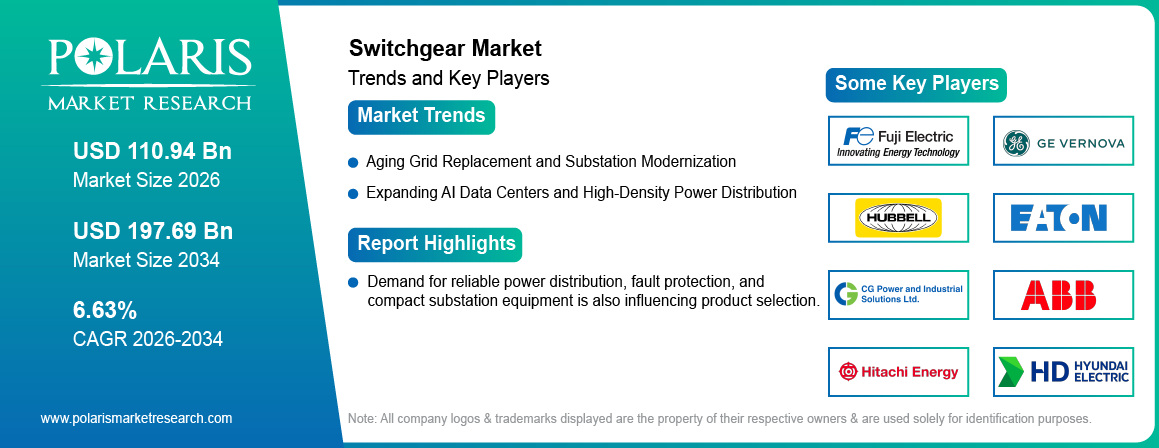
The switchgear market share analysis covers insulation, voltage, end-use and region. Segment leadership and market share percentages must be populated from the approved Polaris Market Research model. The categories below follow the revised taxonomy, with voltage boundaries and insulation definitions applied consistently.
Insulation Type Analysis
The air-insulated switchgear (AIS) segment is expected to account for 51.84% of the global switchgear market share in 2025. AIS uses air as the main insulation medium and is widely used in transmission and distribution networks, industrial facilities and commercial infrastructure. Its proven technology, ease of maintenance and suitability for a variety of voltage applications all support adoption. In grid expansion and substation modernization projects, utilities also use AIS. Demand is dictated by the space available for installation, environmental conditions, voltage requirements and costs of the project. Growing demand for electricity and investment in power distribution infrastructure are likely to support the use of air-insulated switchgear in utility and industrial applications.
The gas-insulated switchgear (GIS) segment is expected to register a CAGR of 6.83% during the forecast period 2026-2034. GIS uses insulating gas to insulate the equipment electrically in compact assemblies. This makes it ideal for substations where space is at a premium, in urban infrastructure and for high voltage applications. The increased investment into grid modernization, renewable energy integration and reliable power distribution is benefiting GIS manufacturers. The move toward SF₆-free switchgear is also stimulating the development of alternative gas and insulation technologies. Adoption is dependent on equipment cost, technical qualification, voltage class, environmental requirements, and lifecycle performance. Increasing demand for compact substations and reliable grid infrastructure is expected to drive growth of the gas-insulated switchgear market.
Air-Insulated Switchgear Vs Gas-Insulated Switchgear (AIS Vs GIS)
| Attribute | Air-insulated switchgear (AIS) | Gas-insulated switchgear (GIS) |
| Insulation medium | Ambient air at atmospheric pressure | Pressurized insulating gas in sealed compartments (SF₆ historically; SF₆-free mixtures or clean air in newer designs) |
| Footprint | Largest; needs phase and ground clearances | Substantially smaller |
| Installation environment | Indoor or outdoor where land is available | Indoor or compact outdoor: urban, underground, offshore, industrial; sealed against pollution and humidity |
| Capital cost | Lower equipment cost; higher land and civil cost | Higher equipment cost; lower land and civil cost |
| Maintenance | Exposed parts are visible and accessible; more routine inspection | Sealed live parts need little maintenance; requires gas monitoring and specialist servicing |
| Environmental profile | No fluorinated insulating gas | Depends on the gas: SF₆ has very high global-warming potential; SF₆-free options are low-GWP |
| Typical applications | Rural and suburban substations, utility yards, industrial sites with space | Urban substations, data centers, offshore platforms and wind, hydropower, space-constrained sites |
Source: Polaris Market Research Analysis
The solid-insulated switchgear segment is expected to record a CAGR of 8.12% during the forecast period. Solid-insulated switchgear uses solid dielectric materials to insulate energized components and separate them from grounded parts. It offers an alternative to conventional air-insulated and gas-insulated designs, with potential benefits such as compact construction, reduced reliance on insulating gases, and lower environmental impact. Utilities and industrial plants could also consider the application of solid-insulated equipment for medium-voltage distribution networks, indoor substations, and space-constrained plants. Choice depends on voltage ratings, thermal performance, insulation integrity, maintenance needs and life cycle costs. Manufacturers are designing compact designs to meet the needs of grid modernization and environmental requirements.
Voltage Analysis
The high voltage switchgear segment represented 20.08% share of the global switchgear market in 2025. For voltages above 52 kV, high-voltage switchgear is used. High-voltage switchgear is used in electricity transmission, large substations, and high-capacity power networks. It enables circuit switching, fault interruption and equipment isolation throughout transmission infrastructure. High-voltage equipment is being driven by grid expansion, replacement of aging transmission assets and integration of large-scale renewable energy projects. Utilities also use switchgear to move electricity long distances and to keep the grid stable. Demand is a function of transmission investment, project timelines, equipment specs, and procurement costs.
The medium-voltage switchgear segment is projected to record a 6.91% CAGR during the forecast period. It is used at voltages above 1 kV and up to 52 kV. It is commonly used in distribution substations, industrial plants, commercial buildings, and renewable energy installations. Increasing electrification, distribution network upgrades and the growth of data centers are leading to greater demand for medium-voltage power distribution equipment. Utilities and industrial users are also looking at SF₆-free GIS, solid-insulated switchgear and ring main units (RMUs) to satisfy space, reliability and environmental requirements. Equipment availability and compliance with applicable standards are critical for grid investment and growth. Segment is expected to be supported by demand for reliable distribution infrastructure.
End-Use Analysis
In 2025, the transmission and distribution (T&D) utilities segment dominated the global switchgear market share with 38.26%. T&D utilities use switchgear to control the flow of electricity, isolate faults, protect network assets, and ensure reliable power. Replacement and installation are driven by factors such as aging grid infrastructure, substation modernization, increased electricity consumption, and renewable energy integration. Further investment is being made in advanced circuit breakers, disconnectors, protection relays, busbars, and digital monitoring systems to further optimize the performance of the network. The equipment selected is based on voltage ratings, reliability requirements, maintenance requirements, and regulatory requirements. Grid expansion and replacement of legacy switchgear are expected to drive sustained demand from utility operators.
The data center segment is expected to record a 10.42% CAGR during the forecast period of 2026-2034. To ensure that vital computing infrastructure is protected and that uptime is guaranteed, data centers require reliable power distribution systems. As investment in AI data centers and hyperscale facilities increases, there is growing demand for switchgear that can handle high electrical loads, offer redundancy and connect with monitoring and protection systems. Important parts of these installations are low-voltage and medium-voltage switchgear, circuit breakers and digital power distribution equipment. Buyers consider equipment reliability, fault-clearing performance, footprint, lead times, and total cost of ownership. Opportunities are anticipated to increase for switchgear manufacturers as AI workloads and cloud infrastructure expand.
Switchgear for AI and Hyperscale Data Centers
Reliable, high-capacity switchgear and power distribution equipment is in demand as AI and hyperscale data centers proliferate. AI data center expansion is driving demand for AI data center switchgear. Also, the growth of GPU-based computing and continuous workloads increases rack power density and requires reliable LV and MV switchgear, circuit breakers, busbars, protection relays and disconnectors. The equipment must be able to isolate faults, be electrically protected, be redundant and restore power to critical IT infrastructure quickly.
Digital switchgear and smart monitoring systems enhance equipment visibility, allow for condition monitoring and predictive maintenance. Buyers also consider footprint, installation schedules, equipment availability and, total cost of ownership. Increased investment in AI infrastructure provides opportunities for manufacturers of scalable power distribution systems and reliable protection and solutions for high density data center environments.
Switchgear for Renewables, Storage, Microgrids and EV Charging
Switchgear is required for power distribution, fault protection, equipment isolation and reliable grid integration of renewable energy, battery storage, microgrids and EV charging infrastructure. Such applications create a demand for equipment that can manage variable power flows, changing electrical loads and distributed energy resources.
Solar, Wind and Offshore Wind Connections
Switchgear connects solar and wind generation equipment to collection networks, transformers, substations, and transmission infrastructure. Switching and protection equipment is required at the inverter outputs and grid connection points of solar farms. Medium voltage and high voltage switchgear is used to control turbine collection circuits, offshore substations and export connections for onshore and offshore wind switchgear projects. Offshore wind installations have to deal with severe environmental conditions, limited space and the requirement for reliable operation. Demand for AIS, GIS, circuit breakers, disconnectors and protection relays is being driven by grid expansion and additions of renewable energy capacity. The SF 6 -free GIS is also becoming more relevant as project developers consider environmental requirements and other insulation technologies.
Battery Energy Storage Systems
Battery energy storage systems (BESS) need switchgear to handle the connections between battery inverters, transformers, the local distribution network and utility grids. The equipment isolates faults, switches and protects during charge and discharge operations. The demand depends on storage capacity, voltage ratings, project configuration and grid connection requirements. The growing penetration of renewable energy sources makes the switchgear indispensable for reliable power distribution and secure operation of storage facilities. Buyers also look at digital monitoring, protection coordination, equipment footprint and lifecycle costs.
Microgrids
Microgrids switchgear are used to control distributed generation, batteries and local electricity loads. Switching and protection equipment provide disconnection and fault detection, and allow the transition between islanded and grid-connected operation. Demand is linked to industrial resilience, remote supply of power, renewable integration and reliable delivery of electricity.
EV Charging Hubs
Power distribution to the charging equipment and electrical circuit protection require low-voltage switchgear and medium-voltage switchgear in EV charging hubs. High-power charging installations might require dedicated transformers, circuit breakers and coordinated protection systems. The decision to adopt depends on charging capacity, availability of grid connection, safety requirements and costs of infrastructure.
Bidirectional Power Flow and Protection Coordination
Distributed generation, BESS and bidirectional EV charging can lead to different power-flow conditions in distribution networks. The switchgear and protection relays must be able to accommodate the relevant fault-current levels, operating modes and coordination requirements. Protection coordination is good because it doesn’t trip healthy circuits unnecessarily while isolating faults. As distributed energy resources grow, utilities and facility operators will evaluate the settings of equipment, communication capabilities and system compatibility to ensure reliable power distribution.
Manufacturing Capacity, Lead Times and Localization
Manufacturing capacity and lead time for delivery are key factors in the global switchgear market. On-time delivery of equipment is essential to meet commissioning schedules and infrastructure expansion targets for utilities, industrial operators, data center developers and renewable energy project owners. High voltage switchgear, custom GIS, special circuit breakers and large substation assemblies may require detailed engineering, component sourcing, testing and qualification.
Availability of skilled labor, changing demands, supply chain issues, and production constraints can all affect delivery schedules and project costs. Producers are investing in capacity, supplier networks and regional facilities to make their supply more agile. Localization also helps suppliers meet domestic purchasing needs, regional technical standards and after-sales service requirements. Besides equipment specifications and total cost of ownership, buyers are increasingly looking at manufacturing capacity, delivery commitments, spare parts availability and maintenance support.
Switchgear Market Regional Insights
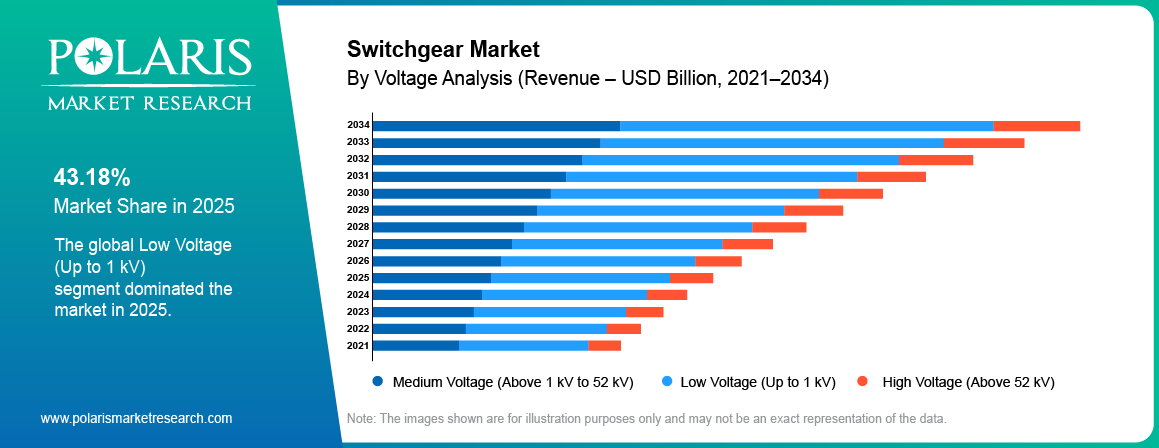
Power demand, grid modernization, industrialization, renewable energy integration, and data center expansion are the factors that influence regional dynamics in the global switchgear market. The demand for low-voltage (LV), medium-voltage (MV) and high-voltage (HV) switchgear is across utilities and industrial applications. Asia Pacific is anticipated to lead the market, driven by infrastructure development and industrialization, while North America is projected to witness substantial growth spurred by grid upgrades, renewable energy projects and investments in AI data centers switchgear.
Asia Pacific Switchgear Market Trends
Asia Pacific held the largest market share in 2025, accounting for 43.12%. Electricity consumption, industrialization, urban infrastructure development, and investment in transmission and distribution (T&D) networks are driving demand across China, India, Japan, and South Korea. Southeast Asia’s electricity demand is expected to increase by 5.4% a year through 2030. Rising adoption of data center coolant distribution units propels the demand for switchgear for data centers. The amount of energy used per person has grown by almost 30% in the last ten years. Demand for low, medium, and high-voltage switchgear is driven by grid expansion, aging equipment replacement, renewable energy connections and substation modernization. Also, growth of battery energy storage systems (BESS), and EV charging infrastructure is creating additional opportunities. Adoption of GIS, AIS, and digital switchgear depends on project requirements, equipment costs, and environmental regulations (Source: IEA).
North America Switchgear Market Trends
North America is projected to register a CAGR of 6.18% during 2026–2034. Regional growth is influenced by grid modernization, replacement of aging electrical infrastructure, renewable energy integration, and rising investment in AI and hyperscale data centers. The U.S. market requires dependable switchgear for substations, industrial plants, power distribution networks, and high capacity computing infrastructure. Demand for circuit breakers, protection relays, busbars, and digital monitoring systems is driven by demand for equipment upgrades. Battery energy storage systems, microgrids and EV charging hubs are creating new installation opportunities. Market growth depends on utility investment, manufacturing capacity, equipment lead times, and adoption of SF 6 -free GIS and other advanced insulation technologies. G&W Electric rolled out an integrated voltage-sensing solution in August 2025 to boost real-time grid monitoring, fault detection and predictive diagnostics in switchgear operations (Source: Business Wire).
Europe Switchgear Market Trends
Europe had 21.06% of the global switchgear market share in 2025. Regional demand is driven by grid modernization, renewable energy deployment, interconnections to offshore wind, and environmental requirements. EU Regulation 2024/573 introduces phased bans on some new switchgear with fluorinated greenhouse gases, increasing interest in SF₆-free GIS, clean-air technology and solid-insulated switchgear. Utilities and industrial users are considering equipment in terms of voltage ratings, safety, reliability and life cycle costs. Substation upgrades, integration of battery storage, and adoption of digital switchgear also support demand. The development of the market is based on the application of regulations, investment in projects, qualification of equipment and the ability of manufacturers to provide compliant products. In May 2025, nVent completed the acquisition of Avail Infrastructure Solutions’ Electrical Products Group for USD 975 million, expanding its offerings of switchgear, enclosures and bus systems for utilities, data centers and renewable energy infrastructure (Source: nVent).
Latin America and Middle East & Africa Switchgear Market Trends
In 2025, the global switchgear market revenue in Latin America, the Middle East & Africa accounted for 11.64%. The regional demand is being driven by the expansion of the electricity network, industrial development, urbanization, and investment in renewable energy projects. Latin America’s main markets are Brazil and Mexico, and the Middle East is investing in power infrastructure, solar energy, and large-scale industrial development. Utilities and industrial operators require low-, medium-, and high-voltage switchgear for substations, power distribution, and equipment protection. The choice of air-insulated switchgear (AIS), gas-insulated switchgear (GIS), and digital monitoring solutions is based on the project requirements, equipment cost, and environmental conditions. Market growth will depend on grid modernization, infrastructure spending, project financing, and equipment availability.
Competitive Landscape
The switchgear market includes global electrical equipment suppliers, specialist medium-voltage manufacturers, high-voltage GIS providers and vendors of digital protection and substation systems. Competition is shaped by voltage coverage, insulation technology, product reliability, manufacturing capacity, service networks and qualification for utility projects. These leading players are investing in research and development of new products to enhance their offerings in the market. Acquisitions and collaborations are also observed in the industry, enabling them to strengthen market presence and enter new geographic regions.
The top switchgear companies compete across distinct product categories rather than one uniform market. ABB Ltd., Schneider Electric SE, Eaton Corporation, and Legrand have positions in low-voltage distribution. Medium-voltage suppliers include several of these manufacturers alongside specialist vendors. Hitachi Energy and GE Vernova are identified in the brief for high-voltage GIS and SF₆-free transmission solutions. Siemens AG and Siemens Energy AG should remain separate entities in the report because their portfolio roles differ.
Key Players
- ABB Ltd.
- CG Power and Industrial Solutions Limited
- Eaton Corporation plc
- Fuji Electric Co., Ltd.
- GE Vernova Inc.
- HD Hyundai Electric Co., Ltd.
- Hitachi Energy Ltd.
- Hubbell Incorporated
- Hyosung Heavy Industries Corporation
- Legrand SA
- Mitsubishi Electric Corporation
- Powell Industries, Inc.
- Schneider Electric SE
- Siemens AG
- Siemens Energy AG
- Toshiba Energy Systems & Solutions Corporation
Key Switchgear Vendor Portfolios
| Company (legal name) | Positioning tier | Voltage focus | Technology and portfolio focus | Core end-use sectors |
| ABB Ltd. | Global full-line electrification | LV, MV | MV AIS/GIS; SF₆-free MV (SafeRing/SafePlus Air); digital | Utilities, data centers, industrial, buildings |
| CG Power and Industrial Solutions Limited | Regional champion (India), MV to UHV | MV, HV, UHV | Substation automation; AIS/GIS | Utilities (India), Middle East tenders |
| Eaton Corporation plc | LV/MV specialist, arc-safety leader | LV, MV | Arc-resistant LV (Magnum PXR); digital monitoring | Data centers, healthcare, industrial |
| Fuji Electric Co., Ltd. | Regional LV/MV supplier | LV, MV | LV/MV distribution equipment | Industrial, utilities |
| GE Vernova Inc. | HV GIS specialist, SF₆-free pioneer | HV | HV GIS; SF₆-free g³ (CO₂-O₂ and fluoronitrile mixtures) | TSOs, utilities, industry |
| HD Hyundai Electric Co., Ltd. | Korean full-range GIS supplier | LV, MV, HV | GIS; MV/LV switchgear | Utilities, industrial, Americas |
| Hitachi Energy Ltd. | HV/UHV specialist, SF₆-free leader | HV, UHV | AIS, GIS, hybrid; EconiQ SF₆-free GIS | TSOs, utilities, offshore wind |
| Hubbell Incorporated | Component and utility T&D niche | LV (components) | Utility T&D hardware; LV components | Utilities |
| Hyosung Heavy Industries Corporation | Korean full-range GIS supplier | LV, MV, HV | HV GIS; MV/LV switchgear | Utilities, industrial |
| Legrand SA | LV distribution specialist | LV | LV power distribution; digital | Buildings, data centers |
| Mitsubishi Electric Corporation | Diversified Asian OEM, LV to HV | LV, MV, HV | GIS and broad switchgear range | Utilities, industrial (strong in Asia) |
| Powell Industries, Inc. | Custom MV specialist | MV | Custom metal-enclosed MV gear | Petrochemical, utilities, industrial |
| Schneider Electric SE | Global full-line, SF₆-free MV and digital leader | LV, MV | Pure-air + vacuum AirSeT; embedded sensors; digital | Data centers, utilities, industrial, buildings |
| Siemens AG | Global LV/MV supplier | LV, MV | MV AIS/GIS; digital | Utilities, industrial, infrastructure |
| Siemens Energy AG | HV GIS specialist | HV | HV GIS; SF₆-free GIS | Utilities, offshore wind |
| Toshiba Energy Systems & Solutions Corporation | Regional MV/HV supplier | MV, HV | MV/HV switchgear | Utilities, industrial |
Source: Polaris Market Research Analysis
Recent Developments
- July 2026, GE Vernova has been contracted by Stromnetz Berlin for two contracts to design, deliver and install 110 kV gas-insulated substations using SF₆-free g³ technology to help modernize the grid and facilitate lower-emission power transmission. (Source: GE Vernova)
- May 2026, Hitachi Energy and State Grid Corporation of China put into operation the world’s first operational 550 kV SF₆-free gas-insulated switchgear installation at the Yuxian substation in Wuhan, an important step in decarbonizing high-voltage grids. (Source: Hitachi Energy)
- March 2026, Hitachi received an order from Chubu Electric Power Grid to supply its EconiQ 550 kV SF₆-free gas-insulated switchgear, which reduces CO₂-equivalent emissions from insulating gas by approximately 99% compared to conventional SF₆ equipment. (Source: Hitachi)
- November 2025, Schneider Electric launched GM AirSeT, an SF₆-free primary gas-insulated switchgear solution with pure-air insulation, vacuum interruption and embedded sensors for digital monitoring and condition-based maintenance. (Source: Schneider Electric)
- July 2025, ABB and E.ON announced that they are working together to bring the SafeRing and SafePlus Air 24 kV SF6-free secondary gas-insulated switchgear to Germany. It will help enable the transition to lower-emission medium-voltage distribution networks ahead of deadlines set by EU regulation. (Source: ABB)
Future Outlook
The switchgear market is expected to grow as utilities and industries invest in grid modernization, aging infrastructure replacement, and reliable power distribution. Rising demand from AI and hyperscale data centers, renewable energy, BESS, microgrids, and EV charging hubs will create opportunities across LV, MV, and HV switchgear. We expect to see greater adoption of SF₆-free GIS, solid-insulated switchgear, digital substations and predictive maintenance technologies. Market growth will be determined by regulatory requirements, manufacturing capacity, equipment lead times and total cost of ownership.
Research Methodology
The global switchgear market report uses secondary research, market estimation, primary validation, forecasting, and data triangulation to assess market trends, technologies, applications, fluids, architectures, and regional opportunities.
Secondary Research & Data Collection
The study reviews company disclosures, industry reports, utility investment plans, technical standards and regulations such as EU Regulation 2024/573, to evaluate AIS, GIS, SF₆-free technologies, grid modernization, and emerging applications.
Market Estimation & Modelling
Insulation Type, Voltage Class, End Use, Application and Area. The forecast assumption includes electricity demand, substation upgrades, integration of renewable energy, expansion of data centers, pricing of equipment, and manufacturing capacity.
Primary Validation
Inputs from industry manufacturers, utilities, distributors, and technical experts help validate assumptions about technology adoption, procurement priorities, equipment costs, lead times, and the market.
Data Triangulation & Final Review
Market estimates, CAGR, segment shares and regional positions are validated by comparing company disclosures, industry indicators and research inputs. Unsupported figures and unverified leadership claims are excluded.
Switchgear Market Report Segmentation
By Insulation Type Outlook (Revenue, USD Billion, 2021–2034)
- Air-Insulated Switchgear (AIS)
- Gas-Insulated Switchgear (GIS)
- SF₆-Free Gas-Insulated Switchgear
- Solid-Insulated Switchgear
- Others
By Voltage Outlook (Revenue, USD Billion, 2021–2034)
- Low Voltage (Up to 1 kV)
- Medium Voltage (Above 1 kV to 52 kV)
- High Voltage (Above 52 kV)
By End-Use Outlook (Revenue, USD Billion, 2021–2034)
- Transmission & Distribution Utilities
- Industrial
- Commercial & Residential
- Data Centers
- Others
By Regional Outlook (Revenue, USD Billion, 2021-2034)
- North America
- U.S.
- Canada
- Europe
- Germany
- France
- UK
- Italy
- Spain
- Netherlands
- Russia
- Rest of Europe
- Asia Pacific
- China
- Japan
- India
- Malaysia
- South Korea
- Indonesia
- Australia
- Vietnam
- Rest of Asia Pacific
- Middle East & Africa
- Saudi Arabia
- UAE
- Israel
- South Africa
- Rest of Middle East & Africa
- Latin America
- Mexico
- Brazil
- Argentina
- Rest of Latin America
Switchgear Market Report Scope
| Report Attributes | Details |
| Market Size in 2025 | USD 103.34 Billion |
| Market Size in 2026 | USD 110.94 Billion |
| Revenue Forecast by 2034 | USD 197.69 Billion |
| CAGR | 6.63% from 2026 to 2034 |
| Base Year | 2025 |
| Historical Data | 2021–2024 |
| Forecast Period | 2026–2034 |
| Quantitative Units | Revenue in USD Billion and CAGR from 2026 to 2034 |
| Report Coverage | Revenue Forecast, Competitive Landscape, Growth Factors, and Industry Trends |
| Segments Covered |
|
| Regional Scope |
|
| Competitive Landscape |
|
| Report Format |
|
| Customization | Report customization as per your requirements with respect to countries, regions, and segmentation. |
Source: Polaris Market Research Analysis
Switchgear Market FAQ's
The market was valued at USD 103.34 billion in 2025 and is projected to reach USD 197.69 billion by 2034, at a CAGR of 6.63%during 2026–2034.
A few key drivers include grid modernization, replacing aging infrastructure, integrating renewable energy, industrial electrification, and expanding AI data centers.
SF?-free switchgear is based on alternatives to sulfur hexafluoride, such as clean air insulation and vacuum interruption, to minimize the use of high global warming potential gases.
Air-insulated switchgear (AIS) dominated the market revenue share of 51.84% in 2025. It has been used for a long time in utility substations, industrial facilities, and electricity distribution networks where space constraints are not a problem.
The high voltage switchgear segment dominated the global switchgear market by holding 20.08% share in 2025. It is driven by rising investments in transmission networks, substation upgrades, and the integration of renewable energy sources into the power grid.
Asia Pacific dominated the global market share with 43.12% in 2025, due to rapid industrialization and urbanization and rising electricity consumption.
AIS uses air as an insulator and generally requires more space. GIS uses enclosed compartments for compact installation. GIS can use SF 6 or other insulating media.
Switchgear is used for switching, protection, and isolation. A switchboard distributes power to circuits, and a circuit breaker interrupts current in specified fault conditions.
The report proposes a classification of LV up to 1 kV, MV above 1 kV up to 52 kV, and HV above 52 kV.
Digital switchgear integrates sensors, electronic protection and communication systems, enabling remote monitoring, asset management and switchgear predictive maintenance.
Arc-resistant switchgear is tested to manage specified internal arc-fault hazards. Safe operation also requires suitable protection settings and procedures.
Switchgear distributes power, isolates a fault, and protects critical equipment. AI & hyperscale data centers: Reliable power distribution & redundancy
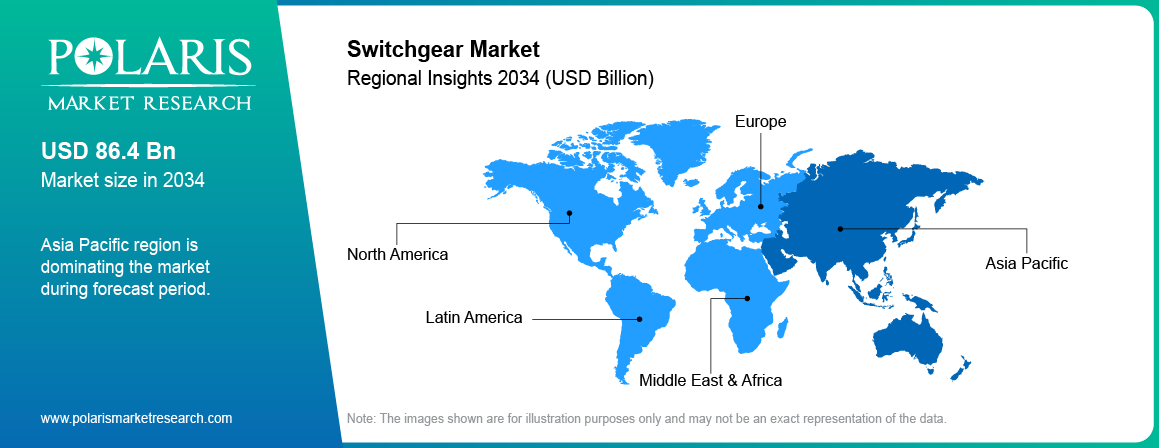
A few key players include ABB Ltd.; CG Power and Industrial Solutions Limited; Eaton Corporation plc; Fuji Electric Co., Ltd.; GE Vernova Inc.; HD Hyundai Electric Co., Ltd.; Hitachi Energy Ltd.; Hubbell Incorporated; Hyosung Heavy Industries Corporation; Legrand SA; Mitsubishi Electric Corporation; Powell Industries, Inc.; Schneider Electric SE; Siemens AG; Siemens Energy AG; and Toshiba Energy Systems & Solutions Corporation.
Low voltage covers up to 1 kV, medium voltage ranges from above 1 kV to 52 kV, and high voltage is above 52 kV.

Download Sample Report of Switchgear Market
Please fill out the form to request a customized copy of the research report.


