
DevSecOps Orchestration Market Size, Share, Trends and Forecast, 2026–2034
REPORT DETAILS
DevSecOps Orchestration Market Summary
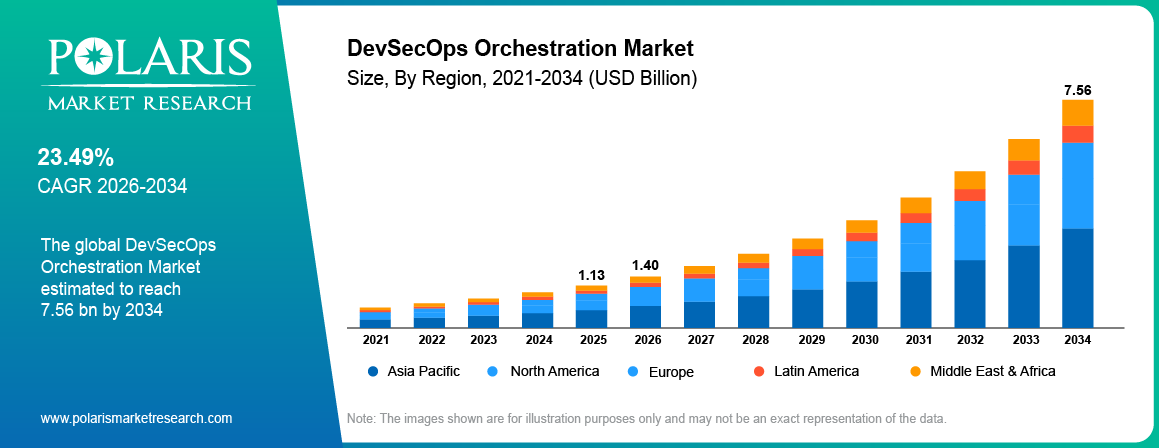
DevSecOps orchestration market size was valued at USD 1.13 billion in 2025 and is expected to reach USD 7.56 billion by 2034, at a CAGR of 23.49% from 2026 to 2034. Growth is driven by AI generated code volumes, EU Cyber Resilience Act reporting duties and demand for automated remediation. DevSecOps orchestration market trends 2026 reflect agent based remediation in application security orchestration.
Market Statistics
Key Takeaways
- North America held a leading position in the DevSecOps orchestration market, with 38.42% share in 2025, driven by vendor activity and federal software assurance developments.
- Europe is projected to register the significant growth at 23.17% CAGR during 2026–2034, driven by reporting obligations under the EU Cyber Resilience Act.
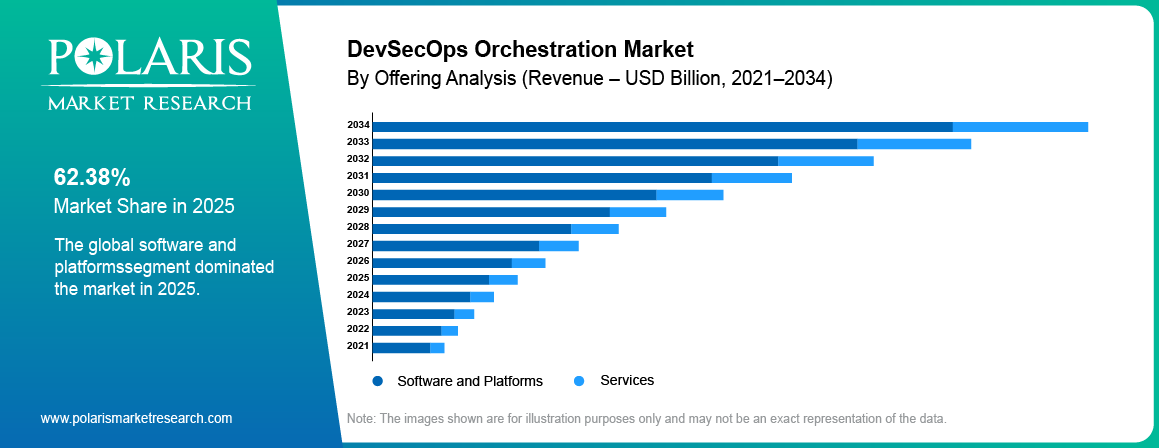
- Software and Platforms segment held a share of 62.38% in 2025 due to increasing demand for coordinated security and pipeline automation.
- Automated and Agentic Remediation is anticipated to grow at a CAGR of 29.74% during 2026-2034, owing to advanced remediation capabilities offered by companies like JFrog, GitLab, Snyk, and GitHub.
- Pipeline Native Platforms captured a share of 43.28% in 2025, owing to security functionalities embedded within software development and delivery pipelines.
- Manufacturing is expected to register the significant growth among end users at 22.64% CAGR during 2026–2034, driven by software security and vulnerability reporting requirements under the EU Cyber Resilience Act.
Note: Figures and projections outlined in this report are the result of Polaris Market Research’s proprietary analytical processes, grounded in the latest available datasets and market observations.
What is DevSecOps Orchestration Market?
The DevSecOps orchestration market consists of software and services that orchestrate security tools, findings, and policies across the software delivery pipeline. These solutions link scanners to build systems, schedule tests, correlate findings, prioritize vulnerabilities, enforce policies, and trigger remediation. The offerings include software platforms, integration services, policy configuration and workflow automation.
The market is different from the broader DevOps market and the security testing market. DevOps is the broader software delivery process and security testing uses tools to find vulnerabilities. DevSecOps orchestration means orchestrating security checks and actions across the CI/CD pipeline, including quality gates that stop a build until security requirements are met. Standalone scanners without coordination, general CI/CD tools without security gates, incident-response automation and runtime-only cloud protection are out of the market scope. This report sizes the coordination and enforcement layer, so scanner revenue counted in the security testing market is not double counted. Black Duck describes its Polaris platform as event and policy based automation across GitHub, GitLab, Azure DevOps and Bitbucket (Source: Black Duck).
The commercial market is moving away from vulnerability detection and toward coordinated remediation. In 2026, GitLab added agent-based security functions, Snyk put its remediation agent in public preview, Checkmarx announced hybrid scanning and JFrog introduced Zero Touch Remediation.(Source: GitLab, Snyk, Checkmarx, JFrog) These launches show vendor investment in automated security workflows, although independent evidence of remediation performance remains limited.
The market is also shaped by software supply chain security requirements. The EU Cyber Resilience Act, whose reporting obligations began on September 11, 2026, requires the reporting of severe incidents and actively exploited vulnerabilities. (Source: European Commission) Software inventories, SBOM records, policy enforcement and remediation logs can support organizations in meeting these requirements. The Act does not require the purchase of a DevSecOps orchestration product.
Market Dynamics
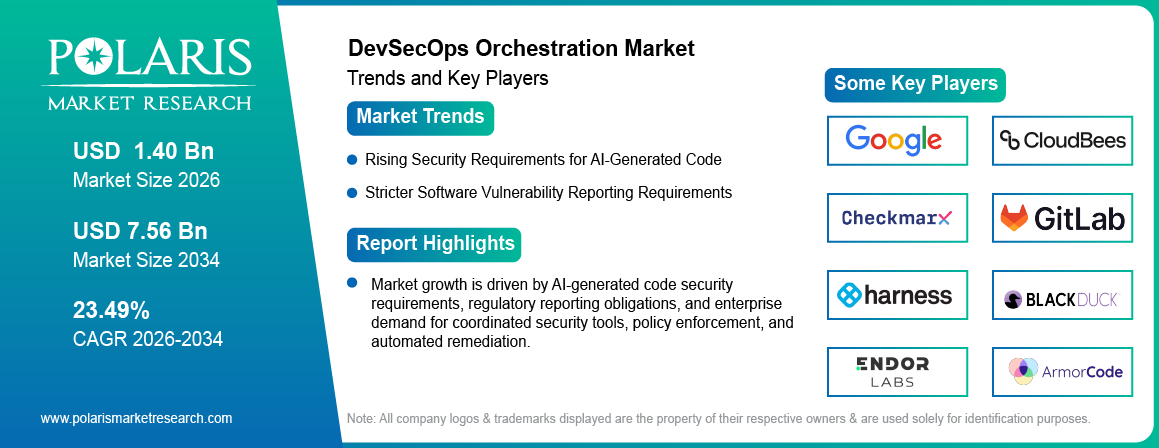
Driver: Rising Security Requirements for AI-Generated Code
The expansion of software development output through the use of AI coding tools is generating a greater need to identify vulnerabilities and enforce security policies across delivery pipelines. Jellyfish analyzed 20 million pull requests across 1,000 companies, finding AI coding tool adoption went from 22% to 90%, with full adoption correlated to 2x higher PR throughput, 24% shorter cycle times and 18% larger pull requests. (Source: Jellyfish) This creates demand in the DevSecOps orchestration market for solutions that coordinate scanning, finding prioritization and security checks in development workflows. Vendors are introducing capabilities to evaluate AI-generated code and link security findings to remediation processes. Such developments enhance the role of orchestration in shift left risk management of software before its release. As enterprises adopt AI-assisted development, there may be a growing demand for integrated security coordination across organizations looking to maintain the speed of development and consistent security standards. Checkmarx reports that 49% of production code is now AI generated, a vendor survey figure, and its Fusion hybrid scanning, which combines deterministic engines with Anthropic models, entered early access in July 2026 with a reported F1 score of 0.741 (Source: Checkmarx). Harness added Secure AI Coding, which scans code as Cursor, Windsurf and Claude Code generate it (Source: IT Brief). Every figure here is vendor reported, and no independent benchmark of AI era scanning was found.
Driver: Stricter Software Vulnerability Reporting Requirements
The requirements to report software vulnerabilities are increasing the need for coordinated security processes across development teams. The rules specify certain timeframes for early warnings, notices and final reports. These requirements can only be satisfied if vulnerabilities are detected timely, ownership is clearly assigned and remediation workflows are documented. IBM X-Force reported that publicly disclosed CVEs across Microsoft, Oracle, Google Chrome and Apache rose by roughly 578%, from about 1,493 in January-September 2025 to over 10,124 in the same period in 2026. (Source: IBM) DevSecOps orchestration platforms can integrate security tools and development systems to improve policy tracking and enforcement. As the scope of regulatory requirements increases, enterprises are deploying coordinated security workflows to be better prepared for reporting and to mitigate software risks along the development lifecycle. The EU Cyber Resilience Act sets an early warning within 24 hours, a full notification within 72 hours and a final report within 14 days after a fix is available, with full application on December 11, 2027 (Source: Crowell). The Act does not name orchestration, so it acts as a demand pull rather than a mandate.
Restraint: Platform Bundling and Unproven Effectiveness
Security vendors are adding orchestration capabilities to their existing platforms for application security and software delivery. That can restrict demand for standalone solutions as enterprises can be more likely to extend existing contracts than to purchase additional tools. Buyers want to see real evidence that orchestration platforms improve security outcomes and reduce manual labor. Automated remediation brings with it new challenges in terms of the correctness of the fixes, unintended changes to code and risks to production. In organizations with stringent controls over software releases, a lack of independent performance evidence may slow down the decision-making process regarding investments. Such considerations may result in delayed adoption unless vendors are able to prove the value of the solution through actual results, remediation, and operational benefits within different development environments. GitLab ships Secrets Manager, false positive detection with confidence scores and agents inside its own platform (Source: Investing.com), and Palo Alto Networks’ Cortex Cloud ASPM collects results from seven third party scanners, including Black Duck, Checkmarx, GitLab, HashiCorp, Semgrep, Snyk and Veracode (Source: SecurityBrief NZ). Because confidence scores are vendor assigned, vulnerability prioritization claims remain hard for buyers to audit, and no customer measured false positive rate was found in the sources reviewed.
Opportunity: Growing Demand for Automated and Agentic Remediation
As software releases produce more code, vulnerabilities and security findings, security teams’ workloads are increasing. Manual remediation can slow releases and add to the workload of development teams. Automated and agentic remediation provides an opportunity to couple vulnerability detection to fix generation, validation, and deployment workflows. In April 2026, GitLab enhanced its agentic AI capabilities by incorporating automation for security vulnerability remediation, CI pipeline creation, and software delivery analytics. Where approvals are in place, DevSecOps orchestration platforms can orchestrate all of this activity. This approach could cut repetitive work and enhance remediation speed. As enterprises look for more rapid responses to security findings, there may be increased demand for orchestration solutions that integrate risk prioritization, automated fixes and policy-based controls into existing software delivery processes.(Source: Business Wire) JFrog introduced Zero Touch Remediation in September 2026, which finds the best available fix from ecosystem partners including Broadcom, Chainguard, Echo, IBM and Red Hat, Moderne, TuxCare and Seal Security and applies it through the customer’s pipeline (Source: JFrog). The release gives no measured result for the gap between discovery and patch, so remediation automation is visible in launches and unproven in outcomes.
Opportunity: Centralized Coordination Across Security Tools
An enterprise will have many security scanners and code repositories, build systems and policy tools across the software delivery pipeline. Fragmented systems can result in duplicate findings, inconsistent security rules, and missed opportunities for vulnerability tracking. DevSecOps orchestration platforms provide a central coordination layer that connects existing tools and standardizes security actions without needing to overhaul the system entirely. In July 2026, Pervaziv AI announced the release of Cortex 5.0 with the Cortex-LLM-1.0 model, the first in-house trained AI model to assist with security analysis, structured vulnerability findings, and automated code remediation in secure software development workflows. This allows vendors to improve visibility, correlate findings, enforce quality gates and route remediation tasks across development workflows. As software environments grow more complex, organizations may want to centrally control security activities. Demand may rise for platforms that integrate existing investments and improve coordination across the software development lifecycle. (Source: Pervaziv AI) CloudBees introduced CloudBees Unify on May 20, 2025 as a control plane over existing toolchains such as GitHub Actions and Jenkins, with full availability expected in fall 2025 and no confirmation found in the sources reviewed (Source: CloudBees). Palo Alto Networks’ Cortex Cloud ASPM similarly unifies findings from native and third party scanners (Source: Palo Alto Networks).
Market Dynamics Impact Analysis
| Factor | Type | Impact Rating | Regions Most Affected | Impact Timeline |
| Rising volumes of AI generated code | Driver | High | Global, North America | Short to medium term |
| Stricter software vulnerability reporting rules | Driver | High | Europe, North America | Short term |
| Platform bundling and unproven effectiveness | Restraint | Medium | Global | Short to medium term |
| Automated and agentic remediation | Opportunity | High | Global, North America | Medium term |
| Centralized coordination across security tools | Opportunity | Medium | Global | Medium term |
Source: Polaris Market Research Analysis. Impact ratings are qualitative.
Market Segmentation Analysis
The report provides a comprehensive DevSecOps orchestration market analysis by offering, orchestration capability, control point, deployment, end user, and region to identify key market segments and emerging growth opportunities. Organization size and automation level are not used as segmentation variables because available sources do not support a reliable split. Control point is the variable that most directly shapes a buyer’s shortlist.
Offering Insights
Software and Platforms are the leading segment of the DevSecOps orchestration platform market, accounting for 62.38% share in 2025. The solutions connect security tools to software development workflows to coordinate scanning, prioritize findings, enforce policies and manage remediation. Enterprises are using orchestration platforms to improve security visibility in code repositories, build systems and deployment pipelines. For example, integrations of Black Duck Polaris with GitHub, GitLab, Azure DevOps and Bitbucket demonstrate how platforms can connect security checks with today’s development environments. (Source: DEVOPSdigest) Demand could increase as organizations look to centrally coordinate security across software delivery processes. GitLab sells Secrets Manager as a paid add on billed through GitLab Credits (Source: Help Net Security).
Services are expected to register the fastest growth with a CAGR of 24.52% during 2026–2034. Enterprises need consulting, implementation, integration, configuration and technical support to connect orchestration platforms with existing security and development systems. The requirements for deployment differ based on the tool selection, the pipeline design, the policy rules, and the remediation workflows. Service providers help organizations establish security gates, integrate scanning tools and develop processes to deal with vulnerabilities. As enterprises orchestrate across multiple development teams and applications, demand may rise. Technical expertise is used to handle integration complexities and ensure consistency of security controls throughout the software development lifecycle.
Orchestration Capability Insights
Tool Integration & Coordination is the largest application segment in 2025 with 29.34% market share. This capability connects security scanners, code repositories, build systems and deployment tools into a common workflow. Enterprises use these integrations to share findings across systems and to synchronize security checks. Black Duck Polaris integrations with GitHub, GitLab, Azure DevOps and Bitbucket are one example (Source: CIO Influence). As organizations look to integrate workflows and reduce manual coordination between development teams, there may be increased demand for managing fragmented security environments.
Automated and Agentic Remediation is expected to record the highest CAGR of 29.74% during the forecast period 2026-2034. These capabilities connect vulnerability detection and remediation actions across development workflows. In September 2026 JFrog announced Zero Touch Remediation and in August 2026 Snyk announced a remediation agent in public preview. (Source: JFrog, Snyk) GitHub also announced a public preview that lets users assign code scanning alerts to Copilot for automated fixes. (Source: GitHub) This shows an increasing investment in automated correction. Adequate review and validation controls may drive demand, as enterprises may demand faster remediation.
Finding Correlation and Prioritization is expected to expand at a 24.86% CAGR from 2026 to 2034. Enterprises receive security findings from multiple scanners which results in duplicate alerts and makes the risk assessment challenging. Orchestration tools can assist in correlating findings and prioritizing vulnerabilities based on remediation needs and risk. This lets developers focus on critical problems and complete security tasks more efficiently. As organizations add more security tools, and need a better picture of software risks, the demand may grow.
Policy and Quality Gate Enforcement commanded a 19.46% share of the market in 2025. These capabilities allow security rules to be enforced at specific points in the software delivery pipeline. Organizations set quality gates that prevent code or builds from progressing until they meet specified security requirements. Automated policy checks also help ensure consistency across dev teams. That could drive demand for more repeatable security controls and more enforcement of internal policies across software releases, which enterprises may increasingly want.
Test Scheduling and Execution is estimated to grow at 23.68% CAGR during the forecast period 2026-2034. These capabilities connect security testing to the development lifecycle and relate test results to delivery pipelines. Companies run scheduled or event driven scans to examine code changes before they are released. Security pipeline automation allows teams to eliminate manual steps and apply consistent testing practices on applications. The demand could be spurred by organizations shortening their software release cycles and integrating security checks into development processes.
Control Point Insights
Pipeline native platforms lead the segment with 43.28% market share in 2025. Such solutions incorporate security controls directly into the source code management, build, testing, and deployment process. Security findings are delivered to developers at the appropriate stages, allowing teams to remediate issues before software release. This is demonstrated by the automated scans that are triggered by pull requests. Enterprises will probably want to continue to require security checks as part of existing development processes, and want to minimize separate workflows for software delivery activities. GitLab ships coordination inside its own platform (Source: GitLab), which illustrates the pipeline native model.
Independent Overlay Platforms are growing at the highest CAGR of 25.37% in the forecast period. These solutions include existing development and security tools that provide a central coordination layer. Businesses use them to aggregate results, enforce group policies and control workflows without having to swap out every tool in their environment. Organizations with multiple vendors or complex development systems may be interested in the model. Demand may increase as companies seek consistent security oversight across distributed teams and entrenched software tool chains. Palo Alto Networks’ Cortex Cloud ASPM and CloudBees Unify are examples (Source: SC Media, InfoWorld).
The Security Suite Platforms market is projected to grow at a 23.82% CAGR during 2026-2034. These platforms embed security features into a broader product ecosystem, and can correlate results across multiple scanning functions. Some enterprises may prefer this model, where security operations are centralized through a single interface with an existing vendor relationship. Integrated capabilities can make policy management easier and eliminate the need to maintain separate workflows. Demand could rise as security vendors extend their platforms to include vulnerability prioritization, pipeline controls and remediation.
Deployment Insights
Cloud deployment is the leading segment with 52.76% share in 2025. With cloud-based orchestration you get a single place to run security workflows across distributed dev teams and applications. These platforms enable enterprises to connect code repositories, scanners and delivery systems, without having to support all the orchestration infrastructure on their own machines. Cloud deployment also enables providers to provide platform updates and integration features through managed environments. Organizations that require flexible deployment and easier collaboration among teams located in different geographic locations could see an increase in demand, provided that data security and compliance requirements are met.
The on-premises deployment is expected to grow at the significant rate of 19.84% CAGR between 2026 and 2034. Organizations can run the orchestration software on their own infrastructure, so they maintain direct control of security data and system configuration. If an enterprise has strict internal policies or specific data handling requirements, they may prefer locally managed environments. Deployment requires integration with existing repositories, scanners, and build systems. There may be more demand from organizations that need more control over infrastructure, access and security workflows.
Hybrid deployment accounted for 27.62% of the market in 2025. The model is a hybrid of cloud tools and services and on-premises infrastructure. Enterprises utilize hybrid environments to coordinate security activities with different development systems and infrastructure locations. Orchestration platforms can help keep common policy and link findings across these environments. Some organizations keep certain systems in house and use the cloud for other development and security functions, which could drive demand.
End User Insights
IT & Telecom is the largest segment with 25.84% market share in 2025. In this sector, these companies develop software, run digital platforms and enable complex technology environments. These companies run several development teams and release software on a regular basis, so they need to coordinate security testing and policy enforcement. DevSecOps orchestration tools connect scanners, prioritize findings and orchestrate remediation across delivery pipelines. Demand could increase as technology vendors extend software services and look for consistent security processes across applications and infrastructure. Snyk reports about 4,800 customers (Source: Snyk).
Manufacturing is projected to register an 22.64% CAGR during 2026–2034, and accounted for 10.76% share in 2025. Manufacturers use software in production systems, industrial applications, supply chain platforms and connected equipment. These applications can have vulnerabilities that may affect business operations and data security. DevSecOps orchestration allows for the orchestration of code testing and policy enforcement and remediation across software development workflows. The need for consistent software security controls may be driven by the increasing development of connected products by manufacturers, and the modernization of internal applications. The EU Cyber Resilience Act covers products with digital elements, which brings manufacturers into scope of its reporting duties (Source: CRA Guide).
BFSI accounted for 23.76% market share in 2025. Financial service providers, insurers and banks hold sensitive data and software systems, so they need consistent security controls. DevSecOps orchestration for financial services governs vulnerability checks, policy enforcement and remediation tracking throughout application development workflows. Such capabilities would enable financial organizations to manage software risks and record security processes. That could mean more demand as institutions expand digital services and seek greater security controls across application releases.
In 2025, Government & Public Sector accounted for 13.42% of the market. Public agencies operate applications and digital services that need documented processes and security controls for risk management. DevSecOps orchestration can be used to coordinate vulnerability assessments, apply release policies and track remediation across development teams. The specific security needs of an agency also play a role in how it chooses to deploy and integrate solutions. Public organizations may face higher expectations to upgrade their software systems and enhance software supply chain security practices. OMB Memorandum M-26-05 of January 23, 2026 rescinded the common form attestation and left SBOM requests to each agency (Source: Inside Government Contracts).
Healthcare and Life Sciences is expected to grow at a 25.73% CAGR during 2026–2034. Organizations in this sector build and run applications that process sensitive information and support mission-critical services. Security coordination allows teams to evaluate code modifications, address vulnerabilities and implement uniform controls prior to software deployment. The integration with the existing development systems might also help reduce the manual security work. As healthcare providers, technology vendors and life sciences companies expand digital platforms and software-based services, demand may grow.
Retail and Ecommerce is expected to grow at a 24.96% CAGR during 2026-2034. Retailers and e-commerce providers run customer-facing apps, payment systems, digital storefronts and internal software platforms. Security checks should not interfere with release schedules on frequent updates. DevSecOps orchestration can include vulnerability scanning in development workflows and security policy enforcement before deployment. Demand could rise as companies look for more efficient ways to manage software risk across multiple applications and expand digital commerce.
DevSecOps Orchestration Market Regional Insights
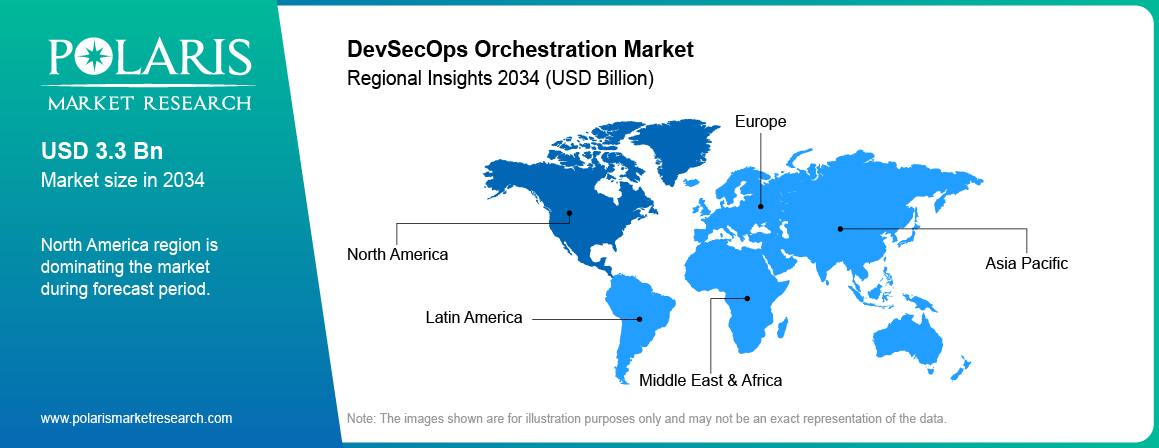
The DevSecOps orchestration market shows a clear regional contrast. Europe is rule driven: since September 11, 2026, the EU Cyber Resilience Act requires a 24 hour early warning for actively exploited vulnerabilities, which raises demand for software supply chain controls and shift left practices. North America is vendor driven, as federal agencies set their own requirements under OMB memorandum M-26-05.
North America DevSecOps Orchestration Market Trends
North America is the leading region in the DevSecOps orchestration market and accounts for 38.42% of the market share in 2025. The area has a mature ecosystem of software security vendors, cloud providers and enterprise development platforms. The need for application security, vulnerability management and automated policy enforcement is fueling regional adoption. Federal software assurance activities also promote organizations’ implementation of security controls across the software development lifecycle.
In January 2026, the US Office of Management and Budget issued Memorandum M-26-05, moving federal software assurance to agency-specific risk assessments. Orchestration platforms also have other opportunities such as vendor investment in tool integration and automated remediation. These solutions empower enterprises to synchronize security scans, improve vulnerability tracking, and implement uniform controls throughout development pipelines. (Source: Davis Wright Tremaine)
Europe DevSecOps Orchestration Market Trends
Europe DevSecOps orchestration market is expected to grow at significant pace with a 23.17% CAGR during 2026–2034. The EU Cyber Resilience Act has applied reporting duties since September 11, 2026 for actively exploited vulnerabilities and serious security incidents such as 24-hour early warnings and 72-hour notifications. These requirements increase the need for timely vulnerability tracking, remediation workflows and documented security processes.
DevSecOps orchestration platforms allow companies to synchronize security issues, assign tasks for remediation, and document these processes within the development pipeline. Further opportunities across European industries may arise with further adoption of software security controls. A final report is due within 14 days after a corrective measure is available, and full application of the Act follows on December 11, 2027 (Source: Redergo).
Asia Pacific DevSecOps Orchestration Market Trends
Asia Pacific accounted for 24.78% share in 2025. The region is a major market for technology, telecommunications, manufacturing and digital services. GSMA says mobile technologies and services are projected to add USD 1.4 trillion to the Asia Pacific economy by 2030, a 40% increase. Since these industries develop software, they need security checks in code repositories, build processes and deployment workflows. DevSecOps orchestration enables teams to coordinate security tooling and enforce consistent policies across distributed teams. As enterprises modernize software development and strengthen application security processes, regional adoption may increase. (Source: GSMA)
Middle East and Africa DevSecOps Orchestration Market Trends
The Middle East and Africa accounted for 5.02% share in 2025. Digital transformation initiatives in government, financial services, telecommunications and other industries are driving demand for secure software development processes. DevSecOps orchestration tools can potentially help organizations connect security testing with development workflows and improve vulnerability tracking. Adoption is influenced by technology investment, cloud infrastructure, internal security expertise, and enterprise software maturity. Market expansion may follow wider use of digital services and stronger application security practices across regional industries.
Latin America DevSecOps Orchestration Market Trends
Latin America accounted for 6.14% share in 2025. Organizations in the banking, telecommunications, retail and public service sectors use digital applications that need to be regularly maintained and checked for security. DevSecOps orchestration can help coordinate findings from security scanners, enforce release policies, and manage remediation across development teams. Enterprise technology budgets, integration requirements and the availability of skilled security professionals will determine the adoption of the solution. As organizations modernize software delivery processes and look for more consistent security management across applications, demand may expand.
DevSecOps Orchestration Market Competitive Landscape
The DevSecOps orchestration market features pipeline-native platforms, security suite platforms, and independent overlay platforms. These models differ across tool integration, workflow coverage, policy enforcement, and remediation capabilities. Competition will be a function of how well vendors orchestrate security activity across existing development environments.
Integration coverage, vulnerability prioritization, security quality gates, and remediation performance are competitive differentiators. DevSecOps orchestration tools comparison: GitLab, Snyk, Checkmarx, JFrog, Harness and Black Duck expand security capabilities. Vendors with strong integrations and real workflow improvements may be better able to carve out a market position. Veracode expanded its AI powered Fix remediation to open source dependencies in 2026 (Source: Veracode) and analyzed 1.6 million applications for its annual software security report (Source: Business Wire), while ArmorCode raised USD 16 million in March 2026 for its exposure management platform (Source: SecurityWeek). No source ranks suppliers by DevSecOps orchestration market share, so the order of companies in this report does not indicate share.
Vendor Landscape Snapshot
| Company | Market Position | Value Chain Category | Core Offering |
| Black Duck Software | Leader | Security suite | Polaris Platform |
| Checkmarx | Leader | Security suite | Checkmarx One |
| GitLab | Leader | Pipeline native | GitLab platform, Duo Agent Platform |
| Microsoft | Leader | Pipeline native | GitHub code scanning, Copilot |
| Palo Alto Networks | Leader | Overlay and ecosystem | Cortex Cloud ASPM |
| Snyk | Challenger | Security suite | Snyk AI Security Platform |
| Harness | Challenger | Pipeline native | Harness DevSecOps platform |
| JFrog | Challenger | Artifact and supply chain | JFrog Unified Security |
| | Challenger | Overlay and ecosystem | Wiz on Google Cloud |
| IBM | Challenger | Overlay and ecosystem | Project Lightwell with Red Hat |
| Veracode | Challenger | Security suite | Application Risk Management platform |
| Sonatype | Niche Player | Artifact and supply chain | Nexus One |
| CloudBees | Niche Player | Pipeline native | CloudBees Unify |
| ArmorCode | Niche Player | Overlay and ecosystem | Unified exposure management |
| Qualys | Niche Player | Security suite | TruRisk Eliminate |
| Endor Labs | Emerging Player | Overlay and ecosystem | AI era application security platform |
Source: Polaris Market Research Analysis. Positions are qualitative assessments and do not indicate market share.
DevSecOps Orchestration Market Technology and Innovation Landscape
AI-Generated Code and Hybrid Security Scanning
AI coding tools increase the volume of code requiring security assessment. Checkmarx introduced Fusion hybrid scanning in early access within Checkmarx One in July 2026. The feature combines deterministic scanning engines with Anthropic models. (Source: Checkmarx) Checkmarx reported that 49% of production code was AI-generated, based on its own research. (Source: Yahoo Finance)
Automated and Agentic Remediation
Automated remediation connects vulnerability detection with fix generation and validation. JFrog announced Zero Touch Remediation in September 2026. Snyk introduced a remediation agent in public preview in August 2026. GitHub also introduced a public preview for assigning code scanning alerts to Copilot for automated fixes. GitHub later extended this with agentic autofix for code scanning alerts, which entered public preview in July 2026 (Source: GitHub Changelog).
Policy as Code and Security Quality Gates
Policy as code is a software defined security approach that makes sure security policies are applied consistently across development workflows. Quality gates stop a build or deployment from continuing if the requirements are not met. In March 2026, Harness announced beta versions of AI Testing and AI Firewall initiatives, which indicate vendor investment in integrated security and testing controls. (Source: Techzine)
Application Security Posture Management Integration
ASPM aggregates application security findings and improves risk visibility. The application security posture management market overlaps with DevSecOps orchestration through finding correlation, prioritization, and remediation coordination. Palo Alto Networks described Cortex Cloud ASPM as collecting results from seven third-party scanners in an early-access announcement. (Source: Palo Alto Networks) General availability had not been confirmed in the sources reviewed for this report.
Technology and Innovation Landscape Snapshot
| Technology | Function | Example Vendors | Status |
| Agentic SAST remediation | Opens ready to merge fixes with confidence scores | GitLab | Generally available, bulk mode in beta |
| Zero touch remediation | Applies partner fixes through the pipeline | JFrog | Announced September 2026 |
| Hybrid AI scanning | Combines rules engines with AI models | Checkmarx | Early access |
| Agentic autofix | Assigns code scanning alerts to Copilot | GitHub | Generally available |
| AI pentesting | Tests applications and agents continuously | Snyk | Generally available |
| AI secure coding | Scans code as assistants generate it | Harness | Launched March 2026 |
| ASPM aggregation | Collects findings from third party scanners | Palo Alto Networks | Early access, GA unconfirmed |
| Control plane over toolchains | Connects existing CI/CD tools | CloudBees | Early access, GA unconfirmed |
| Shield and fix workflow | Pairs virtual patching with open source fixes | Palo Alto Networks, IBM, Red Hat | Announced June 2026 |
Source: Polaris Market Research Analysis based on vendor announcements cited in this report.
Use Case Analysis
Software Development and CI/CD Pipeline Security
Development teams use DevSecOps orchestration to connect security checks with code commits, pull requests, builds, and deployments. Black Duck Polaris integrates with GitHub, GitLab, Azure DevOps and Bitbucket. DevSecOps pipeline security gates and automated scans aid teams in discovering vulnerabilities early and enforcing uniform security controls across their development workflows.
Software Supply Chain Security
Vulnerabilities can be introduced into applications by open source components and third party packages. DevSecOps orchestration provides the coordination of dependency findings, security policies, and remediation tasks across the development pipelines. Sonatype announced Nexus One in November 2025 and reported analysis of more than 270 million open-source components. (Source: Sonatype) Its announcement also referred to agentic dependency automation.
Cloud-Native Application Security
Cloud-native applications involve distributed services and frequent deployments. Orchestration platforms connect security findings with development workflows and coordinate remediation. Google closed its acquisition of Wiz in March 2026, consolidating code, cloud and runtime security capabilities into a wider security strategy. (Source: Google Cloud Press Corner) This reflects industry interest in gaining greater visibility into application security.
AI-Assisted Development Workflows
AI coding assistants speed up code generation, and need security audits that keep up with development. In March 2026, Harness announced Secure AI Coding for Cursor, Windsurf and Claude Code. (Source: IT Brief Asia) GitHub also announced a public preview of assigning code scanning alerts to Copilot for automated fixes (Source: GitHub Changelog).
Buyer Analysis and Market Entry Barriers
Buyers weigh integration effort, with an emphasis on accuracy, speed of remediation, deployment options and compatibility with existing development workflows. Enterprises may prefer platforms that coordinate existing security investments, rather than replacing them. Risks to the software supply chain, control of access, audit trails and source code protection are also part of the vendor selection.
Integration and Migration Requirements
Integration complexity may delay adoption when enterprises use multiple repositories, scanners, build systems, and deployment tools. Connecting these systems requires configuration, testing, access management, and policy ownership. Platforms that integrate with existing toolchains and reduce implementation effort may improve adoption prospects.
Remediation Accuracy and Operational Risk
Automation reduces manual effort but bad fixes can introduce defects or break releases. The agentic remediation DevSecOps solutions need to have accurate fixes, validation, approval controls, rollback procedures and audit records. Vendors must offer concrete proof of the quality of their remediation and the operational benefits they offer, to build confidence with buyers.
Regulatory and Governance Requirements
The European Union’s Cyber Resilience Act has applied reporting duties since 11 September 2026 for actively exploited vulnerabilities and serious security incidents. Such requirements may generate demand for traceable vulnerability workflows. The Act doesn’t call out a specific orchestration product, but platforms can help coordinate remediation and maintain records. (Source: CyEQT)
Regulatory Landscape Snapshot
| Regulation | Region | Key Requirement | Effective Date | Relevance |
| EU Cyber Resilience Act | Europe | 24 hour warning, 72 hour notice, final report in 14 days | Reporting from September 11, 2026; full application December 11, 2027 | Pull on inventory and pipeline records |
| OMB Memorandum M-26-05 | United States | Agencies set risk based software assurance; SBOM and attestation optional | January 23, 2026 | Requests handled agency by agency |
Source: ISMS Copilot, Dark Reading.
Premium Insights and Forward Outlook
Automated Remediation May Change Security Operations
Security teams manage findings from code analysis, dependency checks, and application security tools. Automated remediation connects detection with fix generation, validation, and review. Vendor announcements from JFrog, Snyk, and GitHub indicate investment in this area, although feature availability and independent performance evidence vary.
The Control Plane Over Many Tools
Enterprises use multiple security products across development teams and applications. A central orchestration layer connects these products, correlates findings, enforces policies, and routes remediation tasks. This approach may reduce fragmented workflows and help organizations standardize security practices without replacing every existing tool. Sellers rarely describe these products as DevSecOps orchestration, so the control point, not the capability list, decides who captures revenue.
Software Supply Chain Visibility
SBOMs identify the software components and dependencies that an application contains. Orchestration platforms can integrate component information with vulnerability tracking, policy enforcement and remediation workflows. This enables teams to find the affected apps and set actions. An SBOM doesn’t orchestrate by itself — the platform must orchestrate security decisions and development processes.
Key Players in the DevSecOps Orchestration Market
- ArmorCode
- Black Duck Software
- Checkmarx
- CloudBees
- Endor Labs
- GitLab
- Harness
- IBM
- JFrog
- Microsoft
- Palo Alto Networks
- Qualys
- Snyk
- Sonatype
- Veracode
Industry Developments
- October 2026: GitHub made agentic autofix for code scanning alerts generally available, letting users assign alerts to Copilot, which proposes a fix, reruns the analysis and opens a draft pull request for review. (Source: GitHub)
- October 2026: Qualys launched TruRisk Eliminate 2.0 with TruConfidence, a remediation intelligence and orchestration engine for hybrid environments. (Source: PR Newswire)
- September 2026: EU Cyber Resilience Act reporting obligations began, requiring manufacturers to submit an early warning within 24 hours and a full notification within 72 hours for actively exploited vulnerabilities. (Source: AI Journal)
- September 2026: JFrog announced Zero-Touch Remediation, which applies vulnerability fixes through customer pipelines. Initial partners included Broadcom, Chainguard, IBM/Red Hat, and others. (Source: JFrog)
- August 2026: GitLab 19.3 introduced updates to Secrets Manager, SAST false-positive detection, and Flow Creator Agent to expand security automation. (Source: GitLab)
- August 20, 2026: Harness launched AI security agents, including a Triage Agent, a Remediation Agent and a Zero Day Agent, along with AI SAST and virtual patching. (Source: SecurityBrief India)
- August 4, 2026: ArmorCode expanded its Agentic Control Plane with Context Risk Graph capabilities and purpose built agents for agentic vulnerability remediation. (Source: ArmorCode)
- August 2026: Snyk made Evo Continuous Offensive Security generally available and placed its remediation agent in public preview. (Source: Snyk)
- July 2026: Checkmarx launched Fusion hybrid scanning in early access in Checkmarx One that brings together security engines and Anthropic models. (Source: Checkmarx)
- June 2026: IBM, Red Hat and Palo Alto Networks expanded Project Lightwell, pairing Palo Alto Networks virtual patching with open source remediation. (Source: Palo Alto Networks)
- June 2026: Black Duck announced new Polaris Platform capabilities to close security testing gaps and automate remediation pipelines. (Source: Black Duck Newsroom)
- April 2026: GitLab 18.11 made Agentic SAST Vulnerability Resolution generally available for GitLab Ultimate customers, with a confidence score on each proposed fix. (Source: SD Times)
- March 2026: Harness launched AI Security and Secure AI Coding, with AI Discovery generally available and AI Testing and AI Firewall in beta. (Source: SecurityBrief UK)
- March 2026: Google completed its acquisition of Wiz, adding security capabilities for code, cloud, and runtime environments. (Source: Google)
- March 2026: ArmorCode raised USD 16 million in strategic funding, bringing total funding to USD 81 million. (Source: ArmorCode Newsroom)
- February 2026: Black Duck enhanced Polaris integration with GitHub, GitLab, Azure DevOps, and Bitbucket to enhance security scanning in development workflows. (Source: Black Duck)
- January 2026: OMB issued Memorandum M-26-05, rescinding the common form software attestation in favor of agency level risk decisions. (Source: Aquia)
DevSecOps Orchestration Market Report Segmentation
By Offering (Revenue, USD Billion, 2021–2034)
- Software and Platforms
- Services
By Orchestration Capability (Revenue, USD Billion, 2021–2034)
- Tool Integration and Coordination
- Finding Correlation and Prioritization
- Policy and Quality Gate Enforcement
- Test Scheduling and Execution
- Automated and Agentic Remediation
By Control Point (Revenue, USD Billion, 2021–2034)
- Pipeline Native Platforms
- Security Suite Platforms
- Independent Overlay Platforms
By Deployment (Revenue, USD Billion, 2021–2034)
- Cloud
- On Premises
- Hybrid
By End User (Revenue, USD Billion, 2021–2034)
- BFSI
- IT and Telecom
- Government and Public Sector
- Healthcare and Life Sciences
- Manufacturing
- Retail and Ecommerce
- Others
By Regional Outlook (Revenue, USD Billion, 2021-2034)
- North America
- US
- Canada
- Europe
- Germany
- France
- UK
- Italy
- Spain
- Netherlands
- Russia
- Rest of Europe
- Asia Pacific
- China
- Japan
- India
- Malaysia
- South Korea
- Indonesia
- Australia
- Vietnam
- Rest of Asia Pacific
- Middle East & Africa
- Saudi Arabia
- UAE
- Israel
- South Africa
- Rest of Middle East & Africa
- Latin America
- Mexico
- Brazil
- Argentina
- Rest of Latin America
Report Scope
| Report Attributes | Details |
| Market Size in 2025 | USD 1.13 Billion |
| Market Size in 2026 | USD 1.40 Billion |
| Revenue Forecast by 2034 | USD 7.56 Billion |
| CAGR | 23.49% from 2026 to 2034 |
| Base Year | 2025 |
| Historical Data | 2021–2024 |
| Forecast Period | 2026–2034 |
| Quantitative Units | Revenue in USD Billion and CAGR from 2026 to 2034 |
| Report Coverage | Revenue Forecast, Competitive Landscape, Growth Factors, and Industry Trends |
| Segments Covered |
|
| Regional Scope |
|
| Competitive Landscape |
|
| Report Format |
|
| Customization | Report customization as per your requirements with respect to countries, regions, and segmentation. |
Source: Polaris Market Research Analysis
Why Choose Polaris Market Research
The DevSecOps orchestration market report from Polaris Market Research examines market structure, technology adoption, vendor positioning, and industry developments. The analysis covers security tool integration, vulnerability prioritization, policy enforcement, and remediation automation. It relies on dated company announcements, product documentation, regulatory sources, and industry publications. The report differentiates between actual product developments and vendor claims, and notes gaps in the evidence where product availability or performance has not yet been verified. This methodology offers a structured perspective of the market without making use of unverifiable competitor market estimates.
The report offers a unique perspective on the DevSecOps orchestration industry through segmentation by offering, orchestration capability, control point, deployment, end user and region. It examines pipeline-native platforms, security suite platforms, independent overlay platforms and automated remediation capabilities. The analysis also covers software supply chain security, application security posture management, integration requirements, and competitive developments. Buyers seeking custom DevSecOps orchestration market research can request a study focused on a specific capability, end-user industry, or deployment model through Polaris Market Research & Consulting, Inc., subject to scope and data availability. If you need this scope cut by control point or by end user, Polaris Market Research & Consulting, Inc. will build a custom study around it. The report can be purchased through the report details module on this page.
Research Methodology
Polaris Market Research & Consulting, Inc. structures its DevSecOps orchestration market analysis around scoping, secondary research, estimation, validation, and quality review. The scope focuses on the coordination and enforcement layer across software delivery pipelines. This excludes standalone security scanners without an orchestration layer, general CI/CD tools without security gates, incident-response automation, and runtime-only cloud protection. Research includes company announcements, product documentation, publications of regulations, and dated industry sources. The DevSecOps orchestration industry forecast and market size outputs are derived from Polaris internal estimation models.
During the validation phase, product announcements, feature availability, integration coverage and regulatory changes are reviewed. It distinguishes between generally available products, early access features and public previews. Vendor-reported figures and performance claims are attributed to the original sources, unless independent evidence of the results can be provided. The review also checks company profiles, market boundaries, source dates, and potential overlap with adjacent markets, including the Security Testing Market and Software Defined Security Market. Final quality review identifies evidence gaps and prevents unsupported market shares, growth rates, or competitive rankings from entering the report.
Research Methodology Phases
| Phase | Activity | Primary evidence in this report |
| 1 Scoping | Coordination layer versus scanners, overlap check with four Polaris reports | Scope definition and adjacent market review |
| 2 Secondary research | Releases, release notes, regulator summaries, trade press | Company releases and regulator summaries cited in text |
| 3 Estimation | Revenue sizing on a stated basis | Polaris internal data |
| 4 Validation | Launch, regulation and deal evidence | Market Dynamics and Industry Developments |
| 5 Quality review | Senior analyst review and quality checklist | Reviewer sign off |
Source: Polaris Market Research Analysis
DevSecOps Orchestration Market FAQ's
The base-year market size is USD 1.13billion, projected to reach USD 7.56 billion by 2034.
The market is projected to grow at an 23.49% CAGR during 2026 to 2034, with 2025 as the base year.
North America is provisionally identified as the leading region, with an estimated 38.42% revenue share in the base year.
Pipeline Native Platforms are provisionally identified as the leading segment, with an estimated 43.28% share.
Asia Pacific is provisionally identified as the fastest growing region, with an estimated 26.72% CAGR during 2026 to 2034.
DevSecOps orchestration coordinates security tools, findings, policies, and remediation across software delivery pipelines.
It connects source control and build systems, initiates security scans, correlates the results, enforces policies and manages remediation.
No. DevSecOps orchestration vs. ASPM is a matter of scope. ASPM is focused on application security visibility and risk prioritization while DevSecOps orchestration coordinates security tests, security gates and remediation workflows. It also differs from a DevSecOps platform, which bundles development and security tools, and from SOAR, which automates security operations and incident response.
The key companies include GitLab, Snyk, Checkmarx, JFrog, Harness, Black Duck Software, Sonatype, CloudBees, and Veracode. Product features and availability will vary by vendor.
Yes. AI-generated code needs security reviews, vulnerability assessment and policy enforcement within the development workflows to identify risks prior to release.
Google bought Wiz on March 11, 2026. The deal integrates code, cloud and runtime security capabilities as a piece of Google’s larger security play. The all cash transaction was valued at USD 32 billion (Source: Cleary Gottlieb).
The EU Cyber Resilience Act requires reporting on active exploitation of vulnerabilities and serious security incidents as of September 11, 2026. Full application follows on December 11, 2027. In the US, OMB Memorandum M-26-05 of January 23, 2026 leaves software assurance requirements to each agency.
Price depends on licensing, integrations, deployment and support you require. No reliable market wide price benchmark was found, and the only public reference point is a manual penetration test priced at USD 20,000 to 100,000 or more for about 15 days.
A security quality gate determines whether the software meets certain security criteria prior to release.
Partly. Agents from GitLab, GitHub and Snyk generate fixes and open them for review, but no source shows unattended production changes, so human approval remains standard practice.
Download Sample Report of DevSecOps Orchestration Market
Please fill out the form to request a customized copy of the research report.


