
Seurity Testing Market Size, Share & Growth Analysis Report, 2026-2034
REPORT DETAILS
Security Testing Market Summary
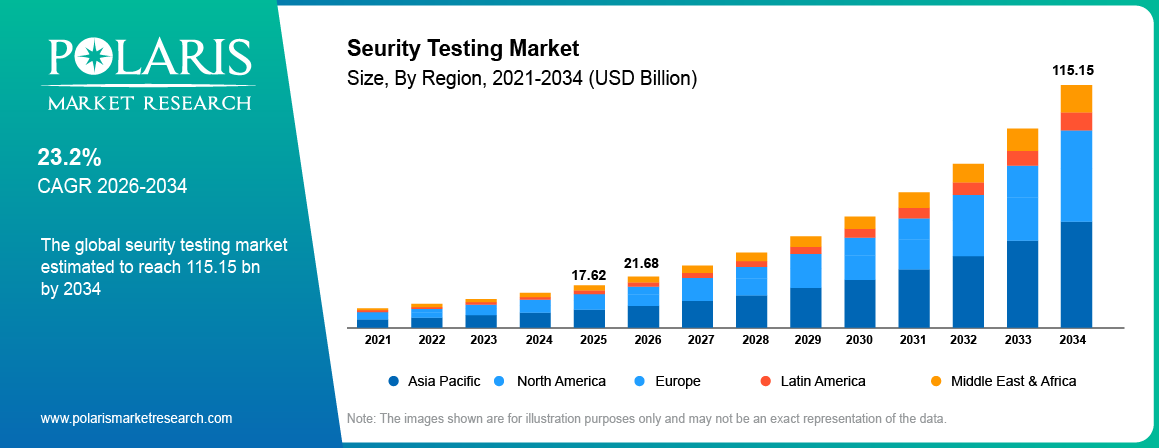
The global security testing market size was valued at USD 17.62 billion in 2025. The market is projected to grow at a CAGR of 23.2% during 2026 to 2034. Key factors driving demand for security testing include increasing frequency of cyber-attacks, the need to comply with stringent data privacy regulations like GDPR and HIPAA, and the rapid growth of cloud services and IoT devices.
Market Statistics
Key Takeaways
- North America dominated the global security testing market, accounting for 35.31% of total revenue in 2025. Extensive digitalization across industries and growing cybersecurity investments support its leading position.
- Europe is projected to grow at a CAGR of 22.43% during the forecast period. The evolving threat landscape and strict regulatory requirements are expected to support regional market growth.
- The application security segment is expected to grow at a CAGR of 21.71% during the forecast period. Increasing use of software applications and the growing need to identify vulnerabilities are driving demand.
- The cloud segment held the largest market share, accounting for 60.98% of total revenue in 2025. Businesses are increasingly shifting sensitive data and operations to cloud environments, driving demand for cloud security testing.
- The small and medium enterprises (SMEs) segment is expected to witness growth of 20.51% CAGR during the forecast period. Growing cybersecurity awareness and the need for affordable security solutions are encouraging SMEs to strengthen their digital defenses.
- The healthcare segment is projected to register the fastest growth, with a CAGR of 24.78% during the forecast period. Increasing use of digital health records, telemedicine platforms, and connected medical devices is driving demand for security testing.
Note: Figures and projections outlined in this report are the result of Polaris Market Research’s proprietary analytical processes, grounded in the latest available datasets and market observations.
What Is Security Testing?
Security testing is the process of identifying vulnerabilities in software applications, networks, cloud systems, and digital infrastructure. It helps organizations protect sensitive data, prevent unauthorized access, and reduce the risk of cyberattacks. Common methods include penetration testing, vulnerability assessment, and application security testing.
In simple terms, security testing checks digital systems for weaknesses that attackers could exploit. It helps businesses find security gaps, fix them early, and protect their data and operations.
The growing use of digital platforms, cloud computing, and mobile applications is increasing demand for security testing. Businesses across industries are investing in cybersecurity testing services to protect customer information and maintain secure operations. Application security testing helps identify weaknesses in software, while network security testing checks network systems for possible threats. Cloud security testing helps organizations identify risks such as misconfigurations and unauthorized access to cloud resources.
Technology is also changing how organizations approach security testing. Artificial intelligence (AI) and machine learning help security teams detect threats and identify vulnerabilities more efficiently. DevSecOps security testing integrates security checks into software development, allowing teams to identify issues earlier. At the same time, ethical hacking services and penetration testing solutions help businesses assess how attackers could exploit weaknesses in their systems.
For instance, in April 2025, HCLSoftware introduced HCL AppScan RapidFix in collaboration with Pixee. The solution uses AI-powered automation to help developers identify application security issues and generate code fixes. This development highlights the growing role of AI in application security testing and DevSecOps practices (Source: hcl-software.com)
As cyber threats continue to evolve, security testing is becoming an important part of business risk management. Organizations are using regular testing to strengthen their digital defenses, support compliance efforts, and maintain customer trust. These needs are creating opportunities for security testing providers across industries.
How Security Testing Works
Security testing follows a clear process to check systems for weaknesses and improve their protection against cyber threats. It helps businesses assess security risks across applications, networks, and cloud environments.
The process begins with planning the scope, where teams decide which systems and applications need testing. They then identify digital assets, including software, network components, and cloud resources that may face security risks.
Next, security professionals conduct vulnerability assessments and penetration testing to find weaknesses. Application security testing tools can also help detect software flaws. The team then prioritizes vulnerabilities based on their severity and potential impact on business operations.
Once the risks are assessed, teams fix the identified issues through code updates, software patches, or configuration changes. Finally, they retest the systems and prepare a report to confirm whether the issues have been resolved.
This process helps organizations strengthen their cybersecurity testing practices and integrate security checks into the software development lifecycle. Regular testing also supports DevSecOps security testing by helping teams identify and address vulnerabilities earlier.
AI, Automation and DevSecOps Trends
Artificial intelligence (AI) and automation are changing how organizations approach security testing. These technologies help security teams identify vulnerabilities, review security risks, and respond to potential threats more efficiently. As applications become more complex, businesses are adopting automated security testing to improve coverage and reduce manual work.
AI-powered tools can help analyze large volumes of security findings and prioritize vulnerabilities based on their severity. This assisted triage helps teams focus on critical issues and reduce the time spent reviewing less important alerts. However, security professionals still need to validate findings and check whether recommended fixes address the actual risks.
DevSecOps security testing is another important trend. It integrates security checks into the software development lifecycle, including coding, building, testing, and deployment. By adding security tools to continuous integration and continuous delivery (CI/CD) pipelines, development teams can identify vulnerabilities before applications reach production.
Continuous security testing also helps organizations assess changes to applications and infrastructure as they occur. Automated tools can run checks during development, while penetration testing and manual reviews provide deeper assessments of potential weaknesses.
Cloud adoption and frequent software updates are increasing the need for flexible security testing solutions. Organizations are combining automation, AI-assisted analysis, and human expertise to strengthen application security testing and improve vulnerability management. This approach supports faster development while helping businesses maintain stronger security controls.
Market Dynamics
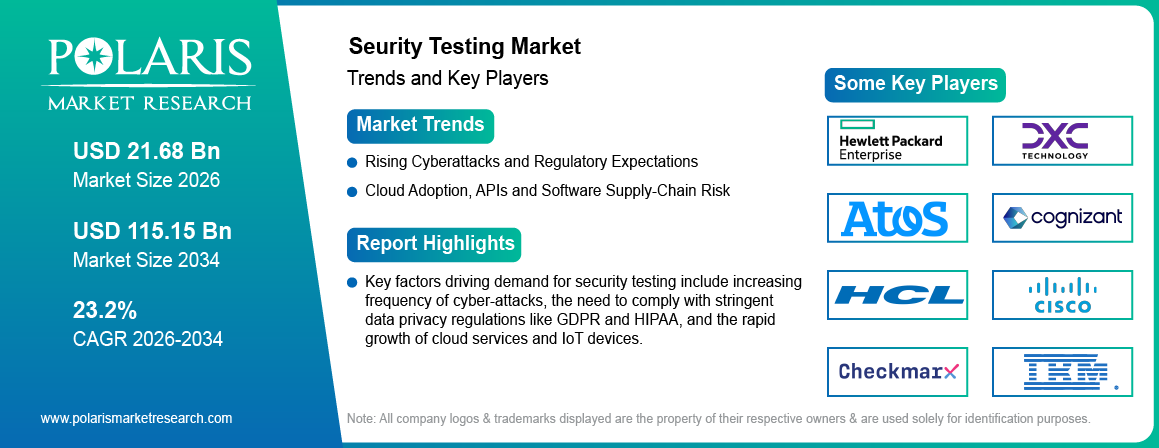
Market Driver- Rising Cyberattacks and Regulatory Expectations
Cyberattacks are becoming more frequent and complex, encouraging businesses to strengthen their digital defenses. Security testing helps organizations identify weaknesses, protect sensitive information, and reduce the risk of data breaches. Compliance requirements also encourage businesses to review their security controls and manage cyber risks. According to Verizon’s 2025 Data Breach Investigations Report, vulnerability exploitation as an initial attack method increased by 34%, accounting for 20% of breaches analyzed. This highlights the importance of regular vulnerability assessments and penetration testing solutions (Source: verizon.com).
Market Driver- Cloud Adoption, APIs and Software Supply-Chain Risk
Businesses increasingly use cloud platforms, APIs, and third-party software to run their operations. These systems can introduce security gaps if they are not properly assessed. Cloud security testing and software vulnerability testing help organizations identify misconfigurations, access-control issues, and weaknesses in connected systems. Verizon’s 2025 Data Breach Investigations Report found that third-party involvement accounted for 30% of breaches. This highlights the need to assess risks linked to external suppliers, software components, and connected services. (Source: verizon.com).
Market Opportunity- AI-Powered Security Testing and Automation
Artificial intelligence and automation are creating opportunities to improve security testing. AI-powered tools help teams analyze vulnerabilities, prioritize risks, and review large volumes of security alerts. These tools can reduce manual work and support faster responses, although security professionals must still validate findings. IBM’s 2025 Cost of a Data Breach Report found that organizations using AI and automation extensively in security saved an average of USD 1.9 million per breach compared with organizations that did not use these technologies. This creates opportunities for automated security testing and AI-assisted vulnerability analysis (Source: ibm.com).
Market Opportunity- Growing Demand for Managed Security Testing Services
Managed security testing services give businesses access to cybersecurity experts without requiring large in-house teams. Providers can conduct penetration testing, cloud security assessments, and application vulnerability testing. This creates opportunities to serve small and medium enterprises with limited budgets and technical resources. IBM’s 2025 Cost of a Data Breach Report found that the average cost of a data breach in India reached INR 220 million. The financial impact of security incidents creates demand for services that help businesses identify vulnerabilities and strengthen their digital defenses (Source: newsroom.ibm.com).
Market Restraint- Talent Gaps, False Positives and Cost Constraints
A shortage of skilled cybersecurity professionals can make security testing difficult to manage. Businesses may also face high testing costs and false positives that require further investigation. These challenges can delay vulnerability fixes and limit regular testing, particularly for smaller organizations. The 2025 ISC2 Cybersecurity Workforce Study found that 59% of respondents reported critical or significant cybersecurity skills needs. This skills gap can make it harder for organizations to implement security testing effectively and maintain strong cybersecurity practices (Source: isc2.org).
Security Testing Types and Technologies
Security testing includes different methods to identify vulnerabilities and protect digital systems. Organizations use these methods to assess software, networks, cloud environments, and connected devices. The choice of testing method depends on the system being tested, the risks involved, and the level of security required.
Security Testing Types and Technologies: Comparison Table
| Security Testing Type | What It Evaluates | Common Methods | Example Use Case |
| Penetration Testing | Whether security weaknesses can be exploited. | Controlled attack simulations, manual testing, and automated tools. | Testing authentication and transaction security in a banking app. |
| Vulnerability Assessment | Known or potential weaknesses across systems and assets. | Vulnerability scanning, configuration checks, and risk ranking. | Identifying and prioritizing vulnerabilities across an enterprise network. |
| Application Security Testing | Source code, application behavior, and runtime security. | SAST, DAST, IAST, RASP, and code reviews. | Finding insecure input handling before a software release. |
| Network Security Testing | Network devices, connections, segmentation, and exposed services. | Port scanning, configuration reviews, and penetration testing. | Checking whether office and production networks are properly separated. |
| Cloud Security Testing | Cloud configurations, user permissions, workloads, and exposed resources. | Configuration assessments, access reviews, and workload testing. | Identifying publicly accessible cloud storage or excessive user permissions. |
| API Security Testing | API authentication, access controls, input validation, and data exposure. | API discovery, security testing, and access-control checks. | Checking whether an API allows users to access another customer's records. |
| Mobile and IoT Security Testing | Mobile app data, device interfaces, communications, and connected devices. | Static and dynamic analysis, protocol testing, and device testing. | Assessing a mobile banking app or a connected medical device. |
| Managed and Continuous Security Testing | Security across changing systems, applications, and software releases. | Managed testing services, CI/CD-integrated checks, and retesting. | Testing application updates regularly to identify new vulnerabilities. |
Source: Polaris Market Research Analysis
Penetration Testing vs. Vulnerability Assessment
Penetration testing and vulnerability assessment help organizations identify security weaknesses, but they serve different purposes. Penetration testing simulates controlled cyberattacks to determine whether vulnerabilities can be exploited. It helps businesses understand how attackers could gain access to systems or sensitive data.
A vulnerability assessment identifies and evaluates known or potential weaknesses across applications, networks, and IT infrastructure. It often uses automated scanning tools to detect issues and rank them by severity. The results help security teams decide which vulnerabilities need attention first.
Penetration testing typically provides validated findings, possible attack paths, and recommendations for fixing security gaps. Vulnerability assessments provide a list of identified weaknesses and their risk levels. Organizations often use both methods together to improve cybersecurity testing and strengthen their defenses.
Penetration Testing vs. Vulnerability Assessment
| Dimension | Penetration Testing | Vulnerability Assessment |
| Primary Objective | Determines whether security weaknesses can be exploited to gain unauthorized access or achieve a specific objective. | Identifies known or potential security weaknesses across systems and applications. |
| Approach | Uses controlled attack simulations and manual testing to assess security risks. | Uses vulnerability scanners and security checks to identify and classify weaknesses. |
| Results | Provides details about exploitable weaknesses, potential business impact, and recommended fixes. | Provides a list of vulnerabilities ranked by severity and remediation priority. |
| Testing Frequency | Usually conducted periodically or after significant system changes. | Can be conducted regularly or continuously to identify new vulnerabilities. |
| Best Use | Evaluates how attackers could exploit weaknesses and whether security controls are effective. | Helps organizations identify, assess, and prioritize vulnerabilities across multiple assets. |
| Relationship | Complements vulnerability assessments by validating whether identified weaknesses can be exploited. | Complements penetration testing by providing a broader view of security weaknesses. |
Source: Polaris Market Research Analysis
Application Security Testing and Secure SDLC
Application security testing identifies weaknesses in software during development and after deployment. It helps developers protect applications against unauthorized access, data exposure, and other security risks. Integrating testing into the secure software development lifecycle (SDLC) allows teams to find and fix issues earlier.
Common application security testing methods include:
- Static Application Security Testing (SAST): Examines source code without running the application to identify potential security flaws.
- Dynamic Application Security Testing (DAST): Tests a running application to identify vulnerabilities that may appear during use.
- Interactive Application Security Testing (IAST): Monitors an application during execution to help identify vulnerabilities.
- Runtime Application Self-Protection (RASP): Monitors applications while they run and can help detect or block certain attacks.
These methods support secure coding practices and help organizations integrate application security testing into DevSecOps workflows.
Network, Cloud, API, Mobile and IoT Security Testing
Security testing covers different digital environments, each with its own risks and protection needs.
- Network security testing: Checks network devices, connections, firewalls, and access controls for weaknesses. It helps organizations identify exposed services and gaps in network protection.
- Cloud security testing: Examines cloud configurations, user permissions, workloads, and storage settings. For example, it can identify cloud storage that has been left publicly accessible.
- API security testing: Checks application programming interfaces for weaknesses in authentication, access control, and data handling. It can help identify whether an API exposes information to unauthorized users.
- Mobile application security testing: Evaluates mobile apps for insecure data storage, weak authentication, and unsafe communication. This is important for banking, healthcare, and shopping applications.
- IoT security testing: Assesses connected devices, their software, and communication channels. It helps identify weaknesses in smart devices, industrial equipment, and connected healthcare systems.
- These testing methods help businesses address risks across their digital infrastructure and select suitable cybersecurity testing services based on their needs.
Report Segmentation
By Type Analysis
The security testing market is segmented into network security, application security, device security, and others. The network security segment held the largest market share, accounting for 37.23% of total revenue in 2025. Its leading position is supported by the growing need to protect business networks, prevent unauthorized access, and secure digital infrastructure against cyber threats. Increasing network complexity and the rising risk of cyberattacks are also driving demand for network security testing.
The application security segment is projected to grow at a CAGR of 21.71% during the forecast period. This growth is driven by the increasing use of software and applications across industries. Penetration testing, code reviews, and other application security testing methods help businesses identify vulnerabilities and protect sensitive data. The growing adoption of secure software development practices is also supporting demand for application security solutions.
The device security segment focuses on identifying vulnerabilities in connected devices, including mobile devices and Internet of Things (IoT) systems. The others segment includes additional security testing methods used to protect digital infrastructure from potential threats.
By Deployment Mode Analysis
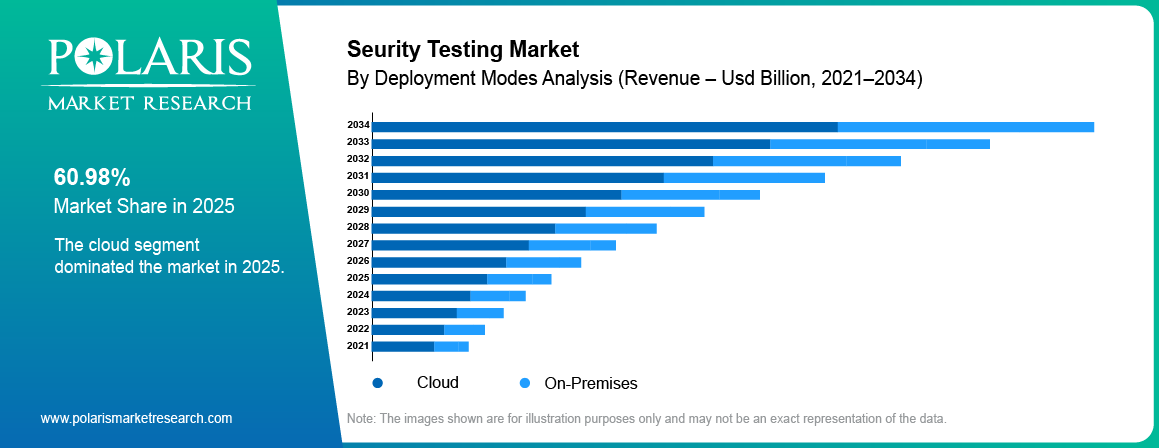
The security testing market is segmented into cloud and on-premises deployment modes. The cloud segment held the largest market share, accounting for 60.98% of total revenue in 2025. Its leading position is supported by the growing adoption of cloud computing and the need to protect sensitive data, applications, and digital infrastructure. Increasing use of cloud platforms is driving demand for cloud security testing to identify misconfigurations, access-control issues, and other vulnerabilities.
The on-premises segment is projected to grow at a CAGR of 23.91% during the forecast period. This deployment mode remains relevant for organizations that require greater control over their security infrastructure and sensitive data. Businesses with strict internal security policies and specific data protection needs use on-premises security testing to identify vulnerabilities, assess network security, and protect critical systems.
By Size of Enterprise Analysis
The security testing market is segmented into small and medium enterprises (SMEs) and large enterprises. The SMEs segment is expected to witness growth of 20.51% CAGR during the forecast period. Growing cyber threats and increasing digital adoption are encouraging smaller businesses to invest in security testing. Affordable testing solutions and managed cybersecurity services are also helping SMEs identify vulnerabilities and protect their digital assets within limited budgets.
The large enterprises segment dominated with largest share of 56.79% in 2025. Large organizations manage complex IT infrastructure, multiple applications, and large volumes of sensitive data. These businesses require regular penetration testing, application security testing, and network security testing to identify weaknesses and reduce cyber risks. Growing investment in cybersecurity and the need to protect critical business operations are supporting demand in this segment.
By Industry Vertical Analysis
The security testing market is segmented into IT & telecom, BFSI, healthcare, e-commerce & retail, and others. The BFSI segment held the largest market share in 2025, accounting for 26.50% of total revenue in 2025, and is expected to maintain its leading position throughout the forecast period. Banks, financial institutions, and insurance providers handle large volumes of sensitive financial data and must meet strict regulatory requirements. Growing cyber threats are driving investment in vulnerability assessments, penetration testing, and compliance testing to protect financial transactions and customer information.
The healthcare segment is projected to grow at the fastest CAGR of 24.78% during the forecast period. The increasing use of digital health records, connected medical devices, and cloud-based healthcare systems is creating a greater need for security testing. Healthcare organizations are investing in application, network, and device security testing to protect patient data, identify vulnerabilities, and reduce the risk of cyberattacks.
Industry Applications and Real-World Use Cases
| Industry / Application | Security Testing Use Case | Purpose |
| Banking and Financial Services | Testing banking apps, login systems, and digital transactions | Identify vulnerabilities that could expose financial data or enable unauthorized access. |
| Healthcare | Testing electronic health records and healthcare systems | Protect patient information and identify weaknesses in data access controls. |
| E-commerce and Retail | Testing online payment gateways, checkout systems, and customer accounts | Detect payment security risks and prevent unauthorized access to customer data. |
| Cloud Infrastructure | Testing cloud configurations, storage permissions, and access controls | Identify misconfigurations that could expose sensitive data or create security gaps. |
| APIs | Testing API endpoints, authentication, and data exchange | Detect weaknesses that could allow unauthorized access or data leakage. |
| Ransomware Preparedness | Simulating ransomware attack scenarios in controlled environments | Assess security controls, backup readiness, and incident response capabilities. |
Source: Polaris Market Research Analysis
Regional Analysis
North America
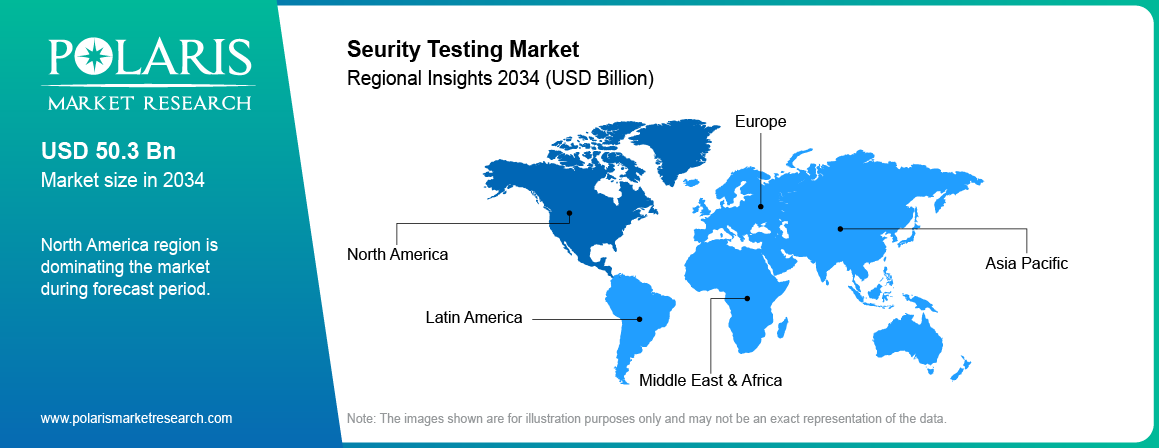
North America dominated the global security testing market in 2025, accounting for 35.31% of total revenue. The region is expected to maintain its leadership throughout the forecast period, supported by extensive digitalization, rising cyber threats, and strong investment in cybersecurity. High-profile data breaches and strict security requirements are encouraging organizations to adopt advanced security testing solutions. The region's established technology companies, financial institutions, and cybersecurity providers further support market growth.
US
The United States is a major contributor to regional demand due to its large technology sector, financial services industry, and growing focus on application and cloud security. Organizations are investing in penetration testing, vulnerability assessments, and compliance testing to protect sensitive data and digital infrastructure.
Canada
Canada's growing digital economy and focus on data protection are supporting demand for security testing. Businesses across financial services, healthcare, and technology are adopting security testing to identify vulnerabilities and strengthen their cybersecurity measures.
Europe
Europe is expected to remain a key regional market for security testing, growing at a CAGR of 22.43% during the forecast period. Strict data protection requirements and increasing awareness of cyber risks are supporting market expansion. The General Data Protection Regulation (GDPR) and other cybersecurity requirements are encouraging businesses to strengthen their security testing practices. Investment in penetration testing, application security, and compliance testing is also supporting regional demand.
UK
The UK's developed financial services and technology sectors are driving demand for security testing. Organizations are strengthening applications network, and cloud security to manage cyber risks and protect sensitive information.
Germany
Germany's strong industrial base and growing adoption of connected technologies are increasing the need for security testing. Businesses are focusing on protecting enterprise networks, industrial systems, and digital applications from cyber threats.
France
France's financial services, healthcare, and technology industries are supporting demand for security testing. Organizations are investing in vulnerability assessments and penetration testing to improve data protection and meet security requirements.
Asia-Pacific
The Asia-Pacific security testing market is expected to benefit from rapid digitalization, expanding internet use, and the growing adoption of cloud-based services. Businesses are increasingly investing in cybersecurity to protect digital transactions, customer information, and enterprise systems. Rising cyber threats and greater awareness of application and network vulnerabilities are also supporting market growth.
Japan
Japan's advanced technology sector and growing use of connected systems are creating demand for security testing. Organizations are focusing on application security, network protection, and vulnerability assessments.
China
China's expanding digital economy, e-commerce sector, and cloud adoption are supporting demand for security testing. Businesses are strengthening their cybersecurity practices to protect applications, networks, and sensitive information.
India
India's expanding IT services industry, digital payment ecosystem, and cloud adoption are increasing the need for security testing. Businesses are investing in penetration testing, application security, and vulnerability assessments to address growing cyber risks.
Middle East & Africa
The Middle East and Africa security testing market is supported by increasing digital transformation, cloud adoption, and cybersecurity investment. Organizations across banking, government, telecommunications, and energy are strengthening their security measures to protect critical systems and sensitive data. Growing awareness of cyber threats and the need to meet regulatory requirements are also encouraging the adoption of security testing solutions.
Latin America
The Latin American security testing market is gaining momentum as businesses adopt digital services, online payment systems, and cloud technologies. The growing use of digital banking and e-commerce is increasing the need to identify application, network, and data security vulnerabilities. Organizations are investing in security testing to reduce cyber risks, protect customer information, and improve the resilience of their digital infrastructure.
Key Market Players & Competitive Insights
The security testing market is fragmented and is anticipated to witness competition due to several players' presence. Major service providers in the market are constantly upgrading their technologies to stay ahead of the competition and to ensure efficiency, integrity, and safety. These players focus on partnership, product upgrades, and collaboration to gain a competitive edge over their peers and capture a significant market share.
Accenture provides cybersecurity services that help organizations identify vulnerabilities, assess security risks, and protect digital infrastructure. Its offerings include penetration testing, application security, cloud security, and security assessments. The company helps businesses strengthen their security controls and address emerging cyber threats across complex IT environments.
IBM provides cybersecurity solutions and services that support security testing, application protection, and vulnerability management. Its security capabilities help organizations identify weaknesses, assess risks, and improve their security posture. IBM also supports businesses in integrating security practices into software development and digital infrastructure.
Key Players
- Accenture plc
- Atos SE
- Checkmarx Ltd.
- Cisco Systems, Inc.
- Cognizant Technology Solutions Corporation
- DXC Technology Company
- HCL Technologies Limited (HCLTech)
- Hewlett Packard Enterprise Company
- IBM Corporation
- Jacobs Solutions Inc.
- NCC Group plc
- OpenText Corporation
- PortSwigger Ltd.
- Qualys, Inc.
- Rapid7, Inc.
- Synopsys, Inc.
- Veracode, Inc.
- Wipro Limited
Vendor Positioning Table
| Company Name | Headquarters | Key Security Testing Capabilities | Industry Focus |
| Accenture plc | Dublin, Ireland | Cybersecurity consulting, penetration testing, application security | Banking, healthcare, IT, and telecommunications |
| Atos SE | Bezons, France | Cybersecurity services, vulnerability assessments, security testing | Government, finance, and enterprise IT |
| Checkmarx Ltd. | Ramat Gan, Israel | Application security testing, code analysis, DevSecOps | Software development and enterprise applications |
| Cisco Systems, Inc. | San Jose, California, United States | Network security, application security, security assessments | Networking, telecommunications, and enterprise IT |
| Cognizant Technology Solutions Corporation | Teaneck, New Jersey, United States | Cybersecurity consulting, application security, security testing | Banking, healthcare, and IT services |
| DXC Technology Company | Ashburn, Virginia, United States | Cybersecurity services, vulnerability assessments, security testing | Government, finance, and enterprise IT |
| HCL Technologies Limited (HCLTech) | Noida, India | Application security, cybersecurity consulting, security testing | IT, telecommunications, and financial services |
| Hewlett Packard Enterprise Company | Spring, Texas, United States | Infrastructure security, network security, security assessments | Enterprise IT, networking, and cloud computing |
| IBM Corporation | Armonk, New York, United States | Application security, enterprise security services, security testing | Banking, healthcare, government, and IT |
| Jacobs Solutions Inc. | Dallas, Texas, United States | Cybersecurity consulting and security assurance | Government, infrastructure, and critical systems |
| NCC Group plc | Manchester, United Kingdom | Penetration testing, application security, cybersecurity assurance | Finance, technology, and critical infrastructure |
| OpenText Corporation | Waterloo, Ontario, Canada | Application security testing and software security | Enterprise software and IT |
| PortSwigger Ltd. | Knutsford, United Kingdom | Web application security testing and Burp Suite | Software development and web applications |
| Qualys, Inc. | Foster City, California, United States | Vulnerability management, security assessments, exposure management | Enterprise IT, cloud, and financial services |
| Rapid7, Inc. | Boston, Massachusetts, United States | Vulnerability management, penetration testing, exposure management | Enterprise IT, finance, and healthcare |
| Synopsys, Inc. | Sunnyvale, California, United States | Application security testing and software security | Software development and technology |
| Veracode, Inc. | Burlington, Massachusetts, United States | Application security testing, code analysis, secure software development | Software development and enterprise applications |
| Wipro Limited | Bengaluru, India | Cybersecurity consulting, application security, security testing | Banking, healthcare, manufacturing, and IT |
Source: Polaris Market Research Analysis
Recent Developments
- October 2026: Checkmarx joined Anthropic’s Project Glasswing to support defensive cybersecurity research using advanced AI models. The initiative focuses on improving vulnerability detection and helping security teams identify and address software weaknesses. (Source: checkmarx.com)
- September 2026: Veracode integrated its Static Application Security Testing (SAST) capabilities with DryRun Security to bring security findings and AI-powered contextual analysis into developer workflows. The integration helps teams identify potential vulnerabilities, improve coverage of business logic flaws, and receive remediation guidance during code reviews and pull requests. (Source: veracode.com)
- March 2026: Veracode expanded its application security capabilities with AI-powered software composition analysis remediation. The update aims to help development teams address software supply chain risks and fix vulnerabilities more efficiently. (Source: businesswire.com)
- March 2026: Rapid7 introduced new cloud security capabilities for its Exposure Command platform, including runtime validation and data security posture management. These capabilities help organizations identify cloud risks and improve visibility into security issues across their environments. (Source: rapid7.com)
- August 2025: Rapid7 launched Vector Command Advanced, expanding its continuous red-teaming and exposure-validation services. The offering includes internal penetration and network segmentation testing to help organizations assess security controls and meet compliance requirements. (Source: rapid7.com)
Security Testing Market Future Outlook
The security testing market is expected to grow as organizations face rising cyber threats, adopt cloud-based technologies, and expand their use of digital applications. Stricter data protection requirements and the integration of security testing into software development are likely to support demand. AI-powered testing and automated vulnerability detection may create further opportunities. However, budget constraints, a shortage of skilled professionals, and rapidly evolving cyber threats could affect market growth. Future market estimates will depend on technology adoption, cybersecurity spending, and the ability of businesses to address emerging risks.
Research Methodology
Polaris Market Research analyzes the global security testing market by evaluating industry trends, market demand, competitive developments, and technological advancements across key regions and industry verticals. The study covers security testing tools and services used to identify vulnerabilities in applications, networks, cloud environments, connected devices, and IT infrastructure. Key areas include penetration testing, vulnerability assessment, application security testing, and managed security testing services.
The research draws on secondary sources, including company annual reports, corporate websites, product announcements, regulatory publications, industry associations, and publicly available industry data. Primary research, where conducted, provides additional insights into market trends, technology adoption, competitive strategies, and customer requirements.
Market sizing and forecasting consider historical market trends, cybersecurity spending, digital transformation, cloud adoption, regulatory requirements, and the growing use of automated and AI-powered security testing. The analysis also examines demand across deployment modes, enterprise sizes, industry verticals, and geographical regions. Competitive assessments consider key market participants, their service portfolios, and developments shaping the industry.
Market estimates and forecasts are developed by evaluating these factors alongside regional demand patterns, emerging cyber threats, and changes in enterprise security requirements. This approach provides a structured view of the market's current landscape and future growth potential.
Security Testing Market Report Scope
| Report Attributes | Details |
| Market size value in 2025 | USD 17.62 billion |
| Market size value in 2026 | USD 21.68 billion |
| Revenue forecast in 2034 | USD 115.15 billion |
| CAGR | 23.2% from 2026 – 2034 |
| Base year | 2025 |
| Historical data | 2021 – 2024 |
| Forecast period | 2026 – 2034 |
| Quantitative units | Revenue in USD billion and CAGR from 2026 to 2034 |
| Segments covered |
|
| Regional scope |
|
| Customization | Report customization as per your requirements with respect to countries, region and segmentation. |
Source: Polaris Market Research Analysis
Security Testing Market FAQ's
The security testing market includes tools and services used to identify vulnerabilities in applications, networks, cloud environments, and IT infrastructure before attackers can exploit them.
The global security testing market was valued at USD 17.62 billion in 2025.
The global security testing market is projected to reach USD 115.15 billion by 2034.
Rising cyberattacks, increasing cloud adoption, stricter data protection requirements, and growing demand for secure software are key factors driving market growth.
The banking, financial services, and insurance (BFSI) sector held the largest market share in 2025, driven by the need to protect financial transactions, sensitive customer data, and digital banking systems.
North America held the largest share of the global security testing market in 2025, supported by strong cybersecurity investment, advanced technology infrastructure, and rising demand for security testing services.
AI-powered testing, automated vulnerability detection, continuous security testing, and the integration of security into software development workflows are key trends shaping the market.

Download Sample Report of Security Testing Market
Please fill out the form to request a customized copy of the research report.


