
Continuous Authentication Market Size, Share, Trends and Forecast, 2026–2034
REPORT DETAILS
Continuous Authentication Market Summary
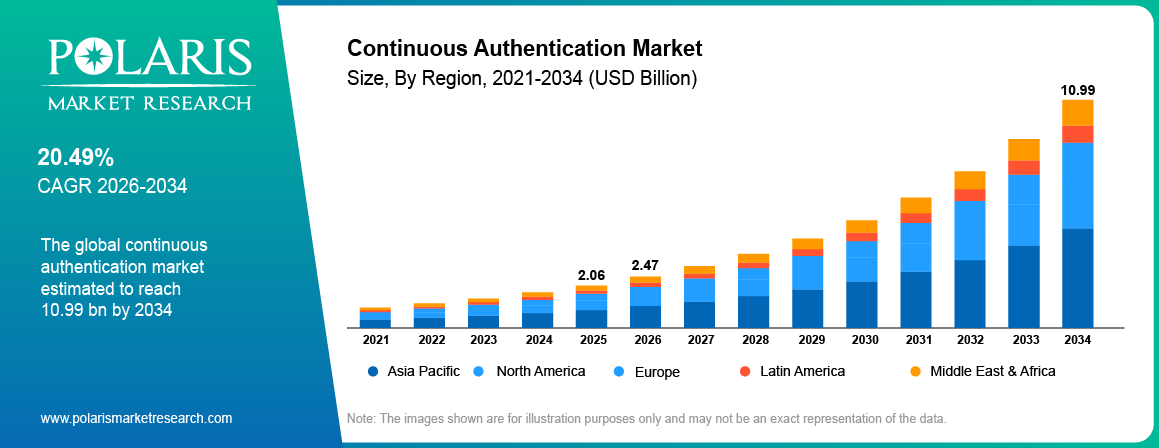
Continuous authentication market size was valued at USD 2.06 billion in 2025. The market is expected to grow at a CAGR of 20.49% from 2026 to 2034. Market growth is driven by rising account takeover risks, growing demand for behavioral biometrics, and the adoption of event-driven access evaluation.
Market Statistics
Key Takeaways
- The North America continuous authentication market share was 34.28% of the global total in 2025. The region’s position is linked to documented adoption among major US banks and enterprise identity security providers.
- The Asia Pacific market is projected to register a 23.72% CAGR during the forecast period. Risk-based authentication requirements in India create opportunities for advanced identity security solutions.
- The behavioral biometrics market segment accounted for 34.62% of the market share in 2025. Demand in the behavioral authentication market is linked to the use of typing patterns, touch handling, and user behavior signals to identify suspicious sessions.
- The event-driven evaluation segment is projected to record a 22.62% CAGR during the forecast period. Final Shared Signals Framework and Continuous Access Evaluation Profile standards provide a framework for exchanging security signals.
- The BFSI segment accounted for 27.86% of the market share in 2025. Adoption is linked to the need to detect account takeover and suspicious activity during digital banking sessions.
Note: Figures and projections outlined in this report are the result of Polaris Market Research’s proprietary analytical processes, grounded in the latest available datasets and market observations.
Continuous Authentication Market Definition
Continuous authentication refers to software and services that verify user identity after login. These types of solutions consider things like your typing, your touch behavior, the device context and the session risk. The behavioral authentication market is all about solutions that look at how users behave to spot suspicious activity during a live session, taking identity verification beyond the initial sign in.
The continuous authentication market is comprised of software and services that score behaviors during a session, assess access based on events, and consistently check to make sure identities are the same. These solutions are deployed in banking, enterprise security, and other digital access environments. They differ from sign-in-only tools, such as standard passkeys or multifactor authentication, which do not evaluate signals after sign-in. Continuous authentication vs adaptive authentication is a related distinction, because adaptive authentication adjusts requirements at sign in, while continuous authentication keeps evaluating risk after access is granted. The market also differs from transaction fraud systems that evaluate payments without signals of user behavior. The scope sits inside the identity and access management market, which sizes multifactor authentication and single sign on, so this report counts only reverification after login. Risk based authentication scores a sign in and step up authentication adds a check when that score is high, whereas continuous authentication keeps scoring after access is granted. On continuous authentication vs MFA, continuous authentication solutions keep evaluating the session after the one time login check that MFA provides. This continuous authentication market analysis treats a product as in scope if it keeps judging the user after login, and as out of scope if it decides only at login or onboarding.
Market growth is driven by rising account takeover risk and the need for better session security. Behavioral biometrics can be used to establish whether activity patterns are consistent with expected user behavior and event-driven evaluation allows access decisions to react to changes in account or device risk. The latest versions of the Shared Signals Framework and Continuous Access Evaluation Profile standards offer a common framework for the exchange of security signals.
Market Dynamics
Driver Impact Analysis
| Factor | Type | Impact level | Regional relevance | Timeline |
| Banking fraud risks | Driver | High | North America, Global | Short term |
| Shared security standards | Driver | Medium | North America, Europe | Medium term |
| Step up authentication rules | Opportunity | Medium | Asia Pacific, Europe | Medium term |
| AI adoption and agent identity | Opportunity | Medium | Global | Long term |
Source: Polaris Market Research Analysis. Impact levels are qualitative Polaris assessments.
Driver: Banking Fraud Risks Are Driving Demand for Continuous Authentication
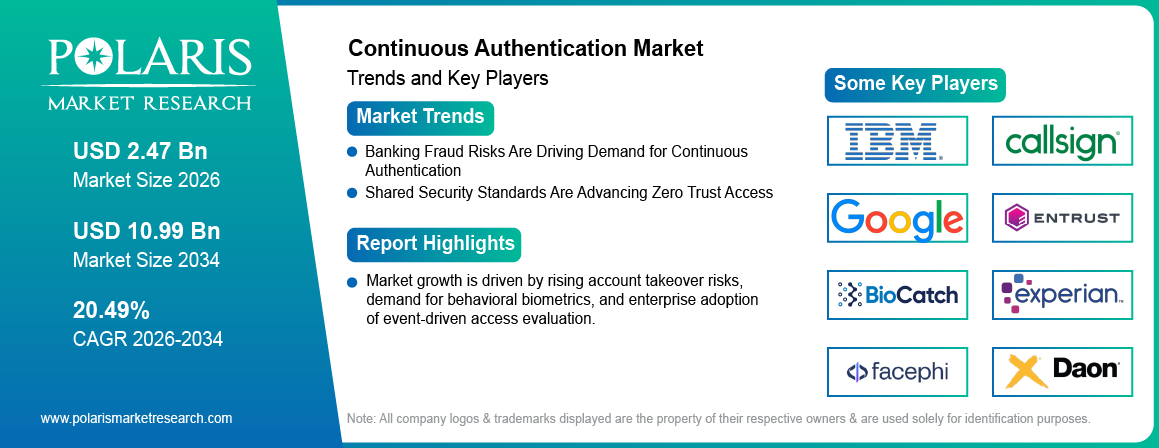
Continuous authentication for banking is now becoming relevant since banks are always on the lookout for a way to improve fraud detection and protection from account takeover or scams during live transactions. Visa agreed to acquire BioCatch in August 2026 for $2.4 billion in cash. BioCatch reported coverage of 1.8 billion devices, 760 million users, more than 350 banking clients across 21 countries, and 19 billion sessions per month. Its 2025 annual recurring revenue reached USD 185 million, according to a company release (Source: Biometric Update). The deal values the company at roughly 13 times its reported recurring revenue. The above numbers show how bank fraud budgets pull the continuous authentication market, yet the acquisition is still pending, and Visa expects it to close by the end of its fiscal second quarter of 2027. Visa says scams and account takeovers cost the global economy more than USD 1 trillion a year, which explains why it is buying BioCatch. The deal prices one company, not the market, and should not be read as a continuous authentication industry forecast (Source: Visa).
Driver: Shared Security Standards Are Advancing Zero Trust Access
Zero trust continuous authentication is gaining relevance as organizations seek faster responses to changes in account and device risk. In October 2025, eight organizations tested the interoperability of the finalized Shared Signals Framework (SSF) and Continuous Access Evaluation Profile (CAEP) specifications at Authenticate 2025. Participants included Google, IBM, Okta and SGNL. Although access tokens can be valid for up to 28 hours, Microsoft Entra continuous access evaluation responds to five critical event types (Source: Microsoft Learn). In January 2026, Ping Identity announced Universal Services for customer, workforce, partner, non-human and agentic AI identities (Source: Ping Identity). The developments provide buyers with a common framework for signal exchange, but interoperability tests do not confirm widespread commercial adoption (Source: OpenID Foundation).
Restraint: Response Delays and Unproven Accuracy Limit Adoption
Session hijacking remains a security concern, but continuous authentication products need stronger performance evidence to gain buyer confidence. Microsoft states that critical event propagation may take up to 15 minutes. CAE-capable tokens may last up to 28 hours, compared with a default of 60 to 90 minutes, and Office web apps and guest users are excluded (Source: Microsoft Learn). TypingDNA does not publish an accuracy or false-positive rate for ActiveLock. In May 2026, Verizon’s 2026 Data Breach Investigations Report found that vulnerability exploitation accounted for 31% of initial access, compared with 13% for credential abuse. Passkeys also do not prevent every session takeover. Buyers therefore need measured results before expanding budgets for in-session checks (Source: Verizon).
Opportunity: Risk-Based Checks Create Demand for Step-Up Authentication
Step up authentication creates an opportunity for continuous identity checks as organizations respond to stronger monitoring expectations. Regulatory frameworks in different markets permit or require additional risk checks for selected activities. India’s authentication directions allow issuers to add risk-based checks beyond two factors, although they do not require continuous authentication or end SMS one-time passwords (Source: KPMG). In Europe, PSD3 and the Payment Services Regulation package will introduce monitoring obligations and direct liability for failure to monitor, with most obligations expected in 2028. Monitoring systems are expected to assess risk factors such as abnormal use of the device. Such developments may spur investment in session security. However, neither framework explicitly requires continuous authentication (Source: PwC).
Opportunity: AI Adoption Is Expanding Identity Security Requirements
With the rise of AI tools and automated agents across organizations and their employees, continuous authentication software may help address new identity risks. The 2026 Verizon DBIR reporting said that regular use of AI by employees on corporate systems increased from 15% to 45%, with 67% of users accessing AI services through non-corporate accounts. Such patterns create additional identity management challenges between business environments. In October 2026, Incognia introduced AI Agent Detection for financial institutions, which checks AI initiated actions against signals from a customer’s trusted devices, account activity and location (Source: Yahoo Finance) Vendors need to demonstrate practical use cases and measurable security outcomes before this opportunity can be quantified (Source: SpyCloud).
Market Segmentation Analysis
The report provides a comprehensive continuous authentication market analysis by component, authentication method, enforcement model, deployment, end user, and region to identify key market segments and emerging growth opportunities.
Component Insights
Continuous authentication software was the dominant component of the market in 2025, with a commanding 65.28% share. Software solutions examine user behavior, device information and session activity to detect changes in identity risk. These are tools that organizations use to find anomalous access patterns and to prompt extra verification when needed. Examples of software capabilities to assess risk and make event-driven access decisions include IBM Verify adaptive access and Microsoft Entra Continuous Access Evaluation. Integration with identity management systems, fraud prevention platforms and enterprise applications also help drive adoption across banking and workforce security environments.
Services are expected to record the fastest growth of 22.08% CAGR during 2026-2034. Enterprises need consulting, implementation, integration, configuration, and technical support to deploy continuous authentication across their existing security systems. Integration requirements vary by infrastructure, application design and identity management policies. The integration of Daon Identity Continuity into ebankIT’s digital banking platform is a good example of the deployment of identity capabilities and the role of implementation partnerships. Organizations deploying session risk assessment across a variety of applications and user groups may experience an uptick in service requests. Providers also bring the technical know-how to help manage the complexity of deployment and maintain authentication workflows.
Authentication Method Insights
In 2025, behavioral biometrics held a dominant share of 34.62% in the overall market and was the leading authentication method. These solutions monitor typing rhythm, touch interactions and other user behavior to identify potential identity changes during a session. Keystroke dynamics is used to analyze typing patterns which can be used to assess user identity. BioCatch uses behavioral intelligence to detect digital fraud, while TypingDNA provides typing authentication via ActiveLock. Organizations use behavioral signals to identify unusual access patterns beyond the initial login across banking, workforce security, and digital services. The behavioral biometrics market is sized in a separate Polaris report, so this segment counts only behavior scored during a session and revenue is not double counted.
Device and session risk signals are expected to register the significant growth at an 20.72% CAGR during 2026–2034. They analyze device changes, session activity and security events to detect potential unauthorized access. Microsoft Entra Continuous Access Evaluation is an example of event-driven access decisions based on selected critical events. Organizations can use contextual signals to re-assess access risk and layer additional controls during digital sessions. Demand is a function of enterprise adoption of zero trust security, session monitoring and risk based authentication access policies. Integrated with identity platforms and security systems, these signals also can be leveraged across enterprise applications.
Physiological biometrics accounted for an estimated 24.18% of the market in 2025. These biometric authentication techniques use physical features like facial features or fingerprints to verify identity. In continuous authentication scenarios, behavioral analysis and device information can be combined with biometric checks. Organizations assess these methods based on device capabilities, privacy requirements, user consent, and system integration needs. Physiological biometrics can be used in applications that require additional identity verification beyond digital services and enterprise environments. The decision to use them also depends on whether biometric checks are suitable for certain workflows, as well as the organization’s policies on data handling. Physiological methods such as face and fingerprint recognition draw on the wider biometric system market, which is sized separately.
The market for multisignal authentication was to be 18.44% in 2025. These solutions combine behavioral, device and contextual information to assess identity risk. Instead of looking for one signal, organizations can assess multiple signals to identify anomalous activity. Multisignal methods may also be used in banking, workforce access and digital platforms that need further identity verification during active sessions. The implementation will depend on availability of signals, integration needs, and ability to manage risk decisions across systems. These solutions are part of broader identity security strategies that integrate authentication methods with session risk assessment.
Enforcement Model Insights
In-session scoring held sway over the market with 44.36% share in 2025 and emerged as the leading enforcement model in the market. This model is based on the analysis of user behavior and session signals during an active session to detect changes in risk. Behavioral intelligence platforms, in turn, use interaction patterns to identify activity outside of the user’s established behavior. Organizations can require additional verification or limit access when risk levels change. In-session scoring applies to digital banking, enterprise applications and workforce security, where the access risk may change after the initial login. Its use depends on signal quality and integration with existing security systems.
Event-driven evaluation is expected to register the fastest growth at an 22.62% CAGR during 2026–2034. This model triggers access decisions when selected security events occur. Microsoft Entra Continuous Access Evaluation responds to five critical event types, although processing latency may reach 15 minutes in certain cases. The Shared Signals Framework and Continuous Access Evaluation Profile provide mechanisms for sharing security events between compatible systems. This adoption by enterprises shows a demand for responsive access policies and better coordination between identity and security platforms. This allows organizations to deliver targeted changes in identity risk across connected applications and services. In the comparison of continuous access evaluation vs continuous authentication, the former reacts to defined security events, while the latter scores user behavior during the session. SGNL is among the eight firms that tested CAEP interoperability in October 2025 (Source: OpenID Foundation).
Periodic identity continuity accounted for an estimated 21.36% share of the market in 2025. This model rechecks identity at selected points during a user journey rather than scoring every interaction continuously. Daon’s Identity Continuity integration with ebankIT provides an example of re-verification when risk signals change. Such methods are relevant to digital banking, account recovery, and high-risk actions. Deployment depends on organizational risk policies, application design, and requirements for additional identity checks throughout a transaction or session. The model provides another approach to maintaining identity assurance after initial verification.
Deployment Insights
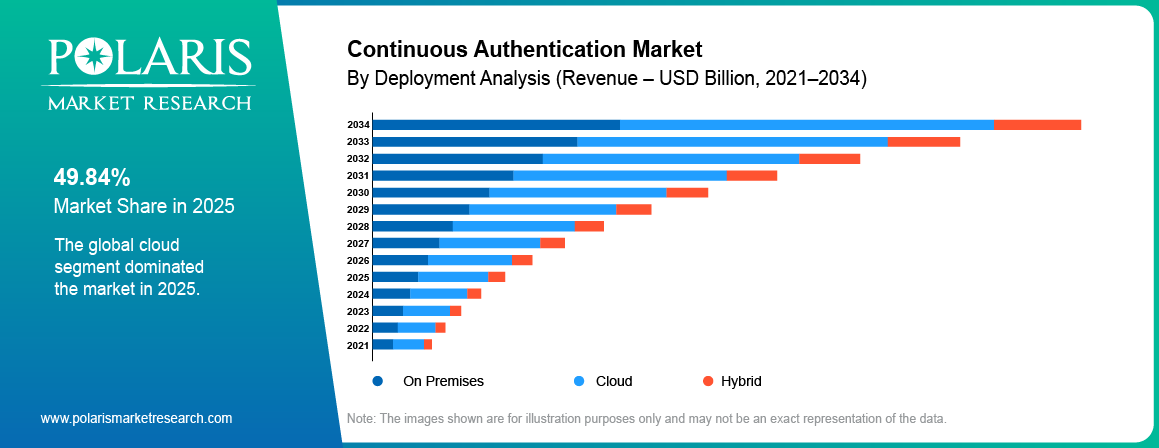
In 2025, cloud deployment held the leading share of 49.84% and was the dominant deployment segment in the market. Cloud platforms expose authentication capabilities as hosted services, and integrate them with digital applications and identity systems. These platforms allow organizations to manage access policies across distributed users, devices and applications. Cloud deployment is relevant for enterprises that use cloud infrastructure and centralized security management. Adoption is a function of data policies, integration needs and operational needs. Cloud deployment is also relevant to organizations with distributed workforces, due to the ability to manage authentication capabilities across digital environments.
Hybrid deployment is anticipated to record the highest CAGR of 22.73% during 2026-2034. This model marries cloud-based authentication services with on-premises infrastructure, enabling enterprises to bridge newer identity platforms with legacy applications. Organizations may adopt hybrid environments to accommodate varying data needs and technology investments across different business units. Adoption is driven by the complexity of integration, security policies and infrastructure design. Hybrid deployment allows organizations the flexibility they need to keep some systems on-premises while still deploying cloud-based identity capabilities. This model is applicable to organizations that operate in multiple application environments and have diverse operational requirements.
In 2025, the on-premises deployment segment accounted for an estimated 24.62% of the market. This model enables organizations to run authentication infrastructure within their own environments. This approach might be suitable for enterprises with stringent data control needs, legacy systems, or internal security policies that restrict external hosting. Internal infrastructure, technical knowhow and maintenance resources are needed for its implementation. Adoption is determined by organizational security standards, integration requirements, and the ability to manage authentication systems in house. On-premises deployment still makes sense for organizations that require direct control over their technology environments and identity security operations.
End User Insights
BFSI is the largest end-user segment in the market in 2025, accounting for a share of 27.86%. Banks and financial institutions are vulnerable to account takeover, scams and illicit digital transactions. BioCatch has relationships with more than 350 banking clients in 21 countries demonstrating the application of behavioral intelligence in financial services (Source: SecurityWeek). In August 2026, Visa announced an agreement to buy BioCatch for USD 2.4 billion. These developments reflect the industry's interest in fraud prevention and identity risk assessment across digital banking channels. Continuous authentication also provides an approach to assessing user activity beyond initial login verification.
IT and Telecom is expected to register the fastest growth at an 21.18% CAGR during 2026–2034. Organizations in this sector manage access across cloud applications, connected devices, and distributed workforces. Continuous authentication tools analyze behavioral patterns and risk of a session after initial login. Microsoft Entra provides event-driven access evaluation, and TypingDNA provides typing-based authentication for workforce computers. Demand is driven by enterprise needs to secure digital infrastructure, control user access and enhance security across applications used by employees and business partners. Adoption also hinges on integration with identity platforms and security policies across enterprise tech environments.
Government and Defense accounted for an estimated 15.72% share of the market in 2025. Public agencies and defense organizations manage access to sensitive information, internal applications and restricted systems. Continuous authentication can provide identity verification during active sessions and can help in detecting abnormal access patterns. Deployment needs are driven by security policies, infrastructure constraints and data protection requirements. Organizations can assess behavioral signals and device context in addition to traditional control of access. Adoption is also dependent upon procurement processes, system interoperability and the security needs of individual agencies.
Healthcare accounted for an estimated 12.84% share of the market in 2025. Healthcare organizations use to control access to clinical applications, admin systems and sensitive patient data. Continuous authentication can help to assess identity risk for staff using shared workstations or accessing applications during a shift. Clinical workflow needs, system compatibility, privacy policies, and costs of implementation drive adoption. Tools may be sought by healthcare providers to confirm the identity of people needing to access their staff and to protect their digital systems. Their decisions also depend on the capacity to integrate these tools into existing clinical and administrative settings without interfering with routine operations.
Retail and Ecommerce accounted for an estimated 11.36% share of the market in 2025. Digital retailers and online service providers manage customer accounts, payments and transactions on a variety of devices. Continuous authentication tools can detect abnormal behavior during an open session and trigger further verification when risk changes. These capabilities are important for account protection and fraud prevention on online platforms. Adoption depends on the balance between security, customer experience, system integration, and transaction risk. Retailers may combine behavioral and device signals to strengthen digital access controls and protect customer accounts.
Regional Insights
The continuous authentication market regional analysis comprises North America, Europe, Asia Pacific, Latin America, and Middle East and Africa. This segmentation reflects the adoption of digital identity security, behavioral biometrics, cloud-based security platforms, and risk-based authentication solutions across these regions. The continuous authentication industry forecast reflects growing cybersecurity requirements, rising digital banking activity, expanding continuous authentication for remote workforce environments, and the adoption of zero trust security frameworks. Other factors that will drive regional demand for continuous authentication include regulatory developments and corporate investments in identity management. Account takeover and third party exposure shape demand in every region, with third parties involved in 48% of breaches in the 2026 Verizon DBIR (Source: Verizon). In this continuous authentication market report, evidence on continuous authentication vendors is drawn mainly from banks and regulators in North America, Europe and India, and is thinner elsewhere.
North America Continuous Authentication Market Trends
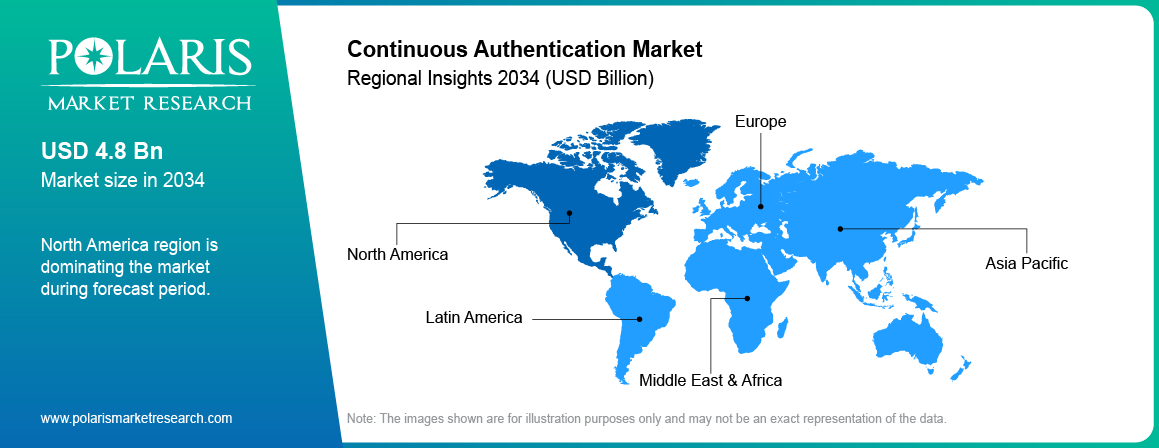
North America held a dominating share of 34.28% in 2025, making it the leading region in the global market. The region has commercial activity across behavioral biometrics, identity security, and enterprise access management. In October 2026, AI Agent Detection was introduced by Incognia for banks and financial institutions to evaluate AI-driven activities based on agent validation, behavioral clues, device information, and location intelligence in order to avoid fraud. These are some of the examples that represent identity risk assessment and digital fraud protection efforts. Financial services, enterprise technology, and digital platforms provide relevant use cases for continuous authentication across the region, including access monitoring and risk-based verification during digital sessions (Source: PR Newswire).
Asia Pacific Continuous Authentication Market Trends
Asia Pacific is expected to register the fastest growth at an 23.72% CAGR during 2026–2034. Continuous authentication market trends 2026 reflect rising demand for identity security across digital banking, ecommerce, telecommunications, and enterprise technology. For example, Indonesia’s QRIS reached 57 million users and 39.3 million merchants, processing 6.05 billion transactions worth USD 37 billion in H1 2025. The scale of mobile payment activity widens the base of sessions that may need risk based checks. In India, the Reserve Bank of India’s authentication directions took effect on April 1, 2026 and emphasize risk based checks (Source: News On AIR). Such rules give banks a reason to reduce account takeover risk during sessions. Banks and financial institutions can leverage identity and context-based signals to evaluate access risks. Such use cases offer chances for continuous authentication in digital services (Source: ASEAN Briefing).
Europe Continuous Authentication Market Trends
In 2025, Europe held an estimated 27.14% share of the global market. The regional demand is indicative of the focus on digital identity protection, data privacy, and secure access to online services. In October 2026, the German Bundestag passed a digital identity law allowing users to exclude biometric facial photos in the European Digital Identity Wallet. Identity verification and risk-based authentication are used by financial institutions and enterprises to manage digital access risks. Regulatory developments around payment security and fraud monitoring also influence security investments. The use of cloud services, remote employment systems and enterprise identity platforms creates the opportunity for continuous authentication solutions across regional industries (Source: Biometric Update).
Middle East and Africa Continuous Authentication Market Trends
Middle East and Africa held an estimated 5.98% share of the global market in 2025. Demand in the region is fueled by digital transformation within financial services, government platforms, telecommunications, and enterprise systems. Organizations require secure control of access for managing digital identities and securing online transactions. The emergence of cloud platforms and digital banking services create opportunities for behavioral biometrics and risk-based authentication. In addition, demand for continuous authentication solutions is driven by enterprise investments in security and identity management across regional markets. In June 2026, Callsign partnered with Ooredoo to make its Digital DNA technology available to banks, airlines, healthcare providers and government agencies in Qatar (Source: Callsign).
Latin America Continuous Authentication Market Trends
The Latin America market is projected to reach 6.74% of the global market in 2025. Regional demand is reflecting the growth of mobile-based transactions, online commerce, and digital financial services. Banks and digital service providers need to detect unusual account activity and reduce the risks of unauthorized access. Continuous authentication solutions enhance identity security by analyzing user behavior and session data. The broader adoption of digital platforms and enterprise cybersecurity systems creates opportunities for authentication vendors across financial services, retail, telecommunications and other digital industries. In March 2026, Facephi Biometria, S.A. signed a five year contract with a Central American bank for mule account detection and behavioral biometrics (Source: Biometric Update).
Continuous Authentication Market Competitive Landscape
The continuous authentication market is shaped by access to banking fraud budgets and distribution through platform identity vendors. Visa’s USD 2.4 billion acquisition of BioCatch signals a strategic interest in behavioral fraud detection and its role in digital identity security. The deal was announced in August 2026 and is expected to close by the end of Visa’s fiscal second quarter of 2027. (Source: MLQ) Other competition includes Microsoft, Ping Identity, Daon and TypingDNA. These companies are addressing identity risk with event-driven access assessment, identity continuity, and behavioral biometrics. Continuous authentication vendors fall into platform identity providers, behavioral specialists and risk data networks, and many pair their tools with risk based authentication policies. Their positions reflect different approaches to continuous authentication market share.
Microsoft, Ping Identity, Daon, and TypingDNA have documented activity in this market. SGNL is a notable differentiator because it participated in a Shared Signals Framework and Continuous Access Evaluation Profile interoperability test, although this evidence does not establish a broad commercial product position. Mastercard Incorporated, which owns the NuData Security behavioral biometrics unit, is a significant participant. Callsign Inc. and Facephi Biometria S.A. are also significant participants, as the 2026 developments below show. Incognia is significant for adding behavioral signals to web risk checks and AI agent detection for banks in October 2026 (Source: RuntimeWire). Facephi launched the Facephi Intelligence Platform in October 2026 to assess identity risk across the customer session (Source: Biometric Update). Companies that offer continuous authentication, by documented product activity, include BioCatch, Microsoft, Ping Identity, Daon, TypingDNA, Callsign, Incognia and Facephi. This list reflects evidence availability, not a ranked market share. It is important for buyers evaluating continuous authentication behavioral biometrics vendors to consider the scope and capabilities of their products.
Industry consolidation also shapes the competitive landscape. LexisNexis Risk Solutions acquired BehavioSec, Experian acquired NeuroID, and Prove acquired UnifyID (Source: LexisNexis Risk Solutions, Experian, Prove). Visa’s proposed acquisition of BioCatch adds another transaction to this pattern, although the deal remains subject to regulatory approvals (Source: Fraudbeat). These initiatives link identity verification and fraud detection capabilities of these vendors. Ping Identity completed its acquisition of Keyless in January 2026, adding zero knowledge biometrics to its platform (Source: Biometric Update).
Continuous Authentication Vendor Landscape Snapshot
| Vendor | Core offering | Focus area | Market position |
| BioCatch | Behavioral intelligence | BFSI | Leader |
| Microsoft | Entra continuous access evaluation | Enterprise | Leader |
| Ping Identity | Universal Services, zero knowledge biometrics | Enterprise and customer identity | Leader |
| Okta | Identity Threat Protection | Workforce identity | Challenger |
| IBM | IBM Verify adaptive access | Enterprise | Challenger |
| LexisNexis Risk Solutions | BehavioSec behavioral biometrics | BFSI and ecommerce | Challenger |
| Experian | NeuroID behavioral analytics | Fraud and identity | Challenger |
| Mastercard | NuData Security behavioral biometrics | Payments | Challenger |
| Daon | Identity Continuity | Digital banking | Challenger |
| Callsign | Digital DNA behavioral intelligence | BFSI | Challenger |
| | SSF and CAEP participant | Standards | Niche Player |
| TypingDNA | ActiveLock typing biometrics | Workforce endpoints | Niche Player |
| Prove Identity | Mobile behavioral biometrics | Mobile identity | Niche Player |
| Zighra | On device behavioral authentication | Mobile | Niche Player |
| Entrust | Identity platform | Enterprise | Niche Player |
| RSA Security | Identity platform | Enterprise | Niche Player |
| SecureAuth | Identity platform | Enterprise | Niche Player |
| SGNL | CAEP hub | Access policy | Emerging Player |
| Incognia | AI Agent Detection | BFSI | Emerging Player |
| Facephi | Facephi Intelligence Platform | BFSI | Emerging Player |
Source: Polaris Market Research Analysis. Market position reflects Polaris analyst assessment of product scope and evidence, not ranked market share.
Continuous Authentication Market Technology and Innovation Landscape
The shared signals framework enables identity and security platforms to exchange event notifications when a device or credential is compromised. The Shared Signals Framework (SSF) and Continuous Access Evaluation Profile (CAEP) allow one system to communicate security changes to another system. Continuous authentication works by combining scored user behavior with event notifications and access rechecks. The OpenID Foundation completed SSF and CAEP in 2025 and held an interoperability event in October 2025 with eight organizations. These developments lay the groundwork for sharing identity risk signals across security platforms.
Passkeys reduce exposure to phishing and credential theft via cryptographic authentication, but they don’t stop every session takeover after login. Behavioral biometrics analyze typing patterns, touch interactions and device handling to identify changes in user activity. BioCatch uses behavioral intelligence for fraud detection and TypingDNA provides typing-based authentication. Zighra described on-device behavioral authentication in 2017 as a vendor claim. The continuous authentication accuracy false positives question remains unresolved, since the reviewed sources provide no independent false-positive rate for behavioral biometrics.
Continuous access evaluation enables identity platforms to respond to selected security events during an active session. Microsoft Entra identifies five critical event types for access evaluation, but processing latency may reach 15 minutes. CAE-capable sessions may use access tokens valid for up to 28 hours, compared with the default token lifetime of 60 to 90 minutes, and Office web apps and guest users are excluded from the documented coverage (Source: Microsoft Learn). Microsoft, Google, Okta, and IBM participate in the wider identity and security ecosystem. SSF and CAEP are finalized standards, but the available evidence points to early adoption of event-driven interoperability. In-session behavioral scoring represents a more established use case. Event driven continuous authentication solutions are still early, so any continuous authentication industry forecast should weight in session scoring more heavily in the near term.
Technology and Innovation Landscape Snapshot
| Technology | Function | Maturity | Example vendors |
| Behavioral biometrics | Scores typing, touch and device handling | Established | BioCatch, TypingDNA |
| Continuous access evaluation | Revokes access on critical events | Established | Microsoft |
| SSF and CAEP | Shares security events across vendors | Early adoption | Google, IBM, Okta, SGNL |
| Identity continuity | Rechecks identity when risk changes | Emerging | Daon, ebankIT |
| On device behavioral checks | Processes signals on the endpoint | Emerging | TypingDNA, Hancomwith |
| AI agent detection | Separates agent checks from action approval | Emerging | Incognia, Ping Identity |
Source: Polaris Market Research Analysis
Continuous Authentication Market Use Case Analysis
Banking: BioCatch and Account Takeover
Session hijacking and account takeover expose banks and customers to fraud during digital sessions. Visa states that scams and account takeover cost the global economy more than USD 1 trillion annually (Source: Yahoo Finance). BioCatch applies behavioral scoring across a reported base of 760 million users to help financial institutions identify suspicious activity. Visa has agreed to acquire BioCatch in a deal worth USD 2.4 billion announced in August 2026, which remains subject to regulatory approvals (Source: Disruption Banking). The deal does not show continuous authentication market share. Continuous authentication may flag changes in user behavior during a session, but the reviewed sources do not provide an independent accuracy figure or a quantified customer outcome. Banks remain the primary source for validating real-world results.
Workforce: Typing Checks on Company Computers
Step up authentication addresses situations where a company computer remains active after the authorized user leaves or an attacker takes over a session. As continuous authentication software, TypingDNA ActiveLock for Windows and macOS checks typing patterns and can lock a machine or send a silent alert when the input does not match the expected user. Microsoft Entra also evaluates selected critical events and may revoke access when conditions require it. Such abilities help in providing additional verification beyond just the login process for zero trust session monitoring. Unfortunately, the analyzed sources do not provide any independent measurements of accuracy or customer results for ActiveLock. The available evidence describes product features rather than proven results.
Digital Banking: Daon Inside ebankIT
A single identity check during onboarding does not cover later account recovery or high-risk transactions. Daon’s Identity Continuity integrates with the ebankIT digital banking platform and re-verifies identity when risk signals change. The companies describe this integration as a way to maintain identity assurance across digital banking interactions. This approach connects authentication with changes in session risk rather than relying only on the initial verification event. The example is based on vendor and partner information, and the reviewed source does not report quantified customer outcomes. Banks using the integration would need to provide results to establish its impact on fraud prevention, user experience, and operational performance. Identity continuity of this kind also feeds the wider digital trust market, because trust, privacy and fraud budgets come from the same buyers.
Healthcare: Clinical Workforce Access
Healthcare deployments of continuous authentication with a stated customer outcome are not publicly documented. The available sources cover banking fraud detection, workforce typing checks, enterprise identity platforms, and event-driven access evaluation. They do not establish a healthcare-specific deployment with measured results. The reviewed evidence also does not connect continuous authentication to a specific healthcare rule or mandate. Healthcare providers may have identity security requirements across clinical systems and staff access, but these needs do not establish actual market adoption. Documented clinical workforce deployments with measurable outcomes would be needed to size this use case.
Buyer Analysis and Market Entry Barriers
Buyer Framework
| Buyer | Typical need | Decision criteria | Evidence |
| Bank fraud and digital channel teams | Stop account takeover and scams during a session | Detection before payment, integration with the digital channel | BioCatch's 350+ banking clients; ebankIT and Daon |
| Enterprise security and identity teams | Revoke access when risk changes | Standard signal feeds, platform fit | CAEP test; Microsoft Entra CAE; Ping Universal Services |
| Card issuers and payment providers | Risk based checks beyond two factors | Regulatory compliance | RBI directions; EU PSD3 and PSR |
| Digital trust and privacy owners | Trust and consent for behavior data | Privacy treatment of behavioral data | Polaris Digital Trust Market report; no regulator position on behavioral data |
Source: Polaris Market Research Analysis
Market Entry Barriers
Eight organizations participated in an interoperability event to test signal exchange through SSF and CAEP. This illustrates the technical work required to establish consistent communication between identity platforms. A zero trust environment demands that security solutions consider the identity and context information when making access decisions, which requires certain integration capabilities from the new vendor. Buyers also weigh account takeover losses and the cost of step up authentication against the unproven accuracy of continuous authentication solutions.
Accuracy and validation: Buyers need evidence that behavioral models distinguish authorized users from suspicious activity. The reviewed sources provide no independent false-positive figure for behavioral biometrics. TypingDNA ActiveLock describes its response to mismatched typing patterns but does not publish an accuracy result. Buyers asking how accurate is behavioral biometrics should request independent testing results, error rates, and performance data across user groups.
Platform limitations: Microsoft Entra CAE responds to selected critical events, but processing latency may reach 15 minutes. Office web apps and guest users are outside the documented coverage. Policy and group changes may also take up to a day to apply. These limitations affect implementation decisions and the scope of continuous access evaluation.
Consolidation and competition: Visa agreed to buy BioCatch for USD 2.4bn (Source: Visa). Previous deals include LexisNexis Risk Solutions and BehavioSec, Experian and NeuroID and Prove and UnifyID. These deals link behavioral intelligence to broader identity and fraud prevention portfolios. New entrants need a clear product advantage and access to enterprise customer base.
Privacy and threat coverage: Behavioral data introduces issues of consent, data processing and retention. The evidence reviewed does not establish a specific regulator position on behavioral authentication under continuous authentication privacy GDPR. Ping Identity describes zero-knowledge biometrics in its product information. Verizon’s 2026 DBIR reports credential abuse at 13% of initial access, compared with vulnerability exploitation at 31% (Source: Help Net Security). Continuous authentication addresses selected identity risks, not every attack method. The reviewed sources do not provide a standard price per user or per session. Until pricing is disclosed, any continuous authentication industry forecast rests on assumptions.
Premium Insights and Forward Outlook
Continuous Authentication Is Not Instant
Buyers may interpret continuous authentication as constant, immediate checking, but documented platform behavior shows different response times. Microsoft reports latency of up to 15 minutes for selected critical event evaluations in continuous access evaluation. CAE-capable sessions may use access tokens valid for up to 28 hours, and Office web apps and guest users are not covered by the documented functionality. Policy and group changes may take up to a day to apply. Continuous authentication is not the same as MFA. The solution provides additional verification in terms of behavioral scoring, notifications, and access decisions beyond authentication. SSF and CAEP are fully developed; however, the evidence base includes only one interoperability test among eight organizations. Buyers should compare response times and coverage across real deployment conditions.
The Visa Deal Reflects One Company's Value, Not the Total Market
Visa announced a USD 2.4 billion cash agreement to acquire BioCatch (Source: Jerusalem Post). BioCatch reported USD 185 million in annual recurring revenue for 2025, according to trade press reporting of company information. The announced purchase price equals approximately 13 times that ARR. Based on more than 350 banking clients, ARR per client would be below approximately USD 0.53 million annually. Based on 760 million users, ARR equals approximately USD 0.24 per user annually. These are derived averages, not actual customer prices. The figures describe one banking-focused business in the behavioral authentication market and do not establish the total continuous authentication market size. Ping Identity and TypingDNA do not publish comparable prices in the reviewed sources. Continuous authentication pricing therefore stays opaque, and this continuous authentication market analysis treats the Visa multiple as a single data point.
Cost and Pricing Benchmarking Analysis
Continuous authentication pricing solutions remains limited in the reviewed evidence. No list price was identified for Ping Identity, Microsoft, Daon, or TypingDNA. The available financial benchmarks relate to the Visa-BioCatch transaction and BioCatch's reported recurring revenue. The per-client and per-user figures below are derived from reported revenue and customer counts, so they should not be treated as quoted prices. Enterprise pricing may vary by deployment scope, number of users, session volume, integration requirements, and product features.
Key Players in the Continuous Authentication Market
Key Players by Value Chain Category
| Value chain category | Companies | Basis |
| Platform identity providers | Entrust; Google; IBM; Microsoft; Okta; Ping Identity; RSA Security; SecureAuth | Platform and standards participants |
| Behavioral specialists | BioCatch; Prove Identity; TypingDNA; Zighra; Callsign; Incognia | Behavioral signal products |
| Risk and data networks | Experian; LexisNexis Risk Solutions; Mastercard | Owners of acquired behavioral assets |
| Identity continuity and signal sharing | Daon; SGNL; Facephi | Re verification and CAEP participation |
Source: Polaris Market Research Analysis
Some of the key players in the continuous authentication market includes:
- BioCatch
- Callsign
- Daon
- Entrust
- Experian
- Facephi
- IBM
- Incognia
- LexisNexis Risk Solutions
- Mastercard
- Microsoft
- Okta
- Ping Identity
- Prove Identity
- RSA Security
- SGNL
- TypingDNA
Industry Developments
- October 2026: Facephi launched the Facephi Intelligence Platform, which combines identity verification with behavioral, device and network signals to assess risk throughout the customer session. (Source: GlobeNewswire)
- October 2026: Incognia launched AI Agent Detection for financial institutions, with Web Behavioral Biometrics and an MCP Server for fraud investigations. (Source: The Paypers)
- August 2026: Visa announced a definitive agreement to acquire BioCatch for USD 2.4 billion, adding behavioral and device intelligence to its fraud and security portfolio. (Source: Security MEA)
- July 2026: Callsign joined the FIDO Alliance to contribute its behavioral intelligence expertise to authentication standards and digital identity security. (Source: Callsign)
- June 2026: ebankIT integrated Daon’s Identity Continuity into its digital banking platform, enabling risk-based re-verification and step-up authentication when risk signals change. (Source: Daon)
- May 2026: Hancomwith, a subsidiary of Hancom Group, launched xCAuth, an AI powered continuous authentication system that analyzes behavior, location and device context in real time. (Source: Biometric Update)
- April 2026: Microsoft updated its Entra Continuous Access Evaluation documentation, detailing five critical events, potential latency of up to 15 minutes, and access tokens valid for up to 28 hours in compatible sessions. (Source: Microsoft)
- March 2026: Facephi Biometria, S.A. announced a five year contract with a Central American bank for mule account detection and behavioral biometrics. (Source: Facephi)
- March 2026: Ping Identity announced general availability of Identity for AI, which extends its identity platform to AI agents. (Source: Ping Identity)
- January 2026: Ping Identity announced Universal Services, a set of identity services for continuous identity assurance across customer, workforce, partner and AI identities. (Source: Help Net Security)
- January 2026: Ping Identity completed its acquisition of Keyless, adding zero knowledge biometrics for re verification. (Source: Ping Identity)
- October 2025: Eight technology firms demonstrated that the final Shared Signals Framework and Continuous Access Evaluation Profile specifications enable real time security coordination across vendors. (Source: OpenID Foundation)
- September 2025: The Reserve Bank of India issued authentication directions for digital payment transactions, allowing additional risk-based checks and setting April 1, 2026, as the compliance deadline. (Source: Reserve Bank of India)
Market Segmentation
By Component (Revenue, USD Billion, 2021–2034)
- Software
- Services
By Authentication Method (Revenue, USD Billion, 2021–2034)
- Behavioral Biometrics
- Physiological Biometrics
- Device and Session Risk Signals
- Multisignal
By Enforcement Model (Revenue, USD Billion, 2021–2034)
- In Session Scoring
- Event Driven Evaluation
- Periodic Identity Continuity
By Deployment (Revenue, USD Billion, 2021–2034)
- Cloud
- On Premises
- Hybrid
By End User (Revenue, USD Billion, 2021–2034)
- BFSI
- IT and Telecom
- Government and Defense
- Healthcare
- Retail and Ecommerce
- Others
By Regional Outlook (Revenue, USD Billion, 2021-2034)
- North America
- US
- Canada
- Europe
- Germany
- France
- UK
- Italy
- Spain
- Netherlands
- Russia
- Rest of Europe
- Asia Pacific
- China
- Japan
- India
- Malaysia
- South Korea
- Indonesia
- Australia
- Vietnam
- Rest of Asia Pacific
- Middle East & Africa
- Saudi Arabia
- UAE
- Israel
- South Africa
- Rest of Middle East & Africa
- Latin America
- Mexico
- Brazil
- Argentina
- Rest of Latin America
Report Scope
| Report Attributes | Details |
| Market Size in 2025 | USD 2.06 Billion |
| Market Size in 2026 | USD 2.47 Billion |
| Revenue Forecast by 2034 | USD 10.99 Billion |
| CAGR | 20.49% from 2026 to 2034 |
| Base Year | 2025 |
| Historical Data | 2021–2024 |
| Forecast Period | 2026–2034 |
| Quantitative Units | Revenue in USD Billion and CAGR from 2026 to 2034 |
| Report Coverage | Revenue Forecast, Competitive Landscape, Growth Factors, and Industry Trends |
| Segments Covered |
|
| Regional Scope |
|
| Competitive Landscape |
|
| Report Format |
|
| Customization | Report customization as per your requirements with respect to countries, regions, and segmentation. |
Source: Polaris Market Research Analysis
Why Choose Polaris Market Research
The continuous authentication market report from Polaris Market Research & Consulting, Inc. examines market structure, technology adoption, vendor positioning, and industry developments. The analysis uses dated company announcements, product documentation, standards publications, and regulatory sources. It separates reported figures from derived calculations in the cost and pricing table. The report also identifies gaps in product evidence and highlights the absence of independent accuracy data for behavioral biometrics. This approach provides a clear view of market developments without relying on unverified syndicated market estimates.
The report offers a distinct view of continuous authentication vendors through enforcement model segmentation, covering in-session scoring, event-driven evaluation, and periodic identity continuity. This segmentation helps readers compare approaches to session risk assessment and re-verification. The analysis also examines behavioral biometrics, shared signal standards, platform limitations, use cases, and competitive developments. Where can I buy a continuous authentication market report? Readers can request this report through the Polaris Market Research report details module. If you need this scope cut by enforcement model or by end user, Polaris Market Research & Consulting, Inc. will build a custom continuous authentication market research study around it.
Research Methodology
Polaris Market Research & Consulting, Inc. structures its continuous authentication market analysis around five phases: scoping, secondary research, estimation, validation, and quality review. The scope focuses on re-verification during an active session and separates this activity from login and onboarding checks, including risk-based authentication at sign-in. The research reviews company announcements, product documentation, standards publications, regulatory sources, and dated trade press. Syndicated research figures are excluded from the analysis. The continuous authentication industry forecast uses internal Polaris modeling.
The validation phase reviews evidence such as Visa’s proposed BioCatch acquisition, the SSF and CAEP interoperability event, Microsoft’s stated access evaluation limitations, and Reserve Bank of India directions. Vendor claims remain identified as such until independent or customer evidence confirms the reported outcomes. The review also checks company product evidence, market boundaries, source dates, and derived pricing calculations. A senior analyst review and a 40-item checklist form the final quality stage. The report methodology distinguishes confirmed source information from internal modeling.
Research Methodology Phases
| Phase | Activity | Primary evidence in this report |
| 1 Scoping | In session re verification versus login checks, overlap check with four Polaris reports | Market definition and scope note |
| 2 Secondary research | Releases, documentation, standards and regulator texts, trade press | Sources list |
| 3 Estimation | Revenue sizing on a stated basis | Polaris internal data |
| 4 Validation | Deal, standards, latency and regulatory evidence | Competitive Landscape and Industry Developments |
| 5 Quality review | Senior analyst review and 40 item checklist | Reviewer sign off |
Source: Polaris Market Research Analysis
Continuous Authentication Market FAQ's
The market is valued at USD 2.06 billion in 2025 and is projected to reach USD 10.99 billion by 2034.
The market is projected to grow at a CAGR of 20.49% during the forecast period.
North America is the provisional leading region, with an estimated 34.28% share in 2025.
BFSI is the provisional leading segment, with an estimated 27.86% share. IT and Telecom is the provisional fastest-growing segment.
The main types are behavioral biometrics, physiological biometrics, device and session risk signals, and multisignal methods.
Continuous authentication is the process of verifying user identity across an active session by using behavioral and device signals.
Continuous identity verification is the repeated re-checking of who is using an account throughout a live session, after the initial login. This report counts it as part of the continuous authentication market. Sign-in checks such as passkeys, MFA, risk-based authentication at login and onboarding verification decide once and fall outside the scope.
It assesses user behavior and session risk and when needed, triggers alerts, access changes or additional checks.
No. MFA verifies identity at login, while continuous authentication rechecks identity or session risk after access. The difference between continuous authentication vs MFA lies in the timing and method of identity checks.
BioCatch, Microsoft, Ping Identity, Daon, TypingDNA, Callsign, Incognia and Facephi offer products or capabilities relevant to continuous authentication.
It allows compatible systems to respond to selected security events without having to wait for access tokens to expire.
Visa announced a USD 2.4 billion agreement to acquire BioCatch for its behavioral fraud detection capabilities.
The reviewed sources provide no independent accuracy or false-positive figures.
Public list prices were not found. BioCatch's reported figures imply up to approximately USD 0.53 million in annual recurring revenue per banking client, a derived estimate.
It helps detect suspicious session activity and reduce session hijacking risks, but it cannot prevent every attack.
No single regulation explicitly mandates continuous authentication. Regulations such as RBI’s digital payment directions and EU PSD3/PSR include risk-based security requirements.
Download Sample Report of Continuous Authentication Market
Please fill out the form to request a customized copy of the research report.


