
Data Center Power and Energy Management Market Size, Share, Trends & Forecast, 2026–2034
REPORT DETAILS
Data Center Power and Energy Management Market Summary
The global data center power and energy management market was valued at USD 35.95 billion in 2025 and is projected to reach USD 107.06 billion by 2034, growing at a CAGR of 12.9% during 2026 to 2034. Market growth is driven by rising rack power density from AI workloads, adoption of smart energy management systems, and the shift toward onsite and distributed power.
Market Statistics
Data Center Power and Energy Management Market Key Takeaways
- In 2025, North America led the global data center power and energy management market share with 38.58%. Electricity consumption is increasing due to the rise of AI, cloud, and large-scale data centers.
- Europe is expected to register a CAGR of 12.3% during the forecast period, due to rising demand for artificial intelligence (AI), cloud services, and overall digital infrastructure growth.
- The Asia Pacific market is expected to witness significant growth at a 14.6% CAGR during the forecast period, driven by the increasing need for artificial intelligence, cloud services, and other digital technologies.
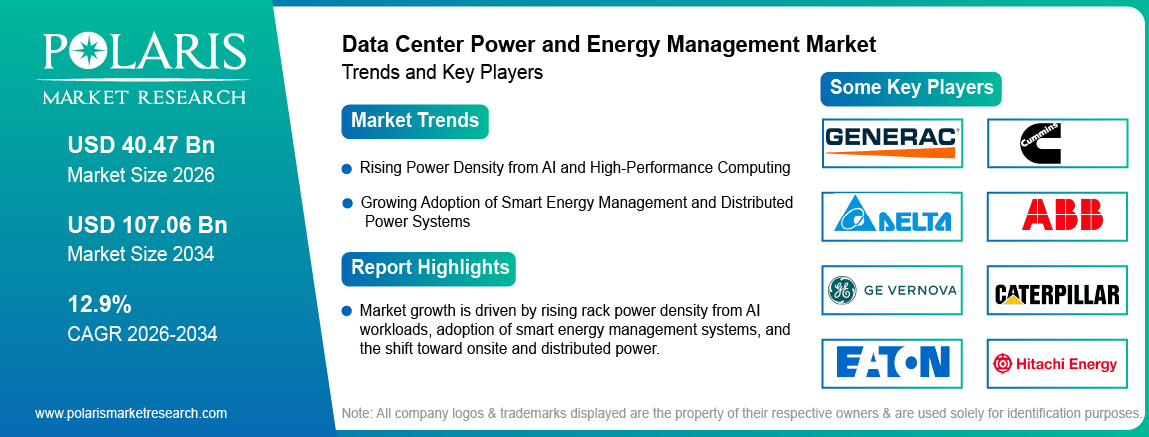
- In 2025, the power distribution & backup segment accounted for the largest market share of 44.89% due to rising power needs in data centers.
- The colocation data center segment is anticipated to experience a CAGR of 12.7% during the forecast period as businesses use shared data center facilities instead of building their own.
Note: Figures and projections outlined in this report are the result of Polaris Market Research’s proprietary analytical processes, grounded in the latest available datasets and market observations.
Data Center Power and Energy Management Market Definition
Data center power and energy management includes various solutions and equipment for controlling electricity consumption in data centers. Such tools are designed to guarantee the proper functioning of data centers, servers, power supplies, cooling systems, and other infrastructure components. They are usually developed to optimize power distribution and consumption to ensure energy efficiency and cost-effectiveness of operations. Moreover, modern energy management solutions help configure and control power supplies within data centers and facilities, which allows minimizing expenses on energy.
Data center power and energy management starts with the power supply, which provides electricity to the facility. Power monitoring systems are used to gather information on the electric power consumed by servers, air conditioning systems, and other equipment. This information is compiled and analyzed to find areas of high power consumption and suggest process improvements to improve performance and reduce energy consumption. The data is used to optimize power consumption based on the center’s needs. In addition, cooling systems can regulate power consumption. Backup power supplies can also be installed to provide electricity during power outages.
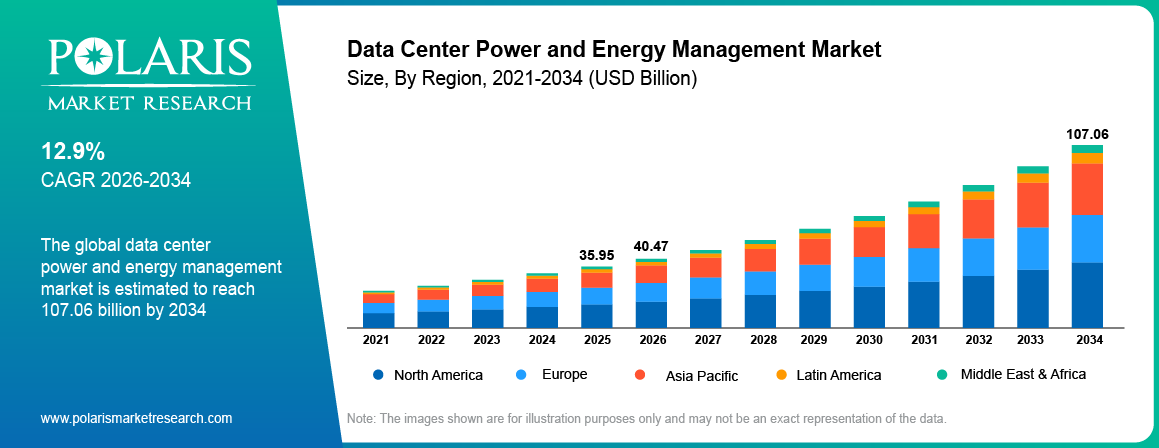
The growing adoption of hyperscale data centers, cloud computing, AI, high-performance computing, and data-intensive enterprise applications across the globe is substantially raising power demand for global digital infrastructure, driving the data center power and energy management market growth. Power and energy management solutions include power distribution, uninterrupted power supply (UPS) systems, intelligent power monitoring systems, energy management software, battery energy storage systems, backup generation, power quality management, and sophisticated cooling energy management solutions. The high pace at which AI servers are being rolled out is more specifically transforming the data center power architecture, as increasing rack densities demand enhanced real-time monitoring, load balancing, capacity planning, and energy efficiency.
Impact of AI on Data Center Power and Energy Management Market
- AI racks draw far more power than conventional enterprise racks, and rack power ratings are rising with each new generation of AI servers.
- Artificial intelligence systems are increasing electricity demand in data centers.
- AI servers require more power, driving demand for advanced power distribution.
- Higher AI workloads are increasing data center cooling and energy requirements.
- Real-time power monitoring is becoming more important for AI data centers.
- Growing power demand is increasing the use of battery storage and backup systems.
- Smart energy management helps reduce energy waste and improve overall efficiency.
Industry Dynamics
Driver Impact Analysis
| Market Driver | Geographic Relevance | Linked Segments and CAGR | Regional CAGR | Impact Level | Impact Timeline |
| Rising Power Density from AI and HPC | North America, Asia Pacific | Power Distribution & Backup 12.6%, Energy Monitoring & Management 12.9% | Asia Pacific 14.6%, North America 12.0% | High | Short Term |
| Adoption of Smart Energy Management and Distributed Power | North America, Europe | Energy Visualization & Analytics 13.0%, Energy Monitoring & Management 12.9% | Europe 12.3%, North America 12.0% | High | Medium Term |
| Integration of Renewables, Battery Storage and Microgrids | Middle East & Africa, Latin America | Energy Generation 13.5% | Middle East & Africa 13.6%, Latin America 13.4% | High | Medium to Long Term |
Short Term: 2026 to 2027. Medium Term: 2028 to 2030. Long Term: 2031 to 2034.
Source: Polaris Market Research Analysis
Driver: Rising Power Density from AI and High-Performance Computing
The rapid development of artificial intelligence, machine learning, graphics processing clusters, GPU, and high-performance computing (HPC) is raising power densities within data centers. Compared with traditional enterprise computing platforms, AI-based facilities need more electricity at the rack level. They also require more power-consuming distribution, backup, liquid cooling, and monitoring infrastructure. Operators are seeking to upgrade legacy electrical infrastructure based on intelligent power distribution units, higher-power uninterruptible power supplies, advanced switchgear, and load-balancing technologies to manage power and improve reliability at the rack level. It becomes critical to monitor and optimize consumption at the rack level for the facility to avoid overloads and ensure high utilization, capacity, and resilience. Thus, increasing power density from AI and HPC drives the market expansion.
Driver: Growing Adoption of Smart Energy Management and Distributed Power Systems
Growing pressure to improve energy efficiency and reduce grid load is driving demand for advanced energy management platforms, battery storage, microgrids, and on-site generation. Data center operators are looking to harness the value of power-monitoring software combined with predictive analytics, automation, renewables, and demand response. It helps them free up capacity by shedding load and right-sizing backup power. Meanwhile, the rise of digital twins and AI for energy management enables the modeling of power needs and infrastructure changes before committing to costly upgrades. These platforms are extending the market beyond electrical equipment into software and services.
Restraint: High Cost and Complex Upgrade Process
Advanced power and energy-management solutions require substantial investments in electrical equipment, monitoring tools, complementary software, batteries, and related services. This puts a high entry cost threshold. Retrofitting existing facilities can also be challenging and demands the operator’s due diligence. Upgrading power infrastructure requires careful balancing of new and legacy equipment, including uninterruptible power supplies, switches, sensors, and building-management systems. Moreover, smaller enterprise centers may be reluctant to adopt a large-scale modernization program that targets switching, power electronics, and other equipment that is still under warranty, thereby restraining the industry growth.
Restraint: Limited Grid Capacity and Increasing Cybersecurity Concerns
The limited grid capacity and delays for new connections restrain data center operators that plan to adopt advanced power technologies. At the same time, the growing digitization and networking of power equipment create new cybersecurity challenges. Advanced monitoring and control capabilities enable better power and energy analytics but generate new security risks due to the expanded attack surface. Thus, many operators avoid adopting digitized power infrastructures due to the potential for large-scale cyberattacks that disrupt operations and compromise data. These factors are limiting market growth.
Opportunity: Integration of Renewable Energy, Battery Storage, and Data Center Microgrids
The increasing need of hyperscale, cloud, colocation, and AI data centers for power to meet the growing demand is creating opportunities for renewable, battery, and microgrid companies. Although data centers require a steady power supply, they face several grid constraints, rising electricity costs, and the need to reduce their carbon footprint. Energy management systems can address these load-serving needs by intelligently managing power from the grid, renewables, batteries, and backup generators and balancing it with IT and facility loads. Rising power needs at data centers are expected to drive demand for smart UPS systems, power management systems, energy storage, and advanced power control systems, thereby fueling the market expansion. Operators are already contracting onsite power at campus scale, with multi gigawatt fuel cell agreements signed in 2026, which points to sustained demand for onsite generation and storage.
Emerging Trends in the Data Center Power and Energy Management Market
| Market Trend | What Is Changing | Why It Matters | Industry Examples |
| AI Driven Power Management | AI platforms forecast load, predict equipment faults and optimize energy use in real time | Lower downtime and energy cost | Schneider Electric EcoStruxure IT, Vertiv Trellis, Legrand Raritan PX4 |
| High Voltage DC Distribution | HVDC and central busways reduce conversion stages in AI racks | Lower losses and smaller footprint | ABB Infinitus DC Portfolio, Eaton and NVIDIA HVDC architectures |
| Software Defined Medium Voltage Switchgear | SF6 free switchgear with software control built for AI sites | Faster and more flexible grid connection | Schneider Electric RM AirSeT 38 |
| Modular High Density UPS | Single frame UPS capacity reaching the megawatt range | Capacity added in steps within existing halls | Schneider Electric Galaxy VXL, Vertiv Liebert EXL S1 |
| Battery Storage for AI Load Smoothing | Batteries absorb rapid load swings and demand peaks | Stable load profile and lower peak demand | Cummins 5 MWh lithium iron phosphate system |
| Onsite Power and Fuel Cells | Fuel cells and gas generator sets energize campuses ahead of grid connection | Faster time to power | Bloom Energy fuel cells, Rolls-Royce mtu fast start gas gensets |
| Liquid Cooling and Power Integration | Direct to chip cooling designed together with rack power | Supports higher rack power ratings | Eaton and Boyd Thermal |
Source: Polaris Market Research Analysis
Data Center Power and Energy Management Market Segmentation Analysis
Solution Type Insights
In 2025, the power distribution and backup segment held the largest share of 44.89% in the data center power and energy management market. UPS systems, switchgear, intelligent PDUs, batteries and standby generators are installed in every facility, which gives the segment the widest installed base. Rising rack densities are leading operators to replace legacy units with modular UPS systems and lithium-ion batteries that scale in steps. Newer modular UPS designs support up to 1.25 MW in a single frame and use less floor space than earlier systems, which helps operators add protected capacity within existing halls.
The energy generation segment is expected to grow at the fastest CAGR of 13.5% during 2026 to 2034, increasing its share from 26.00% in 2025 to 27.30% by 2034. Grid connection delays are leading operators to add onsite generation, including gas generator sets, solar and fuel cells, so that new capacity can be energized sooner. Battery storage is being paired with generation to manage the load swings of AI training clusters. Multi gigawatt fuel cell supply agreements signed in 2026 show that onsite power is now being contracted at campus scale.
Data Center Type Insights
Hyperscale data centers held the largest share of 37.33% in 2025. These campuses are planned at very large capacities, so operators specify power architecture, onsite generation and energy monitoring at the design stage. They also carry the largest electricity bills, which makes efficiency software and demand response a direct cost lever. Grid interconnection limits are pushing these operators toward batteries and microgrids.
The colocation segment is expected to grow at a CAGR of 12.7% during 2026 to 2034. Providers sell power capacity to tenants, so rack level metering and modular capacity additions directly affect revenue. Tenant demand for AI racks is raising the power rating of colocation halls, which increases spending on UPS, switchgear and monitoring. Providers in developing markets are also adding batteries and onsite backup to offset unreliable grids.
Data Center Size Insights
Mega data centers held a 35.44% share in 2025. These sites run the highest rack counts and the highest AI chip density, which makes load balancing and real time power monitoring essential. They are also the sites most affected by grid connection queues, which raises demand for onsite power and batteries.
Large data centers are expected to record the highest CAGR of 13.1% during 2026 to 2034. Many colocation and enterprise operators are adding AI capacity in this size class, so demand centers on modular UPS systems, switchgear and monitoring that can be installed in phases.
End User Insights
The IT and telecom segment accounted for 53.83% of revenue in 2025. Cloud providers, internet companies and network operators run the largest fleets of facilities, and 5G and edge deployments add further sites that need continuous power. This end user also leads adoption of energy monitoring and efficiency software.
The BFSI segment is expected to grow at a CAGR of 13.0% during 2026 to 2034. Financial institutions run workloads with strict uptime requirements, so they specify redundant power paths, UPS systems and generator backup. Digital payments and AI analytics are raising their computing load, which increases power demand.
Regional Analysis
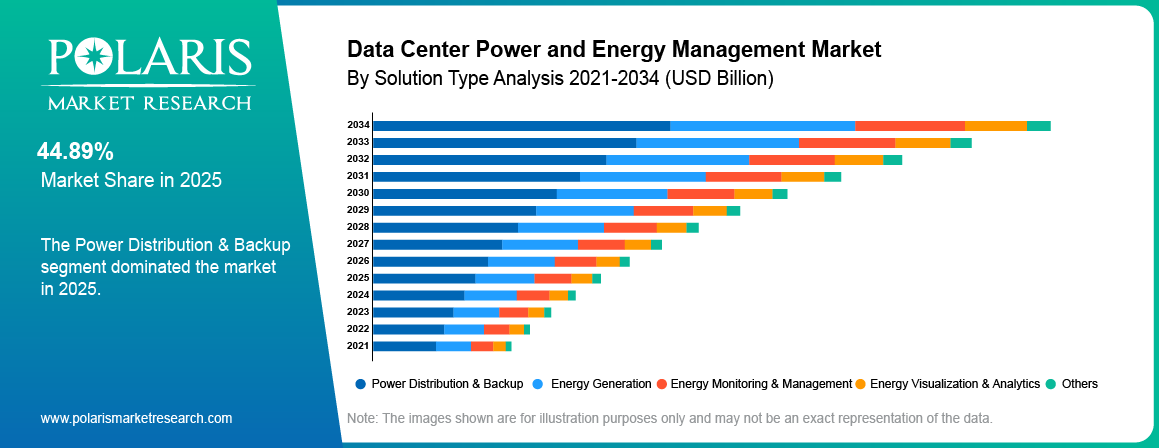
The data center power and energy management market by region is segmented into North America, Europe, Asia Pacific, the Middle East & Africa, and Latin America.
North America Data Center Power and Energy Management Market Trends
In 2025, North America accounted for the largest share of 38.58%. The regional market was valued at USD 13,870.0 million in 2025 and is projected to grow at a CAGR of 12.0% during 2026 to 2034. Electricity consumption is increasing due to the rise of AI, cloud, and large-scale data centers. The limited power infrastructure is compelling players to adopt onsite power and batteries, as well as renewable energy. Additionally, data centers are further turning to smart power management systems that offer complete visibility and control of energy consumption and optimize it. Moreover, the demand for modular data centers and strategic power planning is also fueling the market's growth in the region. The 2025 Update on U.S. Data Center Energy Usage by the U.S. Department of Energy, released in 2026, predicts that total electricity consumption by the data centers across the U.S. can climb to about 464 TWh by 2028 and 649 TWh by 2030. The report also predicts that data centers will account for 11.8% of total U.S. electricity by 2030 (Source: energy.gov). This increase in demand is prompting utilities and operators to maximize power efficiency. Also, operators are increasingly adopting AI-powered energy management solutions, automated power-distribution systems, smart metering, battery storage, renewable-energy integration, and demand-response solutions to reduce costs of operation.
Europe Data Center Power and Energy Management Market Trends
The market in Europe is expected to record a 12.3% CAGR over the forecast period due to rising demand for artificial intelligence (AI), cloud services, and overall digital infrastructure growth. The European the market is projected to reach USD 27,748.7 million by 2034. The energy efficiency regulations are driving industry players toward adopting smart power systems, batteries, and renewable energy, as well as implementing energy monitoring solutions. Additionally, grid capacity constraints are compelling colocation providers to adopt alternative solutions and designs, making expansion more favorable across regions. The EU Commission’s Energy Efficiency Directive prescribes that eligible data centers shall measure and report to a European database on energy performance and water footprint indicators. In April 2026, the European Commission published aggregated results from mandatory data center reporting, covering 776 facilities in 18 member states with a weighted average PUE of 1.36. (Source: datacenterdynamics.com). The data center industry's increasing focus on energy efficiency, sustainability, and transparency around energy use further drives the power and energy management market in Europe.
Asia Pacific Data Center Power and Energy Management Market Trends
The Asia Pacific market is expected to witness a significant CAGR of 14.6% during the forecast period due to the increasing need for artificial intelligence, cloud services, and other digital technologies. Asia Pacific market is projected to reach USD 30,200.2 million by 2034. Regional expansion of data centers is driven by China, India, Japan, Australia, as well as several other countries. There is a rise in the demand for uninterruptible power supplies (UPS), batteries, smart power distribution, and other products, due to the growing need for power infrastructure and energy management solutions. In addition, limited grid capacity drives the adoption of onsite power and renewable energy sources in the region, thereby driving the industry growth.
Latin America Data Center Power and Energy Management Market Trends
Latin America market is projected to witness a significant CAGR of 13.4% during the forecast period. The regional market growth is driven by the growth of cloud computing, artificial intelligence, and digital services. A surge in the demand for data centers is witnessed due to the rising investments in renewable energy. Moreover, the region has abundant solar, wind, and hydro resources that are utilized efficiently to harness electricity. The limitation in grid capacity has increased the need for battery storage and power sources as backup. The rising demand for hyperscale data centers is further fueling the demand for electricity. Increasing efforts for improving energy efficiency and adopting smart technologies and supportive government policies are further fueling the growth in the region.
Middle East & Africa Data Center Power and Energy Management Market Trends
The data center power and energy management industry in the Middle East and Africa is expected to witness significant growth of CAGR 13.6% during the forecast period due to increased investment in artificial intelligence, cloud services, and digital infrastructure. The region’s countries such as Saudi Arabia and UAE are investing in large data centers, which are increasing the need for power systems, batteries, backup power, and energy management systems. Additionally, high temperatures in the region fuel the demand for energy-efficient equipment. High solar energy potential is a key factor in renewable energy adoption in the Middle East and Africa. Unreliable electric power grids drive the demand for power backup and on-site power in Africa, which is expected to boost the market during the forecast period.
Data Center Power and Energy Management Market Competitive Landscape
Vendor Landscape
| Company | Headquarters | Market Position | Core Offering | Strategic Focus |
| Schneider Electric SE | Paris, France | Market Leader | UPS, switchgear, cooling, DCIM software | Integrated AI ready reference designs |
| Vertiv Holdings Co. | Westerville, U.S. | Market Leader | UPS, busway, PDUs, thermal, services | High density AI and microgrid power |
| Eaton Corporation plc | Dublin, Ireland | Market Leader | UPS, switchgear, busway, power quality | Grid to rack electrical architecture |
| ABB Ltd. | Zurich, Switzerland | Established Player | Medium voltage, UPS, DC distribution | DC architectures for AI sites |
| Siemens AG | Munich, Germany | Established Player | Electrical distribution, building and energy software | Digital twin driven design |
| Delta Electronics, Inc. | Taipei, Taiwan | Established Player | Rack power, UPS, power supplies | High efficiency rack and server power |
| Huawei Digital Power Technologies Co., Ltd. | Shenzhen, China | Established Player | Modular UPS, prefabricated data centers, storage | Cost competitive integrated power |
| Hitachi Energy Ltd. | Zurich, Switzerland | Established Player | Transformers, HVDC, grid automation | Grid connection for large campuses |
| Legrand SA | Limoges, France | Established Player | Busway, intelligent PDUs | Rack level power distribution |
| Cummins Inc. | Columbus, U.S. | Backup Power Leader | Generator sets, controls, battery storage | Standby power and microgrids |
| Caterpillar Inc. | Irving, U.S. | Backup Power Leader | Generator sets, gas turbines | Large scale prime and standby power |
| Generac Holdings Inc. | Waukesha, U.S. | Emerging Challenger | Backup generators, switchgear | Expansion into data center power |
| Bloom Energy Corporation | San Jose, U.S. | Emerging Challenger | Fuel cell systems | Onsite power for AI campuses |
| GE Vernova Inc. | Cambridge, U.S. | Specialist | Gas turbines, electrification | Fast deployment onsite power |
| Rolls-Royce (mtu) | Friedrichshafen, Germany | Specialist | High speed gensets and engines | High reliability backup power |
Source: Company filings, company press releases and Polaris Market Research Analysis
The data center energy and power management market contains a diverse group of diversified electrical equipment manufacturers, data center infrastructure, power management providers, and engine-generator manufacturers. They can be grouped based on the main products that the companies offer, their technological capabilities, and the presence in the data center power infrastructure segment.
Schneider Electric SE, Vertiv Holdings Co., and Eaton Corporation plc can be grouped as the main providers of data center power and infrastructure. The companies offer a wide range of products from uninterruptible power supplies (UPS), power distribution, and monitoring, cooling infrastructure, power management software, and integrated data center solutions.
ABB Ltd. and Siemens AG can be grouped as diversified electrical and automation providers. The companies can provide electrical distribution, switchgear, power monitoring, automation solutions, and digital energy-management technologies for data centers.
Huawei Digital Power Technologies Co., Ltd., Delta Electronics, Inc., and Hitachi Energy Ltd. can be grouped as digital power and advanced energy infrastructure providers. The companies offer power conversion, energy storage, electrical distribution, monitoring, and digitally managed power infrastructure.
Cummins Inc., Caterpillar Inc., Rolls-Royce Power Systems AG, and GE Vernova Inc. can be grouped as providers of power generation and backup-power solutions. The companies can offer a variety of products from generator sets, engines, and distributed power systems that ensure uninterrupted power supply for data centers.
Legrand SA can be grouped with data center power and infrastructure providers for its busway, intelligent PDU and rack power products. Generac Holdings Inc. and Bloom Energy Corporation can be grouped as onsite and backup power providers. Generac supplies backup generators and, following its February 2026 agreement to acquire Enercon, switchgear and enclosures, while Bloom Energy supplies fuel cell systems for onsite power.
Key Players in the Data Center Power and Energy Management Market
-
ABB Ltd.
-
Bloom Energy Corporation
-
Caterpillar Inc.
-
Cummins Inc.
-
GE Vernova Inc.
-
Generac Holdings Inc.
-
Hitachi Energy Ltd.
-
Huawei Digital Power Technologies Co., Ltd.
-
Legrand SA
-
Rolls-Royce Power Systems AG
-
Schneider Electric SE
-
Siemens AG
-
Vertiv Holdings Co.
Industry Developments
-
October 2026: ABB introduced its Infinitus DC Portfolio for next generation AI data centers, covering medium voltage powertrains, DC sources and power quality, DC power distribution, DC power protection and cooling optimization. ABB says the design delivers efficiency gains of more than 5%. (Source: abb.com)
-
September 2026: Schneider Electric unveiled its Software-Defined Medium Voltage switchgear portfolio and RM AirSeT 38 at Yotta 2026. The company also highlighted Galaxy VXL, a high-density modular UPS designed for AI-ready data centers, supporting scalable power infrastructure, energy efficiency, and operational resilience. (Source: se.com)
-
September 2026: Schneider Electric and AMD collaborated to simplify AI data center deployment by creating a validated reference design for AMD Helios rackscale systems. The design supported rack densities up to 246 kW and addressed power, cooling, resilience, and deployment challenges. (Source: datacenterdynamics.com)
-
September 2026: Vertiv announced an agreement to acquire UtilityInnovation Group for approximately $1.45 billion. The deal will expand its microgrid controls, onsite generation and behind-the-meter power capabilities. The acquisition aims to help data center operators accelerate power availability and support AI infrastructure deployment amid growing grid constraints. (Source: vertiv.com)
-
August 2026: Cummins announced its largest-ever battery storage system for a U.S. data center project. The system helps manage rapid AI-driven power fluctuations, stabilize electricity supply, prevent outages during peak demand, and provide operators with greater flexibility to scale power capacity as data center requirements increase. (Source: cummins.com)
-
April 2026: Bloom Energy and Oracle expanded their partnership to deploy up to 2.8 GW of fuel cell systems, with an initial 1.2 GW contracted. (Source: bloomenergy.com)
-
February 2026: Generac signed an agreement to acquire Enercon, a maker of switchgear, power distribution and generator enclosures, to expand in data center and switchgear markets. (Source: prnewswire.com)
Investment and Deal Activity
| Date | Companies | Type | Value | Relevance |
| October 2026 | Infineon Technologies, C2i Semiconductors | Acquisition completed | NA | Power delivery chips for AI data centers |
| September 2026 | Schneider Electric, AMD | Collaboration | NA | Reference design for racks up to 246 kW |
| September 2026 | Vertiv, UtilityInnovation Group | Acquisition | USD 1.45 billion plus up to USD 1.15 billion earnout | Microgrid controls and behind the meter power |
| August 2026 | Cummins, U.S. data center customer | Supply contract | 5 MWh system, value undisclosed | Battery storage for AI load swings |
| June 2026 | Bloom Energy, Brookfield | Partnership expansion | Increased to USD 25 billion from USD 5 billion | Financing for onsite power at AI sites |
| April 2026 | Bloom Energy, Oracle | Supply agreement | Up to 2.8 GW, 1.2 GW contracted | Onsite fuel cell power |
| February 2026 | Generac, Enercon | Acquisition | NA | Switchgear and enclosures for data centers |
| November 2025 | Eaton, Boyd Thermal | Acquisition | USD 9.5 billion | Liquid cooling combined with power |
| August 2025 | Vertiv, Great Lakes Data Racks & Cabinets | Acquisition completed | About USD 200 million | Racks and integrated cabinets |
| July 2025 | Eaton, Resilient Power Systems | Acquisition | NA | Solid state transformer technology |
| June 2025 | Eaton, Siemens Energy | Partnership | 500 MW standard configuration | Integrated onsite power for data centers |
| March 2025 | Eaton, Fibrebond | Acquisition | USD 1.4 billion | Modular power enclosures |
Source: Company press releases and Polaris Market Research Analysis
Data Center Power and Energy Management Market Technology and Innovation Landscape
Technology development in the data center power and energy management market is moving along three lines. Power equipment is being redesigned for higher density, with modular UPS frames reaching 1.25 MW and software defined medium voltage switchgear moving to order intake in 2027. Direct current distribution is the second line, as suppliers such as ABB bring DC portfolios, covering medium voltage powertrains through DC protection, to market for AI facilities. The third line is onsite power, where battery storage, fuel cells and microgrid controls help operators energize capacity ahead of grid connections. Software and AI driven control tie these layers together by predicting equipment faults and managing load. The table below lists the main technologies, the companies developing them and their commercial status.
| Technology | Leading Developers | Role in Data Center Power | Commercial Status |
| Software Defined MV Switchgear | Schneider Electric | Faster grid connection for AI sites | Orders from 2027, deliveries from 2028 |
| Modular High Density UPS | Schneider Electric, Vertiv | Up to 1.25 MW per frame | Commercial |
| HVDC Power Architecture | ABB, Eaton, Delta Electronics | Fewer conversion stages | Early deployment |
| Battery Storage for Load Smoothing | Cummins | Manages AI load swings | Commercial |
| Onsite Fuel Cells | Bloom Energy | Bridges grid constraints | Early deployment |
| Fast Start Gas Generator Sets | Rolls-Royce (mtu), Generac | Backup and bridging power | Commercial |
| Microgrid Controls | Vertiv, Cummins | Behind the meter power management | Deal pending |
| AI Driven Power Management | Schneider Electric, Vertiv, Legrand | Predictive control and monitoring | Commercial |
Source: Company press releases and Polaris Market Research Analysis
Data Center Power and Energy Management Market Future Outlook
The data center power and energy management market is expected to grow in the coming years. Expansion of AI, cloud computing, and digital services will boost the market growth. Data centers will need more reliable and efficient power systems. The use of renewable energy, battery storage, and microgrids is likely to increase. Smart energy management systems will help reduce power waste and costs. Operators will also focus more on sustainability and lower emissions. Rising rack power and grid limits will further support demand for advanced UPS, power distribution, monitoring, and energy management solutions.
Data Center Power and Energy Management Market Segmentation
By Solution Type Outlook (Revenue – USD Billion, 2021 to 2034)
- Power Distribution & Backup
- Energy Generation
- Conventional Power Generation
- Renewable Power Generation
- Fuel Cell-based Generation
- Others
- Energy Monitoring & Management
- Energy Monitoring Systems
- Energy Management Systems
- Power Quality Monitoring
- Others
- Energy Visualization & Analytics
- Real-time Energy Dashboards
- Energy Consumption & Load Visualization
- PUE & Efficiency Monitoring
- Others
- Others
By Data Center Type Outlook (Revenue – USD Billion, 2021 to 2034)
- Hyperscale Data Centers
- Colocation Data Centers
- Enterprise Data Centers
- Others
By Data Center Size Outlook (Revenue – USD Billion, 2021 to 2034)
- Mega Data Centers
- Large Data Centers
- Medium Data Centers
- Small Data Centers
- Others
By End User Outlook (Revenue – USD Billion, 2021 to 2034)
- IT & Telecom
- BFSI
- Government & Public Sector
- Healthcare
- Others
By Regional Outlook (Revenue – USD Billion, 2021 to 2034)
- North America
- U.S.
- Canada
- Europe
- Germany
- France
- UK
- Italy
- Spain
- Netherlands
- Russia
- Rest of Europe
- Asia Pacific
- China
- Japan
- India
- Malaysia
- South Korea
- Indonesia
- Australia
- Vietnam
- Rest of Asia Pacific
- Middle East & Africa
- Saudi Arabia
- UAE
- Israel
- South Africa
- Rest of the Middle East & Africa
- Latin America
- Mexico
- Brazil
- Argentina
- Rest of Latin America
Data Center Power and Energy Management Market Report Scope
| Report Attributes | Details |
| Market size in 2025 | USD 35.95 billion |
| Market size in 2026 | USD 40.47 billion |
| Revenue forecast in 2034 | USD 107.06 billion |
| CAGR | 12.9% from 2026 – 2034 |
| Base year | 2025 |
| Historical data | 2021 – 2024 |
| Forecast period | 2026 – 2034 |
| Quantitative units | Revenue in USD billion and CAGR from 2026 to 2034 |
| Segments Covered |
|
| Regional scope |
|
| Competitive Landscape |
|
| Report Format |
|
| Customization | Report customization as per your requirements with respect to countries, region, and segmentation |
Source: Polaris Market Research Analysis
Data Center Power and Energy Management Market Research Methodology
The Data Center Power and Energy Management Market study follows the Polaris Market Research structured seven step research process. It combines secondary research, primary validation and a dual estimation model so that the final figures can be traced back to evidence. The study covers 2021 to 2024 as the historical period, 2025 as the base year and 2026 to 2034 as the forecast period. All values are in USD million unless stated otherwise.
Step 1: Project Setup
The analyst team first defined the scope of the market. The study covers equipment, software and services that supply, distribute, back up, generate, monitor and analyze electricity at data center sites. The market was divided into five segmentation lenses: solution type, data center type, data center size, end user and region. Solution type was further divided into power distribution and backup, energy generation, energy monitoring and management, energy visualization and analytics, and others. Definitions, segment boundaries and the forecast horizon were fixed at this stage so that every later estimate uses the same scope.
Step 2: Data Collection
Data collection started with secondary research. The team reviewed company annual reports, investor presentations, regulatory filings, government energy publications, industry association data, trade journals and paid databases. These sources established the market structure, product portfolios, pricing, recent developments and data center capacity trends. Primary research followed. Analysts interviewed [number] industry participants, including power and energy equipment manufacturers, data center operators, colocation providers, engineering consultants and energy management software vendors. The interviews validated secondary findings, filled data gaps and tested growth assumptions.
Step 3: Data Structuring
All collected data was cleaned, normalized and organized by segment and region in the Polaris internal database. Figures from different sources were converted to a common currency and base year. Where sources disagreed, the team reconciled them against company disclosures and interview feedback. The variance in the structured data was kept within the Polaris set tolerance.
Step 4: Top-Down Estimation
The top-down approach estimated the overall market from global data center capacity and the power and energy spending per unit of capacity. Capacity additions by data center type and size, rack power density trends and electricity cost trends were the main inputs. The resulting global figure was then allocated to regions and segments.
Step 5: Bottom-Up Estimation
The bottom-up approach built the market from company level data. Revenue, product pricing and shipment estimates were compiled for [number] companies across power distribution and backup, onsite generation, energy monitoring and analytics. These figures were aggregated by solution type and region, with penetration assumptions applied to each data center type and size.
Step 6: Forecasting
The forecast for 2026 to 2034 uses segment wise growth models. These account for rack power density growth, hyperscale and colocation capacity additions, grid connection constraints that drive onsite generation and storage, electricity cost trends, and energy efficiency regulation. Key assumptions were tested under alternative scenarios to check how sensitive each segment is to changes in capacity additions and power costs.
Step 7: Validation and Quality Check
The top-down and bottom-up results were reconciled, and any gap beyond the set tolerance was resolved through additional primary validation. The team confirmed that segment values add up to the global total, that regional values add up to the global total, and that the CAGRs are consistent with the yearly values. Senior analysts reviewed the final output before release.
| Research Parameter | Approach in This Study |
| Historical Period | 2021 to 2024 |
| Base Year | 2025 |
| Forecast Period | 2026 to 2034 |
| Segmentation Lenses | Solution type, data center type, data center size, end user, region |
| Geographic Coverage | North America, Europe, Asia Pacific, Middle East & Africa, Latin America |
| Secondary Sources | Company filings, annual reports, government and regulatory publications, trade journals, paid databases |
| Primary Validation | 28 interviews with manufacturers, operators, consultants and software vendors |
| Estimation Method | Top down and bottom up, triangulated |
| Quality Check | Segment and regional totals reconciled to the global total, senior analyst review |
| Output | Market size and forecast in USD million, charts and Excel files |
Source: Polaris Market Research Analysis
Data Center Power and Energy Management Market FAQ's
The market was valued at USD 35.95 billion in 2025 and is projected to reach USD 107.06 billion by 2034. It is expected to add about USD 71.1 billion in revenue over that period.
The market is expected to grow at a CAGR of 12.9% from 2026 to 2034. Growth is driven by AI rack density, onsite power and smart energy management.
It covers the equipment, software and services that supply, distribute, back up and monitor electricity inside a data center. This includes UPS systems, PDUs, switchgear, batteries, generators and energy monitoring tools.
North America held the largest share of 38.58% in 2025, valued at USD 13,870.0 Billion. Asia Pacific is the fastest growing region, with a CAGR of 14.6% from 2026 to 2034.
Power distribution and backup held the largest share of 44.89% in 2025. Energy generation is the fastest growing segment, at a CAGR of 13.5%.
Rising rack power density from AI and high performance computing is the main driver. Adoption of smart energy management and distributed power systems adds further demand.
High upfront cost and the complexity of upgrading existing facilities limit adoption. Grid capacity limits and cybersecurity risks in connected power equipment add further pressure.
Schneider Electric SE, Vertiv Holdings Co. and Eaton Corporation plc lead the market. ABB Ltd., Siemens AG, Delta Electronics, Inc. and Hitachi Energy Ltd. are other major participants.
The U.S. Department of Energy projects 649 TWh in its reference case, about 11.8% of U.S. electricity. Its scenarios range from 9.5% to 15.3%.
Power usage effectiveness compares total facility energy with IT energy, so a lower figure means less wasted power. Europe's mandatory reporting has recorded a weighted average of 1.36.
Download Sample Report of Data Center Power and Energy Management Market
Please fill out the form to request a customized copy of the research report.


