
800 VDC Data Center Power Architecture Market Size, Share, Trends & Forecast, 2026–2034
REPORT DETAILS
800 VDC Data Center Power Architecture Market Summary
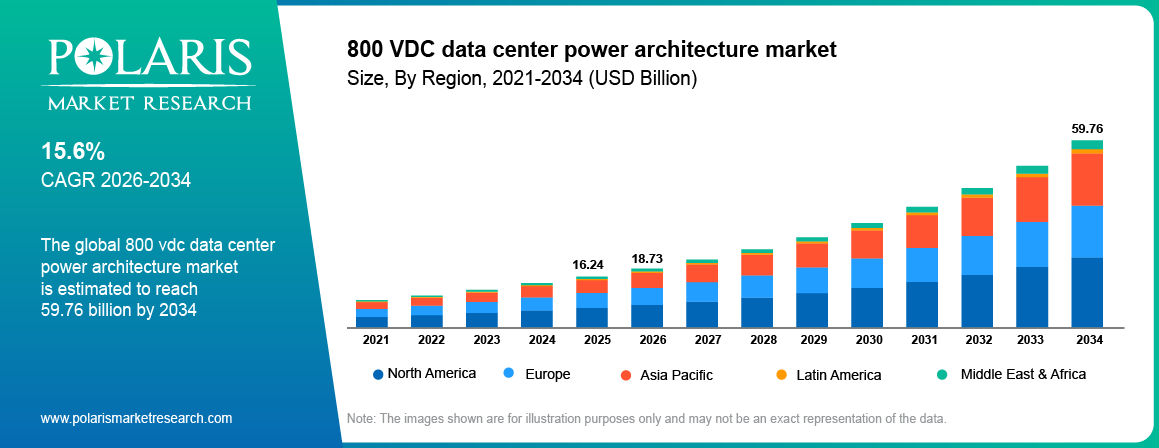
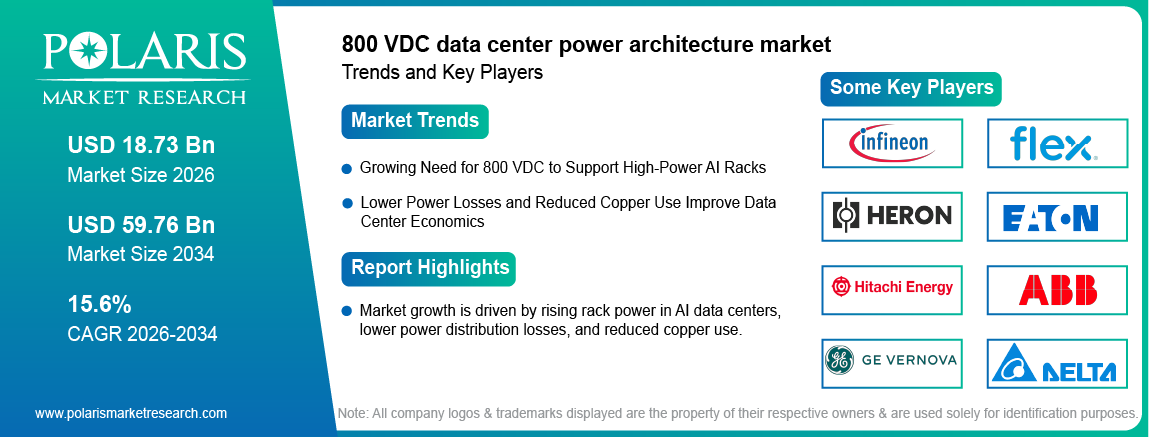
The global 800 VDC data center power architecture market was valued at USD 16.24 billion in 2025, growing at a CAGR of 15.6% during 2026–2034. Market growth is driven by rising rack power in AI data centers, lower power distribution losses, and reduced copper use.
Market Statistics
800 VDC Data Center Power Architecture Market Key Takeaways
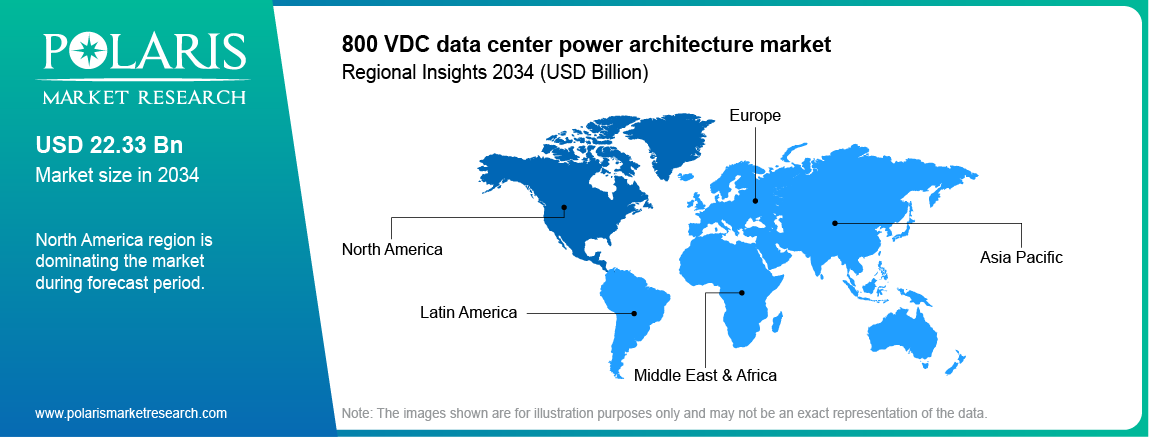
- North America dominated with USD 6.22 bn in 2025, due to its concentration of AI infrastructure investment and hyperscale operators.
- The market in Asia Pacific is expected to register a CAGR of 16.7% during the forecast period. It is driven by the rapid data center expansion and rising demand for AI and cloud services.
- Europe is expected to witness a CAGR of 15.0% during the forecast period. This is fueled by the rising focus on energy efficiency, renewable power, and sustainable data center operations.
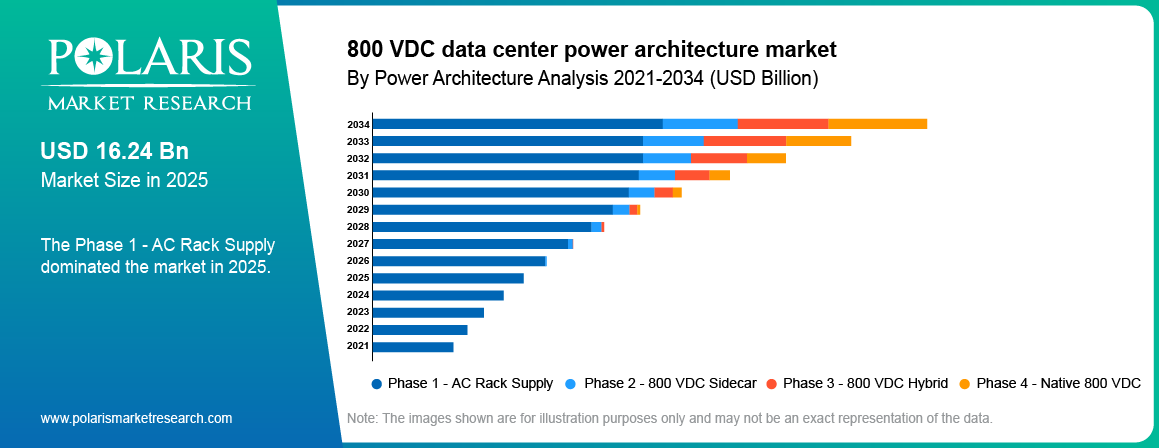
- The Phase 1 – AC rack supply segment accounted for USD 16.24 billion revenue in 2025. The dominance is attributed to the industry's tendency to utilize established AC-based power systems.
- The conversion from 800 VDC to 50/54 V segment is expected to value at USD 4.18 bn in 2026. Rising need to utilize high-power density power supplies in AI servers and data centers drives the segment growth.
Note: Figures and projections outlined in this report are the result of Polaris Market Research’s proprietary analytical processes, grounded in the latest available datasets and market observations.
What is 800 VDC Data Center Power Architecture?
The 800 VDC data center power architecture market includes the equipment that transports electricity from a medium-voltage grid connection to the processor in an AI or hyperscale data center. This includes the switching and conversion components needed to adapt the rack supply from alternating current (AC) to 800 volts of direct current (VDC). The market comprises the traditional AC rack supply base, the 800 VDC sidecar, hybrid and native architectures, the medium-voltage conversion layer, and the downstream converters. This excludes the generators, utility transformers, cooling plant, and the servers which belong to the wider AI data center market. Data centers are transitioning to 800 VDC as racks drawing a megawatt cannot be effectively served by 54 VDC distribution. The architecture is also described as high voltage direct current (HVDC) distribution. NVIDIA's reference design converts 13.8 kV AC grid power to 800 VDC at the data center perimeter.
A solid-state transformer is a power electronics stack that replaces a conventional transformer and rectifier lineup. Siemens and Reinhausen announced one in August 2026 designed to connect grids of up to 36kV directly to an 800 VDC bus. A sidecar is a dedicated side power rack that converts existing 480VAC to plus or minus 400VDC or 0 to 800VDC next to the compute racks. A hybrid design runs both supplies inside one facility, and a native design takes medium voltage straight to 800VDC which NVIDIA's work with the Open Compute Project supports as direct MV AC to 800VDC designs for future AI factories.
Comparison Matrix: Sidecar vs Native 800 VDC
| Parameter | Sidecar 800 VDC | Native 800 VDC |
| Definition | A dedicated power cabinet or rack placed adjacent to the IT rack. It receives facility AC power and converts it to 800 VDC before feeding the compute rack. | An end-to-end high-voltage DC architecture in which the facility, data hall, and IT rack are designed to receive and distribute 800 VDC directly. |
| Where AC-to-DC conversion occurs | At the sidecar, close to the rack. | Upstream at the facility, pod, or data-hall power block, typically using a rectifier or solid-state transformer (SST). |
| Power path | Utility/grid → existing AC distribution → sidecar AC/DC conversion → 800 VDC busbar → compute rack. | Utility/grid → medium-voltage power block/SST → 800 VDC facility busway → native 800 VDC rack → onboard DC/DC conversion → GPU. |
| Deployment speed | Fast; suitable for brownfield retrofits and phased AI expansion without rebuilding the facility power system. | Slower; best suited to greenfield AI factories or major facility upgrades where DC-ready infrastructure can be designed from the outset. |
| Best-fit facilities | Brownfield data centers, colocation providers, mixed-workload sites, and operators adding high-density AI racks to existing AC facilities. | Greenfield AI factories, hyperscale campuses, and facilities designed for 600 kW to 1 MW+ racks with homogeneous AI workloads. |
| Best-fit rack density | Practical for high-density AI racks, especially where existing AC infrastructure must be retained. | Most compelling for 600 kW to 1 MW+ racks, where conventional AC and 48/54 VDC distribution become physically impractical. |
| Main advantage | Fast, lower-risk path to 800 VDC while preserving existing AC investment. | Highest efficiency, density, scalability, and long-term architectural simplicity. |
| Main limitation | Duplicates some conversion equipment and may become stranded as facilities centralize DC power. | Higher upfront complexity, immature standards, supply-chain constraints, and more demanding safety and protection requirements. |
| Market role | Transitional and near-term deployment architecture, expected to dominate early 800 VDC adoption. | Long-term target architecture for purpose-built AI factories, with adoption expected to scale from around 2029 onward. |
Source: Polaris Market Research Analysis.
How Does Data Center Power Architecture and 800 VDC Work?
Data center power architecture is the system that supplies, controls, and distributes electricity to servers and other equipment. Power first enters the data center and is converted into the required voltage levels. In an 800 VDC system, electricity is supplied at around 800 volts in direct current form. This helps reduce power losses during distribution and can improve overall efficiency. The system also works with batteries, power converters, and backup systems to provide a stable and reliable power supply to data center equipment.
Why Data Centers are Moving to 800 VDC?
AI factories are pushing rack power toward the megawatt level, and conventional distribution cannot carry that load efficiently. Enverus Intelligence Research estimates that 800 VDC can reduce electrical capex by 13%, lift end to end facility efficiency from 79.8% to 93.8%, and reduce copper mass by up to 60% per MW compared with 415 VAC (Source: enverus.com). Higher rack power also raises cooling needs, which links power design to liquid cooling in new AI halls.
Market Dynamics
Driver Impact Analysis
| Market Driver | Geographic Relevance | Impact Timeline |
| Growing Need for 800 VDC to Support High-Power AI Racks | North America, Asia Pacific | Active; MGX 800 VDC rack H2 2026, Kyber 2027 |
| Lower Power Losses and Reduced Copper Use | Global | Ongoing through 2034 |
| Faster, More Efficient Solid-State Transformers | North America, Europe, Asia Pacific | Medium term; ABB components within 12 months |
| Brownfield Retrofits and Sidecar Power Racks | North America, Asia Pacific | Near term; first revenue 2026 |
Source: Company announcements, NVIDIA, Enverus, and Polaris Market Research Analysis
Driver: Growing Need for 800 VDC to Support High-Power AI Racks
The rapid development of AI and high-performance computing is driving up the power needs of each data center rack. NVIDIA has stated that powering its Kyber rack with a 54 VDC system at the level of megawatts would require power shelves to take up to 64U of rack space, leaving little room for computing equipment. This makes higher-voltage power distribution, such as 800 VDC, more suitable to future high-power AI data centers. NVIDIA has also demonstrated an 800 V sidecar for its next generation of GPU systems.
NVIDIA is planning to scale 800 VDC systems into production with its Kyber platform in 2027. The company expects the architecture to reduce overall ownership costs by up to 30% by virtue of improved efficiency, reliability, and a simpler power design. Approximately 20 companies have joined NVIDIA's 800 VDC initiative at the Open Compute Project Global Summit in October 2025. Foxconn's 40 MW Kaohsiung-1 data center in Taiwan is already using 800 VDC technology. (Source: nvidia.com)
The supporting industry is also ramping up around this change. Vertiv scheduled its 800 VDC portfolio for the second half of 2026 to support the 2027 launch of NVIDIA's Rubin Ultra platforms. The company is already working on a number of large AI data center projects using this architecture. This creates a clear market timeline, with early deployments using sidecar power systems followed by widespread adoption of 800 VDC throughout entire data center facilities. (Source: prnewswire.com)
The move to 800 VDC also involves a growing ecosystem of suppliers. NVIDIA has identified companies such as Infineon, STMicroelectronics, Texas Instruments, Delta, Flex Power, Eaton, Schneider Electric, and Vertiv as part of the wider ecosystem. By October 2025, the ecosystem had expanded to include ABB, GE Vernova, Heron Power, Hitachi Energy, Mitsubishi Electric, and Siemens. This broad supplier base is a testament to 800 VDC as an integrated power system rather than a single product.
The change can affect a number of aspects of a data center, such as power equipment, cables, connectors, protection systems, and monitoring equipment. As AI racks continue to require more power and the limitations of current systems become more apparent, the need for higher-voltage power distribution rises, thereby driving the growth.
Driver: Lower Power Losses and Reduced Copper Use Improve Data Center Economics
The rising need for energy efficiency is driving the data center power architecture and 800 VDC market growth. Data center operators worldwide are looking to cut down the electricity consumption and costs that come with higher power demands. Power distribution systems can account for a big portion of energy loss, especially in large-scale data centers that require extremely high electricity needs. The 800 VDC architecture offers better power distribution with minimized losses. This system further reduces the complexity and the size of power conversion systems in some cases. As organizations are focusing on making their data centers more energy efficient and reduce costs, the demand for 800 VDC is expected to grow, thereby driving the 800 VDC data center power architecture market growth.
The demand from large-scale data centers for artificial intelligence (AI) racks is increasing. Moreover, the higher voltage would enable data centers to transmit the same amount of power using less copper. According to Navitas, the conductor thickness could be lower by up to 45%, as higher voltages allow a smaller current for the same power level, thus minimizing losses. The lower losses would be especially beneficial for data centers as they scale their power consumption to the level of megawatts. The rising demand for power efficiency is driven by the increase in power consumption. NVIDIA’s philosophy of bringing power closer to the GPU also aims to reduce the number of power conversion stages and, therefore, decrease power losses. These factors add to the rising importance of power efficiency, which is crucial for the adoption of 800 VDC infrastructure.
Restraint: Standards Development and Regulatory Scrutiny for 800 VDC
Standards development and regulatory scrutiny constitute a restraint to the 800 VDC data center market growth. Current safety standards are inadequate to the task of ensuring the safety of personnel working on high-voltage DC. The NFPA 70E standard does not include recommendations for protective equipment for working on 600-1,000 VDC circuits, and the IEEE 1584 standard does not address DC arc flash at all. Meanwhile, broader adoption of 800 VDC is not expected for years, requiring initial installations to undergo a prolonged regulatory approval process.
Adopting agencies and utilities have limited experience with 800 VDC, and UL Solutions has initiated a research program to create appropriate safety models. However, certification of some critical equipment, including data center solid-state transformers, is still pending. According to Schneider Electric’s 2026 arc flash study, 800 VDC hazards can be controlled and are generally comparable to those of AC at similar voltages, but the firm also notes the absence of a comprehensive standard for converter-based 800 VDC.
The lack of settled standards creates technical and regulatory challenges on both sides of the 800 VDC debate. Google, Meta, and Microsoft are promoting a ±400 VDC architecture, while NVIDIA is advocating for 800 VDC. However, in August 2026, Google, Microsoft, and NVIDIA, joined by more than 80 other companies within the Open Compute Project, announced their intention to collaborate on standardized 800 VDC electrical infrastructure specifications. While the data center power architecture and 800 VDC market is expected to benefit from the growing consensus, the technical details of the ongoing standardization effort may impact the ability of data center operators to adopt any particular solution (Source: opencompute.org).
Development of 800 VDC data center standards is currently taking place at the level of circuit breakers, transformers, switchgear, and rack distribution units, with little consideration for the unique needs of data centers. These factors add extra costs and complexity to the selection process and delay the time-to-value for 800 VDC data centers. Until the regulatory environment catches up with the innovation taking place in data center infrastructure, the additional safety and design considerations are expected to restrain the 800 VDC market growth.
Restraint: High Initial Investments and System Upgrade Costs
Adoption of 800 VDC systems incurs a high initial cost which may limit its penetration in the data center power architecture and 800 VDC market. This is mainly because data centers need to make significant changes to their existing infrastructure which include upgrading power converters, power distribution systems, protective relays, cabling, and backup systems. Moreover, the system requires system upgrades that are very expensive especially to centers that were using AC power system. This is why most data center operators are hesitant to adopt the technology, thereby restraining the industry growth.
Opportunity: Rising AI Power Demand Creates a Need for Faster and More Efficient Solid-State Transformers
Expansion of AI data centers is creating an opportunity for solid-state transformers (SSTs) as operators look to deliver greater amounts of power in reduced space, with less energy loss. Traditional power systems involve multiple conversion steps that can increase losses and use up more space. Solid-state transformers can cut down on these conversion steps and create a more direct link from the grid to 800 VDC systems. This is becoming increasingly important for high density AI data centers that want to deliver higher power, improved efficiency and faster deployment.
ABB introduced Infinitus on September 21, 2026, stating that it was the first integrated source-to-rack DC portfolio, with a solid-state transformer at its heart. ABB also noted that the portfolio included its fully IEC-certified solid-state circuit breaker (Source: abb.com). Eaton's MVSST 2.0 platform is also being developed for 800 VDC data center applications, while Infineon will supply silicon carbide devices for the platform under an agreement announced on September 29, 2026.
The opportunity is also supported by increased investment. Siemens and Reinhausen announced a modular transformer for grids up to 36 kV in August 2026, while Heron Power raised USD 140 million in a Series B round on February 18, 2026 (Source: powerelectronicsnews.com). The Open Compute Project also circulated version 0.3 of its Solid State Transformer specification in 2026, with contributions from Microsoft, Google, NVIDIA, and other industry participants.
Opportunity: Brownfield Retrofits Create a Near Term Market for 800 VDC Sidecar Power Racks
Most operating AI data centers were designed around AC distribution, which creates demand for retrofit solutions that add 800 VDC capability without rebuilding the facility. NVIDIA's MGX compatible 800 VDC power rack, arriving in the second half of 2026, is designed as a hybrid architecture for facilities that are already built and operational (Source: nvidia.com). For new AI factory campuses, NVIDIA expects row power centers of up to 2 megawatts per row in 2027. Sidecar systems represent the first revenue-generating phase of 800 VDC adoption.
Use Case Analysis
| Use Case | Named Companies / Platforms | Application Rationale |
| NVIDIA-based AI training clusters | NVIDIA Kyber, Rubin Ultra, MGX, and future Rubin systems | Primary demand driver as GPU rack power moves toward 600 kW and 1 MW-class levels. |
| AI cloud and neocloud facilities | CoreWeave, Lambda, Nebius, Oracle Cloud Infrastructure, and Together AI | These providers are preparing facilities for high-density AI infrastructure and higher-voltage power systems. |
| Hyperscale AI factories | Microsoft, Google, Meta, Amazon, and NVIDIA ecosystem partners | Suitable for greenfield campuses where grid conversion, storage, busways, cooling, and rack layouts can be designed together. |
| Greenfield sovereign AI campuses | ABB, Eaton, Schneider Electric, Siemens, Vertiv, and Hitachi Energy | Enables new facilities to adopt direct medium-voltage-to-DC conversion, high-density busways, and integrated storage. |
| Brownfield AI retrofits | Vertiv sidecar systems, Schneider Electric/APC sidecars, Eaton hybrid AC/DC systems, and Delta power racks | Adds 800 VDC capability to existing AC facilities while retaining some upstream electrical assets. |
| Large-scale GPU rack deployment | NVIDIA Kyber NVL576, designed for up to 576 Rubin Ultra GPUs | Represents a major use case for moving power conversion outside the compute rack and distributing high-voltage DC directly to the rack. |
| AI data-center demonstration site | Foxconn / Hon Hai Kaohsiung-1, Taiwan | A 40 MW AI data-center project associated with NVIDIA’s 800 VDC architecture, AI servers, and renewable-energy integration. |
| HPC and scientific computing | NVIDIA MGX systems, HPE, Dell Technologies, and specialist HPC integrators | Benefits from greater rack density where HPC installations reach power levels that justify 800 VDC. |
| Colocation AI halls | Equinix, Digital Realty, CyrusOne, and NTT Global Data Centers | Likely to deploy 800 VDC in dedicated AI halls or tenant-specific sidecars rather than convert entire campuses. |
| Renewable- and storage-integrated AI campuses | Heron Power, DG Matrix, ABB, Eaton, and Delta Electronics | Direct DC integration can connect batteries, solar, fuel cells, and AI loads with fewer conversion stages. |
| Telecom and edge facilities | Vertiv and telecom operators with existing DC-power expertise | May adopt 800 VDC selectively where AI workloads, power density, or space constraints are significant. |
Source: Company announcements and Polaris Market Research Analysis.
800 VDC Data Center Power Architecture Market Segmentation Analysis
Segmentation Summary
| Segment | Leading Segment | Share/CAGR | Driver |
| Power Architecture | Phase 1 – AC Rack Supply | 6.7% CAGR | Increasing inclination for utilization of established AC - based power system |
| MV to 800 VDC Conversion System | SST-based Systems | 99.2% CAGR | Rising demand for smaller and efficient conversion systems |
| Downstream Conversion Stage | 800 VDC to 50/54 V | 49.2% CAGR | High adoption of high power density equipment |
| Deployment Type | Retroft | 58.36% Share | Surging demand for brownfield retrofit projects |
Source: Polaris Market Research Analysis.
Power Architecture Insights
The Phase 1 – AC rack supply segment accounted for USD 16.24 bn in 2025 driven by the tendency in the industry towards utilizing established AC-based power systems. These systems are typically utilized in the current data centers, which are already operating at a stable level. Furthermore, as the data center industry begins to adopt high-power AI systems, AC power supply will see increased use in the early stages of transition to 800 VDC. The wide application base, combined with a relative ease of maintenance and reduced need for major upgrades, is expected to drive the growth of this segment.
Deployment Insights
The Retrofit segment held 58.36% market share in 2025, driven by a tendency in the industry toward brownfield retrofit projects. The focus is on being able to add new capacity rather than building new facilities with many data centers already built and operating at close to optimal levels. The need for higher power is expected to necessitate the use of higher power infrastructure, such as 800 VDC power supplies. These can be selectively adopted within a facility, thus allowing for a balanced upgrade of power infrastructure within a data center without disrupting operations at the level of the whole facility. The need for capacity expansion is expected to drive the utilization of retrofit technology in existing data centers, and the ability to selectively adopt it is expected to drive the growth of this segment.
MV to 800 VDC Conversion System Insights
SST-based systems are expected to witness USD 733.7 mn in 2034, driven by a growing adoption of smaller, lighter, and more efficient power conversion systems. Such systems utilizing solid-state transformers are expected to enable less power loss at the conversion stage and offer reduced footprint compared to existing solutions. Furthermore, SSTs are expected to help facilitate the transition to higher voltage DC power, such as 800 VDC, which will be essential in powering high-power AI racks. Increased investment in AI is expected to create demand for power conversion equipment during the forecast period, thereby driving the segment growth.
Downstream Conversion Stage Insights
The conversion from 800 VDC to 50/54 V segment is expected to value at USD 4.18 bn in 2034 driven by a need to utilize high-power density power supplies in AI servers and data centers. High-power DC to DC conversion is expected to enable increased power output while reducing losses associated with the conversion process. Furthermore, the two-step conversion process will allow for maintaining the low voltage at the end of the line, thus enabling the utilization of existing low-voltage power supplies. The need for higher power will necessitate the transition to higher voltages, which will result in reduced footprint and power loss. Thus, the growing trends towards higher power AI will drive the growth of this segment.
Regional Anlaysis
North America 800 VDC Data Center Power Architecture Market Trends
North America accounted for USD 6.22 bn revenue in 2025 in 800 VDC data center power market due to the strong AI infrastructure and data center industry. Major technology companies and cloud providers are investing heavily in AI data centers; this creates a need for higher power capacity and improved efficiency. The presence of NVIDIA, Microsoft, Google and other major technology companies is also driving the development of 800 VDC systems. Growing investment in AI factories and high-power computing facilities is expected to fuel the regional demand, thereby expanding the 800 VDC data center power architecture market share.
Asia Pacific 800 VDC Data Center Power Architecture Market Trends
The Asia Pacific market is expected to witness a CAGR 16.7% during the forecast. The regional market growth is supported by the rapid data center expansion and rising demand for AI and cloud services. Countries such as China, Japan, South Korea, Singapore and India are boosting their investment in large data center facilities. The region also has a robust electronics and power equipment manufacturing base that support the development and supply of 800 VDC components. Growing electricity demand and the need for more efficient power systems is expected to further boost the adoption. These factors propel the 800 VDC data center architecture market growth in Asia Pacific.
Europe 800 VDC Data Center Power Architecture Market Trends
The market in Europe is expected to witness a CAGR of 15.0% during the projected period. It is fueled by the rising emphasis on energy efficiency, renewable power, and sustainable data center operations. Data center operators are focusing on cutting electricity use and boost the efficiency of their facilities. The region further has strong power equipment companies such as Siemens, Schneider Electric, ABB and Eaton that facilitate the development of advanced power systems. Rising AI workloads and new data center investments are creating additional demand for efficient high-voltage power distribution, thereby driving the growth of industry.
Middle East and Africa 800 VDC Data Center Power Architecture Market Trends
The Middle East and Africa market is expected to witness growth of CAGR 16.4% during the forecast period. MEA countries are investing in new data centers, cloud services, and AI infrastructure. Countries such as the UAE and Saudi Arabia are developing large digital infrastructure projects and focusing on AI. New data centers can adopt modern power systems from the beginning, making 800 VDC easier to introduce than in older facilities. Growing electricity demand and the need to boost data center efficiency is expected to further boost the regional adoption.
Latin America 800 VDC Data Center Power Architecture Market Trends
Latin America is expected to record a CAGR of 14.1% during the forecast period. Its growth is propelled by the expansion of cloud services, digital infrastructure and data center capacity. Countries such as Brazil, Mexico and Chile are attracting investment in new data center projects due to the growing demand for online services and AI applications. New facilities provide an opportunity to use modern power architectures without replacing large amounts of existing equipment. The growing need for reliable and efficient electricity supply, combined with increasing investment from cloud and technology companies, is expected to boost the future adoption of 800 VDC systems in the region.
800 VDC Data Center Power Architecture Market Technology and Innovation Landscape
The 800 VDC Data Center Power Architecture Market is shaped by a small set of power conversion technologies that decide how much copper, space and conversion loss a rack carries at AI scale. Solid state transformers, silicon carbide and gallium nitride power stages, high ratio DC to DC conversion and DC protection hardware move the architecture from a design concept to deployable rack power. Vendor announcements in 2026 from ABB, Eaton, Infineon Technologies, Flex and Navitas Semiconductor show that these technologies are now moving into product development and qualification. The table below lists each technology, the companies developing it, the role it plays in an 800 VDC rack, and its current commercial status.
| Technology | Leading Developer | Role in 800 VDC Architecture |
| 800 VDC AI rack architecture | NVIDIA Kyber, Rubin Ultra, and MGX platforms | Designed to support rack densities approaching or exceeding 1 MW while reducing copper use and rack-space requirements. |
| 800 VDC sidecar power rack | NVIDIA 800 V sidecar, Vertiv 800 VDC MGX architecture, Schneider Electric/APC 800 V sidecar, Flex, Delta Electronics, and LITEON power racks | Provides a retrofit pathway by placing AC-to-800 VDC conversion, protection, and battery backup beside the compute rack. |
| Medium-voltage AC-to-800 VDC conversion | ABB Infinitus, Eaton 800 VDC reference architecture, Delta Electronics SST, Heron Power Heron Link, and DG Matrix SST | Targets direct conversion from medium-voltage AC to 800 VDC, reducing conversion stages and equipment footprint. |
| DC distribution and busways | Vertiv, Schneider Electric, ABB, Eaton, and Delta Electronics | Supports high-density AI halls through DC busways, distribution units, protection equipment, and rack interfaces. |
| Wide-bandgap power semiconductors | Infineon, STMicroelectronics, Texas Instruments, Navitas, onsemi, ROHM, Renesas, Analog Devices, MPS, and Innoscience | SiC supports high-voltage conversion, while GaN enables compact and high-frequency rack and server-board conversion. |
| 800 V-to-6 V / 12 V conversion | Texas Instruments, STMicroelectronics, Navitas, and Infineon | Reduces intermediate conversion stages and moves high-density conversion closer to GPUs and accelerators. |
| High-ratio LLC conversion | NVIDIA Kyber architecture and partner designs using 64:1 LLC converters | Steps 800 VDC down to approximately 12 V near the GPU while freeing rack space. |
| DC protection and solid-state switching | ABB SACE Infinitus, Schneider Electric, Eaton, Vertiv, and Littelfuse | Addresses high-voltage DC fault interruption, arc management, isolation, and selective coordination. |
| Integrated energy storage | NVIDIA Kyber and Rubin architectures, Delta 800 VDC in-row rack, Eaton supercapacitor systems, and Texas Instruments capacitor-bank designs | Buffers GPU load changes and supports ride-through without relying only on centralized AC UPS systems. |
| Liquid-cooled power infrastructure | NVIDIA liquid-cooled busbar concepts, Vertiv power-and-cooling systems, Delta liquid-to-liquid CDUs, and Schneider Electric AI infrastructure | Integrates electrical and thermal design for high-density GPU racks. |
| Open bipolar high-voltage DC | Open Compute Project Diablo 400 / Mt Diablo, with participation from Google, Meta, and Microsoft | Provides a ±400 VDC alternative to NVIDIA’s 800 VDC architecture and may leverage EV-derived components. |
Source: Company announcements and Polaris Market Research Analysis
800 VDC competitive landscape
The 800 VDC data center power market includes companies across power systems, power conversion, electrical equipment, and semiconductor technologies. 800 VDC companies are forming strategic partnerships to expand their business. They compete by emphasizing launching innovative products. Eaton, ABB, Siemens with Maschinenfabrik Reinhausen, Schneider Electric, Vertiv, Hitachi Energy, Mitsubishi Electric, and GE Vernova are companies that makes 800 VDC power equipment. Delta Electronics, Flex, LITEON, and MEGMEET are involved in power conversion and related equipment. Heron Power focuses on advanced power conversion technologies. Infineon Technologies, Texas Instruments, STMicroelectronics, and Navitas Semiconductor supply power semiconductors that support high-efficiency power conversion. This broad mix of companies shows that the market is developing across the entire power supply chain.
Vendor Positioning
| Vendor | Market Position | Primary Business | Key Role in 800 VDC | Competitive Strength |
| Vertiv Holdings Co | Market Leader | Data center power and cooling | Rack and facility power systems aligned to NVIDIA 800 VDC | Direct data center customer base and global service network |
| Schneider Electric SE | Market Leader | Energy management and data center infrastructure | Power distribution and system integration | Broad portfolio from grid connection to rack |
| Eaton Corporation plc | Market Leader | Electrical power management | Distribution, protection and solid state transformer development | Medium voltage and DC protection expertise |
| Delta Electronics, Inc. | Market Leader | Power supplies and thermal management | Rack power shelves and conversion stages | High volume power supply manufacturing |
| ABB Ltd | Established Player | Electrification and automation | Medium voltage conversion and DC distribution | Grid scale power electronics experience |
| Siemens AG | Established Player | Electrification and automation | Power distribution with transformer technology supplied through Maschinenfabrik Reinhausen GmbH | Transformer and switchgear depth |
| Hitachi Energy Ltd | Established Player | Grid and power electronics | Grid interface and high voltage conversion | Transmission class power equipment |
| GE Vernova Inc. | Established Player | Power generation and electrification | On site power and electrical balance of plant | Generation and electrification portfolio |
| Mitsubishi Electric Corporation | Established Player | Electrical equipment and power systems | Power conversion and protection equipment | Industrial power electronics base |
| Flex Ltd. | Established Player | Electronics manufacturing and power | Power shelves and rack level conversion | Contract manufacturing scale |
| Infineon Technologies AG | Component Leader | Power semiconductors | Silicon, SiC and GaN devices for conversion stages | Widest power device portfolio |
| STMicroelectronics N.V. | Component Leader | Semiconductors | SiC and GaN power devices | Vertically integrated SiC supply |
| Texas Instruments Incorporated | Component Leader | Analog and embedded semiconductors | Power stage controllers and gate drivers | Mixed signal control expertise |
| Navitas Semiconductor Corporation | Emerging Challenger | GaN and SiC power semiconductors | 800 VDC to point of load conversion | Early NVIDIA ecosystem alignment |
| Heron Power, Inc. | Emerging Challenger | Solid state transformer developer | Solid state transformer for data center power | Focused product design |
| LITEON Technology Corporation | Emerging Challenger | Power supplies | Rack power supply units | Established server power supply base |
| Shenzhen Megmeet Electrical Co., Ltd. | Emerging Challenger | Power electronics | Power conversion modules | Regional manufacturing base |
Source: Company filings, company press releases and Polaris Market Research Analysis
Key Players in the 800 VDC Data Center Power Architecture Market
-
ABB Ltd.
-
Delta Electronics, Inc.
-
Flex Ltd.
-
GE Vernova Inc.
-
Heron Power, Inc.
-
Hitachi Energy Ltd.
-
Infineon Technologies AG
-
Lite-On Technology Corporation
-
Shenzhen Megmeet Electrical Co., Ltd.
-
Mitsubishi Electric Corporation
-
Navitas Semiconductor Corporation
-
Siemens AG
-
Maschinenfabrik Reinhausen GmbH
-
STMicroelectronics N.V.
-
Texas Instruments Incorporated
-
Vertiv Holdings Co
Buyer Analysis and Barriers
Hyperscalers, including Google, Microsoft, Meta, and Amazon, and AI cloud providers, including CoreWeave, Lambda, Nebius, and Oracle Cloud Infrastructure, will be the leading adopters of 800 VDC data-center power architecture due to their heavy use of high-density GPU infrastructure, with influence on technical standards, supplier qualification, and rack design. Colocation companies, including Equinix, Digital Realty, CyrusOne, and NTT Global Data Centers, will deploy the technology in dedicated AI halls, while enterprise users of pharmaceuticals, banking, automotive, and engineering will select it for private AI clusters.
The technology faces high costs of solid-state transformers, DC switchgear, protection systems, busways, connectors, power shelves, and monitoring equipment, as well as brownfield adaptation costs (due to lack of compatibility with existing AC UPS systems, PDU, busways), DC arc-flash protection, fault interruption, safety certification, insufficient technical standards, conflicting 800 VDC and 400 VDC architectures, vendor lock-in, workforce shortages, supply-chain disruptions, and operational references. Due to the need for AC power for cooling auxiliaries, many buyers will favor hybrid AC/DC systems at first before transitioning to fully native 800 VDC infrastructures.
Cost of 800 VDC Data Center Power
| Cost / Pricing Benchmark | Estimated Price Range | Description |
| 800 VDC power sidecar / power rack | USD 400,000 – USD 500,000 per unit | Typical early-stage retrofit solution integrating rectification, battery backup, DC distribution, and monitoring. |
| Power-side rack pricing intensity | USD 500,000 per MW | Early sidecar deployments are substantially more expensive than conventional AC power equipment on a per-MW basis. |
| Conventional AC power equipment | USD 40,000 per unit | Mature AC UPS, PDU, and distribution equipment benefits from established supply chains and standardized designs. |
| 800 VDC battery rack / DC distribution rack | USD 200,000 per MW | Applicable when AC-to-800 VDC rectification is moved to facility-level equipment and the rack retains storage and DC distribution functions. |
| Solid-state transformer system | USD 1.0–USD1.5 million per MW | Expected long-term benchmark for medium-voltage AC-to-800 VDC conversion, including high-voltage conversion and protection functions. |
Industry Developments
-
September 2026: Exascale Labs Holdings Inc. entered into a non-binding Letter of Intent with Compal Electronics, Inc. to jointly develop a U.S.-based platform for next-generation GPU systems. It will be built on a native 800-VDC architecture with the use of solid-state transformer (SST) technology. (Source: GLOBE NEWSWIRE)
-
September 2026, Infineon and Eaton partnered to advance solid-state transformers for 800 VDC AI data centers. Infineon will supply silicon carbide power devices for Eaton’s MVSST 2.0 platform, helping improve efficiency, power density, reliability, and power conversion for high-density AI data centers. (Source: infineon.com)
-
September 2026, ABB launched Infinitus, its direct current portfolio for AI data centers. The portfolio combined solid-state transformers, DC distribution, and protection technologies to improve energy efficiency, reduce infrastructure space, and support high-power AI racks using 800 VDC architecture. (Source: new.abb)
-
March 2026: Flex, in collaboration with NVIDIA, developed 800 VDC Power Rack. It is expected to support the NVIDIA Vera Rubin platform. (Source: investors.flex.com)
-
March 2026, Navitas launched an 800V–6V DC–DC power delivery board at NVIDIA GTC. The GaNFast-based solution eliminated the 48V intermediate stage, improving efficiency, reducing power losses, saving board space, and supporting high-density AI data center systems. (Source: semiconductor-today.com)
Premium Insights and Forward Outlook
The future of the 800 VDC data center power market looks strong as AI and high-performance computing continue to increase power demand. Data centers are expected to adopt 800 VDC systems to support higher rack power, reduce energy losses, and improve space efficiency. Major technology and power companies are developing new power conversion, distribution, and protection solutions to support this transition. Growing use of solid-state transformers, advanced semiconductors, and direct 800 VDC-to-low-voltage conversion will further improve system performance. As standards, safety practices, and supply chains develop, adoption is expected to increase across new data centers and existing facilities through retrofit and upgrade projects.
800 VDC Adoption Roadmap
| Date | Milestone |
| Oct 2025 | NVIDIA names 800 VDC partners at the OCP Summit |
| Mar 2026 | Flex power rack, Navitas 800 V to 6 V board |
| H2 2026 | NVIDIA MGX 800 VDC rack; Vertiv portfolio scheduled |
| Sep 2026 | ABB Infinitus, Eaton MVSST 2.0 |
| 2027 | Kyber racks; row power centers up to 2 MW |
| 2029 | Native 800 VDC revenue begins in the Polaris model |
Source: NVIDIA, company announcements, and Polaris Market Research Analysis
800 VDC Data Center Power Architecture Market Report Segmentation
By Power Architecture Outlook (Revenue – USD Billion, 2021–2034)
-
Phase 1 – AC Rack Supply
-
Phase 2 – 800 VDC Sidecar
-
Phase 3 – 800 VDC Hybrid
-
Phase 4 – Native 800 VDC
By Deployment Type Outlook (Revenue – USD Billion, 2021–2034)
-
Brownfield / Retrofit
-
Greenfield / New Build
By MV to 800 VDC Conversion System Outlook (Revenue – USD Billion, 2021–2034)
-
SST Based Systems
-
MV Rectifier Systems
By Downstream Conversion Stage Outlook (Revenue – USD Billion, 2021–2034)
-
800 VDC to 50/54 V
-
800 VDC to 12/6 V
-
50/54 V to 12/6 V
-
POL and VRM (below 1 V)
By Regional Outlook (Revenue – USD Billion, 2021–2034)
-
North America
-
U.S.
-
Canada
-
-
Europe
-
Germany
-
France
-
UK
-
Italy
-
Spain
-
Netherlands
-
Russia
-
Rest of Europe
-
-
Asia Pacific
-
China
-
Japan
-
India
-
Malaysia
-
South Korea
-
Indonesia
-
Australia
-
Vietnam
-
Rest of Asia Pacific
-
-
Middle East & Africa
-
Saudi Arabia
-
UAE
-
Israel
-
South Africa
-
Rest of the Middle East & Africa
-
-
Latin America
-
Mexico
-
Brazil
-
Argentina
-
Rest of Latin America
-
800 VDC Data Center Power Architecture Market Report Scope
| Report Attributes | Details |
| Market size in 2025 | USD 16.24 billion |
| Market size in 2026 | USD 18.73 billion |
| Revenue forecast in 2034 | USD 59.76 billion |
| CAGR | 15.6% from 2026 – 2034 |
| Base year | 2025 |
| Historical data | 2021 – 2024 |
| Forecast period | 2026 – 2034 |
| Quantitative units | Revenue in USD billion and CAGR from 2026 to 2034 |
| Segments Covered |
|
| Regional scope |
|
| Customization | Report customization as per your requirements with respect to countries, region, and segmentation |
Source: Polaris Market Research Analysis
Why choose Polaris for 800 VDC market research
Polaris provides reliable, data-driven insights into the 800 VDC data center power architecture market. The market analysis report helps businesses understand evolving industry trends, technological advancements, competitive landscapes, and growth opportunities. Our insights support informed strategic decisions through detailed market analysis, regional perspectives, and emerging technology assessment. With comprehensive 800 VDC market research, Polaris helps stakeholders identify opportunities and stay ahead in the rapidly evolving data center power landscape.
Research Methodology
The 800 VDC Data Center Power Architecture Market report is built on a structured seven step research process that combines secondary research, primary validation and a dual estimation model. The study covers 2021 to 2024 as the historical period, 2025 as the base year and 2026 to 2034 as the forecast period. All market values are in USD Billion unless stated otherwise.
Step 1: Project Setup
The analyst team first defined the scope of the market. The study covers the four architecture phases: AC rack supply, sidecar, hybrid and native 800 VDC. The market was then divided into segments by architecture phase, component, data center type and region. The scope, definitions and forecast horizon were fixed before data collection began, so that every later estimate uses the same boundaries.
Step 2: Data Collection
Secondary research covered company annual reports, investor presentations, regulatory filings, press releases, technical documents from NVIDIA and the Open Compute Project, standards body publications, trade journals and paid databases. This stage established the market structure, vendor activity, technology status and deployment timelines. Primary research followed. Analysts interviewed [number] industry participants, including power equipment manufacturers, semiconductor suppliers, data center operators and engineering consultants, to validate secondary findings and fill data gaps.
Step 3: Data Structuring
All collected data was cleaned, normalized and organized by segment and region in the Polaris internal database. Conflicting figures from different sources were checked against company disclosures and interview feedback, and the variance in structured data was kept within the set tolerance.
Step 4: Top Down Estimation
The top down approach estimated the overall market from global data center power capacity and the share of that capacity moving to each architecture phase. Rack power density trends for AI workloads and the adoption pace of 800 VDC designs were the main inputs for this estimate.
Step 5: Bottom Up Estimation
The bottom up approach built the market from vendor level data. Revenue, product pricing and shipment estimates were compiled for [number] companies active in power conversion, distribution and protection for 800 VDC systems. These figures were aggregated by segment and region, with penetration assumptions applied to each architecture phase.
Step 6: Forecasting
The forecast for 2026 to 2034 uses a phase wise adoption model. It accounts for the transition from AC rack supply to sidecar, hybrid and native 800 VDC, along with power density growth, falling costs for silicon carbide and gallium nitride devices, and regional data center build plans. Key assumptions were tested under alternative scenarios.
Step 7: Validation and Quality Check
The top down and bottom up results were reconciled and any gap was resolved through additional primary validation. The team confirmed that segment values add up to the total market value and that regional figures match global totals. Senior analysts then reviewed the final output.
800 VDC Data Center Power Architecture Market FAQ's
The market was valued at USD 16.24 billion in 2025 and is projected to reach USD 59.76 billion by 2034, growing at a CAGR of 15.6% from 2026 to 2034. All 2025 revenue came from AC rack supply, with 800 VDC systems adding revenue from 2026.
It distributes 800 volts of direct current from the facility to the rack, replacing multiple AC conversion stages. NVIDIA's reference design converts 13.8 kV AC grid power to 800 VDC at the data center perimeter.
North America accounted for USD 6.22 bn revenue in 2025, supported by AI infrastructure investment. Asia Pacific is projected to grow fastest, at a CAGR of 16.7%.
At megawatt scale, 54 VDC power shelves would take up to 64U of rack space in an NVIDIA Kyber rack, leaving little room for compute. Higher voltage carries the same power with less current and less copper.
Enverus Intelligence Research estimates an increase in end to end facility efficiency from 79.8% to 93.8% and a 13% cut in electrical capex versus 415 VAC. These are modeled estimates, not results from operating halls.
Schneider Electric's 2026 study found 800 VDC arc flash hazards can be controlled and are comparable to AC at similar voltages. A complete standard for converter based 800 VDC does not yet exist.
NVIDIA's design uses monopolar 800 VDC, while the OCP Mt Diablo design from Google, Meta and Microsoft uses bipolar ±400 VDC. In August 2026 Google, Microsoft and NVIDIA said they would work on common 800 VDC specifications.
ABB, Eaton, Siemens with Reinhausen, and Heron Power all develop them. Infineon supplies silicon carbide devices for Eaton's MVSST 2.0 platform.
NVIDIA expects its MGX compatible 800 VDC rack in the second half of 2026 and Kyber racks in 2027. ABB expects the first DC native facilities using its full portfolio within two to three years.
Partly. A sidecar power rack converts existing AC power next to the compute rack, so operators can raise rack power without rebuilding the hall. NVIDIA designed its 2026 power rack as a hybrid path for facilities already built.
NVIDIA's partner list includes Analog Devices, Infineon, Innoscience, MPS, Navitas, onsemi, Renesas, ROHM, STMicroelectronics and Texas Instruments. SiC suits medium voltage conversion, and GaN suits compact rack level conversion.
2026 to 2034, with 2025 as the base year and 2021 to 2024 as historical data.
Download Sample Report of 800 VDC Data Center Power Architecture Market
Please fill out the form to request a customized copy of the research report.


