
Rotary Switches Market Size, Share, and Forecast 2027 to 2035
REPORT DETAILS
Rotary Switches Market Summary
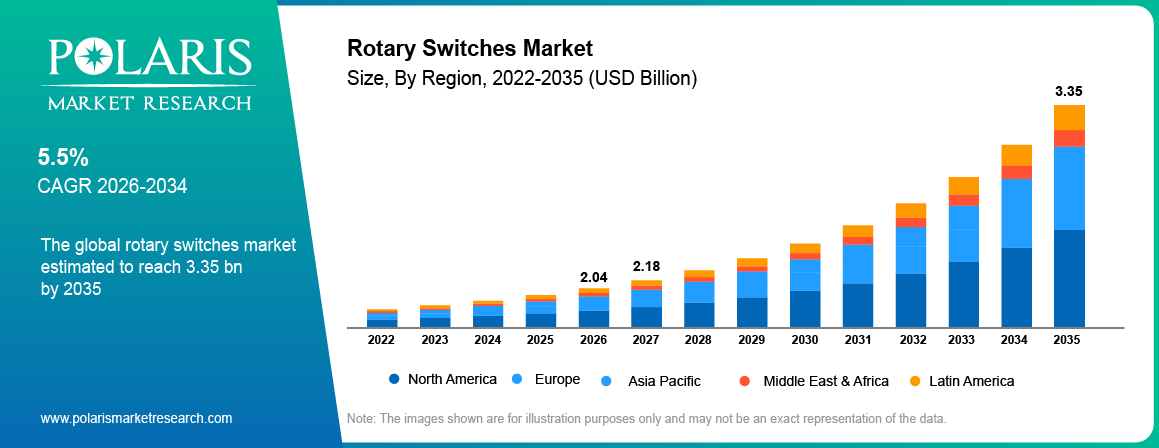
According to Polaris Market Research analysis, the rotary switches market was valued at USD 2.04 Billion in 2026. It is projected to reach USD 3.35 Billion by 2035, growing at a CAGR of 5.5% from 2027 to 2035. Demand comes from machine builders, appliance makers, vehicle suppliers, and equipment designers that need a positive, tactile way to select a mode, a range, or an address with one turn of a shaft. The largest type share belongs to Single Deck Rotary Switches, while Rotary Coded and DIP Switches expand quickest. The market tracks revenue from rotary operated switches that select between fixed positions, and leaves out rotary limit switches, continuous rotary encoders, and potentiometers. North America is the leading market. Asia Pacific is the fastest growing region.
Market Statistics
Key Takeaways
- North America captures 33.8% of 2027 revenue, since the densest base of industrial equipment makers, defense electronics suppliers, and certified controls buyers is in the United States.
- Asia Pacific records the steepest regional climb, at 6.3% each year through 2035, owing to appliance, electronics, and machinery output in China and a fast rising component base in India.
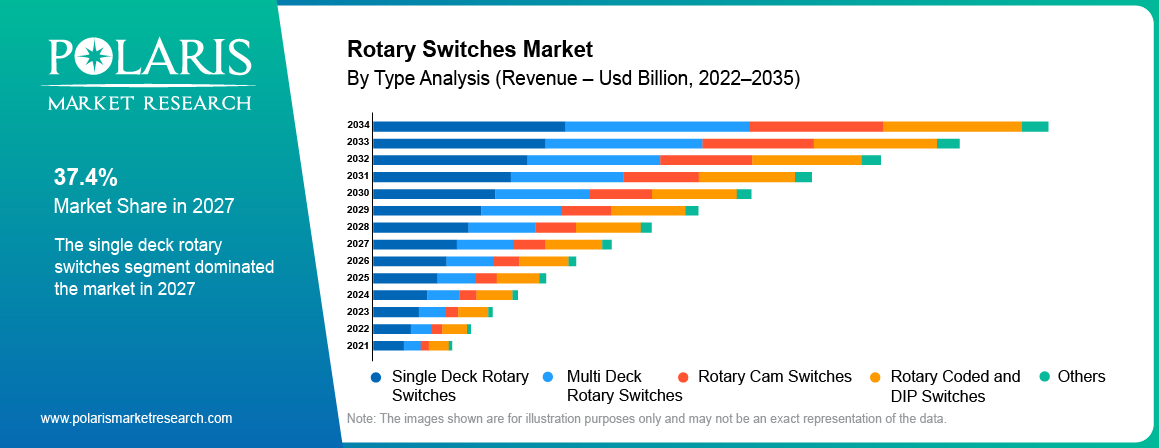
- Type revenue in 2027 is led by Single Deck Rotary Switches with 37.4%, due to their low cost and wide use in panels, instruments, and appliances.
- Rotary Coded and DIP Switches post the highest type CAGR, 8.9% through 2035, as designers swap jumper links for settable codes.
- Industrial Equipment accounts for 26.0% of 2027 application revenue, whereas Telecommunications and Networking lead growth among applications at 7.6% a year.
- Plants and utilities give Industrial 45.8% of 2027 value. Building systems and service equipment push Commercial up 5.9% a year as selector controls spread.
- Direct to OEMs takes 50.5% of 2027 channel revenue, and Online climbs 9.6% a year, quicker than any other channel, as small buyers order samples through web stores.
- Automotive adds 7.0% a year from a mid sized base, attributed to cabin and off highway controls that test bodies now favor in physical form.
Note: Figures and projections outlined in this report are the result of Polaris Market Research’s proprietary analytical processes, grounded in the latest available datasets and market observations.
Rotary Switches Market Definition
The rotary switches market covers electromechanical switches whose shaft or knob is turned to select one of several fixed circuit positions, including single deck, multi deck, cam operated, and coded or DIP formats. It excludes rotary limit switches, continuous rotary encoders, potentiometers, and sales of knobs sold separately.
Published figures for rotary switches vary a great deal, since some sources count only panel selectors while others add cam switches, enclosed isolators, or free spinning encoders. This report counts detented switches only, so the total follows real selector behavior.
Related categories are studied elsewhere. Coil driven devices that open and close a circuit are covered in the relay market, and factory controls and drives belong to the industrial control and factory automation market. A switch counts here once a turn of the shaft moves a contact set to a stop.
Revenue arises from four product families. Single deck switches carry one wafer of contacts, and multi deck switches stack several wafers on one shaft. Cam switches use shaped cams to drive snap action contacts, while coded or DIP switches output a fixed value that a circuit reads at power up.
Buying terms differ by customer type. Equipment makers order custom shaft lengths and detent torque from the factory, distributors stock catalog parts for repair and prototyping, and small designers order single pieces through web stores.
Construction changes the economics. Silver or gold plated wafers suit low current signal circuits, heavier cam assemblies suit motor and power switching, and sealed designs with panel gaskets serve washdown, outdoor, and vehicle cabin duty.
Rotary Switch vs Rotary Encoder: Key Differences
| Attribute | Rotary Switch | Rotary Encoder |
| Output | One contact closes at each fixed position | Pulses or a code stream as the shaft turns |
| Travel | Stops at defined positions with a detent | Continuous rotation without end stops |
| Typical use | Mode, range, and address selection | Volume, menu scrolling, and position feedback |
| Main benefit | Clear tactile position and simple wiring | Unlimited range and software control |
| Market treatment | Counted here, with a 5.5% CAGR from 2027 to 2035 | Outside the scope of this report |
Source: Polaris Market Research Analysis
The two parts often share a panel, since a control may use a detented selector for the operating mode and an encoder for fine adjustment. Polaris therefore counts the selector content here and leaves the encoder content to adjacent component studies.
Porter's Five Forces Analysis
| Force | Intensity | Rationale |
| Bargaining power of suppliers | Moderate | Silver, copper, and engineering plastics are bought on open markets, although precision stamping and contact plating skills sit with a limited group of subcontractors. |
| Bargaining power of customers | High | Large appliance and equipment makers buy in volume and qualify second sources, so price and delivery terms are negotiated every year. |
| Threat of new entrants | Moderate | Tooling is affordable and the design is mature, yet safety approvals, long life testing, and customer qualification slow credible entry. |
| Threat of substitutes | High | Touch panels, encoders with software menus, and pushbutton arrays can replace a selector when a design needs no tactile stop. |
| Competitive rivalry | High | Established brands and low cost Asian makers sell look alike parts, so approvals, custom shafts, and delivery speed decide share. |
Source: Polaris Market Research Analysis
Certification and supply record often outweigh list price. A machine builder with a listed control cabinet accepts a higher quote for a switch with the right agency marks, so producers invest in life testing and buffer stock as much as in tooling.
Market Dynamics
Driver Impact Analysis
| Driver | Impact on Market Growth | Time Horizon |
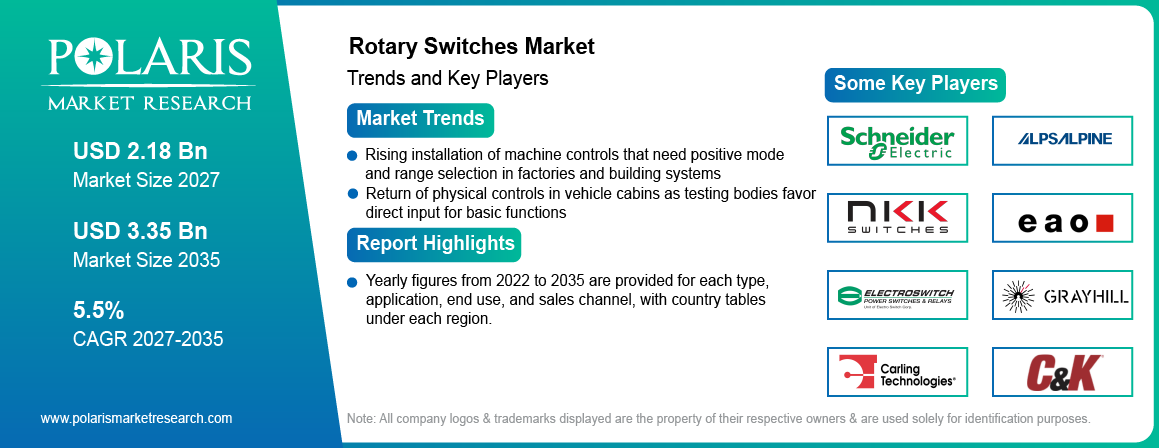
| Rising installation of machine controls that need positive mode and range selection in factories and building systems | High | Short to Medium Term |
| Return of physical controls in vehicle cabins as testing bodies favor direct input for basic functions | Moderate | Medium to Long Term |
Source: Polaris Market Research Analysis
Driver: Machine Builders Are Specifying Selector Controls for Operating Modes, Creating Market Demand
A production machine usually runs in several modes, such as setup, manual, and automatic, and operators need a control that shows the chosen mode at a glance. A rotary selector gives that clear position, resists accidental changes, and wires directly into a control or safety circuit.
For example, in February 2026, EAO added an illuminated selector switch and a keylock switch to its Series 82 range, with a stainless steel housing, an illuminated handle, and tactile feedback, owing to demand for rugged operator panels. The company lists operating modes in machine controls, production steps, and door and gate systems among the uses.
Industrial Equipment is the largest application, and the Industrial end use brings in USD 999.7 Million in 2027. Multi Deck Rotary Switches grow 6.9% a year, driven by control panels that switch several circuits with one shaft.
Replacement demand adds to new installations. Panels in service for decades lose switches to wear and contamination, and a maintenance team usually reorders the same part to avoid rewiring, so installed machines keep a steady flow of orders moving to catalog suppliers.
Driver: Test Bodies Are Favoring Physical Controls in Vehicle Cabins, Creating Market Demand
Touchscreen menus took over many cabin functions, yet a driver must look away from the road to use them. Physical knobs and switches can be found by feel, so vehicle makers and test bodies are bringing them back for frequently used functions.
For example, in October 2026, Euro NCAP said that indicators, wipers and washer, hazard lights, horn, and eCall should be operated by direct physical input under its 2026 protocols (Source: Euro NCAP). The release does not name rotary controls, so the effect on selector volumes is a Polaris inference, attributed to the wider return of tactile cabin hardware.
Automotive was worth USD 333.1 Million in 2027 and is projected to grow at a CAGR of 7.0% from 2027 to 2035, owing to climate, drive mode, and seat controls in cars, trucks, and off highway machines.
Cabin and off highway duty favor sealed designs with panel gaskets and long life ratings. Suppliers that run automotive grade quality systems therefore gain, since a carmaker will not qualify a switch without lot traceability and reliability records.
Restraint: Touch Interfaces and Encoders Are Replacing Mechanical Selectors in Some Designs, Limiting Adoption
A selector has fixed positions, and every position needs its own contact and a wire. A designer who wants many modes, a menu, or software updates can move to a touch panel or an encoder, and that removes the cost of contacts and the wear that comes with them.
For example, in September 2026, Grayhill announced that its T1 Touch Encoder Series received CANopen certification from CAN in Automation. The release does not mention a rotary switch, but it shows a switch and encoder supplier moving part of its interface line toward networked touch controls.
Home Appliances grow only 3.2% a year and trail every other application, while Consumer Electronics grow 3.6%, as both categories lean toward touch panels and app control. A simple one circuit selector is the easiest part to replace with software, so Single Deck Rotary Switches post the slowest type growth.
Producers respond with illuminated, sealed, and coded variants that add functions a touch panel cannot give, such as blind operation with gloves and a visible position with no power. Those premium versions protect price, although they also narrow the volume that plain parts once supplied.
Cost pressure compounds the shift. A touch module shares one controller across many functions, whereas a selector carries its own contacts, shaft, and bezel, so large appliance makers weigh bill of materials savings against the tactile feel that customers ask for.
Opportunity: Component Localization Programs in India, Mexico, and Brazil Are Creating New Manufacturing Capacity
Governments are paying for local production of electronic and electrical components, so equipment makers can buy closer to their plants. A switch maker with a local line gains shorter lead times, lower freight, and a stronger claim under local content rules.
For example, in August 2026, India approved 31 further electronics component projects worth about Rs 7,877 crore, taking the total under its component scheme to 106, according to ThePrint. The report does not name switches, and the scheme covers components in general, so the link to rotary switches is indirect.
Asia Pacific has the steepest regional curve, at 6.3%. India is the quickest country, compounding at 10.6% across 2027 to 2035 from only USD 61.3 Million in 2027.
Mexico offers a second path. Industrial parks near the United States border give appliance, vehicle, and equipment plants ready space, and each plant needs control components that suppliers can ship in days instead of weeks.
Opportunity: Machine Safety Rules in Europe Are Creating Replacement Demand for Certified Control Devices
Machinery rules set what a control panel must do when something fails, and they push builders to review every operator device. Selector and keylock switches that limit access to a mode are part of that review.
For example, in June 2023, Brussels enacted Machinery Regulation 2023/1230, which becomes mandatory on 20 January 2027 (Source: European Commission). The regulation adds rules for machinery with AI powered safety functions and cyber safety requirements for safety control systems.
Europe grows 5.1% a year, the second slowest region, so compliance work adds a useful lift to a mature base. Commercial is the fastest end use, at a CAGR of 5.9% from 2027 to 2035, as service and building equipment is refreshed.
Builders redesign panels ahead of deadlines, and a new panel usually needs newly approved devices. Suppliers with agency marks and test reports ready win those redesigns, so documentation becomes a sales tool as much as the switch itself.
Trend: Variable Feel and Illuminated Rotary Controls Are Spreading Into Vehicles and Machines
Makers are adding light, motors, and sensors to the classic knob. An illuminated handle shows the chosen mode in a dark cab, and a motorized knob can change its turning resistance to match the function.
For example, in January 2026, Alps Alpine showed rotary knobs at CES 2026 in Las Vegas that feel easier or harder to turn depending on the situation, using motorized haptic feedback, heise reported. Only individual parts were on display, so volume production dates are not yet public.
Illuminated and motorized parts sit mostly within Others, and Rotary Cam Switches hold a steady place in power and motor control while the newer formats develop.
Such parts carry electronics, so they cost more and need driver support, and adoption starts in premium vehicles, test equipment, and medical devices before it reaches mainstream panels.
Value Chain Analysis
| Stage | Activities | Representative Participants |
| Materials and components | Supplying contact metals, plastics, springs, and shafts | Metal refiners, plastics compounders, and precision stamping subcontractors |
| Switch manufacturing | Stamping, plating, assembling, and life testing rotary switches | Grayhill, EAO, Alps Alpine, C&K Switches, APEM, Carling Technologies, Electroswitch, and NKK Switches |
| Distribution | Stocking catalog parts, kitting, and shipping small orders | Mouser Electronics and other catalog distributors |
| Equipment design and assembly | Specifying shafts, detents, and ratings, then building panels and boards | Machine builders, appliance makers, vehicle suppliers, and instrument makers |
| End installations | Operating, servicing, and replacing switches in the field | Factories, building operators, fleets, and households |
Source: Polaris Market Research Analysis
Value gathers at the design in stage and at the approval stage. A supplier whose switch is written into a panel drawing and carries the right agency marks earns repeat orders for the life of the machine, whereas generic parts face price competition from distributors.
Costs concentrate in contact plating, tooling upkeep, and testing. Gold plated wafers suit low level signals but cost more than silver, and a long life test run takes weeks, so suppliers with automated test benches can quote shorter qualification times.
Distributors sit between factories and small buyers. They stock hundreds of positions, poles, and shaft styles for repair and prototype orders, and they earn a margin on parts that equipment makers would rather not hold in their own stores.
Pricing follows the product. Plain single deck parts sell per piece at low prices, multi deck and cam assemblies sell per assembly with tooling surcharges, and illuminated or sealed versions carry a premium, so the mix of products sets the revenue path.
Geography shapes the chain. Contact stamping and assembly cluster in China, Japan, and Taiwan, specialist industrial and military lines stay in North America and Western Europe, and distributors place stock near the largest buyer regions to shorten delivery for urgent repairs.
Rotary Switches Market Segmentation Analysis
Segmentation follows the construction of the switch, the equipment that uses it, the setting where it is installed, and the route by which it is bought. Each split changes contact ratings, agency approvals, lead times, and the time a new part needs to be approved for a panel.
Type Insights
Market share by type favored Single Deck Rotary Switches in 2027, at 37.4% of type revenue, driven by low unit cost and use in instruments, appliances, and control panels. One wafer of contacts is turned by a shaft through a spring loaded detent, and the design is simple, compact, and well proven in volume.
Multi Deck Rotary Switches are projected to grow at a CAGR of 6.9% from 2027 to 2035, attributed to panels that switch several circuits at once. Wafers are stacked on one shaft, so a single knob can change ranges, filters, and indicator lines together.
Rotary Cam Switches were worth USD 391.2 Million in 2027, owing to their place in motor control, isolation, and power changeover duty. Shaped cams drive snap action contacts, so the part carries higher currents than a signal wafer and tolerates frequent operation.
Rotary Coded and DIP Switches are the fastest growing type segment, at a CAGR of 8.9% from 2027 to 2035, as board designers drop jumpers for settable addresses and modes. Its output is a fixed code that the circuit reads at power up, so installers skip a visit to the programming bench.
For example, in April 2026, C&K Switches introduced the TDB ultra miniature surface mount half pitch DIP switches, with gold plated contacts and 100 milliohm contact resistance, according to a Mouser Electronics listing. Smaller coded switches fit crowded boards, and they suit automated assembly lines.
Others brings in USD 169.9 Million in 2027 and covers illuminated, motorized, and specialty rotary formats that fall outside the four main groups. Demand arises where a standard switch cannot meet a panel, a color, or a feel requirement.
Buyers compare constructions using different yardsticks. Appliance makers judge cost and detent feel, panel builders judge poles, positions, and agency marks, and board designers judge height, pitch, and output code.
Boundaries between types are shifting. A single control may combine a cam assembly with an auxiliary signal wafer, so Polaris assigns revenue to the construction that carries the main load current.
Application Insights
Industrial Equipment accounted for 26.0% of application revenue in 2027, driven by machine tools, packaging lines, pumps, and process skids that need mode, speed, and range selection. Operators wear gloves and work in dust, so a large detented knob remains the preferred control.
Home Appliances are projected to grow at a CAGR of 3.2% from 2027 to 2035, owing to program selection on washers, ovens, and cooking hobs. Many makers keep a rotary dial for the main program because users find it faster than a menu, yet touch panels are taking share in premium ranges.
Consumer Electronics were worth USD 293.0 Million in 2027, supported by audio gear, power tools, and small devices that use coded and miniature rotary parts. Unit volumes are large and buyers press hard on price.
Automotive held 15.3% of application revenue in 2027, due to cabin comfort, drive mode, and seating controls in passenger cars, trucks, and farm and construction machines. Sealed, long life designs and lot traceability are the entry requirements.
Telecommunications and Networking is the fastest growing application segment, at a CAGR of 7.6% from 2027 to 2035, attributed to coded switches that set addresses and modes on racks, radios, and network cards. Each new rack position needs a settable ID without a software step.
Aerospace and Defense accounted for 9.3% of application revenue in 2027, owing to demand for rugged rotary parts in radios, avionics panels, and ground vehicles. Programs specify sealed, vibration tested switches with documented sourcing.
For example, in June 2025, North Atlantic Treaty Organization allies committed in The Hague to invest 5% of GDP annually on defense related spending by 2035, with at least 3.5% for core requirements (Source: NATO). Higher budgets raise orders for qualified panel hardware, although contract timing varies by country.
Healthcare and Medical Equipment brought in USD 196.7 Million in 2027, backed by instruments, imaging carts, and bedside devices that need a cleanable selector. Washdown ratings and low particle contact materials guide purchases.
Needs differ by application. Factories value durability and visible position, appliance makers value cost and feel, and military programs value sealing and traceability, so one switch design rarely fits all of them.
Approval cycles also differ. An appliance part can pass through a model year, an industrial part needs agency listings for the control cabinet, and a vehicle or defense part must clear reliability programs that run for many months.
Cross links connect these uses to neighboring markets, since a range of kitchen and smart appliances now share the same selector formats. Related demand appears in the smart home appliances market report.
End Use Insights
Industrial took 45.8% of 2027 value, driven by factories, utilities, and mining sites that run large fleets of motors and control panels. Replacement and spares add to new equipment orders.
Commercial is the fastest growing end use segment, at a CAGR of 5.9% from 2027 to 2035, attributed to building systems, kitchens, and service equipment in shops, offices, and hospitality sites. Facility managers refresh controls during retrofits, and a selector switch is a low cost part to swap.
Residential was worth USD 498.7 Million in 2027, owing to the number of cookers, washers, and heaters in homes that carry a rotary dial. It grows slowest, since touch panels gain share in new homes.
For example, in September 2026, EC&M magazine reported that the 2026 National Electrical Code requires service equipment for one and two family dwellings to be located outdoors. Outdoor rated disconnecting hardware benefits from such a rule, although the report does not mention rotary selectors by name.
Buying routines differ by customer. Industrial plants buy through approved vendor lists and annual contracts, commercial installers buy from distributors for each job, and households replace parts only when a device fails.
Service life matters more than price in industrial duty. A switch that runs a conveyor for fifteen years avoids line stops that cost far more than the part, so buyers pay for sealing and plating quality.
Sales Channel Insights
Direct to OEMs accounted for 50.5% of channel revenue in 2027, due to custom shafts, detent torque, and terminal styles that equipment makers specify for their own panels. Annual volume agreements set the price and the delivery schedule.
Distributors brought in USD 809.8 Million in 2027, supported by repair, prototype, and small batch buyers that need catalog parts in days. Stocking hundreds of poles, positions, and shaft styles is the business of the channel.
Online is the fastest growing channel segment, at a CAGR of 9.6% from 2027 to 2035, owing to designers and technicians who buy prototypes and single units from web stores that show datasheets and live stock. Lower cost of reach lets small buyers source parts that once required a sales call.
For example, in March 2026, the Electronic Components Industry Association (ECIA) recorded an Industry Pulse sales sentiment index of 149.2, the highest in five years, with electro mechanical components rising 20.2 points. Strong channel sentiment supports stocking decisions, so distributors place larger orders with switch makers.
Risk tolerance differs across routes. Equipment makers accept long qualification for a single source, distributors want fast moving catalog parts, and online buyers want immediate availability and clear datasheets.
Rotary Switches Market Regional Analysis
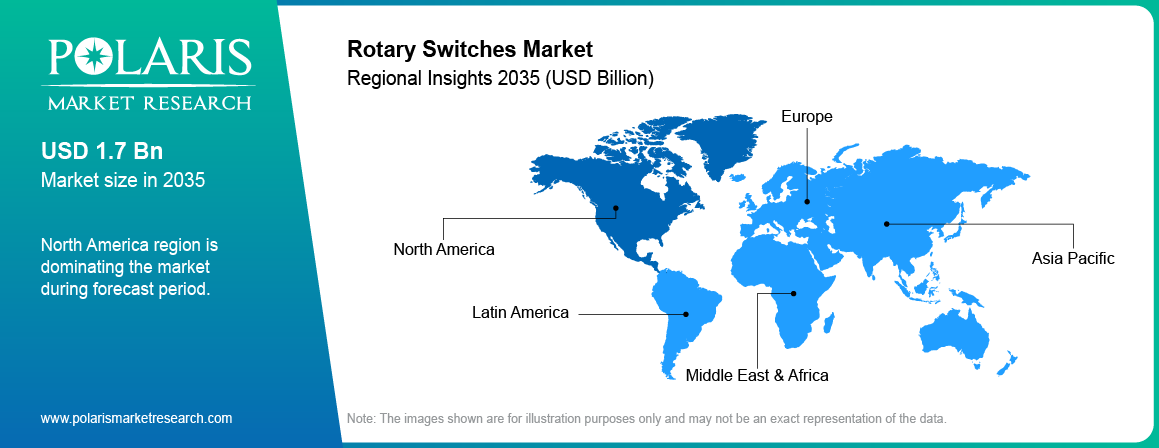
Regional demand mirrors where machines are built, appliances are assembled, vehicles are equipped, and electronic boards are produced. North America and Europe combine large installed bases with defense and compliance demand, while Asia Pacific concentrates manufacturing and adds the fastest growth.
North America Market
North America is the leading market, with 33.8% of 2027 revenue, owing to the deepest concentration of industrial equipment makers, defense programs, and distributor stock. Its CAGR of 4.8% through 2035 is the weakest of any region, since the base is already large.
The United States was worth USD 603.8 Million in 2027 and holds most of the regional total. Mexico grows fastest among the national markets, at a CAGR of 6.0% from 2027 to 2035, as plants move closer to United States customers, and Canada grows 4.8% a year.
For example, in October 2026, President Claudia Sheinbaum added 20 industrial parks to Plan Mexico, with about 4.6 million square meters of floor space, The Rio Times reported. That lifts the program to 40 parks against a goal of 100 by 2030, and new plants in appliance, vehicle, and electronics sectors need control components, so Mexican demand rises with each park.
Rivalry in North America favors suppliers that hold approvals. Established brands carry agency marks and military sourcing records, while low cost imports compete on catalog parts, so winners pair certification with stock in the United States.
Europe Market
Europe contributes 25.4% of 2027 revenue and expands at 5.1% a year, ranking next to last among regions, due to a mature machinery and appliance base. Germany leads European countries at USD 143.6 Million in 2027.
Russia is the slowest national market in the region, at 3.3% a year, attributed to constrained access to imported components. Next in size are the United Kingdom at USD 72.1 Million, France at USD 66.6 Million, Italy at USD 61.0 Million, Spain at USD 33.3 Million, and smaller markets at USD 139.9 Million.
For example, in July 2026, the German Electro and Digital Industry Association (ZVEI) reported that May 2026 orders were up about 19% on a year earlier. Real production fell about 5.4%, with two fewer working days (Source: ZVEI). Strong orders point to later gains in control gear that uses selector switches.
Machine safety rules set the pace for demand. The new Machinery Regulation applies from January 2027, and builders in Germany, Italy, and France are updating control panels ahead of that date, so certified selector and keylock parts are in demand.
Asia Pacific Market
Asia Pacific is the fastest growing region, at a CAGR of 6.3% from 2027 to 2035, and it holds 29.7% of 2027 revenue, owing to appliance, electronics, and machinery production in China and expanding component output in India.
China is the largest national market at USD 247.4 Million in 2027, and India climbs fastest, at 10.6% annually, off a low starting point. Japan trails the major markets, at 4.0%, as its factory base is mature. South Korea was worth USD 58.4 Million and Australia USD 26.0 Million.
For example, in December 2025, the Japan Electronics and Information Technology Industries Association (JEITA) forecast that global electronics and information technology production would reach USD 4,510.3 billion in 2026, up 10% from 2025. Larger device output raises demand for board level coded switches and panel selectors.
Local supply is also growing. In October 2025, EAO founded EAO India Private Limited to expand its presence in the railway and machinery industries of India, and brands from Japan and Europe are adding sales offices to serve local equipment makers.
The rest of the region totals USD 147.8 Million in 2027, mostly from assembly and electronics plants in Southeast Asia.
Latin America Market
Latin America accounts for 5.4% of 2027 revenue and is growing at a CAGR of 6.2% from 2027 to 2035, owing to appliance, vehicle, and mining equipment production in Brazil and Argentina. Brazil leads the region at USD 56.7 Million and outgrows Argentina.
The rest of the region adds USD 45.5 Million in 2027. Many customers import switches already mounted in appliances and machines, so local revenue follows assembly more closely than switch manufacture.
For example, in August 2026, the Manaus free trade zone authority Suframa approved a R$ 107.6 million electricity meter project by Sunhope, InvestNews reported. The authority cleared 56 new industrial projects from January to August, up about 40% on 2025, and new assembly plants in the zone raise demand for control components.
Currency swings and import duties shape pricing. Distributors that hold local stock can quote in local currency, and that protects them from shocks that hit buyers who import against each order.
Middle East & Africa Market
Middle East & Africa supplies 5.6% of 2027 revenue and expands at 6.2% a year, as a result of power, water, and building projects in the Gulf and mining equipment in Africa. Saudi Arabia is the largest national market at USD 24.9 Million and also the quickest, at 7.3%.
The United Arab Emirates was worth USD 18.6 Million in 2027, Turkey USD 20.9 Million, South Africa USD 17.1 Million, and the remaining countries USD 41.6 Million. Government agencies both buy switches and sponsor local manufacturing.
For example, in April 2026, Schneider Electric committed to nearly triple its Saudi manufacturing capacity to 32 production lines by 2030, making low voltage switchboards, distribution boards, and medium voltage switchgear in the Kingdom, Zawya reported. Local panel assembly raises demand for selector and cam switches that panel builders source nearby.
Gulf governments increasingly tie contracts to local assembly, training, or joint ventures, so vendors with local offices and inventory hold an edge.
Rotary Switches Market Competitive Landscape
Suppliers fall into four groups. Specialist makers design the parts, led by Grayhill, EAO, and Alps Alpine, with C&K Switches, APEM, Carling Technologies, Electroswitch, and NKK Switches close behind. Electrical groups such as Schneider Electric, Eaton, and ABB sell cam and panel switches inside control gear. Component houses such as Omron, Bourns, TE Connectivity, and Schurter sell related switching parts, and catalog distributors move small orders.
EAO widened Series 82 with illuminated selector and keylock versions in February 2026, and Alps Alpine demonstrated knobs with adjustable turning resistance at CES 2026 in January. C&K Switches listed new surface mount DIP switches in April 2026, and Schneider Electric pledged larger Saudi plants the same month.
Grayhill announced CANopen certification for a touch encoder in September 2026, and EAO founded an Indian subsidiary in October 2025. Carling Technologies markets a CRS Series rotary encoder switch with an IP67 rating above the panel and endurance ratings of 500,000 cycles.
Nobody in this field reports rotary switch revenue separately, so any market share ranking is approximate. Polaris treats launches, plant news, and distributor listings as evidence of presence, not of measured revenue.
Contests turn on approvals and delivery. Buyers favor suppliers with agency marks, long life test data, and stock near the plant, and share drifts toward companies that deliver on schedule with complete documentation.
Brand ownership matters when comparing suppliers. C&K Switches is part of Littelfuse, and APEM belongs to IDEC Corporation, so each brand draws on a larger group for sales reach and capital, while Alps Alpine has offered rotary switches since its founding.
Entry by new players is possible in niches such as illuminated, coded, or sealed formats. Low cost Asian makers enter through catalog and online channels, then move to direct supply once approvals are in hand.
Vendor Landscape Snapshot
| Company | Vendor Positioning | Role |
| Grayhill | Leader | Announced CANopen certification of its T1 Touch Encoder Series in September 2026 and lists rotary switches among its components |
| EAO | Leader | Added an illuminated selector switch and a keylock switch to Series 82 in February 2026 and founded EAO India in October 2025 |
| Alps Alpine | Leader | Showed variable feel rotary knobs at CES 2026 and has offered rotary switches since its founding |
| C&K Switches | Challenger | Part of Littelfuse and listed TDB surface mount DIP switches in April 2026 |
| Schneider Electric | Challenger | Committed to nearly triple Saudi manufacturing capacity to 32 production lines by 2030 |
| Carling Technologies | Niche Player | Markets the CRS Series rotary encoder switch with an IP67 rating above the panel |
Source: Polaris Market Research Analysis
Rotary Switches Market Technology and Innovation Landscape
Technical progress follows four aims: longer contact life, a clearer position cue, better sealing, and smarter output. Most progress comes from plating and spring design, from illuminated handles, and from sensors added to the shaft.
Contact design is the central skill. A wafer must keep low resistance across hundreds of thousands of turns, so makers choose silver or gold plating, wiping contact geometry, and detent springs that hold position without creating dust.
Position cues are improving. Illuminated handles and colored bezels show the selected mode in dim cabs and control rooms, and EAO built illumination and a stainless steel housing into its Series 82 selector switch.
Sealing is spreading to more families. Panel gaskets, shaft seals, and potted terminals let a rotary switch survive washdown and outdoor spray, and Carling Technologies rates its CRS Series at IP67 above the panel.
Coded output is moving closer to the board. Surface mount coded and DIP switches suit automated assembly, and designers use them to set addresses and modes instead of resistors or jumpers.
Haptics are an active area. Alps Alpine demonstrated knobs whose turning resistance changes with the function, using motorized feedback, and such parts blur the line between a selector and an encoder.
Networking is arriving at the panel. Grayhill earned CANopen certification for a touch encoder, so interface components increasingly talk to controllers over a bus, and plain selectors compete against devices that carry their own communications.
Materials are also changing. Halogen free plastics, lead free platings, and recycled metal content are entering specifications, and buyers ask suppliers for declarations as part of the approval file.
Reliability evidence is becoming a selling point. Customers ask for life curves at rated load, and suppliers that publish clear test data win approvals sooner than rivals that quote catalog claims.
Technology and Innovation Landscape Snapshot
| Area | Role | Status and Representative Developers |
| Illuminated selectors | Show the chosen mode and add keylock access control | EAO added illuminated selector and keylock switches to Series 82 in February 2026 |
| Variable feel knobs | Change turning resistance to match the function | Alps Alpine showed motorized haptic knobs at CES 2026 |
| Networked touch encoders | Link panel input to controllers over a bus | Grayhill received CANopen certification in September 2026 |
| Sealed rotary switches | Survive washdown, outdoor spray, and vibration | Carling Technologies rates its CRS Series at IP67 above the panel |
| Surface mount DIP switches | Set addresses and modes on automated lines | C&K Switches listed TDB half pitch DIP switches in April 2026 |
Source: Polaris Market Research Analysis
Use Case Analysis
Machine Mode Selection
Operators of machine tools and packaging lines turn a selector to choose setup, manual, or automatic mode. A keylock version limits the change to trained staff, and the position can be read from across the floor.
Appliance Program Selection
Washers, ovens, and cooking hobs use a rotary dial for the main program. Makers of cooking equipment keep the dial because users reach it without looking, and wider kitchen demand is covered in the kitchen appliances market report.
Test and Measurement Ranges
Meters, power supplies, and audio gear use multi deck switches to change ranges and filters with one shaft. The detent feel tells the user which range is active, and a gold plated contact keeps signal noise low.
Address and Mode Setting
Network cards, drives, and sensors use coded rotary switches to set a node address at installation. Technicians change the value with a screwdriver and no laptop, and the setting survives power loss.
Vehicle and Off Highway Controls
Trucks, tractors, and construction machines use sealed rotary switches for drive mode, lights, and hydraulics. Operators wear gloves and work in vibration, and electrified vehicle platforms add more selectors, as covered in the electric vehicle market report.
Data Center and Power Equipment
Power distribution and switchgear panels in server halls use cam and selector switches to choose feeds and test positions. Operators value a clear mechanical position, and related equipment is covered in the AI data center switchgear market report.
Maintenance duty runs through every use case. Switches are inspected for contact wear, logged by lot, and replaced on a schedule, so operators keep spares and agree part numbers with suppliers.
Total installed cost is the last test. A rotary switch must beat a touch panel or a pushbutton array on wiring, assembly, and life together, so designers compare layouts side by side before they freeze a panel.
Buyer Needs and Decision Criteria
| Buyer Need | Decision Criteria | Why It Matters |
| Approvals | Agency marks, flammability rating, and traceable lots | A control cabinet cannot ship with unlisted parts |
| Life and sealing | Rated cycles at load and panel protection rating | A failed switch can stop a production line |
| Price and flexibility | Cost per piece, tooling charges, and minimum quantities | Large buyers split orders among suppliers |
| Fit and feel | Shaft length, detent torque, poles, and positions | Wrong shaft or torque can reject a good switch |
| Delivery | Lead time, local stock, and second source | A late part can stall a machine build |
Source: Polaris Market Research Analysis
Entry barriers are agency approvals, life testing, customer qualification, and distribution reach. Panel builders keep orders with suppliers whose parts have shipped for years, so a new brand starts with samples and small runs.
Qualification depends on test reports, supply security, price per piece, and delivery terms, and a supplier with all four documented shortens the buyer review by weeks.
Contract scope is widening. Panel builders now ask for switches, knobs, bezels, and printed labels in one kit, so a supplier with a full range wins larger accounts.
Premium Insights and Forward Outlook
Coded and Networked Formats Will Gain Share
Board designers will move more settings from jumpers to coded rotary switches, and suppliers will add sensors and bus interfaces to selectors. Producers with surface mount parts and clear output tables will win repeat orders.
Web ordering will alter terms of sale. Small designers want single unit prices, visible stock, and sample kits, and a supplier offering all three picks up orders that a static price list loses.
Compliance Will Drive Replacement Cycles
Machinery rules in Europe and building codes in North America will trigger panel redesigns. Suppliers with agency listings and documentation ready will gain, because a redesign usually brings a fresh part choice.
Localization Will Spread Production
Public programs in India, Mexico, Brazil, and Saudi Arabia will add local assembly and component capacity. Suppliers with stock in several regions will spread tooling cost over more orders.
Touch and Tactile Will Share the Panel
Appliance and consumer designs will keep moving toward touch, while industrial, vehicle, and defense panels hold on to tactile selectors. Premium illuminated and variable feel parts will carry higher prices, and plain parts will face pricing pressure.
Energy and sustainability rules will shape specifications. Halogen free materials and recycled content will become approval items, so suppliers that document material content early will clear audits faster.
Growth rests on more machine controls, steady replacement orders, coded boards, and rising demand for sealed parts in vehicles and defense equipment. The largest share of added revenue should go to producers with approvals, regional stock, and differentiated formats.
Key Players in the Rotary Switches Market
- Grayhill
- EAO
- Alps Alpine
- C&K Switches
- APEM
- Carling Technologies
- Electroswitch
- NKK Switches
- Schneider Electric
- Eaton
- Omron
- ABB
- Bourns
- TE Connectivity
- Schurter
Industry Developments
- October 2026: Euro NCAP set out that core driving controls need direct physical input in its 2026 testing, favoring tactile hardware (Source: Euro NCAP).
- October 2026: Mexico added 20 more industrial parks to Plan Mexico, bringing the national total to 40 of a planned 100 (Source: The Rio Times).
- September 2026: Grayhill announced CANopen certification of its T1 Touch Encoder Series, extending networked interface controls (Source: Grayhill).
- April 2026: Schneider Electric pledged to nearly triple its Saudi plant capacity by 2030, reaching 32 production lines (Source: intlbm.com).
- February 2026: EAO widened its Series 82 line with illuminated selector and keylock versions (Source: EAO).
Rotary Switches Market Report Segmentation
By Type
- Single Deck Rotary Switches
- Multi Deck Rotary Switches
- Rotary Cam Switches
- Rotary Coded and DIP Switches
- Others
By Application
- Industrial Equipment
- Home Appliances
- Consumer Electronics
- Automotive
- Telecommunications and Networking
- Aerospace and Defense
- Healthcare and Medical Equipment
By End Use
- Industrial
- Commercial
- Residential
By Sales Channel
- Direct to OEMs
- Distributors
- Online
By Region
- North America
- United States
- Canada
- Europe
- United Kingdom
- Germany
- France
- Italy
- Spain
- Rest of Europe
- Asia Pacific
- China
- Japan
- India
- South Korea
- Australia
- Rest of Asia Pacific
- Latin America
- Brazil
- Mexico
- Argentina
- Rest of Latin America
- Middle East & Africa
- Saudi Arabia
- United Arab Emirates
- South Africa
- Rest of Middle East & Africa
Rotary Switches Market Report Scope
| Report Attribute | Details |
| Market Size in 2026 | USD 2.04 Billion |
| Market Size in 2027 | USD 2.18 Billion |
| Revenue Forecast by 2035 | USD 3.35 Billion |
| CAGR | 5.5% (2027 to 2035) |
| Base Year | 2026 |
| Historical Data | 2022 to 2025 |
| Forecast Period | 2027 to 2035 |
| Quantitative Units | Revenue in USD Billion for the market, USD Million for segments, and CAGR in percent |
| Report Coverage | Revenue Forecast, Growth Factors, Competitive Landscape, Industry Trends, and Strategic Analysis of the rotary switches market |
| Segments Covered | By Type, By Application, By End Use, By Sales Channel, and By Region |
| Regional Scope | North America, Europe, Asia Pacific, Latin America, Middle East & Africa |
| Competitive Landscape | Company Profiling, Product Benchmarking, Financial Analysis, Market Developments, and Strategic Initiatives |
| Report Format | PDF and Excel |
| Customization | Available by Country, Region, and Segment |
| Research Team | Polaris Market Research & Consulting, Inc. research team |
| Last Updated | 25 November 2026 |
Source: Polaris Market Research Analysis
Why Choose Polaris Market Research
The estimate starts from twenty four country and group entries, five of which are residual blocks such as Rest of Europe. Every entry gets its own figure, regions come from summing countries, and the four segment splits are then calibrated against those totals.
Scope shifts the total. Before comparing it with another published number, confirm whether that source counted limit switches, continuous encoders, potentiometers, or enclosed isolators.
Every outside fact names its publisher and shows a date when the page gives one. Pages are grouped as government, association, company, or press, which lets an editor check any claim against its page.
Custom studies can be requested for one country, switch type, application, end use, or sales channel.
Research Methodology
Research Approach
Revenue is counted for switches that select among fixed circuit positions through a turned shaft or knob. Limit switches, free spinning encoders, potentiometers, and loose knobs are left out.
Secondary Research
Research drew on a register of 20 facts: 7 from companies, 6 from public bodies and associations, and 7 from trade press and distributors. Among them, 5 show no exact page date, 7 were taken from search snippets because the page itself was not opened, and 1 is older than 24 months and stays for ownership accuracy.
Primary Research
Polaris follows its standard process of primary interviews. These interviews cover manufacturers, distributors and channel partners, and industry experts and consultants. They are used to validate secondary estimates, segment shares, regional trends, and growth drivers.
Data Structuring
Every value is in US dollars and every period is a calendar year. Scope was settled before collection began, and a switch is counted once even if several sources mention it.
Market Size Estimation
Estimates are built from the country level upward. Five regions come from adding countries, the world figure comes from adding regions, and each total is then split four ways.
Public sizes for comparable scopes were read before the 2026 base of USD 2.04 Billion was fixed. They differ widely, because analysts draw the scope line in different places, so they guided judgment without setting the answer.
Forecasting
Annual growth steps down gradually through 2035, and compounding the whole series gives the stated CAGR. The series reflects machine control installations, vehicle cabin trends, component localization programs, and the move of some designs to touch interfaces.
Data Triangulation and Validation
Four tests were run on each forecast year. Shares within a dimension total 100%, countries match their regions, regions match the world figure, and early years depart from 2026 at a believable pace.
Limitations
Few producers split out rotary switch sales, so segment and regional values are modeled instead of lifted from filings, and later editions may differ as product dates and plant plans change. The estimate is also sensitive to scope, since counting isolators or encoders would raise the total. Market figures in this report are Polaris estimates.
Research Methodology Phases
| Phase | Focus | Evidence / Output |
| Scope and Setup | Market boundary, segments, and regions | Fixed scope and segment list |
| Secondary Data Collection | Agencies, associations, companies, and news reports | 20 sourced facts with dates |
| Primary Research | Interviews with manufacturers, channel partners, and industry experts | Validated segment shares, regional trends, and growth drivers |
| Data Structuring | Dollar values by calendar period | Each switch entered once |
| Bottom Up Estimate | Country and segment estimates | Regional and global totals |
| Top Down Estimate | Global base for 2026 and its segment mix | Base set beside published estimates |
| Forecasting | Annual growth path to 2035 | Stated CAGR |
| Triangulation and Validation | Share totals, roll ups, and growth path tests | Tests that passed |
| Output | Report tables and text | One dataset feeding all tables |
Source: Polaris Market Research Analysis
Data Sources by Type
| Type of Source | Named Examples | Used For |
| Company pages (7) | EAO; Grayhill; Schneider Electric through Zawya; Carling Technologies; Alps Alpine; IDEC Corporation | Product launches, plant commitments, and ownership |
| Agency, association, and standards body pages (6) | Euro NCAP; European Commission; ZVEI; JEITA; NATO; ECIA | Cabin control rules, machinery rules, industry orders, and channel sentiment |
| News and distributor reports (7) | EC&M; ThePrint; InvestNews; heise; The Rio Times; Mouser Electronics | Code changes, local programs, trade show news, and product listings |
Source: Polaris Market Research Analysis
Rotary Switches Market FAQ's
Such switches are turned by hand to pick one fixed circuit position, which lets a user choose a mode, range, or address in a single motion.
The Polaris estimate for the 2026 rotary switches market is USD 2.04 Billion, counted as revenue from rotary operated switches with defined positions. Sales are forecast to climb to USD 3.35 Billion by 2035.
Polaris projects USD 3.35 Billion for the rotary switches market by 2035, a CAGR of 5.5% over 2027 to 2035, supported by machine controls, vehicle cabins, coded boards, and local component programs.
North America is the leading market, holding 33.8% of 2027 spending, since the United States combines industrial equipment makers, defense programs, and deep distributor stock.
Asia Pacific expands fastest, with a regional CAGR of 6.3% through 2035, as appliance, electronics, and machinery output expands in China and component production scales up in India.
By 2027 value, 37.4% belongs to Single Deck Rotary Switches, the biggest type, while Rotary Coded and DIP Switches grow fastest, at 8.9%, as boards replace jumpers with settable codes.
Grayhill, EAO, and Alps Alpine appear most often in the register, while Schneider Electric and Eaton add cam and panel switches to the mix.
Illuminated and variable feel knobs are spreading, coded switches are moving onto boards, vehicle makers are bringing back physical controls, and local component programs are adding capacity in India, Mexico, and Saudi Arabia.
Touch panels and encoders can replace a selector when a design needs no tactile stop, and price pressure from low cost imports limits margins on plain parts, while approvals and life tests slow new entrants.
Industrial Equipment leads with 26.0% of 2027 application value, and Telecommunications and Networking grows fastest, at a CAGR of 7.6% to 2035, owing to coded switches that set addresses on racks and radios.
Industrial is the largest, with 45.8% of 2027 value, and Commercial grows fastest, with a CAGR of 5.9% through 2035, as building systems and service equipment are refreshed.
Online gains most, with a CAGR of 9.6% through 2035, since small buyers favor web stores, while Direct to OEMs stays the largest channel at 50.5% of 2027 value.
A rotary switch stops at fixed positions and closes one contact at each stop. An encoder spins without end stops and sends pulses to software, so Polaris counts only the switch in this report.
The United States is first with USD 603.8 Million in 2027, and China follows with USD 247.4 Million, while India grows at 10.6% a year, the highest national pace.
Machine builders that need positive mode selection, vehicle makers returning to tactile controls, coded settings on boards, and replacement orders for installed equipment all add demand for rotary switches.

Download Sample Report of Rotary Switches Market
Please fill out the form to request a customized copy of the research report.


