
Wood Coatings Market Insights, Demand, Share & Opportunity, 2026-2034
REPORT DETAILS
Wood Coatings Market Summary
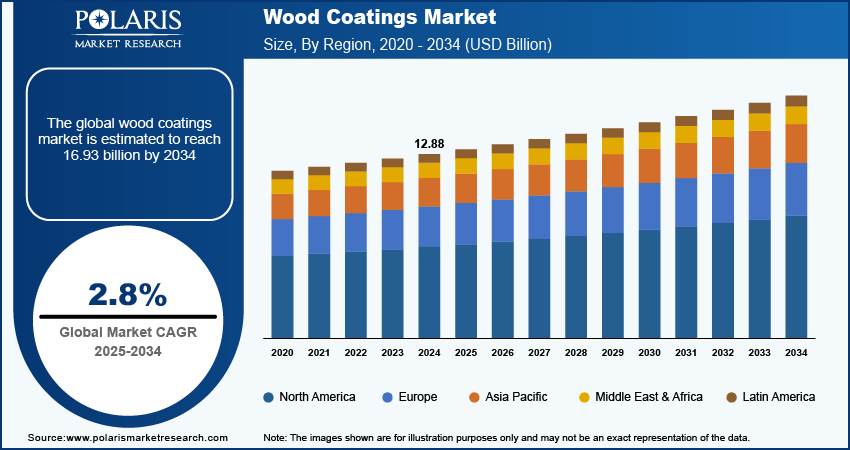
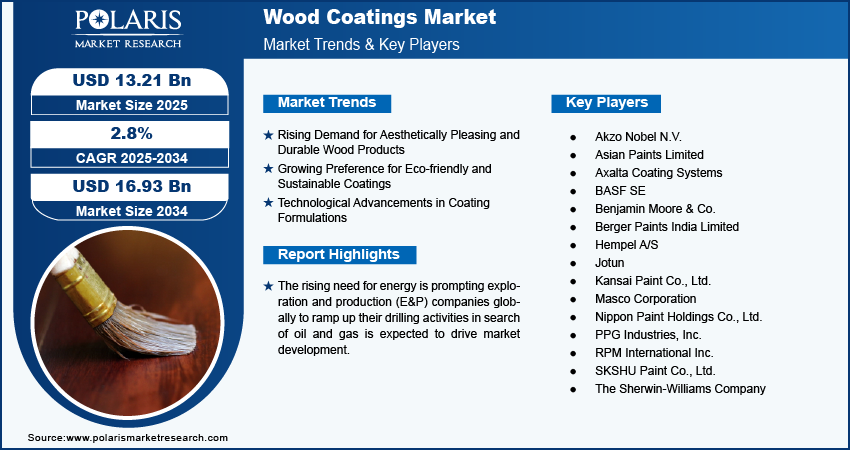
The wood coatings market size was valued at USD 13.21 billion in 2025 and is projected to grow at a CAGR of 2.8% from 2026 to 2034. Market growth is primarily driven by increased demand for aesthetically appealing wood products and the rising popularity of interior design and home renovation projects.
Market Statistics
Key Takeaways
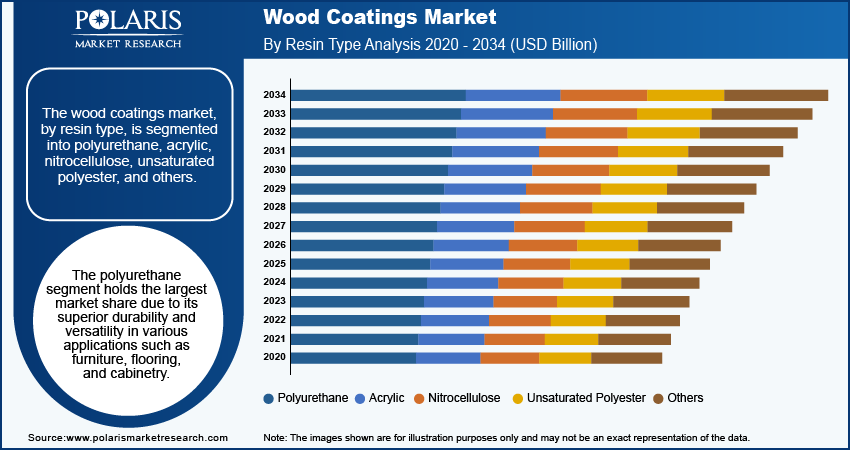
- The polyurethane segment accounted for the largest market share in 2025. The segment’s dominance is attributed to the high durability and versatility of polyurethane wood coatings across a range of applications, thereby strengthening the market.
- The waterborne segment is dominating the market. It provides environmental advantages and complies with the stringent VOC regulations. These points help in the development of the waterborne wood coatings market.
- The flooring & decking segment is witnessing the fastest growth. The increased popularity of outdoor wooden decking and hardwood flooring is driving robust growth in wood coatings for these applications.
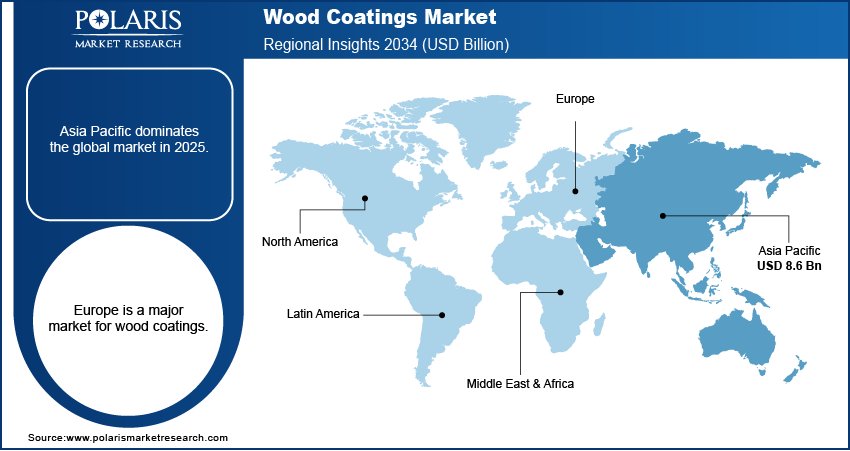
- Asia Pacific accounts for the largest market share. Rapid urbanization and infrastructure development contribute to the region’s leading position in the Asia Pacific wood coatings market.
- Europe is a major market for wood coatings. The presence of stringent emission regulations and the emphasis on sustainability define the market landscape in the region.
From an industry perspective, the wood coatings market is undergoing changes as manufacturers increasingly prioritize performance, sustainability, and compliance. The market is increasingly influenced by the trend toward low-VOC and eco-friendly coatings, particularly in developed countries, whereas developing countries are contributing to the growth in demand. The market prospects are positive due to continuous construction activity, furniture production, and renovation work in the residential and commercial sectors. Innovation in coating technology and continuous end-use demand are expected to contribute to stable market growth.
Industry Dynamics
- The growing consumer demand for durable, aesthetically pleasing wood products is driving the market.
- The shift toward eco-friendly coatings made from renewable resources with reduced toxic VOC emissions is affecting the market.
- The emergence of UV-cured and water-based coatings is opening up highly profitable avenues.
- The wood coatings industry is challenged by fluctuations in raw material costs, particularly for resins and additives, which are pressuring manufacturers' margins.
- Strict regulations on VOC emissions are increasing formulation costs while also stimulating the development of sustainable solutions, such as bio-based and waterborne wood coatings.
Source: Polaris Market Research Analysis
The market comprises protective and decorative coatings for wood surfaces, including furniture, flooring, and structural wood. The market is driven by rising demand for high-performance wood products with aesthetic appeal. The market is influenced by the growing adoption of eco-friendly, low-VOC wood coatings and the emergence of new technologies, including water-based and UV-cured wood coatings. The growing interest in home renovation and interior design is also increasing demand for high-performance wood coatings.
Market Dynamics
Rising Demand for Aesthetically Pleasing and Durable Wood Products
The increasing demand for high-quality, durable, and aesthetically pleasing wood products is driving the market. The extensive use of wood in furniture, construction, and automotive sectors is also driving demand for wood coatings. Consumers demand coatings that enhance wood's aesthetic properties and provide durability by resisting moisture, UV, and wear. The growing global demand for furniture, particularly high-quality and luxury furniture, is driving demand for high-performance wood coatings.
The industry is also developing wood coatings that are attractive and durable. The coatings are water-, UV-, and abrasion-resistant, making them suitable for high-traffic zones.
Growing Preference for Eco-Friendly and Sustainable Coatings
Environmental sustainability has emerged as a major concern for industries worldwide, including the wood coatings industry. With the increasing stringency of regulations and consumers' growing awareness of the environmental impacts of products, there is a growing need for eco-friendly coatings that emit lower levels of toxic VOCs and are made from renewable resources. Water-based coatings, which are more environmentally friendly than the previous solvent-based coatings, are also gaining popularity. In the U.S., the EPA's strict regulations on VOC emissions are encouraging the development of environmentally friendly coatings.
Technological Advancements in Coating Formulations
Innovation in coating technology, including UV and water-based coatings, is propelling the wood coatings market. UV coatings have the advantages of rapid curing and high durability, making them well-suited for the furniture and flooring industries, where faster production is required. Water-based coatings are gaining popularity due to their non-toxicity, ease of application, and stain, scratch, and UV-resistant properties. Advances in coating formulations are increasing their efficiency, thereby fueling the growth of the wood coatings industry.
Source: Polaris Market Research Analysis
Segment Insights
Market Assessment – Resin Type-Based Insights
The wood coatings market, by resin type, is classified into polyurethane, acrylic, nitrocellulose, unsaturated polyester, and other resins. Polyurethane holds a prominent market share due to its high durability and versatility. Polyurethane has high resistance to water, abrasion, and UV light. This makes polyurethane a prominent material in the high-performance wood coatings industry. The demand for polyurethane wood coatings is high in the construction and furniture markets, where durability is a key consideration. In addition, the market is growing rapidly due to rising consumer demand for high-quality products that deliver enhanced performance and durability.
The market for acrylic resin is expanding rapidly because of the increasing demand for environmentally friendly and water-based coatings. Acrylic coatings are widely used due to their low VOC content, which meets environmental standards. Water-based acrylic coatings are being adopted in countries with stringent environmental standards, thereby fueling growth in the residential and commercial markets. Other resins, such as nitrocellulose and unsaturated polyester, are also expanding but at a slower pace than acrylic and polyurethane resins.
Market Outlook – Technology-Based Insights
The wood coatings market is segmented by technology into waterborne, solvent-borne, powder, radiation-cured, and other coatings. Water-based coatings currently hold the largest market share due to their environmental friendliness and compliance with strict VOC regulations. They are in high demand because of their safety, ease of application, and environmental friendliness, mainly in Europe and North America. With the increasing emphasis on sustainable development, waterborne coatings are expected to grow the fastest due to advances in resin technology that provide resistance to stains, scratches, and UV radiation for furniture and flooring.
The solvent-borne segment is still significant, particularly in countries with less stringent environmental regulations. It exhibits excellent durability but has a slow growth rate due to stringent regulations. Powder wood coatings are increasingly used in the industrial sector because they are durable and environmentally friendly, with no VOCs. UV-cured wood coatings are a niche market due to their rapid curing properties.
Although solvent-borne wood coatings remain cost-effective in less-regulated markets, their future growth is increasingly hindered by environmental concerns. On the other hand, the UV-cured wood coatings and powder wood coatings show potential, particularly in industrial applications, where rapid curing and the absence of VOCs are distinct advantages.
Market Evaluation – Application-Based Insights
The wood coatings market, by application, is segmented into furniture, joinery, flooring & decking, siding, and others. The furniture segment accounts for the largest market share, driven by ongoing demand for high-quality, visually appealing furniture products. With growing consumer demand for durable, aesthetically pleasing furniture, the demand for coatings that provide protection and aesthetic appeal is also increasing. This market comprises coatings for wood surfaces in residential, commercial, and office furniture, with a focus on durability and scratch resistance. The furniture sector's growth is supported by trends in interior design, where wood finishes are highly sought after for their natural aesthetic and versatility. The increased demand for premium furniture and custom designs is driving this segment's strong market presence.
The flooring and decking category is expanding the fastest. This is because demand for hardwood flooring and decking is increasing. Customers prefer the products because they are durable and attractive. Flooring and decking require coatings that are resistant to wear, water, UV, and damage.
The major growth in the flooring and decking wood coatings industry is being driven by the rising investment in outdoor living and renovation. This is creating a demand for wood coatings with improved UV and water resistance.
Source: Polaris Market Research Analysis
Regional Insights
The report covers the following regions, North America, Europe, Asia Pacific, Latin America, the Middle East, and Africa. Asia Pacific dominates the global market. This is due to rapid urban growth, new construction, and increasing demand in the furniture and construction industries. Increasing per capita incomes and a growing middle class are driving demand for high-quality, durable, and aesthetically pleasing wood products. Asia Pacific also has a strong manufacturing sector and increased expenditures on home improvement and renovation. Although North America and Europe are growing steadily due to the availability of eco-friendly coatings and stringent regulations, Asia Pacific's production and consumption volumes make it the leading market. China, India, and Japan are major participants in Asia Pacific market, with China being a major global producer of furniture and wood products.
Europe is a major market for wood coatings. Low-VOC and waterborne coatings are in high demand as companies follow European Union regulations. Germany, Italy, and France are the major players in this market, with well-established furniture and construction industries. Renovation and restoration activities, particularly in Western Europe, are also increasing demand for durable, aesthetically pleasing wood coatings.
Source: Polaris Market Research Analysis
Key Players and Competitive Insights
The wood coatings market comprises several prominent companies that are actively driving its growth and innovation. A few notable players include PPG Industries, Inc.; The Sherwin-Williams Company; Akzo Nobel N.V.; Nippon Paint Holdings Co., Ltd.; RPM International Inc.; Axalta Coating Systems; BASF SE; Asian Paints Limited; Kansai Paint Co., Ltd.; Masco Corporation; Jotun; Hempel A/S; Benjamin Moore & Co.; SKSHU Paint Co., Ltd.; and Berger Paints India Limited. These companies offer a diverse range of wood coating products catering to various applications and industries.
In the competitive market, Sherwin-Williams is a major company with a diversified product line and a strong global presence. The company’s position has been enhanced by the acquisition of Sayerlack. PPG Industries has a strong market position because of innovation and a diversified range of coating products. Akzo Nobel emphasizes sustainability and offers environmentally friendly products to meet growing demand. Nippon Paint uses advanced technology to provide high-performance coatings, while RPM International provides specialty coating solutions.
Regional players are also important in determining the wood coatings industry. Asian Paints, an Indian firm, has a strong presence across Asia Pacific, with products tailored to local environmental conditions. Kansai Paint, a Japanese firm, is expanding through alliances and the adoption of new technologies. European firms such as Jotun and Hempel A/S are also expanding, offering high-quality products and extensive distribution networks.
PPG Industries, established in 1883 and headquartered in Pittsburgh, Pennsylvania, is a worldwide supplier of paints, coatings, and specialty materials. The company serves various industries, including industrial, automotive, and architectural coatings, with a primary emphasis on innovation and sustainability.
Sherwin-Williams was founded in 1866 and is headquartered in Cleveland, Ohio. The firm manufactures and sells paints and related products. It has more than 5,000 stores in the U.S., Canada, Latin America, and the Caribbean. Sherwin-Williams markets its products to both professionals and do-it-yourselfers. The firm plans to expand globally and develop environmentally friendly products.
How We Forecast the Wood Coatings Market
Our wood coatings market forecasts are based on a comprehensive research process that combines primary and secondary sources. We examine historical data, current trends, government regulations, and emerging technologies to forecast market size and growth. The factors that influence our forecasts include production volumes, market prices, resin demand, and demand in the furniture, flooring, construction, and industrial sectors. The markets are examined with respect to economic trends, construction activity, furniture production, and government regulations.
Value Chain & Cost Structure Analysis
The value chain for wood coatings begins with raw material suppliers, who provide resins, solvents, additives, and pigments. These raw materials account for a substantial part of production costs. Coating manufacturers process the raw materials through formulation, blending, and testing. The distribution process takes place through direct sales to large OEMs, furniture manufacturers, and construction companies, as well as through regional distributors and retailers. Fluctuations in raw material prices, energy costs, regulatory compliance costs, and logistics drive cost structures. However, the increasing investment in waterborne and low-VOC products is also altering production costs. In addition, digital manufacturing and supply chain management are improving the industry's profitability.
Buyer Personas: Who Uses Wood Coatings and Why
Wood coatings are used by various consumer categories, and each category has distinct demands regarding performance, cost, and safety. Wood coatings for furniture manufacturers must be aesthetically pleasing, durable, and scratch-resistant for high-end products. Construction and flooring companies require coatings that are robust, water-resistant, and UV-stable, particularly in high-traffic and outdoor environments. Industrial and OEM customers require coatings that are quick-drying, consistent in quality, and easy to manufacture, making UV-cured and powder coatings the preferred choice. Contractors and DIYers also require coatings that are easy to apply and have low VOCs, meeting environmental and health regulations.
List of Key Companies
- Akzo Nobel N.V.
- Asian Paints Limited
- Axalta Coating Systems
- BASF SE
- Benjamin Moore & Co.
- Berger Paints India Limited
- Hempel A/S
- Jotun
- Kansai Paint Co., Ltd.
- Masco Corporation
- Nippon Paint Holdings Co., Ltd.
- PPG Industries, Inc.
- RPM International Inc.
- SKSHU Paint Co., Ltd.
- The Sherwin-Williams Company
Industry Developments
October 2025: The wood coatings industry is being driven by factors including digitalization, sustainability, and AI integration. Firms are entering into strategic partnerships to leverage each other’s strengths. Competition is shifting from being price-based to innovation, technology, and supply chains.
July 2025: In the U.S., Sherwin-Williams collaborated with a leading technology company to apply AI in product development. The collaboration between Sherwin-Williams and the technology company is expected to enhance innovation and operational efficiency. Sherwin-Williams will apply technology to improve customer connectivity and product customization.
September 2024: Sherwin-Williams has introduced SHER-WOOD Environmentally Adaptive (EA) Hydroplus technology. This new waterborne wood coating is effective across a range of environmental conditions without the productivity losses typically associated with waterborne coatings.
June 2024: Axalta Building Products, a division of Axalta Coating Systems, has introduced the Zenamel range of solutions designed for the cabinet manufacturing market.
Wood Coatings Market Segmentation
By Resin Type Outlook
- Polyurethane
- Acrylic
- Nitrocellulose
- Unsaturated Polyester
- Others
By Technology Outlook
- Waterborne
- Solvent-Borne
- Powder Coating
- Radiation Cured
- Others
By Application Outlook
- Furniture
- Joinery
- Flooring & Decking
- Siding
- Others
By Regional Outlook
- North America
- US
- Canada
- Europe
- Germany
- France
- UK
- Italy
- Spain
- Netherlands
- Russia
- Rest of Europe
- Asia Pacific
- China
- Japan
- India
- Malaysia
- South Korea
- Indonesia
- Australia
- Vietnam
- Rest of Asia Pacific
- Middle East & Africa
- Saudi Arabia
- UAE
- Israel
- South Africa
- Rest of Middle East & Africa
- Latin America
- Mexico
- Brazil
- Argentina
- Rest of Latin America
Report Scope
| Report Attributes | Details |
| Market Size in 2025 | USD 13.21 Billion |
| Market Size in 2026 | USD 13.55 Billion |
| Revenue Forecast by 2034 | USD 16.93 Billion |
| CAGR | 2.8% from 2026 to 2034 |
| Base Year | 2025 |
| Historical Data | 2021–2024 |
| Forecast Period | 2026–2034 |
| Quantitative Units | Revenue in USD billion, 2021–2034, and CAGR from 2026 to 2034 |
| Report Coverage | Revenue Forecast, Market Competitive Landscape, Growth Factors, and Trends |
| Segments Covered |
|
| Regional Scope |
|
| Competitive Landscape |
|
| Report Format |
|
| Customization | Report customization as per your requirements with respect to countries, regions, and segmentation. |
Source: Polaris Market Research Analysis
Wood Coatings Market FAQ's
Waterborne wood coatings are gaining popularity due to low VOC emissions, regulatory compliance, good performance, and eco-friendliness.
The wood coatings market size was valued at USD 12.88 billion in 2024 and is projected to grow to USD 16.93 billion by 2034.
The market is projected to register a CAGR of 2.8% during the forecast period.
Asia Pacific held the largest share of the market in 2024.
A few key players in the wood coatings market are PPG Industries, Inc.; The Sherwin-Williams Company; Akzo Nobel N.V.; Nippon Paint Holdings Co., Ltd.; RPM International Inc.; Axalta Coating Systems; BASF SE; Asian Paints Limited; Kansai Paint Co., Ltd.; Masco Corporation; Jotun; Hempel A/S; Benjamin Moore & Co.; SKSHU Paint Co., Ltd.; and Berger Paints India Limited.
The polyurethane segment dominated the wood coatings market share in 2024.
The waterborne segment holds the largest market share in 2024.
Wood coatings are protective and decorative finishes applied to wooden surfaces to enhance their durability, appearance, and resistance to environmental factors such as moisture, UV light, and wear. These coatings are commonly used in applications such as furniture, flooring, decking, and joinery to improve the wood's lifespan and maintain its aesthetic appeal. Wood coatings can be formulated using various resins such as polyurethane, acrylic, and nitrocellulose and are available in different technologies, including waterborne, solvent-borne, and radiation-cured options. They are designed to meet specific performance requirements while also addressing environmental and regulatory considerations, particularly through the development of low-VOC and eco-friendly products.
A few key trends in the market are described below: Rising Demand for Eco-Friendly Products: Increasing emphasis on sustainability is driving the adoption of low-VOC, waterborne, and bio-based coatings to meet environmental regulations and consumer preferences. Growth in Furniture and Construction Sectors: Expanding residential, commercial, and infrastructure projects globally are fueling demand for wood coatings in furniture, flooring, and decking applications. Technological Advancements: Innovations in coating technologies, such as UV-curable and powder coatings, are gaining traction for their superior performance, faster curing times, and reduced environmental impact. Increased Focus on Aesthetic Appeal: Growing consumer interest in high-quality finishes that enhance the visual and tactile aspects of wood surfaces is driving the development of premium coatings.
A new company entering the wood coatings market could focus on developing eco-friendly and low-VOC products to align with growing environmental regulations and consumer demand for sustainable solutions. Investing in innovative technologies, such as waterborne and UV-curable coatings, would provide a competitive edge in terms of performance and application efficiency. Targeting high-growth regions such as Asia Pacific, where rapid urbanization and construction activities drive demand, can offer significant opportunities. Additionally, building strong distribution networks and leveraging digital marketing to reach diverse customer bases would help establish a strong market presence. Emphasizing customization and premium finishes for furniture and flooring applications could further differentiate the company's offerings.
Companies manufacturing, distributing, or purchasing wood coatings and related products and other consulting firms must buy the report.
Flooring and decking are the fastest-growing markets. This is due to home renovation trends, investment in outdoor living, and the demand for coatings that provide protection against UV radiation and moisture.
Asia Pacific dominates the wood coatings market. This is due to rapid urban growth, furniture production, infrastructure development, and increasing demand for high-quality wood products.
Polyurethane resins dominate the market. This is because polyurethane resins are highly durable, water-resistant, UV-resistant, and widely used in furniture, flooring, and construction.
The wood coatings market is expected to grow from USD 13.21 billion in 2025 to USD 16.93 billion by 2034, at a 2.8% CAGR.
Download Sample Report of Wood Coatings Market
Please fill out the form to request a customized copy of the research report.


