In the past, studying genes was costly and slow. A lot of manual work was also needed. Next generation sequencing (NGS) has changed the way genes are studied. It has made it faster and more efficient. As such, it’s used by hospitals and biotech companies every day. NGS has become an important tool in various aspects of life. In this blog, we’ll look at what NGS is, how it works, and why it has such a promising future.
Next Generation Sequencing Market: Overview
Next-generation sequencing is a modern technology capable of parallel decoding of RNA or DNA fragments, based on single-molecule sequencing or sequencing-by-synthesis principles. It generates a massive amount of data that can be analyzed using dedicated bioinformatics tools. Next-generation sequencing platforms can be used to monitor, identify, detect, and discover living organisms. With the rapid development and widespread applications of NGS technologies, it is within reach to use genome sequence information to help discover life mysteries, detect pathogens, improve crop yields, and enhance the overall quality of life.
Key Market Metrics
The global next generation sequencing market stood at USD 11.74 billion in 2025, according to the latest assessment by Polaris Market Research. The market is projected to expand at a CAGR of 12.8% from 2026 to 2034.
NGS plays a crucial role in clinical diagnostics by focusing on free circulating DNA to monitor tumor development during patient treatment. In addition, next-generation sequencing can be used as a powerful tool for mapping microbial populations and detecting pathogenic microbes. Furthermore, NGS also finds application in the agricultural sector, where it is used for genetic selection to improve crop yields. Growing awareness of next-generation sequencing, rising investments in research activities, and the reduction in the price of NGS platforms are creating a positive environment for the global NGS market.
NGS Market Highlights
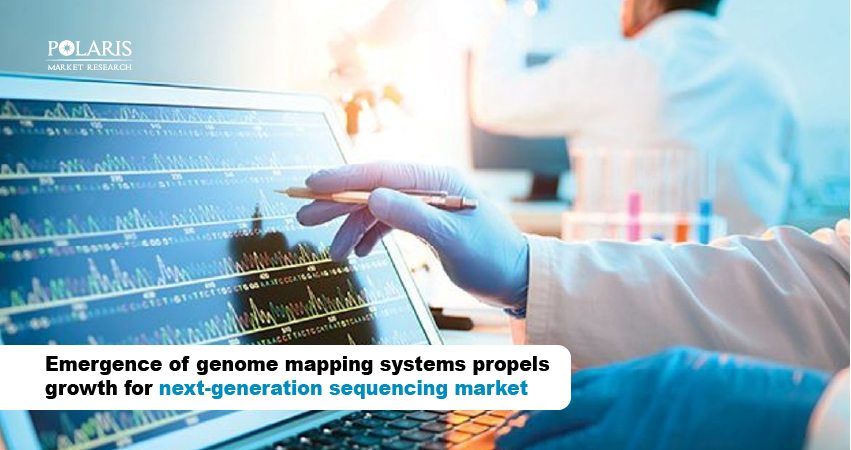
- Next-generation sequencing has effectively replaced traditional genomics methods and also simplified the study of nucleotides for future use. In addition, the introduction of genome-mapping systems is expected to be the major factor driving growth in the next-generation sequencing market in the years to come.
- Technological advancements in the healthcare industry are occurring at a rapid pace, driving the faster development of the personalized medicine market. NGS has numerous applications in personalized medicine. Thus, the increasing demand for personalized medicine creates new avenues for NGS applications.
- The diagnostics/infectious diseases segment within the application category accounted for the largest revenue share in the next generation sequencing market. This remarkable growth of the segment can be attributed to rising cancer cases worldwide, the increasing focus of leading market players on product innovation, and favorable reimbursement policies in developed countries.
- The academics segment from the end-use segment is witnessing significant growth. Increasing efforts to develop cost-effective NGS-based testing services and related products, along with major partnerships between global market players and research institutes, are supporting the segment's growth.
- The next-generation sequencing market is led by North America, followed by the Asia Pacific in terms of market share. The increasing volume of diagnostic and genomic research activities related to NGS technology is driving exponential market growth in the region. North America also leads the next generation sequencing sample preparation market.
Competitive Landscape
The global market for next generation sequencing is highly fragmented and competitive, with a few leading players dominating. Agreements, collaborations, mergers, and partnerships among companies and health centers are key strategies adopted by next generation sequencing market participants to strengthen their foothold. Leading companies working in the global next-generation sequencing market include Beijing Genomics Institute, Genomatix GmbH, Thermo Fisher Scientific, Inc., Illumina, Inc., Bio-Rad Laboratories, Inc., and Eurofins Scientific. These prominent market players are collaborating with clinical research agencies to investigate the pathogenesis of specific diseases using NGS platforms.
Conclusion
Next generation sequencing is not only a laboratory procedure, but is an emerging technology that enables many impactful discoveries in medicine, agriculture, the environment, and scientific investigation. NGS has transformed the process by which physicians diagnose diseases, agricultural research teams evaluate and develop new crops, health teams track outbreaks, and scientists conduct research on living organisms. With continued advancements in technology leading to smaller, easier, and more cost-effective devices and procedures, solutions from the next generation sequencing market will continue to be incorporated into daily life.