
Drones have revolutionized various industries, from photography and agriculture to logistics and defense. At the heart of every drone's performance lies its battery. The efficiency, longevity, and capacity of a drone battery dictate how far, fast, and effectively a drone can operate. With integrated battery management systems and longer battery life, smart battery innovations are enabling real-time monitoring and expanding drone capabilities.
As the demand for drones continues to grow, so does the innovation in battery technology. This blog explores the importance of drone batteries, the factors influencing their performance, and the top companies in the drone batteries market.
What Is the Role of Drone Batteries?
A drone's battery is its lifeline, directly influencing flight duration, payload capacity, and operational efficiency. Here’s why drone batteries are crucial:
- Flight Time: The battery capacity determines how long a drone can stay airborne. While consumer drones usually offer flight times of 20-30 minutes, industrial and military drones require extended durations.
- Payload Capacity: Drones carrying cameras, sensors, or delivery packages need batteries that provide consistent power without adding excessive weight.
- Stability of Performance: High-quality batteries ensure a consistent energy supply to the drones, thereby reducing the risk of mid-air drone failures.
- Rechargeability: Efficient batteries charge quickly and retain their capacity over multiple charge cycles and longer periods, hence reducing operational downtime.
What Are Major Market Metrics?
Our analysis reveals the drone batteries market to witness sustained growth in the years to come. The market for drone batteries is expected to account for a CAGR of 16.40% during the projection period. The market is expected to reach USD 19.87 billion by 2032.
The growing usage of drones for various applications across industries has led to increased demand for drone batteries. Rising focus of governments on the advancements of their military and defense sector, along with the introduction of advanced drones, is contributing to the drone batteries market expansion.
What Are the Types of Drone Batteries?
Drone batteries come in various types, each with its pros and cons. The following are a few different types of drone batteries:
Lithium-Ion Batteries (Li-Ion): Lithium-ion batteries are rechargeable batteries that store energy by moving lithium ions between the anode and cathode electrodes. Batteries from the lithium-ion battery market are known for their durability and stability. Li-ion batteries are a bit heavier but ideal for long-distance drones.
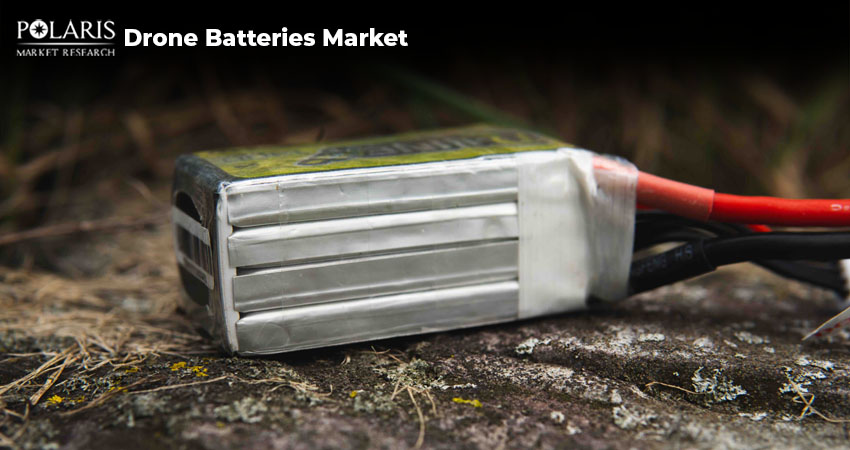
Lithium-Polymer Batteries (LiPo): These are the most common types of batteries being used, offering high energy density, lightweight properties, and flexibility in shape. However, lithium-polymer batteries are sensitive to overcharging and require careful handling.
Nickel-Metal Hydride Batteries (NiMH): Despite having a similar architecture, NiMH and lithium-ion batteries differ significantly. Compared to lithium-ion batteries, NiMH batteries, such as nickel-cadmium batteries, have higher rates of self-discharge and provide less energy and power. The memory impact affects them as well.
Solid-State Batteries: Solid-state batteries (SSBs) are a type of electrical battery that uses a solid electrolyte to conduct ions between electrodes instead of the liquid or gel electrolytes found in conventional batteries. Batteries from the solid-state battery market are an emerging technology with higher energy density, safety, and longer lifespans compared to LiPo and Li-Ion batteries.
Which Are the Top Drone Batteries Market Companies?
DaJiang Innovation Technology Company (DJI)
DJI was founded in 2006. The company's headquarters are located at DJI Sky City in Shenzhen, Guangdong, China. DJI is a global leader in drone manufacturing and accessories. Their intelligent flight batteries are renowned for reliability and performance. DJI uses LiPo technology to ensure extended flight times and safety features like overcharge protection.
Panasonic
The headquarters of Panasonic Holdings Corporation is located in Kadoma City, Osaka, Japan. The company was founded in 1918 and is a Japanese multinational pioneer in lithium-ion battery technology, supplying batteries for a variety of drones. Panasonic specializes in lightweight and durable batteries that are ideal for long-range drones.
Sony
The headquarters of the Japanese multinational company Sony Group Corporation, originally known as Tokyo Tsushin Kogyo K.K. and Sony Corporation, is located in Minato, Tokyo, Japan. It was founded in 1946 in Japan. Sony has ventured into drone battery technology, leveraging its expertise in consumer electronics. Sony excels at producing high-density lithium-ion batteries with superior energy retention. Sony is tapping into the exploration of graphene-enhanced batteries for faster charging and longer life.
MaxAmps Lithium Batteries
MaxAmps Lithium Batteries, a company that specializes in battery technology and unmanned systems, was founded in 2004. The company manufactures affordable and reliable lithium-ion and LiPo batteries for hobbyists and professionals. They have their headquarters based in Spokane, Washington, USA.
Samsung SDI
Samsung SDI started as a display maker, producing CRTs, LCDs, and PDP panels. In 2008, Samsung Mobile Display was spun off, and Samsung SDI shifted its focus to renewable energy, mainly Li-ion batteries. Samsung SDI Co., Ltd is headquartered in Yongin, South Korea. They specialize in high-density cells suitable for lightweight drones. These days, they are investing in research into next-generation battery materials like silicon anodes.
Along with these, other major drone battery companies are:
Autel Robotics: Autel Robotics produces intelligent LiPo batteries. The integration of these batteries with management systems makes safety features possible.
Amperex Technology Limited: The company offers lithium-ion battery cells that many drone manufacturers use. Several consumer and commercial drones are powered by the company’s batteries.
Venom Power: The company offers several series of LiPo batteries. Its batteries are specifically created for various types of drones and multirotors.
EaglePicher Technologies: EaglePicher Technologies is primarily engaged in the development of high-end batteries for military and aerospace applications.
Doosan Mobility Innovation: The company focuses on hydrogen fuel cell power packs for drones. Its power packs offer longer flight times than conventional batteries.
What Are the Key Drone Batteries Market Trends?
Increasing Focus on Graphene-based Batteries
Graphene is a two-dimensional material made of carbon that has a large surface area, high conductivity, and flexibility. They offer numerous benefits such as faster charging, safer, sustainability, longer lifespan, durability, and cost-efficiency.
Growing Use of Solid-State Batteries
Solid-state batteries are an advanced form of Li-ion batteries. They employ a new technology that uses a solid electrolyte instead of a liquid or gel electrolyte to convert chemical energy into electrical energy. They offer higher energy density and safety, and thus, solid-state batteries are revolutionizing drone flight times and reliability.
Rising Adoption of Smart Battery Systems
A smart battery system (SBS) allows the operating system to manage power by communicating with a smart battery charger to determine the battery's state of charge and estimated run time. Integration of artificial intelligence (AI) for real-time monitoring, predictive maintenance, and optimized performance is an area of research in this field.
Final Saying
The development of drone batteries is critical to the expansion of the drone industry. As drones become more advanced and flexible, the demand for lightweight, high-capacity, and long-lasting batteries will increase. Companies such as DJI, Samsung SDI, Panasonic, and others are leading the way, pushing the limits of battery technology to suit a wide range of operational requirements. As advancements like solid-state batteries and graphene technology gain traction, the future of the drone batteries market is brighter and lighter than ever.



 Charging Infrastructure Market.png)


