
Drone Batteries Market Size, Share, Trends and Forecast, 2026–2034
REPORT DETAILS
Drone Batteries Market Summary
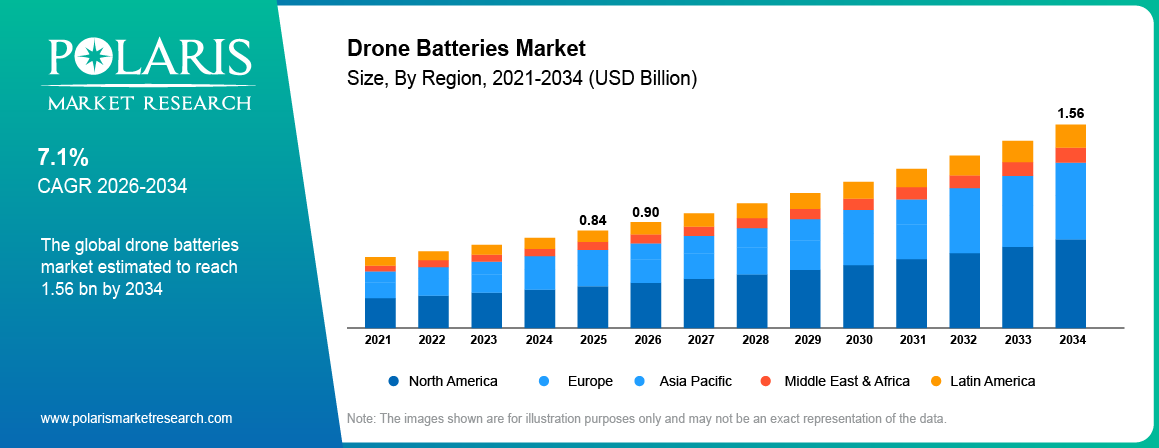
The global drone batteries market size was valued at USD 0.84 billion in 2025 and is anticipated to register a CAGR of 7.1% from 2026 to 2034. The growth is driven by rising drone demand from the military & defense sector, increasing investment, and improvements in battery energy storage.
Market Statistics
Key Takeaways
- North America dominated the global market with 33.65% revenue share in 2025, due to rising investments in the defense sector and the expanding logistics sector.
- The Asia Pacific market is anticipated to record a CAGR of 8.4% during the projected period, owing to the increased number of governments and private companies investing heavily in Unmanned Aerial Vehicle (UAV) technology.
- The Europe market is anticipated to witness a CAGR of 6.8% during the forecast period, due to rising use of drones in defense, agriculture, logistics and infrastructure inspection.
- The lithium-polymer battery accounted for 54.87% of total revenue in 2025, driven by its lightweight design and ability to deliver high power.
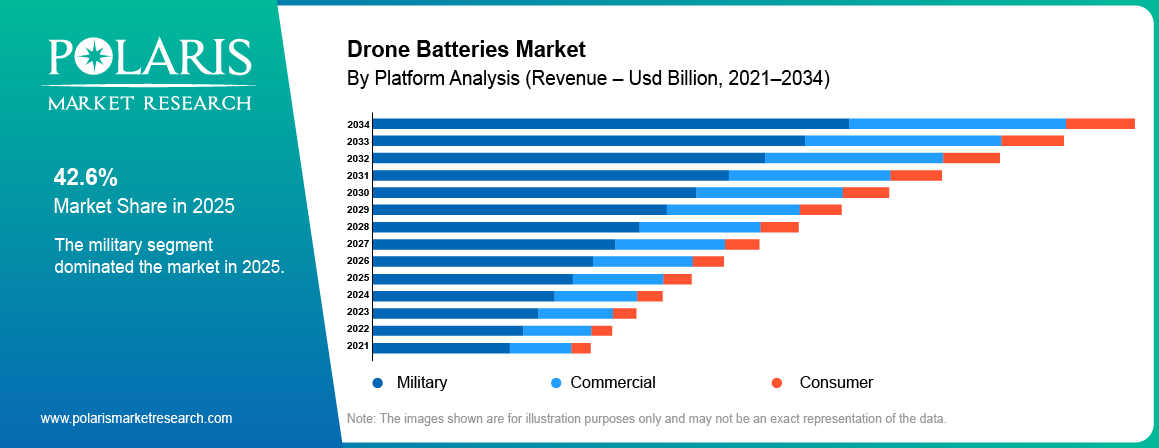
- The military drone battery market accounted for 42.6% of revenue share in 2025. The segment expansion is fueled by increasing defense expenditure, and increasing demand for drone systems within surveillance, reconnaissance & combat operations.
Note: Figures and projections outlined in this report are the result of Polaris Market Research’s proprietary analytical processes, grounded in the latest available datasets and market observations.
What are Drone Batteries?
Drones (UAVs) rely on batteries for power in order to operate their motors, flight control, sensors and payload. The capacity (measured in mAh/Wh) determines how long a drone can fly for. The C rating determines how much power it can deliver, and the energy density (Wh/kg) determines how much weight is needed to achieve that flight time. Drones are available in many forms, from small quadcopter drones to long endurance military drones, which is leading to a wide variety of requirements for batteries.
The drone batteries market emphasizes rechargeable battery packs and fuel cell power systems used in drones. Battery packs contain a series of cells, a Battery Management System (BMS) that monitors voltage, temperature, and charge, a housing, and connectors. This market can be split down by type of battery chemistry (Lithium-Ion, Lithium Polymer, Solid-State, Hydrogen Fuel Cell, Nickel Based and Others), platform (Military, Commercial and Consumer), capacity and region. Robot batteries and eVTOL passenger aircraft are excluded from the research scope.
Demand is driven by the defense sector and use of low cost drones in battle, therefore high discharge Lithium Polymer battery packs are seeing greater demand. Commercial applications such as inspection, mapping, agriculture and delivery are driving demand for longer endurance Lithium Ion and Silicon Anode cells. Regulations in the supply chain (FCC Covered List in December 2025, NDAA in the U.S.) are driving demand for non-Chinese cells. Today the market is dominated by Lithium-based batteries but Semi-Solid State, Lithium Metal and Hydrogen Fuel Cells are beginning to emerge from pilot projects to early market entry. Demand is led by North America, manufacturing is led by Asia Pacific and Europe are building up local capacity. Additional demand comes from aftermarket battery packs.
How Do Drone Batteries Work?
Drone batteries supply the power needed to operate a drone. They store electrical energy and release it to run the motors, cameras, sensors, and other onboard systems. When the drone is switched on, the battery sends power to these components. This allows the drone to take off, fly, hover, and land. Most drones use rechargeable lithium-based batteries because they are lightweight and provide good power. The battery’s capacity and efficiency affect flight time, performance, and charging needs.
AI Impact on Drone Batteries Market
- Artificial intelligence (AI) improves battery performance by optimizing energy use and extending drone flight time.
- AI predicts battery failures by monitoring battery health and identifying early warning signs.
- The technology optimizes charging cycles to reduce charging time and extend battery life.
- It improves flight-time estimates by analyzing battery levels, weather, and drone weight.
- Integration of AI helps enhance battery safety by detecting overheating and unusual voltage changes.
- AI accelerates battery development by helping manufacturers identify better materials and improve battery designs.
Market Dynamics
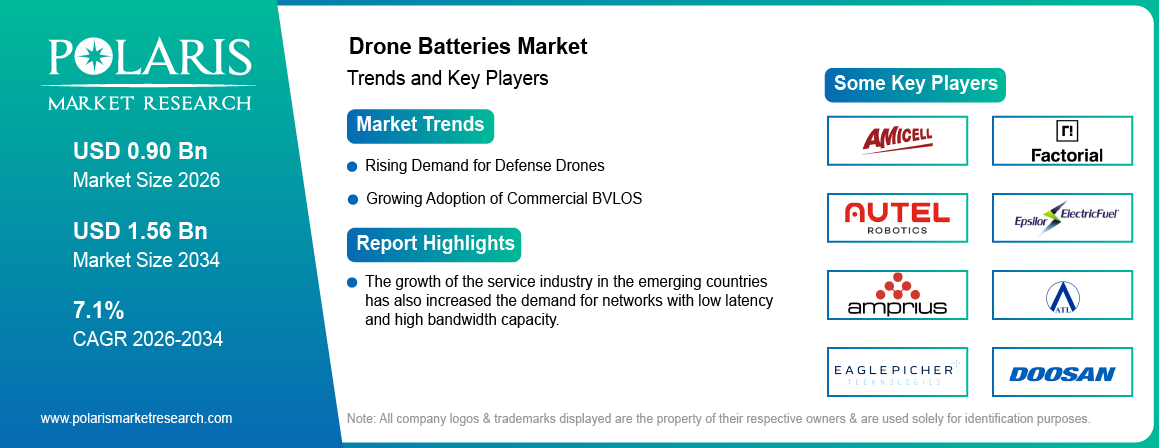
Driver: Rising Demand for Defense Drones
The increasing demand for drones within the defense sector is increasing the drone battery market share due to their use of drones for surveillance, monitoring borders, collection of intelligence, and engaging in combat. For instance, in October 2026, the Indian government cleared capital acquisition proposals for drones and other defense equipment worth USD 22.28 billion. These require reliable batteries in order to provide long flight times and consistent performance. As drones become more widely used in modern warfare, there is an increased requirement for drone batteries. Defense agencies are investing in expanding their drone fleet, accelerating the demand for lightweight, high-capacity, and durable batteries (Source: bharatshakti.in).
Driver: Growing Adoption of Commercial BVLOS
The increasing use of Beyond Visual Line of Sight (BVLOS) drones is supporting the drone batteries market growth. BVLOS drones can operate outside of the operators view. They are used for many commercial applications, including agriculture, infrastructure inspections, delivery, and monitoring of remote areas. They often require longer flight times and reliable power. This is increasing demand for batteries with long runtimes and fast charging capabilities. As regulations and infrastructure develop, the increased use of BVLOS drones contributes to market growth.
Driver: Increased Energy Density
Batteries with higher energy density are contributing to growth in the drone battery market. Energy density describes how much energy can be stored within the battery. High energy density batteries extend flight times without significant added weight. This is beneficial for delivery, inspections, mapping, and defense applications. Manufacturers are improving battery materials to increase performance. For instance, in September 2026, Neo Battery launched high density 6.3Ah 21700 cylindrical battery. The battery achieves 307 Wh/kg, specifically for drones and robotics (Source: finance.yahoo.com). Such improvements will increase drones' payload capacity and enable longer missions, making them more useful across industries.
Restraint: High Costs of Solid-State Batteries/Fuel Cells
High costs of solid-state batteries/fuel cells are restraining growth. Batteries can offer increased flight duration and improved performance. They can be costly to develop and manufacture. High investments are required in new innovative materials, specialist machinery, and testing. This drives up drone battery prices, making them less attractive for smaller companies and those seeking to reduce costs. These aspects can slow down the growth of the industry.
Challenge: Risk of Fire
This fire risk in batteries limits market adoption. The majority of drones utilize lithium battery technology. These batteries can overheat or catch fire. This raises concerns about battery safety during charging, storage, transport, and operation. Therefore, manufacturers need to invest in protective systems and safety testing. This can cause higher production costs. This can also affect how customers feel about using products with this issue. Safety concerns may lead to the need for safety regulations for the use of batteries for different uses of drones.
Restraint: Reliance on Imports
Dependence on imported battery cells can create challenges for the drone (UAV) battery market. Manufacturers will often source their key components from abroad. This can cause manufacturers to suffer from delays, import duty changes, and currency rate fluctuations. Regulations can increase costs and disrupt production schedules. If there aren’t many manufacturers within the area, this can cause higher reliance on overseas sources. This can lead to less stable battery pricing for manufacturers.
Opportunity: Emphasis on Domestic Cell Production
The expansion of domestic battery cell production will create growth opportunities in the drone batteries market. Domestic production can help reduce reliance on imported cells and reduce risks within the supply chain. It can aid manufacturers to control costs and provide batteries. With government support and investments in battery production, there can be an increase in growth. As demand for drones continues to grow in the defense, agriculture, and commercial sectors, domestic battery production can help meet demand and boost the drone industry.
Opportunity: Aftermarket Battery Packs
The aftermarket battery pack segment is expected to offer strong opportunities in the drone batteries industry. Over time, drone batteries will lose charge and therefore will need to be replaced. This can create a constant demand for battery packs to be purchased by drone owners and companies. Customers may also want to purchase additional batteries to reduce downtime. As drones become more common within the agriculture, delivery, defense, and inspection sectors, there will be an increase in demand for compatible and reliable battery packs. This can create opportunities for battery manufacturers and replacement parts.
Opportunity: Hybrid Fuel Cell Systems
Hybrid fuel-cell systems will offer new opportunities in the UAV battery market. Hybrid systems combine fuel cell and battery technologies to provide power to drones. The fuel cells can provide increased flight times, whereas batteries can provide increased power during take off and sudden demand. This can be useful for long-distance deliveries, monitoring, and infrastructure inspection. As industries try to increase drone runtime, there may be increased interest in hybrid systems. Improvements to cost, size, and reliability could also help increase uptake.
Drone Batteries Market Segmental Insights
Battery Chemistry Analysis
The lithium-polymer battery accounted for 54.87% of total revenue in 2025. Demand for LiPo drone battery is driven by its lightweight design and ability to deliver high power. These batteries support quick acceleration and rapid changes in power demand during flight. Their flexible shapes also allow manufacturers to design compact drones. Growing demand for racing drones, consumer drones, and high-performance unmanned aircraft is supporting the use of lithium-polymer batteries.
The lithium-ion battery segment is expected to witness a CAGR of 7.4% during the forecast period. The growth is attributed to its high energy storage capacity, long service life, and reliable performance. These batteries offer a good balance between weight, cost, and flight time. Their wide availability and established manufacturing processes also support adoption. Growing demand for drones in defense, agriculture, delivery, and inspection is further increasing the need for lithium-ion drone battery.
The solid-state battery segment is expected to grow at an 8.9% CAGR during the forecast period. It is supported by the demand for longer flight times and improved battery safety. These batteries use solid materials instead of liquid electrolytes. This design may offer higher energy storage and lower fire risk. Ongoing research and investment are improving their performance. Growing interest in advanced defense and commercial drones is encouraging the development of solid-state drone battery technology.
The hydrogen fuel cell segment is expected to witness a CAGR of 8.2% during the forecast period, driven by the need for longer flight times and extended drone operations. These systems generate electricity using hydrogen and oxygen. They can help drones remain airborne longer than many conventional battery systems. Growing demand for long-distance delivery, industrial inspections, and defense surveillance is supporting their development. Improvements in fuel cell design are also helping expand their potential use.
Lithium-Ion vs Lithium-Polymer (LiPo) vs Solid-State/ semi-solid-state drone battery /Li-Metal vs Hydrogen Fuel Cell (hydrogen vs lithium drone battery)
| Attribute | Lithium-Ion | Lithium-polymer (LiPo) | Solid-state / semi-solid / Li-metal | Hydrogen fuel cell |
| Energy density | ~200–300 Wh/kg; silicon-anode cells 450–520 Wh/kg (Amprius SiCore) | ~150–250 Wh/kg | Up to 350 Wh/kg semi-solid (Grepow); 364 Wh/kg pack (Sion Licerion) | System-level; flight time is the metric (Doosan DS30 up to ~2 h) |
| Cycle life | ~500–1,000+ | ~200–500 | Limited field data | Set by stack life; not comparable per cycle |
| Power delivery | Moderate to high | Very high discharge | Improving; varies by design | Steady; needs a battery buffer for peaks |
| Cost | Moderate | Low | High | Highest |
| Safety profile | Thermal-runaway risk | Swelling and fire risk | Improved | Hydrogen storage and handling |
| Maturity | Mass market | Mass market | Pilot to early commercial | Niche; pilot to early commercial |
| Best-fit platform | Commercial survey, delivery; premium consumer | FPV, multirotor, short-range military and consumer | ISR and long-endurance defense | Heavy-lift, long-range, BVLOS |
| Named 2025–26 examples | Amprius SiCore; DJI TB100 | MaxAmps; Grepow (Tattu) | Factorial FEST; Sion Licerion; Grepow semi-solid; SES AI | Intelligent Energy IE-FLIGHT 120; Doosan DS30 |
Source: Polaris Market Research Analysis
Platform Analysis
The military drone battery segment accounted for 42.6% of revenue share in 2025. The military drone battery market size is driven by increasing defense expenditure and rising demand for drone systems within surveillance, reconnaissance & combat operations. Reliable batteries are required to extend mission durations and support advanced equipment. Lightweight, high-power batteries are increasingly in demand. Unmanned Air Vehicles are becoming widely used in modern warfare, which is fueling the demand for high-performance batteries in military operations.
The commercial segment is anticipated to record a CAGR of 7.8% during the forecast period. This is attributed to increased usage across sectors such as agriculture, logistics, construction, and infrastructure. Businesses use drones to reduce operational hours and improve efficiency. This means there is a demand for batteries to increase flight hours and frequent operations. With rising demand for drone deliveries, crop monitoring, and industrial inspections, the need for reliable, lightweight, rechargeable commercial drone batteries is growing, fueling segment growth.
As per our drone battery market forecast 2034, the consumer drone segment is expected to exhibit a CAGR of 6.5% during the projected period. The growth is supported by rising interest in aerial photography, videography, recreation, and personal drone use. Consumers prefer batteries that offer longer flight times, quick charging, and reliable performance. The growing popularity of social media content creation is also supporting demand for camera drones. Improvements in battery design and the availability of affordable consumer drones are further encouraging market growth.
| Platform | Battery requirements | Chemistry skew | Demand signals |
| Military | High energy density, ruggedized, wide temperature range, NDAA / Buy American compliance | LiPo for FPV drone battery and loitering; silicon-anode Li-ion; solid-state and fuel cell for ISR | Ukraine output over 4M drones (2025), target above 7M (2026); EaglePicher on Global Hawk, X-47B |
| Commercial | Cycle life, fast charge, hot-swap, BMS data | Li-ion; LiPo; fuel cell for heavy-lift | - |
| Consumer | Low cost and weight, safety, small packs | LiPo dominant; Li-ion in premium models | High unit volume; replacement packs |
Source: Polaris Market Research Analysis
Drone Type Analysis
The mini quad segment accounted for major market revenue share of 38.6% in 2025, and is anticipated to retain its market position during the projected period. These types of drones have become increasingly popular and gained traction in recent years, especially among hobbyists and drone enthusiasts, which has fueled the demand and growth of the segment market. Moreover, the significant advancements in battery technology, that allows for longer flight-times and enhanced performance and rising affordability of mini quad drones, which makes them more accessible in wide range of industries including delivery, agriculture, and construction.
The macro quad segment is likely to record a significant CAGR of 7.6% during the forecast period. The growth is mainly driven by the rising popularity of drone racing as a sport, which has led to an increased demand for high-performance batteries. These batteries can power racing drones for longer periods as well as provide the necessary power for high-speed maneuvers. Moreover, its versatility that allows it to be used for a wide range of applications. Besides this, they are also used in industries such as agriculture, construction, and mining for monitoring and inspection tasks, which in turn, has been propelling the market growth.
The commercial and industrial segment is expected to witness a CAGR of 8.1% during 2026–2034. This growth is attributed to the rising use in agriculture, construction, logistics, and infrastructure inspection. Businesses use drones to improve efficiency, reduce manual work, and save time. These applications require batteries that support longer flight times and frequent operations. Growing demand for drone deliveries, crop monitoring, and industrial inspections is increasing the need for reliable, lightweight, and high-capacity battery solutions.
Battery Capacity Analysis
The 3000–5000 mAh segment is expected to grow at a significant CAGR of 7.5% during the anticipated period. The growth is highly attributed to increased demand for longer flight times, higher payload capacity, and continuous advancements in drone battery technology. Also, the rising awareness regarding its capabilities to offer good balance between flight time, weight, and cost boosts the segment growth.
The below 3000 mAh segment led the industry with a substantial market share of 42.8% in 2025. The dominance is supported by rising demand and popularity of drones that are designed to be lightweight and compact. These batteries are ideal for meeting these requirements, while allowing for longer flight times and better maneuverability.
Use Cases and Named Examples
| Application | Named example |
| Enterprise heavy-lift inspection and mapping | DJI Matrice 400 with TB100 |
| Military high-altitude and unmanned combat aircraft | EaglePicher batteries on RQ-4 Global Hawk, Aurora Excalibur, X-47B |
| Urban delivery | Matternet with Amprius |
| Agricultural spraying | Hylio with KULR NDAA-compliant systems |
| Offshore and BVLOS endurance | Intelligent Energy 25 kg hexacopter, Llanbedr |
| Mid-size endurance upgrade | Sion Power Licerion Strike on Astro Max |
| Industrial hydrogen flight | Doosan DS30, 2.6 kW fuel cell, up to ~2 h |
| Public safety and surveillance in India | Garuda Aerospace SURAJ |
Source: Polaris Market Research Analysis
Regional Analysis
North America Drone Batteries Market Trends
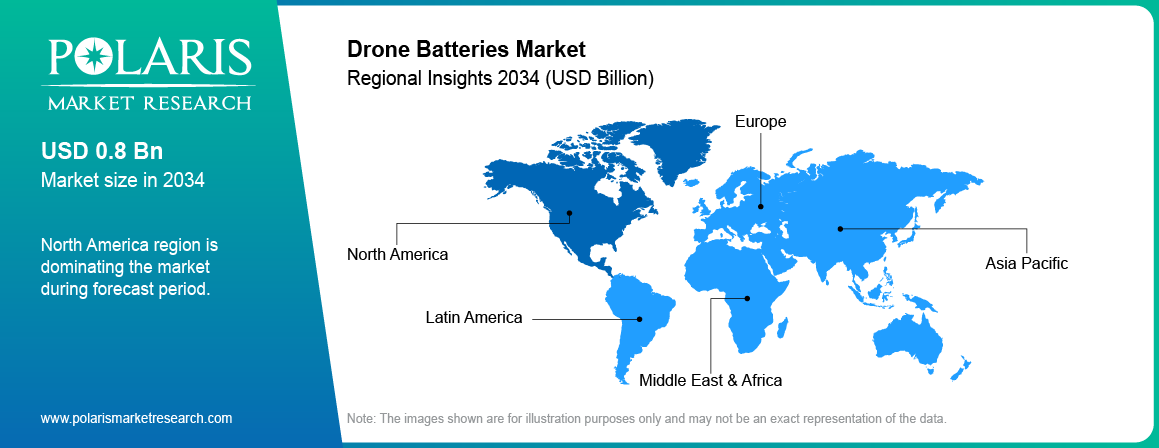
North America dominated the global drone batteries market share with 33.65% in 2025. The regional market growth can be largely accelerated due to the growing focus and incorporation of drone batteries that are energy-efficient, cost-effective, and higher payload capacity. The batteries are ideal for various commercial applications like last mile delivery. Additionally, there are numerous government regulations that are being implemented by countries across the region. For example, the Federal Aviation Administration (FAA) in the U.S. has established clear regulations for drone operations, including battery safety requirements, as these regulations have created a supportive environment for the market. Such regulatory landscape boosts the drone adoption, pushing the demand for drone batteries.
Asia Pacific Drone Batteries Market Trends
The Asia Pacific market is anticipated to exhibit the highest CAGR of 8.4% during the study period. The growth is attributed to the increased number of governments and private companies investing heavily in Unmanned Aerial Vehicle (UAV) technology. It led to the development of advanced drone batteries. This is also creating new opportunities for drone manufacturers and battery suppliers in the region.
Europe Drone Batteries Market Trends
The Europe market is anticipated to witness a CAGR of 6.8% during the forecast period. This is due to increased use of drones in defense, agriculture, logistics, and infrastructure inspection. Increased investments in defense technologies have increased demand for reliable batteries with long flight times. Drones are increasingly being used in agriculture by farmers to monitor crops. Commercial drone services are also growing in popularity, increasing demand for batteries. A rising focus on local battery production and performance improvements is creating growth opportunities across the region.
Middle East and Africa Drone Batteries Market Trends
The drone batteries market in the Middle East and Africa is witnessing growth at a CAGR of 6.4% due to increased defense spending. Countries within the region are increasingly using drones for security and surveillance. They are also adopting drones for inspection work in the oil and gas industry, agriculture and infrastructure. This has increased demand for reliable batteries. Investments in smart city projects and industry have increased drone usage. An increased focus on modernizing defense systems is also driving demand for high-performance drone batteries.
Latin America Drone Batteries Market Trends
The drone batteries market in Latin America is expected to record a CAGR of 6.8% during the forecast period. The growth is attributed to an increased use of drones within agriculture, mining, energy, and infrastructure. Large farms are adopting drones to monitor their crop. Mining and energy companies are using drones to monitor remote locations and equipment. This has increased demand for batteries with long flight times. Increased investments in commercial drone services and an increased use of drones for security and surveillance are also driving growth.
Regional Insights Summary Table
| Region | Role in market | Named signals |
| North America | Largest Market with 33.65% Share | FCC and NDAA rules, Drone Dominance framework, U.S. cell makers (Amprius, Sion Power, KULR, Lyten) |
| Europe | Local capacity build-out and defense demand | Titan Batteries Tilburg; UK hydrogen BVLOS flight and ATI HEIGHTS funding; Lyten’s Northvolt Sweden assets |
| Asia Pacific | Fastest-growing | China produces roughly 99% of drone batteries (DroneXL); Japan: Terra Drone battery business; South Korea: Doosan DS30, SES AI Chungju, Amprius–Intralink; India: Garuda Aerospace |
| Latin America; Middle East & Africa | Emerging Markets | - |
Source: Polaris Market Research Analysis
Policy and Supply Chain: FCC Covered List and NDAA
The policy and supply chain landscape is changing within the drone battery industry. The recent FCC Covered List means foreign-manufactured drones and key components, including batteries and smart batteries, may be seen as national security risks. This has made it difficult to get new equipment approved and increased complexity with importing, selling, and replacing. NDAA procurement means that the DoD and Federal Government cannot use drones and batteries connected to foreign entities of concern. This has led to an increase in demand for battery packs that can be traced back to the USA or allied nations. However, there are increased costs in the short term, less choice of suppliers and increased lead times. Manufacturers will also need to complete audits of their multi-tiered BOMs, identify alternative suppliers and re-design their products (Source: ucanr.edu).
Drone Batteries Market Competitive Insights
The drone batteries market is highly competitive, with established manufacturers and emerging technology companies serving different applications. Key players include SZ DJI Technology, Shenzhen Grepow, EaglePicher Technologies, and RRC Power Solutions. Companies such as Amprius Technologies focus on high-performance batteries, while Doosan Mobility Innovation and Intelligent Energy develop hydrogen fuel cell solutions. Competition is driven by battery life, weight, safety, cost, and reliability. Drone battery manufacturers are investing in new technologies and improved battery designs to meet growing defense and commercial UAV demand.
Vendor Positioning
| Vendor | Type | Chemistry focus | Platform focus | Positioning |
| A. Drone OEMs with in-house battery systems | ||||
| SZ DJI Technology | Drone OEM | Li-ion / LiPo packs | Commercial, consumer | Largest OEM; in-house packs (TB100) |
| Autel Robotics | Drone OEM | Li-ion / LiPo smart packs | Commercial, consumer | In-house intelligent batteries for EVO series; enterprise-focused challenger to DJI |
| Parrot | Drone OEM | Li-ion / LiPo packs | Defense, commercial | European OEM (ANAFI range); in-house packs; positioned on security and data-sovereignty |
| Skydio | Drone OEM | Li-ion packs | Public safety, defense, enterprise | US-built autonomous drones; in-house packs; beneficiary of NDAA-driven demand |
| Uvify Inc. | Drone OEM | LiPo packs | FPV, commercial | Niche FPV and enterprise drone maker; packs are platform-specific and sourced |
| B. Cell and pack makers | ||||
| Shenzhen Grepow (Tattu, Gens ace) | Cell and pack maker | LiPo; semi-solid up to 350 Wh/kg | Consumer, commercial | Volume LiPo leader moving to semi-solid |
| Amperex Technology Limited (ATL) | Cell maker | High-energy polymer Li-ion / LiPo cells | Consumer, commercial | TDK-owned; scale cell supplier with strong consumer-electronics heritage |
| Panasonic | Cell maker | Li-ion cylindrical (18650 / 21700) | Commercial, industrial | Established cylindrical-cell supplier; cells widely used by pack builders |
| Samsung SDI | Cell maker | Li-ion cylindrical, high-power | Commercial, industrial | Diversified Tier-1 cell maker; drone is a small adjacent segment |
| Amprius Technologies | Cell maker | Silicon-anode Li-ion, 450–520 Wh/kg | Commercial, military | Highest reported energy density; US production plan |
| SES AI | Cell maker | Lithium-metal | Defense, commercial | Limited drone deployment |
| Sion Power | Cell maker | Lithium-metal (Licerion) | Commercial, defense | 364 Wh/kg pack flight demonstration |
| Factorial Energy | Cell maker | Solid-state (FEST) | Defense, commercial | First drone shipment June 2025 |
| Lyten | Cell maker | Lithium-sulfur | Defense, aerospace, commercial | Lightweight Li-S cells; US-based supply-chain pitch; early commercial stage |
| Amicell-Amit Industries | Cell and pack maker | Li-ion / LiPo | Military, commercial | India-based; defense and UAV pack supplier; relevant to local-sourcing programs |
| Tadiran Batteries | Cell maker | Lithium primary (Li-SOCl2), hybrid cells | Industrial, auxiliary | Niche for auxiliary and remote power; not a main propulsion supplier |
| C. Pack and thermal-management specialists | ||||
| EaglePicher Technologies | Pack maker | Li-ion, specialty | Military | Qualified on large unmanned aircraft |
| Epsilor-Electric Fuel | Pack maker | Li-ion | Military | Ruggedized soldier and UAV packs |
| RRC Power Solutions | Pack maker | Li-ion smart packs | Commercial, military | Smart-battery systems |
| MaxAmps | Pack maker | LiPo | Consumer, FPV | High-capacity LiPo packs |
| Venom Power | Pack maker | LiPo | Consumer, hobby, FPV | Mass-market LiPo brand with retail and distributor reach |
| KULR Technology | Pack and thermal maker | Li-ion | Commercial (agriculture), defense | NDAA-compliant systems |
| D. Hydrogen fuel-cell players | ||||
| Intelligent Energy | Fuel-cell maker | PEM hydrogen | Heavy-lift, fixed-wing | IE-FLIGHT 120; UK program |
| HES Energy Systems | Fuel-cell maker | PEM hydrogen | Commercial, long-endurance UAV | Singapore-based; lightweight fuel-cell modules for UAV endurance |
| Doosan Mobility Innovation | Fuel-cell drone maker | PEM hydrogen | Industrial | DS30 hydrogen drone |
Source: Polaris Market Research Analysis
List of Drone Battery Top Companies
- Amicell-Amit Industries
- Amperex Technology Limited (ATL)
- Amprius Technologies
- Autel Robotics
- Doosan Mobility Innovation
- EaglePicher Technologies
- Epsilor-Electric Fuel Ltd
- Factorial Energy
- HES Energy Systems
- Intelligent Energy
- KULR Technology
- Lyten
- MaxAmps
- Panasonic
- Parrot
- RRC Power Solutions
- Samsung SDI
- SES AI Corporation
- Shenzhen Grepow Battery Co., Ltd.
- Sion Power
- Skydio
- SZ DJI Technology Co., Ltd.
- Tadiran Batteries
- Uvify Inc.
- Venom Power
Drone Batteries Industry Developments
- October 2026: DJI Power launched the Auro 2000 Elite, its most compact 2 kWh portable power station. It delivers up to 2 kW continuous output, uses LFP cells, weighs about 19 kg, and costs €1,099. The station supports solar input, app monitoring, expandable capacity up to 12 kWh, and SDC fast charging for compatible drone batteries. (Source: ess-news.com)
- September 2026: GenX launched its 575 Wh/kg solid-state UAV battery in India. The high-energy-density battery targets agricultural and commercial drones, aiming to extend flight times, improve payload performance, and strengthen India’s indigenous drone-battery supply chain. (Source: botsanddrones.in)
- September 2026: NEO Battery Materials entered a partnership with Japanese drone maker Liberaware and its subsidiary Hinotate through a three-year letter of intent. The companies will integrate NEO’s silicon-enhanced cells, packs, and battery-management systems into UAS platforms and evaluate a Japanese battery-manufacturing facility, strengthening Japan’s sovereign drone supply chain. (Source: newswire.ca)
- June 2026: NEO Battery Materials launched high-power, high-energy pouch batteries for FPV strike drones and loitering munitions. The 6.5 Ah and 11.5 Ah packs delivered an 82% energy-density increase and 103% flight-range gain versus Chinese incumbents, while supporting U.S. FY2026 NDAA-compliant, non-Chinese supply-chain procurement. (Source: neobatterymaterials.com)
Research Methodology
- Market estimates are derived using a blend of primary and secondary research, validated through weighted-average and combined top-down/bottom-up modeling approaches.
- Secondary research covers company filings, battery energy density and chemistry patents, drone regulatory frameworks, defense and commercial UAV procurement data, industry journals, and paid third-party databases to build baseline estimates.
- Primary research includes interviews with key industry participants such as drone battery manufacturers, UAV OEMs, defense procurement officials, and commercial drone operators, to validate accuracy and capture forward-looking insights.
- Base year considered is 2025, with a forecast provided through 2034; revenues are expressed in USD Billion.
- Parent market is identified as the global battery market; the addressable segment is narrowed using drone fleet size, flight endurance requirements, and battery replacement cycles across military, commercial, and consumer platforms.
- Bottom-up model aggregates regional drone battery demand across battery chemistry, platform, drone type, and battery capacity, validated against vendor revenue disclosures from SZ DJI, Panasonic, Samsung SDI, Amprius Technologies, EaglePicher, and others.
- Regional coverage spans North America, Europe, Asia Pacific, Middle East & Africa, and Latin America, further segmented by major countries.
- Projected 7.1% CAGR (2026–2034) reflects weighted analysis of rising military and commercial drone deployments, growing demand for longer flight endurance, advancements in solid-state and hydrogen fuel cell technologies, and expanding drone-based delivery and inspection applications.
- Findings are cross-validated across multiple estimation methods to ensure consistency, accuracy, and reliability of the final market sizing.
Drone Batteries Market Report Segmentation
By Battery Chemistry Outlook (Revenue – USD Billion, 2021–2034)
- Li-ion
- Li-Po
- Solid-State
- Hydrogen Fuel Cell
By Platform Outlook (Revenue – USD Billion, 2021–2034)
- Military
- Commercial
- Consumer
By Drone Type Outlook (Revenue – USD Billion, 2021–2034)
- Mini Quad
- Macro Quad
- Commercial/Industrial
- Others
By Battery Capacity Outlook (Revenue – USD Billion, 2021–2034)
- Below 3000 mAh
- 3000-5000 mAh
- 5000-10000 mAh
- Above 10000 mAh
By Regional Outlook (Revenue-USD Billion, 2021–2034)
- North America
- U.S.
- Canada
- Europe
- Germany
- France
- UK
- Italy
- Spain
- Netherlands
- Russia
- Rest of Europe
- Asia Pacific
- China
- Japan
- India
- Malaysia
- South Korea
- Indonesia
- Australia
- Vietnam
- Rest of Asia Pacific
- Middle East & Africa
- Saudi Arabia
- UAE
- Israel
- South Africa
- Rest of Middle East & Africa
- Latin America
- Mexico
- Brazil
- Argentina
- Rest of Latin America
Drone Batteries Market Report Scope
| Report Attributes | Details |
| Market Size in 2025 | USD 0.84 billion |
| Market Size in 2026 | USD 0.90 billion |
| Revenue Forecast by 2034 | USD 1.56 billion |
| CAGR | 7.1% from 2026 to 2034 |
| Base Year | 2025 |
| Historical Data | 2021–2024 |
| Forecast Period | 2026–2034 |
| Quantitative Units | Revenue in USD billion and CAGR from 2026 to 2034 |
| Report Coverage | Revenue Forecast, Competitive Landscape, Growth Factors, and Industry Insights |
| Segments Covered |
|
| Regional Scope |
|
| Competitive Landscape |
|
| Report Format |
|
| Customization | Report customization as per your requirements with respect to countries, regions, and segmentation. |
Source: Polaris Market Research Analysis
Drone Batteries Market FAQ's
A drone (UAV) battery is the rechargeable, or fuel-cell-based, power pack that supplies energy to a drone’s motors, flight controller, and payload. It comprises cells, a battery management system, an enclosure, and connectors. Chemistry, capacity, discharge rate, and energy density (Wh/kg) determine flight time and payload.
The global drone batteries market was valued at USD 0.84 billion in 2025 and is projected to reach USD 1.56 billion by 2034, at a CAGR of 7.1% during 2026–2034
Lithium-based chemistries lead. Lithium-polymer (LiPo) dominates multirotor, FPV, and consumer drone battery due to its high discharge rate. However, lithium-ion is preferred where endurance and cycle life matter. LiPo held 54.87% of 2025 revenue.
They are at an early commercial stage. Factorial shipped its first solid-state (FEST) cells to Avidrone Aerospace in June 2025 and reported roughly 30% flight-time gain in Tulip Tech tests in July 2026, while Grepow offers semi-solid cells of up to 350 Wh/kg. Cost and volume remain limiting.
Fuel cells deliver longer endurance for heavy-lift and long-range missions, for example, the Doosan DS30 at up to about two hours, but cost more and need hydrogen logistics. Lithium batteries remain the default for short-range and high-peak-power flights.
Military and defense dominate in the drone battery demand, while commercial is the fastest-growing platform. Consumer drones add volume through replacement (aftermarket) packs.
North America led in 2025 with 33.65% on defense procurement and domestic-sourcing policy, while Asia Pacific is the fastest-growing region with 8.4% CAGR and the main production base.
On December 22, 2025, the FCC added foreign-produced drones and critical components, including batteries, to its Covered List, with exemptions for Blue UAS and Buy American-qualified products from January 7, 2026. The shift favors the U.S., allied, and NDAA-compliant cell sources.

Download Sample Report of Drone Batteries Market
Please fill out the form to request a customized copy of the research report.


