
Advanced Semiconductor Cooling Systems Market Size, Share, and Forecast 2026 to 2034
REPORT DETAILS
Advanced Semiconductor Cooling Systems Market Summary
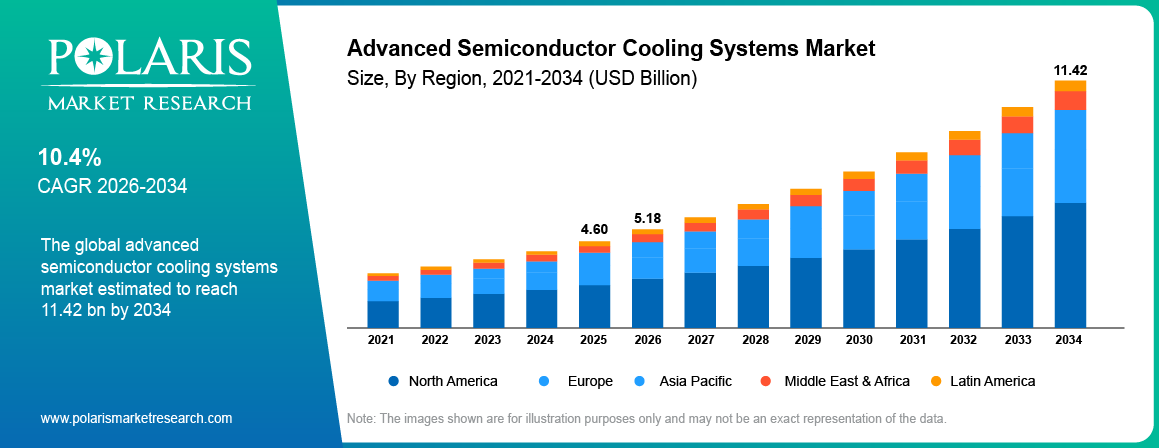
According to Polaris Market Research analysis, the advanced semiconductor cooling systems market was valued at USD 4.60 Billion in 2025. It is projected to reach USD 11.42 Billion by 2034, growing at a CAGR of 10.4% from 2026 to 2034. Demand is driven by growing chip power in AI servers, since heat loads now exceed what air can carry away from a rack. Direct to chip liquid loops and immersion tanks are winning share from fans and heat sinks, and coolant distribution units and heat exchangers earn the largest component revenue. The market covers the hardware, materials, and controls that remove heat from processors, memory, and power chips. North America is the leading market. Asia Pacific is the fastest growing region.
Market Statistics
Key Takeaways
- North America took 35.5% of 2026 revenue, led by hyperscale operators and chip designers that concentrate AI budgets in the United States.
- Asia Pacific is the fastest growing region, at a CAGR of 12.4% from 2026 to 2034, owing to the concentration of chip packaging and server assembly in Taiwan, South Korea, and China.
- Air Cooling retained 36.9% of 2026 technology revenue, attributed to its use in consumer devices and servers below 500 W.
- Immersion is growing fastest among technologies, at 18.0% a year, as operators look for a way to cool racks that exceed 100 kW.
- Revenue from coolant units and heat exchangers reached USD 1,386 Million in 2026, the largest component total, since every liquid loop requires one.
- Accelerator racks lift data center and AI server demand to a CAGR of 13.6% from 2026 to 2034, because they draw far more power than earlier servers.
- The above 1,000 W tier grows fastest among power classes, at 21.8% a year, since next generation accelerators cannot run on air alone.
- Operators of data centers held 39.1% of 2026 end user revenue, due to large scale liquid cooling retrofits and new builds.
- Electric vehicle and automotive electronics should grow 13.1% a year over the forecast period, as power modules in these vehicles run hotter.
Note: Figures and projections outlined in this report are the result of Polaris Market Research’s proprietary analytical processes, grounded in the latest available datasets and market observations.
Advanced Semiconductor Cooling Systems Market Definition
The advanced semiconductor cooling systems market covers the equipment, materials, and software used to pull heat out of semiconductor devices and carry it away to a facility or the open air. It spans fans and heat sinks at one end and pumped liquid, immersion, and two phase systems at the other, together with the controls that run them.
Counted products include cold plates, heat sinks, heat pipes, vapor chambers, thermal interface materials, pumps, coolant distribution units, heat exchangers, and monitoring software. Whole systems sold to data centers are counted, as are parts sold to server makers and chip packagers. Power plant cooling, building air conditioning that does not touch the IT load, and consumer gaming coolers sold at retail are outside the scope. The wider facility view sits in the data center liquid cooling market study, and this market is the device level layer beneath it.
Heat leaves a chip in stages. A thermal interface material fills the gap between the die and a lid or plate, a cold plate or heat sink spreads the load, and a fluid or airflow then carries it off to a heat exchanger. Each stage has its own suppliers, and therefore a single rack can involve five or six vendors before any software is added.
Operating temperatures demonstrate how far liquid designs have moved. NVIDIA stated in June 2026 that coolant enters its Rubin processors at 45 degrees Celsius and leaves at approximately 55 degrees, using a mix of 75% water and 25% propylene glycol. Warm loops of this kind let a facility reject heat without chillers in numerous climates.
Air Cooling vs Liquid and Immersion Cooling: Key Differences
| Attribute | Air Cooling | Liquid and Immersion Cooling |
| Heat carrier | Moving air across fins | Water glycol mix, dielectric oil, or engineered fluid |
| Typical use | Consumer devices, telecom cabinets, lower power servers | AI accelerator racks, supercomputers, high density power modules |
| Space needed | Large heat sinks and airflow paths | Compact plates or tanks with pipework |
| Facility change | Little change to existing rooms | Piping, pumps, and floor loading planning |
| Energy profile | Fan power rises quickly with chip power | Lower fan load and warmer return fluid |
| Growth direction | Stable in volume, falling in share | Rising in volume and share |
Source: Polaris Market Research Analysis
Air stays the default because it is cheap, familiar, and easy to service. Liquid takes over where the heat per square centimeter of silicon grows past what a heat sink and fan can handle. Numerous sites run both, with liquid on the accelerators and air on memory, storage, and networking gear.
Porter's Five Forces Analysis
| Force | Intensity | Rationale |
| Bargaining power of suppliers | Low to Moderate | Copper, aluminum, and specialty fluids come from broad supply bases, while precision parts such as microchannel plates rely on fewer shops. |
| Bargaining power of buyers | High | Hyperscale operators and server makers buy in volume and push for price cuts and custom designs. |
| Threat of new entrants | Low to Moderate | Funding is available, but chip makers and server brands qualify each supplier slowly. |
| Threat of substitutes | Low | Lower power chips and better airflow can delay liquid, but no alternative removes heat at 1,000 W per chip. |
| Competitive rivalry | High | Power and HVAC groups, thermal specialists, and start ups all chase the same accelerator platforms. |
Source: Polaris Market Research Analysis
Rivalry is the force that matters most, as large power and cooling groups have been buying thermal specialists, and that raises the cost of competing for small firms that lack a service network. Buyers respond by splitting orders across two or three suppliers, and therefore prices stay under pressure.
Market Dynamics
Driver Impact Analysis
| Driver | Impact on Market Growth | Time Horizon |
| Rising chip power and denser packaging | High | Short to Medium Term |
| Data center electricity costs and efficiency targets | High | Medium Term |
Source: Polaris Market Research Analysis
Driver: Rising Chip Power and Denser Packaging Are Pushing Heat Beyond the Limits of Air, Creating Market Demand
Accelerator racks now draw so much power that a fan and heat sink cannot remove the heat, and that pushes buyers toward cold plates and coolant loops. Server designers specify liquid from the first rack layout instead of adding it later. The hyperscale data center market sets the pace, since its operators order cooling by the megawatt.
For example, in June 2026, NVIDIA said its Rubin servers can run on coolant at up to 45 degrees Celsius in a closed loop with no fans. The company described Rubin as its first generation with fully liquid cooled chips and networking parts, and it said a 50 megawatt hyperscale site could save more than USD 4 million a year in cooling related energy and water costs. Direct to chip cooling therefore takes a larger share of every new accelerator deployment.
Packaging adds to the pressure, since several dies, memory stacks, and power parts now sit inside one module and the heat of a whole system leaves through a small area. TrendForce reported in June 2026 that investors expect the supply gap for TSMC CoWoS packaging to narrow from approximately 20% to approximately 10% by the end of 2026. Capacity is estimated at 120,000 to 140,000 wafers per month. More packages shipped means more devices that require a purpose built cold plate, which supports the forecast through 2034.
Driver: Growing Data Center Electricity Use Is Making Cooling Efficiency a Cost Priority, Creating Market Demand
Cooling has historically used a large part of a data center power bill, and therefore operators treat each point of efficiency as a cost saving. Liquid carries heat far better than air, and that lets a site run warmer coolant and cut chiller work. Regulators in several regions are also asking operators to report energy use, which turns cooling choices into a compliance matter.
For example, in April 2025, the International Energy Agency projected that global data center electricity demand would reach approximately 945 terawatt hours by 2030, more than double the current level. The agency expects demand from AI optimized data centers to more than quadruple, and power grids in the leading data center markets are already strained, and therefore operators have a reason to cut cooling load first.
Data center operators are projected to grow at a CAGR of 13.1% from 2026 to 2034, since efficiency targets keep cooling budgets growing even where chip power rises more slowly.
Restraint: Retrofit Costs and Leak Concerns Are Slowing Liquid Adoption in Existing Facilities, Limiting Adoption
Numerous existing data halls were built for air, and therefore adding liquid means new pipework, floor loading checks, and staff training. Operators also worry about leaks near expensive servers, and that makes them slow to approve designs without a track record. These costs weigh most on older sites and smaller operators.
For example, in September 2025, a report on Microsoft microfluidic cooling noted that etching channels into the back of a silicon die adds a manufacturing step and requires new packaging to prevent leaks. The same cost and leak tradeoff applies to plates and tanks at rack scale, and it delays approvals.
Air systems still generated 36.9% of 2026 technology revenue, since numerous sites keep them for lower power equipment. The restraint therefore trims the growth of liquid systems in retrofit projects, although new builds avoid most of the cost.
Opportunity: Chip Level Cooling Inside the Package Is Creating a New Class of Thermal Products
Cooling that sits inside the chip package removes the thermal layers that slow heat transfer today. Fluid channels placed next to hot spots can hold temperatures down at lower coolant flow, and therefore chip designers see a path to higher clock speeds within the same power budget. Suppliers of etching, bonding, and coolant services stand to gain.
For example, in September 2025, Microsoft reported lab tests of microfluidic channels etched into silicon that cut peak chip temperature by up to 65% and cooled up to three times better than cold plates. The company worked with the Swiss firm Corintis on channel design and said the method was ready for full scale production in its chip pipeline.
Two Phase Cooling is projected to grow at a CAGR of 17.2% from 2026 to 2034, and in package methods extend the same idea further. Software and controls gain as these systems require tuned flow and monitoring.
Opportunity: New Data Center Builds in the Gulf and Latin America Are Creating Greenfield Cooling Demand
Gulf states and Latin American countries are building AI capacity in new halls, and therefore cooling can be designed in without retrofit cost. Hot climates raise the value of efficient heat rejection, and that favors liquid and immersion designs. Suppliers with local service teams hold an advantage in winning these projects.
In October 2026, ODATA, a unit of Aligned Data Centers, said it would invest USD 630 million in a first phase of liquid cooling at its campuses in Brazil and Mexico, using the DeltaFlow system developed with Munters. Submer announced a Saudi Arabian subsidiary in October 2025 to serve Middle East hyperscalers and telecom operators, citing regional capacity growth from 1 GW in 2025 to 3.3 GW within five years. Both moves demonstrate cooling being specified at the design stage of new halls.
Middle East & Africa is projected to grow at a CAGR of 12.1% from 2026 to 2034 and Latin America at 10.7%. Both start from small bases, and therefore these projects add modestly to totals while lifting regional growth rates.
Trend: Power and HVAC Groups Are Buying Liquid Cooling Specialists to Offer Complete Thermal Systems
Electrical, air conditioning, and power equipment groups want to sell one thermal package from chip to chiller, and therefore they are acquiring specialists in plates, tanks, and coolant units. Buyers favor fewer vendors with one service contract, and specialists respond by tying their products to chip makers and server brands.
For example, in March 2026, Eaton closed its purchase of Boyd Thermal, announced in November 2025 at USD 9.5 billion, adding a business with more than 6,000 employees. LiquidStack, a maker of immersion tanks and a 10 MW coolant distribution unit, agreed in February 2026 to be bought by Trane Technologies. Schneider Electric also introduced two new Motivair coolant distribution units for utility corridors, with production ramping in early 2026.
Coolant units and heat exchangers earned 26.8% of component revenue in 2026, which explains why large groups target them. Consolidation raises barriers for small suppliers and shapes who wins the next round of hyperscale orders.
Value Chain Analysis
| Stage | Activities | Representative Participants |
| Materials and parts | Copper and aluminum plates, heat pipes, vapor chambers, fans, pumps, and thermal interface materials | Fujikura, Ferrotec, and Advanced Cooling Technologies |
| Liquid and immersion systems | Cold plates, manifolds, tanks, and two phase assemblies | CoolIT Systems, Asetek, ZutaCore, Submer, and LiquidStack |
| Rack and facility units | Coolant distribution units, heat exchangers, and controls | Vertiv, Schneider Electric, Delta Electronics, and Rittal |
| Integration and thermal design | Server makers, chip packagers, and data center builders who specify and install systems | Server brands, outsourced assembly firms, and engineering contractors |
| Service and fluids | Commissioning, fluid management, monitoring, and maintenance | Vendor service teams and specialist contractors |
Source: Polaris Market Research Analysis
Value sits in the coolant distribution and plate layers, since they are specified early and replaced rarely. Material suppliers earn on volume and face metal price swings, while integrators earn on design hours and commissioning.
Margins differ by stage, with rack and facility units carrying the highest ticket per project. Parts such as fans and thermal pads sell in large quantities at thin margins, and software adds recurring revenue to hardware sales.
Advanced Semiconductor Cooling Systems Market Segmentation Analysis
Each of the five dimensions tells a different part of the story, because buyers choose a cooling method, a component set, and a power class for different reasons.
Cooling Technology Insights
Air Cooling accounted for 36.9% of cooling technology revenue in 2026, owing to its dominance in consumer devices, telecom cabinets, and servers below 500 W. Heat sinks, fans, and heat pipes remain inexpensive to build and simple to service. NVIDIA said in June 2026 that its Rubin servers require no fans, a sign that the highest power racks are leaving air behind. Air will therefore lose share even while unit volumes hold steady.
Liquid Cooling Direct to Chip is projected to grow at a CAGR of 11.7% from 2026 to 2034, driven by cold plates becoming the standard answer for accelerator boards. A plate attaches to the processor, a manifold feeds it, and a coolant unit sends the warm fluid away. For example, in May 2026, Asetek reported its largest RackCDU order to date, worth approximately USD 350,000 for 29 racks at a US federal high performance computing center, placed through an OEM partner. Orders of this kind demonstrate that direct to chip is moving from pilot racks to production fleets.
Immersion Cooling is the fastest growing technology, at a CAGR of 18.0% from 2026 to 2034, because servers submerged in dielectric fluid shed heat from every component at once. Operators value the quiet operation and the lack of fans, although tanks require new floor layouts and service routines. In May 2026, S Oil and Global Standard Technology showed an immersion cooling oil at HVAC Korea 2026, with demonstration tests planned at Sungkyunkwan University. Fluid suppliers from the oil and chemical industries are entering the market and widening the supplier base for tanks.
Two Phase Cooling is projected to grow at a CAGR of 17.2% from 2026 to 2034, as boiling fluid absorbs far more heat per unit of flow than water does. The approach suits chips that exceed 1,000 W, and sealed designs keep water away from the electronics. ZutaCore, a maker of sealed waterless plates, closed a USD 100 million Series C round in June 2026 with several strategic investors. Thermoelectric and Hybrid Cooling held 7.9% of revenue in 2026, attributed to the numerous sites that pair liquid on the processors with air on the rest of the rack.
Component Insights
Coolant Distribution Units and Heat Exchangers was worth USD 1,386 Million in 2026, due to every liquid loop needing a pumping and heat exchange unit. Capacities are rising from kilowatts to megawatts as row and hall level units replace rack mounted ones. For example, in February 2026, Trane Technologies announced a deal to acquire LiquidStack, whose products include a 10 MW modular coolant distribution unit. Buyers of large halls will continue specifying these units early in the design.
Cold Plates and Heat Sinks held 23.9% of component revenue in 2026, driven by the cold plate fitted to each processor and the heat sink still used on lower power parts. Precision machining and brazing set quality, and plate makers qualify with a chip maker before volume begins. Boyd Thermal, a supplier of thermal components and liquid cooling for data centers and aerospace, joined Eaton in March 2026. Polaris tracks the wider heat sink industry in its heat sinks market study, where air cooled parts remain the volume base.
Thermal Interface Materials and Heat Pipes and Vapor Chambers together contributed 25.5% of component revenue in 2026, as these parts sit inside every device. Larger packages require thinner, more conductive pads and bigger vapor chambers to spread heat evenly. TrendForce reported in June 2026 that TSMC plans to lift CoWoS capacity by more than 60% by 2027, adding numerous large packages that require these parts. Growth stays steady but trails liquid loops, since materials are bought in volume and price pressure is constant.
Pumps Fans and Blowers is projected to grow at a CAGR of 6.4% from 2026 to 2034, the lowest among the component groups, as fanless designs spread in high power racks. Pump demand rises with liquid loops, while fan demand follows lower power equipment. Software and Controls was worth USD 314 Million in 2026, as operators require tuned flow and early leak warnings. Microsoft worked with Corintis in September 2025, a Swiss firm that used AI to refine the channel geometry in its microfluidic cooling tests.
Application Insights
Data Centers and AI Servers is the fastest growing application, at a CAGR of 13.6% from 2026 to 2034, driven by accelerator racks that draw numerous times the power of web servers. Each megawatt of new capacity requires plates, units, and heat exchangers sized for liquid. For example, in February 2026, Vertiv reported fourth quarter 2025 net sales of USD 2.88 billion, up 19% organically, with a backlog of USD 15 billion, up 109%. Supply capacity at the leading vendors will shape how fast operators can deploy.
Consumer Electronics held 18.8% of application revenue in 2026, owing to the large volumes of phones, laptops, and gaming devices that use thin vapor chambers and graphite sheets. Unit prices are low and design cycles follow annual product launches, while premium devices with on device AI raise thermal needs, yet most of the segment still relies on passive spreading. Growth therefore trails data centers by a wide margin.
Automotive and EV Electronics is projected to grow at a CAGR of 13.1% from 2026 to 2034, as inverters, onboard chargers, and driver assistance computers run at higher power. Liquid cooled power modules are standard in numerous electric platforms, and S Oil said in May 2026 that its immersion cooling oil suits high heat settings that include EV batteries and energy storage systems. Carmakers pushing faster charging will add cooling content per vehicle.
Telecommunications held 8.8% of application revenue in 2026, covering radio units, baseband cabinets, and edge sites that often run outdoors or unmanned. Sealed heat sinks and thermoelectric coolers suit these sites, and edge servers add liquid demand where power density rises, as the edge computing market study describes. Submer said in October 2025 that its Saudi Arabian subsidiary would work with hyperscalers, telecoms, and government backed digital programs. Network operators building AI at the edge will gradually add liquid options.
End User Insights
Data Center Operators generated 39.1% of end user revenue in 2026, attributed to the size of their orders and their exposure to power costs. Colocation and cloud firms both specify liquid in new halls, and ODATA, a unit of Aligned Data Centers, committed USD 630 million to a first phase of liquid cooling in Brazil and Mexico in October 2026. Operators with long term power contracts will maintain this group as the largest purchaser through 2034.
Electronics and Automotive OEMs are projected to grow at a CAGR of 6.3% from 2026 to 2034, as device makers buy cooling parts built into each product. Server brands also fall into this group when they ship complete liquid cooled racks. For example, in November 2025, Eaton announced its agreement to buy Boyd Thermal for USD 9.5 billion, giving a power equipment group a supplier of thermal parts for OEM customers. Buying power sits with a few large makers, and therefore supplier qualification is slow and sticky.
Semiconductor Manufacturers represented 19.2% of end user revenue in 2026, owing to the chillers and thermal chucks that test, burn in, and packaging lines need. New fabrication and assembly plants in Asia add this demand. India approved two more semiconductor units in Gujarat in May 2026, including an assembly and test plant with a proposed capacity of over 1,033 million chips a year. Every new plant brings process cooling orders for local and global suppliers.
Thermal Design Power Insights
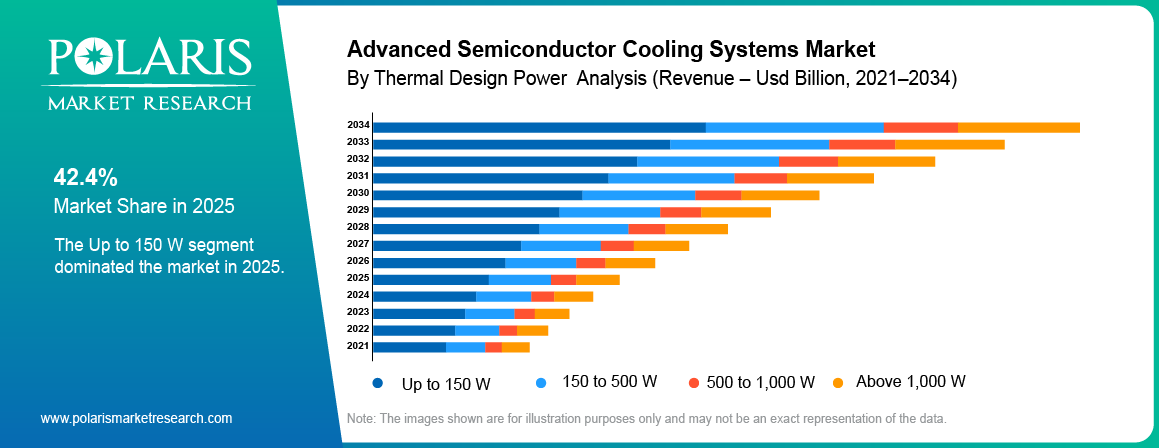
Up to 150 W held 42.4% of revenue in 2026, driven by phones, laptops, network gear, and mainstream servers that sit in this class. Air handles most of the load, and cold plates are spreading into the upper end. 150 to 500 W was worth USD 1,688 Million in 2026, a base that keeps volume steady while the higher classes take the growth. Mid power racks adopt plates first, as the Asetek order for 29 racks at a federal computing site in May 2026 showed.
500 to 1,000 W is projected to grow at a CAGR of 16.9% from 2026 to 2034, since current accelerators fall in this range and require liquid on every package. Cold plate designs here use microchannels and must be matched to each board. For example, in June 2026, TrendForce estimated record TSMC CoWoS output for the year, a base that feeds these high power parts. Suppliers that hold chip maker approvals gain the longest contracts.
Above 1,000 W is the fastest growing power class, at a CAGR of 21.8% from 2026 to 2034, as next generation accelerators move beyond what plates can cool at current flow rates. The Open Compute Project Foundation and ASHRAE formed an alliance in October 2025 to align liquid cooling standards for high density AI racks. Microsoft lab work on channels inside the die, reported in September 2025, points the same way. Vendors that supply these methods at scale will capture the premium end of demand.
Advanced Semiconductor Cooling Systems Market Regional Analysis
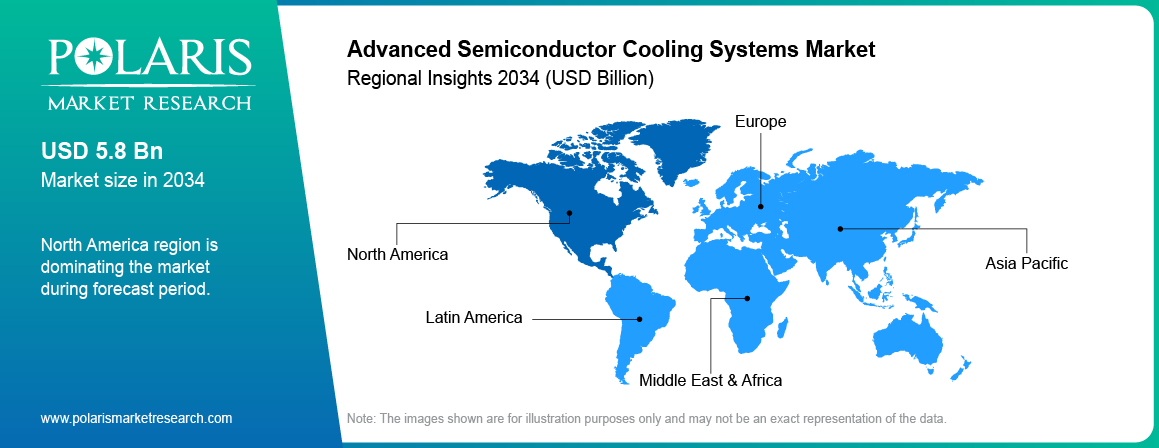
Climate, power prices, and the location of chip and server plants shape how each region buys cooling. North America and Asia Pacific together hold roughly two thirds of revenue, Europe follows efficiency rules, and Latin America and Middle East & Africa depend on new data center campuses.
North America Market
North America generated 35.5% of advanced semiconductor cooling systems market revenue in 2026, driven by hyperscale operators and AI cloud firms placing the largest cooling orders from the United States. Mexico is projected to grow faster than the United States, at a CAGR of 11.0% from 2026 to 2034, since automotive and electronics plants are expanding there. For example, in December 2025, Vertiv completed its USD 1 billion acquisition of PurgeRite, adding fluid maintenance services to its liquid cooling business. The region grows at a CAGR of 8.8% from 2026 to 2034, the lowest rate among the regions, because its base is already large.
A US federal high performance computing site ordered Asetek RackCDU systems for 29 racks in May 2026, and Polaris sizes the facilities that house such equipment in the data center market study. Start ups in two phase and immersion cooling sell beside large power groups, and therefore competition stays strong.
Europe Market
Europe held 21.8% of revenue in 2026, owing to demand from automotive, industrial, and aerospace makers and from colocation hubs in Frankfurt, London, and Amsterdam. Germany leads on country revenue and the Netherlands has the highest growth rate among them, at a CAGR of 10.4% from 2026 to 2034. For example, in March 2026, the European Commission published a draft regulation for a common rating scheme for EU data centres, with feedback open until 23 April 2026 (Source: European Commission). Ratings that compare data centers push operators toward efficient cooling designs.
Europe is projected to grow at a CAGR of 9.2% from 2026 to 2034. Power grid limits in major hubs and high energy prices raise the value of heat reuse, and warm fluid from liquid loops suits that purpose. Automotive power electronics add steady demand in Germany and Eastern Europe.
Asia Pacific Market
Asia Pacific captured 33.5% of revenue in 2026 and is the fastest growing region, at a CAGR of 12.4% from 2026 to 2034. Growth is driven by Taiwan, South Korea, and China hosting most chip packaging and server assembly. China leads on country revenue and India has the highest growth rate among its countries, at a CAGR of 18.0% from 2026 to 2034. For example, in May 2026, India approved two more semiconductor units under its semiconductor mission, bringing the number of approved projects to 12. Japan also opened a government backed programme that month to fund projects cutting emissions from digital infrastructure.
Manufacturing density makes the region both a buyer and a maker, with suppliers in Taiwan, Japan, and South Korea shipping plates, fans, and pumps to server brands around the world. Local demand follows as cloud firms in the region build AI halls.
Latin America Market
Latin America contributed 4.3% of revenue in 2026 and is projected to grow at a CAGR of 10.7% from 2026 to 2034. The rise is due to Brazil and Mexico adding capacity for cloud and AI workloads. Brazil leads on country revenue and is projected to grow faster than Argentina, at 10.7% against 9.6%. For example, in October 2026, ODATA committed USD 630 million to initial liquid cooling work at its SP04 campus in Brazil and QR03 campus in Mexico. Local cooling supply is thin, and therefore imported systems and service contracts carry much of the market.
Middle East & Africa Market
Middle East & Africa held 4.9% of revenue in 2026 and is projected to grow at a CAGR of 12.1% from 2026 to 2034, the second fastest region, driven by Saudi Arabia and the United Arab Emirates building AI campuses. Saudi Arabia is the largest country market and also the fastest growing, at 13.3%. For example, in October 2025, Submer set up a Saudi Arabian subsidiary and cited a regional capacity forecast of 1 GW in 2025 rising to 3.3 GW within five years. High ambient temperatures make efficient heat rejection a design priority for every new hall.
Advanced Semiconductor Cooling Systems Market Competitive Landscape
Competition runs across three layers, as power and HVAC groups sell complete systems from chip to chiller, thermal specialists sell plates, tanks, and fluids, and component makers supply parts to both. A supplier usually wins a platform once and then supplies it for the life of that server generation.
Acquisitions have intensified the contest, and Eaton finished its purchase of Boyd Thermal in March 2026, four months after announcing the USD 9.5 billion deal. Trane Technologies announced an agreement in February 2026 to buy LiquidStack. Schneider Electric, owner of Motivair since February 2025, introduced two new coolant distribution units for installation outside the white space, reflecting a belief that liquid cooling will be sold inside electrical and HVAC portfolios.
Funding rounds back the independent specialists, and ZutaCore raised USD 100 million in June 2026, and Asetek reported its largest rack level order in May 2026. Companies that hold chip maker qualifications and can ship in volume are best placed to gain market share. Service reach counts as much as product design, since operators want a single contact for installation and fluid care.
Vendor Landscape Snapshot
| Company | Vendor Positioning | Role |
| Vertiv Holdings Co | Leader | Rack and facility units with direct to chip lines |
| Schneider Electric SE | Leader | Power and cooling group that owns Motivair |
| Eaton Corporation plc | Challenger | Electrical group that added Boyd Thermal in 2026 |
| Delta Electronics, Inc. | Challenger | Fans, pumps, and units for servers and data centers |
| Trane Technologies plc | Challenger | HVAC group buying LiquidStack in 2026 |
| CoolIT Systems | Challenger | Direct to chip plates and units |
| Asetek A/S | Challenger | Rack level liquid cooling through OEM partners |
| Rittal GmbH & Co. KG | Challenger | Enclosures and rack level cooling units |
| Fujikura Ltd. | Niche Player | Thermal parts, including heat pipes and cooling modules |
| Advanced Cooling Technologies, Inc. | Niche Player | Heat pipes, vapor chambers, and custom designs |
| Ferrotec Holdings Corporation | Niche Player | Thermoelectric modules and equipment parts |
| ZutaCore | Emerging Player | Waterless two phase direct to chip systems |
| Submer | Emerging Player | Immersion systems and liquid cooled data center design |
Source: Polaris Market Research Analysis
Advanced Semiconductor Cooling Systems Market Technology and Innovation Landscape
Innovation focuses on moving the coolant closer to the heat source and raising the operating temperature of the loop. Warmer coolant cuts chiller use, and closer contact lowers chip temperature at the same flow. Standards bodies are lining up so that parts from different suppliers fit together.
A joint effort between the Open Compute Project Foundation and ASHRAE, started in October 2025, covers facility loops, direct to chip and immersion systems, and coolant distribution units in one set of standards. Shared specifications lower qualification costs for buyers and let smaller suppliers reach larger accounts.
Materials engineering is the quieter part of the innovation story, yet it often decides whether a thermal design reaches production. Thermal interface materials must conduct heat efficiently across rough surfaces over years of temperature cycling, and vapor chambers must maintain a sealed working fluid under mechanical stress, and therefore qualification programs frequently run longer than the design work itself. Manufacturers that can document long term reliability data therefore gain a durable advantage in supplier selection, particularly with chip makers that carry the warranty risk for the finished package.
Technology and Innovation Landscape Snapshot
| Area | Role | Status and Representative Developers |
| Direct to chip cold plates | Remove heat at the processor with pumped fluid | Production, with Vertiv, CoolIT Systems, and Asetek |
| Warm water loops | Run coolant near 45 degrees Celsius to cut chiller work | Announced for next generation servers by NVIDIA |
| Two phase cooling | Use boiling fluid to carry more heat per unit of flow | Scaling, with ZutaCore and LiquidStack |
| Immersion tanks and fluids | Submerge servers in dielectric fluid | Production, with Submer and fluid suppliers such as S Oil |
| In chip microfluidics | Etch channels into silicon to cool hot spots | Lab tested by Microsoft with Corintis |
| Coolant distribution at megawatt scale | Move heat between rack loops and facility water | Expanding, with Schneider Electric and LiquidStack |
Source: Polaris Market Research Analysis
Use Case Analysis
AI Training and Inference Clusters
Training clusters pack thousands of accelerators into tight rows, and therefore heat per rack reaches levels that air cannot handle, and operators therefore treat liquid as part of the base design instead of an upgrade. Inference sites follow the same pattern as model sizes grow, although their load is spread across more locations and smaller halls.
Supercomputing and Research Computing
Public research centers run dense racks and favor efficiency, and therefore they adopted direct to chip loops early. A US federal computing site ordered Asetek systems for 29 racks in May 2026. Funding cycles in these centers maintain orders that are lumpy but dependable.
Semiconductor Test and Packaging Lines
Test and burn in cells heat chips under load and require tight temperature control, and therefore thermal chucks and recirculating chillers are standard equipment in these plants. Packaging lines add further demand for process cooling, and new plants in India, Taiwan, and the United States create orders before the first wafer arrives.
Electric Vehicles and Power Electronics
Inverters, chargers, and battery packs shed heat at high power. Cold plates and immersion fluids are both used, and carmakers weigh cost against charge speed. Content per vehicle rises with every step up in power.
Telecom and Edge Sites
Radio and edge cabinets sit outdoors with limited power available for cooling, and therefore sealed heat sinks, heat pipes, and thermoelectric coolers fit these sites best. Edge AI boxes that run accelerators in small enclosures are starting to add compact liquid options where noise and dust rule out open airflow.
Buyer Needs and Decision Criteria
| Buyer Need | Decision Criteria | Why It Matters |
| Reliable heat removal | Tested flow, pressure, and leak records | Downtime on an accelerator rack is costly |
| Fit with existing halls | Pipework, floor load, and service access | Retrofits drive project cost |
| Energy efficiency | Coolant temperature, pump power, and heat reuse | Cooling power sets the operating cost |
| Supplier scale | Factory output, qualifications, and service reach | Large orders need steady supply |
| Standards fit | Match to OCP and ASHRAE guidance | Parts from several vendors must work together |
Source: Polaris Market Research Analysis
Entry barriers are high at the top of the market. Chip makers and server brands qualify each cold plate and fluid before volume orders, factories require precision machining and brazing capacity, and supply of copper and specialty fluids must hold steady. Prices are hard to compare because flow rate, pressure drop, and service terms differ by design, and therefore buyers compare total cost per kilowatt removed and ask for leak and field failure records.
Premium Insights and Forward Outlook
Liquid Will Move From Option to Default
Chip power keeps rising faster than facility air capacity, and therefore liquid will become the default for accelerator racks within the forecast period, and server designers are already planning manifolds, plates, and service access into new rack architectures. Air will remain in lower power equipment and consumer devices, and that keeps its unit volume large even while its revenue share falls.
Coolant Units Will Capture the Largest Spend
Every liquid rack requires a coolant distribution path, and the capacity of each unit is growing from rack level equipment toward hall level infrastructure. Suppliers that offer megawatt scale units with integrated controls and monitoring will win the largest contracts, because operators prefer to commission one qualified system instead of coordinating several smaller vendors.
Consolidation Will Continue
Large power and HVAC groups have shown that they will pay for thermal capability, and that sets a valuation benchmark for specialists with proven designs and chip maker approvals. Small suppliers without service networks or qualification records face growing pressure, since buyers increasingly favor partners that can support installation, fluid management, and maintenance.
Microchannel and In Package Cooling Will Reach Production
Laboratory results have shown large temperature gains from channels cut near the silicon, and the highest power chips will require that kind of heat removal as package power continues to climb. Manufacturing cost and leak risk must come down before volume use, and therefore adoption will probably begin with a small number of premium accelerator programs and spread only as yields and packaging methods mature.
Key Players in the Advanced Semiconductor Cooling Systems Market
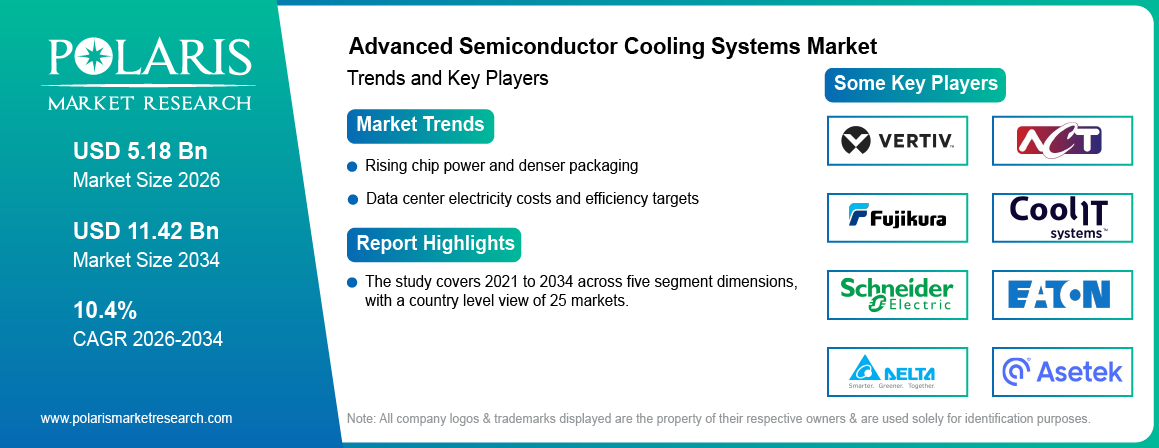
- Vertiv Holdings Co
- Schneider Electric SE
- Eaton Corporation plc
- CoolIT Systems
- Asetek A/S
- Delta Electronics, Inc.
- Fujikura Ltd.
- Advanced Cooling Technologies, Inc.
- ZutaCore
- Submer
- Ferrotec Holdings Corporation
- Trane Technologies plc
- Rittal GmbH & Co. KG
Industry Developments
- October 2026: Aligned Data Centers unit ODATA set aside USD 630 million for the first stage of a DeltaFlow rollout at its Brazilian SP04 and Mexican QR03 sites, as Latin American operators fit liquid loops ahead of AI load.
- June 2026: ZutaCore closed a USD 100 million Series C, with Mitsubishi Electric, Carrier Ventures, and Samsung Venture Investment among the named backers, to commercialize HyperCool systems that cool chips without water (Source: SiliconANGLE).
- June 2026: At the Rubin launch, NVIDIA described fanless servers on 45 degree Celsius coolant inside its DSX AI factory design, and therefore sites in favorable climates may require chillers for only a small part of the year.
- May 2026: A top US federal high performance computing site bought RackCDU loops for 29 racks through an Asetek OEM partner, a deal of roughly USD 350,000 that the company called its largest to date.
- March 2026: Eaton closed its USD 9.5 billion takeover of Boyd Thermal, a group with plants in North America, Asia, and Europe, to add liquid cooling capability to its electrical offer (Source: Data Centre Review).
- February 2026: Trane Technologies agreed to take over LiquidStack, with the immersion specialist set to operate inside the Trane commercial HVAC unit as that group enters data center liquid cooling.
- October 2025: Open Compute Project and ASHRAE announced joint work so that ASHRAE guidance can build on OCP specifications for coolant loops, distribution units, and rack level liquid systems (Source: Open Compute Project).
- September 2025: Microsoft disclosed lab results for coolant channels cut into the back of the die, with peak temperature falling by as much as 65% and cooling performance up to three times that of cold plates.
Advanced Semiconductor Cooling Systems Market Report Segmentation
By Cooling Technology Outlook (Revenue, USD Billion, 2021 to 2034)
- Air Cooling
- Liquid Cooling Direct to Chip
- Immersion Cooling
- Two Phase Cooling
- Thermoelectric and Hybrid Cooling
By Component Outlook (Revenue, USD Billion, 2021 to 2034)
- Cold Plates and Heat Sinks
- Thermal Interface Materials
- Heat Pipes and Vapor Chambers
- Pumps Fans and Blowers
- Coolant Distribution Units and Heat Exchangers
- Software and Controls
By Application Outlook (Revenue, USD Billion, 2021 to 2034)
- Data Centers and AI Servers
- Consumer Electronics
- Automotive and EV Electronics
- Telecommunications
- Industrial and Power Electronics
- Aerospace and Defense
- Others
By End User Outlook (Revenue, USD Billion, 2021 to 2034)
- Data Center Operators
- Semiconductor Manufacturers
- Electronics and Automotive OEMs
- Telecom Providers
- Other End Users
By Thermal Design Power Outlook (Revenue, USD Billion, 2021 to 2034)
- Up to 150 W
- 150 to 500 W
- 500 to 1,000 W
- Above 1,000 W
By Regional Outlook (Revenue, USD Billion, 2021 to 2034)
- North America
- United States
- Canada
- Mexico
- Europe
- Germany
- United Kingdom
- France
- Italy
- Spain
- Netherlands
- Rest of Europe
- Asia Pacific
- China
- Japan
- India
- South Korea
- Australia
- Taiwan
- Rest of Asia Pacific
- Latin America
- Brazil
- Argentina
- Rest of Latin America
- Middle East & Africa
- Saudi Arabia
- United Arab Emirates
- Israel
- South Africa
- Rest of Middle East & Africa
Advanced Semiconductor Cooling Systems Market Report Scope
| Report Attribute | Details |
| Market Size in 2025 | USD 4.60 Billion |
| Market Size in 2026 | USD 5.18 Billion |
| Revenue Forecast by 2034 | USD 11.42 Billion |
| CAGR | 10.4% (2026 to 2034) |
| Base Year | 2025 |
| Historical Data | 2021 to 2024 |
| Forecast Period | 2026 to 2034 |
| Quantitative Units | Revenue in USD Million and USD Billion, and CAGR in percent |
| Report Coverage | Revenue Forecast, Growth Factors, Competitive Landscape, Industry Trends, and Strategic Analysis of the advanced semiconductor cooling systems market |
| Segments Covered | By Cooling Technology, Component, Application, End User, Thermal Design Power, and Region |
| Regional Scope | North America, Europe, Asia Pacific, Latin America, Middle East & Africa |
| Competitive Landscape | Company Profiling, Product Benchmarking, Financial Analysis, Market Developments, and Strategic Initiatives |
| Report Format | PDF and Excel |
| Customization | Available by Country, Region, and Segment |
| Research Team | Polaris Market Research & Consulting, Inc. research team |
| Last Updated | 5 November 2026 |
Source: Polaris Market Research Analysis
Why Choose Polaris Market Research
Every figure in this study traces back to one country by segment model, and therefore a reader can follow any regional number down to the countries and segments beneath it.
Beyond the usual categories, the study adds a split by thermal design power that demonstrates how spending moves as chips draw more watts, and it follows the shift from fans to liquid in each application.
Each external fact carries a source name and, where one exists, a date, and therefore planning teams can tell whether a statement rests on company filings, standards bodies, or public agencies.
Polaris can narrow the study to a country, segment, or company set when a buyer requires a tighter view. To buy this report or request customization, contact Polaris Market Research & Consulting, Inc.
Research Methodology
Research Approach
Sizing follows the supplier side and covers every cooling method that serves semiconductor devices: air, liquid, immersion, two phase, and thermoelectric systems, together with the parts and software sold alongside them. Facility air conditioning, retail gaming coolers, and power plant cooling sit outside the boundary. Estimates run from 2021 to 2034 with 2025 as the base year, in USD Million and USD Billion, with five segment dimensions and country coverage across 25 markets in five regions. The general Polaris research framework is set out on the research methodology page.
Secondary Research
Published sources supplied 17 dated facts, made up of 1 government publication, 1 standards body release, and 15 company and trade press reports. Most are dated within the last 12 months, and older items carry their publication date. External facts are attributed by source name, with the date where available.
Primary Research
Polaris follows its standard process of primary interviews. These interviews cover manufacturers, distributors and channel partners, and industry experts and consultants. They are used to validate secondary estimates, segment shares, regional trends, and growth drivers.
Data Structuring
Before any sizing began, every input was restated in USD on a calendar year basis and the segment boundaries were frozen. Parts that serve several components were assigned to their main use so that nothing is counted twice, and facility air conditioning and retail gaming coolers were taken out to hold totals inside the scope.
Market Size Estimation
The bottom up build starts with each country and segment, using supplier revenue, device shipments, and the cooling content of each platform. Countries are then added into regions, and regions into the global figure.
The top down check sets the 2025 base at USD 4.60 Billion and compares it with published estimates and disclosed company revenue. Published sizes differ because analysts draw the market boundary in different places, and the Polaris base falls within the span of the comparable estimates.
Forecasting
Demand projections tie to accelerator shipments, data center capacity additions, and advanced packaging output. The forecast uses an annual growth path that eases year over year and produces the stated CAGR. Segment and regional mixes drift gradually from 2025 to 2034 as liquid and immersion systems gain share.
Data Triangulation and Validation
Four consistency tests were run on the model. Each set of shares sums to 100% in every year, and country values add up to regional totals and then to the global figure. Past and future years follow one declining growth path, and the 2025 base falls within the span of comparable published estimates.
Limitations
Boundaries between cooling parts, facility equipment, and consumer products blur at the edges, and therefore outside estimates will differ from these figures. Private suppliers disclose little revenue, and regional supplier shares therefore remain estimates. Market figures in this report are Polaris estimates.
Research Methodology Phases
| Phase | Focus | Evidence / Output |
| Scope and Setup | Market boundary, segments, and regions | Fixed scope and segment list |
| Secondary Data Collection | Company releases, standards, and agency notes | 17 dated facts with named sources |
| Primary Research | Conversations with makers, resellers, and specialists | Validated shares, trends, and drivers |
| Data Structuring | USD figures on a calendar year footing | Inputs with no double counting |
| Bottom Up Estimate | Country and segment estimates | Regional and global totals |
| Top Down Estimate | 2025 global base and its split | Base compared with public estimates |
| Forecasting | Annual growth path to 2034 | Stated CAGR |
| Triangulation and Validation | Share, total, and range checks | Four passed checks |
| Output | Report tables and text | One set of figures used throughout |
Source: Polaris Market Research Analysis
Data Sources by Type
| Type of Source | Named Examples | Role in the Estimates |
| Government publications (1) | European Commission | Data center rating rules in Europe |
| Standards bodies (1) | Open Compute Project Foundation | Liquid cooling standards |
| Company and trade press reports (15) | Vertiv, NVIDIA, Asetek, Eaton, Trane Technologies, ZutaCore, Microsoft | Orders, launches, deals, and technical results |
Source: Polaris Market Research Analysis
Advanced Semiconductor Cooling Systems Market FAQ's
Advanced semiconductor cooling covers the plates, fluids, tanks, pumps, and controls that carry heat away from processors and power chips. Systems range from heat sinks with fans to liquid loops and sealed immersion tanks.
The advanced semiconductor cooling systems market size was valued at USD 4.60 Billion in 2025, according to Polaris Market Research analysis. Revenue reached USD 5.18 Billion in 2026, as accelerator racks moved from pilot orders to volume purchases.
The advanced semiconductor cooling systems market is projected to reach USD 11.42 Billion by 2034, growing at a CAGR of 10.4% from 2026 to 2034, according to Polaris Market Research analysis.
North America is the leading market, with 35.5% of revenue in 2026. Large hyperscale buyers in the United States place most of its orders.
Asia Pacific is the fastest growing region, with a CAGR of 12.4% from 2026 to 2034. India is the quickest growing country there.
Air Cooling holds the largest share, at 36.9% of 2026 revenue, though Liquid Cooling Direct to Chip follows closely at 36.2%. Immersion Cooling grows fastest, at 18.0% a year.
The key players include Vertiv Holdings Co, Schneider Electric SE, Eaton Corporation plc, CoolIT Systems, Asetek A/S, Delta Electronics, Inc., Fujikura Ltd., ZutaCore, Submer, and Trane Technologies plc. No company holds a dominant market share, since power groups, thermal specialists, and component makers each lead a layer.
Electrical and cooling equipment groups are acquiring liquid specialists, warm water loops are spreading in AI servers, and standards bodies are aligning liquid cooling specifications. Research teams are also testing channels etched into the chip itself.
Retrofit cost, leak risk, and slow supplier qualification hold back liquid adoption in existing halls. Operators must also rework pipework and train staff before new racks arrive.
Direct to chip cooling attaches a plate to each processor and pumps fluid through it. Immersion cooling places the whole server in dielectric fluid. That cools every component but requires different tanks and service routines.
Coolant Distribution Units and Heat Exchangers earns the most, at USD 1,386 Million in 2026. It is also the quickest growing component, at a CAGR of 14.4% from 2026 to 2034.
Data Centers and AI Servers is growing fastest, at a CAGR of 13.6% from 2026 to 2034. Automotive and EV Electronics follows at 13.1%.
Thermal design power sets how much heat a chip releases, and therefore the method that works. Chips above 1,000 W grow at 21.8% a year, as only liquid and two phase methods can serve them.
The United States leads on country revenue, at USD 1,576 Million in 2026. China leads Asia Pacific on country revenue, and Germany leads Europe.
Demand is driven by accelerator power growth, data center electricity costs, and packaging methods that concentrate heat. The International Energy Agency put 2030 data center power demand near 945 terawatt hours in its April 2025 outlook.

Download Sample Report of Advanced Semiconductor Cooling Systems Market
Please fill out the form to request a customized copy of the research report.


