
AI in Industrial Automation Market Size, Share, Trends and Forecast, 2026–2034
REPORT DETAILS
AI in Industrial Automation Market Summary
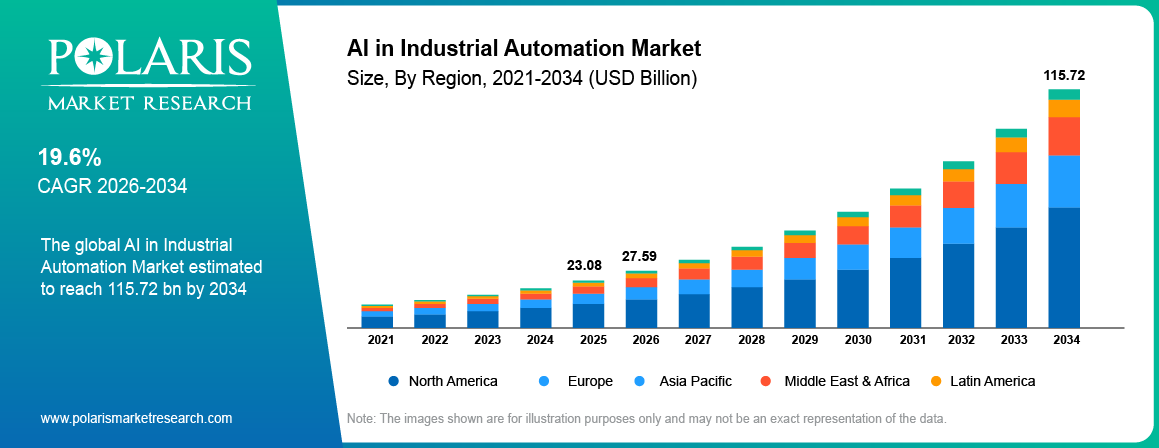
The AI in industrial automation market size was valued at USD 23.08 billion in 2025. The market is expected to record a CAGR of 19.6% from 2026 to 2034. Market growth is driven by rising adoption of AI-powered solutions for predictive maintenance, quality inspection, and process optimization across industrial automation.
Market Statistics
Key Takeaways
- North America accounted for 37.25% of the AI in industrial automation market share in 2025, driven by rising focus on industrial modernization and increasing investments in AI-enabled manufacturing.
- The market in Asia Pacific is projected to record a 22.84% CAGR during the forecast period. The regional market growth is fueled by manufacturing expansion and investments in intelligent manufacturing systems.
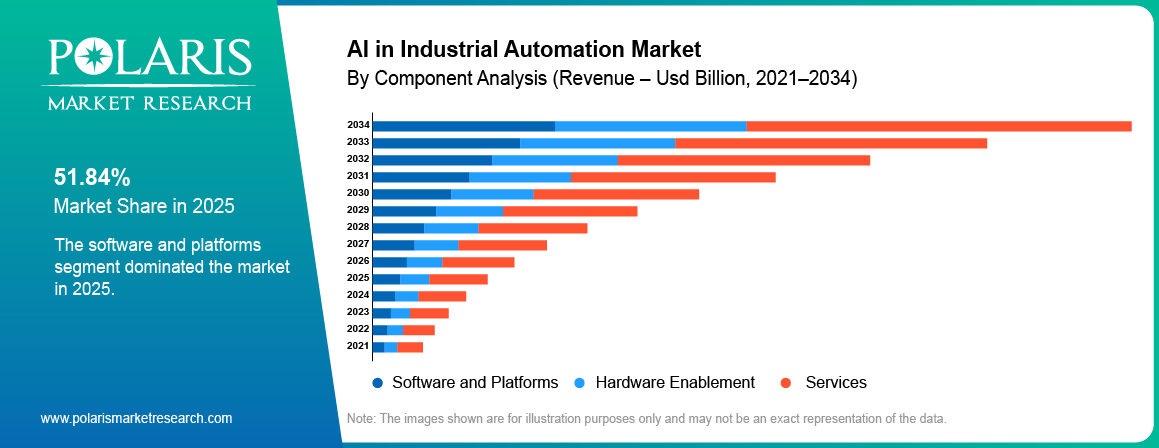
- Software and platforms led with the dominating share of 51.84% in 2025. This is supported by rising demand for industrial AI platforms, predictive maintenance software, and machine vision solutions.
- Edge deployment is expected to register the highest CAGR of 21.72%. The growth is attributed to the surging demand for real-time data processing and faster industrial decision-making.
- Predictive maintenance held the largest market share of 28.00% in 2025, driven by the need to reduce equipment downtime and improve asset performance.
Note: Figures and projections outlined in this report are the result of Polaris Market Research’s proprietary analytical processes, grounded in the latest available datasets and market observations.
What is the AI in Industrial Automation Market?
The AI in industrial automation market comprises hardware, software, platforms, and related services that use artificial intelligence to improve or automate industrial operations. These systems apply industrial AI solutions to analyze OT data, interpret equipment conditions, optimize production processes, and support operational decisions. The market includes AI software platforms, hardware enablement, edge computing systems, machine vision technologies, predictive maintenance tools, and integration services. It covers industrial applications that use machine learning, computer vision, generative AI, and hybrid physics-based analytics to improve manufacturing performance. Conventional PLC and SCADA systems without AI functionality, generic office automation, and standalone cloud foundation models without industrial deployment fall outside the market.
Industrial AI solutions use data from connected equipment, sensors, production systems, and industrial networks to identify patterns and improve operational performance. Predictive maintenance solutions leverage equipment data to identify potential failures and minimize unplanned downtime. Computer vision systems inspect products, detect defects, and improve quality assurance across production lines. Industrial copilots help engineers and plant operators to find technical information, troubleshoot, and select workflow activities. Industrial data platforms unify information across production environments and edge AI inference enables data to be processed closer to industrial equipment. The level of automation varies from one facility to another. Some systems offer recommendations to human operators, while others perform selected tasks within defined operational and safety limits. The market assessment focuses on the actual AI capabilities implemented in industrial operations, not the product descriptions or marketing claims.
The development of industrial automation and control systems is associated with the need for modernization of plants, an increase in production efficiency, reliability of equipment, automated quality inspection, and improvement of utilization of resources. As machine learning, computer vision, industrial connectivity and edge computing advance, they are expanding AI penetration across manufacturing and process industries. Manufacturers are investing in smart factory AI deployment to monitor production better, reduce equipment downtime, and optimize industrial workflows. Automotive and electronics manufacturers use AI-based inspection to spot product defects, while process industries use equipment analysis to monitor asset performance and predict failures. The forecast of the industrial AI industry will be influenced by the growth of industrial AI platforms and connected production environments. Data integration, OT cybersecurity, workforce capabilities, and safety requirements will also influence adoption across industrial facilities.
Market Dynamics
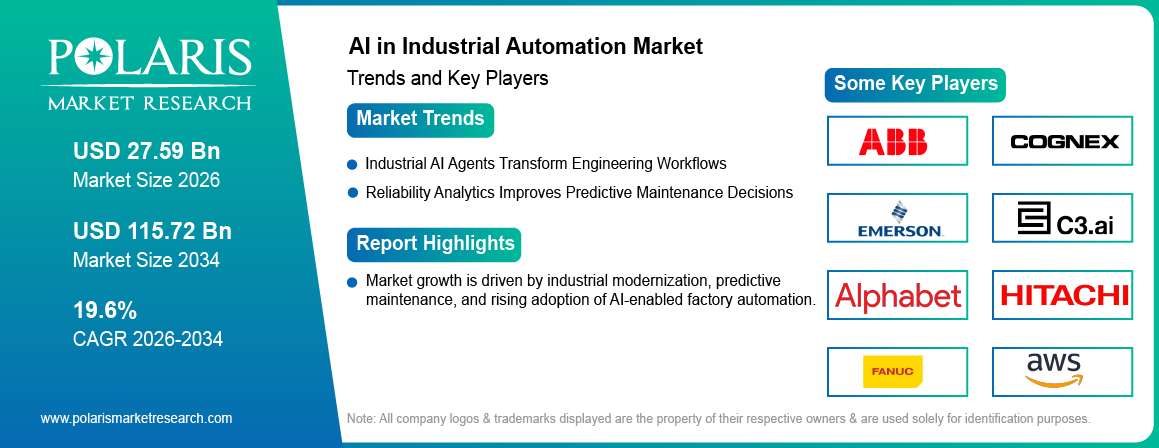
Driver: Industrial AI Agents Transform Engineering Workflows
AI agents are driving the market as they are being used in industrial automation across engineering and production workflows. In April 2026, Siemens expanded its Industrial Edge ecosystem by adding AI, improving cybersecurity, and enhancing data management capabilities. It supports predictive maintenance, visual inspection, and distributed industrial applications. These systems support engineers in analyzing technical information, identifying problems in the operation, and performing selected tasks within certain limits. Industrial copilots also assist with equipment configuration, troubleshooting, and production planning. This shift from simple assistance to hands-off execution reduces manual work and improves workflow efficiency. AI-driven industrial control and factory automation solutions also helps manufacturers link engineering activities and production operations. These capabilities create new investment opportunities in factory artificial intelligence and strengthen demand for industrial AI solutions (Source: Siemens).
Driver: Reliability Analytics Improves Predictive Maintenance Decisions
The AI-powered industrial automation market is gaining popularity as industrial facilities increasingly use reliability analytics. Manufacturers generate large volumes of equipment data through sensors, control systems, and production networks. Körber launched PredictX in September 2026. It is a sensor-based predictive maintenance solution that detects abnormal conditions in equipment and notifies technicians to avoid unplanned downtime. AI tools ingest this historical and real-time OT data to find abnormal operating patterns and to predict possible equipment failures. These insights allow maintenance teams to schedule repairs, reduce unplanned downtime, and maximize asset utilization. Predictive maintenance also provides more insight into the condition of equipment, which helps improve maintenance planning. As manufacturers seek better production reliability, demand for industrial AI solutions and equipment analytics is growing (Source: Körber).
Restraint: Legacy OT Integration and Safety Accountability Limit AI Autonomy
The AI in industrial automation market is faced with challenges caused by legacy operational technology systems and rigorous industrial safety standards. Many facilities are running with different generations of equipment, control systems, and data formats. Technical integration, data standardization, and cybersecurity controls are needed to connect these systems with modern AI platforms. Industrial AI applications also require clear supervision by humans when automated decisions affect equipment, production quality, or worker safety. Risk management and system reliability are integral to NIST guidance on trustworthy AI in critical infrastructure. These requirements complicate deployment and limit autonomous AI functions in sensitive industrial operations.
Opportunity: Edge Inference Improves Real-Time Inspection and Process Control
The AI in industrial automation market offers opportunities by enabling broader use of edge inference in production environments. EnGenius Technologies will showcase its AI computing infrastructure, including data center servers, edge servers, and industrial Edge AI computers at SC26 in November 2026 to promote real-time AI processing and industrial automation. Edge computing is a process of analyzing data near to the industrial equipment, which reduces the latency of transferring data over long distances to servers. This capability enables machine vision systems to identify product defects during production and gives control teams the ability to respond faster to process variations. In contrast, AI-enabled factory automation in plants with limited network connectivity or in which strict controls are required for data transfer also benefits from local processing. Demand for edge inference hardware and industrial AI software is expected to get a boost as manufacturers seek faster inspection and more precise production adjustments.
Opportunity: Contextual Data Platforms Enable Enterprise-Wide AI Deployment
The AI in industrial automation market is expected to offer opportunities during the forecast period. It is projected to develop industrial data fabric platforms that connect information across equipment, production systems, and enterprise applications. Fragmented data impacts AI pilots’ performance and makes it difficult to scale solutions across multiple facilities. Contextual data platforms structure industrial data and deliver relevant operational context to AI models. This enhances data access, model performance, and coordination across production environments. Companies such as Siemens AG, Emerson Electric Co., and Rockwell Automation are building industrial AI capabilities around connected data and automation workflows. These developments create opportunities for enterprise-wide AI deployment.
Market Segmentation Analysis
The AI in industrial automation market is segmented on the basis of component, technology, application, deployment, and end-use industry to identify key market segments and emerging growth opportunities.
Component Insights
Software and platforms dominated the AI in industrial automation market share with 51.84% in 2025. This segment includes industrial AI platforms, predictive maintenance software, production analytics, and AI factory software. These solutions leverage OT data to monitor equipment performance, identify operational issues, and improve production decisions. Manufacturers also use computer vision and predictive analysis to automate quality inspection and reduce equipment downtime. Industrial copilots help engineers handle selected workflows of production and give technical support. Demand for software depends on integration capabilities, data accuracy, processing performance, and compatibility with existing industrial systems.
Services are projected to register the highest CAGR of 22.68% during 2026–2034. This section includes system integration, AI model development, implementation, consulting, maintenance, and technical support. Service providers help manufacturers integrate AI platforms with existing equipment, control systems, and enterprise applications. They also help with data preparation, model configuration, cybersecurity, and deployment management. These activities reduce technical barriers and improve the reliability of industrial AI applications. Complexity of integration, internal technical capabilities, and demand to scale AI deployments across production facilities.
Hardware enablement held 31.67% of the AI in industrial automation market share in 2025. This section covers industrial sensors, edge processing, AI controllers, computing devices, and other hardware required to run AI applications in the factory operations. These components collect and process OT data from connected machines and production lines. Edge hardware also enables faster data analysis close to industrial assets, which decreases latency in time-critical applications. Processing capability, equipment compatibility, sensor accuracy, and the need for reliable industrial data collection all affect demand.
Technology Insights
Machine learning was the leading segment with 36.42% share in 2025. This technology leverages historical and real-time production data to detect trends, predict equipment failures and improve process performance. Manufacturers deploy machine learning algorithms for predictive maintenance, production planning and process optimization. Such applications help reduce unplanned downtime and to improve operational efficiency. Demand is determined by the availability of data, the accuracy of the models, and the integration across industrial systems.
Generative AI is expected to record the highest CAGR of 27.46% during 2026–2034. The technology enables industrial copilots, technical assistance, engineering documentation, and natural language access to operational information. Manufacturers use these applications to simplify engineering tasks and to enhance access to production knowledge. Industrial AI agents also support selected workflows by performing tasks and information retrieval. Demand is a function of enterprise data access, system integration, governance, and the reliability of generated outputs.
Computer vision held 29.18% market share in 2025. The technology uses cameras and AI models to inspect products, identify defects, and monitor production activities. Computer vision is being used by manufacturers in automotive, electronics, and food processing operations to improve accuracy in inspections. Automated visual inspection also cuts down on manual inspections, helping to maintain consistent product quality. The demand is determined by camera performance, model accuracy, speed of production, and ability to detect defects among various types of products.
Hybrid physics-based analytics 15.75% market share in 2025. This technology combines engineering principles and physical models of systems with AI models to analyze industrial processes. These solutions are used by manufacturers in the analysis of equipment performance, simulation of processes, and monitoring of operations. Combining technical models with production data boosts the relevance of predictions in complex industrial environments. Demand is a function of model accuracy, engineering expertise, data quality, and the need for reliable decisions in critical operations.
Application Insights
Predictive maintenance dominated with 28.00% share in 2025. This application leverages AI models to analyze equipment conditions and detect early signs of failure. Maintenance teams can apply this knowledge to schedule repairs, reduce unplanned downtime, and improve asset utilization. Predictive analytics allows manufacturers to prioritize maintenance and manage the performance of equipment. Demand is a function of the sensor data available, the accuracy of failure prediction, and the need to maintain continuity in production.
Engineering copilots are estimated to record the highest CAGR of 26.72% during 2026–2034. Engineering copilots leverage the power of AI to support engineers in documenting, configuring, fixing, and executing their processes. Industrial copilots improve access to technical information and reduce time spent on repetitive engineering tasks. AI agents also help connect engineering knowledge to selected operational activities. Demand depends on system compatibility, access to technical data, output reliability, and enterprise governance requirements.
Quality inspection held 23.16% of the market in 2025. AI-powered inspection systems use computer vision to detect defects, measure variations in product and track quality along the manufacturing line. The applications help manufacturers reduce the need for manual inspection and improve the uniformity of the product. Automated inspection allows for faster detection of production errors on high-volume manufacturing lines. Demand is driven by defect detection accuracy, camera performance, and production speed and quality requirements in automotive, electronics, and food processing facilities.
Process optimization accounted for 25.42% market share in 2025. Artificial intelligence systems can examine production parameters, resource consumption, and equipment performance and propose improvements to processes. Manufacturers use these applications to reduce waste of materials, improve energy efficiency, and increase production. Predictive analytics can also help operators detect variations in the process and adjust operating conditions. Demand is influenced by the complexity of production, data availability, requirements of energy management, and the need to manage operating costs in industrial facilities.
Material movement held 13.18% of the market share in 2025. In this area, AI applications support the coordination of automated material handling, robotic systems, and movement within production facilities. These solutions improve task allocation, movement planning, and coordination of equipment using operational data. Manufacturers are using AI in internal logistics, warehouse operations, and the movement of production materials. The demand is dependent on the facility layout, automation needs, equipment compatibility, and the desire to increase the efficiency of material handling.
Deployment Insights
On premises had the significant market share with 28.68% of the market share in 2025. The model enables manufacturers to run AI platforms on their own IT and OT infrastructure. It gives greater control over industrial data, system access, and deployment configurations. Manufacturers are also using on-premises systems to connect AI applications to existing factory equipment and control networks. This depends on the requirements for data security, the internal infrastructure, the regulatory obligations, and the need for direct control of industrial operations.
Edge is anticipated to witness the highest CAGR of 21.72% from 2026 to 2034. This deployment model processes the industrial data near the connected equipment. It removes the delays associated with the remote transfer of data and enables a faster response for inspection, monitoring, and process control. In areas with limited network connectivity, edge AI helps facilities manage time sensitive applications. The need for it is dictated by the need for processing, hardware capability, data security, and the ability to make operational decisions in real-time.
In 2025, cloud captured 22.15% of the market share. Cloud platforms enable manufacturers to tap into AI applications, control production data and roll out analytics across connected facilities. These solutions need less local computer infrastructure and make software updates simpler. Centralized platforms also permit organizations to review operational information from multiple production sites. Demand is driven by connectivity, data management requirements, platform scalability, cybersecurity controls and centralized industrial analytics.
Hybrid held 17.75% share of the market in 2025. The model leverages edge, cloud, and on-premises infrastructure to distribute industrial AI workloads across the different environments. Companies are using hybrid industrial AI to analyze time-sensitive data in-house and to do more extensive analysis on a central platform. This approach allows flexibility for facilities with differing data access and processing requirements. Demand is affected by integration capabilities, infrastructure requirements, cybersecurity, and the trade-off between processing speed and operational control.
End-Use Industry Insights
Automotive accounted for the largest share of 30.84% of the artificial intelligence in industrial automation market by 2025. Car makers are using AI to run robotic production, predictive maintenance, automated inspection, and process optimization. Applications like these increase consistency in production and reduce equipment downtime across the entire assembly operations. AI-based quality checks help find defects in manufacturing. Demand is a function of production volume, investments in automation, product quality requirements, and the need to enhance manufacturing efficiency.
Process manufacturing is expected to witness the highest CAGR of 17.92% during the forecast period. AI is used by this industry to track equipment performance, fine-tune production parameters, and predict process disruptions. Applications in chemicals and other process-based industries help improve asset reliability and operational efficiency. AI analytics also allows operators to detect changes in production conditions. The demand is driven by the modernization of plants, the need to monitor equipment, the complexity of processes, and the need to improve the utilization of resources.
Electronics accounted for 22.76% of the market share in 2025. AI is used to check circuit boards, identify defects in components, and check that precision assembly is on track in electronics production. Computer vision and predictive analytics improve the accuracy of inspections and reduce production mistakes. They also help manufacturers control quality across complicated production lines. The demand depends on the complexity of product design, component size, inspection accuracy, production speed, and strict manufacturing quality requirements.
Food and beverage made up 12.10% of the market in 2025. Manufacturers are employing AI to inspect products, monitor fill weight, control production, and maintain equipment. These applications help increase product consistency and decrease material waste in processing and packaging operations. AI-based monitoring also helps identify production variations and equipment performance problems. Demand is linked to the quality requirements of the food, the precision of the packaging, the efficiency of production, and the necessity of having a steady output across production plants.
Energy and utilities held a market share of 12.82% in 2025. AI applications in this vertical allow monitoring industrial assets, predicting equipment failures, and enhancing the performance of operations in the energy and utilities infrastructure. They help in the optimization of maintenance schedules and offer increased visibility into the operations environment. Artificial intelligence helps detect the differences in equipment performance. Demand depends on asset reliability requirements, infrastructure modernization, equipment monitoring needs, and efficient resource management.
Regional Insights
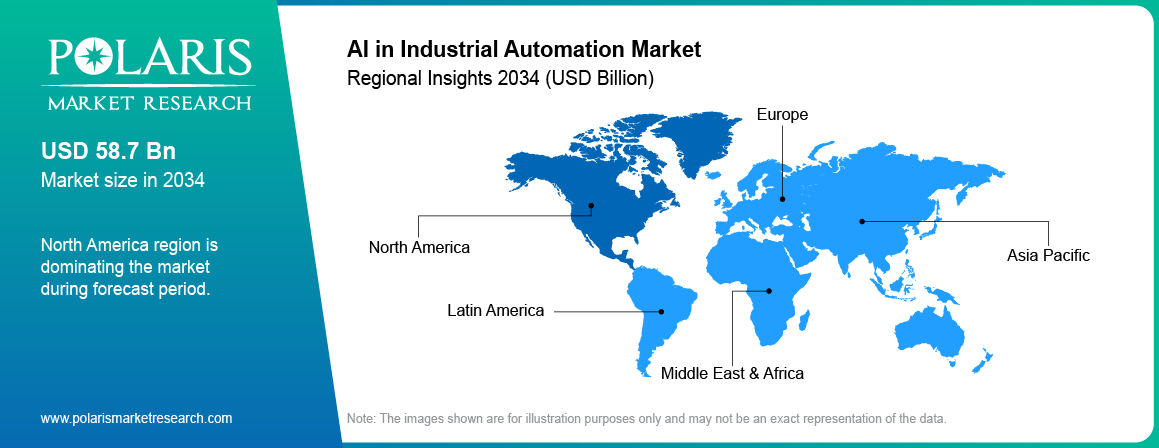
The AI in industrial automation market covers North America, Europe, Asia Pacific, Latin America, and the Middle East & Africa. Regional demand is driven by industrial artificial intelligence adoption, manufacturing investment, industrial robot analytics, and plant modernization. AI-based solutions are used by manufacturers to improve equipment reliability, automate quality checks, optimize production processes, and manage industrial operations. The digitalization, availability of operational data, skilled labor force, cybersecurity needs, and investments in connected manufacturing systems are driving the market development in each region. These factors will influence the industrial AI industry forecast across major manufacturing economies.
North America AI in Industrial Automation Market Trends
North America dominated the AI in industrial automation market share with 37.25% in 2025. The existing presence of technology providers in the industrial technology industry drives the regional market growth. Investments in the upgradation of plants and the adoption of AI in the manufacturing process also propel the growth. Industrial AI solutions are used for predictive maintenance, automated quality assurance, and production optimization. Also, the advanced manufacturing facilities increase the regional demand for connected machinery and industrial robots. The U.S. is one of the biggest countries for industrial automation technologies. Palladyne AI and FANUC America said in September 2026 that they will partner to link physical AI software to industrial robots. Regional growth depends on industrial artificial intelligence adoption, OT data integration, workforce capabilities, and investment in advanced manufacturing systems.
Asia Pacific AI in Industrial Automation Market Trends
The market in Asia Pacific is projected to register a CAGR of 22.84% during 2026–2034. The regional growth is attributed to the expansion of manufacturing, investment in industrial automation, and increasing adoption of industrial robots. Manufacturers in China, Japan, South Korea, and India are betting on smart production systems to increase output and product quality. Opportunities brought by electronics and automotive manufacturing include computer vision, predictive maintenance and process optimization. Industrial artificial intelligence adoption will likely to grow as manufacturers modernize production facilities and improve connected manufacturing capabilities. Estek Automation invested USD 5 million in November 2026 to build a new manufacturing facility in Penang, Malaysia, to improve semiconductor equipment production, AI-powered inspection solutions, and industrial automation capabilities (Source: tnglobal).
Europe AI in Industrial Automation Market Trends
Europe held 24.38% market share in 2025, driven by advanced manufacturing capabilities, industrial digitization, and the need to boost production efficiency. In October 2026, TÜV SÜD and Accenture’s idea of a Physical AI Safety Suite was based on NVIDIA technologies, digital twins, AI agents, and simulations to speed the safety certification and deployment of autonomous robots in factories and warehouses. Germany is a key manufacturing market, especially in terms of automotive and industrial equipment manufacturing. Manufacturers are leveraging AI applications to monitor equipment performance, automate quality inspection, and improve process control. Industrial artificial intelligence is also subject to requirements for data protection, cybersecurity and operational safety. Regional demand for industrial AI solutions will be influenced by investments in plant modernization and connected production systems.
Latin America AI in Industrial Automation Market Trends
Latin America accounted for 3.88% in 2025. Regional opportunities are linked to manufacturing modernization, automotive investment, and industrial automation growth in major economies. Brazil is an important market for industrial robots and automated production systems. Manufacturers are looking at AI for equipment monitoring, quality inspection and production optimization. Mining, energy and food processing are also looking for analytics for equipment and predictive maintenance. The adoption of AI in the industry depends on the investment in technology, the skills of the workforce, the readiness of the infrastructure and its integration with existing production systems.
Middle East & Africa AI in Industrial Automation Market Trends
The Middle East & Africa held 3.33% of the market in 2025. Industrial diversification, infrastructure development, and investments in energy, utilities, mining, and manufacturing drive the demand regionally. Industrial operators use AI solutions to monitor assets, predict equipment failures, and improve production performance. The process industries also have opportunities for predictive maintenance and operational analytics. Industrial artificial intelligence adoption depends on digital infrastructure, access to skilled professionals, OT data availability, and investment in plant modernization. These factors will shape regional demand for industrial AI solutions across major industrial applications.
Competitive Landscape
The AI in industrial automation market includes industrial technology companies, automation equipment manufacturers, industrial software providers, and specialized AI solution developers. Siemens AG, Emerson Electric Co., Rockwell Automation, Inc., ABB Ltd., and Honeywell International Inc. offer industrial AI platforms, automation systems, and analytics solutions. Cognex Corporation specializes in machine vision and artificial intelligence-powered inspection systems. The companies compete by using their industrial knowledge, equipment compatibility, software skills, and integration into production operations. Their products assist manufacturing companies in improving their equipment performance and production processes.
Competition rests on the ability to integrate AI applications with existing operational technology (OT) systems. Industrial AI vendors build solutions that combine data from equipment, control systems, sensors, and production software. Siemens and Rockwell Automation concentrate on factory automation and industrial software integration. Emerson and Honeywell provide process analytics and asset performance solutions. ABB offers AI-based industrial analytics, while Cognex focuses on automated visual inspection. OT integration, deployment flexibility, data management, and expertise in industrial applications are factors influencing supplier selection.
AI in Industrial Automation Competitive Positioning
| Company | Primary Evidence of in-Scope Offering | Commercial Positioning |
| ABB Ltd | Genix AI and APM Copilot | Asset and operations intelligence |
| Amazon Web Services, Inc. | AWS IoT SiteWise, Amazon SageMaker and Amazon Bedrock for industrial data and ML | Cloud-based industrial data and AI platform |
| C3.ai, Inc. | C3 AI Reliability and C3 AI Process Optimization applications | Enterprise AI for predictive maintenance and process optimization |
| Cognex Corporation | In-Sight 2800 AI inspection | Machine vision inspection |
| Emerson Electric Co. | AspenTech AVA and Mtell | Process AI and reliability |
| FANUC Corporation | Zero Down Time (ZDT), AI servo monitor and FIELD system | Robotics and CNC with embedded AI |
| Google LLC (Alphabet Inc.) | Google Cloud Manufacturing Data Engine, Visual Inspection AI and Vertex AI | Cloud data and AI for manufacturing |
| Hitachi, Ltd. | Lumada industrial AI solutions | OT and IT integration for industrial operations |
| Honeywell International Inc. | Forge Production Intelligence | Industrial performance management |
| Intel Corporation | OpenVINO toolkit and edge AI processors for industrial inference | Edge AI silicon and inference software |
| International Business Machines Corporation (IBM) | Maximo Application Suite and watsonx | Asset management and predictive maintenance |
| KUKA AG | KUKA iiQKA robot operating system and AI-enabled robotics | Intelligent robotics and automation (Midea Group subsidiary) |
| Microsoft Corporation | Azure AI, Azure IoT Operations and Copilot integrations | Cloud and copilot platform for industrial workloads |
| Mitsubishi Electric Corporation | Maisart AI embedded in MELSEC controllers | Factory automation with compact AI |
| NVIDIA Corporation | Omniverse, Isaac, Metropolis and Jetson | AI compute, simulation and digital twins |
| Omron Corporation | Sysmac controllers with AI functions, AI-enabled vision and cobots | Edge AI controllers and inspection |
| PTC Inc. | ThingWorx and Kepware industrial connectivity | IIoT and industrial data enablement |
| Rockwell Automation, Inc. | FactoryTalk Analytics LogixAI | Production analytics at the edge |
| SAP SE | SAP Digital Manufacturing with Joule AI assistant | ERP-integrated manufacturing execution |
| Schneider Electric SE | EcoStruxure automation and analytics portfolio | Energy and process automation with AI |
| Siemens AG | Industrial Copilot and agent architecture | Engineering and operations workflow |
| Yaskawa Electric Corporation | MOTOMAN NEXT AI-enabled robotics and motion control | Autonomous robotics and motion control |
| Yokogawa Electric Corporation | AI-based autonomous control (FKDPP) and OpreX portfolio | Autonomous process control |
Source: Polaris Market Research Analysis
Technology and Innovation Landscape
Industrial AI Agents and Workflow Automation
Industrial AI agents are extending automation beyond data analysis and recommendations. These systems interpret operational information, assist engineering teams, and execute approved tasks through connected industrial applications. Siemens has rolled out industrial AI agent features for engineering workflows, while other automation vendors are working on AI-powered tools for plant operations. Linking with production software and control systems reduces manual work and improves decision-making. Task accuracy, system access, safety controls, and human supervision also play a role in the development of industrial artificial intelligence (AI) technology.
Digital Twins and Predictive Analytics
Digital twins combine operational data, engineering models, and simulation tools to represent industrial assets or production processes. AI models use this information to identify performance gaps, predict equipment failures, and evaluate changes in processes. Manufacturers use these capabilities for predictive maintenance, production planning, and asset performance management. Digital twins and predictive analytics in combination provide industrial teams with insights into equipment behavior and the ability to test operational decisions before they are implemented. Adoption is a function of data quality, model accuracy, integration capabilities, and access to reliable OT data.
Machine Vision and Edge AI
Machine vision systems apply computer vision models to inspect products, detect defects, and monitor production activities. Cameras and inspection platforms enabled by AI process visual information from the manufacturing line and help to improve quality control. Edge inference enables data processing close to the equipment, reducing delays in inspection tasks that are time sensitive. Cognex's In-Sight 2800 platform shows how pretrained standard artificial intelligence can be used for industrial inspection. Further adoption relies on image quality, processing capacity, inspection accuracy, and compatibility with existing production systems (Source: Cognex).
Industrial Data Platforms and AI Governance
Industrial data platforms bring together data from equipment, sensors, control systems, and enterprise applications. Data fabric technologies help organize this information and improve access across industrial environments. These platforms provide the basis for AI agents, predictive analytics, and digital twins. Governance capabilities help manufacturers manage data access, cybersecurity, model performance, and automated actions. Reliability of OT integration and clarity of safety controls are prerequisites for industrial AI deployment. These developments will affect the industrial AI industry forecast as manufacturers shift from isolated AI pilots to broader production deployment.
Use Case Analysis
Automotive and Electronics Manufacturing
Industrial AI applications help manufacturers automate quality inspection, monitor production lines, and detect equipment performance problems. Machine vision detects product defects; predictive analytics helps identify equipment failure risks. These AI factory applications enhance quality assurance, reduce downtime, and support production efficiency. Adoption depends on the accuracy of the inspection, compatibility of the equipment, quality of the OT data, and integration requirements.
Process Manufacturing
Industrial AI is used by process manufacturers to monitor equipment, optimize production parameters, and improve asset reliability. AI models analyze operational data from sensors and control systems to detect process variation and predict equipment failures. These applications help reduce unplanned downtime and improve the utilization of resources. Deployment depends on data availability, OT integration, process safety, and model accuracy.
Food and Beverage Manufacturing
Food and beverage manufacturers use industrial AI to automate product inspection, monitor production conditions, and maintain quality standards. Machine vision can detect packaging flaws and product inconsistencies, while predictive analytics can monitor equipment performance. These applications enhance quality assurance and reduce production losses. Adoption is contingent on inspection accuracy, hygiene requirements, system compatibility, and reliable production data.
Energy and Utilities
Industrial AI is used by energy and utility companies to monitor critical assets, predict equipment failures, and optimize operational performance. AI-based analytics analyzes equipment and sensor data to identify abnormal operating conditions. These applications contribute to increasing asset reliability and reducing maintenance interruptions. Deployment is dependent on OT integration, cybersecurity requirements, system reliability, and validation testing.
Buyer Analysis and Market Entry Barriers
Buyer Decision Framework
| Buyer / Stakeholder | Decision criterion | Potential blocker |
| Plant manager | OEE, scrap, safety and availability | Disruption during commissioning |
| OT / controls engineer | PLC integration, determinism and support | Unsafe write access |
| IT / security | Network architecture, identity and data custody | OT exposure and data handling |
| Finance / procurement | Payback and contract exposure | Uncertain repeatability |
| Quality / maintenance | Alert precision, traceability and workflow fit | False alarms or poor labels |
Market Entry Barriers
- Legacy equipment and fragmented control systems increase OT integration complexity and implementation costs.
- Limited historical failure data affects model training and prediction accuracy.
- Validation testing and safety requirements extend deployment timelines.
- Shortages of skilled industrial AI professionals restrict implementation and system management.
- Unclear return on investment slows industrial AI purchasing decisions.
- Cybersecurity risks and data access restrictions limit connectivity across operational environments.
Premium Insights and Forward Outlook
From Application Pilots to Governed Industrial Agent Systems
Industrial AI adoption is moving beyond isolated applications toward connected agent-based systems. AI agents will be able to help with engineering workflows, collect operational data, and execute approved tasks through industrial software. Agent orchestration helps to coordinate activities across connected applications. Broader deployment depends on industrial access control, safety governance, model accuracy, and human supervision. Such developments will influence the industrial AI outlook.
Industrial Data Context Becomes a Competitive Asset
The quality and availability of industrial data are becoming key factors in AI deployment. Data fabric platforms for industry connect data from equipment, sensors, production systems, and enterprise applications. This context improves predictive analytics, digital twin, and AI agent performance. Companies that are good at managing operational data have better visibility into equipment and production processes. Data governance, cybersecurity, and OT integration remain key adoption requirements.
Cost and Pricing Benchmarking Analysis
The price of AI software for industry depends on several factors, including how much user uses it, how user uses it, user’s data requirements, and the type of license user has. Vendors can bill with a software subscription, a perpetual license, a usage fee, or an enterprise agreement. System integration, hardware upgrades, model development, and implementation services result in additional costs. Industrial AI software pricing is also dependent on the number of connected assets and production facilities.
Publicly Disclosed Assistant Pricing
| Product / offering | Public price status | Budget interpretation |
| FactoryTalk Analytics LogixAI | Public product description; quote required | License plus integration and support |
| AspenTech AVA | Contract pricing not publicly disclosed | Enterprise platform and deployment scope |
| In-Sight 2800 AI vision system | Configuration-specific vendor/partner quote | Camera, lighting, setup, model tuning |
| Siemens Industrial Copilot | Commercial terms depend on configuration | Engineering workflow and site scope |
Implementation costs are not limited to initial software purchases. Manufacturers also face costs for sensor installation, edge computing infrastructure, data preparation, cybersecurity, employee training, and system integration. Lifecycle support includes software updates, model monitoring, technical assistance, and system maintenance. Buyers weigh these costs against operational benefits such as reduced downtime, improved quality, and higher production efficiency.
Key Players
List of the Key Players
- ABB Ltd
- Amazon Web Services, Inc.
- AVEVA Group Limited
- C3.ai, Inc.
- Cognex Corporation
- Emerson Electric Co.
- FANUC Corporation
- Google LLC (Alphabet Inc.)
- Hitachi, Ltd.
- Honeywell International Inc.
- Intel Corporation
- International Business Machines Corporation (IBM)
- KUKA AG
- Microsoft Corporation
- Mitsubishi Electric Corporation
- NVIDIA Corporation
- Omron Corporation
- PTC Inc.
- Rockwell Automation, Inc.
- SAP SE
- Schneider Electric SE
- Siemens AG
- Yaskawa Electric Corporation
- Yokogawa Electric Corporation
Industry Developments
- October 2026: Rockwell Automation introduced FactoryTalk Conductor, an AI-native platform designed to coordinate AI agents and automate engineering workflows across industrial automation operations. (Source: PR Newswire)
- May 2026: Emerson announced enhancements to its AspenTech Inmation OT Data Fabric, a solution designed to unify and contextualize operational data across industrial environments to create an AI-ready enterprise data foundation.
- January 2026: Emerson unveiled a new AspenTech Asset Performance Management portfolio with Aspen Mtell capabilities for AI-enabled failure prediction and operational improvement.
- November 2025: At SPS 2025, Siemens showed off its Engineering Copilot TIA. It can perform engineering tasks, generate code, and modify project elements within TIA Portal. (Source: Siemens)
- May 2025: Siemens launched advanced industrial AI agents for its Industrial Copilot ecosystem to provide orchestration capabilities to automate complex tasks across industrial workflows.
Market Segmentation
By Component (Revenue, USD Billion, 2021–2034)
- Software and Platforms
- Hardware Enablement
- Services
By Technology (Revenue, USD Billion, 2021–2034)
- Machine Learning
- Computer Vision
- Generative AI
- Hybrid Physics-Based Analytics
By Application (Revenue, USD Billion, 2021–2034)
- Predictive Maintenance
- Quality Inspection
- Process Optimization
- Engineering Copilots
- Material Movement
By Deployment (Revenue, USD Billion, 2021–2034)
- Edge
- On-Premises
- Cloud
- Hybrid
By End-Use Industry (Revenue, USD Billion, 2021–2034)
- Automotive
- Electronics
- Process Manufacturing
- Food and Beverage
- Energy and Utilities
By Regional Outlook (Revenue, USD Billion, 2021-2034)
- North America
- U.S.
- Canada
- Europe
- Germany
- France
- UK
- Italy
- Spain
- Netherlands
- Russia
- Rest of Europe
- Asia Pacific
- China
- Japan
- India
- Malaysia
- South Korea
- Indonesia
- Australia
- Vietnam
- Rest of Asia Pacific
- Middle East & Africa
- Saudi Arabia
- UAE
- Israel
- South Africa
- Rest of Middle East & Africa
- Latin America
- Mexico
- Brazil
- Argentina
- Rest of Latin America
AI in Industrial Automation Market Report Scope
| Report Attributes | Details |
| Market Size in 2025 | USD 23.08 Billion |
| Market Size in 2026 | USD 27.59 Billion |
| Revenue Forecast by 2034 | USD 115.72 Billion |
| CAGR | 19.6% from 2026 to 2034 |
| Base Year | 2025 |
| Historical Data | 2021–2024 |
| Forecast Period | 2026–2034 |
| Quantitative Units | Revenue in USD Billion and CAGR from 2026 to 2034 |
| Report Coverage | Revenue Forecast, Competitive Landscape, Growth Factors, and Industry Trends |
| Segments Covered |
|
| Regional Scope |
|
| Competitive Landscape |
|
| Report Format |
|
| Customization | Report customization as per your requirements with respect to countries, regions, and segmentation. |
Source: Polaris Market Research Analysis
Why Choose Polaris Market Research
Polaris Market Research & Consulting, Inc. provides comprehensive industrial automation AI market report, covering market definition, component categories, AI technologies, industrial applications, deployment models, end-use industries, regional trends, and competitive developments. The study examines industrial AI platforms, hardware enablement, integration services, predictive maintenance, machine vision, and AI-enabled factory automation. It also evaluates industrial AI vendors, OT integration requirements, and emerging technology developments. This research helps businesses understand market opportunities, assess supplier capabilities, and identify growth prospects across industrial applications.
Clients can ask for a customized industrial AI market report by component, technology, application, deployment, end-use industry, and region. The study covers needs for technology assessment, competitive benchmarking, market sizing, pricing analysis, and application-level demand. It also looks at industrial AI adoption in automotive, electronics, process manufacturing, food & beverage, and energy and utilities. The analysis enables clients to assess industrial AI investment opportunities, benchmark supplier capabilities, and track developments across the industrial automation value chain.
Research Methodology
Polaris Market Research & Consulting, Inc. follows a structured research process for its industrial AI industry analysis. The study begins with market definition and scope control, covering AI software platforms, hardware enablement, and services directly linked to industrial AI deployment. It examines applications using machine learning, computer vision, generative AI, and hybrid physics-based analytics to optimize industrial operations. Conventional PLC and SCADA systems without material AI functionality, generic office automation, and standalone cloud foundation models without industrial deployment remain outside the study scope.
The next step involves secondary research, market segmentation, market size estimation, data triangulation and analyst review. Secondary research looks at supplier disclosure, company reports, product information, technical publications, industry developments, and regulatory changes. The forecasting process assesses component, technology, application, deployment, end-use industry, and regional demand. Information on supplier disclosures and products assists in evaluating industrial AI capabilities, deployment models, and competitive positioning. The final review assesses the industrial AI market analysis by source reliability, segment classification, market boundaries, and forecasting consistency.
Research Methodology Phases
| Phase | Description |
| 1. Scope definition | Define industrial AI product and revenue eligibility |
| 2. Primary research review | Inspect manufacturer product disclosures and dated releases |
| 3. Use-case classification | Map purchases to component, technology, application and industry |
| 4. Forecast reconciliation | Integrate confirmed Polaris market statistics and segment assumptions |
| 5. Editorial assurance | Check numbers, sources, product names, consistency, and publication language |
Source: Polaris Market Research Analysis
AI in Industrial Automation Market FAQ's
The market was valued at USD 23.08 billion in 2025.
The market is projected to grow at a CAGR of 19.6% during 2026–2034.
North America led the market in 2025, accounting for 37.25% of global revenue.
Predictive maintenance held the largest share at 28.00% in 2025.
AI supports predictive maintenance, quality inspection, process optimization, engineering workflows, and material movement.
Traditional automation follows predefined rules, while AI identifies patterns, predicts outcomes, and adapts to changing conditions.
It reduces equipment downtime, lowers maintenance costs, and improves asset reliability.
Computer vision models analyze product images to detect defects and improve quality inspection.
Yes. Edge devices and on-premises systems enable local AI processing without continuous cloud connectivity.
Key barriers include legacy systems, OT integration, cybersecurity risks, high costs, and skill shortages.
Major providers include Siemens, Emerson, Rockwell Automation, ABB, Honeywell, and Cognex.
Manufacturers should track downtime reduction, maintenance savings, production yield, defect rates, and equipment utilization.

Download Sample Report of AI in Industrial Automation Market
Please fill out the form to request a customized copy of the research report.


