
AI Powered Industrial Robot Market Size, Share, and Forecast 2026 to 2034
REPORT DETAILS
AI Powered Industrial Robot Market Summary
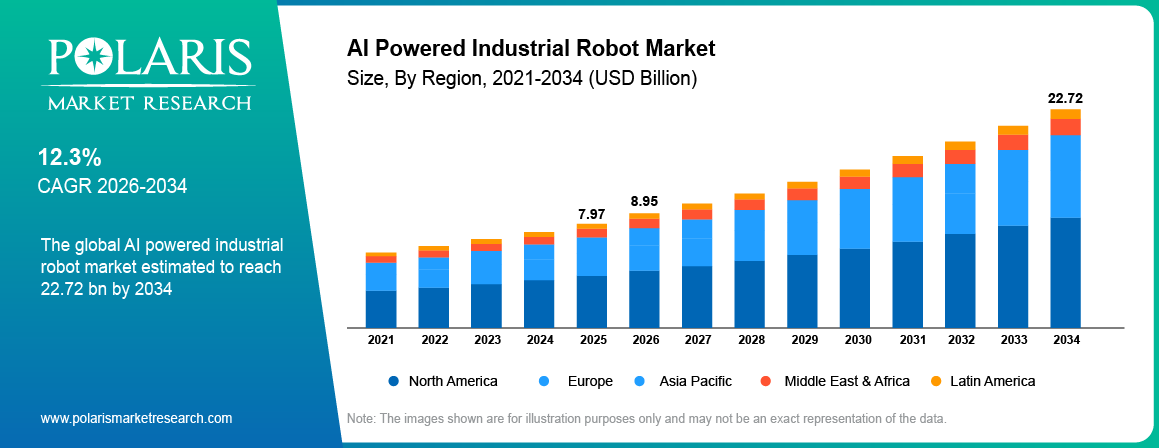
According to Polaris Market Research analysis, the AI powered industrial robot market was valued at USD 7.97 Billion in 2025. It is projected to reach USD 22.72 Billion by 2034, growing at a CAGR of 12.3% from 2026 to 2034. Demand is driven by factory labor shortages, cheaper vision and edge computing, and physical AI software that lets robots handle varied tasks without reprogramming. Hardware earns the largest component revenue, while software is gaining ground as plants license learning and vision tools for each robot fleet. Supply spans arms, controllers, AI software, and integration services sold to automotive, electronics, metals, and food plants. Asia Pacific is the leading market. North America is the fastest growing region.
Market Statistics
Key Takeaways
- Asia Pacific brought in 46.7% of 2026 revenue, led by electronics, automotive, and metal plants in China, Japan, and South Korea.
- North America is the fastest growing region, at a CAGR of 18.9% from 2026 to 2034, owing to plant relocation into the region and a surge in chip and drug plant orders.
- Articulated Robots retained 52.4% of 2026 robot type revenue, attributed to six axis flexibility and a decades long track record on vehicle lines.
- Collaborative Robots is the quickest robot type to scale, with a CAGR of 24.6% through 2034, as plants place AI guided arms next to workers without safety cages.
- Hardware earned USD 7,651 Million in 2026, ranking first among components because every deployment starts with an arm, a controller, and sensors.
- In 2026, Machine Learning and Deep Learning led AI technology revenue with 38.0%, due to models that plan grasps and predict part wear.
- Vision guided checking drives the fastest application, with a CAGR of 20.1% from 2026 to 2034, because robots now inspect parts that people once judged by eye.
- Automotive led end use revenue with 29.9% in 2026, owing to long established robot lines, although Electronics and Semiconductor follows closely at 29.0%.
- Software expands faster than any other component, since learning, simulation, and fleet tools are licensed on top of each installed robot.
Note: Figures and projections outlined in this report are the result of Polaris Market Research’s proprietary analytical processes, grounded in the latest available datasets and market observations.
AI Powered Industrial Robot Market Definition
The AI powered industrial robot market covers industrial robots that use machine learning, computer vision, language models, or context sensing to perceive a task and adjust their motion without fresh programming. It spans articulated, Selective Compliance Assembly Robot Arm (SCARA), Cartesian, collaborative, and parallel robots, together with the AI software and services sold with them.
Counted products include robot arms with embedded learning or vision functions, AI controllers, perception and planning software, simulation tools, and integration services priced with those systems. Conventional programmed robots are counted only where an AI module is sold with them. This keeps the market a fraction of the broader industrial robotics market. Humanoid and mobile robots, bare machine vision cameras, and consumer robots sit outside the boundary.
An AI powered robot cell works in four steps. Cameras and force sensors capture the scene, a learned model identifies the part and plans a path, the controller executes the motion, and results feed back to improve later cycles. Different vendors often supply each step, and therefore a plant may buy from four or five suppliers before the first part is handled.
Scale demonstrates how far robot adoption has moved. The International Federation of Robotics (IFR) counted about 5 million industrial robots operating in factories at the end of 2025, with more than 600,000 new units installed during the year. Most of those units still run fixed programs, and every year more of them are upgraded with vision and learning functions.
AI Powered Industrial Robots vs Conventional Programmed Robots: Key Differences
| Attribute | AI Powered Industrial Robots | Conventional Programmed Robots |
| Task setup | Taught by demonstration or generated from instructions | Programmed point by point by specialists |
| Handling variation | Adjusts to part position, shape, and lighting | Needs fixtures and exact part placement |
| Typical use | Bin picking, inspection, flexible assembly, and machine tending | Repeated welding, painting, and palletizing |
| Changeover time | Minutes to hours using stored models | Days of reprogramming for new parts |
| Cost per unit | Higher, with software licensed on top | Lower, and stable at volume |
| Growth direction | Fast, as software and sensors get cheaper | Steady, with upgrades adding AI functions |
Source: Polaris Market Research Analysis
Programmed robots stay popular where parts never change. A car body weld line repeats the same motion millions of times, and therefore learning adds little. Plants that make numerous variants in small batches gain far more from AI, and numerous run both types side by side.
Porter's Five Forces Analysis
| Force | Intensity | Rationale |
| Bargaining power of suppliers | Moderate to High | Reducers, servo motors, and AI chips come from few specialists, while NVIDIA supplies much of the computing used for training and edge inference. |
| Bargaining power of buyers | Moderate | Large automotive and electronics groups buy in volume and demand discounts, yet switching robot brands means retraining staff and rewriting programs. |
| Threat of new entrants | Moderate | Software startups enter with large funding rounds, although hardware reliability, service networks, and safety certification still take years to build. |
| Threat of substitutes | Low to Moderate | Manual labor and fixed automation remain alternatives for simple tasks, but labor shortages and variant growth weaken both. |
| Competitive rivalry | High | Japanese, European, and Chinese makers compete on price, payload range, and AI features for the same plant budgets. |
Source: Polaris Market Research Analysis
Supplier concentration deserves the closest attention, since a handful of firms make the precision gears and motors inside almost every arm. Robot makers respond by designing parts in house and signing multiyear supply contracts, and AI software firms are now bargaining with chip vendors for computing capacity.
Market Dynamics
Driver Impact Analysis
| Driver | Impact on Market Growth | Time Horizon |
| Factory labor shortages and AI driven electronics investment | High | Short to Medium Term |
| Physical AI platforms and simulation tools | High | Medium Term |
Source: Polaris Market Research Analysis
Driver: Factory Labor Shortages and AI Driven Electronics Investment Are Lifting Robot Orders, Creating Market Demand
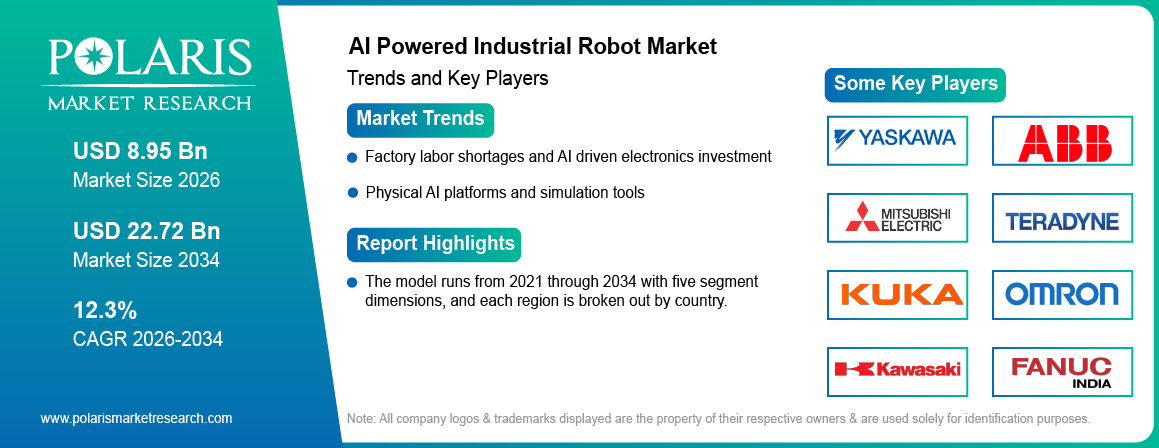
Plants in most major economies struggle to hire for repetitive and physically demanding jobs, and robots fill those gaps once they can cope with variation. At the same time, investment in electronics and AI server production is raising orders for assembly and handling robots. The artificial intelligence in manufacturing market study follows the same shift from the software side.
For example, in July 2026, FANUC raised its full year revenue forecast to JPY 948.1 billion after first quarter orders rose 36.9% to JPY 281.9 billion, a single quarter record. The Japan Robot Association had already lifted its 2026 order forecast in June to JPY 1.22 trillion, citing strong demand tied to AI related electronics.
Electronics and Semiconductor is projected to grow at a CAGR of 16.5% from 2026 to 2034, since chip and server plants add automated lines faster than other industries. Suppliers with vision guided assembly arms gain most, as these plants change products every few months.
Driver: Physical AI Platforms and Digital Twins Are Cutting Robot Setup Time, Creating Market Demand
Physical AI means models that let a robot sense its surroundings and plan its own motion. Training them on real hardware is slow and costly, and therefore makers now train in simulated plants and move the result to the real cell. That cuts commissioning time, and it lets plants test a new layout before any equipment is bought.
For example, in March 2026, FANUC, ABB Robotics, YASKAWA, and KUKA announced they were integrating NVIDIA Omniverse libraries and Isaac simulation frameworks into virtual commissioning tools, and Jetson modules into controllers. Together the four makers have an installed base of more than 2 million robots (Source: NVIDIA).
Software is projected to grow at a CAGR of 21.5% from 2026 to 2034, as simulation, learning, and fleet management tools are licensed on top of each robot. Suppliers of edge computing modules also benefit, since industrial inference is moving onto small modules inside controllers.
Restraint: Trade Barriers, Regulatory Rules, and High Integration Costs Are Slowing Deployments, Limiting Adoption
Robots cross borders as finished machines and as precision parts, and therefore tariffs and approval rules change what a plant pays. Foreign ownership deals now face scrutiny, and new safety rules for learning machines add testing work. Smaller plants often delay purchases until prices and rules settle, and integration can cost more than the robot itself.
For example, in January 2027, the EU Machinery Regulation will begin to apply and require notified body review of safety components that use machine learning, adding testing time and cost for makers that sell into Europe. A United States proclamation signed on 28 October 2026 also ordered talks on robotics and industrial machinery imports and imposed no tariffs yet.
Welding and Soldering is projected to grow at a CAGR of 10.1% from 2026 to 2034, the lowest among applications, due to mature automotive lines that add few new cells. The restraint therefore weighs most on buyers that depend on cross border sourcing and on older programmed work cells.
Opportunity: Robot Foundation Models Are Creating Openings for Software Licensing and Retrofit Upgrades
Robot foundation models are trained on large sets of images, video, and motion data, and one model can control arms, mobile bases, and grippers. Plants can license such a model instead of writing code for each task. Existing robots can be upgraded with an AI controller, opening a large retrofit market beside new installations.
For example, in January 2026, Skild AI raised close to USD 1.4 billion at a valuation above USD 14 billion in a round led by SoftBank Group, with NVentures, Macquarie Capital, and strategic investors including Samsung and LG. The company says its Skild Brain controls numerous robot bodies without retraining, and ABB Robotics is a named deployment partner.
Natural Language Processing is projected to grow at a CAGR of 21.9% from 2026 to 2034, the fastest AI technology, since operators can now instruct a robot in plain words. Hardware makers that open their controllers to outside AI software will gain from this shift.
Opportunity: Low Cost AI Native Arms and Cobots Are Creating Entry for Small and Mid Sized Manufacturers
Small and mid sized plants have long been priced out of robotics because programming specialists cost more than the arm. New suppliers sell arms that learn from demonstration and arrive with a software stack included. Collaborative designs require less guarding and therefore lower installation costs for plants with little floor space.
For example, in June 2026, Standard Bots raised USD 200 million in a Series C round led by RoboStrategy at a USD 1 billion valuation, to expand its Glen Cove, New York facility from 16,000 to 70,000 square feet. The company claims a 30% price advantage over incumbents and sells AI native arms taught by demonstration.
Collaborative Robots is projected to grow at a CAGR of 24.6% from 2026 to 2034, well above Articulated Robots at 13.6%. Their starting revenue is modest, and therefore the segment adds limited value to the 2026 total yet lifts overall growth through 2034.
Trend: Robot Makers Are Partnering With Chip and Software Firms and Restructuring Ownership Around Physical AI
Robot makers rarely build every layer themselves, and therefore partnerships with chip vendors, simulation firms, and AI startups are now routine. Ownership is shifting as well, with industrial groups selling robot units to buyers that treat robots as a platform for physical AI. Smaller suppliers respond by narrowing to specialties where they can still win on price or application know how.
For example, in November 2026, China prohibited SoftBank Group from acquiring the ABB Robotics business in China, after SoftBank agreed in October 2025 to pay USD 5.375 billion for the unit and called physical AI its next frontier. Teradyne reported on 27 October 2026 that its Robotics segment earned USD 96 million in the third quarter, its highest third quarter revenue to date, and turned profitable.
Services is projected to grow at a CAGR of 16.9% from 2026 to 2034, as partnerships bundle installation, training, and model updates with each robot. Ownership changes make life harder for small suppliers when the next round of plant contracts is awarded.
Value Chain Analysis
| Stage | Activities | Representative Participants |
| Components and computing | Reducers, servo motors, sensors, and AI chips | Harmonic Drive Systems, Nabtesco, and NVIDIA |
| Robot design and manufacturing | Arms, controllers, and teach pendants built for defined payloads | FANUC, ABB Robotics, YASKAWA, and KUKA |
| AI software and models | Perception, planning, simulation, and learning platforms | NVIDIA, Skild AI, and Standard Bots |
| System integration | Cell design, installation, safety validation, and training | Regional integrators and robot maker service units |
| End use plants and service | Production lines, maintenance contracts, and model updates | Automotive, electronics, metals, and food manufacturers |
Source: Polaris Market Research Analysis
Value sits in the software and integration layers, since each installed robot pulls through licenses and service for years. Hardware makers earn from placement and spare parts, while component suppliers depend on volume and face price pressure from the largest buyers.
Margins differ by stage, with software carrying recurring revenue and integration depending on project timing. Plants that own their robots buy updates directly, and those that lease pay a fee that bundles hardware, support, and model upgrades.
AI Powered Industrial Robot Market Segmentation Analysis
The five dimensions below are read one at a time, since buyers pick a component, a robot type, an AI method, an application, and an industry for separate reasons.
Component Insights
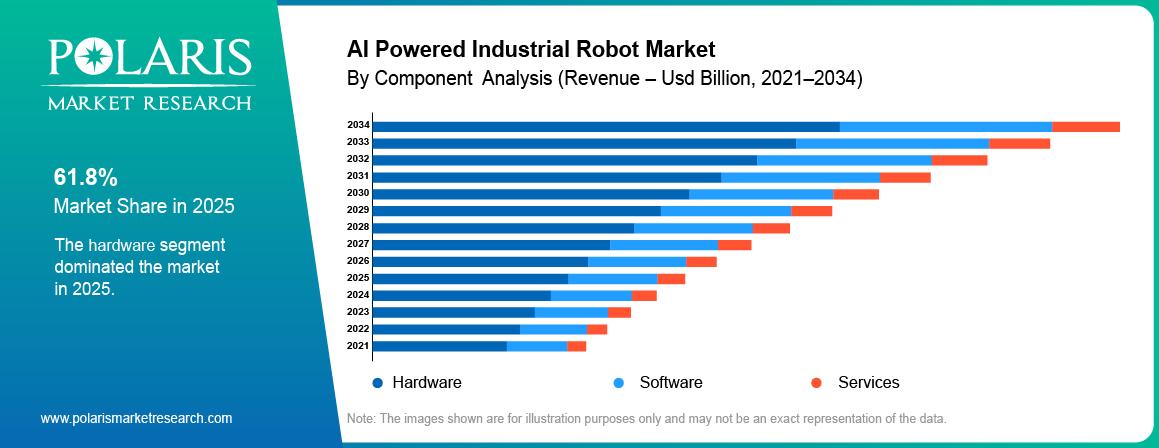
Hardware accounted for 61.8% of component revenue in 2026, owing to the arms, controllers, grippers, and sensors that every deployment starts with. A placed robot runs for a decade or more, and plants reorder spare parts and tooling on a fixed schedule. Controllers with built in accelerators now sell into plants that never used learning functions before.
Software is projected to grow at a CAGR of 21.5% from 2026 to 2034, as plants license perception, planning, and simulation tools for each robot fleet. For example, in March 2026, WORKR said it was integrating its AI platform with ABB industrial robots and using NVIDIA Omniverse libraries to train robotic workers.
Services was worth USD 2,540 Million in 2026, due to integration, safety testing, training, and model updates that plants buy around each cell. Remote monitoring lets suppliers push new models to installed robots, adding a recurring fee beside the original sale.
Demand for service work follows a pattern of its own. Plants outsource cell design during new product launches, and integrators plan staffing months ahead of automotive and electronics model changes. Integrators with strong safety expertise and quick commissioning keep customers over numerous project cycles.
Pricing differs sharply across these three groups. Hardware is bought once at a negotiated unit price, software is licensed by the robot or by the year, and services are billed per project or per month. Suppliers that combine all three in one contract earn steadier revenue and make switching harder for the buyer.
Robot Type Insights
Articulated Robots accounted for 52.4% of robot type revenue in 2026, owing to their reach, payload range, and long record in welding, handling, and machine tending. Six axes let the arm approach a part from numerous angles, and vision plus learning lets it pick from loose bins. The collaborative robot market study covers the fast growing segment next to it.
Collaborative Robots is projected to grow at a CAGR of 24.6% from 2026 to 2034, as plants place AI guided arms beside workers without safety cages. For example, in October 2026, the Association for Advancing Automation reported that North American cobot orders reached 1,831 units in the third quarter, up roughly 56% and 16.7% of all robot units ordered.
SCARA Robots was worth USD 1,575 Million in 2026, attributed to fast, precise assembly of small electronic parts, where a vision camera now corrects part position on every cycle. Cartesian Robots held 8.8% of robot type revenue in 2026, driven by gantry systems in packaging and machine loading.
Delta and Parallel Robots is projected to grow at a CAGR of 12.8% from 2026 to 2034, since food, pharmaceutical, and electronics lines require very fast pick and place with camera guidance. Others covers 7 axis arms, mobile manipulators, and humanoid style machines that are small in revenue but absorb much of the new product work.
Plants rarely pick a robot type on price alone. Payload, reach, cycle time, and floor space limit the choice first, and AI functions are then added through controllers or camera kits. Suppliers that offer one software layer across several robot types make it easier for plants to mix them.
AI Technology Insights
Machine Learning and Deep Learning accounted for 38.0% of AI technology revenue in 2026, owing to its use in grasp planning, motion tuning, and fault prediction. Models trained on millions of simulated picks now run on a small module inside the controller. The edge AI market study follows the computing that sits behind this trend.
Computer Vision is projected to grow at a CAGR of 14.8% from 2026 to 2034, as plants add cameras and depth sensors to find parts, read labels, and check surfaces. Camera costs keep falling, and learned models handle glare and clutter that older rule based software could not. The 3D machine vision market report sizes the sensing layer.
Natural Language Processing was worth USD 1,275 Million in 2026, due to interfaces that turn a spoken or typed instruction into a robot task. For example, in October 2026, Mitsubishi Electric said it had developed a machining system where a humanoid robot and a computer controlled machine tool plan work together from natural language instructions. It showed the system at the Japan International Machine Tool Fair.
Context Awareness held 12.2% of AI technology revenue in 2026, driven by sensing that lets a robot slow down, reroute, or stop as people and objects move around it. Others, at 5.6%, covers reinforcement learning toolkits and planning engines sold as stand alone modules.
Compute supply deserves attention, since training and inference chips come from a small group of makers and a shortage can slow numerous projects. Buyers increasingly ask for models that run on several chip families, and suppliers with portable software have an advantage.
Application Insights
Material Handling accounted for 28.3% of application revenue in 2026, driven by palletizing, depalletizing, machine tending, and bin picking in plants and warehouses. Vision guided picking lets one cell handle mixed cartons that once needed several fixed stations. Steady e commerce and factory volumes keep this work predictable.
Assembly was worth USD 2,682 Million in 2026, due to electronics, appliance, and vehicle parts that must be fitted with small tolerances. For example, in September 2026, Agility Robotics unveiled its Digit 5 humanoid and said it held more than USD 300 million in multiyear customer orders as of May, with GXO, Schaeffler, Amazon, and Toyota Motor Manufacturing Canada among its customers.
Inspection and Quality Control is projected to grow at a CAGR of 20.1% from 2026 to 2034, as learned vision models flag defects that people miss on long shifts. Kawasaki Robotics presented a weld inspection tool at Automate 2026 that it says can work up to ten times faster than earlier methods.
Welding and Soldering held 17.1% of application revenue in 2026, owing to long established arc and spot welding lines in vehicle and machinery plants. Painting and Dispensing is projected to grow at a CAGR of 12.6% from 2026 to 2034, since closed loop vision lets a robot adjust the bead of sealant or paint as parts vary.
End Use Industry Insights
Automotive contributed 29.9% of end use revenue in 2026, driven by body shops, powertrain lines, and battery plants that already run thousands of robots. Spending moves with vehicle program launches, and therefore model changes and electric vehicle capacity decisions demonstrate up quickly in orders.
Electronics and Semiconductor bought 29.0% of the end use total in 2026, owing to chip, server, and component plants that require fast, precise handling. For example, in June 2026, the Japan Robot Association reported that 2025 orders rose 25.7% to JPY 1.0456 trillion, the first annual increase in three years, and forecast a further rise in 2026 on AI related electronics demand.
Healthcare and Pharmaceuticals is projected to grow at a CAGR of 22.7% from 2026 to 2034, as laboratories and drug plants automate sample handling and packaging under strict cleanliness rules. North American life science robot orders rose 38.7% in units in the third quarter of 2026, according to the Association for Advancing Automation.
Metals and Machinery was worth USD 1,763 Million in 2026, due to machine tending and welding in job shops that face skilled labor gaps. Food and Beverage is projected to grow at a CAGR of 17.3% from 2026 to 2034, attributed to vision guided picking of irregular products.
Others covers plastics, logistics, aerospace, and energy plants. These industries are small in revenue but are the focus of new product work, because learned vision lets one robot design serve numerous different parts.
AI Powered Industrial Robot Market Regional Analysis
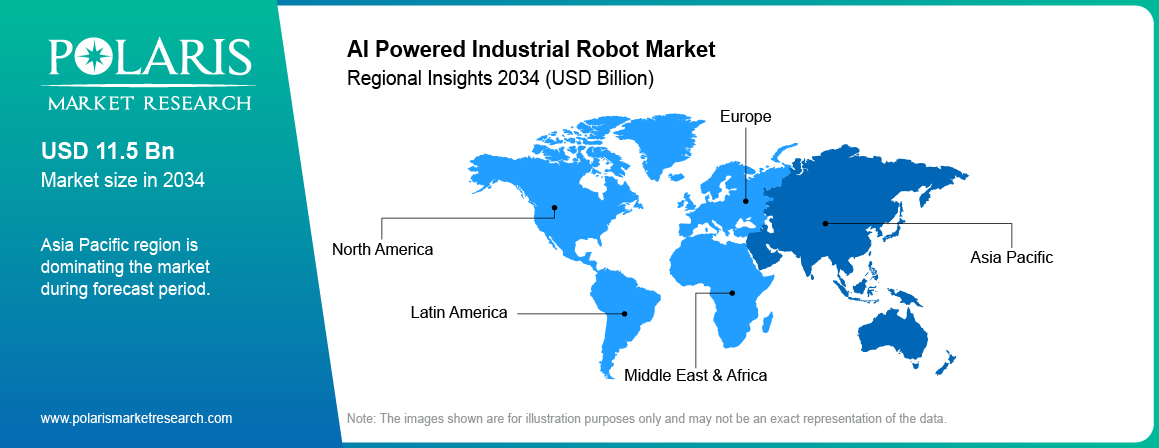
Regional demand follows manufacturing output, labor costs, and national automation policy. Asia Pacific supplies close to half of revenue, North America grows fastest from a smaller base, while Europe, Latin America, and Middle East & Africa follow different paths.
North America Market
Revenue in North America reached 24.8% of the AI powered industrial robot market total in 2026, driven by reshoring projects, tight labor markets, and rising orders from electronics and life science plants in the United States. Mexico is set to outpace its larger neighbor, with a CAGR of 20.9% from 2026 to 2034, as vehicle and appliance plants add automation. For example, in September 2026, the International Federation of Robotics reported almost 38,500 robot installations in the United States for 2025, up 12%, making it the second largest market ahead of Japan.
Canada is projected to grow at a CAGR of 18.9% from 2026 to 2034, as metal fabricators and food processors adopt vision guided cells. Supplier headquarters sit mostly outside the region, and therefore demand depends on import rules and currency swings.
Orders in the region improved through 2026, with nine month totals of 28,984 robots, up 9.6% in units. Semiconductor and electronics orders nearly doubled in the third quarter, while automotive original equipment orders stayed 17% below the prior year, according to the Association for Advancing Automation.
Europe Market
Europe held 21.0% of revenue in 2026, owing to strong machinery, automotive, and metals industries and early adoption of safety rules for learning machines. Germany is the biggest country market, while the United Kingdom grows quickest of the five named, at a CAGR of 13.7% from 2026 to 2034. For example, in April 2026, ABB showed at Hannover Messe how NVIDIA Omniverse and Microsoft Azure services feed its Genix industrial AI suite so operations teams can use AI agents for root cause analysis.
Europe is projected to grow at a CAGR of 12.6% from 2026 to 2034, the slowest region, due to weak car production and cautious capital spending. IFR data demonstrate German installations at fewer than 25,000 units in 2025, down 8%, and Italy at about 7,800, down 11%.
Rules will shape purchases next year. From 20 January 2027, makers selling machinery in the EU must put safety components that use machine learning through notified body review, a step that raises testing costs but favors suppliers with documented safety cases.
Asia Pacific Market
Asia Pacific supplied 46.7% of revenue in 2026 and is projected to grow at a CAGR of 14.7% from 2026 to 2034, driven by electronics and battery plants and by domestic suppliers in China. China holds the biggest national market in the region, and India grows quickest, at a CAGR of 22.2% from 2026 to 2034. For example, in July 2026, FANUC reported first quarter China revenue of JPY 69.3 billion, up 30.0%, the strongest regional gain in its results.
The IFR counted 354,000 installations in China in 2025, up 20% and 59% of the world total, and Chinese suppliers held 55% of their home market. Japan fell 19% to 36,219 units, Korea slipped 1% to 30,000, and India rose 15% to almost 10,500.
Domestic competition is intense, and therefore prices are falling and AI features are spreading to lower priced arms. Japan keeps a mature base in components and controllers, while Taiwan and Korea link robot demand to chip plant construction.
Latin America Market
Latin America added 3.5% of revenue in 2026 and is projected to grow at a CAGR of 15.6% from 2026 to 2034. Growth is attributed to Brazil and Argentina adding automation in vehicle, food, and metal plants. Brazil has the biggest national market and also outgrows Argentina, at 15.6% against 14.2%. For example, in August 2026, ABB Robotics reported that its Sorocaba training center in Brazil had trained more than 1,000 professionals in three years and that it was linking RobotStudio with NVIDIA Omniverse.
The IFR counted almost 4,300 installations in Brazil in 2025, up 38%. Local integrators and training programs decide how quickly plants can use new robots, while currency swings and import duties raise prices.
Middle East & Africa Market
Middle East & Africa had 4.1% of revenue in 2026 and is projected to grow at a CAGR of 17.1% from 2026 to 2034, ranking second for growth among the five regions. Growth is driven by industrial diversification plans in the Gulf, led by Saudi Arabia and the Emirates. Saudi Arabia is both the biggest and the quickest growing country there, at a CAGR of 20.0% from 2026 to 2034. Lianhe Sowell signed a non binding term sheet in October 2025 for USD 105 million of financing toward a USD 132.5 million AI robot plant in the United Arab Emirates that would build several thousand painting robots a year.
Governments fund these plans as part of national industry strategies, and local assembly is being sought to cut import reliance. Africa south of the Sahara is much smaller in revenue, although South Africa hosts automotive plants that buy robots, and training programs are building skills.
AI Powered Industrial Robot Market Competitive Landscape
The field splits into three layers, as established robot makers sell arms, controllers, and software as one platform, AI specialists sell models and perception tools, and chip firms sell the computing underneath. A supplier usually wins a plant once and then supplies it for the life of the robot.
FANUC, ABB Robotics, YASKAWA, and KUKA are all integrating NVIDIA tools, while startups such as Skild AI and Standard Bots sell learning software and AI native arms. Company results demonstrate demand recovering unevenly, since FANUC raised its forecast on record orders, yet ABB described its robotics division as under pressure from weak discrete manufacturing demand in 2025.
Ownership moves continue to shift positions. SoftBank agreed to buy ABB Robotics for USD 5.375 billion, and China blocked the transfer of the China business in November 2026. Market share moves slowly, and companies that hold proven reliability, installed bases, and safety approvals are best placed to gain it, as plants rarely change robot brands once a line passes audit.
Vendor Landscape Snapshot
| Company | Vendor Positioning | Role |
| FANUC Corporation | Leader | Industrial robots and controllers, with NVIDIA tools in virtual commissioning |
| ABB Ltd | Leader | ABB Robotics arms, RobotStudio, and Genix AI software, subject to a pending ownership change |
| Yaskawa Electric Corporation | Leader | Motoman robots and motion control, with NVIDIA Jetson modules in controllers |
| KUKA AG | Leader | Industrial robots and automation systems with NVIDIA integration |
| Kawasaki Heavy Industries, Ltd. | Challenger | Robots including an 8 axis physical AI platform shown at Automate 2026 |
| Mitsubishi Electric Corporation | Challenger | Robots, controllers, and a humanoid with CNC machining system |
| Teradyne, Inc. | Challenger | Collaborative robots through Universal Robots, with Robotics segment revenue of USD 96 million in the third quarter of 2026 |
| Omron Corporation | Challenger | Industrial automation, robots, and vision systems |
| NVIDIA Corporation | Challenger | Isaac, Omniverse, and Jetson platforms used by robot makers |
| Skild AI | Emerging Player | Skild Brain robot foundation model, backed by SoftBank Group |
| Standard Bots | Emerging Player | AI native robot arms taught by demonstration |
| Agility Robotics | Emerging Player | Digit humanoid for logistics and factory work |
| Neura Robotics GmbH | Niche Player | Cognitive robots for industrial tasks |
Source: Polaris Market Research Analysis
AI Powered Industrial Robot Market Technology and Innovation Landscape
Innovation centers on shorter setup time, broader task coverage, and lower computing cost per robot. Simulation platforms generate synthetic images and motion so models can be trained before any hardware moves, and edge modules run the result inside the controller.
Robot foundation models are the second theme. One model trained on video, simulation, and robot data can control arms, mobile bases, and humanoids, and in context learning lets it adapt to a changed payload or a jammed joint without retraining. Skild AI makes this claim for its Skild Brain.
Language interfaces add a further layer, as products such as the Mitsubishi Electric machining planner turn spoken instructions into task plans. Safety is moving in parallel, with independent safety controllers and human detection now standard on new designs such as the Digit 5.
Technology and Innovation Landscape Snapshot
| Area | Role | Status and Representative Developers |
| Simulation and digital twins | Train and test robot programs before deployment | Production, with NVIDIA, FANUC, ABB Robotics, YASKAWA, and KUKA |
| Edge AI controllers | Run learned models inside the robot controller | Production, with NVIDIA Jetson modules in leading brands |
| Robot foundation models | Control many robot bodies from one model | Scaling, with Skild AI and ABB Robotics |
| Language and task planning | Turn plain instructions into machine and robot tasks | Early commercial use, with Mitsubishi Electric |
| Vision guided inspection | Check welds and surfaces while the robot moves | Production, with Kawasaki Robotics and others |
| Teach by demonstration | Let workers show a task instead of coding it | Scaling, with Standard Bots |
Source: Polaris Market Research Analysis
Use Case Analysis
Bin Picking and Machine Tending
Plants use vision guided arms to pick loose parts from bins and load them into machine tools, work that once required fixtures and operators. The robot learns each new part from images, and therefore changeovers take minutes. One cell can serve several machines in a shift pattern.
Adoption is slowed by the require for good lighting, reliable grippers, and training for maintenance staff. Plants that run pilot cells and publish cycle time data find it easier to win budget, and suppliers increasingly help with remote tuning.
Electronics Assembly and Inspection
Electronics plants combine fast SCARA and articulated robots with cameras that check solder joints, connectors, and cable routing. Orders are large and planned around product launches, and therefore suppliers compete on speed, accuracy, and software support.
Quality control matters as much as speed, since a defect in one batch can reach thousands of devices. Plants therefore ask suppliers for image logs, consistent models across lines, and support for traceability, and these requires favor vendors with proven scale.
Welding and Fabrication
Job shops and vehicle suppliers use robots to weld varied parts, and learned vision follows the seam without detailed programming. Weld inspection tools check quality as the arm moves. Low volume, high variety work benefits most.
Skilled welder shortages shape ordering, as shops add cells when they cannot hire. Producers also want results that plug into production planning software, and therefore suppliers that provide data in standard formats gain an edge.
Warehouse and Logistics Handling
Palletizing, truck loading, and tote handling use arms and humanoid machines that work in spaces designed for people. Customers such as GXO and Amazon are testing these systems in live sites. Orders can be large but are tied to milestones.
Timelines are fixed by customer peak seasons, and therefore late delivery of robots is costly for the operator. Integrators therefore keep spare units and prefer suppliers with reliable shipping, documented safety cases, and clear service terms.
Laboratory and Pharmaceutical Automation
Laboratories and drug plants use robots to handle samples, vials, and packages under strict cleanliness rules. Records of every motion support audits, and therefore software that logs actions is as valued as the arm itself. Growth from a small base is strong.
Several of these sites sit inside hospitals and contract manufacturers, where qualification work sets the schedule. Orders arrive in bursts after approvals, and suppliers that offer qualification documents keep these accounts through the gaps.
Buyer Needs and Decision Criteria
| Buyer Need | Decision Criteria | Why It Matters |
| Reliable task success rate | Cycle time and error rate on real parts | A missed pick stops a line and costs more than the robot saves |
| Fit with existing lines | Controller compatibility and integration effort | Plants rarely replace brands that passed safety audit |
| Cost per cell at scale | Hardware price, licenses, and service terms | Large buyers compare quotes across several suppliers |
| Fast changeover | Teaching time and model reuse | Short batches make setup time the real cost |
| Safety and compliance | Certification and rules for learning machines | Machinery rules now cover machine learning safety components |
Source: Polaris Market Research Analysis
Entry barriers are high in safety critical settings. Robots require certification in each region, service networks must cover wide areas, and reliable hardware takes years to build. Price comparison is difficult, since payload, software terms, and support differ, and buyers favor suppliers whose results they have already audited.
Premium Insights and Forward Outlook
Software Licenses Will Outgrow Robot Unit Sales
Plants that buy robots today will add learning and fleet tools once the arms are running, since the marginal cost of a new model is small. Suppliers with open controllers benefit, and license pricing will decide how fast the change happens.
Early signs are visible in subscription offers that bundle updates with each robot. Buyers will want proof that updates raise uptime, and suppliers that publish such results stand to gain preferred status.
Open Controllers Will Decide Platform Wins
Buyers now ask whether outside AI software can run on their robots. Suppliers that expose application programming interfaces, as Kawasaki does with its open real time control interface, will hold an edge over those selling closed systems. Chip firms are likely to shape these specifications.
Partnerships with simulation and model providers may become a source of competitive advantage, since access to training data speeds deployment. Smaller suppliers can partner with universities and startups to build capabilities that large vendors do not offer.
Cobots Will Absorb Light Duty Work First
Falling prices and easy teaching will move light assembly and machine tending toward collaborative robots, yet heavy payload and high speed work will stay with articulated arms because physics still favors them. Makers selling both types are well placed in either case.
The pace of this shift depends on plant budgets and on how quickly safety standards mature. Where robots work beside people, numerous plants will keep cages for fast motion and use cobots only where speed limits are acceptable.
Ownership Changes Will Redraw Supplier Maps
Robot units are being sold to buyers that see physical AI as a platform, and that raises the value of installed bases. Small firms without distinct software or service networks will face pressure to partner or to sell.
The blocked China portion of the ABB Robotics sale demonstrates how quickly plans can change when governments intervene. Buyers of long term contracts should therefore ask suppliers how ownership changes affect support before they commit.
Key Players in the AI Powered Industrial Robot Market
- FANUC Corporation
- ABB Ltd
- Yaskawa Electric Corporation
- KUKA AG
- Kawasaki Heavy Industries, Ltd.
- Mitsubishi Electric Corporation
- Teradyne, Inc.
- Omron Corporation
- NVIDIA Corporation
- Skild AI
- Standard Bots
- Agility Robotics
- Neura Robotics GmbH
Industry Developments
- November 2026: Chinese regulators barred SoftBank Group from buying the ABB Robotics business in China, leaving the USD 5.375 billion global deal unfinished (Source: Robotics 24/7).
- October 2026: North American manufacturers ordered 10,989 robots worth USD 723.5 million in the third quarter, up 24.8% in units and 26.1% in value, according to the Association for Advancing Automation (Source: Robotics 24/7).
- September 2026: World Robotics 2026 data from the International Federation of Robotics put 2025 installations above 600,000, up 11%, with an operating stock of 5 million units (Source: International Federation of Robotics).
- July 2026: FANUC lifted its revenue outlook for the year to JPY 948.1 billion, with first quarter orders of JPY 281.9 billion.
- June 2026: Standard Bots secured USD 200 million at a USD 1 billion valuation to scale production of AI native robot arms.
- March 2026: The four largest robot brands said they would build NVIDIA Omniverse, Isaac, and Jetson technology into their tools and controllers.
- January 2026: Skild AI closed a round of nearly USD 1.4 billion that valued the company above USD 14 billion, led by SoftBank Group.
- October 2025: SoftBank Group agreed to acquire the ABB Robotics business for USD 5.375 billion, citing physical AI as its next frontier.
AI Powered Industrial Robot Market Report Segmentation
By Component Outlook (Revenue, USD Billion, 2021 to 2034)
-
Hardware
-
Software
-
Services
By Robot Type Outlook (Revenue, USD Billion, 2021 to 2034)
-
Articulated Robots
-
SCARA Robots
-
Cartesian Robots
-
Collaborative Robots
-
Delta and Parallel Robots
-
Others
By AI Technology Outlook (Revenue, USD Billion, 2021 to 2034)
-
Machine Learning and Deep Learning
-
Computer Vision
-
Natural Language Processing
-
Context Awareness
-
Others
By Application Outlook (Revenue, USD Billion, 2021 to 2034)
-
Material Handling
-
Welding and Soldering
-
Assembly
-
Painting and Dispensing
-
Inspection and Quality Control
-
Others
By End Use Industry Outlook (Revenue, USD Billion, 2021 to 2034)
-
Automotive
-
Electronics and Semiconductor
-
Metals and Machinery
-
Food and Beverage
-
Healthcare and Pharmaceuticals
-
Others
By Regional Outlook (Revenue, USD Billion, 2021 to 2034)
-
North America
-
United States
-
Canada
-
Mexico
-
-
Europe
-
Germany
-
United Kingdom
-
France
-
Italy
-
Spain
-
Rest of Europe
-
-
Asia Pacific
-
China
-
Japan
-
India
-
South Korea
-
Taiwan
-
Rest of Asia Pacific
-
-
Latin America
-
Brazil
-
Argentina
-
Rest of Latin America
-
-
Middle East & Africa
-
Saudi Arabia
-
United Arab Emirates
-
Israel
-
South Africa
-
Rest of Middle East & Africa
-
AI Powered Industrial Robot Market Report Scope
| Report Attribute | Details |
| Market Size in 2025 | USD 7.97 Billion |
| Market Size in 2026 | USD 8.95 Billion |
| Revenue Forecast by 2034 | USD 22.72 Billion |
| CAGR | 12.3% (2026 to 2034) |
| Base Year | 2025 |
| Historical Data | 2021 to 2024 |
| Forecast Period | 2026 to 2034 |
| Quantitative Units | Revenue in USD Million and USD Billion, and CAGR in percent |
| Report Coverage | Revenue Forecast, Growth Factors, Competitive Landscape, Industry Trends, and Strategic Analysis of the AI powered industrial robot market |
| Segments Covered | By Component, Robot Type, AI Technology, Application, End Use Industry, and Region |
| Regional Scope | North America, Europe, Asia Pacific, Latin America, Middle East & Africa |
| Competitive Landscape | Company Profiling, Product Benchmarking, Financial Analysis, Market Developments, and Strategic Initiatives |
| Report Format | PDF and Excel |
| Customization | Available by Country, Region, and Segment |
| Research Team | Polaris Market Research & Consulting, Inc. research team |
| Last Updated | 9 November 2026 |
Source: Polaris Market Research Analysis
Why Choose Polaris Market Research
Each number in this study comes from a single country by segment model, letting a reader trace any regional figure down through its countries and segments.
Besides the standard categories, the report splits revenue by AI technology, showing spending move from vision toward language and context sensing, and it tracks the shift from programmed arms to collaborative robots inside each application.
Each outside fact is credited to a named source, with a date wherever the source gives one. Planning teams can then see whether a claim comes from company results, industry associations, or trade reports.
Polaris can tailor the study to a single country, segment, or set of companies. To buy this report or request customization, contact Polaris Market Research & Consulting, Inc.
Research Methodology
Research Approach
Sizing starts from the supplier side. It covers the arms that carry learned perception functions, AI controllers, planning software, and integration services priced with them. Conventional programmed robots without an AI module, humanoid and mobile robots, and bare machine vision cameras are left out. The model spans 2021 to 2034 with 2025 as the base year, reports USD Million and USD Billion, and holds five segment dimensions across 23 countries and country groups in five regions. See the research methodology page for the wider Polaris framework.
Secondary Research
The secondary evidence base holds 19 dated facts: 1 from industry associations and agencies, 4 from company releases, and 14 from trade press and legal reports. Most appeared during the past year, and the remainder demonstrate their own dates in the register. Each outside fact is credited to its source by name.
Primary Research
Polaris follows its standard process of primary interviews. These interviews cover manufacturers, distributors and channel partners, and industry experts and consultants. They are used to validate secondary estimates, segment shares, regional trends, and growth drivers.
Data Structuring
All inputs were expressed in USD for each year, and segment boundaries were frozen ahead of sizing. A product serving several robot types is placed under its main use to prevent double counting, and programmed robots without AI modules were removed to keep totals inside the scope.
Market Size Estimation
Bottom up work begins in each national market, where robot orders, installed base, and software and service content per robot feed every segment figure. Country figures then add into regions, and regional figures into the global total.
The top down view places the 2025 base at USD 10.40 Billion and compares it with disclosed third party estimates of USD 7.9 Billion to USD 9.2 Billion for the same year. Those sizes diverge since each analyst firm sets its own scope, and the Polaris base sits above them as its scope includes software and services sold with each robot.
Forecasting
Projections follow robot orders, installed base growth, and AI attach rates. Growth eases from one year to the next along a single path that yields the stated CAGR, while segment and regional mixes shift slowly between 2025 and 2034 as collaborative robots and software take share.
Data Triangulation and Validation
The model passed four consistency tests. Shares add to 100% in each year. Country figures sum to regional totals and then to the global figure, and history and forecast follow one easing growth rate. The 2025 base was also set against the range of comparable third party estimates.
Limitations
AI powered robots, conventional industrial robots, and machine vision overlap at the edges, and this explains why third party sizes differ from the figures here. Suppliers that are privately held report little revenue, and their regional shares are therefore estimates. Market figures in this report are Polaris estimates.
Research Methodology Phases
| Phase | Focus | Evidence / Output |
| Scope and Setup | Market boundary, segments, and regions | Fixed scope and segment list |
| Secondary Data Collection | Company releases, association data, and trade reports | 19 sourced facts with dates |
| Primary Research | Talks with manufacturers, distributors, and domain experts | Checked shares, trends, and drivers |
| Data Structuring | Annual USD figures with fixed boundaries | Inputs with no double counting |
| Bottom Up Estimate | Country and segment estimates | Regional and global totals |
| Top Down Estimate | Global base for 2025 and its segment mix | Base compared with public estimates |
| Forecasting | Annual growth path to 2034 | Stated CAGR |
| Triangulation and Validation | Share, total, and range checks | Four passed checks |
| Output | Report tables and text | A single data set behind every table |
Source: Polaris Market Research Analysis
Data Sources by Type
| Type of Source | Named Examples | Role in the Estimates |
| Industry associations and agencies (1) | International Federation of Robotics | Installations by country and operational stock |
| Company releases (4) | NVIDIA, SoftBank Group, Mitsubishi Electric, ABB | Deals, launches, and product positioning |
| Trade press and legal reports (14) | Robotics 24/7, SiliconANGLE, Mayer Brown | Orders, funding, results, and trade rules |
Source: Polaris Market Research Analysis
AI Powered Industrial Robot Market FAQ's
AI powered industrial robots combine learned vision, language skills, and sensing of their surroundings so they can read a scene and change their motion without being reprogrammed. Plants use them in handling, assembly, welding, and inspection work.
The AI powered industrial robot market size was valued at USD 7.97 Billion in 2025, according to Polaris Market Research analysis. Reported revenue rose to USD 8.95 Billion in 2026, as labor shortages and electronics investment added orders.
The AI powered industrial robot market is projected to reach USD 22.72 Billion by 2034, growing at a CAGR of 12.3% from 2026 to 2034, according to Polaris Market Research analysis.
Asia Pacific is the leading market, with 46.7% of revenue in 2026. Most of its orders come from electronics, vehicle, and metal plants across China, Japan, and South Korea.
North America is the fastest growing region, at 18.9% a year from 2026 to 2034. Among its countries, Mexico grows quickest.
Articulated Robots hold the largest share, at 52.4% of 2026 revenue, though Collaborative Robots follow at 12.9%. Collaborative Robots are the fastest riser, expanding 24.6% a year.
The key players include FANUC Corporation, ABB Ltd, Yaskawa Electric Corporation, KUKA AG, Kawasaki Heavy Industries, Ltd., Mitsubishi Electric Corporation, Teradyne, Inc., Omron Corporation, and NVIDIA Corporation. Leadership is split, since robot makers, chip firms, and AI software startups each control a different layer.
Robot makers are partnering with chip and simulation firms, training robots in digital twins, and licensing foundation models. Language interfaces and teach by demonstration arms are also reaching commercial use.
Trade barriers, new safety rules for machine learning components, and high integration costs hold back some deployments. Plants must also retrain staff and repeat safety checks when they change robot brands.
Conventional robots repeat a programmed path and require exact part placement. AI powered robots sense the scene and adjust, suiting mixed parts and short batches, although they cost more and require software support.
Hardware earns the most, at USD 7,651 Million in 2026, because every deployment starts with an arm and a controller. Software is the quickest growing component, at a CAGR of 21.5% from 2026 to 2034.
Quality checking is growing fastest, at a CAGR of 20.1% from 2026 to 2034. Material Handling remains the largest application.
The AI method decides what a robot can do. The largest AI method is learning based control, with 38.0% of 2026 revenue, while Natural Language Processing is the quickest riser, gaining 21.9% a year, since plain instructions cut programming time.
Country revenue is highest in China, at USD 2,901 Million in 2026, ahead of the United States in North America and Japan in Asia Pacific.
Demand is driven by factory labor shortages, electronics and AI server investment, and physical AI platforms that shorten setup time. The International Federation of Robotics counted more than 600,000 new installations around the world in 2025.

Download Sample Report of AI Powered Industrial Robot Market
Please fill out the form to request a customized copy of the research report.


