
Anti-Drone Market Size, Share, Trends & Forecast, 2026–2034
REPORT DETAILS
Anti-Drone Market Summary
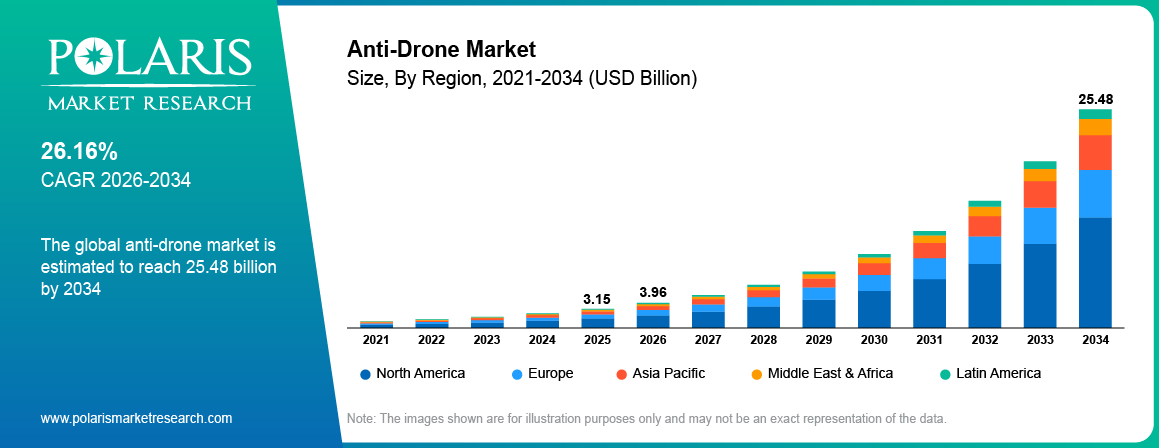
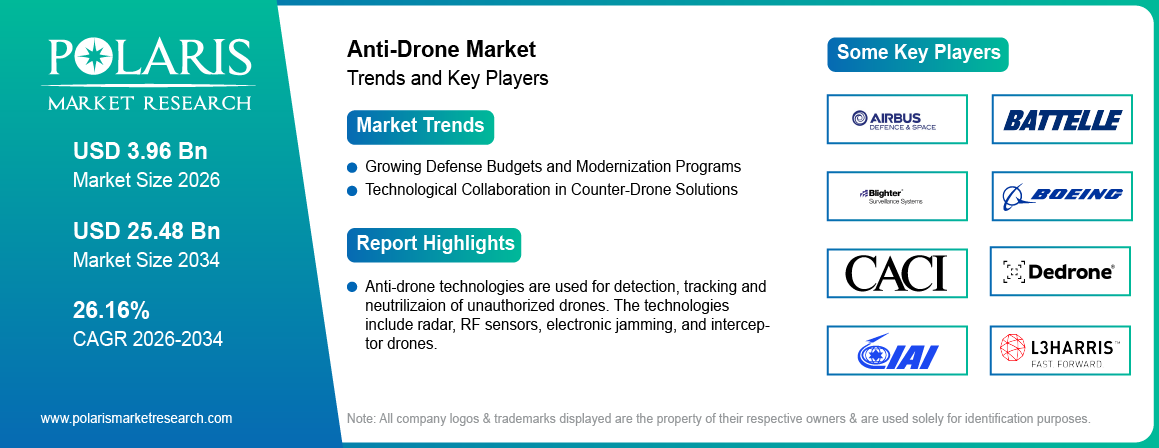
The global anti-drone market size was valued at USD 3.15 billion in 2025. The market is projected to exhibit a CAGR of 26.16% from 2026 to 2034. Growing defense budgets and modernization programs, along with technological collaboration in counter-drone solutions, are propelling the market growth.
Market Statistics
Anti-Drone Market Key Takeaways
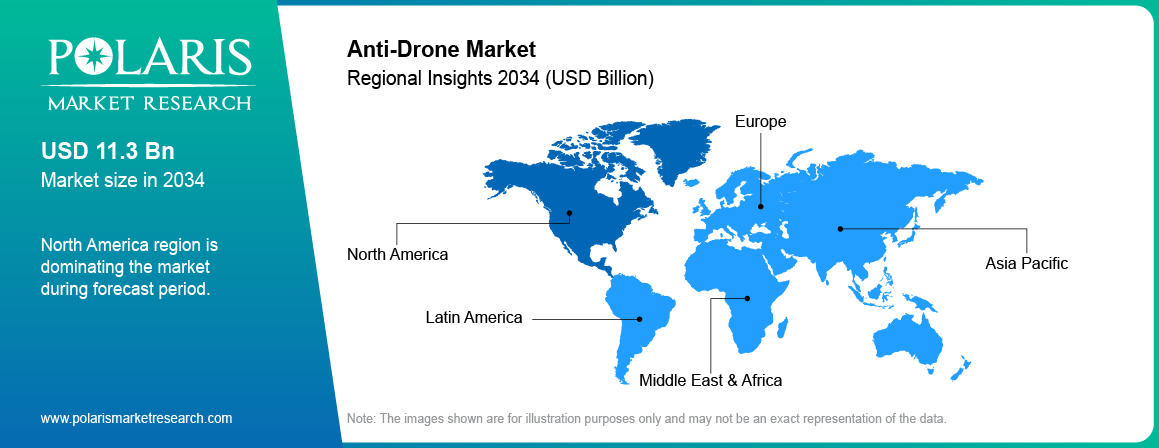
- North America held the largest anti-drone market share of 42.6% in 2025. The regional market dominance is attributed to increasing drone intrusions near airports, military installations, and critical infrastructure assets, along with rising investments in counter-UAS technologies.
- The U.S. dominated the North America market with a 78.9% share in 2025. The country’s leading position is driven by substantial defense expenditures, expanding the counter-UAS market, and growing deployment of advanced drone detection and mitigation systems.
- Asia Pacific is expected to grow at a 28.4% CAGR during the forecast period. This is owing to the rapid proliferation of commercial and recreational drones, increasing security concerns, and rising investments in airspace monitoring technologies.
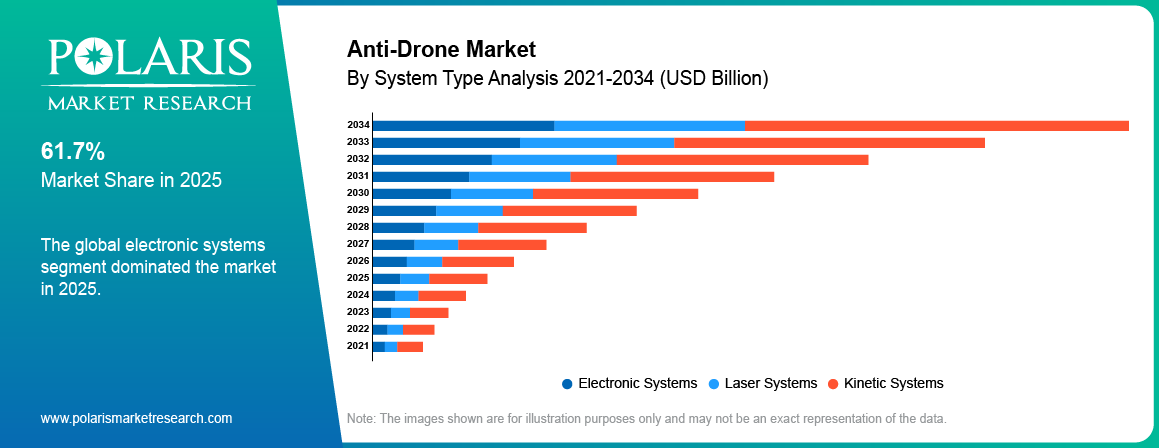
- Electronic systems dominated with a 61.7% share in 2025. The segment’s dominance is driven by its ability to rapidly detect, track, identify, and neutralize unauthorized drones using technologies such as radio frequency jamming and electronic countermeasures.
- Fixed radar systems are anticipated to grow rapidly at a 27.8% CAGR during the forecast period. The segment’s growth is fueled by its capability to provide continuous surveillance, long-range detection, and reliable monitoring of unauthorized drone activity around sensitive locations.
Note: Figures and projections outlined in this report are the result of Polaris Market Research’s proprietary analytical processes, grounded in the latest available datasets and market observations.
What is the anti-drone market?
The anti-drone market includes sophisticated drone detection and mitigation solutions to detect, track, and neutralize unauthorized or hostile drones. The solutions integrate radar, radio frequency, electro-optical, and infrared technology to provide airspace protection in defense, critical infrastructure, and public safety sectors. Growing threats from drones and perimeter security needs are driving adoption. Ongoing innovation in the drone sensor market, electronic countermeasures, and artificial intelligence-driven threat analysis is increasing the accuracy of response and operational efficiency.
Anti-drone technologies are used for detection, tracking, and neutralization of unauthorized drones. The technologies include radar, RF sensors, electronic jamming, and interceptor drones. It works in four steps, including drone detection, identification, tracking, and defeat. Different types of sensors, such as RF sensors, cameras, and thermal sensors, detect the unauthorized drones. After detection, software assesses the movement and threat of the drone. Countermeasures such as electronic interference, interception, or directed-energy systems then stop or redirect the drone. Major consumers of anti-drone technology include airports, military & defense forces, oil & gas facilities, and ports.
National and regional governments are setting new air traffic management and urban air mobility security rules, and that is boosting the anti-drone industry. For example, in August 2025, Ireland published a National Policy Framework for Unmanned Aircraft Systems (UAS). The framework will guide its strategic development of drones while ensuring safety, security, the environment, and public acceptance. These regulations are aimed at giving controlled airspace operations, enhancing public safety, and preventing unapproved drone operations, resulting in mass installation of counter-drone technologies on critical infrastructure and public areas.
How Do Anti-Drone Systems Work?
- Anti-drone systems detect drones using radar, RF sensors, cameras, and acoustic sensors.
- They identify and classify the drone and its communication signals.
- The systems then track the drone's location, speed, and flight path in real time.
- Threat level is assessed based on behavior and restricted airspace.
- Anti-drone systems neutralize the drone using RF jamming, GPS spoofing, laser systems, nets, or interceptor drones.
- Then they monitor the airspace continuously to detect additional drone threats.
Anti-Drone Systems vs Traditional Air Defense Systems
| Comparison Factor | Anti-Drone System | Traditional Air Defense System |
| Nature of Target | Low-altitude drones | Bigger aircraft and missile attacks |
| Response Time | Faster real-time detection | Slower engagement time |
| Technology Used | High-frequency jamming and laser technologies | Missile defense system |
| Operation Expenses | Lower operational cost for local threat | High defense expense on a large scale |
| Handling of Threats | Optimized for drones and drone swarm systems | System for larger air threats |
| Deployment Flexbility | Provides portable and mobile solutions | Mostly large-scale systems only |
Source: Polaris Market Research Analysis
AI Impact on the Anti-Drone Market
- Artificial intelligence contributes to the rapid detection and identification of drones that pose any security threats to the airspace.
- It facilitates faster threat assessment with the help of drone behavior patterns and movement.
- AI helps in optimizing response mechanisms through automated drone defense activities.
- Continuous analysis of data helps in efficient surveillance and airspace security.
Anti-Drone Market Dynamics
Driver: Growing Defense Budgets and Modernization Programs
Increasing defense spending and modernization programs in leading economies are boosting the acquisition of counter-unmanned aerial systems (C-UAS). Global spending on military forces increased to USD 2,887 billion in 2025, a real rise of 2.9% in real terms, as according to the Stockholm International Peace Research Institute (SIPRI). Military organizations are making top priority complex anti-drone technologies to protect airbases, border areas, and key assets from monitoring and potential attacks (Source: sipri.org).
Driver: Technological Collaboration in Counter-Drone Solutions
Rising partnership among defense contractors and tech companies is encouraging innovation in next-gen counter-drone weapons. In September 2025, Anduril Industries and Zone 5 Technologies successfully tested their prototypes of drone interceptors under the U.S. Department of Defense. Companies were given additional funding for enhancing their systems and preparing for future live-fire tests after the trial. Advancements in directed energy, radio frequency jamming, and artificial intelligence-based detection systems are improving the accuracy and efficiency of anti-drone operations, stimulating defense forces across the world (Source: defensescoop.com).
Driver: Rise in Security Threats from Drones
The use of drones for unauthorized access, surveillance, and security threats is driving the demand for anti-drone systems. The threats from unauthorized drones are rising worldwide. For instance, in September 2025, 19 European countries witnessed numerous unauthorized drones in the region. These drones are deployed for espionage, cross-border smuggling of contraband and weapons, and strategic reconnaissance of critical infrastructure. This in turn is driving the demand for the anti-drone systems worldwide. Moreover, advances in the technology are further driving their demand for security systems, which is further driving the market growth. (Source: thehindu.com)
Restraint: High Cost of System
High initial investment in the procurement or manufacturing of major components required for anti-drone systems restrains the market expansion. Major components with advanced technology, such as radar, RF sensors, cameras, AI-based detection software, communication infrastructure, and countermeasure technologies, are highly expensive. This requires substantial investment for procurement or manufacturing. This in turn limits the market expansion, as entry for smaller businesses or businesses with less capital is restricted. Moreover, the installation and maintenance of this equipment further need higher capital. Higher maintenance and installation costs further limit the adoption in the facilities with lower defense budgets, such as small regional airports, thereby restraining the industry expansion.
Restraint: Regulatory Restrictions
Regulatory restrictions are restricting the industry growth, as anti-drone systems can interfere with communications or navigation. Major regions such as Europe, North America, and Asia Pacific have implemented strict regulation on the usage of these systems. This restricts the expansion of the market in the commercial and civilian applications. Moreover, anti-drone systems need to operate safely in crowded environments and avoid interfering with legitimate aircraft, communications, or other electronic systems; this further limits the expansion as it restricts the flexibility of deployment of anti-drone systems, thereby restricting the industry expansion.
Opportunity: Integration of Artificial Intelligence
The integration of artificial intelligence in the counter-drone systems creates an opportunity for businesses operating in the market. Integration of AI improves the efficiency of the system by removing total human intervention and automating the complicated tasks. AI-powered systems detect multiple drones, classify threats, predict flight paths, prioritize targets, and coordinate responses in real time. Moreover, this integration is further expected to lower the overall cost of deployment as it removes the human intervention, which is expected to fuel the market expansion.
Anti-Drone Market Segment Analysis
By System Type
Based on system type, the anti-drone market is categorized into electronic systems, laser systems, and kinetic systems. Electronic systems dominated with a 61.7% share in 2025 due to their ability to detect and deter drones through electromagnetic signals and jamming technologies.
Laser systems are expected to grow rapidly, driven by their ability to precisely target and instantly neutralize enemy drones. Growing defense spends and consistent R&D in directed-energy weapons are likely to further push their adoption higher over the next few years.
Segment Comparison: System/Mitigation Type
| System Type | Mechanism | Best Suited For | 2025 Position |
| Electronic Systems | RF detection, jamming, electromagnetic countermeasures | Broad-spectrum detection + non-kinetic disruption | Market leader (~42.7% share, Polaris 2024 data) |
| Laser Systems | Directed-energy beam neutralization | Precision, low-collateral-damage engagement | Fastest-growing (per Polaris, GVR, and MnM) |
| Kinetic Systems | Physical interception (nets, projectiles, interceptor drones) | High-value/hard-kill scenarios; jam-resistant threats | Smaller but resilient share; strong vs. autonomous drones |
| Hybrid Systems | Combines electronic + kinetic/laser in one platform | Layered, multi-threat defense (military installations) | Emerging category—named by MnM & GVR, absent from Polaris |
Source: Polaris Market Research Analysis
By Component
The hardware segment dominated the market with a 63.21% share in 2025, as hardware is a major component in the anti-drone technologies. Hardware includes radar systems, RF sensors, electro-optical/infrared cameras, acoustic sensors, and countermeasure equipment. The demand for hardware is rising due to an increase in the need for anti-drone systems for airport facilities and military bases. Moreover, governments globally are increasing funding in the airport security to prevent high-profile terrorist threats and manage soaring passenger volumes safely. For instance, in August 2026, the U.S. Department of Transportation granted USD 870 million for upgradations of 339 U.S. airports, which also include security upgrades in the country. This rise in the funding is further driving the demand for hardware in the country, thereby driving the segment growth (Source: travelpulse.com).
Electronic Warfare & RF Jamming Technologies
| Aspect | Electronic Warfare (EW) | RF Jamming Technologies |
| Definition | A broad set of technologies that use the electromagnetic spectrum to detect, disrupt, protect, or deceive electronic systems. | A specific technology that disrupts radio-frequency signals used for communication or navigation. |
| Main Purpose | Provides broader electromagnetic-spectrum awareness and countermeasure capabilities. | Primarily prevents or interferes with communication between a drone and its controller. |
| Role in Counter-Drone | Can include RF detection, signal intelligence, jamming, and other electromagnetic countermeasures. | Used as a direct countermeasure to disrupt or disable certain drone operations. |
| Technology | Includes sensors, signal intelligence, electronic protection, jamming, and related systems. | Uses RF transmitters designed to interfere with targeted frequencies or signals. |
Source: Polaris Market Research Analysis
By Range
Based on range, the anti-drone market is divided into short-range (<2 km), medium-range (2–5 km), and long-range (>5 km) systems. Short-range systems dominated the market position in 2025 owing to its extensive usage for facility security, border security, and event monitoring.
Medium-range systems are expected to grow at a fast pace, owing to their ability to protect industrial assets, transportation facilities, and sensitive infrastructures. These systems provide an optimal coverage range versus cost ratio, well-suited for mid-sized security perimeters.
By Deployment Type
By deployment type, the market is segmented into portable radar, fixed radar, and vehicle-mounted radar. Portable radar systems dominated the market in 2025 owing to their mobility and ease of operation in tactical missions and temporary surveillance operations.
Fixed radar systems are anticipated to grow rapidly at a 27.8% CAGR during the forecast period as it is well suited for airports, power plants, and defense bases that require continual monitoring. These systems are leveraged for their capability to offer 24/7 surveillance, monitor multiple targets at a single time, and connect with larger air defense networks.
By Application
On the basis of application, the anti-drone market is classified into detection systems and detection & disruption systems. Detection & disruption systems held market dominance in 2025 owing to its total threat detection and neutralization in real time.
Detection-only systems are anticipated to grow rapidly, serving commercial segments with an emphasis on surveillance and early-warning uses. Their ease of use, affordability, and compatibility with established security structures are also driving the demand.
By End-Use
Based on end-use, the market is segmented into military & defense, commercial, government, and others. The military & defense segment held the largest share in 2025 owing to increasing demand for counter-UAV systems to safeguard strategic assets, combat areas, and controlled airspace.
The aviation industry is projected to grow at a fast pace, as airports, event promoters, and private security companies are integrating anti-drone technology for public protection. Rising drone intrusions near forbidden areas and mass events have spurred the need for sophisticated monitoring and discouragement systems.
Real-World Applications & Use Cases
| Sector / Environment | Primary Objective | Typical Use Cases |
| Military bases & battlefields | Force protection and airspace dominance | Detect and defeat surveillance and attack drones; protect troops, vehicles, ammunition depots, and command posts during conflicts and patrols. |
| Borders & coastal security | Prevent smuggling and cross‑border intrusion. | Stop drones used for drug and contraband smuggling, illegal crossings, and ISR (intelligence, surveillance, reconnaissance) along land borders and coastlines. |
| Airports & civil aviation | Flight safety and airspace integrity | Monitor approach/departure corridors; detect rogue drones near runways; trigger automated responses and temporary airspace restrictions to avoid flight disruption. |
| Critical infrastructure | Continuity of essential services | Protect power plants, refineries, pipelines, data centers, ports, telecommunication towers, and water facilities from espionage, disruption, or attacks by drones. |
| Prisons & correctional facilities | Prevent contraband and escapes. | Detect and neutralize drones delivering phones, drugs, weapons, or tools into prison yards and rooftops; support incident forensics. |
| Government buildings & defense sites | Protection of sensitive facilities | Safeguard ministries, embassies, intelligence sites, and R&D labs from aerial spying, weaponized drones, and disruptive flyovers. |
| Large public events & stadiums | Crowd safety and incident prevention | Temporary deployments around concerts, sports events, demonstrations, and political rallies to stop drones with cameras, banners, or potential explosives. |
| VIP protection & convoys | Personal security | Vehicle‑mounted or portable systems to create a protective bubble around VIP motorcades, summits (e.g., G20), and temporary high‑profile gatherings. |
| Corporate campuses & private estates | Privacy and IP protection | Defend headquarters, R&D campuses, and high‑net‑worth residences from drones conducting industrial espionage, media intrusion, or harassment. |
Source: Polaris Market Research Analysis
Key Areas of the Anti-Drone Market
AI & Machine Learning in Counter-Drone Systems
The integration of AI and machine learning has improved the efficiency of the anti-drone systems. These integrations have improved the ability to detect, identify, track, and respond to unauthorized drones. Traditional systems used to rely heavily on individual sensors, which had certain limitations such as limited detection range, blind spots, and limited situational awareness. The integration of AI and ML has overcome these limitations significantly and resulted in wider adoptions. AI-powered computer vision is able to identify drones from video and distinguish them from birds, aircraft, and other airborne objects. While ML algorithms analyze flight patterns, speed, altitude, and behavior to classify potential threats and reduce false alarms. Moreover, the integration of AI and ML has enabled automated threat assessment, which means it evaluates factors such as the drone's location, movement, and proximity to protected areas. This helps the operator focus on potential threats, thereby improving the efficiency of the anti-drone systems.
Comparison: Countering Autonomous & Swarm Drones
| Aspect | Autonomous Drones | Swarm Drones |
| Definition | Drones that can navigate and perform tasks with limited or no continuous human control. | A group of drones that coordinate and operate together to achieve a common objective. |
| Control | Primarily controlled by onboard AI, sensors, and navigation systems. | Controlled through coordinated algorithms and communication between multiple drones. |
| Main Challenge | Difficult to predict because the drone can make decisions independently. | Difficult to manage because many drones may approach from different directions simultaneously. |
| Counter-Drone Requirement | Advanced detection, tracking, and AI-based threat assessment. | Rapid multi-target detection, tracking, prioritization, and coordinated response. |
| Key Technologies | AI, computer vision, radar, RF detection, and sensor fusion. | AI, sensor fusion, automated tracking, and scalable countermeasures. |
Source: Polaris Market Research Analysis
Directed Energy & Laser-Based Anti-Drone Systems
The directed energy & laser-based anti-drone systems are an advanced version of anti-drone systems. This technology uses concentrated energy to destroy drones. The system combines radar electro-optical cameras, tracking software, and high-energy lasers to track down the hostile drones. Directed energy and laser-based anti-drone systems have certain advantages, such as rapid response and potentially low cost per engagement. This advantage makes it attractive in protecting military installations, airports, borders, and critical infrastructure. Their cost-effectiveness fuels its adoption against multiple low-cost drones where conventional interceptors may become expensive. Moreover, the laser-based anti-drone system is scalable, as it potentially engages repeated drone threats without rapidly exhausting physical interceptors, which further saves the cost of traditional interceptors.
Protection of Critical Infrastructure
With the rise in potential threats from the use of unauthorized drones, the uptake of technology to mitigate against drone attacks is becoming more common among the military, industries, and public infrastructure companies. Critical infrastructure, which includes power generation stations, oil and gas refining stations, airports, telecom towers, government facilities, data centers, and transportation hubs, has become prone to threats from drones, which include cyber threats, smuggling, surveillance, and even security threats. In response, companies and organizations are implementing advanced technologies to combat UAVs, including radar, RF detection, artificial intelligence surveillance, thermal imaging, and drone jamming. This includes developing a system that will detect, track, and eliminate drone threats in real-time at low altitudes. With the continued increase in issues concerning national security, energy security, and even public safety, anti-drone technologies are now a key component of modern critical infrastructure protection technology.
Commercial & Civilian Adoption
The commercial adoption of anti-drone systems is rising in major areas such as stadiums, concerts, festivals, airports, shopping centers, and public gatherings. For instance, in August 2026, Delhi police in India deployed anti-drone systems for the celebration of Independence Day of India. This rise in the adoption is driven by efforts to avoid event disruption, crowd harm, and mass panic. Portable and rapidly deployable systems are more attractive for these settings, as they offer a flexible setup, quick response to sudden threats, and minimal impact on daily venue operations. Portable systems further provide localized protection without needing permanent, expensive fixed infrastructure, which in turn drives the adoption of anti-drone systems in the commercial and civilian spaces (Source: thehindu.com).
Anti-Drone Market Regional Analysis
North America Anti-Drone Market Overview
held the largest anti-drone market share of 42.6% in 2025. Rising cases of illegal drone use near airports, military bases, and government buildings are driving the growth of counter-drone technology adoption. Increasing public and private expenditures to safeguard strategic infrastructure like energy facilities and prisons are also propelling regional market growth.
U.S. Anti-Drone Market Overview
The U.S. dominated the North America market with a 78.9% share in 2025, supported by significant defense funding and active programs from the U.S. Department of Defense (DoD). The U.S. Department of Defense requested USD 3.1 B USD for counter-drone capabilities in its fiscal 2026 budget, contingent on broader legislation. In the current fiscal year, the Pentagon spent USD 7.4 B USD on counter-drone systems, over 50% more than a decade ago. Mass procurements and deployment of counter-unmanned aerial systems (C-UAS) are given top priority in order to better secure national security and safeguard high-risk areas.
Asia Pacific Anti-Drone Market Insights
Asia Pacific is expected to grow at a 28.4% CAGR during the forecast period. Rising growth in drone proliferation for commercial and recreational uses is creating concerns regarding airspace security and privacy intrusion. Governments are putting more emphasis in counter-drone systems to deal with these issues. Growing concerns on border security and anti-terror activities is also driving strong regional demand for sophisticated detection and neutralization technologies.
China Anti-Drone Market Analysis
China is leading the Asia Pacific market, driven by expanding defense modernization initiatives and rising emphasis on domestic defense manufacturing. In April 2024, Xi Jinping announced a military reorganization aimed to enhance the People's Liberation Army's (PLA) capacity to engage in information warfare and execute combined joint operations during wartime. Spending on radar, electronic warfare, and directed-energy technology is driving the development of next-generation counter-drone technologies.
Europe Anti-Drone Market Assessment
Europe held substantial market share, fueled by growing attention to protecting airports, public spaces, and energy installations from unauthorized drone activity. Growing investments by European defense institutions and NATO in advanced counter-drone and air defense systems are fortifying regional defense structures. In September 2025, NATO invested in an Australian-designed high-power laser system, also known as "Apollo," to enhance its capability to counter drones. The Apollo laser weapon by Electro Optic Systems (EOS) uses thermal destruction to disable drones and operate well in various weather conditions.
Anti-Drone Regulations & Airspace Governance by Region
| Region | Airspace & Drone Governance | Who May Use Anti‑Drone Systems? | Legal Stance on Neutralizing Drones | Notable Features / Gaps |
| North America (primarily U.S., Canada) | U.S.: The FAA governs national airspace with strict rules on UAS operations, registration, and no‑fly zones. Canada: Transport Canada with a similar risk‑based framework. | Generally limited to federal agencies (DoD, DHS, DOJ) and certain authorized entities; state/local use often requires federal authority or partnerships. | Direct “self‑help” actions (jamming, kinetic shoot‑down, hacking) by private actors are largely illegal; authorities act under specific statutes and waivers. | Mature UAS rules, but C‑UAS authority is concentrated at the federal level; ongoing policy updates to expand protection of critical infrastructure and events. |
| Europe (EU/EEA, U.K.) | EASA and national CAAs implement EU UAS rules (e.g., Regulation (EU) 2019/947) with risk‑based categories and UAS geographical zones. The U.K. has a similar CAA framework post‑Brexit. | Use of C‑UAS is mainly reserved for state entities: police, military, and aviation/security agencies; private operators usually cannot deploy jamming or kinetic systems. | Neutralization tools are heavily constrained by weapons, aviation safety, telecoms, and privacy law; most states forbid private C‑UAS except for detection/monitoring. | Strong harmonized drone rules, but C‑UAS policy is still fragmented; the EU is issuing C‑UAS guidance and handbooks, while member states build their own national strategies. |
| Asia Pacific | Mix of mature regimes (Japan, Australia, Singapore) and rapidly evolving ones (China, India, and others). Civil aviation authorities define licensing, registration, and no‑fly zones, often with very low‑altitude UAS rules. | C‑UAS authority is typically held by national security, police, and defense forces; some countries deploy systems widely at airports, borders, and critical sites. | Private “shoot‑down” or jamming is usually prohibited; enforcement relies on government‑run systems and criminal penalties for misuse of drones. | The region is aggressive in deploying C‑UAS around airports, events, and borders, but regulatory clarity on responsibilities and data sharing is still maturing. |
| Middle East & Africa (MEA) | Many states follow ICAO guidance plus national UAS decrees; airspace is often tightly controlled by aviation and security ministries, with broad no‑fly zones around key sites. | Military, interior ministries, and police are primary C‑UAS users; private deployment is rare and usually needs explicit permits. | Neutralization (jamming, kinetic intercept) may be allowed for state security forces, but legal frameworks are often opaque or embedded in national security laws. | Fast uptake of anti‑drone systems for critical infrastructure and conflict zones; formal, transparent C‑UAS regulations are limited and vary widely by country. |
| Latin America | National CAAs regulate drones with growing emphasis on registration, licensing, and restricted zones around airports, borders, and government facilities. | Security forces (military, federal police, and prison authorities) are increasingly authorized to deploy C‑UAS at critical infrastructure, prisons, and major events. | Most countries bar private neutralization; some introduce explicit penalties for criminal drone use and give security agencies legal cover for RF jamming or intercept. | Regulatory shift under way toward risk‑based UAS rules and clearer state authority to defeat malicious drones; regional cooperation is expanding but still uneven. |
Source: Polaris Market Research Analysis
Anti-Drone Market Competitive Analysis
The anti-drone market globally is highly competitive and fueled by ongoing technological development in detection, tracking, and neutralization systems. Firms are placing emphasis on creating comprehensive counter-UAV solutions that integrate radar, RF sensors, electro-optical systems, and jamming systems to make the defense more effective against unauthorized or adversary drones. Increasing security threats to key infrastructure, defense facilities, and public areas are driving product development and deployment. Strategic partnerships between defense contractors and technology innovators are also driving market growth and innovation.
Key Players
- Aaronia AG
- Airbus Defence and Space GmbH
- Battelle Memorial Institute
- Blighter Surveillance Systems Ltd.
- Boeing Company
- CACI International Inc.
- Chess Dynamics Ltd.
- Dedrone Holdings, Inc.
- DroneShield Ltd.
- Israel Aerospace Industries Ltd.
- L3Harris Technologies, Inc.
- Leonardo S.p.A.
- Lockheed Martin Corporation
- Northrop Grumman Corporation
- Raytheon Technologies Corporation
Future Outlook
The anti-drone market is expected to witness significant growth in the coming years due to the increased threat of security risks posed by drones, military modernization projects, and investments in protecting critical infrastructure. Various entities are resorting to the deployment of counter-drone technologies in order to keep sensitive areas, as well as public places, safe from any unwanted drone activity. With the development of AI-based detection, directed energy, and autonomous drone interceptors, there has been an increase in the efficiency of counter-drone technologies. With rising concerns about national security, border security, and public safety, anti-drone technology is expected to become an integral part of future defense and homeland security systems.
Anti-Drone Industry Developments
- July 2026: Solar Defence and Aerospace Ltd. (SDAL) demonstrated its indigenous “Bhargavastra” vehicle-mounted counter-swarm drone system to the Indian Army. SDAL showcased a layered hard-kill solution. The solution can neutralize weaponized drones, loitering munitions, and autonomous drone swarms. (Source: bharatshakti.in)
- June 2026: Electro Optic Systems Holdings Limited announced securing a USD 124 million contract for its Slinger Counter-Drone Remote Weapon System (RWS). The company stated that the order encompasses the RWS, cannon, spares, training, and other supplies. The order will be supplied to Generation 5 Holding L.L.C., a UAE-owned defense technology company. (Source: eos-aus.com)
- June 2026: Thales announced receiving an order for 60 GO12 short-range battlefield radars from the Federal Office of Bundeswehr Equipment, Information Technology, and In-Service Support (BAAINBw). The company stated that GO12 is a reconnaissance and artillery radar capable of detecting drones and vehicles at 360°. Thales revealed that the systems will be delivered in 2026. (Source: thalesgroup.com)
- April 2025: The Tawazun Council, the defense procurement agency of the UAE, signed a term sheet with Raytheon for a joint production of the company's Coyote counter-UAS interceptor systems in the UAE. The partnership is an extension of their 2023 cooperation agreement to localize counter-drone technology in Abu Dhabi. (Source: defence-industry.eu)
Anti-Drone Market Segmentation Outlook
By Component Outlook (Revenue, USD Billion, 2021–2034)
-
Hardware
-
Radars
-
Acoustic Sensors
-
Infrared and Video Surveillance Systems
-
RF Detectors
-
Jammers
-
Others
-
-
Software
By System Type Outlook (Revenue, USD Billion, 2021–2034)
-
Electronic Systems
-
Laser Systems
-
Kinetic Systems
By Range Outlook (Revenue, USD Billion, 2021–2034)
-
Short-Range (<2 KM)
-
Medium-Range (2-5 KM)
-
Long-Range (>5 KM)
By Deployment Mode Outlook (Revenue, USD Billion, 2021–2034)
-
Portable Radar
-
Fixed Radar
-
Vehicle-Mounted Radar
By Application Outlook (Revenue, USD Billion, 2021–2034)
-
Detection Systems
-
Detection & Disruption Systems
By End-Use Outlook (Revenue, USD Billion, 2021–2034)
-
Military & Defense
-
Commercial
-
Government
-
Others
By Regional Outlook (Revenue, USD Billion, 2021–2034)
-
North America
-
U.S.
-
Canada
-
-
Europe
-
Germany
-
France
-
UK
-
Italy
-
Spain
-
Netherlands
-
Russia
-
Rest of Europe
-
-
Asia Pacific
-
China
-
Japan
-
India
-
Malaysia
-
South Korea
-
Indonesia
-
Australia
-
Vietnam
-
Rest of Asia Pacific
-
-
Middle East & Africa
-
Saudi Arabia
-
UAE
-
Israel
-
South Africa
-
Rest of Middle East & Africa
-
-
Latin America
-
Mexico
-
Brazil
-
Argentina
-
Rest of Latin America
-
Anti-Drone Market Report Scope
| Report Attributes | Details |
| Market Size in 2025 | USD 3.15 Billion |
| Market Size in 2026 | USD 3.96 Billion |
| Revenue Forecast by 2034 | USD 25.48 Billion |
| CAGR | 26.16% from 2026 to 2034 |
| Base Year | 2025 |
| Historical Data | 2021–2024 |
| Forecast Period | 2026–2034 |
| Quantitative Units | Revenue in USD Billion, Volume in Kilotons, and CAGR from 2026 to 2034 |
| Report Coverage | Revenue Forecast, Competitive Landscape, Growth Factors, and Industry Trends |
| Segments Covered |
|
| Regional Scope |
|
| Competitive Landscape |
|
| Report Format |
|
| Customization | Report customization as per your requirements with respect to countries, regions, and segmentation. |
Source: Polaris Market Research Analysis
Anti-Drone Market FAQ's
The global market size was valued at USD 3.15 billion in 2025 and is projected to grow to USD 25.48 billion by 2034.
The global market is projected to register a CAGR of 26.16% during the forecast period.
North America dominated the market with a 42.6% share in 2025, driven by strong market demand and technological advancements.
A few of the key players in the market are Aaronia AG, Airbus Defence and Space GmbH, Battelle Memorial Institute, Blighter Surveillance Systems Ltd., Boeing Company, CACI International Inc., Chess Dynamics Ltd., Dedrone Holdings, Inc., DroneShield Ltd., Israel Aerospace Industries Ltd., L3Harris Technologies, Inc., Leonardo S.p.A., Lockheed Martin Corporation, Northrop Grumman Corporation, and Raytheon Technologies Corporation.
The electronic systems segment accounted for the largest market share of 61.7% in 2025, driven by increasing adoption of advanced electronic systems.
Anti-drone systems detect, identify, track, and neutralize unauthorized drones using technologies such as radar, RF sensors, cameras, AI, and authorized countermeasures
The medium-range systems segment is projected to witness the fastest growth during the forecast period.
Detection systems identify and track drones, while detection & disruption systems add countermeasures designed to interfere with or stop the drone
AI analyzes sensor data to improve drone identification, reduce false alarms, track multiple targets, and support faster threat assessment
Legality varies by country and application, and RF jamming is often restricted to authorized government or security users, so commercial operators must comply with local regulations
Download Sample Report of Anti-Drone Market
Please fill out the form to request a customized copy of the research report.


