
Artificial Intelligence (AI) in Diagnostics Market Size, Share, Trends and Forecast, 2026–2034
REPORT DETAILS
Artificial Intelligence (AI) in Diagnostics Market Summary
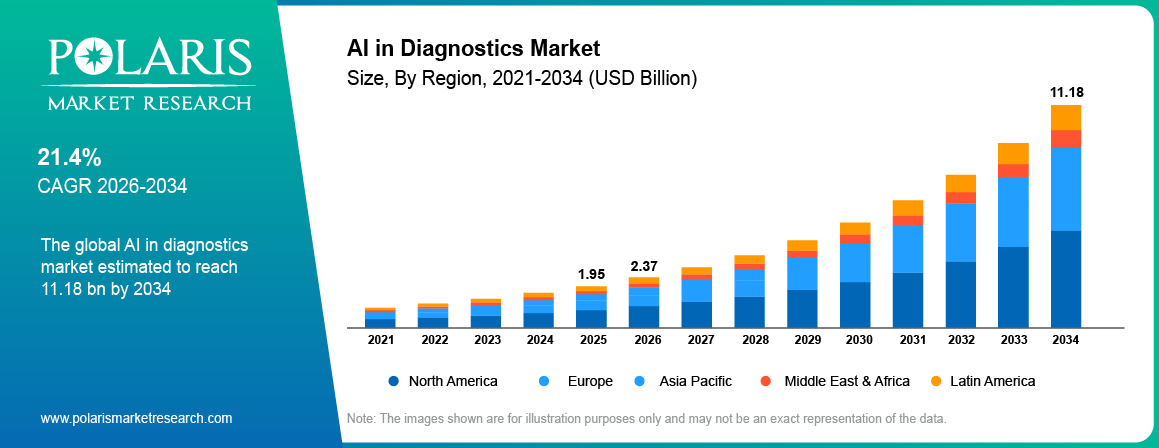
The global Artificial Intelligence (AI) in diagnostics market size was valued at USD 1.95 billion in 2025. The market is projected to register a CAGR of 21.4% from 2026 to 2034. The growth is driven by increasing demand for faster and more accurate diagnosis, rising usage of medical devices, and demand for technological advancements in diagnostics.
Market Statistics
Key Takeaways
- North America market accounted for the largest share of 53.89% in 2025. This is driven by early adoption of high-end healthcare technologies and the presence of AI solutions providers.
- The market in Europe is anticipated to witness a CAGR of 20.6% during the forecast period. The region is witnessing increased investments in healthcare technology, driving the regional market growth.
- The Asia Pacific market is expected to record a CAGR of 24.3% during the forecast period, driven by increased healthcare expenditure, rising patient population, and growing demand for high-end diagnostic services.
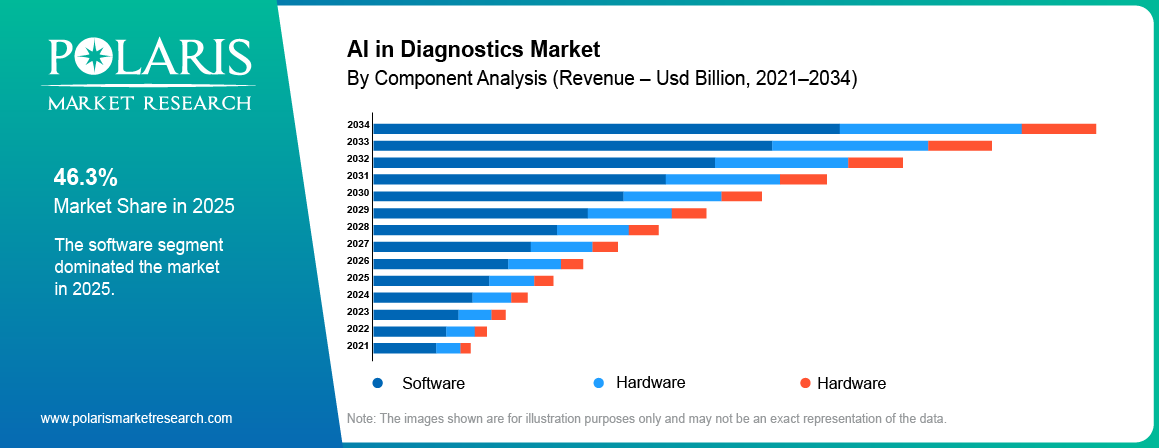
- The software segment accounted for the largest AI diagnostics market share of 46.3% in 2025, driven by the increasing adoption of AI-based tools in hospitals, laboratories, and diagnostic centers.
- The oncology segment dominated the artificial intelligence in diagnostics market size with 32.8% in 2025. It is due to the increasing number of cancer cases and the rising requirement for early detection.
Note: Figures and projections outlined in this report are the result of Polaris Market Research’s proprietary analytical processes, grounded in the latest available datasets and market observations.
What is Artificial Intelligence in Diagnostics?
Artificial Intelligence (AI) in diagnostics refers to the application of machine learning, deep learning, computer vision, and other related technologies. It helps analyze medical data such as medical images, physiological signals, pathology slides, lab results, and patient records to help identify, classify, and/or evaluate disease.
In simple terms, there are AI tools for diagnostics that have been trained to detect patterns in the data. For example, they can be used to analyze medical data like X-rays, CT scans, ECG tracings, pathology slides, and lab results. Once any potential abnormality has been identified, they will show the user and prioritize those with high urgency. The output will then be reviewed by a clinician, who will make a diagnosis based on the output. Very few fully autonomous systems have been approved to provide specific diagnostic outputs. However, they can only be used for very specific situations.
This report includes AI software, hardware, and services used for diagnostics within cardiology, oncology, pathology, radiology, thorax/lung, neurology, and other clinical areas. The market is moving away from single function tools to platforms that can analyze multiple findings from one scan. Regulatory approvals, rollout programs across multiple hospitals, and decisions around reimbursement by Medicare in the U.S. are helping to move the market away from pilot projects and to full scale implementations. Software is the top component in most reported estimates. North America is the largest region and Asia Pacific is often reported as the fastest growing. The market is competitive with many imaging giants, pure AI players and pathology focused players.
How AI-Based Diagnosis Works?
- AI vs. Machine Learning vs. Deep Learning in Diagnostics
AI helps computers carry out tasks that would typically require human thought. Machine learning helps systems learn from historical medical data to produce better outcomes. Deep learning uses complex models to analyze complicated medical data and find patterns.
- Autonomous AI vs. Assistive AI
Autonomous models will be able to complete some diagnostic tasks without direct input from a doctor. They will be able to analyze patient data and give results. Assistance-based models will help doctors by highlighting potential issues with patients' health, analyzing medical images, and making better decisions.
- Single-Condition vs. Multi-Condition AI and Foundation Models
Single disease AI will be used to diagnose one illness, such as diabetic retinopathy. Mult disease AI can diagnose multiple illnesses. Foundation models use lots of medical data to train the model and can be used for various diagnostic tasks.
- Generative AI in Diagnostic Reporting
Generative AI helps produce diagnostic reports. They can take medical findings and produce a clear summary. This can help organize test results, highlight key findings, and draft reports. This can save time for doctors.
Technology and Approach Comparison
| Approach | How it works | Typical use | Oversight | Example |
| Assistive AI | Flags, measures or prioritizes; clinician makes the call | Triage, detection, measurement | Clinician reviews every result | CARE Body CT Multi-Triage (Aidoc): FDA 510(k) January 2026, 14 cleared indications |
| Autonomous AI | Produces a defined diagnostic result without specialist interpretation, within cleared conditions | Point-of-care screening | Cleared intended-use limits; positive result is referred on | LumineticsCore (Digital Diagnostics, formerly IDx-DR): diabetic retinopathy; first FDA-cleared autonomous AI diagnostic system (2018) |
| Single-condition AI | Narrow model for one abnormality | One finding per scan | Per-algorithm clearance | Examples include Aidoc's earlier pulmonary embolism and pneumothorax tools |
| Multi-condition / foundation-model AI | Pretrained model supports many findings from one exam | Broad triage across an exam | Clearance per indication | CARE Body CT Multi-Triage, built on the CARE foundation model |
| Generative reporting AI | Drafts report text from image findings | Radiology reporting | Radiologist reviews and signs every report | First Read (Aidoc): FDA Breakthrough Device Designation, June 2026, chest radiographs; investigational, not cleared |
Source: Polaris Market Research Analysis
Market Dynamics
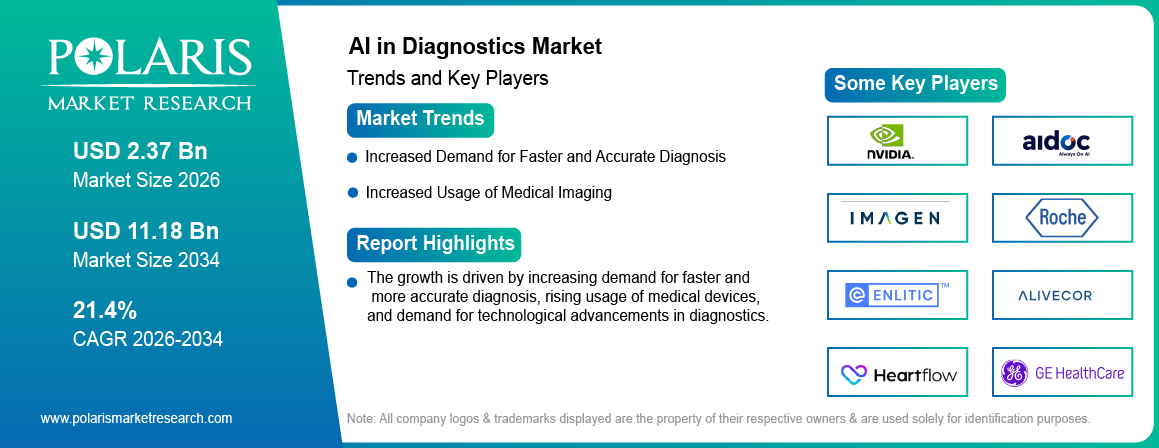
Driver: Increased Demand for Faster and Accurate Diagnosis
There is an increased demand for fast and accurate diagnostic systems. This is due to high numbers of tests performed in hospitals and diagnostic centers. For instance, according to Roche Diagnostics, annually approx. 14 billion tests are done in the U.S. alone. AI tools can quickly analyze scans, slides, and patient information to help doctors identify abnormal patterns. This reduces the time taken for the report to be given. Early diagnosis can lead to timely treatment. With increasing demands for improved quality of services within healthcare, many organizations are using AI based systems within their diagnostic departments and hospitals (Source:diagnostics.roche.com).
Driver: Increased Usage of Medical Imaging
As there is an increased usage of medical imaging and a high demand for AI based analysis. Radiology departments deal with a variety of imaging, including X-ray, CT scans and MRI scans, which can be time-consuming. AI tools can be used within radiology to help identify areas of interest. These tools can be used to prioritize time-sensitive cases. This helps with the diagnosis of medical imaging by helping clinicians keep up with the high volumes of work. Moreover, rising approval of medical imaging with the integration of AI is further fueling the growth. For instance, the FDA has approved nearly 1600 AI enabled medical devices as of September 2026; this also includes AI-enabled medical imaging devices (Source: fda.gov).
Restraint: High Cost of Implementation and Maintenance
High cost of the system may limit the use of AI-based systems within diagnosis. Small hospitals and clinics may struggle to afford implementing a new system. This could involve the cost of the software, computer systems, staff training, and technical support. For hospitals using older systems, it can be challenging to integrate with PACS systems. Connecting tools using DICOM, HL7, and FHIR standards can create additional costs and time constraints. This can cause delays and make purchasers hesitant.
Restraint: Concerns Regarding Accuracy, Safety, and Data Security
Doubts with accuracy, safety, and data can restrain the AI in diagnostics market growth. AI-based systems will have to be tested with different patient types and clinical settings. Doctors may not trust the results. Using measures like sensitivity, specificity and AUROC can help with understanding how well the AI is diagnosing. However, the results will have to be reviewed by clinicians. Hospitals will need to ensure patient data is safe and comply with local regulations. There may be uncertainty about who would be responsible for any mistakes, which could cause a lack of trust.
Opportunity: Growing Potential of Multi-Purpose AI Diagnostic Systems
AI systems that can support more than one diagnostic task creates an growth opportunity. Foundation models for medical imaging may help developers build tools for different scans and clinical needs. AI in digital pathology can assist with whole-slide image analysis by finding patterns across large tissue images. Similar advances may support AI ECG interpretation and cardiac AI diagnostics. As these systems become more reliable, providers may use them to expand access to faster testing and specialist support over time.
Regulation, Reimbursement, and Governance
| Area | Key framework / mechanism | What it covers | Implication for AI diagnostics |
| FDA regulation, SaMD & lifecycle management | FDA 510(k), De Novo, PMA; Software as a Medical Device (SaMD); Predetermined Change Control Plans (PCCPs); 2025 draft lifecycle guidance | Intended use, clinical validation, risk controls, cybersecurity, marketing submissions, post-market performance monitoring, and controlled model updates. A PCCP specifies planned modifications, the modification protocol, and benefit-risk impact assessment. | AI diagnostic software is generally regulated as a device when it diagnoses, triages, or informs clinical decisions. Manufacturers must plan for model drift, real-world monitoring, and update management. |
| EU and other regulatory frameworks | EU MDR (Regulation 2017/745), IVDR (Regulation 2017/746), EU AI Act (Regulation 2024/1689), UKCA/MHRA, Health Canada, PMDA in Japan | MDR/IVDR require quality management, clinical/performance evaluation, technical documentation, conformity assessment, CE marking, vigilance, and post-market surveillance. AI-enabled medical devices are high-risk AI systems; AI Act requirements, including data governance, transparency, human oversight, robustness, logging, and cybersecurity, are assessed through the MDR/IVDR pathway. | In the EU, an AI diagnostic may need simultaneous MDR/IVDR and AI Act compliance, using one technical-documentation set. The high-risk AI Act obligations for Annex I medical devices apply from August 2, 2028 under the 2026 Digital Omnibus adjustment. |
| Reimbursement for AI diagnostics | U.S.: Medicare Physician Fee Schedule CPT/HCPCS codes, Hospital Outpatient Prospective Payment System, IPPS New Technology Add-on Payment (NTAP), Transitional Coverage for Emerging Technologies (TCET); ex-U.S.: NICE/NHS in the UK, Japan’s NHI, Germany’s DiGA-style evidence-based pathways | Separate payment may be available for qualifying AI services, such as autonomous diabetic-retinopathy screening (CPT 92229) and software-derived FFRct analysis (CPT 75580). NTAP provides temporary inpatient add-on payments, typically for two to three years, for technologies meeting newness, cost, and clinical-improvement criteria. | There is no single global reimbursement route. Vendors need FDA/CE authorization, clinical-evidence generation, billing-code strategy, health-economic evidence, and payer engagement; coverage often depends on whether AI improves outcomes, workflow, or access rather than merely automating interpretation. |
| Clinical AI governance | Hospital AI governance committees, risk-tiered review, model validation, incident reporting, audit trails, clinician override, monitoring dashboards, retirement/decommissioning policies | Governance spans procurement, local validation, deployment, human oversight, bias and equity testing, privacy and security, workflow integration, clinician training, performance monitoring, and escalation when harms or drift occur. | Providers should retain meaningful clinician review and override for diagnosis-affecting AI, monitor subgroup performance and drift, document decisions, and assign clear accountability across clinical, IT, data, legal, and patient-safety functions. |
Source: Polaris Market Research Analysis
Clinical Validation, Accuracy, and Bias
How AI Diagnostic Accuracy Is Measured?
Diagnostic accuracy can be measured using several metrics including sensitivity, specificity, accuracy, PPV, NPV, F1 score and AUROC. Sensitivity and specificity are used to detect true positives and negatives. PPV and NPV provide reliability of positive and negative results. AUROC gives an overall summary of the model’s discriminatory ability across thresholds. Independent representative datasets should be used to validate performance. The results should also be interpreted in relation to prevalence and clinical context.
Accuracy Metrics in Plain Language
| Metric | What it tells you | Plain-language question it answers |
| Sensitivity | Share of people with the condition the AI correctly flags | Does it catch real cases? |
| Specificity | Share of people without the condition the AI correctly clears | Does it avoid false alarms? |
| Positive predictive value | Share of flagged cases that are truly positive | When it flags, how often is it right? |
| Negative predictive value | Share of cleared cases that are truly negative | When it clears, how often is it right? |
| AUROC | Overall ability to separate positive from negative across thresholds | How well does it rank cases overall? |
| Calibration | Whether predicted probabilities match observed rates | Can the score be read as a real probability? |
Source: Polaris Market Research Analysis
Bias, Generalizability and Model Drift
Bias occurs when there is uneven performance between patient groups using unrepresentative data, labelling issues or proxy variables. To test generalizability external, multi-center, temporal and prospective validation should occur. Model drift occurs when accuracy decreases due to changes in clinical practice, equipment, population or data patterns. This can be mitigated by analyzing subgroups, ongoing monitoring and re-calibration. Incident reports should be made and regular evaluation undertaken.
Implementation and Integration
How Hospitals Implement Diagnostic AI
Hospitals will typically identify areas where they can apply diagnostic AI to help improve diagnosis. After identifying what requirements they have and selecting appropriate diagnostic AI software, hospitals will test the tools with medical data. They will train doctors and technical staff on how to use the systems, alongside regular performance assessments to ensure that the AI tools are providing accurate results.
PACS, EHR and Interoperability (DICOM, HL7, FHIR)
Diagnostic AI systems need to be integrated with hospital systems so they can access patient data. These systems include PACS, which stores and manages medical images, and EHR, which stores patient health records. DICOM helps transfer medical images; HL7 & FHIR help transfer health information. This will allow the AI tools to access the correct information, analyze medical images, and provide results to doctors.
Costs, Build vs. Buy and Cloud vs. On-Premise
The cost of implementing diagnostic AI will depend on the requirements such as software, hardware, training and maintenance. Hospitals can either design their own AI systems or purchase already designed systems from technology providers. Designing your own systems gives more control over the system however requires a skilled team and more investment. Purchasing can save time during development. Hospitals can also choose whether they want to use a cloud-based system or on premise system. Cloud systems are easier to access and update, on premise systems give more control over the data storage.
Cybersecurity and Patient Privacy
Diagnostic AI systems will deal with sensitive patient data. Hospitals must ensure they keep medical records and diagnostic images safe from unauthorized access, data theft and cyber- attacks. This can be done with methods such as encrypting data, secure logins, secure access and regular cybersecurity checks. Healthcare providers must also make sure they follow patient privacy laws and data protection laws. Having strong cybersecurity will help create trust between patients, doctors and healthcare organizations.
AI in Diagnostics Market Segmentation Analysis
By Component
The software segment accounted for largest AI diagnostics market share of 46.3% in 2025 driven due to the increasing adoption of AI based tools in hospitals, laboratories, and diagnostic centers. These tools aid in the analysis of medical images and identifying patterns of diseases. Software is becoming more efficient in handling large volumes of medical data due to improvements in machine learning and deep learning. Healthcare providers are increasingly using AI platforms to decrease manual effort, increase diagnostic accuracy, and reduce high patient volumes.
The services segment is expected to witness growth of 22.6% CAGR during the AI in diagnostics market forecast 2034 driven due to the increasing requirement for seamless integration and ongoing support of AI diagnostic platforms. Hospitals require expert services to install software, integrate systems, train staff and maintain systems. Service providers aid healthcare organizations in integrating AI tools into hospital systems. As more hospitals begin to adopt AI based diagnostic tools, there is higher demand for technical support, system updates and consultancy services. These services help healthcare providers make the most of AI solutions.
By Diagnosis
The oncology segment dominated the artificial intelligence in diagnostics market size with 32.8% in 2025 due to the increasing number of cancer cases and the increasing requirement for early detection. AI tools aid doctors in analyzing medical images to identify areas of concern. AI in medical image diagnostics can be used to review CT scans, MRI scans and mammograms. This can aid doctors in making quicker and more consistent judgements on cancer related findings. Personalized cancer care is growing in popularity which is therefore driving the adoption of AI based diagnostic solutions.
The neurology segment is anticipated to witness growth of CAGR 23.1% during the forecast period driven due to the increasing need for early detection of brain and nerve related disorders. AI tools aid in the analysis of MRI scans, CT scans and other neurological data to identify signs of conditions such as stroke, brain tumors and Alzheimer's Disease. AI tools can identify abnormal patterns and aid quicker review by clinicians. The increasing adoption of advanced brain imaging and requirement for quick diagnosis is encouraging hospitals to adopt AI based neurology diagnostic solutions.
Regional Insights
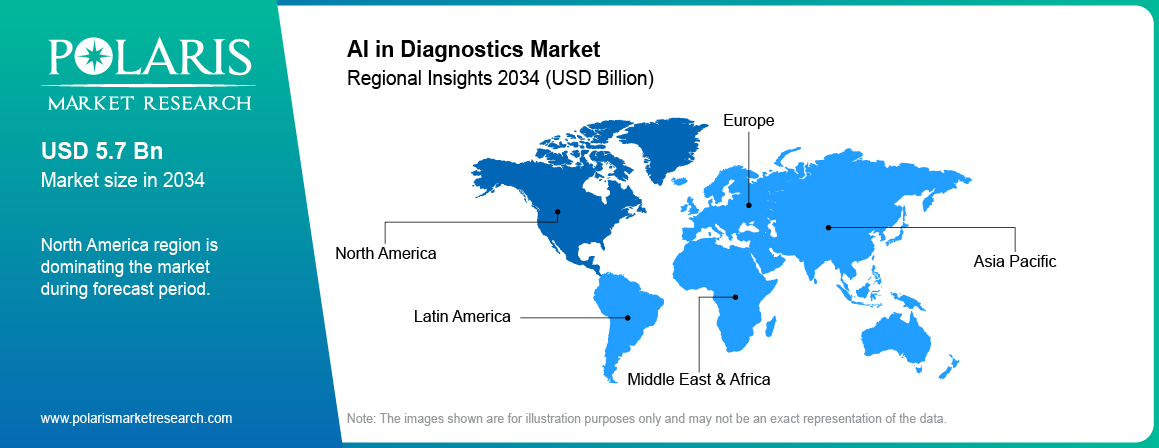
North America accounted for largest share of 53.89% in 2025. The North America AI in diagnostic market growth is driven by early adoption of high-end healthcare technologies and the presence of AI solutions providers. The market is witnessing increased adoption of AI technologies in hospitals and diagnostic centers for accurate disease detection. This is driven by increased healthcare expenditure and well-established healthcare infrastructure. Increased investments in healthcare research also fuels market growth. Furthermore, an increase in the adoption of AI in radiology and digital pathology drives the market.
The Europe AI in diagnostic market is anticipated to witness a CAGR of 20.6% during the forecast period. The region is witnessing increased investments in healthcare technology. Hospitals are increasingly adopting AI based tools for more efficient diagnostics. The market is further being driven by increased government support for digital healthcare, increased research activities, and the presence of medical technology providers. Furthermore, an increase in adoption of machine learning in medical imaging and pathology is driving market growth.
The Asia Pacific AI in diagnostic market is expected to record a CAGR of 24.3% during the forecast period. This is driven by increased healthcare expenditure, rising patient population, and growing demand for high-end diagnostic services. Countries such as China, India, Japan, and South Korea are investing in digital healthcare. Hospitals are increasingly adopting AI diagnostic solutions to increase access to medical services. Increase in adoption of AI in medical imaging diagnostics and increased government support for digital healthcare is driving market growth.
The Latin America AI in diagnostic market accounted for 7.8% share in 2025, fueled by the rising need to increase access to healthcare services. Hospitals and diagnostic centers are gradually adopting digital solutions to increase disease detection. Rising investments in healthcare infrastructure and increasing private healthcare facilities are driving demand for AI based solutions. Furthermore, increased focus on early diagnosis and adoption of AI solutions to support medical imaging is driving market growth.
The Middle East & Africa AI in diagnostic market is anticipated to witness a CAGR 22.4% during the forecast period driven by increased investments in healthcare infrastructure and increased adoption of digital healthcare technologies. Countries like Saudi Arabia and UAE are focusing on modernizing their healthcare services. Hospitals are increasingly adopting AI based diagnostic systems to increase disease detection. Increased government healthcare development initiatives and increased investments in high-end medical imaging is creating opportunities for AI diagnostic solutions.
Competitive Insights
The market is highly competitive and has a number of top players in the healthcare tech and AI sectors. AI in diagnostics market key companies such as Siemens Healthineers, GE HealthCare and Philips have large portfolios of imaging technologies and a wide network of hospitals. Aidoc, Qure.ai, Lunit, Viz.ai and PathAI have advanced diagnostic algorithms. Roche and NVIDIA also bring innovation through integration. Many companies are now focusing on developing their products, obtaining regulatory clearances, forming partnerships, mergers and working on clinical validation to increase their market share and gain an edge over their competitors.
Vendor Positioning
| # | Company | AI diagnostics offering / key products | Clinical focus | Market positioning and differentiators | Positioning tier |
| 1 | Aidoc Medical Ltd. | aiOS clinical AI platform; CARE foundation-model-based triage and notification for CT/X-ray (intracranial hemorrhage, PE, aortic, stroke, spine fractures) | Radiology; acute care triage | Enterprise-scale clinical AI platform player; one of the broadest FDA-cleared acute-care imaging portfolios; sells platform deployments to large health systems, with embedded workflow and PACS/EHR integrations | Platform-Led Specialist |
| 2 | AliveCor, Inc. | KardiaMobile personal ECG devices (single-lead, 6-lead) and Kardia AI algorithms for AFib, bradycardia and tachycardia detection; 12-lead AI-assisted ECG | Cardiology; remote and consumer ECG | Consumer-to-clinician cardiac diagnostics; strong in remote patient monitoring and direct-to-consumer; differentiated by FDA-cleared AI on low-cost handheld ECG hardware | Niche Specialist |
| 3 | Enlitic, Inc. | ENDEX data standardization and Curie platform for imaging data curation, de-identification, and AI workflow orchestration | Medical imaging data infrastructure | Data-layer enabler rather than a diagnostic algorithm vendor; positioned on image/report normalization for health systems and AI developers | Niche Enabler |
| 4 | F. Hoffmann-La Roche Ltd. | Roche Diagnostics: navify digital pathology and algorithm suite, VENTANA digital pathology scanners, computational-pathology algorithms, AI-enabled clinical decision support | Pathology; in-vitro diagnostics (IVD) | Integrates AI with its IVD/tissue-diagnostics installed base and companion-diagnostics ties to pharma; computational pathology is a core growth lever | Diversified Leader |
| 5 | GE HealthCare Technologies Inc. | Edison platform and AI-enabled imaging systems (deep-learning image reconstruction, Critical Care Suite, ultrasound AI, MIM Software, Caption/Intelligent Ultrasound AI assets) | Radiology, ultrasound, MR, CT, cardiology, nuclear medicine | Among the largest holders of FDA AI-enabled device authorizations; competes on embedded AI across the installed modality base plus acquisitions for software depth | Diversified Leader |
| 6 | HeartFlow, Inc. | HeartFlow FFRct Analysis, Plaque Analysis and Roadmap; AI-based coronary CT angiography analysis | Cardiology; non-invasive coronary diagnostics | Category leader in AI-driven CT-based coronary physiology and plaque assessment; strong reimbursement and guideline traction; publicly listed since 2025 | Platform-Led Specialist |
| 7 | IDx Technologies Inc. (now Digital Diagnostics Inc.) | LumineticsCore (formerly IDx-DR): autonomous AI for diabetic retinopathy screening in primary care | Ophthalmology; screening | First FDA-authorized autonomous AI diagnostic system (2018); owns a strong regulatory and reimbursement precedent for point-of-care autonomous AI | Niche Specialist |
| 8 | Imagen Technologies, Inc. | OsteoDetect and FractureDetect: AI fracture detection on X-ray for emergency and urgent care | Musculoskeletal radiology | Focused fracture-detection specialist with early FDA authorizations; positioned on reducing missed fractures in emergency and urgent-care workflows | Niche Specialist |
| 9 | Koninklijke Philips N.V. | AI-enabled MR, CT, ultrasound and ECG; Philips Radiology Workspace, HealthSuite imaging and AI Manager for third-party algorithm deployment | Radiology, cardiology, ultrasound, enterprise informatics | Broad health-tech portfolio blending embedded modality AI with enterprise informatics and an open marketplace for third-party AI | Diversified Leader |
| 10 | Lunit Inc. | INSIGHT CXR, MMG and DBT (AI for chest X-ray, mammography, tomosynthesis); SCOPE (AI pathology biomarkers); Volpara breast-health software (acquired 2024) | Radiology; breast cancer; oncology pathology | Leading Asia-origin AI imaging vendor with a strong breast-screening franchise and international footprint; expanding into AI pathology and companion biomarkers | Platform-Led Specialist |
| 11 | NovaSignal Corporation | NovaGuide robotic transcranial Doppler ultrasound with AI-guided probe positioning and automated analysis | Neurology; cerebrovascular diagnostics | Niche neuro-ultrasound player that uses robotics and AI to lower operator dependence for TCD exams | Niche Specialist |
| 12 | NVIDIA Corporation | NVIDIA Clara, MONAI and Holoscan: AI compute, SDKs and foundation-model tooling for imaging, genomics and sensor workflows | Cross-modality AI infrastructure | Technology enabler rather than a diagnostics vendor; partner of choice for OEMs (GE HealthCare, Siemens Healthineers, Philips) and AI developers; sets the compute baseline for the market | Technology Enabler |
| 13 | PathAI, Inc. | AISight image management system, PathExplore and AI-assisted diagnostic algorithms; AI biomarkers for pharma trials (e.g., MASH); laboratory services | Digital and computational pathology | Leader in AI pathology for both clinical diagnostics and biopharma R&D; vertically integrated with lab operations | Platform-Led Specialist |
| 14 | Qure.ai Technologies Private Limited | qXR (chest X-ray, TB), qCT (head CT, stroke), qER, qure.ai lung nodule solutions | Radiology; TB and lung screening; stroke | Emerging-market-led AI vendor with a large international deployment base and public-health programs; cost-efficient screening at scale and expanding into the US and Europe | Platform-Led Specialist |
| 15 | Riverain Technologies, Inc. | ClearRead CT and ClearRead Xray: lung nodule detection and bone suppression | Thoracic imaging; lung cancer screening | Long-standing thoracic AI specialist; positioned on lung nodule workflow efficiency and reader support | Niche Specialist |
| 16 | Siemens Healthineers AG | AI-Rad Companion, syngo.via, Atellica diagnostics, teamplay digital health platform, AI-enabled CT, MR and X-ray | Radiology, IVD, cardiology, oncology | Diversified imaging and diagnostics leader; competes on large installed base, automation across the AI-Rad Companion portfolio, and IVD integration | Diversified Leader |
| 17 | Viz.ai, Inc. | Viz LVO (first FDA-cleared AI triage), Viz HCM, Viz Platform for AI-driven care coordination across stroke, cardiology and vascular | Neurology and cardiology; care coordination | Pioneer of AI-triggered care coordination; strong network effects across hospital networks and a growing pharma partnership channel | Platform-Led Specialist |
| 18 | VUNO Inc. | VUNO Med-Chest X-ray, Med-LungCT, Med-DeepBrain, Med-Fundus AI, DeepECG | Radiology, ophthalmology, cardiology | Multi-modality Korean AI vendor; strong domestic hospital base with selective international expansion | Niche Specialist |
| 19 | Zebra Medical Vision Ltd. (now Nanox AI Ltd.) | Nanox.AI HealthCCSng, HealthOST, HealthPNX: opportunistic AI screening on CT/X-ray for coronary calcium, osteoporosis, pneumothorax and more | Population health; opportunistic screening | Acquired by Nanox in 2021; positioned on population-health and early-detection use cases that leverage existing scans | Niche Specialist |
Source: Polaris Market Research Analysis
List of Artificial Intelligence in Diagnostics Companies
-
Aidoc Medical, Ltd.
-
AliveCor, Inc.
-
Enlitic, Inc.
-
GE HealthCare Technologies Inc.
-
HeartFlow, Inc.
-
IDx Technologies Inc.
-
Imagen Technologies, Inc.
-
Lunit Inc.
-
NovaSignal Corporation
-
NVIDIA Corporation
-
PathAI, Inc.
-
Qure.ai Technologies Private Limited
-
Riverain Technologies, Inc.
-
Siemens Healthineers AG
-
Viz.ai, Inc.
-
VUNO Inc.
-
Zebra Medical Vision Ltd. (now Nanox AI Ltd.)
Recent Developments
- November 2026, PulseAI received U.S. FDA 510(k) clearance for its AI-powered arrhythmia analysis model for wearables. The Belfast-based company said its model improved atrial fibrillation detection and reduced inconclusive ECG interpretations by 92%. (Source: prnewswire.com)
- March 2026, Roche launched an NVIDIA-powered AI factory with 2,176 new Blackwell GPUs, bringing its total to more than 3,500 GPUs. The company will use the infrastructure to accelerate drug discovery, diagnostics development, clinical trials, and manufacturing. (Source: roche.com)
- September 2026, Mayo Clinic and Thermo Fisher Scientific launched Precure, an AI-supported diagnostics company focused on early disease detection. Precure will build a large multi-omics dataset from one million biospecimens and Mayo Clinic clinical data to advance diagnostics and drug development. (Source: healthexec.com)
Future Outlook
The AI in diagnostics market is poised for significant growth in the coming years. The growth will be driven by rising demand for early disease detection, personalized medicine, and improved clinical efficiency. Advancements in machine learning, medical imaging, and predictive analytics will enhance diagnostic accuracy and speed. Increasing healthcare digitization, investment, and AI integration into clinical workflows will create opportunities, while data privacy, regulatory compliance, and implementation costs remain key challenges.
Research Methodology
- Market estimates are derived using a blend of primary and secondary research, validated through weighted-average and combined top-down/bottom-up modeling approaches.
- Secondary research covers company filings, FDA and CE regulatory clearances for AI-enabled diagnostic tools, clinical validation studies, healthcare IT spending data, industry journals, and paid third-party databases to build baseline estimates.
- Primary research includes interviews with key industry participants such as AI diagnostic software developers, radiologists, pathologists, hospital administrators, and medical imaging equipment manufacturers, to validate accuracy and capture forward-looking insights.
- Base year considered is 2025, with a forecast provided through 2034; revenues are expressed in USD Billion.
- Parent market is identified as the global AI in healthcare and diagnostic imaging market; the addressable segment is narrowed using AI adoption rates across clinical diagnostic workflows.
- Bottom-up model aggregates regional AI in diagnostics demand across component and diagnosis type, validated against vendor revenue disclosures from GE HealthCare, Siemens Healthineers, Philips, F. Hoffmann-La Roche, NVIDIA, and others.
- Regional coverage spans North America, Europe, Asia Pacific, Middle East & Africa, and Latin America, further segmented by major countries.
- Projected 21.4% CAGR (2026–2034) reflects weighted analysis of rising diagnostic imaging volumes, growing radiologist workforce shortages, increasing regulatory approvals of AI-based tools, and expanding demand for early and accurate disease detection in oncology and cardiology.
- Findings are cross-validated across multiple estimation methods to ensure consistency, accuracy, and reliability of the final market sizing.
Artificial Intelligence (AI) in Diagnostics Market Report Segmentation
By Component Outlook (Revenue – USD Billion, 2021–2034)
- Software
- Hardware
- Services
By Diagnosis Outlook (Revenue – USD Billion, 2021–2034)
- Cardiology
- Oncology
- Pathology
- Radiology
- Chest and Lung
- Neurology
- Others
By Regional Outlook (Revenue – USD Billion, 2021–2034)
- North America
- U.S.
- Canada
- Europe
- Germany
- France
- UK
- Italy
- Spain
- Netherlands
- Russia
- Rest of Europe
- Asia Pacific
- China
- Japan
- India
- Malaysia
- South Korea
- Indonesia
- Australia
- Vietnam
- Rest of Asia Pacific
- Middle East & Africa
- Saudi Arabia
- UAE
- Israel
- South Africa
- Rest of the Middle East & Africa
- Latin America
- Mexico
- Brazil
- Argentina
- Rest of Latin America
Artificial Intelligence (AI) in Diagnostics Market Report Scope
| Report Attributes | Details |
| Market Size in 2025 | USD 1.95 Billion |
| Market Size in 2026 | USD 2.37 Billion |
| Revenue Forecast in 2034 | USD 11.18 Billion |
| CAGR | 21.4% from 2026 – 2034 |
| Base Year | 2025 |
| Historical Data | 2021 – 2024 |
| Forecast Period | 2026 – 2034 |
| Quantitative Units | Revenue in USD Billion and CAGR from 2026 to 2034 |
| Segments Covered | By Component By Diagnosis |
| Regional Scope | North America, Europe, Asia Pacific, Latin America, Middle East & Africa |
| Customization | Report customization as per your requirements with respect to countries, region, and segmentation |
Source: Polaris Market Research Analysis
Artificial Intelligence (AI) in Diagnostics Market FAQ's
The market size was USD 1.95 billion in 2025 and is expected to reach USD 11.18 billion by 2034.
The artificial intelligence (AI) in diagnostics market is growing at a CAGR of 21.4% during the forecast period.
Key companies include Siemens Healthineers, GE HealthCare, Philips, Aidoc, AliveCor, Roche, Digital Diagnostics, VUNO, and Zebra Technologies.
AI in diagnostics uses computer software to analyse medical images and patient data, identify disease patterns, and support doctors' decisions.
No, AI cannot fully replace doctors. It supports disease detection, reviews medical data, and helps doctors make faster and better-informed decisions.
AI accuracy varies by application and dataset. It is measured using sensitivity, specificity, accuracy, and AUROC to assess diagnostic performance.
Yes, several AI diagnostic tools have received FDA clearance, approval, or authorization, depending on their intended medical use and regulatory pathway.
Traditional diagnosis relies on doctors' assessments. AI analyses medical data, while clinical decision support provides recommendations to help doctors make decisions.
The future includes faster disease detection, multi-condition analysis, improved imaging, personalised diagnosis, wider hospital adoption, and greater use of advanced AI systems.

Download Sample Report of Artificial Intelligence (AI) in Diagnostics Market
Please fill out the form to request a customized copy of the research report.


