
Asphalt Mixing Plants Market Growth & Industry Trend 2026-2034
REPORT DETAILS
Asphalt Mixing Plants Market Summary
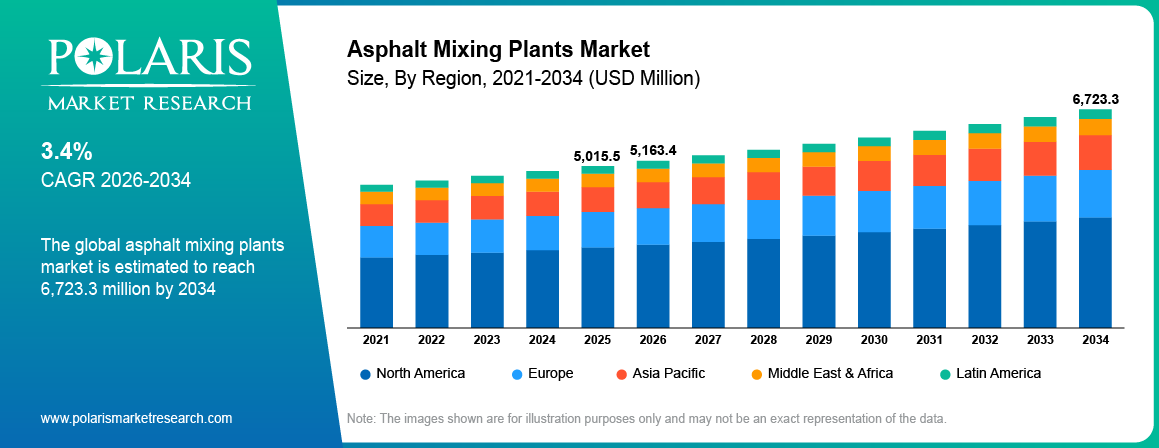
The global asphalt mixing plants market is estimated around USD 5,015.5 Million in 2025,with consistent growth anticipated during 2026–2034. Increasing public transportation infrastructure investments, rising highway modernization projects, and growing road construction activities are supporting market expansion. The market is projected to grow at a CAGR of 3.4% during the forecast period.
Market Statistics
Key Takeaways
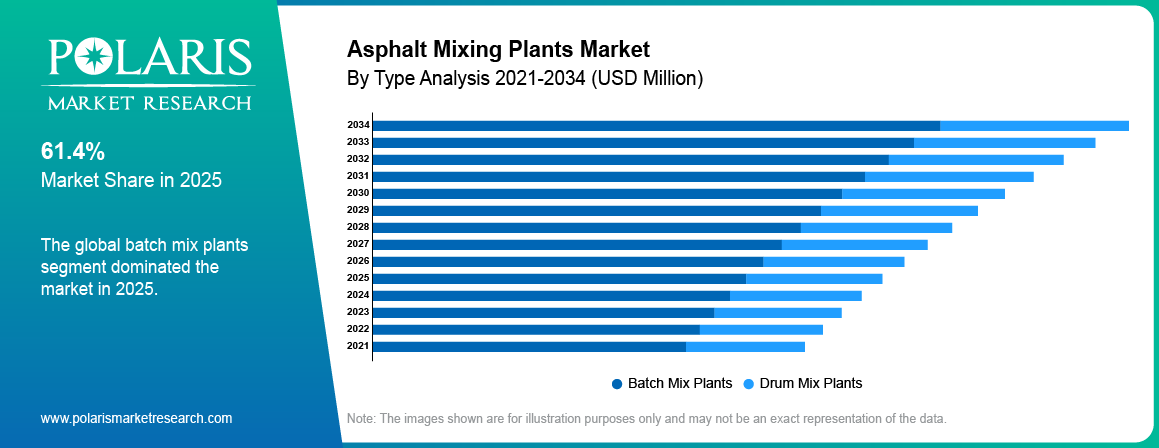
- Batch mix plants dominated the market by 61.4% revenue share in 2025 due to strong demand for high-quality and flexible asphalt production systems.
- Stationary plants dominated the market by 69.1% revenue share in 2025 driven by increasing deployment across large-scale infrastructure projects.
- Mobile asphalt plants are projected to grow at the fastest CAGR of 3.7% during the forecast period owing to rising infrastructure construction in remote and temporary project locations.
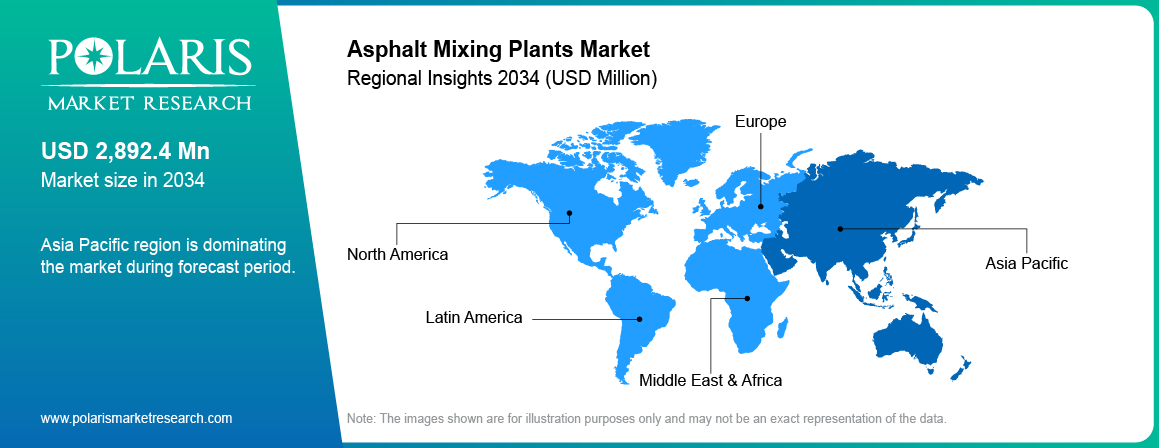
- Asia Pacific dominated the market in 2025 by 41.90% share supported by strong highway construction and urban infrastructure development activities.
- North America is expected to grow at a substantial pace of around 3.6% CAGR during the forecast period owing to increasing investments in road rehabilitation projects.
Industry Dynamics
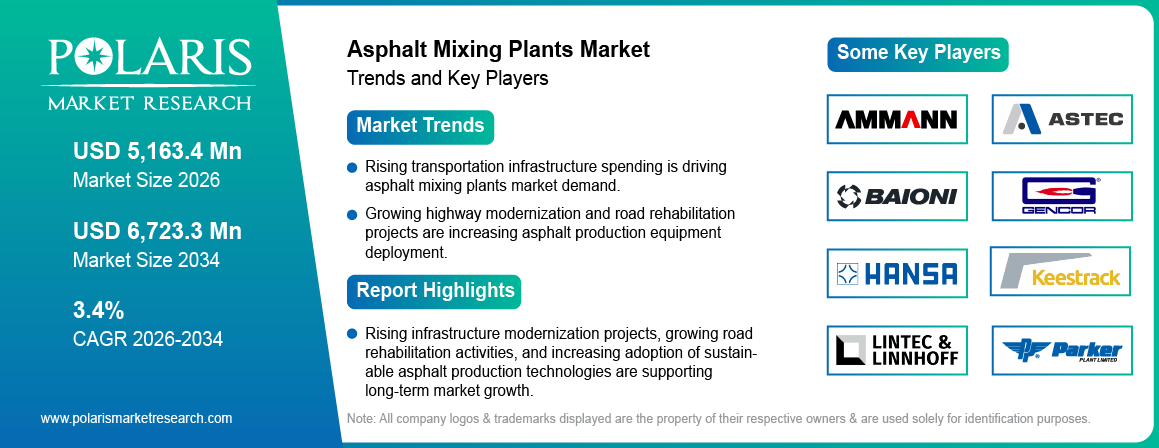
- Rising transportation infrastructure spending is driving the market growth.
- Growing road rehabilitation projects are increasing asphalt plant demand.
- Stringent environmental emission regulations are restraining market expansion.
- Rising adoption of sustainable asphalt production technologies is creating growth opportunities.
What is the Asphalt Mixing Plants Market?
Asphalt mixing plants are industrial systems used for producing asphalt mixtures required in highway construction, airport runways, bridges, parking lots, and urban road infrastructure. These plants combine aggregates, bitumen, and fillers under controlled temperature and mixing conditions to manufacture durable paving materials for transportation projects. Asphalt plants are widely used in infrastructure development, road rehabilitation, and municipal construction activities.
The value chain of asphalt mixing plants consists of suppliers of raw materials, component producers, asphalt plant producers, distributors, EPC contractors, construction firms, and infrastructure developers. The various components including steel frame, burners, control panels, mixers, and drying systems are combined into an asphalt production unit that is marketed to construction firms and governmental infrastructure departments involved in building roads.
Source: Polaris Market Research Analysis
The industry is experiencing high growth due to the rising expenditure of governments on infrastructure development. Urbanization, higher car ownership, and public infrastructure development activities are driving the demand for asphalt production technologies in developed and developing nations.
Drivers & Opportunities
Growing Infrastructure Investment in Transportation is Fueling the Market Demand: Several countries are making significant investments in highway development, bridge development, airport developments, and intelligent transportation infrastructure, thus driving the demand for asphalt production machinery. Various road development schemes are implemented on a huge scale in India, China, the US, and South-East Asia are fueling the establishment of large asphalt plants. According to the Green Finance & Development Center, the involvement of Belt and Road Initiative reached its peak by involving construction and investment worth USD 128.4 billion and USD 85.2 billion, respectively, in 2025., indicating strong global infrastructure expansion activities.[Green Finance & Development Center, "China Belt and Road Initiative (BRI) Investment Report 2025", greenfdc.org]
Growing Number of Road Rehabilitation Projects Leading to Higher Demand for Asphalt Plants: The demand for asphalt plants that help in improving the condition of existing roads is rising owing to the aging road infrastructure in developed countries. Modern asphalt plants have gained popularity among contractors due to their ability to offer an efficient manufacturing process that results in top-notch pavements. The construction of infrastructure through collaborations between private businesses and government organizations, coupled with rising expenditure on maintenance, is boosting the demand for asphalt plants. The Global Green Bond Initiative Fund was founded in April 2026, receiving funding of about USD 22 billion from the European Union and other development finance institutions.[European Commission, "European Commission advances new climate and energy transition initiatives", ec.europa.eu] These development across countries are strengthening long-term infrastructure financing activities.
Restraints & Challenges
Strict Environmental Regulations Are Restricting Market Growth: The environmental issues associated with the emissions from asphalt plants, dust formation, and energy usage are posing challenges for manufacturers and contractors. Strict emission regulations have been introduced in Europe and North America, which demand the use of efficient pollution control technology in manufacturing processes. The expensive cost of compliance with these regulations is restricting their implementation by smaller contractors.
Opportunity
Rise of Emerging Applications of Sustainable Asphalt Technology is Opening Up Opportunities: Rising demand for sustainable road construction is projected to create significant opportunities for applications of warm mix asphalt technology, recycled asphalt pavement technology, and sustainable asphalt manufacturing equipment. There has been increasing number of contractors who are investing in the modernization of their asphalt mixing facilities by adopting new technologies that improve energy efficiency and reduce pollution. For instance, in April 2025, Kraton Corporation launched the CirKular+ Paving Circularity Series, which targets high levels of reclamation in road construction.[Kraton, "Kraton launches Cirkular+ paving circularity series for reclaimed asphalt reuse maximization", kraton.com] Automation and RAP technology will enhance business productivity and effectiveness.
Source: Polaris Market Research Analysis
Segmental Insights
The report presents an extensive analysis of the asphalt mixing plants market by type, mobility, and capacity, providing insights into the most profitable and fastest-growing market segments.
By Type
-
Batch Mix Plants
Batch mix plants dominated the market by 61.4% revenue share in 2025. This type of asphalt mixing plant helps producers manufacture various types of asphalt mixes in batches. Higher customer demand for customized asphalt mixes and high-quality pavements is driving this segment's growth.
-
Drum Mix Plants
Drum mix plants are projected to grow at the fastest CAGR during the forecast period owing to continuous production capability and lower operational costs. Large-scale infrastructure contractors are increasingly deploying drum mix plants for highway and expressway construction projects that require high production output. The growing need for efficient and productive asphalt mixing plant systems is further promoting segment growth.
By Mobility
-
Stationary Plants
Stationary plants dominated the market by 69.1% revenue share in 2025. These types of asphalt mixing plants offer higher production capacity and the integration of automation systems. The increasing investments made by governments in transportation infrastructure are fuelling the demand for stationary asphalt mixing plants.
-
Mobile Plants
Mobile asphalt plants are projected to grow at the fastest CAGR of 3.7% during the forecast period, owing to increasing demand for remote construction sites and temporary roads. Increasing adoption of mobile asphalt plants by contractors due to their quick set-up and ease of transportation is driving market growth.
By Capacity
-
160–240 TPH Plants
160–240 TPH plants held the substantial share of 30.2% in the market in 2025 due to optimal production capacity, efficient operation, and applicability to medium-to-large scale road constructions. Contractors are increasingly deploying these plants across urban infrastructure and highway construction activities. Rising road rehabilitation programs are supporting segment demand.
-
Above 240 TPH Plants
Above 240 TPH plants are projected to grow at the fastest CAGR during the forecast period owing to increasing demand from mega infrastructure and expressway construction projects. Governments and EPC contractors are focusing on high-capacity asphalt production systems to improve project timelines and large-volume asphalt output efficiency.
Source: Polaris Market Research Analysis
Regional Analysis
Asia Pacific Asphalt Mixing Plants Market Insights
Asia Pacific dominated the market in 2025 by 41.90% share in 2025 driven by strong infrastructure expansion, rising highway construction, and increasing urbanization activities across China, India, Japan, and Southeast Asia. China remains one of the largest infrastructure construction markets globally, while India is witnessing rapid highway and rural road development under national infrastructure programs. Growing transportation investments and rising public infrastructure spending are supporting regional market growth. According to the Asian Development Bank, developing economies across Asia Pacific require nearly USD 26 trillion in infrastructure investments between 2016 and 2030, equivalent to approximately USD 1.7 trillion annually.[Asian Development Bank, "Infrastructure development in Asia: 12 things to know", www.adb.org]
North America Asphalt Mixing Plants Market Overview
North America is expected to grow at a substantial pace of around 3.6% CAGR during the forecast period due to increasing road rehabilitation activities and rising federal infrastructure spending across the US and Canada. The US leads the regional market owing to expansion of highway modernization programs and increasing adoption of advanced asphalt production technologies. Growing focus on sustainable construction practices and automated plant systems is contributing to regional market expansion. The US Congress authorized nearly USD 56.8 billion from the Highway Trust Fund for highway formula programs during FY 2024, exceeding the estimated USD 43.2 billion required for federal-aid road repair projects.[Transportation for America, "Repair priorities for transportation infrastructure investment", t4america.org]
Europe Asphalt Mixing Plants Market Assessment
Europe asphalt mixing plants market is experiencing steady growth due to increasing adoption of sustainable asphalt production technologies and stringent environmental regulations. Germany, France, Italy, and the UK are implementing sustainable technologies, such as warm mix asphalt and recycled asphalt pavement techniques, in road constructions. Growing adoption of asphalt production equipment with lower emissions is augmenting industry growth. In May 2026, Dynapac launched its first all-electric asphalt paver for highway road paving operations in the Dutch infrastructure sector.[Dynapac, "European market premiere for Dutch infrastructure sector", dynapac.com]
Source: Polaris Market Research Analysis
Competitive Landscape
Key Players & Competitive Strategies
The asphalt mixing plants market is moderately fragmented due to the presence of global infrastructure equipment manufacturers and regional construction machinery suppliers. The competition is based on production capacity, automation capabilities, energy efficiency, cost, and after-sales services support. The organizations are paying attention to sustainable asphalt technology, digitalized plant monitoring solutions, collaboration, and regional market expansion initiatives to bolster their market positioning.
Some of the key organizations within the asphalt mixing plants market include Ammann Group Holding AG, Astec Industries, Inc., Baioni Crushing Plants S.p.A., Gencor Industries, Inc., Hansa Mechatronics GmbH, KEESTRACK GmbH, Lintec & LinhHoff Group, MARINI S.p.A. (Fayat Group), Nikko Co., Ltd., Parker Plant Limited (CMI Terex), Roadtec, Inc. (Astec Industries), Sany Group Co., Ltd., Shindery Machinery Equipment Co., Ltd., Sim Asphalt B.V., and Vogele.
Premium Insights
-
Investment Trends:
Infrastructure modernization plans and transport infrastructure projects funded by governments are driving the need for large-scale asphalt production equipment in developing and advanced economies. The contractors are increasingly looking at automated and energy-efficient asphalt plants to ensure better financial outcomes.
-
Technology Transformation:
The manufacturers are incorporating Internet of Things-based plant monitoring solutions, automation technologies, and recycled asphalt pavement technologies. Increasing adoption of warm mix asphalt systems is supporting low-emission road construction activities.
Pricing Intelligence & Roi Analysis
-
Asphalt Plant Pricing (CAPEX)
| Plant Type | Cost Range |
| Mobile Plant | USD 500K – 1.5M |
| Stationary Plant | USD 1M – 5M |
| High-Capacity (>240 TPH) | USD 3M+ |
Source: Polaris Market Research Analysis
-
Operating Economics
| Metric | Value |
| Cost per Ton | USD 30–75 |
| Profit Margins | 15%–25% |
| Payback Period | 2–5 Years |
Source: Polaris Market Research Analysis
-
ROI Scenario
| Scenario | ROI |
| High Utilization (80%) | 25%+ |
| Medium Utilization | 15–20% |
| Low Utilization | <10% |
Source: Polaris Market Research Analysis
Key Players
- Ammann Group Holding AG
- Astec Industries, Inc.
- Baioni Crushing Plants S.p.A.
- Gencor Industries, Inc.
- Hansa Mechatronics GmbH
- Lintec & LinhHoff Group
- MARINI S.p.A. (Fayat Group)
- Nikko Co., Ltd.
- Parker Plant Limited (CMI Terex)
- Roadtec, Inc. (Astec Industries)
- Sany Group Co., Ltd.
- Shindery Machinery Equipment Co., Ltd.
- Sim Asphalt B.V.
- Vogele
Industry Developments
- July 2025: NFLG Inc. launched the LBG3000 asphalt mixing plant in Kazakhstan, boosting their market position in high-quality asphalt machinery in the country. The LBG3000 asphalt mixing plant is designed with modularity and flexibility that allows it to function well even under harsh climatic conditions. [source: en.nflg.com]
- June 2025: Lintec & Linnhoff and Gainwell delivered multiple next-generation Linnhoff DRX DurableMix asphalt mixing plants manufactured in India to support major infrastructure projects in West Bengal and Tamil Nadu. [source: gainwellindia.com]
Asphalt Mixing Plants Market Segmentation
By Type Outlook (Revenue, USD Million, 2021–2034)
- Batch Mix Plants
- Drum Mix Plants
By Mobility Outlook (Revenue, USD Million, 2021–2034)
- Stationary Plants
- Mobile Plants
By Capacity Outlook (Revenue, USD Million, 2021–2034)
- Below 80 TPH
- 80–160 TPH
- 160–240 TPH
- Above 240 TPH
By Application Outlook (Revenue, USD Million, 2021–2034)
- Road Construction
- Highway Construction
- Airport Construction
- Others
By Regional Outlook (Revenue, USD Million, 2021-2034)
- North America
- US
- Canada
- Europe
- Germany
- France
- UK
- Italy
- Spain
- Netherlands
- Russia
- Rest of Europe
- Asia Pacific
- China
- Japan
- India
- Malaysia
- South Korea
- Indonesia
- Australia
- Vietnam
- Rest of Asia Pacific
- Middle East & Africa
- Saudi Arabia
- UAE
- Israel
- South Africa
- Rest of Middle East & Africa
- Latin America
- Mexico
- Brazil
- Argentina
- Rest of Latin America
Asphalt Mixing Plants Market Report Scope
| Report Attributes | Details |
| Market Size in 2025 | USD 5,015.5 Million |
| Market Size in 2026 | USD 5,163.4 Million |
| Revenue Forecast by 2034 | USD 6,723.3 Million |
| CAGR | 3.4% from 2026 to 2034 |
| Base Year | 2025 |
| Historical Data | 2021–2024 |
| Forecast Period | 2026–2034 |
| Quantitative Units | Revenue in USD Million and CAGR from 2026 to 2034 |
| Report Coverage | Revenue Forecast, Competitive Landscape, Growth Factors, and Industry Trends |
| Segments Covered |
|
| Regional Scope |
|
| Competitive Landscape |
|
| Report Format |
|
| Customization | Report customization as per your requirements with respect to countries, regions, and segmentation. |
Source: Polaris Market Research Analysis
Asphalt Mixing Plants Market FAQ's
The global market size was valued at USD 5,015.5 Million in 2025 and is projected to reach USD 6,723.3 Million by 2034 at a CAGR of 3.4%.
Asia Pacific dominated the market in 2025 by 41.90% share driven by strong highway construction and infrastructure development activities.
Major companies include Ammann Group, Astec Industries Inc., Fayat Group, Lintec & Linnhoff Holdings, and Marini S.p.A.
Major growth drivers include rising transportation infrastructure spending, increasing highway modernization projects, and growing road rehabilitation activities.
Batch mix plants dominated the market by 61.4% revenue share in 2025 due to strong demand for flexible and high-quality asphalt production systems.
The market outlook remains positive due to increasing adoption of sustainable asphalt technologies and rising investment in transportation infrastructure.
Asphalt mixing plants are industrial systems used to manufacture asphalt mixtures for highway, airport, bridge, and urban road construction projects.
Download Sample Report of Asphalt Mixing Plants Market
Please fill out the form to request a customized copy of the research report.


