
Automatic Identification and Data Capture Market Trends Analysis, 2026-2034
REPORT DETAILS
Automatic Identification and data capture Market Summary
The global automatic identification and data capture market stood at USD 77.92 billion in 2025. The market is projected to account for a CAGR of 11.8% between 2026 and 2034. The market is driven by the increasing adoption of automation in retail, manufacturing, and logistics. It is also benefiting from smart city initiatives and the expansion of e-commerce and retail networks.
Market Statistics
Key Takeaways
- North America dominated the automatic identification and data capture market with a 49.80% revenue share in 2025. Strong infrastructure and advanced technology have resulted in high deployment of automatic identification and data capture in the region.
- Asia Pacific is anticipated to register the highest CAGR of 12.6%. The growing emerging economies have resulted in increased investment in advanced technologies across various sectors in the region.
- The hardware segment led the automatic identification and data capture market with a 58.26% revenue share in 2025. This is owing to the rising demand for key devices, including barcode scanners, RFID readers, and mobile computing equipment.
- The retail segment is projected to grow at a CAGR of 12.3% during the projection period. The rising adoption of automatic identification and data capture technologies to improve business efficiency and customer experience is contributing to the segment’s growth.
- Hardware currently contributes the largest revenue share. But software and analytics are gaining relevance as companies seek to use collected data to plan, operate, ensure safety, and make decisions.
- Advanced tools, such as artificial intelligence-based visual recognition, intelligent OCR, and predictive analytics, enhance the way information is utilized. Moreover, RFID systems linked together help enterprises handle large amounts of data, enhancing the significance of AIDC tools.
Industry Dynamics
- The increasing number of clinics and hospitals is driving the adoption of AIDC technology for inventory management, medication tracking, and patient identification, thereby supporting the growth of the healthcare market.
- The growing retail and logistics networks are driving increased usage of AIDC in logistics.
- The fast development of the e-commerce industry is driving the growth of the automatic identification and data capture market.
- Regulatory compliance is becoming one of the primary factors driving demand in the AIDC industry. Most industries today require systems that can effectively trace and validate data.
- One major hindrance in the market is the high setup and integration costs, especially for small and medium-sized enterprises.
- Integration of AIDC technology into the existing software may also create challenges for organizations. This might involve ERP, warehouse management, hospital, retail point-of-sale (POS), and legacy database software.
Source: Polaris Market Research Analysis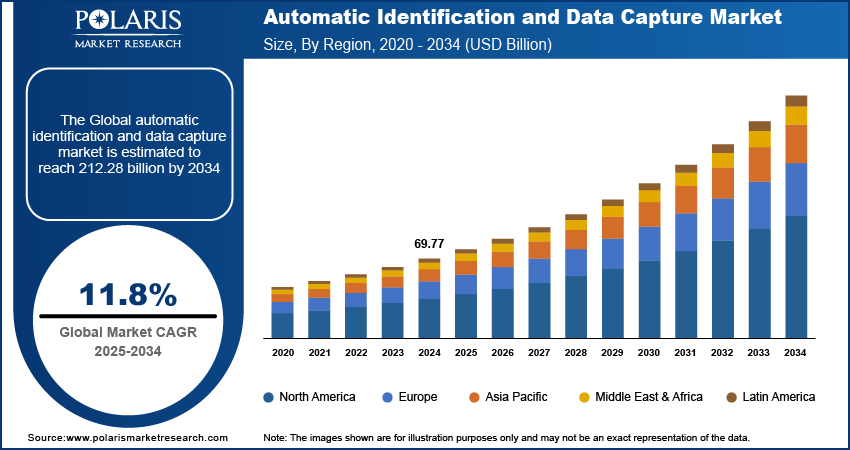
To Understand More About this Research:Download Sample Report
AI Impact on Automatic Identification and Data Capture Market
- AI in AIDC leads to higher accuracy and speed during the process of gathering data. AI helps through barcode scanning, RFID tagging, and image processing. This results in fewer mistakes and enhanced productivity.
- ML algorithms can also be utilized in an AIDC system for predictive analysis. ML algorithms help in optimizing inventory management and forecasting demands.
- The use of AI technology is boosting the relevance of optical character recognition (OCR) technology in the field of AIDC. The recent generation of OCR tools can recognize data on invoices, tags, bills of lading, shipping notes, and regulatory paperwork more effectively. This is especially relevant for companies dealing with multiple types of documents in large volumes.
- In retail organizations and logistics firms, AI helps improve barcode recognition even when codes are damaged or unreadable. Additionally, these tools help increase effectiveness in self-scanning operations and automated package detection in busy areas. In manufacturing, AI-based computer vision technology allows processing product information and labeling.
- AI is being used to convert the collected data into useful action. AIDC systems are now capable of recommending replenishment and identifying delays and losses. They can also assist with planning and scheduling. This has made software and data analytics more crucial in the automatic identification and data capture market.
- Organizations are increasingly shifting to connected operations. This has resulted in the use of AI alongside IoT, edge computing, and AIDC hardware. This helps automate processes and problem-solving. This also leads to faster decision-making within sectors like retail, healthcare, manufacturing, and logistics.
Automatic Identification and Data Capture Market Definition and Scope
Automatic identification and data capture (AIDC) uses technology to automatically recognize and collect information about assets, products, documentation, and even individuals. Rather than relying on manual data input, automatic identification and data capture technology makes use of such technologies as barcodes and biometrics for collecting data quickly and efficiently.
Some examples of AIDC technologies used widely include:
- Barcodes and barcode readers for identifying products and packages
- RFID technology for monitoring assets and inventories without line-of-sight requirements
- OCR technology for reading text and documents
- Smart cards for making payments and accessing restricted areas
- Biometric technology for confirming identities
- Mobile computing for conducting field-based operations
These technologies are widely used across a variety of applications, including logistics, healthcare, retail organizations, manufacturers, banks, the hospitality sector, and government systems.
The demand for AIDC products and technologies is growing as more companies rely on real-time data as opposed to traditional means of capturing and storing data. Industries such as logistics, health care, retail, and government services need to capture and store data instantly. Firms seek technologies that can improve efficiency, minimize mistakes, and facilitate remote management of processes. Additionally, businesses require technologies capable of adapting swiftly to shifts in consumer demands. This implies that the market for AIDC is expanding beyond hardware. The market is slowly transitioning to offering more holistic solutions encompassing analytics, artificial intelligence, cloud computing, and Internet of Things (IoT) applications.
Compliance with regulations in the pharmaceutical and food sectors requires accurate tracking of products throughout the entire supply chain to ensure safety, quality, and authenticity. Therefore, the growth in pharmaceuticals and food production is compelling the adoption of AIDC technologies to meet regulatory requirements. This is boosting the adoption of automatic identification and data capture technologies. Additionally, government investments in economic development are creating demand for automatic identification and data capture market.
Driver Analysis
Expansion of Retail and Logistics Networks
The growing number of retailers and logistics companies around the world is leading to the adoption of AIDC technology. Organizations are increasingly operating on a larger scale to cater to more customers in different geographical areas. Organizations that have storage facilities, distribution centers, transportation terminals, and retail stores require reliable means to operate effectively. AIDC technology facilitates better inventory control and order management.
The use of AIDC hardware such as bar code scanners and RFID technology ensures fast and accurate data collection. This enhances the visibility of stock levels and increases efficiency in counting processes. AIDC use also facilitates real-time shipping tracking. Furthermore, warehouse automation technology can be useful for improving warehouse efficiency and is vital in omnichannel retail businesses where inventory management is essential across multiple channels.
As labor shortage becomes an issue, there is a tendency to embrace technology that requires minimal manual effort. Using AIDC and inventory management technology ensures consistency in scanning and reduces mistakes. This technology also ensures that products are moved quickly through the system.
Growing E-commerce Sector
The e-commerce sector around the world is undergoing fast development. This creates the necessity for improved tracking of inventories and speedy order fulfillment. Thus, AIDC solutions become crucial components for digital commerce operations. Through AIDC solutions, organizations are able to trace e-commerce inventory management in real-time, enhance picking and packing activities, minimize order errors, and achieve high delivery standards.
AIDC technology makes it possible for product details to be consistent whether it comes to online or offline commerce operations. In addition, this helps achieve stock accuracy and improved service to customers. Such requirements become increasingly crucial as volume and assortment of orders grow.
Such technologies are not only employed by traditional retail companies. Direct-to-consumer companies, food delivery businesses, and many other e-commerce companies are more dependent on timely and precise identification processes. As the e-commerce industry continues to grow globally and diversify in terms of products, the significance of AIDC technologies will become more pronounced.
Growing Demand from Healthcare and Regulated Industries
With the rising number of hospitals, clinics, laboratories, and other outpatient facilities, AIDC is becoming increasingly popular. The benefits associated with AIDC in healthcare include identifying patients, monitoring medications, managing samples, and controlling inventories. Hospitals are embracing the technology due to the need for increased safety, accuracy, and speed of accessing information.
Demand for AIDC technology in the pharmaceuticals and food sectors has grown in recent times owing to compliance regulations. This has led to more focus on labeling, serialization, and inventory management practices. Such measures improve product quality, authenticity, and transparency within the supply chain. Hence, there is a positive outlook for future growth in AIDC technology applications.
Smart Infrastructure and Government Initiatives
Smart cities initiatives by governments, along with digital infrastructure programs, have opened up new avenues for the use of AIDC technologies. Applications involving traffic management, security and safety solutions, biometric access control services, secure entry to facilities, and infrastructure surveillance are now becoming increasingly dependent on sensors and other data-capturing devices.
In the public sector, the potential uses of AIDC technologies include improved administrative processes, enhanced access control systems, citizen identity schemes, and effective public safety infrastructure asset management.
Restraint Analysis
A significant constraint in the automatic identification and data capture mark et is the high initial AIDC integration cost. Such costs may include buying hardware, purchasing software licenses, integrating systems, upgrading networks, maintenance issues, and staff training.
Integration complexity is yet another AIDC deployment challenge. It is often necessary for companies to integrate their AIDC systems with enterprise resource planning software, warehouse management systems, transportation management software, electronic medical record systems, retail point-of-sale software, and older database systems.
Privacy and data security in AIDC are also becoming increasingly significant, especially in cases where biometric information, medical history, financial credentials, or other sensitive business data is involved. With the increased connectivity and cloud capability of AIDC technologies, the importance of cybersecurity design and management will also rise.
Source: Polaris Market Research Analysis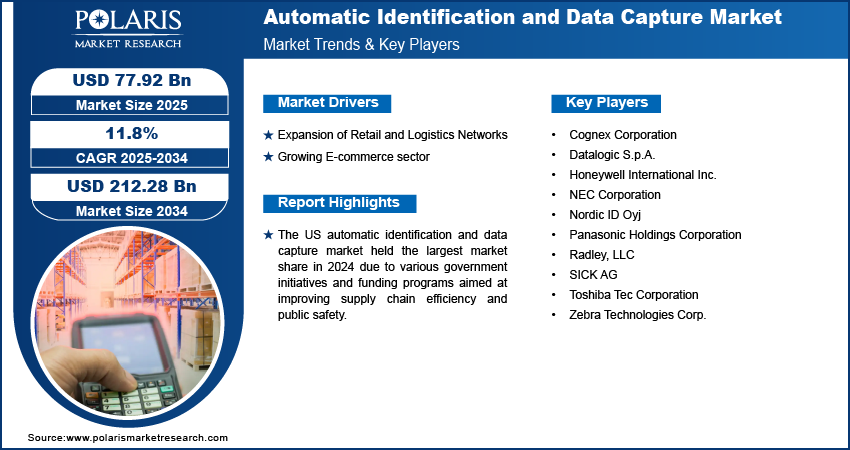
Segment Analysis
Market Assessment by Component
Based on component, the automatic identification and data capture market is segmented into hardware, software, and services. The hardware segment led the market with a 58.26% revenue share in 2025. This is because of high demand for hardware devices like barcode scanners, RFID scanners, OCR scanners, smart cards, biometric devices, and rugged handheld computer devices.
Among hardware devices, barcode scanners are still in wide use because they are cost-effective and scalable. RFID readers are becoming popular where the use of line-of-sight scanning is not required, where batches of items need to be scanned simultaneously, and when it comes to asset tracking. Biometric authentication solutions and smart cards have niche applications but are becoming more significant.
The software segment is forecasted to gain strategic significance as the need to turn gathered information into intelligence grows. The software layers enable better management of device connectivity, integration of AIDC information into corporate information systems, and automation, analysis, and decision-making processes. With AI and cloud orchestration gaining in importance, the AIDC software market value capture will grow further.
The services segment includes integration, installation, support, and maintenance. The AIDC services market remains significant as many organizations need specialized assistance with implementing solutions, developing middleware, conducting system training, and managing system performance.
Market Evaluation by End User
Based on end user, the automatic identification and data capture market segmentation includes manufacturing, retail, transportation & logistics, hospitality, BFSI, healthcare, government, and others. The retail segment is expected to witness the highest CAGR of 12.3% during the forecast period. There is an increasing demand for AIDC solutions from retailers in order to enhance their inventory management, streamline replenishment processes, eliminate bottlenecks in checkouts, facilitate self-service, and enhance customer experience programs. Data collection through AIDC devices also helps in customer analytics and engagement.
AIDC in manufacturing solutions can facilitate part tracking, production process visibility, quality assurance, and asset tracking. These use cases are in line with smart factory and Industry 4.0 aspirations.
For transportation and logistics, AIDC solutions facilitate applications such as shipment tracking, proof of delivery, package routing, yard management, and warehouse operations. This segment benefits from rising global trade volumes and complex order fulfillment requirements.
AIDC in BFSI is used for use cases such as check processing, identity verification, access security, branch documentation, and payments. Even though it may not be the most visible use case within AIDC applications, it continues to be relevant in document-driven and highly regulated industries.
The healthcare sector employs AIDC solutions to enhance patient safety and medication accuracy, sample processing, and equipment utilization. The above AIDC in healthcare applications become more important as health systems work on improving their performance.
Government sectors utilize AIDC technology for managing identities and access, infrastructure monitoring, document scanning, and process automation.
Source: Polaris Market Research Analysis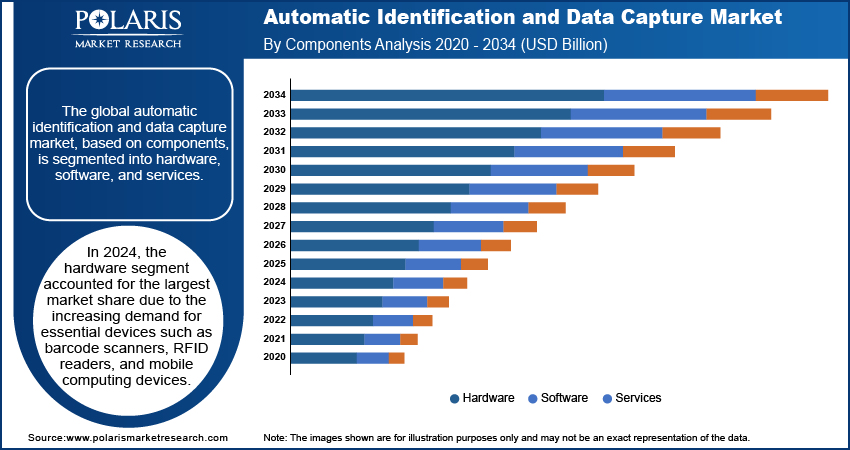
Regional Analysis
By region, the automatic identification and data capture market is segmented into North America, Europe, Asia Pacific, Latin America, and the Middle East & Africa. The North America AIDC market led with a revenue share of 49.80% in 2025. This is because of the well-developed infrastructure of enterprises, widespread adoption of technology, and extensive use of AIDC technology solutions in industries like retail, healthcare, logistics, and manufacturing. The existence of large players in the market, strong IT budget allocations from enterprises, and increased demand for optimized supply chains all help establish the region’s dominant market position.
The US AIDC market accounted for the largest share in North America in 2025. Public-sector funding programs, technology modernization initiatives, and healthcare digitization contribute to market growth in the U.S. Strong e-commerce penetration is also driving sustained demand for AIDC solutions nationwide.
In North America, there is also a robust regulatory framework that applies to industries such as the pharmaceutical, food, and healthcare industries, where traceability and accuracy are important. It therefore ensures continuous investment in technologies such as barcodes, RFID, and more.
Asia Pacific is projected to witness the fastest CAGR of 12.6% during the forecast period. The rising industrialization, increase in organized retailing, digitalization, and e-commerce are some of the main reasons for the growing adoption of AIDC technology in the region. Investment in logistics and manufacturing industries will further fuel the prospects for the market over the coming years.
The China AIDC market is projected to witness substantial growth in the coming years, driven by factors such as urbanization, infrastructure development, large logistics needs, and industrial automation. China's established manufacturing sector and retail operations provide an excellent environment for AIDC implementation.
India is also expected to be an important market for growth due to the expansion of its retail sector, the digitization of its payment systems and identification methods, improvements in its logistics infrastructure, and investments in health care and public infrastructure development.
In Europe, implementation is being facilitated by automated industry processes, tracking and tracing capabilities, product quality control, and security identification systems. This market is still important for high-end manufacturing and compliance-driven deployments.
Latin America and the Middle East & Africa are projected to witness moderate growth, driven by retailers, logistics companies, and government institutions' efforts to improve data capture technologies and enhance tracking capabilities.
Source: Polaris Market Research Analysis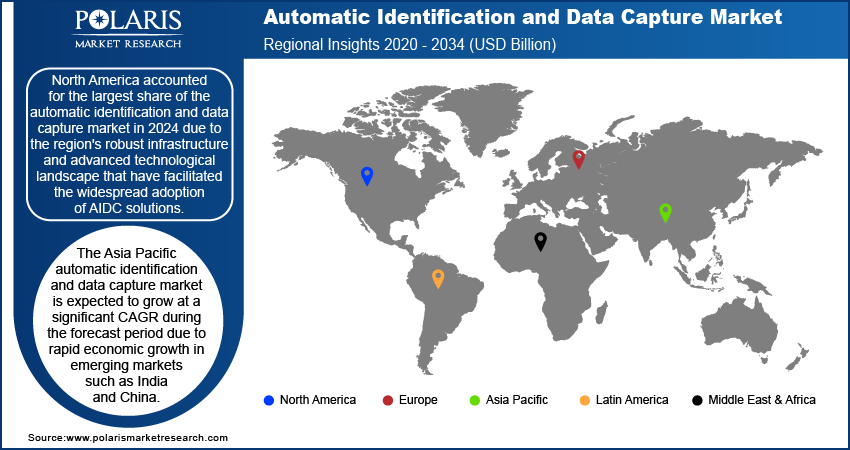
Competitive Landscape
The competitive landscape of the automatic identification and data capture market is dynamic. It encompasses large multinationals and firms specializing in solutions for particular markets. Major AIDC companies compete on reliability, read rates, connectivity, software capabilities, and customization. A few major players include Cognex Corporation; Datalogic S.p.A.; Honeywell International Inc.; NEC Corporation; Nordic ID Oyj; Panasonic Holdings Corporation; Radley, LLC; SICK AG; Toshiba Tec Corporation; and Zebra Technologies Corp.
Competition is also increasingly defined by an organization’s capability to offer integrated solutions rather than just the devices themselves. Firms that have integrated hardware, software, analysis capabilities, cloud connectivity, and industry workflow expertise are expected to gain a competitive advantage in the coming years.
The automatic identification and data capture market is also benefiting from alliances formed by hardware companies, software vendors, system integrators, and industrial automation providers. Such alliances assist in boosting compatibility, accelerating implementation, and integrating AIDC data across enterprises.
Honeywell International Inc. develops bar code scanners, mobile computers, and RFID systems to ensure reliable and fast capturing of data. Honeywell AIDC products are widely used by retailers, hospitals, and logistics companies because accuracy and speed are critical to their daily operations.
Panasonic Holdings Corporation manufactures durable mobile computers and barcode readers for rugged environments. Panasonic AIDC equipment is sturdy and reliable, helping companies streamline their processes.
List Of Key Companies
- Cognex Corporation
- Datalogic S.p.A.
- Honeywell International Inc.
- NEC Corporation
- Nordic ID Oyj
- Panasonic Holdings Corporation
- Radley, LLC
- SICK AG
- Toshiba Tec Corporation
- Zebra Technologies Corp.
AIDC Industry Developments
May 2025: Identiv and InPlay Technology announced co-development of BLE-enabled smart labels for high-value logistics applications. According to Identiv, these labels target cold-chain compliance and asset tracking. (Source: identiv.com)
Why This Market Matters to Buyers?
From a buyer’s perspective, AIDC technology isn’t only a matter of automating existing scanning functions. It is becoming more of a need to create an operational data layer that provides faster, more accurate, more traceable, and more responsive enterprise operations. Companies embracing AIDC solutions adoption aim to achieve specific improvements in areas such as inventory accuracy, order cycle time, patient safety, audit preparation, asset utilization, and labor efficiency.
With further advancements in integrating AI, IoT, analytics, and cloud into AIDC technology, buying considerations will no longer be limited to device quality but will also include interconnectivity, software scalability, installation capabilities, and maintenance provisions.
Market Segmentation
By Component Outlook (Revenue – USD Billion, 2021–2034)
- Hardware
- RFID Reader
- Barcode Scanner
- Smart Cards
- Optical Character Recognition Devices
- Biometric Systems
- Others
- Software
- Services
- Integration & Installation Services
- Support & Maintenance Services
By End User Outlook (Revenue – USD Billion, 2021–2034)
- Manufacturing
- Retail
- Transportation & Logistics
- Hospitality
- BFSI
- Healthcare
- Government
- Others
By Regional Outlook (Revenue, USD Billion, 2021–2034)
- North America
- US
- Canada
- Europe
- Germany
- France
- UK
- Italy
- Spain
- Netherlands
- Russia
- Rest of Europe
- Asia Pacific
- China
- Japan
- India
- Malaysia
- South Korea
- Indonesia
- Australia
- Vietnam
- Rest of Asia Pacific
- Middle East & Africa
- Saudi Arabia
- UAE
- Israel
- South Africa
- Rest of Middle East & Africa
- Latin America
- Mexico
- Brazil
- Argentina
- Rest of Latin America
Automatic Identification and Data Capture Market Report Scope
| Report Attributes | Details |
| Market Size in 2025 | USD 77.92 billion |
| Market Size in 2026 | USD 87.03 billion |
| Revenue Forecast by 2034 | USD 212.28 billion |
| CAGR | 11.8% |
| Base Year | 2025 |
| Historical Data | 2021–2024 |
| Forecast Period | 2026–2034 |
| Quantitative Units | Revenue in USD billion, and CAGR from 2026 to 2034 |
| Report Coverage | Revenue Forecast, Market Competitive Landscape, Growth Factors, and Trends |
| Segments Covered |
|
| Regional Scope |
|
| Competitive Landscape | Automatic Identification and Data Capture Industry Trend Analysis (2025) Company profiles/industry participants profiling include company overview, financial information, product/service benchmarking, and recent developments |
| Report Format | PDF + Excel |
| Customization | Report customization as per your requirements with respect to countries, regions, and segmentation. |
Source: Polaris Market Research Analysis
Automatic Identification and Data Capture Market FAQ's
The market was valued at USD 77.92 billion in 2025. It is projected to reach USD 212.28 billion by 2034.
The market for AIDC is primarily driven by rising automation in retail, healthcare, and manufacturing. The market is also benefiting from increasing regulatory traceability requirements.
AIDC includes barcode scanners, RFID systems, optical character recognition devices, smart cards, biometric systems, and mobile computing devices. These technologies are used to identify objects or people and capture data automatically.
The hardware segment led the market in 2025. This is because barcode scanners, RFID readers, and rugged mobile computers remain the core devices used in operational data capture.
The retail segment is anticipated to register the fastest growth. This is due to increased demand for inventory visibility and checkout automation.
Some of the major barriers are high costs for setting up systems, issues with software compatibility, and integrating old systems into new ones. Cybersecurity challenges are also among the challenges faced.
North America leads the market due to advanced infrastructure and strong enterprise technology adoption.
AI is improving barcode recognition and OCR accuracy. It is helping AIDC systems move from simple data capture to intelligent decision support.
AIDC supports patient identification, medication safety, and specimen tracking. These capabilities help healthcare providers reduce errors and improve operational efficiency.
Download Sample Report of Automatic Identification and Data Capture Market
Please fill out the form to request a customized copy of the research report.


