
Behavior Analytics Market Size, Share, Trends & Forecast, 2026–2034
REPORT DETAILS
Behavior Analytics Market Summary
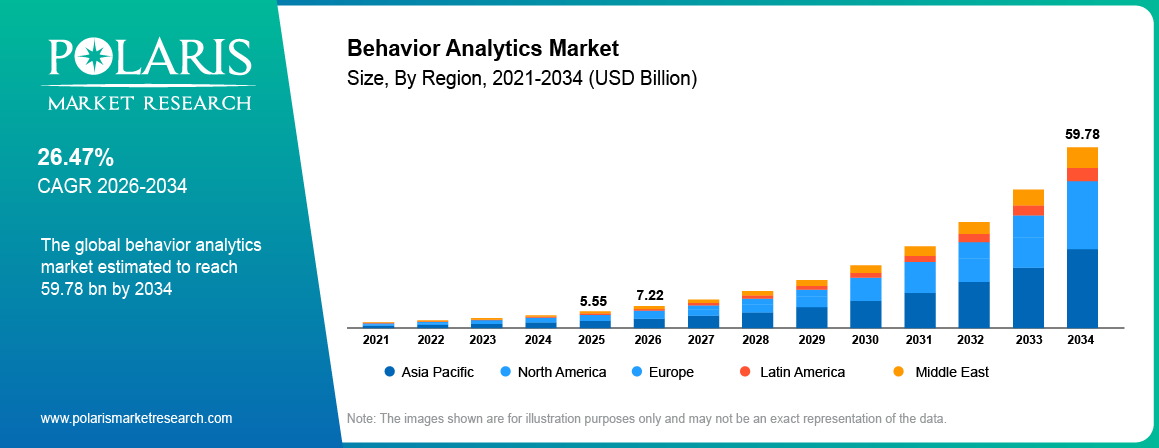
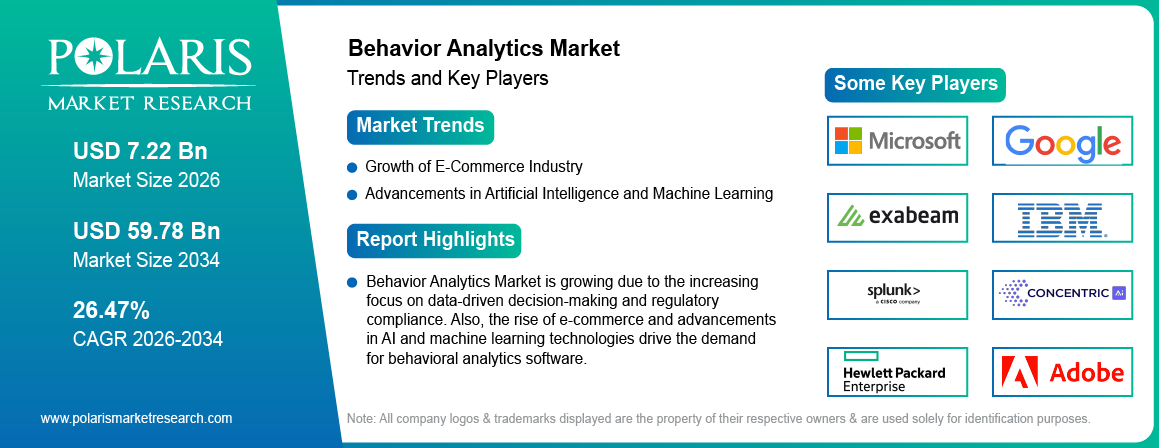
The global behavior analytics market size was valued at USD 5.55 billion in 2025, exhibiting a CAGR of 26.47% from 2026 to 2034. The market is growing due to the increasing focus on data-driven decision-making and regulatory compliance. Also, the rise of e-commerce and advancements in AI and machine learning technologies drive the demand for behavioral analytics software.
Market Statistics
Behavior Analytics Market Key Takeaways
- North America holds the largest market share of 36.9% in 2025, driven by major players in the region, fostering innovation through advanced technologies and digital transformation.
- The Asia Pacific market is projected to grow rapidly with a CAGR of 29.4% during the forecast period, driven by increased investments in cybersecurity and the rising need for advanced analytics solutions to detect anomalies and protect data.
- The India behavior analytics market is expected to record a CAGR of 30.2% during the projected period. The growth is driven by the rapid expansion of its e-commerce industry.
- The services segment in the behavior analytics market is expected to grow at a CAGR of 25.47% due to rising demand for consulting, implementation, and ongoing support services to optimize user engagement and customer experience.
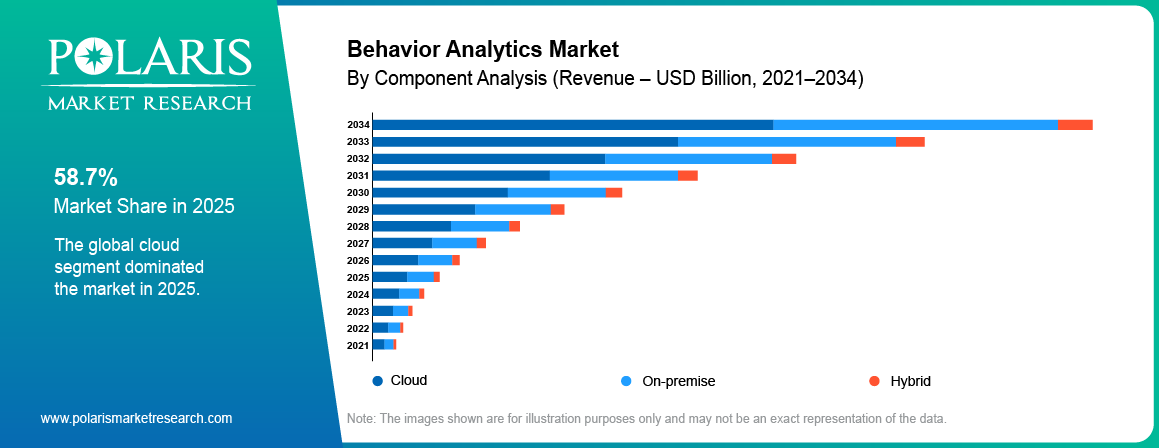
- Cloud deployment is predicted to dominate the behavior analytics market with a 58.7% share, due to its scalability, cost-effectiveness, real-time analytics capabilities, and enhanced data security and compliance.
Note: Figures and projections outlined in this report are the result of Polaris Market Research’s proprietary analytical processes, grounded in the latest available datasets and market observations
What is Behavior Analytics?
Behavior analytics refers to the set of processes that gather, analyze, and report information about the behaviors of objects, users, or customers. Usually, this data is collected through users’ digital footprints in websites, apps, and enterprise software. Through AI, machine learning, and data-mining algorithms, behavior analytics tools can detect patterns and deviations from the norm. It helps enterprises prevent fraud and insider attacks, improve cybersecurity performance, and better personalize the user experience.
In broad terms, behavioral analytics refers to the processes and techniques used to record and analyze system or human behavior. It involves recognizing patterns and irregularities to improve technologies, expose threats, and improve other functions. From a security perspective, the concept is applied in user and entity behavior analytics (UEBA) to detect unusual activities and mitigate risks in enterprise systems.
How Does Behavior Analytics Work?
Behavior analytics collects and studies user activity data. It tracks actions such as logins, file access, searches, and system usage. The system learns what normal behavior looks like for each user. It then compares new activity with this normal pattern. If it finds unusual activity, it creates an alert. This helps businesses detect threats, fraud, and misuse early. Behavior analytics uses data from systems, devices, applications, and networks. It helps security teams understand risks and take action quickly.
Behavior Analytics vs Traditional Analytics
| Dimension | Behavior Analytics | Traditional Analytics |
| Focus | User and entity actions, interactions, and patterns | Historical, structured transactional data |
| Timing | Real-time to near-real-time; predictive | Retrospective; periodic reporting |
| Primary use | Anomaly/fraud/insider-threat detection, personalization | Trend reporting, financial and operational summaries |
| Data sources | Clickstream, session logs, network/access logs, app telemetry | Sales, ERP, CRM, and financial records |
| Typical buyer | Security operations, fraud/risk teams, CX/marketing teams | Finance, operations, BI teams |
Source: Polaris Market Research Analysis
The rising focus on data-driven decision-making is fueling the behavior analytics market expansion. Organizations across various sectors are realizing the importance of using data to shape their strategies, streamline operations, and enhance customer experiences. By gaining valuable insights into user interactions, preferences, and trends, businesses can make well-informed decisions that drive growth. The data-driven approach also allows companies to pinpoint what resonates with their audiences, customize their marketing strategies, and enhance product offerings based on real-time data. The demand for behavior analytics solutions is also increasing as more organizations prioritize data literacy and invest in advanced analytics tools.
The growing focus on regulatory compliance and risk management is driving the behavior analytics market development. As industries face stricter data privacy and security regulations, organizations are increasingly turning to behavior analytics to monitor user activity and ensure compliance. By analyzing behavioral patterns, businesses can detect anomalies, prevent fraud, and identify potential compliance breaches before they escalate. This proactive approach not only mitigates risks but also builds trust with customers and stakeholders.
AI Impact on Behavior Analytics Market
- AI significantly enhances the ability to process and analyze large volumes of behavioral data, providing deeper insights into user patterns.
- Machine learning algorithms allow for more accurate predictions of user behavior, enabling businesses to tailor strategies and improve customer experiences.
- AI security operations can automate the identification of anomalies, helping businesses detect fraud or compliance issues more efficiently.
- AI enables more personalized customer interactions by identifying individual preferences and behaviors, which helps companies refine their marketing and product offerings.
- AI behavior analytics reduces the time required for data analysis, allowing companies to make real-time, data-driven decisions that accelerate growth.
Market Dynamics
Driver: Growth of E-Commerce Industry
As e-commerce platforms expand, they are increasingly relying on behavior analytics to analyze customer interactions and preferences. This data-driven approach enables businesses to refine their marketing strategies and effectively promote relevant products to their target audiences. For instance, according to the U.S. Census Bureau, in the second quarter of 2026, USD 340.2 billion worth of retail e-commerce sales were recorded in the U.S. alone, which was 3.8% growth compared to the first quarter of the same year. As e-commerce continues to grow, the demand for advanced behavior analytics tools will rise. Companies use behavior analytics to improve customer experiences, enhance retention rates, and drive sales through more personalized offerings. Thus, the growth of the e-commerce industry is expected to boost the behavior analytics market revenue (Source: census.gov).
Driver: Advancements in Artificial Intelligence and Machine Learning
With artificial intelligence (AI) and machine learning (ML) technologies, organizations are able to analyze large amounts of behavioral data more efficiently and accurately, leading to enhanced insights. For instance, according to the Applied Behavior Analysis Organization, AI identifies patterns in user behavior that human analysts may overlook. In applied behavior analysis (ABA), AI and ML are revolutionizing therapeutic practices, helping professionals engage children with autism using robots to stimulate interaction. A study by the University of Southern California demonstrated that these technologies effectively re-engaged children when their attention waned, showcasing their potential to enhance social skills. As AI and ML continue to evolve, their integration into behavior analytics will improve personalization, efficiency, and accessibility, particularly for underserved populations, driving the behavior analytics market demand in the coming years.
Driver: Cybersecurity Threats and Insider Risk
Companies are increasingly adopting behavior analytics with rising cybersecurity threats. Organizations are witnessing a significant rise in spear-phishing attacks, credential theft, malware infections, and other irregular user activities. Additionally, insider risk, where employees or contractors intentionally or unintentionally disclose sensitive information, remains a crucial security concern. Behavior analytics enable firms to detect irregular behaviors that occur and thus facilitate faster threat response and mitigation. As businesses witness a surge in cyberattacks, firms are investing in advanced behavior analytics to detect hidden threats, thereby driving the industry growth.
Driver: Growing Adoption of Cloud and Digital Services
Companies are adopting digital platforms and migrating activities to the cloud. The creates base for analytics as businesses generate more data concerning users’ activities on these digital services. Moreover, businesses require better protection and monitoring tools to safeguard the vast amount of data. Traditional analytics solutions are insufficient to reveal non-compliant behaviors in the use of digital services. Behavior analytics offer better protection by helping firms detect anomalous patterns of users, computers, and applications, thereby driving the market demand.
Restraint: Rising Data Privacy Concerns
The concern related to data privacy is limiting the industry growth. The solutions produce insights by analyzing data concerning users’ activities. However, companies are often reluctant to adopt these technologies because they fear data misuse or inadequate protection under privacy laws. Restraints such as legal and regulatory barriers limit the free flow and use of data between organizations. These factors slows down the adoption. Besides, analytics firms need to invest in advanced solutions to guarantee data privacy and security, especially when dealing with sensitive data. This increases the upfront cost and thereby restrains industry growth.
Restraint: Integration Complexity with Legacy Systems
Modern technology firms operate in an environment where legacy systems co-exist with new solutions. Legacy systems pose a significant challenge in the integration process. Thus, organizations have to invest more in integration technologies. The process requires a skilled workforce, and hence firms have to spend more on hiring experts who can handle the procedures. Some organizations might be hesitant to adopt the technologies because of the high capital investment needed in integration. The migration to cloud-based platforms further presents a significant challenge in the operations, especially when the two systems are not compatible, thereby restraining the growth.
Opportunity: Identity-Centric/Zero-Trust Security Adoption
The rising trend of adopting an identity-centric approach and zero-trust security presents opportunities for the behavior analytics market. Organizations have been reluctant to adopt zero-trust security because of the complexity involved and the resources it requires. However, as security concerns rise, firms are investing in solutions that better protect sensitive information. Zero-trust security assumes every user or machine is a threat unless proven otherwise. Thus, it requires organizations to implement stricter security measures and offer continuous protection. Behavior analytics provides insights into users’ behaviors and helps detect irregular activities. As a result, companies are investing more in the adoption of zero-trust security to help protect their data.
Customer Behavior Analytics Applications
| Application | Description | Typical Data Analyzed | Business Value |
| Customer journey and experience optimization | Tracks customer interactions across websites, mobile apps, stores, contact centers, and other touchpoints to identify friction, drop-off points, and service gaps. | Clickstream data, session recordings, navigation paths, transaction history, support interactions, and customer feedback | Improves customer experience, reduces abandonment, and supports smoother omnichannel journeys. |
| Personalization and recommendation | Uses individual and segment-level behavior to deliver relevant products, content, advertisements, messages, and next-best actions. | Browsing history, purchase behavior, search activity, demographic data, engagement history, and stated preferences | Increases engagement, conversion rates, cross-selling, and customer relevance. |
| Churn prediction and retention | Identifies customers whose declining engagement, reduced purchases, complaints, or service issues indicate a risk of leaving. | Purchase frequency, usage decline, cancellation activity, complaints, service tickets, renewal history, and satisfaction scores | Enables proactive retention campaigns, improves customer loyalty, and reduces revenue loss. |
| Conversion and campaign optimization | Analyzes how customers respond to marketing campaigns and where prospects abandon the purchase or application process. | Campaign exposure, email and advertisement engagement, landing-page activity, funnel progression, cart abandonment, and conversion data | Improves campaign effectiveness, increases conversion rates, and optimizes marketing expenditure. |
| Fraud, anomaly, and suspicious behavior detection | Detects unusual transaction or interaction patterns that may indicate fraud, account takeover, abuse, or other anomalous activity. | Transaction history, login behavior, device information, location, payment activity, network usage, and behavioral deviations | Strengthens fraud prevention, reduces financial losses, and improves security response. |
Source: Polaris Market Research Analysis
Segment Insights
Market Assessment Based on Component
The behavior analytics market, based on component, is segmented into solution and services. The services segment is expected to experience significant growth with a higher CAGR of 25.47% from 2026 to 2034. This growth is driven by the increasing demand for consulting, implementation, and ongoing support services that help organizations effectively leverage behavior analytics tools. Businesses seek to optimize user engagement and enhance customer experiences. Thus, expert guidance in data analysis, strategy development, and technology integration becomes critical. Additionally, training and maintenance services are essential for maximizing the value of behavior analytics solutions, boosting the growth of the services segment in the global market.
Market Evaluation Based on Deployment
The behavior analytics market, based on deployment, is segmented into cloud, on-premise, and hybrid. The cloud segment dominated the behavior analytics market share with 58.7% in 2025 due to the advantages of scalability, cost-effectiveness, and easy accessibility offered by cloud-based solutions. Organizations increasingly prefer cloud deployments for their ability to handle large volumes of data, facilitate real-time analytics, and support collaboration across teams. Additionally, cloud solutions enhance data security and compliance, resulting in increased demand for cloud services.
The hybrid deployment is expected to witness a CAGR of 27.2% during the forecast period. It combines cloud-based and on-site systems. It gives businesses more control over sensitive data while also providing cloud flexibility. This model is useful for organizations with existing IT systems. Demand is growing as companies want to modernize security without fully moving away from their current infrastructure.
Market Evaluation Based on Application
The behavior analytics market, based on application, is segmented into customer engagement, brand promotion, workforce optimization, threat detection and prevention. The threat detection and prevention segment dominated the behavior analytics market share with 42.8% in 2025. There is a need to adopt behavior analytics solutions to detect threats at the earliest stage with the increasing occurrence of cyber-attacks. Businesses stay protected by detecting anomalous behavior in their employees or users. The rising number of businesses working from remote places and the adoption of cloud-based services has led to a significant amount of data being vulnerable to cyber-attacks. Thus, the need for businesses to protect themselves from threats and vulnerabilities is rising, which is driving the demand for behavior analytics solutions for threat detection and prevention.
Market Evaluation Based on End User
The behavior analytics market, based on end use, is segmented into retail and e-commerce, BFSI, healthcare, IT and telecom, energy and utilities, government and defense, and others. The IT and telecom segment dominated with 28.6% market share in 2025, as IT and telecom companies carry out complex operations that involve a large amount of data and information. These organizations require a strong and reliable network that protects users’ data from unauthorized access. Increasing cyber-crimes and data breaches have prompted companies to invest in behavior analytics solutions. The rising adoption of cloud-based services and remote working has further increased the risk of cyber-attacks and data theft. Thus, with the growing need for protection from network attacks and threats, the IT and telecom sector is adopting behavior analytics solutions at a high rate.
Real-World Use Cases
| Application | Named organization and use case | Behavioral data or analytics used | Reported outcome |
| Fraud and insider-fraud detection behavior analytics | Fortune 500 bank used behavior analytics to identify employees misusing sensitive customer-account information. | Employee access patterns, application activity, customer-record searches, data copying, and suspicious user actions. | Helped detect insider data misuse, strengthen threat intelligence, protect information relating to 40 million customers, and support regulatory compliance. |
| Insider-threat and data-exfiltration detection | Goldguard Holdings used UEBA solutions to identify abnormal employee activity involving dormant customer accounts and account notifications. | Database queries, account-access frequency, notification changes, and deviations from normal activity patterns. | Helped detect suspected money-laundering behavior conducted through legitimate credentials and authorized applications. |
| E-commerce personalization | MECCA deployed machine-learning models to generate personalized product recommendations across its product catalogue and marketing campaigns. | Customer purchase history, browsing behavior, engagement patterns, product preferences, and campaign interactions. | Generated more than 10 million product recommendations weekly and outperformed the company’s previous recommendation system. |
| Personalized product discovery | Snoonu used real-time behavioral signals and recommendation models to personalize product discovery while considering product availability. | User interactions, cart behavior, browsing activity, recommendation responses, and inventory availability. | Reported a 1,600% increase in grocery add-to-cart events from cart recommendations. Recommended products contributed 30% of basket size in orders containing at least one recommendation. |
| Workforce monitoring and productivity analytics | BRMS used workforce behavior analytics during its transition to a hybrid work model to assess productivity and employee work patterns. | Login times, active hours, application usage, remote-work activity, and productive versus non-productive time. | Improved visibility into productivity trends, supported resource planning, and helped avoid unnecessary hiring costs. |
| OTT content recommendation | SK Broadband’s B tv A.dot used generative artificial intelligence and conversational behavior analysis to help viewers discover relevant content. | Content searches, viewing preferences, user queries, and responses to AI-generated recommendations. | Reached 1.7 million monthly active users, with 55% of customers who searched for content through AI subsequently selecting content based on the AI response. |
Source: Polaris Market Research Analysis
Regional Analysis
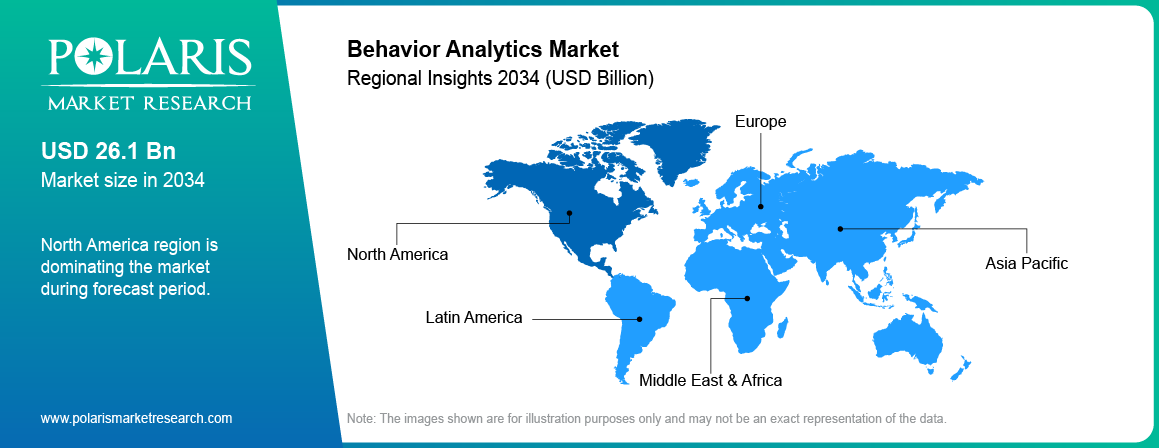
By region, the study provides behavior analytics market insights into North America, Europe, Asia Pacific, Latin America, and the Middle East & Africa. North America led the behavior analytics market share by region by holding 36.9% in 2025, driven by the presence of major players in the region. The leading companies leverage advanced technologies and extensive research and development capabilities to drive innovation in behavior analytics solutions. This competitive landscape drives innovation, enabling businesses to use data-driven insights to improve customer engagement. Additionally, the region benefits from a strong focus on digital transformation across various industries, speeding up the adoption of behavior analytics tools.
The Asia Pacific behavior analytics market is projected to register a substantial CAGR of 29.4% during the forecast period due to increasing investments in cybersecurity analytics. As businesses across various sectors prioritize data protection and compliance, the demand for advanced analytics solutions that monitor user behavior and detect anomalies is growing. Governments and organizations are recognizing the critical need to safeguard sensitive information, leading to heightened spending on cybersecurity initiatives. This focus enhances security measures and fosters a greater understanding of user interactions, enabling companies to tailor their offerings effectively.
The India behavior analytics market is experiencing significant growth at a CAGR of 30.2%, driven by the rapid expansion of its e-commerce industry. With the increasing popularity of online shopping, businesses are using behavior analytics to understand customer preferences, enhance user experience, and boost sales. The rise in internet penetration and smartphone usage has further accelerated this trend, allowing companies to collect and analyze large amounts of data. According to the Our World in Data, 70% of the Indian population has internet access as of 2025. This high internet penetration is fueling the demand for behavior analytics solutions (Source: ourworldindata.org)
The Europe behavior analytics market is expected to witness growth of CAGR 25.1% during the forecast period. It is fueled by the increasing need for cybersecurity and the need to address data security and privacy regulations. The number of organizations that handle customers’ and businesses’ sensitive information is rising which has increased the demand for behavior analytics. This is mainly deployed to prevent and stop cyber-attacks, especially with the rising use of cloud services and remote work and the heightened need for data security. Moreover, financial services, healthcare, IT organizations, and others are adopting behavior analytics to detect and respond to anomalous activity and insider threats. Furthermore, the growing need for zero-trust network security is expected to propel the demand for behavior analytics in the region.
The market in Latin America is expected to witness growth of CAGR 24.3% during the forecast period. The growth is attributed to the growing need for cybersecurity and the need to secure digital transformation. Companies in the region are adopting cloud platforms, online services, and digital payments on a large scale, increasing insider threats and the need to secure users’ data. Moreover, the growing awareness of insider threats and cybersecurity risks is expected to increase the demand for behavior analytics in the region. Additionally, banks, telecom organizations, large enterprises, and others are adopting cybersecurity software to ensure total data security, which is anticipated to drive the Latin America behavior analytics market expansion.
The Middle East and Africa behavior analytics marketis expected to record a CAGR of 23.6% during the forecast period. It is fueled by the growing number of smart city projects and a rising number of digital transformation initiatives. The rising investments in connected infrastructure and systems by governments to empower their communities digitally provide a favorable environment for the regional market development. Further digitalization of financial services is expected to drive demand for analytics solutions to monitor and detect anomalous transaction behavior across the region. Moreover, an increase in investment in cybersecurity by key industries is contributing to the market growth.
Competitive Insights
The behavior analytics market is constantly evolving, with numerous companies striving to innovate and distinguish themselves. Leading global corporations dominate the market by leveraging extensive research and development, advanced software technologies, and significant capital to maintain a competitive edge. These companies pursue strategic initiatives such as mergers, acquisitions, partnerships, and collaborations to enhance their product offerings and expand into new markets.
New companies are impacting the market by introducing advanced solutions and catering to the specific needs of users. This competitive environment is amplified by continuous progress in product offerings, greater emphasis on sustainability, and the rising requirement for tailor-made products in diverse industries.
List of Major Behavior Analytics Companies
- Adobe Inc.
- Cisco Systems, Inc (Splunk Inc.)
- Concentric AI
- Exabeam
- Hewlett Packard Enterprise
- IBM Corporation
- Microsoft Corporation
- NTT Data Corporation
- Oracle Corporation
- Qmulos
- Qualtrics
- SAP SE
- Securonix
- ServiceNow
- TIBCO Software Inc.
- Varonis Systems Inc.
Vendor Positioning / Competitive Benchmarking
| Rank | Company | Segment Focus | Primary Market Positioning | Core Offerings | Key Strengths / Differentiators |
| 1 | Microsoft Corporation | Security + Identity | Platform-led leader embedding behavior analytics across cloud SIEM, identity and endpoint security | Microsoft Sentinel (UEBA), Entra ID Protection, Defender suite, Purview insider risk | Massive installed base, native Azure/M365 telemetry, integrated AI (Security Copilot), bundled licensing advantage |
| 2 | Cisco Systems, Inc. (Splunk Inc.) | Security + Observability | Enterprise SIEM/analytics incumbent; Splunk now part of Cisco, combining network and security telemetry | Splunk Enterprise Security, Splunk UBA / behavioral analytics, Cisco XDR and network visibility | Deep data-ingestion and search heritage, large SOC user base, network + security data convergence post-acquisition |
| 3 | IBM Corporation | Security | UEBA delivered within QRadar SIEM/Security Suite for enterprise threat detection | QRadar SIEM, QRadar User Behavior Analytics, IBM Security services | Strong regulated-industry footprint (BFSI, government), consulting + managed services reach, AI-assisted detection |
| 4 | | Security + Web/Product Analytics | Cloud-native security analytics at scale plus dominant digital behavior analytics through analytics products | Google Security Operations (Chronicle), Mandiant threat intel, Google Analytics | Planet-scale data processing, threat-intelligence depth (Mandiant), unmatched web/app behavioral data reach |
| 5 | Adobe Inc. | Customer / Digital Experience | Customer-journey and digital behavior analytics for marketing and experience optimization | Adobe Analytics, Customer Journey Analytics, Experience Platform | Enterprise marketing-cloud incumbency, real-time customer data platform, strong personalization integration |
| 6 | Oracle Corporation | Enterprise Data + CX | Behavior-informed data integration and analytics across the Oracle cloud and applications stack | Oracle Analytics, Oracle Cloud Infrastructure data services, Oracle CX / advertising data | Large enterprise application base, converged database + cloud infrastructure, cross-suite data access |
| 7 | SAP SE | Enterprise Apps + CX | Behavior analytics embedded in ERP, customer experience and business-process applications | SAP Analytics Cloud, SAP Customer Experience, SAP Enterprise Threat Detection | Entrenched ERP customer base, business-process context for behavior signals, analytics embedded in workflows |
| 8 | ServiceNow | Workflow / Data Fabric | Workflow-centric, behavior-informed data fabric and partner ecosystem across IT, security and operations | Workflow Data Fabric, Security Operations, AI Platform and partner integrations | Workflow automation moat, broad enterprise footprint, ecosystem-led data connectivity |
| 9 | Securonix | Security (Pure-play) | Cloud-native UEBA/SIEM with GenAI-powered SOC agents | Securonix Unified Defense SIEM, UEBA, GenAI SOC agents | UEBA-first heritage, cloud-native architecture, agentic AI differentiation |
| 10 | Exabeam | Security (Pure-play) | Behavior-based threat detection and investigation, with timeline-driven SOC analytics | Exabeam New-Scale SIEM, behavioral analytics, Smart Timelines | Recognized UEBA specialist, analyst-workflow focus, combined scale following LogRhythm merger |
| 11 | Varonis Systems Inc. | Data Security | Data-centric security using behavior analytics on data access and permissions | Varonis Data Security Platform, threat detection and response, data classification | Data-access behavior expertise, strong data-security posture story, rapid SaaS shift |
| 12 | Hewlett Packard Enterprise | Network Security | AI-powered network detection and response (NDR) and Zero Trust Network Access | HPE Aruba Networking (NDR, ZTNA), AI-driven network analytics | Network-layer visibility, hardware + software integration, strong campus/edge presence |
| 13 | Qualtrics | Experience Management | Customer- and employee-experience behavior analytics; named a top player in the source report | Qualtrics XM platform, experience analytics, AI-driven text and sentiment analysis | Experience-management category leadership, survey + behavioral data fusion |
| 14 | TIBCO Software Inc. | Data + Analytics | Real-time data integration and analytics infrastructure enabling behavior insight | TIBCO Spotfire, streaming analytics, data virtualization | Strength in streaming and analytics tooling, established enterprise integrations |
| 15 | NTT Data Corporation | IT / Security Services | Services-led delivery of behavior and security analytics for global enterprises | Managed security, analytics consulting and systems integration | Global systems-integration reach, vertical expertise, strong in Asia-Pacific and Japan |
| 16 | Concentric AI | Data Security Posture | Context-driven behavior analytics for data security posture management | Semantic Intelligence platform (AI-based data discovery and risk analytics) | AI-driven data context, agile challenger in DSPM, lower deployment friction |
| 17 | Qmulos | Compliance / Audit | Compliance-focused user behavior analytics and audit platform (Q-BA2) | Q-BA2, Q-Compliance, continuous monitoring solutions | Federal and compliance-driven use cases, audit-ready analytics |
Source: Polaris Market Research Analysis
Behavior Analytics Industry Developments
- September 2026: Futurism AI launched its AI-powered Behavioral Analytics solution. The solution analyzes customer activity across websites, apps, and digital channels. It can identify behavior patterns, understand customer intent, monitor trends, and improve personalization. The platform used AI and machine learning. (Source: issuewire.com)
- September 2026: Quantum Metric launched its Voice of Customer solution. The solution connected customer feedback with behavioral data. It helped enterprises understand customer issues, measure their impact, and take action in real time. The platform also supported personalized experiences and faster issue resolution. (Source: globenewswire.com)
- July 2026: Abnormal AI launched three new behavioral security products. The products focused on identity threats, AI governance, and infiltration prevention. They used behavioral analysis to detect unusual activity, assess risks, and help security teams respond to threats across users, AI tools, and hiring processes. (Source: enterprisetimes.co.uk)
- September 2026: Fable Security launched Briefing Agent. The AI agent turned emerging threats into targeted employee security training within minutes. It used behavioral signals to identify at-risk employees and delivered tailored guidance through email, Slack, or Teams to reduce risky behavior. (Source: businesswire.com)
Future Outlook
As per our behavior analytics market forecast, the market is expected to grow rapidly in the coming years. Businesses face growing cybersecurity risks and more complex digital environments. Thus, companies are expected to increase spending on tools that monitor user activity and detect unusual behavior. The adoption of cloud services, artificial intelligence, and zero-trust security will further support market growth. Behavior analytics solutions are also expected to become easier to use and more automated. Growing demand for faster threat detection and stronger data protection will create new opportunities for market players.
Research Methodology
- Market estimates are derived using a blend of primary and secondary research, validated through weighted-average and combined top-down/bottom-up modeling approaches.
- Secondary research covers vendor filings, cybersecurity and customer analytics investment data, data privacy and compliance regulations, industry journals, and paid third-party databases to build baseline estimates.
- Primary research includes interviews with key industry participants such as behavior analytics solution providers, cybersecurity analysts, IT security officers, and marketing technology professionals, to validate accuracy and capture forward-looking insights.
- Base year considered is 2025, with a forecast provided through 2034; revenues are expressed in USD Billion.
- Parent market is identified as the global business intelligence and analytics software market; the addressable segment is narrowed using behavior analytics adoption rates across security, marketing, and customer experience applications.
- Bottom-up model aggregates regional behavior analytics demand across component, organization size, deployment, application, and end user, validated against vendor revenue disclosures from Splunk, IBM, Microsoft, Varonis Systems, Securonix, and others.
- Regional coverage spans North America, Europe, Asia Pacific, Middle East & Africa, and Latin America, further segmented by major countries.
- Projected 26.47% CAGR (2026–2034) reflects weighted analysis of rising insider threat and fraud detection needs, growing adoption of AI-driven customer engagement tools, expanding regulatory compliance requirements, and increasing enterprise investment in cybersecurity and digital marketing analytics.
- Findings are cross-validated across multiple estimation methods to ensure consistency, accuracy, and reliability of the final market sizing
Behavior Analytics Market Segmentation
By Component Outlook (Revenue – USD Billion, 2021–2034)
- Solution
- Services
By Organization Size Outlook (Revenue – USD Billion, 2021–2034)
- Large Enterprises
- SMEs
By Deployment Outlook (Revenue – USD Billion, 2021–2034)
- Cloud
- On-Premise
- Hybrid
By Application Outlook (Revenue – USD Billion, 2021–2034)
- Customer Engagement
- Brand Promotion
- Workforce Optimization
- Threat Detection & Prevention
- Risk & Compliance
- IAM
- Customer Experience Management
- Insider Threat Detection
- Cybersecurity & Threat Intelligence
- Advertising Campaign
- Digital Marketing
- Content Delivery
- Others
By End User Outlook (Revenue – USD Billion, 2021–2034)
- Retail and E-commerce
- BFSI
- Healthcare
- IT and Telecom
- Energy and Utilities
- Manufacturing
- Media & Entertainment
- Education
- Government and Defense
- Others
By Regional Outlook (Revenue – USD Billion, 2021–2034)
- North America
- U.S.
- Canada
- Europe
- Germany
- France
- UK
- Italy
- Spain
- Netherlands
- Russia
- Rest of Europe
- Asia Pacific
- China
- Japan
- India
- Malaysia
- South Korea
- Indonesia
- Australia
- Rest of Asia Pacific
- Middle East & Africa
- Saudi Arabia
- UAE
- Israel
- South Africa
- Rest of Middle East & Africa
- Latin America
- Mexico
- Brazil
- Argentina
- Rest of Latin America
Report Scope
| Report Attributes | Details |
| Market Size in 2025 | USD 5.55 billion |
| Market Size in 2026 | USD 7.22 billion |
| Revenue Forecast by 2034 | USD 59.78 billion |
| CAGR | 26.47% from 2026 to 2034 |
| Base Year | 2025 |
| Historical Data | 2021–2024 |
| Forecast Period | 2026–2034 |
| Quantitative Units | Revenue in USD billion and CAGR from 2026 to 2034 |
| Report Coverage | Revenue Forecast, Market Competitive Landscape, Growth Factors, and Trends |
| Segments Covered |
|
| Regional Scope |
|
| Competitive Landscape |
|
| Report End-User |
|
| Customization | Report customization as per your requirements with respect to countries, regions, and segmentation. |
Source: Polaris Market Research Analysis
Behavior Analytics Market FAQ's
The market was valued at USD 5.55 billion in 2025 and is projected to grow to USD 59.78 billion by 2034.
The global market is projected to register a CAGR of 26.47% from 2026 to 2034.
North America had the largest share of the global market in 2025.
A few of the key players in the market are Splunk Inc., IBM Corporation, Microsoft Corporation, Varonis Systems Inc., Google, NTT Data Corporation, SAP SE, Exabeam, TIBCO Software Inc., Oracle Corporation, and Niara Inc.
The services segment is anticipated to experience substantial growth during the forecast period, driven by the increasing demand for consulting, implementation, and ongoing support services that help organizations effectively leverage behavior analytics tools.
The cloud segment accounted for the largest market share of 58.7% in 2025 due to its scalability, cost-effectiveness, real-time analytics capabilities, and accessibility.
The market is driven by rising cybersecurity threats, growing insider risks, increasing cloud adoption, and the need to detect unusual user activity. Businesses are also investing in stronger security systems to protect sensitive data and reduce security risks.
Key challenges include data privacy concerns, high implementation costs, integration with existing systems, and the need for skilled professionals. Businesses also need to manage large amounts of user activity data while meeting data protection requirements.
The growing adoption of identity-centric and zero-trust security creates new opportunities for the market. Behavior analytics can help organizations monitor user activity, identify unusual access patterns, and improve security controls across cloud and digital environments.
Artificial intelligence is helping behavior analytics systems identify unusual activity more quickly and accurately. AI can study large amounts of user data, detect changes in normal behavior, and help security teams respond to potential threats faster.

Download Sample Report of Behavior Analytics Market
Please fill out the form to request a customized copy of the research report.


