
Cloud Seeding Market Share, Size, Trends, Industry Analysis Report, 2022 - 2030
REPORT DETAILS
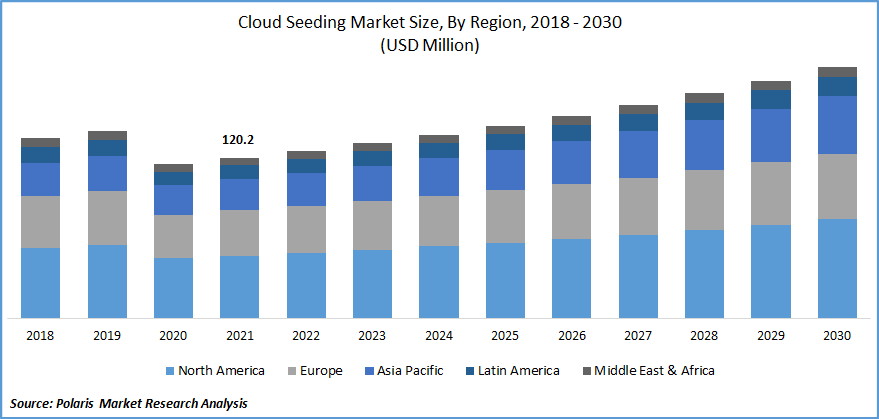
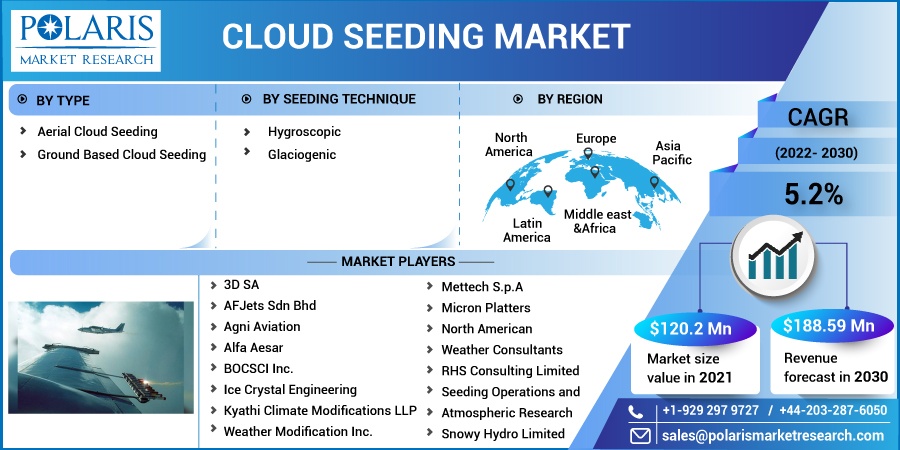
The global cloud seeding market was valued at USD 120.2 million in 2021 and is expected to grow at a CAGR of 5.2% during the forecast period.
The global market is expanding as a result of rising investments in cloud modification programs, the introduction of new technologies, and an increase in demand to reduce environmental hazards. Additionally, the increased use of cloud seeding technology to create artificial rain and keep water levels at a certain level in arid locations opens up new prospects.
Source: Polaris Market Research Analysis
Know more about this report: Download Sample Report
The market is anticipated to be driven by government initiatives, such as boosting the adoption of artificial rainfall technologies to enhance water levels in nations like India. Additionally, governments in China, India, and the United Arab Emirates are investing extensively in weather modification projects, creating tremendous potential for market players to conduct research and introduce new products.
Wide sections of the human population now really worry about water scarcity. More than 2 billion people worldwide are experiencing significant water distress, according to 2019 UN research. According to a Food and Agriculture Organization (FAO) report from 2020, 3.2 billion people live in agricultural areas that experience moderate to severe water shortages.
Therefore, there is an urgent need for weather technologies that can replace depleted natural water reserves and increase water sufficiency in susceptible places due to the world's expanding water crisis.
Cloud seeding technologies, which can encourage artificial rain and increase access to usable water in water-scarce areas, can play a critical role in addressing these concerns. These tools can be really helpful in deserted regions like Middle Eastern and Northern Africa regions.
The outbreak of the COVID-19 pandemic has significantly impacted the growth of the market. The Covid-19 pandemic epidemic caused the manufacturing, trade, transportation, and local commute sectors to abruptly shut down, which had a detrimental effect on the global cloud-seeding economy. It became challenging to make predictions during the pandemic. For instance, Vail Resorts, one of the longest-running financiers of climate change projects in the central Colorado Mountains, stopped supporting all of its scheduled programs this year owing to budgetary effects of COVID-19.
Source: Polaris Market Research Analysis
Know more about this report: Download Sample ReportIndustry Dynamics
Growth Drivers
Worldwide, there is a growing need for agricultural products as well as water sources, which is projected to have a positive impact on the market for cloud seeding systems during the forecast period.
It has been determined that some areas are seeing an increase in the use of cloud seeding technologies to create artificial rain and keep the level of water in drought-stricken areas, and that this is the key driver of the cloud seeding system market. The analysis predicts that there will be more investment in cloud modification initiatives, which will raise demand for cloud-seeding devices in the marketplace.
Rising water demands from various sectors propel the market’s growth. In the upcoming years, rising consumer awareness of cloud seeding's advantages is anticipated to drive market expansion. During the projection period, it is expected that increasing government investments in enhancing water resources would open up new potential for market participants.
Over the next few years, it is anticipated that demand for these goods will increase as commercial and private operators implement cloud seeding technologies at a faster rate. During the forecast period, cloud seeding equipment technological advances are anticipated to open up new potential for market participants.
Report Segmentation
The market is primarily segmented based on type, seeding technique and region.
| By Type | By Seeding Technique | By Region |
|
|
|
Source: Polaris Market Research Analysis
Know more about this report: Download Sample Report
Aerial cloud seeding segment is expected to witness the fastest growth in 2021
According to type, the aerial segment accounted for over two-thirds of the global in 2021. It is anticipated that it will continue to hold the top spot throughout the rest of the forecast period. The global market is expanding as a result of rising investments in cloud modification programs, the introduction of new technologies, and an increase in demand to reduce environmental hazards.
Additionally, the increased use of this technology to create artificial rain and keep water levels at a certain level in arid locations opens up new prospects. The entry of the private service provider boosts the use of cloud seeding, which fuels the segment's growth. The ground-based cloud seeding market is also examined in the paper.
Hygroscopic accounted for the second-largest market share in 2021
The hygroscopic segment contributed to almost three-fourths of the global market. Facts like water are becoming increasingly important for various industrial and daily activities has caused many businesses are competing in the market to offer various cloud-seeding systems, each with its special characteristic.
Multiple market actors contribute to the market's extreme fragmentation. Increased market demand and profitability attract more players to the industry, boosting market competition. Business opportunities are positively impacted by the increase in demand to create rainfall or quicken the cloud condensation process to meet freshwater scarcity demands.
The demand in North America is expected to witness significant growth
According to region, North America accounted for more than one-fourth of the global market in 2021 and had the greatest revenue share. The government's encouragement of expanding its commercial application and the variety of active cloud seeding activities around the U.S. boost market expansion. Due to significant technological improvements in climate control systems, North America held the biggest market share for cloud seeding.
The usage of climate-modifying technologies for communication and surveillance is also propelling market growth in North America.
Due to the region's determined attempts to lessen its reliance on irregular rainfall and create its own "rain cycles," Europe is also anticipated to experience healthy growth in this sector.
On the other hand, the Asia Pacific market is anticipated to grow due to the many rain-inducing initiatives conducted by the region's governments and the rise in demand for commercial applications.
Competitive Insight
Some of the major players operating in the global market include:
- 3D SA,
- AFJets Sdn Bhd,
- Agni Aviation,
- Alfa Aesar,
- BOCSCI Inc.,
- Cloud Seeding Technologies,
- Ice Crystal Engineering,
- Kyathi Climate Modifications LLP,
- Mettech S.p.A,
- Micron Platters,
- North American Weather Consultants,
- RHS Consulting Limited,
- Seeding Operations and Atmospheric Research,
- Snowy Hydro Limited,
- Weather Modification Inc.
Recent Developments
In March 2025: the UAE National Center of Meteorology worked with an AI weather technology startup to launch an automated cloud seeding program. The system used drones and machine learning to detect suitable cloud conditions and the best seeding timing, leading to higher rainfall in selected test areas. This outcome highlights how AI can support national climate resilience plans.
In January 2025: RainTech Solutions introduced its AI-driven Precision Seeding Platform in India’s Maharashtra region. The platform combines satellite images, real-time cloud data, and drone-based seeding tools to improve rainfall results during short cloud formation periods. This rollout supports efforts to manage water shortages for farming in semi-arid areas.
In June 2024: Snowy Hydro Limited announced upgrades to its cloud seeding operations in cold, wet mountain regions. Earlier systems used either LIDAR or radar for cloud tracking, but the updated approach applies both together. The goal is to increase snowfall levels and support steady hydroelectric power generation during peak snow seasons.
Cloud seeding Market Report Scope
| Report Attributes | Details |
| Market size value in 2022 | USD 125.53 million |
| Revenue forecast in 2030 | USD 188.59 million |
| CAGR | 5.2% from 2022 - 2030 |
| Base year | 2021 |
| Historical data | 2018 - 2020 |
| Forecast period | 2022 - 2030 |
| Quantitative units | Revenue in USD million and CAGR from 2022 to 2030 |
| Segments Covered | By Type, By Seeding Technique, By Region |
| Regional scope | North America, Europe, Asia Pacific, Latin America; Middle East & Africa |
| Key Companies | 3D SA, AFJets Sdn Bhd, Agni Aviation, Alfa Aesar, BOCSCI Inc., Ice Crystal Engineering, Kyathi Climate Modifications LLP, Mettech S.p.A, Micron Platters, North American Weather Consultants, RHS Consulting Limited, Seeding Operations and Atmospheric Research, Snowy Hydro Limited, and Weather Modification Inc. |
Source: Polaris Market Research Analysis
Cloud Seeding Market FAQ's
The market was valued at USD 120.2 million in 2021 and will reach USD 188.59 million by 2030 at 5.2% CAGR.
Aerial cloud seeding accounts for over two-thirds of the market due to rising investments in cloud modification programs and new technology introduction.
Hygroscopic technique contributes almost three-fourths of the global market, driven by demand for artificial rain creation and freshwater scarcity solutions.
North America accounts for more than one-fourth of the market due to government encouragement for commercial applications and active cloud seeding activities.
Growth is driven by numerous government rain-inducing initiatives, rising demand for commercial applications, and large populations in water-scarce regions.
Download Sample Report of Cloud Seeding Market
Please fill out the form to request a customized copy of the research report.


