

Reports

Global Coating Additives Market Share, Industry Size, 2026-2034
REPORT DETAILS
Report Code:
PM1120
No. of Pages:
115
Format:
PDF
Published Date:
Base Year:
2025
Author:
Pranshu Trivedi
Historical Data:
2021-2024
REPORT DETAILS
Report Code:
PM1120
Published Date:
No. of Pages:
115
Historical Data:
2021-2024
Format:
PDF
Author:
Pranshu Trivedi
Base Year:
2025
ABOUT THIS REPORT
Coating Additives Market Share, Size, & Industry Analysis Report Information By Function (Wetting & Dispersion, Anti-Foaming, Biocides, Rheology Modification), By Formulation, By Application, And By Region – Market Forecast, 2026 - 2034
Coating Additives Market Overview
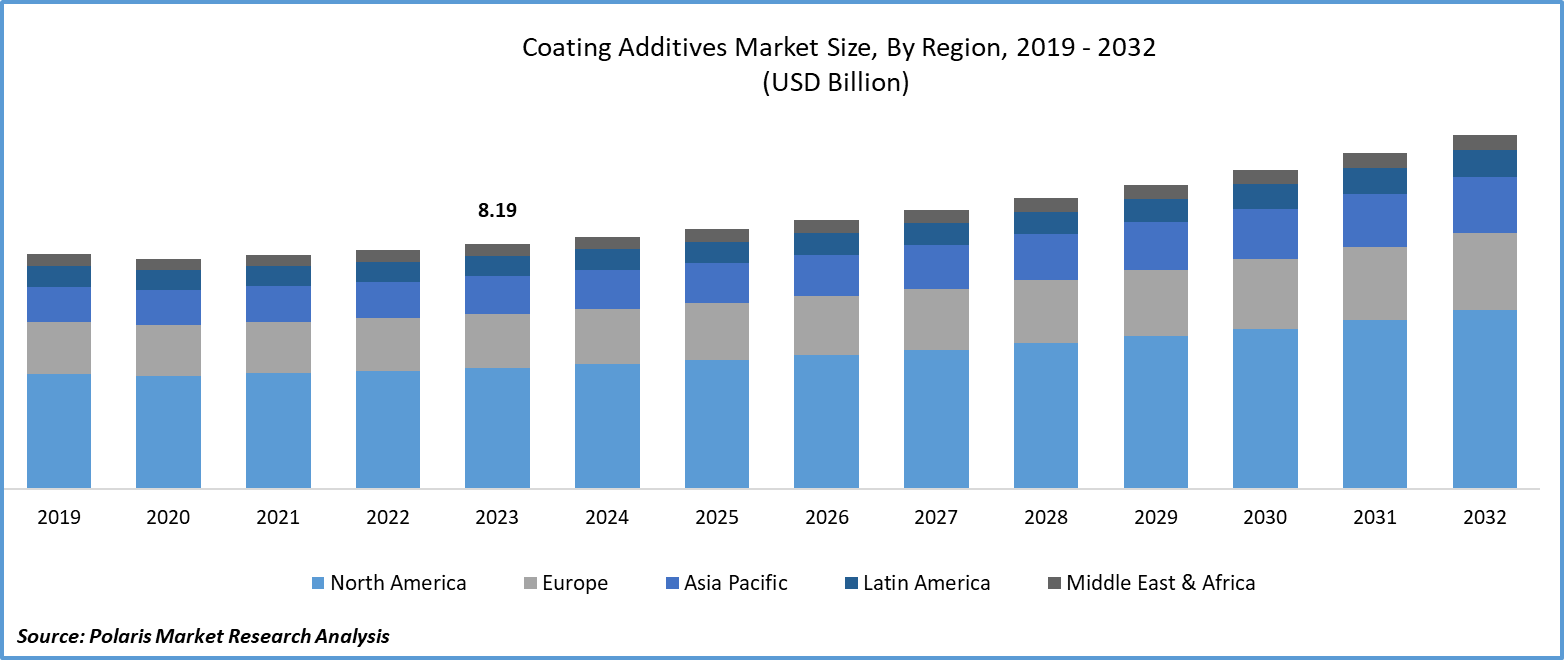
The global coating additives market was valued at USD 8.97 billion in 2025 and is projected to grow at a CAGR of 5.40% from 2026 to 2034. Growth is attributed to the rising demand for high-performance coatings in various industries, including automotive and construction.
Key Takeaways
- North America dominated the global market with the largest market share of 35.21% in 2025. Discerning consumer base, stringent environmental regulations, and technological advancements propel the market.
- The U.S. accounted for the largest market share of 85.50% in 2025. This is due to its large construction sector, industrial activities, and ongoing maintenance requirements for the infrastructure.
- The Asia Pacific coating additives market is expected to register the highest CAGR of 6.5% during the projected period. Rising advancements in house renovation methods and increasing residential construction boost the regional market growth.
- The wetting & dispersion segment is projected to exhibit the highest CAGR of 6.1% during the forecast period. Growing requirement for pigment-dispersing agents and higher standards for precise color reproduction drive the segment growth.
- The architectural segment is expected to record the highest CAGR of 6.2% during the forecast period. Key attributes such as weather resistance, durability, and overall attractiveness will fuel the segment growth.
Note: Figures and projections outlined in this report are the result of Polaris Market Research’s proprietary analytical processes, grounded in the latest available datasets and market observations.
Market Statistics
- 2025 Market Size: USD 8.97 Billion
- 2034 Projected Market Size: USD 14.40 Billion
- CAGR (2026-2034): 5.4%
- North America: Largest market in 2025
Industry Dynamics
- Rising demand for high-performance coatings bolster the use of additives. Additives offer better gloss, scratch resistance, and surface protection.
- Growth in construction activities boosts demand for coating additives that improve durability, weather resistance, and long-term building protection.
- Expansion of the automotive sector is driving the need for additives. In automotive applications, additives enhance corrosion resistance and offer smooth finish and UV stability.
- Increasing use of eco-friendly and low-VOC coatings is supporting demand for water-based additives and sustainable coating solutions.
- The need for durability and corrosion resistance is raising adoption of additives in marine, industrial, and protective coating applications.
- Fluctuations in prices of raw material hinder the growth of the market.
- Expansion of industrial coatings in manufacturing and heavy equipment is increasing demand for additives that improve curing, adhesion, and performance.
AI Impact on the Coating Additives Market
- AI improves additive formulations by enhancing coating performance and reducing product development time.
- Predictive analytics helps identify the best additive combinations for specific coating applications faster.
- AI-driven quality control detects defects and ensures consistent coating additive production.
- Smart manufacturing uses AI to reduce waste, save energy, and improve production efficiency.
- AI supports the development of eco-friendly and low-VOC coating additives for sustainable solutions.
- AI-based demand forecasting helps manage inventory, pricing, and supply chain risks effectively.
What are Coating Additives?
Coating additives are specialized chemical substances. They are added in small quantities to paints and coatings. Coating additives help improve properties such as flow, adhesion, durability, UV resistance, corrosion protection, and surface finish. They are widely used in automotive, construction, wood, packaging, and industrial coating applications to enhance overall coating performance.
The coating additives industry development is experiencing a surge in demand due to the growing emphasis on environmental sustainability. Strict environmental regulations are compelling businesses to innovate and offer environmentally friendly products. Additionally, many countries are implementing stricter regulations regarding volatile organic compounds (VOCs), hazardous air pollutants, and their overall environmental impact. These regulations are influencing the formulation of coatings by encouraging producers to transition to low-VOC, bio-based, and water-based additives, thereby reducing the environmental footprint of coatings.
To Understand More About this Research: Download Sample Report
Moreover, rising consumer awareness and preference for environmentally friendly products are boosting demand for sustainable solutions. This trend is influencing the growth dynamics of the coating additives market and compelling businesses to adopt greener practices. Furthermore, in a competitive market, extensive research and development (R&D) efforts to create new additive formulations that meet both high-performance standards and ecological objectives offer opportunities for innovation and market differentiation, leading to a promising outlook for the market.
However, the automotive and aerospace sectors require high-performance coatings to protect surfaces from wear, corrosion, and harsh environments. There is significant potential for coating additives that enhance adhesion, scratch resistance, durability, and UV protection in these industries. Producers of coating additives are expected to capitalize on this coating additives market opportunity by providing additives that meet the stringent specifications of various industries, as the demand for high-performance coatings is expected to rise.
Environmental Impact of Coating Additives Market
- Imposition of stringent environmental regulations encourages producers to develop safer, recyclable, and eco-friendly coating additive formulations.
- Growing use of low-VOC and water-based additives helps reduce harmful emissions. It supports cleaner coating solutions.
- Industries focus on sustainability and reducing dependence on petrochemical raw materials. Therefore, the demand for bio-based coating additives is rising
- Proper additive selection improves coating durability. It reduces repainting frequency and lowers material waste over time.
- Advanced additives enhance corrosion resistance. This helps extend equipment life and reduces environmental waste from replacements.
- Manufacturing of solvent-based additives can increase chemical emissions. It is creating challenges for environmental compliance and waste management
Market Trends
Growing Demand for Eco-Friendly Products
Manufacturers are leading the charge in adopting innovative strategies to drive a significant transformation. By incorporating bio-based additives, they are boosting the environmental sustainability of coatings, appealing to environmentally conscious consumers who prioritize eco-friendly products. This evolution reflects a harmonious alignment between consumer preferences and industrial responsibility in the coating additives market. Increasingly, consumers are opting for cleaner and sustainable formulations to meet their coating and decorative needs, echoing the global emphasis on sustainability within the industry. The surge in demand for eco-friendly solutions, both from consumers and businesses, is propelling the adoption of bio-based alternatives, highlighting the urgent necessity for chemicals that minimize their environmental impact.
Growing Need Across a Range of Industries
The coating additives market growth is driven by increasing demand from various end-use sectors such as industrial applications, wood products, automotive, and construction. Particularly, the automotive industry utilizes additives to enhance the longevity, appearance, and durability of car coatings, impacting consumer satisfaction and vehicle lifespan. Additionally, the construction sector is increasingly relying on these additives to improve the performance and aesthetics of architectural coatings, which are crucial for both protective and decorative purposes. With urbanization and industrialization on the rise globally, there is a growing need for coatings that can withstand harsh environments, resist corrosion, and maintain their visual appeal over time. This is driven by increased investments in infrastructure and manufacturing resulting from these trends.
Recent Advancements
|
Additive / technology |
Advancement |
Intended benefits / application focus |
|
|
USDA Agricultural Research Service (USDA‑ARS) |
Biobased UV‑curable coating system using natural oil plus bio‑additive |
ARS reports developing a highly durable coating by combining a natural oil with a biobased additive found in apple juice, then curing with UV light to yield a high‑performance film. |
Demonstrates government‑driven innovation in biobased coating components/additives aimed at durability with reduced reliance on petrochemical inputs. |
|
Evonik Coating Additives |
Digital formulation support (COATINO) & new additive platforms |
Evonik’s Specialty Additives spotlight highlights COATINO, a digital formulation network that helps customers select additives (defoamers, dispersants, rheology modifiers, etc.) and optimize sustainable waterborne systems. |
Speeds development of low‑VOC, high‑performance coatings by using data‑driven selection of additives and providing virtual lab capability for formulators. |
|
BASF – Dispersions & Resins, Additives |
Water‑based Basonol AC dispersions and Efka additive portfolio upgrades |
BASF introduces Basonol AC waterborne dispersions for 2K PU topcoats that cut isocyanate use and support CO₂‑reduced, APEO‑free formulations, alongside Efka dispersing/wetting/defoaming additives for eco‑friendly solvent‑borne systems. |
Enables automotive and industrial coatings with lower VOC and improved sustainability while maintaining scratch, weather and chemical resistance. |
|
Brookhaven National Laboratory with Henkel (coating supplier) |
Hybrid Zr‑based anti‑corrosion coating with organic & inorganic additives |
Brookhaven reports that combining Cu compounds and polyamidoamine (PAMAM) additives in zirconium‑based conversion coatings improves morphology, adhesion, and alkaline stability versus conventional systems. |
Supports industry transition away from chromates by using carefully tuned organic/inorganic additives to achieve high anti‑corrosion performance in environmentally friendlier metal pretreatments. |
|
Evonik Coating Additives |
TEGO Airex 923 silicone‑free deaerator |
Evonik describes TEGO Airex 923 as a 100% active organic polymer deaerator offering fast and efficient foam breakdown with high compatibility in radiation‑curable, clear and pigmented coatings. |
Provides high‑efficiency defoaming without silicone, reducing surface defects (pinholes, air inclusions) and supporting high‑gloss or clear systems where silicone can cause issues. |
|
Evonik Coating Additives |
TEGO Foamex 16 and TEGO Foamex 11 low‑/zero‑VOC defoamers |
New defoamers introduced at the American Coatings Show 2024 are described as having very low VOC and SVOC, no solvents or mineral oils, and with TEGO Foamex 16 containing 25% bio‑based content. |
Targets waterborne architectural coatings with strong, long‑lasting defoaming plus improved sustainability profile, helping customers meet strict environmental and ecolabel criteria. |
|
Evonik Coating Additives |
TEGO Wet 570 Terra & 580 Terra biosurfactant wetting agents |
Evonik launches biosurfactant‑based wetting additives produced via microbial fermentation, 100% from natural resources, with low VOC, high biodegradability, and EU Ecolabel suitability. |
Designed for waterborne decorative, industrial, and transportation coatings to improve pigment/filler wetting, cut grinding time and energy, and provide high performance with a “green” additive profile. |
|
Evonik Coating Additives |
TEGO Foamex 8051 high‑efficiency siloxane defoamer |
New defoamer launched with strong knock‑down and long‑lasting anti‑foaming at low use levels, containing no added mineral oils and nearly zero VOCs/SVOCs, with broad global regulatory registrations. |
Offers formulators a globally usable, low‑emission defoamer suited to modern environmental regulations, while maintaining defoaming efficiency even after storage. |
|
BASF Coatings / Additives |
New PFAS‑alternative and sustainability‑focused additives (multiple chemistries) |
BASF communications highlight launches of several coating additives that enhance performance and formulation flexibility while serving as PFAS alternatives and supporting lower VOC/CO₂ footprints. |
Helps customers reformulate away from PFAS and other substances of concern, aligning with tightening global regulations while preserving corrosion protection, durability, and surface quality. |
Segment Insights
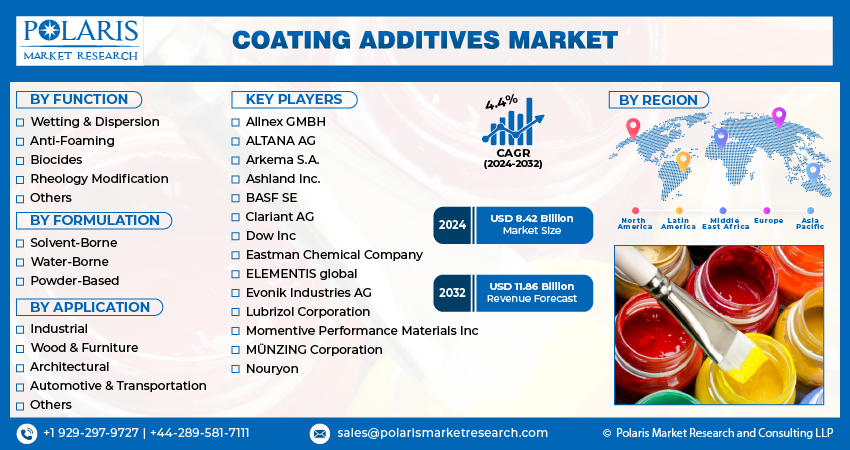
Coating Additives Function Insights
The global coating additives market segmentation, based on function, includes wetting & dispersion, biocides, anti-foaming, rheology modification, and others. The wetting & dispersion segment is projected to grow at the CAGR of 6.1% during the coating additives market forecast period. Wetting and dispersing agents play a crucial role in construction and architectural coatings by ensuring the uniform dispersion of pigments and additives, enhancing both performance and visual appeal. The increasing demand for these chemicals is driven by higher solid content is necessary for coatings to achieve improved color acceptability. Moreover, there is a simultaneous push to reduce the volatile organic compound (VOC) content in formulations to comply with stringent environmental regulations in various regions. Additionally, the market is witnessing a notable rise in the requirement for pigment-dispersing agents and higher standards for precise color reproduction. In response to these industry dynamics, key players in the coatings additives market continually innovate and introduce new wetting agents tailored to meet specific performance requirements.
For instance, in February 2023, Evonik's coating additives business line introduced two new wetting agents: TEGO Wet 296 and TEGO Wet 290. These products are versatile and suitable for substrates including plastic, wood, and metal surfaces. They are particularly designed for waterborne automotive and wood coatings, enhancing wetting and anti-cratering properties, as well as improving flow and leveling characteristics. This innovation is expected to strengthen Evonik's position in the coating additives market.
Coating Additives Application Insights
The global coating additives market segmentation, based on application, includes industrial, wood & furniture, architectural, automotive & transportation, and others. The architectural segment is expected to grow at the CAGR of 6.2% during the coating additives market forecast period. In the coating additives industry, the architectural sector is poised for rapid growth. Coating additives play a vital role in safeguarding building structures against environmental damage. By enhancing both the aesthetic appeal and protective capabilities of structures, these additives provide essential defense against dampness, UV rays, chipping, and related issues. They significantly enhance the performance of architectural coatings, improving key attributes such as weather resistance, durability, and overall attractiveness. Architectural coatings often need to be customized based on specific project requirements or environmental conditions. Coating additives enable companies to tailor coatings to meet these diverse needs, whether it's for extreme climates, high-traffic areas, or specialized applications.
For instance, Evonik Coating Additives is pleased to unveil two groundbreaking defoamers, TEGO Foamex 16 and TEGO Foamex 11, at the American Coatings Show 2024. This event will take place from April 30 to May 2 at the Indiana Convention Center in Indianapolis. These cutting-edge additives are specifically crafted to enhance both the sustainability and performance of waterborne architectural coatings, contributing to a rise in the coating additives market demand.
Source: Secondary Research, Primary Research, PMR Database and Analyst Review
Regional Insights
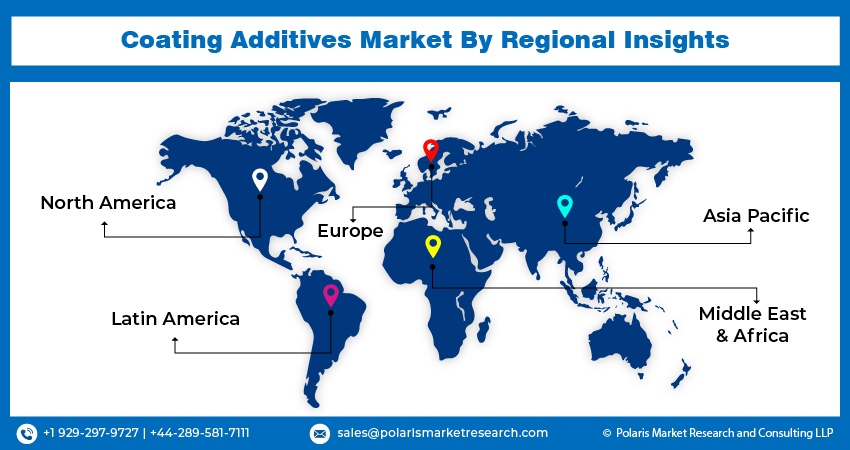
By region, the study provides the market insights into North America, Europe, Asia-Pacific and Rest of the World. The North America region dominated the global market with the 35.21% market share in 2025 and is expected to maintain its dominance over the anticipated period. A discerning consumer base, stringent environmental regulations, and advancements in technology are propelling the North American market. Additionally, the automotive industry's progress, the burgeoning manufacturing sector, and heightened investments in construction and restoration are driving the demand for top-tier coatings with specialized additives. The region is notably inclined toward innovative and sustainable coatings, with a rising preference for water- and bio-based additives. This shift is driven by stricter regulations on volatile organic compound (VOC) emissions and an increasing consumer awareness of environmental concerns.
The key market players are merging, acquiring, and collaborating to strengthen their market presence and to serve better offerings in North America, further driving the market during forecast period.
United States coating additives market accounts for the 85.50% market share due to its large construction sector, industrial activities, and ongoing maintenance requirements for infrastructure. The demand for coating additives continues to grow as new construction projects emerge and existing structures require refurbishment and maintenance. Companies involved in coating additives are continually advancing their technologies to meet evolving customer needs and regulatory requirements. These advancements include the development of additives that improve performance characteristics such as durability, UV resistance, scratch resistance, and chemical resistance.
For instance, according to the American Coating Association, Gerdau Graphene has introduced two novel additives tailored for the paint and coatings sector: NanoDUR and NanoLAV. These additives, developed using Gerdau Graphene's proprietary G2D technology, incorporate graphene nanoplatelets that maintain pH levels unchanged. Gerdau Graphene states that these additives also diminish or eliminate the necessity for certain conventional manufacturing inputs, additives, and procedures. This advancement significantly enhances technological advancement in the coating additives market.
The Asia Pacific coating additives market is expected to be the fastest-growing region, with a healthy CAGR of 6.5% during the projected period. It offers substantial growth prospects for coating additives and is poised to become a highly attractive global market in the coming years. With advancements in house renovation methods and a surge in residential construction, the coating additives market demand in this region is expected to maintain its robust growth trajectory. The region's appeal is further enhanced by the increasing demand in key industries such as building, industrial, furniture, and automotive. Moreover, the Asia Pacific region is witnessing remarkable advancements, evident in its significant population growth and steadily improving living standards. It's important to consider factors such as increasing employment rates, rising disposable income among the population, and growing foreign investments in various economic sectors. Collectively, these elements bolster the Asia Pacific region's standing as a vibrant and promising market for the coating additives industry.
The China coating additives market accounts for the largest market share due to rapid urbanization and infrastructure development driving significant demand for architectural coatings. Coating additives play a crucial role in enhancing the performance and sustainability of these coatings, which are essential for protecting buildings and infrastructure against environmental factors. Companies in China are increasingly focusing on developing advanced coating additives such as wetting and dispersing agents. These additives improve pigment dispersion and substrate wetting, leading to better coating adhesion, color consistency, and overall durability. PTFE-free additives are also gaining traction due to environmental concerns and regulatory pressures to reduce harmful emissions.
For instance, in November 2023, Clariant will unveil its latest innovations at ChinaCoat 2023, featuring a new portfolio of industrial coatings and PTFE-free additives. Among these advancements are specialized wetting and dispersing agents designed for water-based formulations in industrial coating applications, targeting sectors such as containers, transportation, and construction, driving innovation and sustainability in the coating additives market.
Further, the major countries studied in the market report are The US, Canada, German, France, the UK, Italy, Spain, China, Japan, India, Australia, South Korea, Brazil, and others.
Source: Secondary Research, Primary Research, PMR Database and Analyst Review
Competitive Insights
The coating additives market is a dynamic arena, with numerous players competing for dominance. Notably, major service providers are leveraging unique strategies to maintain their competitive edge. These strategies include continuous technological advancements, strategic partnerships, and product upgrades. By doing so, these players are not only ensuring efficiency, integrity, and safety but also capturing a significant market share.
The coating additives market is highly competitive and comprises several key players who drive innovation, influence market trends, and shape industry dynamics.
Major players in the coating additives market, including Allnex GMBH, ALTANA AG, Arkema S.A., Ashland Inc., BASF SE, Clariant AG, Dow Inc., Eastman Chemical Company, ELEMENTS global, Evonik Industries AG, Lubrizol Corporation, Momentive Performance Materials Inc, MÜNZING Corporation, Nouryon, etc.
BASF SE, a global chemical corporation, operates across seven distinct business segments. The company's chemical segment, which supplies petrochemicals and their intermediates, is a key player in the coating additives market. In April 2024, BASF's Coatings division made a significant stride in eco-efficiency with the launch of a new lineup of clearcoats and undercoats. These advanced coatings not only enhance quality and boost productivity but also contribute significantly to reducing CO2 emissions. Designed to streamline operations in body shops, the innovative portfolio aims to drastically cut process times while minimizing material usage and energy consumption, thereby demonstrating BASF's commitment to sustainability.
Evonik is a specialty chemicals company that operates in over 100 countries, achieving sales of €18.5 billion and an adjusted EBITDA of €2.49 billion in 2022. With a workforce of around 34,000, Evonik is dedicated to developing innovative, profitable, and sustainable solutions for its customers. The company offers more than 350 additives and resins for paints, coatings, and inks, including renowned brands like TEGO, ACEMATT, AEROSIL, and SURFYNOL, ensuring a solution for every formulation need. In October 2023, Evonik Coating Additives introduced the TEGO Rad range, a series of custom silicone acrylates featuring a unique, radically cross-linkable additive designed for radiation-curing coatings and inks.
Key Companies
- Allnex GMBH
- ALTANA AG
- Arkema S.A.
- Ashland Inc.
- BASF SE
- Clariant AG
- Dow Inc
- Eastman Chemical Company
- ELEMENTIS global
- Evonik Industries AG
- Lubrizol Corporation
- Momentive Performance Materials Inc
- MÜNZING Corporation
- Nouryon
Coating Additives Industry Developments
February 2026: Borchers highlighted advanced additive technologies at Paint India in Mumbai from February 19–21. They enhance performance, efficiency, and durability in modern coatings formulations . (Source: PRNewswire)
April 2025: Arkema introduced Rheotech™ and Thixol™, biobased thickeners derived from renewable sources, supporting more eco-friendly paint and adhesive formulations. (Source: arkema.com)
March 2025, Evonik Coating Additives launched its first mass balanced products, TEGO® Wet 270 eCO and TEGO® Foamex 812 eCO, enabling sustainable, high-performance coatings and inks with reduced carbon footprints and ISCC PLUS certified sourcing. (Source: evonik.com)
Coating Additives Market Segmentation
Coating Additives Function Outlook
- Wetting & Dispersion
- Anti-Foaming
- Biocides
- Rheology Modification
- Others
Coating Additives Formulation Outlook
- Solvent-Borne
- Water-Borne
- Powder-Based
Coating Additives, Application Outlook
- Industrial
- Wood & Furniture
- Architectural
- Automotive & Transportation
- Others
Coating Additives Regional Outlook
- North America
- US
- Canada
- Europe
- Germany
- France
- UK
- Italy
- Spain
- Netherlands
- Russia
- Rest of Europe
- Asia-Pacific
- China
- Japan
- India
- Malaysia
- South Korea
- Indonesia
- Australia
- Vietnam
- Rest of Asia-Pacific
- Middle East & Africa
- Saudi Arabia
- UAE
- Israel
- South Africa
- Rest of Middle East & Africa
- Latin America
- Mexico
- Brazil
- Argentina
- Rest of Latin America
Report Scope
|
Report Attributes |
Details |
|
Market size value in 2025 |
USD 8.97 billion |
|
Market size value in 2026 |
USD 9.44 billion |
|
Revenue Forecast in 2034 |
USD 14.40 billion |
|
CAGR |
5.40% from 2026 – 2034 |
|
Base year |
2025 |
|
Historical data |
2020 – 2023 |
|
Forecast period |
2026 – 2034 |
|
Quantitative units |
Revenue in USD billion and CAGR from 2026 to 2034 |
|
Report Coverage |
Revenue Forecast, Market Competitive Landscape, Growth Factors, and Trends |
|
Segments covered |
|
|
Regional scope |
|
|
Competitive Landscape |
|
|
Report Format |
|
|
Customization |
Report customization as per your requirements with respect to countries, region, and segmentation. |
FAQ's
The global coating additives market size was valued at USD 8.97 billion in 2025.
The global market is projected to grow at a CAGR of 5.40% during the forecast period, 2026-2034.
North America held the largest share of 35.21 in 2025.
The key players in the market are Allnex GMBH, ALTANA AG, Arkema S.A., Ashland Inc., BASF SE, Clariant AG, Dow Inc., Eastman Chemical Company, ELEMENTS global, Evonik Industries AG, Lubrizol Corporation, Momentive Performance Materials Inc, MÜNZING Corporation, Nouryon, etc.
The wetting & dispersion segment is projected to grow at the CAGR of 6.1% during the coating additives market forecast period
The architectural segment is expected to grow at the fastest CAGR during the coating additives market forecast period
Page last updated on: Dec-2025
Download Sample Report of Coating Additives Market
Please fill out the form to request a customized copy of the research report.


