
Concentrated Milk Fat Market Size, Global Industry Analysis, 2026-2034
REPORT DETAILS
Concentrated Milk Fat Market Summary
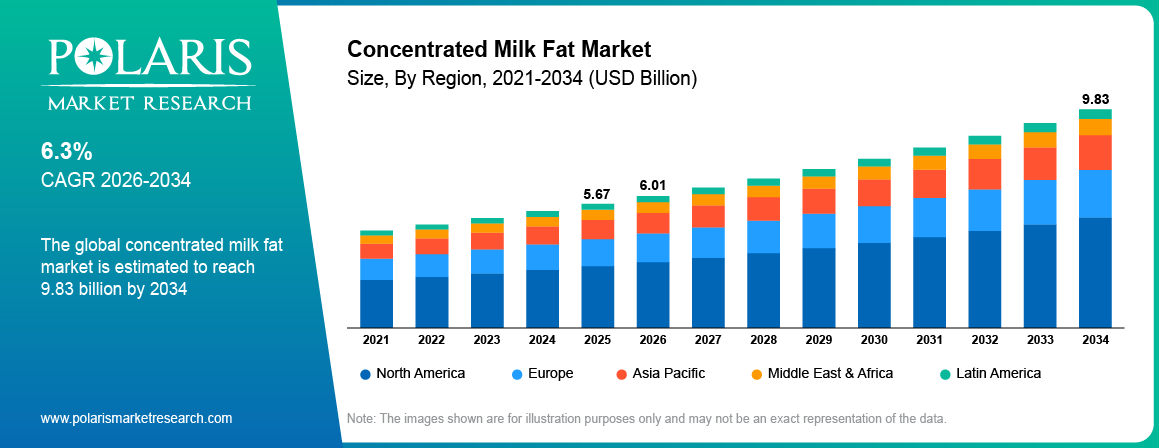
The concentrated milk fat market size was valued at USD 5.67 billion in 2025. The market is anticipated to grow at a CAGR of 6.3% from 2026 to 2034. This market is growing rapidly due to increased usage in bakery, confectionery, and dairy applications. The rising demand for high-fat dairy ingredients, combined with advancements in milk fat processing and storage, is driving global consumption in the food and beverage industry.
Market Statistics
Concentrated Milk Fat Market Key Takeaways
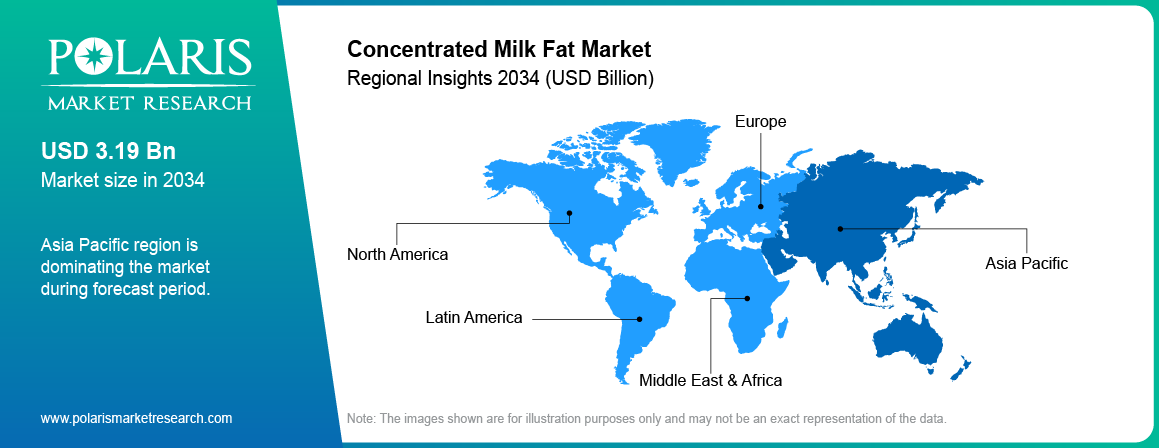
- Asia Pacific dominated with a 32.5% market share in 2025. This is owing to the region’s well-established dairy industry and advanced food processing technologies.
- North America is expected to experience the fastest growth at a 6.7% CAGR. The increasing demand for functional foods and clean-label ingredients contributes to the regional market growth.
- The conventional segment dominated with a 74.6% market share in 2025. This is due to its widespread availability and cost-effectiveness.
- The nutraceuticals segment is expected to register a significant CAGR of 7.2%. Growing demand for functional foods and supplements drives the segment’s growth.
- The bakery & confectionery segment led with a 38.6% market share in 2025. Concentrated milk fat offers crucial structural benefits.
Note: Figures and projections outlined in this report are the result of Polaris Market Research’s proprietary analytical processes, grounded in the latest available datasets and market observations
AI Impact on Concentrated Milk Fat Market
- AI technology helps to enhance the efficiency of the manufacturing of concentrated milk fats through process optimization, yield maximization, and reduced wastage of raw material.
- AI is able to improve quality control with the assessment of fat content, texture, and consistency of products.
- AI can help organizations predict consumer demand and manage inventory accordingly.
- AI is helpful in introducing innovations in products by recognizing trends in the F&B industry
Concentrated milk fat is a dairy product derived from cream or milk, containing a high percentage of butterfat by removing water and non-fat solids. It is widely used to enhance flavor, texture, and richness in food products such as baked goods, confectionery, and dairy items.
The growing demand for premium and indulgent food items, along with the expansion of the bakery and confectionery sectors, is fueling market growth. The increasing use of concentrated milk fat in convenience foods and ready-to-eat products aligns with changing consumer lifestyles.
For instance, report by the California Dairy Research Foundation noted the use of Milk Protein Concentrates (MPC) and Reduced Calcium Milk Protein Concentrates (RCMPC) as natural emulsifiers in clean-label ice cream. These dairy emulsifiers enhance texture, protein content, and storage stability while replacing synthetic options. Additionally, emerging markets are also contributing to growth due to rising disposable incomes and evolving dietary preferences. Innovations in production methods and the rising adoption of clean-label ingredients are further boosting the market.
Source: Polaris Market Research Analysis
To Understand More About this Research: Download Sample Report
Anhydrous Milk Fat vs Butter vs Butter Oil
| Aspect | Anhydrous Milk Fat | Butter | Butter Oil |
| Fat Percentage | Nearly 100% | Around 80% | More than 99% |
| Moisture Content | Minimal | More | Minimal |
| Shelf Life | Long | Short | Long |
| Flavor | Rich dairy flavor | Conventional butter flavor | Concentrated butter flavor |
| Use in Industry | Extensive | Limited | Extensive |
| Storage | Stable | Semi-Stable | Stable |
Market Dynamics
Driver: Expanding Applications Across Industries
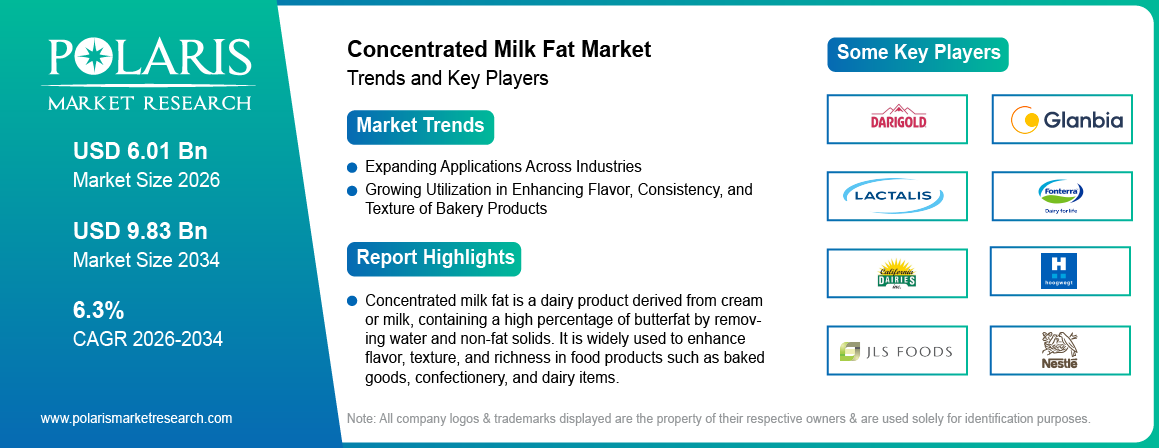
The expanding applications of across various industries, such as bakery products, confectionery, dairy, and processed foods, are driving the concentrated milk fat market growth. These fat’s are valued for their ability to improve flavor, texture, and stability in products, meeting the rising consumer demand for indulgent and high-quality food items. The market continues to benefit from this versatile ingredient as industries increasingly use these fats in a variety of products, including ice creams, spreads, and ready-to-eat meals. Additionally, the shift toward clean-label products, which prioritize natural ingredients, is further fueling their adoption. For instance, in August 2024, Fonterra extended its focus on providing clean-label solutions, with an emphasis on these concentrated milk fats for improving texture, flavor, and functionality in a range of food products, including ice creams and bakery goods.
Driver: Growing Utilization in Enhancing Flavor, Consistency, and Texture of Bakery Products
The growing utilization in bakery products is driven by their ability to enhance flavor, consistency, and texture. These fats improve the richness and creaminess of baked goods, ensuring a premium mouthfeel that meets consumer expectations for indulgent products. For instance, in August 2022, the a2 Milk Company (a2MC) expanded its product portfolio in Australia by introducing a lactose-free version of A2 Milk, addressing the needs of consumers with milk intolerance. Such innovations reflect the broader trend of meeting diverse dietary requirements while maintaining the quality and appeal of products.
Concentrated milk fats also play a vital role in maintaining the structural integrity of pastries, cakes, and cookies by improving air incorporation and stabilization, as these fats help trap air within the dough or batter, making the final product lighter and fluffier. Providing stability refers to their role in preventing the product from collapsing or becoming too dense during baking and storage. This adaptability makes them essential for modern bakery formulations, especially as clean-label and high-quality ingredients gain prominence in the food industry.
Source: Polaris Market Research Analysis
Segment Analysis
Product Outlook
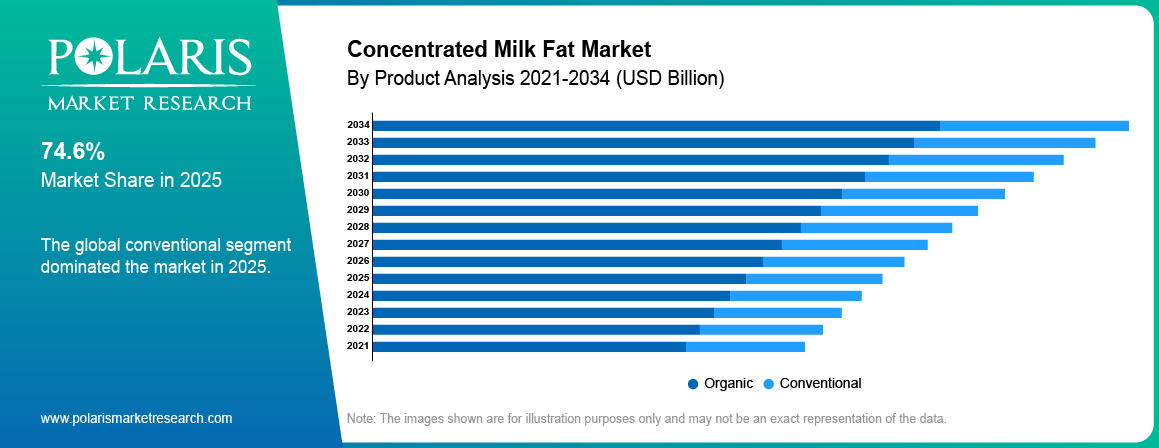
The conventional segment dominated with a 74.6% market share in 2025 due to its widespread availability, cost-effectiveness, and established production processes. The lower cost of conventional milk fats compared to organic alternatives makes them a preferred choice for large-scale manufacturers, especially in food products such as dairy, bakery, and confectionery. Additionally, conventional concentrated milk fats offer consistency in quality and performance, which is crucial for mass production. This dominance is also supported by the greater familiarity and accessibility of conventional dairy supply chains, which continue to cater to the high demand across various industries such as bakery & confectionery and dairy products, among others.
Application Outlook
The nutraceuticals segment is expected to register a significant CAGR of 7.2% due to the increasing demand for functional foods and supplements that offer health benefits beyond basic nutrition. These fats are recognized for their rich nutrient profile, including essential fatty acids, proteins, and vitamins, making them an ideal ingredient for strengthening nutraceutical products. The growing consumer awareness of the link between diet and health, alongside rising interest in natural, bioactive ingredients, is driving the demand for such products in the nutraceuticals sector. Additionally, the shift towards preventive healthcare and wellness is encouraging the incorporation of concentrated milk fats in various health-focused applications such as functional dairy products and dietary supplements.
Source: Polaris Market Research Analysis
Global Dairy Trade and Supply Chain Trends
The global dairy trade is vital to driving the growth of the concentrated milk fat industry, as producers rely on a supply chain network to acquire raw milk, anhydrous milk fat, and butter oil for food processing. These include export-oriented dairy-producing countries such as New Zealand, Ireland, the Netherlands, and the United States, which supply milk fat ingredients to manufacturers worldwide. Issues in trade policies, import-export laws, tariffs, and sanitary requirements have significant impacts on the supply of dairy products within specific markets. In addition, factors such as high cost of logistics, refrigeration infrastructure, production level of milk, and political events can also affect the supply chain management process globally. This is why, when there is an increase in demand for quality dairy products, bakery products, formula milk, and processed food, it becomes crucial for firms to adopt effective supply chain management and distribution strategies to ensure a steady supply of dairy ingredients.
Regional Insights
North America is expected to experience the fastest growth at a 6.7% CAGR due to the region's well-established dairy industry, advanced food processing technologies, and high consumer demand for premium and functional food products. Strong healthcare awareness and a growing shift towards health-conscious, clean-label products have also increased the use of concentrated milk fats in nutraceuticals and functional foods. Moreover, high disposable incomes and robust distribution networks further support the market's growth in the region. The presence of major players in the food and dairy sectors, coupled with significant R&D investments, has led North America to emerge as a leader in the industry.
Source: Polaris Market Research Analysis
Europe concentrated milk fat market is expected to experience the growth during the forecast period due to the increasing demand for functional foods, clean-label ingredients, and high-quality dairy products driven by health-conscious consumer preferences. Additionally, there is a growing trend toward preventive healthcare, with consumers seeking products that contribute to overall wellness. Innovations in dairy processing technologies, along with rising investments in research and development by key market players, are also contributing to the region’s market growth. Moreover, Europe’s established dairy industry, along with stringent regulatory standards for food quality, ensures consumer safety and environmental sustainability. For instance, according to a March 2024 report by the European Parliament, Regulation (EU) 2023/915 establishes maximum limits for contaminants such as nitrates, heavy metals, and dioxins in both animal and plant-based foods, reinforcing Europe’s commitment to maintain high food safety and quality standards across the sector. The regulations also set maximum residue levels, ensuring that foodstuffs with unacceptable contaminant levels are not sold in the EU to protect public health, creating a favorable environment for expanding concentrated milk fats in various food applications.
Competitive Analysis
The competitive landscape of the concentrated milk fat industry features a mix of global leaders and regional players competing for market share through innovation, strategic collaborations, and geographic expansion. Major companies such as Nestle, Darigold, and others utilize their robust R&D capabilities and extensive distribution networks to develop advanced concentrated milk fat solutions catering to diverse applications in bakery, confectionery, dairy, and nutraceuticals. Leading players focus on product innovation, prioritizing clean-label and high-quality ingredients to meet evolving consumer preferences for premium and health-focused products. Simultaneously, smaller regional firms are emerging with tailored offerings to address local market needs and preferences. Competitive strategies include mergers and acquisitions, partnerships with food manufacturers, and the introduction of organic and functional product lines to strengthen market presence in key regions. A few key major players are Darigold; Glanbia Plc; Lactalis Ingredients; Fonterra Co-operative Group Limited; Grassland Dairy Products; California Dairies, Inc.; Hoogwegt; G&R Food; Pine River Dairy; JLS Foods International; and Nestle.
Nestle SA (Nestle), headquartered in Vevey, Waadt, Switzerland, is a manufacturer and supplier of food products and beverages. The company's product portfolio comprises baby foods, bottled water, cereals, chocolates and confectionery, coffee, culinary products, chilled and frozen foods, dairy products, nutritional products, ice cream, and pet products. Nestle also offers nutritional products, sausages, and direct-to-consumer meal delivery services. Its major brands include Aero, Alpo, Milkybar, Nestle Ice Cream, Cerelac, Nescafe, Nespresso, Nestea, Milo, Maggi, Buitoni, Cailler, Movenpick, Freshly, Purina, Boost, Gerber, and Kit Kat. The company has a business presence in Asia, Oceania and sub-Saharan Africa, the Americas, Europe, the Middle East, and North Africa.
Glanbia plc is a global nutrition company headquartered in Kilkenny, Ireland, with operations spanning worldwide. The company is in the manufacturing and sale of sports nutrition and lifestyle nutrition products, offering a range of products such as powders, snacking foods, ready-to-eat bars, and ready-to-drink beverages. These products are distributed through various channels, including specialty retail, gyms, online platforms, drug, food, mass, and club channels. Beyond nutrition products, Glanbia is involved in the production and sale of cheese, non-dairy, and dairy nutritional and functional ingredients, along with mineral and vitamin premixes. The company is diverse in its business activities, participating in financing, research and development, property and land dealings, receivables management, property leasing, business services, weight management, and bioactive solutions. Glanbia plc manages a portfolio of well-known brands such as Optimum Nutrition, Isopure, BSN, SlimFast, Nutramino, Amazing Grass, think! Body & Fit, and LevlUp.
Key Companies
- Darigold
- Glanbia Plc
- Lactalis Ingredients
- Fonterra Co-operative Group Limited
- Grassland Dairy products
- California Dairies, Inc.
- Hoogwegt
- G&R Food
- Pine River Dairy
- JLS Foods International
- Nestle
Recent Developments
- June 2026: Arla Foods and DMK Group completed a merger to create Europe’s leading dairy cooperative. According to Arla Foods, the group of companies will operate under the name Arla Foods. (source: arla.com)
- June 2025: Darigold commissioned its USD 1 billion Pasco, Washington facility, adding 8 million lb/day processing capacity with low-emission technologies supporting the U.S. Dairy Net-Zero goal. (Source: darigold.com)
- April 2025: Arla Foods and DMK Group merged to form Europe’s largest dairy cooperative, generating EUR 19 billion in revenue, aiming to enhance R&D pipelines and expand premium ingredient portfolios. (Source: arla.com)
- April 2025: Chobani announced a USD 1.2 billion New York plant to support growing protein-snack and yogurt production, boosting regional concentrated milk fat consumption. (Source: cowsmo.com)
Concentrated Milk Fat Market Segmentation
By Product Outlook (Revenue, USD Billion, 2021–2034)
- Organic
- Conventional
By Application Outlook (Revenue, USD Billion, 2021–2034)
- Bakery & Confectionery
- Dairy Products
- Nutraceuticals
- Others
By Regional Outlook (Revenue, USD Billion, 2021–2034)
- North America
- US
- Canada
- Europe
- Germany
- France
- UK
- Italy
- Spain
- Netherlands
- Russia
- Rest of Europe
- Asia Pacific
- China
- Japan
- India
- Malaysia
- South Korea
- Indonesia
- Australia
- Vietnam
- Rest of Asia Pacific
- Middle East & Africa
- Saudi Arabia
- UAE
- Israel
- South Africa
- Rest of Middle East & Africa
- Latin America
- Mexico
- Brazil
- Argentina
- Rest of Latin America
Concentrated Milk Fat Report Scope
| Report Attributes | Details |
| Market Size Value in 2025 | USD 5.67 billion |
| Market Size Value in 2026 | USD 6.01 billion |
| Revenue Forecast by 2034 | USD 9.83 billion |
| CAGR | 6.3% from 2026 to 2034 |
| Base Year | 2025 |
| Historical Data | 2021–2024 |
| Forecast Period | 2026–2034 |
| Quantitative Units | Revenue in USD billion and CAGR from 2026 to 2034 |
| Report Coverage | Revenue Forecast, Market Competitive Landscape, Growth Factors, and Industry Trends |
| Segments Covered |
|
| Regional Scope |
|
| Competitive Landscape |
|
| Report Format |
|
| Customization | Report customization as per your requirements with respect to countries, regions, and segmentation. |
Source: Polaris Market Research Analysis
Concentrated Milk Fat Market FAQ's
The global concentrated milk fat market size was valued at USD 5.67 billion in 2025 and is projected to grow to USD 9.83 billion by 2034.
The global market is projected to register a CAGR of 6.3% during the forecast period.
Asia Pacific dominated with a 32.5% market share in 2025 due to the region's well-established dairy industry, advanced food processing technologies, and high consumer demand for premium, functional food products
A few key players in the market are Darigold; Glanbia Plc; Lactalis Ingredients; Fonterra Co-operative Group Limited; Grassland Dairy Products; California Dairies, Inc.; Hoogwegt; G&R Food; Pine River Dairy; JLS Foods International; Nestle.
The conventional segment dominated with a 74.6% market share in 2025 due to its widespread availability, cost-effectiveness, and established production processes.
The nutraceuticals segment is expected to register a significant CAGR of 7.2%.
Download Sample Report of Concentrated Milk Fat Market
Please fill out the form to request a customized copy of the research report.


