
CV Depot Charging Market Size, Share, Trends and Forecast, 2026–2034
REPORT DETAILS
CV Depot Charging Market Summary
The global CV depot charging market size was valued at USD 6.72 billion in 2025. The market is projected to grow at a CAGR of 17.2% during the CV depot charging market forecast period through 2034. The rising adoption of electric vehicles (EVs) for public transportation is one of the factors driving market growth. The shift towards renewable energy sources and megawatt charging is also shaping the market landscape.
Market Statistics
Key Takeaways
- Asia Pacific held an 56.84% CV depot charging market share in 2025. Rapid urbanization and increased adoption of electric buses contribute to the region’s significant market share.
- Europe accounted for an 20.76% share of the global market in 2025. This is owing to its stringent emission norms and EU decarbonization targets.
- By vehicle type, the electric light commercial vehicles (eLCVs) segment held an 74.62% share in 2025. The segment benefits from the high adoption by logistics operators.
- By charger type, the DC chargers segment accounted for an 56.82% CV depot charging market share in 2025. Their high-power output enables rapid charging of commercial vehicles.
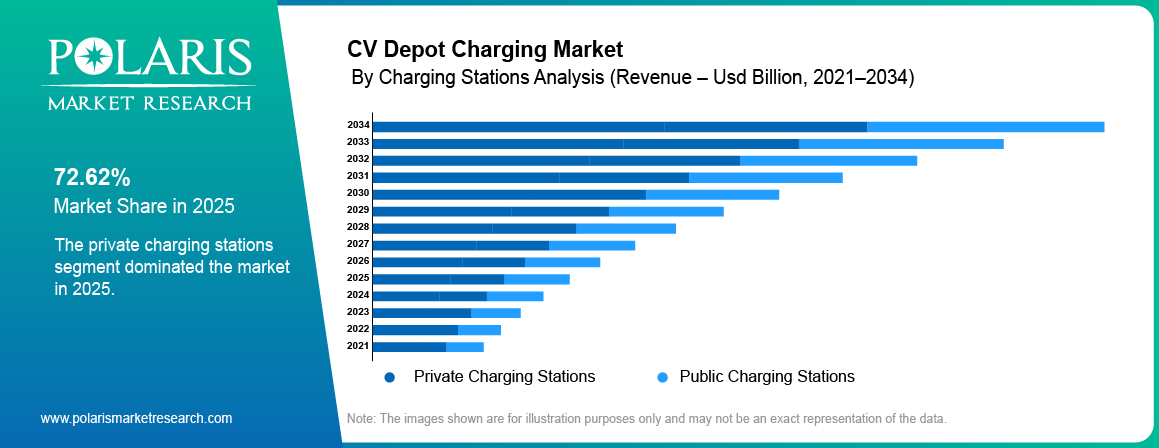
- By charging station, the private stations segment held an 72.62% share in 2025. Private stations are preferred by fleet operators as they ensure predictable charging schedules.
- By power output, the above 150 kW segment is projected to grow at an 25.86% CAGR. Rising investments in high-capacity charging solutions drive the segment’s rapid growth.
Note: Figures and projections outlined in this report are the result of Polaris Market Research’s proprietary analytical processes, grounded in the latest available datasets and market observations.
What Is CV Depot Charging?
The commercial vehicle depot charging market covers charging solutions that are installed in fleet depots for electric trucks, buses, vans, and other types of commercial vehicles. Fleet operators can charge these commercial vehicles at the depots where they normally operate, without having to charge them at public stations.
Depot charging is the charging of electric commercial vehicles at the depot facility. Depot charging of these commercial vehicles occurs when the vehicles are not in use, usually during the night or shift changes. The depot charging schedule may be aligned with the operation schedule of these commercial vehicles.
The infrastructure includes charging stations and also the electrical connections required for the delivery of power to the entire depot. These systems together form part of the electric vehicle charging infrastructure that is essential for commercial EV fleets.
How Does Depot Charging Work
Depot Arrival of Vehicles: Electric vehicles come back to the depot after having completed their schedule of operation. Vehicle charging starts once their scheduled parking time is reached.
Parking in Specific Charging Areas: Vehicles get relocated to specific areas meant for their parking. The area is specifically designed to give easy access to the charging system.
Connection of the Charging System: Vehicle drivers or depot attendants connect the vehicles to the charging stations. This depends on the type of charging system that the vehicle uses.
Power Supply System: Power is provided through the electrical system of the depot. The power distribution system controls power supply.
Vehicle Battery Charging: The charger provides the required power to the vehicle's batteries. The charging rate depends on the power of the charger.
Monitoring of Charging Process: Charging of the vehicles is monitored by the systems of the depot management. Energy consumption may be regulated from there.
Vehicle Preparedness for Operation: After charging, the vehicles are ready to resume operations according to the schedule prepared by the fleet operators.

CV Depot Charging Market Dynamics
Driver : Rising Adoption of Electric Buses
As more attention is drawn to the use of electricity to power public transportation, the need for special depot chargers is increasing. Public transportation companies are switching from old diesel buses to electric buses to reduce operating emissions. In addition, there is a need to adapt fleet operations to new requirements. Electric buses, unlike private cars, usually return to centralized depots upon completion of a route. As a result, depot charging becomes a reasonable choice for transport operators. It is possible to plug buses into charging equipment during overnight storage. In addition, buses can be charged between scheduled trips when enough time is available. According to the International Energy Agency (IEA), there were about 70,000 electric buses sold globally in 2025, up 12 percent from the previous year (source: iea.org). The increasing number of electric buses is prompting public transportation organizations to rethink their current depots. They might need to install more chargers and provide more power supply at depots to handle bigger fleets. This is leading to an increased need for depot charging systems tailored to the needs of public transportation vehicles.
Driver : Lower Operating Costs Encourage Fleet Electrification
Operational costs continue to play a vital role when making a decision on switching from diesel buses to electric buses. Electric vehicles use electric power rather than diesel power. Therefore, they may have lower daily operational costs in markets where there are affordable electricity rates. Additionally, electric buses have fewer mechanical components compared to diesel buses. This reduces the frequency of required maintenance on the bus's power train over the lifespan of the vehicle. Reduced operational costs are especially significant to transit companies that offer bus services to commuters on a daily basis along pre-defined bus routes. However, the capital cost of investing in both the vehicles and the charging infrastructure continues to be considered. The potential savings are being balanced against the costs of purchasing the new electric buses and the infrastructure to charge the buses. With the increase in fleet electrification, there is a need for reliable capacity to charge fleets to keep them operational. This is contributing to investments in charging depots.
Restraints and Challenges : High Infrastructure Costs and Site Development Constraints
Installation of CV charging depots entails huge initial costs. Fleet owners are required to purchase charging facilities in order to start operations on a large scale. This cost is even higher if the existing depot requires electrical upgrades or additional power connection. Acquisition of land is another challenge that may arise, particularly in commercial centers. Heavy commercial vehicles require sufficient space for parking and connection to charging stations. This may necessitate reconfiguration of the existing structure. Licensing and approvals from utility companies may also delay installation of the system.
Restraints and Challenges : Power Availability and Charging Limitations
Power supply continues to be an issue for depots that want to charge many heavy vehicles simultaneously. Existing electrical connections might not be able to provide adequate power supply for such operations. Enhancing power supply capability could increase expenses and slow down the deployment process. The other challenge is charging time. Charging using AC chargers is relatively slow and may not be ideal for vehicles that need to return to the depot shortly after charging. Charging using DC chargers takes less time, but it requires an enhanced power supply capability. Compatibility of charging stations and heavy vehicles is another challenge.
Opportunities : Integration of Renewable Energy and Energy Storage
Charging stations for CVs can rely on solar energy to lessen their reliance on the grid. However, the timing of the production of renewable energy is not always in line with the charging requirements of commercial vehicles. Storage through batteries can be used to fill the gaps. The storage of electricity can then be used when several CVs require charging at once. This may reduce pressure on the grid connection as well. The use of renewable energy along with battery storage will provide fleet owners with more control over their electricity costs. Furthermore, it creates opportunities for building charging stations that are not heavily reliant on traditional electricity sources.
Opportunities : New Charging Models and High-Power Charging Solutions
The high cost of developing EV charging stations is driving the adoption of service-based business models. Depot-as-a-service and charging-as-a-service allow fleet operators to access charging facilities without having to install everything themselves. It may enable fleet owners to make lower upfront investments. Another opportunity comes from megawatt charging solutions that have been developed for trucks. Higher charging rates will reduce downtime during short breaks. Vehicle-to-grid (V2G) technology offers another possibility by enabling electric vehicles to return stored electricity to the power grid. Such solutions will contribute to the commercialization of depot charging stations.

CV Depot Charging Market Segmentation
The market is segmented by charger, vehicle, charging station, power output, and region. The segmentation reflects differences in commercial vehicle charging requirements.
| Segmentation Axis | Segments |
| By Charger Type | AC Chargers · DC Chargers · Megawatt Charging Systems (MCS) |
| By Vehicle Type | Electric Light Commercial Vehicles (eLCVs) · Electric Medium Commercial Vehicles (eMCVs) · Electric Heavy Commercial Vehicles (eHCVs) · Electric Buses (eBuses) |
| By Charging Station | Public Charging Stations · Private Charging Stations |
| By Power Output | Up to 50 kW · 51–150 kW · Above 150 kW |
| By Region | North America (U.S., Canada) · Europe (France, Germany, UK, Italy, Netherlands, Spain, Russia, Rest of Europe) · Asia Pacific (Japan, China, India, Malaysia, Indonesia, South Korea, Rest of Asia Pacific) · Latin America (Brazil, Mexico, Argentina, Rest of Latin America) · Middle East & Africa (Saudi Arabia, UAE, Israel, South Africa, Rest of Middle East & Africa) |
Source: Polaris Market Research Analysis
By Charger Type
The DC chargers segment accounted for an 56.82% CV depot charging market share in 2025. DC chargers find extensive applications in commercial vehicle facilities, as vehicles require shorter parking times to charge. The chargers provide energy to the batteries of the vehicle directly, thus reducing the time needed for charging compared to AC chargers. As a result, they are ideal for use in scheduled electric buses and heavy commercial vehicles. Fleet operators often opt for DC chargers, where the vehicle requires faster recharging. The increased use of electric heavy-duty vehicles calls for increased power charging stations. Furthermore, DC fast charging stations are being installed by depot owners for charging large electric vehicle fleets.
The AC chargers segment is projected to grow at an 12.68% CAGR. AC chargers are generally used in depots where the commercial vehicles are parked for longer durations. The cost of installing an AC charger is less compared to that of DC chargers, thus providing an alternative for fleet owners who have tight budgets for the infrastructure. AC charging is especially applicable to light commercial vehicles that come back to the depot after completing their journey. Vehicles can charge overnight without having to invest in high-capacity chargers. However, AC chargers offer slower charging times and therefore cannot be used for heavy vehicles. The market segment is likely to benefit from the growth of electric commercial vehicles.
Charger Type Comparison
| Attribute | AC Charging | DC Fast (CCS) | Megawatt (MCS) |
| Power range | Low (typically up to tens of kW per port) | Roughly 50 to 500 kW per port | Up to 1.2 MW per port |
| Relative hardware cost | Lowest | Higher | Highest |
| Grid demand | Low per vehicle | High; needs load management | Very high; usually needs dedicated grid upgrades |
| Role in 2026 deployments | Vans and light vehicles | Core of most depots | Added to new truck depots |
Source: Polaris Market Research Analysis
By Vehicle Type
The electric light commercial vehicles (eLCVs) segment held an 74.62% CV depot charging market share in 2025. The rise in the application of electric vans in logistics is adding to this segment. Delivery service providers are integrating electric vehicles into their fleet to cater to short-distance transportation. Usually, they have lower battery demands compared to commercial vehicles. However, operators require several charging stations to accommodate the fleet of delivery vans at a single point. The growth in last-mile deliveries is increasing the need for depots that can support light commercial fleets. This is quite relevant for logistics companies operating from warehouses and regional logistics centers.
The electric heavy commercial vehicles (eHCVs) segment is projected to grow at an 28.62% CAGR. Electrification of freight transport is also creating a need for chargers that are intended to charge the batteries of heavy-duty trucks. Heavy-duty trucks need significant battery capacity to operate effectively over long distances and move heavy cargoes. The usage of heavy-duty trucks also requires adequate charging infrastructure at logistics depots. Manufacturers are introducing higher battery capacities in electric trucks and electric mid- and large buses, creating a need for appropriate depot chargers. A similar infrastructure need is developing in electric bus depot charging, especially among transit authorities with large fleets of buses.
By Charging Station (Private vs Public)
The private segment held an 72.62% CV depot charging market share in 2025. These stations are owned or managed by individual fleet owners, logistics firms, or transportation agencies. The infrastructure of such charging stations is tailored to fit a specific fleet of vehicles. The larger operators may install charging equipment in distribution centers and vehicle depots for their commercial fleets. The private ownership approach enables companies to plan the level of charging infrastructure as well as its expansion. This approach is especially important for companies that have depots and a large number of electric cars.
The public segment is projected to grow at an 22.16% CAGR. Its growth is linked to the participation of independent network operators in the commercial vehicle sector. Unlike private chargers, public chargers have the ability to charge vehicles from various fleet owners. This results in the development of a shared network model where operators do not have to invest in charger installations. Public charging networks can also establish charging centers near transport hubs and freight logistics centers. Collaborations between charging operators and commercial property owners are providing further opportunities in this segment.
Private vs Public Charging Stations
| Comparison Parameter | Private Charging Stations | Public Charging Stations |
| Ownership | Belong to a fleet operator or the company running the depot | Run by a separate charging business |
| Users | Used by the company's own trucks, vans, or buses | Used by vehicles from different fleet operators |
| Entry | Outside vehicles generally cannot use the facility | Other commercial vehicles can charge at the site |
| Site | Located within the operator's depot or parking area | Located at shared charging locations |
| Charging Setup | Based on the number and type of vehicles in the fleet | Depends on the vehicles the site is intended to serve |
| Payment | The company pays for installation and upkeep | The vehicle operator pays for the charging service |
Source: Polaris Market Research Analysis
By Power Output
The 51–150 kW segment accounted for an 33.76% CV depot charging market share in 2025. This range is suitable for commercial vehicle fleets requiring moderate charging capacity. It is usually used by operators of electric delivery vans and medium-duty vehicles that follow fixed routes and frequently return to their depots. The charging systems in this range can meet the energy needs of such vehicles on a day-to-day basis without requiring heavy-duty charging capacity. Another advantage of this category is its compatibility with current fleet facilities. It allows businesses to introduce such systems as they gradually convert their vehicles to electric ones.
The above 150 kW segment is projected to grow at an 25.86% CAGR. A rise in demand is expected due to increasing usage of electric heavy-duty trucks by fleet operators. The trucks have larger batteries and need a higher power supply for their functioning. Similarly, long-distance cargo operators need to minimize stops for charging during their work schedule. High-power depot charging solutions can enable shorter charging times. Their significance has become relevant at logistics centers handling heavy-duty commercial vehicles. Development in high-capacity battery solutions is also expected to contribute to the growth in this segment.
Depot Charging vs Public Charging
| Feature | Depot Charging | Public Charging |
| Access | Fleet-owned or contracted vehicles only | Open to any compatible vehicle |
| Typical users | Bus operators, logistics and delivery fleets, municipal fleets | Mixed traffic, en-route and top-up charging |
| Charging window | Planned: overnight or between shifts | On demand, driven by route and availability |
| Scheduling and control | Operator sets priorities, power limits, and departure readiness | Operator of the site sets rules; fleet has little control |
| Energy cost | Can use off-peak tariffs and site load management | Usually retail per-kWh pricing |
| Infrastructure and grid | Fleet or partner builds and funds the site, often with utility make-ready support | Network operator builds and funds |
| Best suited to | Predictable daily routes returning to base | Long-haul, irregular routes and emergency top-up |
Source: Polaris Market Research Analysis
The benefits of depot charging include better control over where and when the vehicles are charged. Public charging becomes an alternative when vehicles have to travel outside their normal routes or have no access to a depot.
Technology and Innovation Trends
Technology development in the CV depot charging market has gone beyond simple vehicle charging. New technologies are being developed to meet the increased energy demands of heavy-duty commercial vehicles. Software is also becoming increasingly significant in routine operations at the depots. This shift is influencing the planning for charging activities and electricity consumption at fleet operators. Three main areas are receiving particular attention.
Megawatt Charging Systems
The megawatt charging system (MCS) is under development for heavy electric vehicles that require a highly powerful charging system. This includes, for instance, long-haul trucks, which can be negatively impacted by long charging periods, affecting their schedules. The system requires a specialized, high-power charging connector and interface designed for the requirements of the electric system of big trucks. This technology is also relevant to freight businesses that want to electrify their fleets in challenging conditions. The success of its implementation will depend upon the capability of vehicles to support it and appropriate EV charging infrastructure. Truck manufacturers and charging-station suppliers are developing MCS-compatible systems as heavy-duty electrification advances.
Smart Charging, Energy Management and Fleet Software
Smart charging provides depot managers with the possibility to manage how the electric energy is being consumed by specific vehicles. It is possible to regulate it according to the departure schedule of each vehicle and the amount of energy that can be provided on-site. Load management also helps prevent a situation where multiple vehicles consume their maximum power simultaneously. It is especially effective for depots with limited capacity for an electrical connection. A central energy management system can track power consumption and distribute the available energy among the charging points. Meanwhile, the fleet charging software provides information about the state of the charging process. Moreover, it is possible to detect vehicles that require attention before the next trip. This allows the charging process to be managed without manual inspections.
Grid Integration, Energy Storage, and V2G
Grid integration has become an increasingly significant consideration for depot charging design as the demand for electricity increases. The charging facility must operate within the constraints of its local electricity grid. Some operators are exploring on-site energy storage to manage periods when there is high demand for electricity. Stored energy can then be utilized to charge multiple vehicles when needed. Another area under development is vehicle-to-grid (V2G) technology. It allows electric vehicles that are compatible with the technology to feed electricity back into the grid through the batteries of the vehicles. For fleet operators, this technology opens up possibilities to be a part of electricity markets or to provide support in times of peak demand.
Applications and Use Cases
Commercial vehicle depot charging serves several types of fleet operations. The charging arrangement depends on the vehicles being used and the work they perform.
| Application | Typical Depot Profile | 2026 Evidence |
| Electric Bus Depots | Large overnight charging blocks; shared facilities for multiple bus operators | May 2026: Stagecoach opened seven bus depots in the UK to third-party fleets through its Chargd initiative. |
| Port Drayage and Freight Hubs | High-power DC and megawatt charging near freight terminals | April 2026: EV Realty opened a 76-port truck charging hub in San Bernardino with 9 MW of capacity. The site serves medium- and heavy-duty trucks. (source: evrealtyus.com) |
| Shared Charging-as-a-Service Depots | Multiple fleets using one site with booked charging slots and shared power capacity | October 2026: Milence partnered with Depotcharge to provide access to participating third-party depot charging facilities through its freight charging network. |
| Port and Terminal Equipment | Charging facilities for container-handling equipment and service vehicles | September 2026: Kempower signed a framework agreement with DP World to supply charging infrastructure across its Canadian port terminals. (source: kempower.com) |
| Logistics and Distribution Fleets | Company-operated depot charging, often supported by an external service provider | September 2026: ABB E-mobility signed a service agreement with Norwegian logistics company ASKO. Its charging network includes more than 60 high-power chargers across seven cities. (source: abb.com) |
| Last-Mile Delivery and Municipal Vans | Overnight AC or lower-power DC charging at local fleet facilities | PG&E's EV Fleet program reported 431 viable contracts covering 7,830 committed medium- and heavy-duty electric vehicles. Its eligible applications include delivery and municipal fleets. (source: pge.com) |
Source: Polaris Market Research Analysis
CV Depot Charging Market Regional Insights
Regional demand for CV depot charging varies with the pace of commercial vehicle electrification and investment in charging infrastructure. Government support and fleet requirements also influence market development across regions.
CV Depot Charging Market Asia Pacific
Asia Pacific accounted for an 56.84% CV depot charging market share in 2025. China continues to be a major supplier, with more electric trucks in use. There have also been investments being made towards increasing the number of electric buses in India, which will create a need for charging stations for the transport depots. Japan and South Korea are investing in their commercial fleet electrification programs. A notable development took place in June 2026 when China made an announcement about its plan to increase electric vehicles to 40% of all heavy-truck sales in 2030. It includes the establishment of 3,000 stations for charging or swapping batteries. The move is expected to spur investments in charging stations among freight fleets. Increased utilization of electric trucks on short distances will certainly boost such investments in the region.
CV Depot Charging Market Europe
Europe accounted for an 56.84% CV depot charging market share in 2025. There is a growing shift towards electric buses and trucks being used in the region. The key markets in terms of investment in the commercial vehicles' charging infrastructure include Germany, France, and the UK. Moreover, fleet operators have been looking for options to charge their vehicles without having to incur all the costs involved in such installations. A notable development occurred in November 2026 when Daimler Buses extended its Omniplus Charge. The solution covers the whole process of creating a charging infrastructure. This includes its planning, installation, and maintenance (source: daimlertruck.com). Through its Charging-as-a-Service, Daimler Buses pays for the installation of charging equipment in the customer's depot while managing the infrastructure, so bus operators pay only for the electricity consumed.
CV Depot Charging Market North America
The North America CV depot charging market is projected to grow at an 20.62% CAGR. An increased focus on the adoption of electric trucks has been seen in the United States as freight transporters try to limit the use of diesel. The ports are also becoming vital locations for charging investments due to the presence of drayage trucks that travel regularly between ports and nearby distribution centers. Canada is adding to the regional demand through the gradual electrification of its commercial fleets. In September 2026, the Port Authority of New York & New Jersey unveiled two incentive schemes worth $45 million through CALSTART. The funding allocated will be directed to the development of electric truck charging stations in close proximity to the port terminals. This initiative addresses the logistical challenge for drayage firms, which require charging points near their routes. (source: calstart.org)
Latin America
The Latin America CV depot charging market is projected to grow at an 18.86% CAGR. Brazil is likely to lead regional demand due to increased adoption of electric buses in public transport networks. Fleet electrification is becoming increasingly popular in Mexico, especially in logistics companies. Nevertheless, the speed of adoption of depot charging differs from country to country. The high costs of installation and the absence of proper grid connections can delay investment. Many companies are trying to estimate the economic viability of fleet electrification by purchasing electric commercial vehicles. With the increase in the number of electric trucks and buses, the demand for depot charging will grow.
Middle East & Africa
The Middle East & Africa accounted for an 1.90% CV depot charging market share in 2025. Electric commercial vehicles are seeing growing interest in the United Arab Emirates and Saudi Arabia, as part of the broader transport and sustainability agenda being pursued by both countries. The use of electric public buses has increased demand for charging stations in bus terminals. South Africa is yet another market where operators are evaluating the purchase of electric trucks for urban and regional transportation. Nonetheless, there is still some variation in adoption across the region. Lack of charging stations and high prices of electric commercial vehicles continue to influence investment decisions. Expansion will depend on the presence of adequate charging network infrastructure and fleet adoption.

CV Depot Charging Market Competitive Landscape
Competition in the CV depot charging market is intensifying as charging infrastructure providers place greater emphasis on commercial fleets. Market participants are striving to provide solutions that address the needs of electric buses and trucks. Competitors include providers of high-power charging equipment for freight fleets. They also include companies offering depot planning and charging management services. Partnerships with fleet operators and utility companies have enabled some companies to gain a foothold in regional markets. Some companies concentrate on developing fast-charging solutions for cargo vehicles. Others provide depot planning and charging management services. Strategic alliances with fleet owners and utility companies are contributing to the expansion of business into regional markets. The CV depot charging key companies compete in terms of charging capacity, equipment reliability, coverage, and fleet management capabilities.
Vendor Positioning
| Vendor | Category | Positioning in CV Depot Charging |
| ABB E-mobility Holding Ltd | Hardware + services | Supplies high-power charging systems for electric bus and truck depots. Also supports installation and maintenance. |
| Kempower Corporation | Hardware + software | Specializes in modular DC charging. Its systems distribute available power across several charging points. |
| Siemens AG | Hardware + software + services | Combines charging stations with software to monitor and manage fleet charging operations. |
| Heliox Energy Ltd | Hardware + services | Focuses on charging systems for electric buses and trucks. Its depot solutions serve fleets charging several vehicles at one site. |
| Schneider Electric SE | Hardware + energy management | Offers EVlink charging equipment, including high-power DC systems for commercial vehicle depots. |
| ChargePoint Holdings, Inc. | Hardware + software + network services | Supplies networked charging stations and cloud-based tools to monitor fleet charging across multiple sites. |
| Tesla, Inc. | Hardware + charging network | Its Megacharger and Basecharger systems serve Tesla Semi charging needs at truck stops and fleet depots. |
| Delta Electronics, Inc. | Hardware + power management | Supplies EV charging equipment and power conversion systems for commercial charging installations. |
| Wallbox N.V. | Hardware + software | Develops AC and DC charging equipment for commercial sites, supported by charging management software. |
| Robert Bosch GmbH | Charging solutions + services | Participates in the EV charging sector through charging technology and related services. |
Source: Polaris Market Research Analysis
List of Key Companies
- ABB E-mobility Holding Ltd
- Blink Energy Co. (name change filed; effective date pending confirmation as of November 2026)
- BP p.l.c. (bp pulse brand)
- ChargePoint Holdings, Inc.
- Delta Electronics, Inc.
- EV Realty, Inc.
- Forum Mobility, Inc.
- Heliox Energy Ltd
- Kempower Corporation
- Milence B.V.
- Robert Bosch GmbH
- Schneider Electric SE
- Shell EV Charging Solutions B.V.
- Siemens AG
- Tesla, Inc.
- Wallbox N.V.
- WattEV, Inc.
CV Depot Charging Market 2026 Industry Developments
- November 2026: Terawatt Infrastructure announced the opening of four new fleet charging depots in the U.S. The sites are located in South San Francisco, Nashville, Miami, and Dallas. Together, they add 22 MW of charging capacity and can serve more than 3,000 vehicles per day. (source: terawattinfrastructure.com)
- November 2026: The UK Government reopened the second funding window of its Depot Charging Scheme (DCS). The scheme has £38 million allocated for 2027/28 projects. The program will cover up to 60% of eligible charging equipment and installation costs. It aims to help fleet operators install charging facilities for electric trucks, vans, and coaches. (source: find-government-grants.service.gov.uk)
- September 2026: ABB E-mobility and elexon GmbH announced a partnership to support commercial fleet electrification in Germany and Austria. Under the partnership, ABB will supply DC charging technology. Elexon will handle depot planning, installation, operation, and maintenance. (source: abb.com)
Future Outlook
It is anticipated that there will be increased uptake of EV depot charging owing to the trend among commercial fleets to adopt electric vehicles. Operators of electric buses and logistics providers will spur investment in special charging depots. In addition, there is greater scrutiny of the cost of charging and vehicle operation by fleet owners. This might boost the deployment of depot charging solutions that charge multiple vehicles simultaneously. Renewable energy and battery storage technology could be used by some of the charging depots in the future. Over time, the expansion of electric heavy-duty trucks is expected to create demand for higher-capacity charging solutions.
Research Methodology
The study examines the CV depot charging market across dedicated fleet depots, bus garages, and logistics facilities. It covers charging infrastructure used by electric light commercial vehicles (eLCVs), electric medium commercial vehicles (eMCVs), electric heavy commercial vehicles (eHCVs), and electric buses. The analysis follows 2025 as the base year and covers the 2026–2034 forecast period. Market revenue is measured in USD billion.
Secondary Research
The research draws on company annual reports and investor presentations. Product information is reviewed to understand charging equipment and service offerings. Government publications and utility documents provide information on funding programs and infrastructure plans. Industry publications help track changes in commercial vehicle electrification.
Primary Research
Interviews with industry participants help check the findings from secondary research. Inputs are collected from charging equipment suppliers and depot operators. Fleet owners and system integrators provide further insight into project costs and adoption challenges.
Market Sizing and Forecasting
Market estimates are built from installed charging units and their average selling prices. Hardware, installation, and software revenue are assessed across each segment. Forecast estimates account for electric fleet adoption and changes in charging infrastructure investment. Grid connection delays and equipment costs are also considered.
Data Validation
Market estimates are cross-checked against company disclosures and industry data. Differences between sources are reviewed before final figures are set. The study also undergoes internal analyst review.
Report Scope
| Report Attributes | Details |
| Market Size Value in 2025 | USD 6.72 billion |
| Market Size Value in 2026 | USD 7.87 billion |
| CV Depot Charging Market Forecast 2034 | USD 28.09 billion |
| CAGR | 17.2% from 2026 to 2034 |
| Base Year | 2025 |
| Historical Data | 2021–2024 |
| Forecast Period | 2026–2034 |
| Quantitative Units | Revenue in USD billion and CAGR from 2026 to 2034 |
| Report Coverage | Revenue Forecast, Market Competitive Landscape, Growth Factors, and Industry Trends |
| Segments Covered |
|
| Regional Scope |
|
| Competitive Landscape |
|
| Report Format |
|
| Customization | Report customization as per your requirements with respect to countries, regions, and segmentation. |
Source: Polaris Market Research Analysis
CV Depot Charging Market FAQ's
CV depot charging means charging commercial vehicles where a fleet normally parks its vehicles. This could be a bus depot or a logistics yard. Vehicles can be plugged in after completing their daily routes. They are then ready for service when the next shift begins.
The global CV depot charging market size was valued at USD 6.72 billion in 2025. It is estimated to reach USD 28.09 billion by 2034. The market is forecast to register a CAGR of 17.2% between 2026 and 2034.
The vehicle is connected to a charger after coming back to its depot. Charging is done while the vehicle is in the parked position. Smart-charging software guides when to charge each individual vehicle. For instance, a vehicle that will depart earlier may be charged before other vehicles.
The key point of difference lies in the location of the charger as well as who can utilize it. The depot charger is placed within the premises of the fleet company. Public chargers are available to a wider range of drivers. Depot chargers are used by fleet companies.
Electric light commercial vehicles (eLCVs) held the largest share of 74.62% in 2025. Their use in local delivery operations supports demand for depot charging. DC chargers led by charger type. They are preferred where vehicles have limited time to recharge.
Asia Pacific accounted for an 56.84% share in 2025. China accounts for a major part of regional demand. The country has a large electric commercial vehicle fleet. This has increased the need for charging facilities at fleet depots.
Commercial vehicles are being converted from diesel to electric, and this will create an opportunity for depot chargers. The operators require a dedicated place to charge the vehicles after completing the routes. Depot charging eliminates the requirement of a separate visit to a charging station.
In the UK, the UK Depot Charging Scheme provides financial support for installing chargers at commercial depots. In Ireland, the Zero-Emission Heavy Duty Infrastructure Grant Scheme helps with the construction of charging stations for heavy vehicles. In the U.S., the PG&E EV Fleet program helps business owners develop charging stations.

Download Sample Report of CV Depot Charging Market
Please fill out the form to request a customized copy of the research report.


