
Delivery Drone Market Size, Share, Trends & Forecast, 2026–2034
REPORT DETAILS
Delivery Drone Market Summary
The delivery drone market size was valued at USD 1.97 billion in 2025. The market is projected to account for an 21.6% CAGR from 2026 to 2034. Rising demand for fast and secure package delivery across various sectors is driving the delivery drone market growth. Increased investments are also shaping the market landscape.
Market Statistics
Delivery Drone Market Key Takeaways
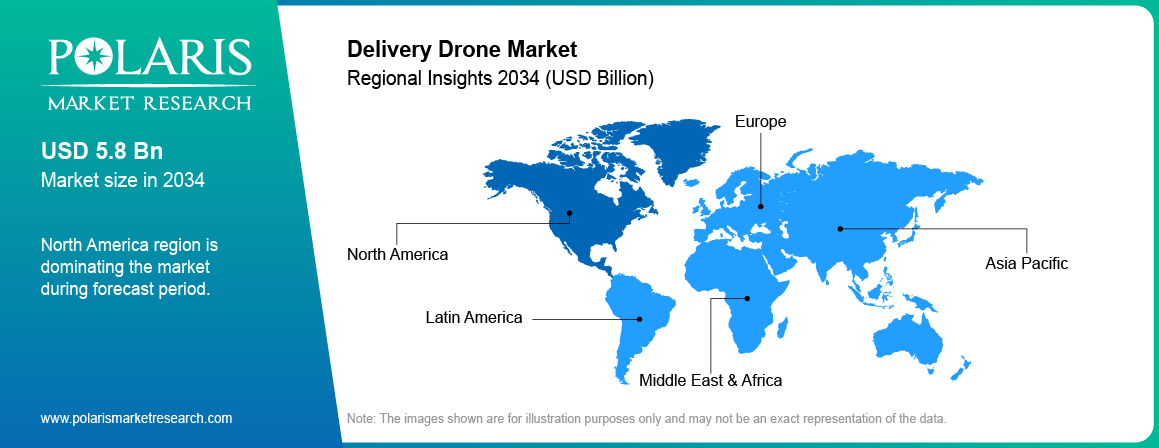
- North America led with an 42.79% share in 2025. This is due to the recent favorable Federal Aviation Administration (FAA) rulings in the region.
- Asia Pacific is projected to witness the fastest growth at an 23.8% CAGR. E-commerce growth in major economies such as China and India drives the regional market growth.
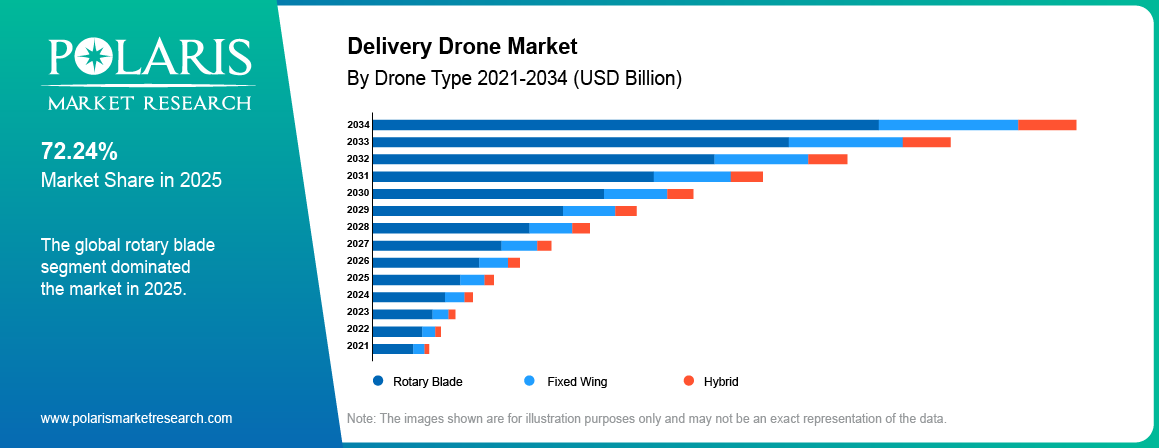
- By drone type, the rotary blade segment held an 72.24% share in 2025. This is due to the high urban maneuverability of rotary blade delivery drones.
- By payload, the less than 2 kg segment accounted for an 56.7% delivery drone market share in 2025. High item eligibility of this payload category drives its leading market position.
- By duration, the more than 30 minutes segment is projected to grow at an 24.2% CAGR. This is primarily due to expanding operational capabilities of delivery drones.
Note: Figures and projections outlined in this report are the result of Polaris Market Research’s proprietary analytical processes, grounded in the latest available datasets and market observations.
Delivery Drone Market in Simple Terms
- What it is: Delivery drones refer to unmanned aerial vehicles that help deliver goods such as packages, medicine, food, and any other product from one point to another.
- Where it is used: They are used in last-mile delivery in urban settings as well as delivering to remote places.
- Why it matters: The application of delivery drones helps in saving time and minimizing the use of delivery vehicles in the delivery process.
How Does Drone Delivery Work?
Order: The customer orders drone delivery. After that, the package is delivered to the facility responsible for drone delivery dispatching.
Loading at Hub: The package is loaded into the cargo hold of the drone. The drone is pre-flight tested.
Route Generation: A flight route is chosen for the drone. This route should meet all local airspace and operational regulations.
Autonomous Flight: The drone starts its journey from the airfield to the destination. During the journey, navigation devices control the flight of the aircraft.
Drop-off: The drone arrives at the destination and drops off the package. In accordance with the chosen design, the drone will either land or lower the package.
Return or Next Mission: After the delivery, the drone goes back to the operating hub. In some cases, the drone can be recharged for a new flight mission.
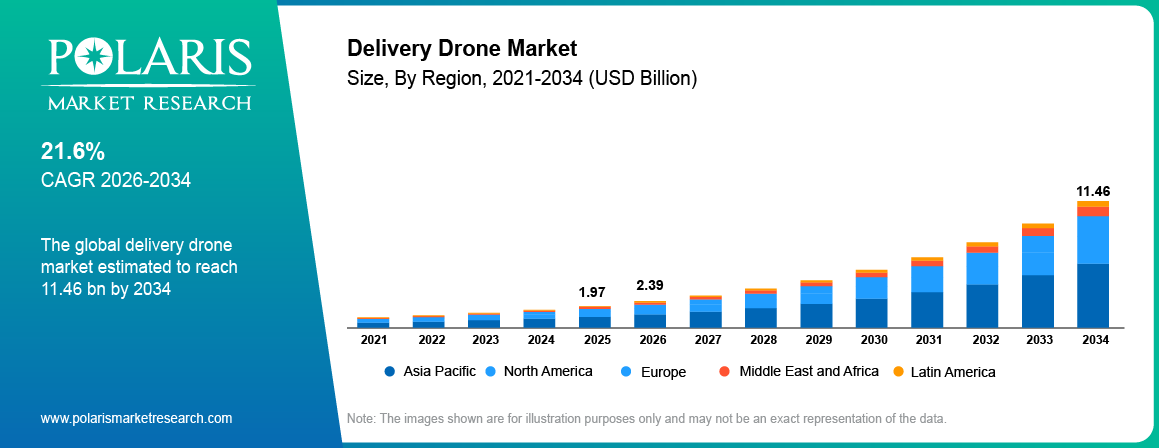
Delivery Drone Market Dynamics
The delivery drone market is driven by evolving delivery requirements, technological advancements, cost considerations, and regulations.
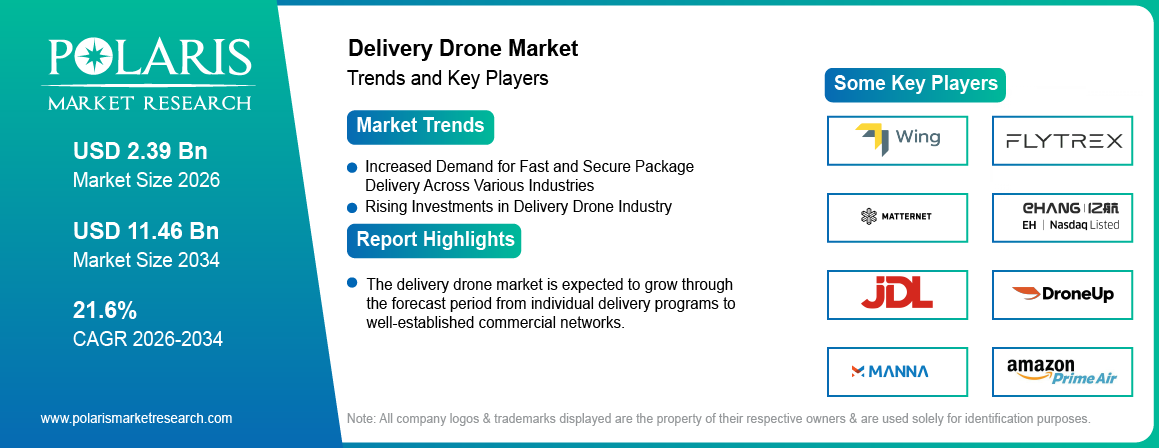
Driver : Increased Demand for Fast and Secure Package Delivery Across Various Industries
Shorter delivery times are becoming more popular in the retail industry, food industry, health care, and other industries. The retailers require delivery solutions that can be used to provide deliveries to the customers but do not depend solely on road-based transport. Faster transport of medications and medical items is required by the healthcare providers. Drone delivery can help deliver selected goods along routes that take longer with conventional transport. This is especially the case in the suburbs and other places that have poor access by road. FedEx and IIT Madras completed urban drone logistics operations in Bengaluru in April 2026. The trials connected Electronic City Phase II to another point near Bangalore International Airport. They reduced the transit time from over one hour to minutes (source: fedex.com). These applications have led to an expansion of last-mile drone delivery beyond small consumer packages. They are also supporting demand for drone-based delivery services within established logistics networks.
Driver : Rising Investments in Delivery Drone Industry
Investments in the delivery drone sector have helped establish commercial networks and expand service reach. Investors are funding aircraft, operational infrastructure, and in-flight autonomy. This is helping move drones from experimental delivery use to commercial applications. Increased delivery platforms have led to more customers for drone operators. Uber made a strategic investment in Zipline for its drone delivery partnership in August 2026. The strategy of integrating Zipline with Uber Eats is expected to allow the company to operate in different regions of the U.S (source: uber.com). As a result, investment in the technology is being extended from drone producers to others. Delivery services and food logistics companies are also investing in developing their drones' delivery capacities. Their increased involvement can support the formation of commercial drone delivery networks. Thus, rising investments are driving the delivery drone market development.
Restraints and Challenges : Airspace Integration and Operational Constraints
There are still some challenges associated with airspace access and the operation of delivery drones. It can be rather difficult to integrate them with unmanned traffic management systems in places with lots of other drones. There is also a restriction on the carrying capacities of delivery drones – they cannot carry very heavy or big loads. Moreover, their batteries may limit their flight range, and they may need to recharge between flights. Heavy rains and strong winds may also be a problem. The general public may also be reluctant to accept them, as noisy drones flying over their homes and recording visual information can be disruptive. Drone costs for operators are very high; in addition, safety requirements put extra pressure on the market.
Opportunities : Expanding Drone Delivery Across Healthcare Networks
Healthcare is a specific application area in which drones can be useful due to the urgent nature of the shipments. Drones can deliver medicines, laboratory samples, blood, and other necessary supplies between health institutions. The model can link hospitals with labs and logistics centers without necessitating the transportation of each shipment on roads. The application area can enable delivery to health institutions situated in distant places. The specific healthcare routes can provide more reliable transportation of certain medical supplies. As healthcare companies increase the size of their network, drone delivery can become part of their internal logistics operations.
Opportunities : Development of Dedicated Drone Corridors for Middle-Mile Logistics
Drone flight corridors could also create new opportunities beyond direct deliveries to customers. The drone corridors could link together warehouses, distribution centers, and local delivery depots over larger distances. A middle-mile solution could enable drones to transfer cargo among logistics facilities before making the final deliveries. Drones using fixed corridors may have better routing than those operating in an unregulated space. Companies could utilize such corridors for transferring smaller shipments among different facilities without having to take another trip on the ground. The development of such networks could support larger-scale commercial drone operations.
Trend : Integration of Drone Delivery With Existing Logistics Platforms
Drone delivery is becoming increasingly intertwined with traditional logistics and delivery channels. The operator can use order management systems to assign drone deliveries along with regular deliveries. In this way, the business owner can choose how to deliver the package depending on its requirements and the delivery zone. Drone deliveries can also be tracked using regular delivery interfaces. Integration with retailers and food delivery portals is increasing the number of clients that will potentially use the services of drone operators. It also eliminates the necessity to develop an individual ordering system for drone delivery services. In the future, this can enable the integration of drone delivery into the entire fulfillment system and not just be a single service.
Trend : Shift Toward Specialized Drone Designs for Delivery Applications
There have been efforts to design drones that are tailored to the needs of delivering packages. Such designs vary in the capacity to carry packages, flying capability, and how packages are handled. For instance, there are drones that have enclosures to ensure that the packages stay safe while flying. Then there are those that enable packages to descend without landing on the ground. Hybrid vertical takeoff and landing designs are also under consideration in cases where long flights are needed. Such specialization ensures that operators can choose an airplane based on the kind of delivery services they offer. This trend is resulting in more diverse designs of delivery drones that will suit various environmental conditions.
Regulatory Landscape and 2026 BVLOS Update
As of September 21, 2026, FAA Part 108 remains a proposed rule, with the final rule still under review. The proposal is aimed at establishing a national framework for routine BVLOS drone delivery and other operations conducted beyond visual line of sight.
United States: FAA Part 108 Status and Timeline
The FAA published its FAA Part 108 proposed rule on August 7, 2025. The proposal sets out requirements for routine BVLOS operations without relying on individual waivers for every flight. Comments closed on October 6, 2025, followed by a limited reopening of the comment period from January 28 to February 11, 2026. The proposed rule remained under review in September 2026. Its review at OIRA began on July 10, 2026, and the nominal 90-day review period runs into October (source: regulations.gov). The proposal covers areas such as detect-and-avoid, Remote ID, and integration with unmanned traffic management. It is separate from the combination of Part 135 certificates, Part 107 waivers, and individual exemptions currently utilized by commercial delivery operators.
For now, FAA Part 135 drone delivery provides an established route for approved commercial package delivery operations. Part 135 is an air-carrier certification framework rather than the proposed Part 108 system. Operators using this route must also meet applicable FAA requirements for their specific operations. This distinction is important for the market because Part 108 has not yet replaced the existing approval structure.
Europe, Canada, China and India
Europe: Drone operations in the European Union are governed through the EASA framework. Higher-risk operations fall under a specific category, where operators generally use an operational risk assessment such as SORA. U-space provides a separate framework for drone traffic in designated airspace. The approach gives operators a common regulatory structure across EU member states rather than separate national BVLOS rules.
Canada: In November 2025, Transport Canada implemented new regulations for BVLOS flights (source: canada.ca). These changes resulted in a path for lower-risk complex operations without the need for an additional SFOC per flight. An operator that meets the listed criteria can follow the new regulations for tasks such as some commercial UAV operations. This gives delivery companies a legal path for operations outside of visual line of sight exclusively in uncontrolled airspace, at low levels, and at least 1 km away from populated areas.
China: China’s strategy has revolved around creating official routes for UAV logistics operations. The CAAC has also been involved in developing standards for fixed-wing UAV routing that can be used for logistics operations in a region. This approach is important in terms of delivery services as operators will be able to conduct routine flights using such routes and not individual flights for each delivery.
India: India's drone market continues to operate under the Drone Rules, 2021 and DGCA requirements. The rules establish operating categories based on factors such as weight and the conditions of flight. DGCA has also issued requirements covering remote pilot training and certification. Commercial BVLOS drone delivery therefore remains dependent on the applicable permissions and operating framework rather than having a broad, standalone BVLOS delivery rule comparable to the proposed U.S. Part 108 framework.
Technology Landscape
Delivery drones rely on several technologies that ensure safe navigation, flight control, and management of the fleets. The main distinctions between rotary-wing / fixed-wing / hybrid VTOL delivery drones are the mechanisms of takeoff, flight, and the ways they manage to navigate through delivery routes. The rotary-wing drones can hover and operate in enclosed spaces. Fixed-wing drones are designed for long-distance flights. Hybrid VTOL drones can combine the features of vertical takeoff and winged flights. This information is presented in detail in the By Drone Type section.
Another layer of technologies is needed to manage flights safely. Detect-and-avoid / unmanned traffic management systems ensure the safety of drones' flights among other vehicles and in shared airspace. Fleet management systems enable the operators to plan flights, keep track of the aircraft, and monitor the completed delivery tasks. Battery systems are responsible for the time a drone can spend in the air. The propulsion systems influence the efficiency of flights, handling of the load, and the distance the flights can cover.
Delivery Drone Market Segment Analysis
The delivery drone market is analyzed by operations, business, and technology aspects. Segmentation makes it easier to analyze how the market revenue varies with respect to different aspects such as aircraft design, applications, systems, payloads, and flying time.
| Segmentation Axis | Segments |
| By Drone Type | Rotary Blade · Fixed Wing · Hybrid |
| By Application | E-commerce · Quick Service Restaurants · Retail · Healthcare · Others |
| By Component | Airframe · Propulsion System · Controller System · Camera & Sensors · Others |
| By Payload | Less Than 2 Kg · 2 Kg to 5 Kg · More Than 5 Kg |
| By Duration | Less Than 30 Minutes · More Than 30 Minutes |
| By Region | North America (US, Canada) · Europe (Germany, France, UK, Italy, Spain, Netherlands, Russia, Rest of Europe) · Asia Pacific (China, Japan, India, Malaysia, South Korea, Indonesia, Australia, Rest of Asia Pacific) · Middle East & Africa (Saudi Arabia, UAE, Israel, South Africa, Rest of Middle East & Africa) · Latin America (Mexico, Brazil, Argentina, Rest of Latin America) |
Source: Polaris Market Research Analysis
By Drone Type
The rotary blade segment led the global delivery drone market with an 72.24% share in 2025. These drones have vertical takeoff and landing capability and, thus, do not require any dedicated runways or large launch surfaces for taking off and landing. Their hovering capability increases control during the process of dropping off the packages, especially in places such as residential and commercial areas. Moreover, this market segment benefits from the extensive use of multirotor design in short-distance deliveries. Manufacturers are now working on enhancing the aircraft with improved payload capacity, increased flight endurance, and advanced navigational technology. In addition to that, the development in battery technology is enabling drones to operate for long periods without recharging.
The hybrid segment is projected to grow at an 22.11% CAGR. Hybrid drones have vertical takeoff and landing as well as wing-borne flight capabilities. This makes them suitable for operation from places with minimal infrastructural facilities as well as traveling longer distances. Hybrid drones are useful in delivery networks that need to extend operational distances without relying on winged-flight takeoff and landing capabilities. The use of hybrid drones allows for different modes of flight depending on the needs of the route. Hybrid drones have become popular in delivery services in suburbs and regions and in the delivery of health logistics where delivery stations may be spread over large distances.
| Attribute | Rotary-wing (multirotor) | Fixed-wing | Hybrid VTOL |
| Take-off and landing | Vertical; can hover | Needs launch and recovery equipment or a strip | Vertical take-off and landing, wing-borne cruise |
| Strength | Precise drops, tight urban spaces | Range and energy efficiency in cruise | Combines point-to-point delivery with longer range |
| Trade-off | Higher energy use per kilometer | Less suited to dense urban drop-off | More complex airframe and certification |
| Best-fit use | Urban and suburban last mile; heavy-lift multirotors for industrial sites | Rural and regional routes, healthcare networks | Suburban home delivery and long-range healthcare |
| Market signal | 72.24% share in 2025 | Forecast, 21.61% CAGR | Highest growth rate, 22.11% CAGR |
Source: Polaris Market Research Analysis
By Application
The e-commerce segment held the largest delivery drone market share of 51.9% in 2025. Online retail companies are exploring e-commerce drone delivery to reduce the delivery time between order fulfillment and receipt of goods. This is especially true for small, time-sensitive packages. Drone delivery can also help serve customers who live in regions where traffic hampers the conventional delivery process. The drones can be deployed from fulfillment centers, warehouses, or special delivery centers based on the delivery process chosen by the company. This delivery process is especially important for same-day or fast deliveries. In this way, as the online retail network continues to grow with time sensitivity in mind, there will be continued use of drones in the delivery process.
The healthcare segment is projected to grow at an 29.1% CAGR. Medical drone delivery is being explored by healthcare organizations for medical shipments that have controlled transportation requirements. Drones can aid in the transportation of prescription drugs, vaccines, diagnostic materials, and many other healthcare products where transportation time can impact usability or availability to patients. Products requiring temperature control can be transported using the drone transport mechanism. This can be used for both scheduled and on-demand transportation depending on the type of medical shipment and environmental circumstances. This can help reduce delays due to traffic and other hard-to-reach delivery destinations. The rising adoption of specialized drone systems for healthcare transportation needs is therefore driving the application market segment.
By Component
The propulsion segment accounted for an 28.7% share in 2025. The propulsion system influences the efficiency with which a drone produces thrust as well as stability when flying during its deliveries. This system incorporates the motors, propellers, speed control electronic system, and drive system for the drone. The demand for a propulsion system depends highly on the need for efficient performance under different payload conditions. More efficient motors may be helpful in controlling battery utilization while ensuring the generation of the thrust needed during flights when the drone is carrying loads. Manufacturers are designing propulsion systems that give maximum power generation without increasing the weight of the drone.
The cameras & sensors segment is projected to grow at an 23.4% CAGR. These technologies give drones visual and environmental information that is required when in flight and delivering packages. Cameras can help with navigation, package placement, and analysis of the landing site, and sensors can detect nearby objects and any changes in the environment while flying. The importance of these technologies increases as delivery drones fly through an environment that includes buildings, trees, power lines, and other obstacles. Improved accuracy of sensing also makes autonomous flights more dependable. The use of miniaturized sensors can bring these features without making the drone heavier. Demand for cameras and sensing systems is expected to grow as drone operators become more automated in their delivery missions.
By Payload
The less than 2 kg segment held an 56.7% delivery drone market share in 2025. Such payloads are well suited for routine deliveries by drones, including retail items, food preparations, medications, and similar small packages. Smaller payloads also need less lift, and this enables them to conserve battery usage while performing deliveries within shorter distances. This delivery drone payload capacity suits the operational needs of many delivery services in urban and suburban areas, where the size of the package is normally restricted. The reduced weight also enables the operator to have more options in choosing the aircraft and planning the flight routes. The growth of drone delivery services in consumer applications is further boosting the market segment.
The 2 kg to 5 kg segment is projected to grow at an 22.8% CAGR. This payload range can carry more diverse packages than light delivery drones. These include larger retail deliveries, grocery deliveries, as well as certain healthcare products. This range is also suitable for delivery services that require a balance between cargo space and flight efficiency. Delivery drones in this range can perform delivery services where a small package is not the only thing required, but heavier drones would result in additional costs. This payload range can therefore be used in delivery services where bigger packages are delivered while remaining flexible enough to use drones. Advances in battery technology and flight systems also help operators carry more cargo while not limiting the routes significantly.
By Duration
The less than 30 minutes segment held an 63.2% delivery drone market share in 2025. Shorter flight times are consistent with many of the delivery systems that only cover a certain geographic region. They are particularly useful in urban and suburban deliveries where the drones can do their delivery mission and fly back within one flight session. Reduced flight time can also lower the requirement for battery storage capacity per mission, making it easier to charge the batteries. The segment suits delivery systems that deliver to nearby clients with repeated delivery missions. As local drone delivery networks are created by the operators, the requirement for this kind of aircraft is expected to continue.
The more than 30 minutes segment is projected to grow at an 24.2% CAGR. Increased drone flight duration enables the aircraft to serve larger territories without needing to return immediately to the starting point. This is significant for deliveries to places that are farther apart from each other, such as regional logistics corridors and far-away territories. Increased endurance would also provide the opportunity for more mission-planning flexibility, especially when there are several restrictions for route selection and landing. Battery power density and efficiency have improved in recent years, and thus delivery drones are gaining increased operating time. This segment may become increasingly important as commercial networks expand.
Regional Analysis
Delivery drone market analysis is done across five prominent regions, which are characterized by varying degrees of adoption and development within each market. The North America market accounted for the largest share of the global market in 2025. Meanwhile, the Asia Pacific region is expected to grow at the fastest rate during the forecast period. Below are discussions of developments in each region and its prominent country markets.
North America
North America held the largest delivery drone market share of 42.79% in 2025. A number of businesses are already providing drone delivery services in the region, especially in the U.S., where companies are increasing drone delivery services in a range of industries, including retail, food, healthcare, and others. Development in this direction is contributing to the creation of drone delivery networks. Canada is creating better ways of conducting BVLOS operations that could help in providing drone delivery services in hard-to-reach places. Logistics infrastructure, as well as investments in autonomous delivery services, is already in place in the region, and large technology and logistics corporations are experimenting with various business models and thus are helping to expand the application of drones beyond pilot projects.
Asia Pacific
The drone delivery market in Asia Pacific is anticipated to register the fastest growth at an 23.8% CAGR. Commercial drones are becoming popular in the region in areas such as e-commerce, food delivery, healthcare, and logistics. Countries like China, Japan, India, South Korea, and Australia are developing their own commercial drone operations depending on their needs. Moreover, growing activity in the online retail market is driving demand for faster last-mile deliveries in major cities. Regulations are also becoming more structured within the region, thereby allowing companies to carry out their commercial drone service tests. Increased investments in drone technology and infrastructure are further contributing to the growth of the regional market.
Europe
Europe accounted for an 24.6% share of the delivery drone market in 2025. The region is developing its ecosystem for drone delivery through uniform European Union regulations in air transport and national-level implementation policies. Countries like Germany, France, the UK, Italy, and the Netherlands have shown interest in using drones for healthcare applications, retail, logistics, and many other kinds of deliveries. Drones play an important role when road transport is likely to be slow and challenging. Moreover, U-space solutions are being created to help ensure that drones can be safely integrated into shared airspace. At the same time, businesses across Europe are developing autonomous aircraft as well as delivery infrastructures. All these factors contribute to the expansion of drone delivery services in the region.
Latin America
The Latin America delivery drone market is projected to grow at an 20.4% CAGR. The application of drones is currently being tested in a wide range of sectors including retail, food delivery, healthcare and logistics services. Drones may be used as an alternative means of making deliveries in areas that have inadequate road networks or where journey times are long. Among the markets that are currently creating opportunities for the use of drones commercially are Brazil and Mexico, with the growing use of e-commerce and automation of logistics services driving demand. Delivery of health care services in far-off areas is another area of interest due to the need for delivering time-sensitive payloads to remote communities. Innovations in drone technology are also improving their suitability in different applications.
Middle East & Africa
The Middle East & Africa delivery drone market is projected to grow at an 19.7% CAGR. There is increasing demand for delivery services in logistics, healthcare, retail, and other sectors where deliveries have to be made to remote areas or inaccessible locations. The Middle East is making investments in smart infrastructure and automation in logistics to try out delivery drones as well as implement them commercially. In Africa, drones can be used to address gaps in road networks and deliver supplies where required. In South Africa, too, drones are being considered for logistics purposes. The regulation of drones, their operational network, and investments will play a key role in this process.
Delivery Drone Use Cases
Delivery drones are now being used in the delivery of various kinds of packages, including consumer products, prepared meals, medications, and health-related goods. Delivery by drones may be particularly useful in areas such as healthcare delivery where timely deliveries may be required, including cold-chain drone delivery. Some of the commercial projects that have been undertaken using drones include those by Walmart, Amazon, and Zipline. The table below provides selected examples.
| Application | Company / Program | Use Case Details |
| Retail and e-commerce | Walmart with Wing | More than 1 million drone deliveries across Dallas-Fort Worth, Greater Houston, and Atlanta (source: walmart.com) |
| Retail and e-commerce | Amazon Prime Air MK30 | Packages up to 5 lb; deliveries in as little as 30 minutes |
| Healthcare | Zipline Cleveland Clinic | Prescription delivery for eligible patients, with planned expansion to lab samples and hospital-at-home supplies (source: clevelandclinic.com) |
| Healthcare | Wingcopter with Sincronía Logística | Pharmaceutical and healthcare product transport in Mexico |
| Food and quick service | Zipline in Austin | Food and retail orders delivered through the Zipline app |
| Industrial and heavy lift | DJI FlyCart 30 with Speedbird Aero | Payloads of up to 30 kg; customized platforms for oil-sector applications |
| Rural and remote healthcare | Zipline in Rwanda and Ghana | Delivery of blood, vaccines, and medical supplies to remote facilities |
Source: Polaris Market Research Analysis
Cost and Sustainability
The drone delivery cost per package differs depending on the route, payload, operation system, and fleet use. In a June 2026 review of 21 case studies of medical drone delivery services, the harmonized cost was estimated to be USD 16.07 per delivery, adjusted to 2025 dollars (source: sciencedirect.com). There were notable variations between cases based on the different operating modes and circumstances. The cost is specific only to medical drone deliveries analyzed in the research and cannot be considered universal for all drone deliveries.
Using electric propulsion can help in reducing direct emissions since delivery drones need neither gasoline nor diesel fuel. Total impact on the environment depends on the power consumed in the process of charging batteries, manufacturing batteries, aircraft utilization, and the type of ground transportation that is replaced. Drones are able to reduce dependence on road vehicles for appropriate short distances.
Another possible advantage that can be achieved by using drones is reduced chances of being affected by road congestion. Drones can make direct flights from one point to another, not having to follow roads. Such an advantage is more relevant for urgent and time-sensitive cargo deliveries when traffic can affect delivery times. As for cost and sustainability, they will depend on how drones are integrated into logistics processes.
Value Chain and Ecosystem
The delivery drone market value chain consists of companies that produce aircraft, supply parts, design software, operate aircraft, and deliver goods. Aircraft producers manufacture aircraft and install systems such as propulsion systems, battery packs, controls, cameras, and sensors. Hardware companies provide hardware needed in these systems.
Operators manage the operation of the aircraft by planning the route, recharging and maintaining the aircraft on a daily basis. Retailers, restaurants, health care companies, and logistics companies provide orders and deliveries for commercial drone deliveries. Other players in this ecosystem are regulators and airspace service providers that dictate operating rules and integration into the airspace system. Customers are the final point in the chain.
Competitive Landscape
The competition in the delivery drone market is influenced by aircraft performance, efficiency, scope of services provided, and the ability to scale up operations commercially. There are various approaches being developed for solving the challenges related to short-haul deliveries in cities, long-range flights, and specific applications such as healthcare services. Commercial delivery drone companies are collaborating with retailers, delivery service providers, healthcare companies, and logistics firms to extend the area of their service provision and reach a larger number of clients. Moreover, obtaining regulatory approvals can influence the speed of entering new markets or extending the existing ones.
Vendor Positioning
| Company | Model and Platform |
| Alphabet Inc. (Wing) | Wing delivery drones and Wing delivery platform |
| Amazon (Amazon Prime Air) | MK30 and Prime Air delivery system |
| DroneUp Ecosystem, including DBX, Uncrew, and autonomous delivery drones | |
| Flytrex Inc. | Flytrex drone delivery platform and on-demand delivery service |
| Guangzhou EHang Intelligent Technology Co., Ltd. (EHang) | EHang 216L heavy-cargo pilotless aircraft and Command-and-Control System |
| JD.com, Inc. (JD Logistics) | JD Logistics delivery drones and autonomous logistics platform |
| Manna Drone Delivery | Manna drone delivery service and ordering platform |
| M2 drone, automated landing station, and Matternet Software Platform | |
| Meituan | Meituan drone delivery system and autonomous delivery network |
| Skyports Drone Services Limited | Automated drone delivery services and multi-aircraft delivery platform |
| Speedbird Aero | BIRD-S, BIRD-M, BIRD-X and Cloud Control Station (CCS) |
| UPS Flight Forward Inc. | Matternet M2 drone delivery platform |
| Volatus Aerospace Corp. (operating Drone Delivery Canada) | Canary, Robin XL, Sparrow, and Condor delivery platforms |
| Wingcopter GmbH | Wingcopter 198 delivery drone and Wingcopter delivery solutions |
| Zipline International Inc.
| Zipline Platform 2 (P2) and autonomous delivery system |
Source: Polaris Market Research Analysis
Industry Developments
- August 2026: Amazon Prime Air announced plans to reach over 500 towns and cities in the U.S. The company stated that this will bring ultrafast drone delivery to communities with tens of millions of customers across the U.S. (source: aboutamazon.com)
- July 2026: Zipline announced the next phase of its expansion in the U.S. The company highlighted upcoming launches in Austin and Cleveland. It also revealed that the number of businesses offering delivery through the Zipline app grew by 13X during the first half of 2026. (source: globenewswire.com)
Future Outlook
The delivery drone market is expected to grow through the forecast period from individual delivery programs to well-established commercial networks. The adoption level in different markets is expected to vary depending on whether drone delivery provides an operational advantage over traditional transportation modes. There could be differentiation in the way networks operate as well, with some networks providing frequent local deliveries and others fulfilling other specific needs. With increasing experience, companies are expected to prioritize the utilization of their fleets and the economics of each route. The drone operator and fulfillment network will likely see increased integration, with drones delivering select orders through fulfillment networks. The gradual transition from individual programs to networks will define the future development of the market.
Research Methodology
The study defines the delivery drone market based on the types of unmanned aerial vehicles (UAVs), onboard systems, ground systems, and payloads included in the analysis. Ground delivery robots and revenue from delivery services are excluded from the market size.
Secondary research draws on publications from aviation regulators, company filings and announcements, trade and customs data, and industry associations. Regulatory information is checked against sources such as the Federal Aviation Administration (FAA), European Union Aviation Safety Agency (EASA), and national aviation authorities.
The primary research involves interviews with the drone makers, delivery providers, logistics companies, healthcare companies, and regulatory experts. These interviews offer more insights into the commercial operation, operational environment, and market penetration.
Market sizing involves the top-down analysis that depends on the number of parcels deliverable by drones and locations in which drone delivery can be performed. The findings from the analysis are compared with the bottom-up estimate using fleet size, number of deliveries for each drone, and revenue per unit. Both analyses reconcile to obtain the market estimates.
The forecasting involves expected changes in the BVLOS permits, fleet size, and delivery economics. The base year of the forecast is 2025, while the forecast period is between 2026 and 2034. The market estimates are cross-checked using company deliveries and permitted routes. Other published market estimates are reviewed when relevant to identify major differences in the delivery drone market size or growth estimates.
Delivery Drone Market Report Scope
| Report Attributes | Details |
| Market Size Value in 2025 | USD 1.97 billion |
| Market Size Value in 2026 | USD 2.39 billion |
| Delivery Drone Market Forecast 2034 | USD 11.46 billion |
| CAGR | 21.6% from 2026 to 2034 |
| Base Year | 2025 |
| Historical Data | 2021–2024 |
| Forecast Period | 2026–2034 |
| Quantitative Units | Revenue in USD billion and CAGR from 2026 to 2034 |
| Report Coverage | Revenue Forecast, Market Competitive Landscape, Growth Factors, and Industry Trends |
| Segments Covered |
|
| Regional Scope |
|
| Competitive Landscape |
|
| Report Format |
|
| Customization | Report customization as per your requirements with respect to countries, regions, and segmentation. |
Source: Polaris Market Research Analysis
Delivery Drone Market FAQ's
The delivery drone market size was valued at USD 1.97 billion in 2025. The market is projected to reach USD 11.46 billion by 2034.
The market is projected to account for a CAGR of 21.6% from 2026 to 2034.
North America dominated with an 42.79% share in 2025. The recent favorable Federal Aviation Administration (FAA) rulings contributed to the region’s leading market position.
The more than 30 minutes segment is anticipated to account for an 24.2% CAGR. This is owing to the expanding operational capabilities of delivery drones.
A few of the key drone delivery market players include Alphabet Inc. (Wing); Amazon (Amazon Prime Air); DroneUp, LLC; Flytrex Inc.; Guangzhou EHang Intelligent Technology Co., Ltd. (EHang); JD.com, Inc. (JD Logistics); Manna Drone Delivery; Matternet Inc.; Meituan; Skyports Drone Services Limited; Speedbird Aero; UPS Flight Forward Inc.; Volatus Aerospace Corp. (operating Drone Delivery Canada); Wingcopter GmbH; and Zipline International Inc.
Delivery drones are used to transport medicines and medical supplies. They can also carry laboratory samples. The use of drones is relevant for time-sensitive healthcare shipments.
Delivery drones generally carry lightweight packages. The suitable payload depends on the aircraft model. Some commercial drones can carry packages weighing more than 5 kg.
There are regulations regarding where delivery drones can fly. The range of flight also impacts their use. Weather conditions can hinder some delivery paths. Operating costs are yet another consideration for service providers.
Yes. The use of drone delivery services in the United States is legal, subject to requirements by the FAA. Package delivery can be done commercially under the guidelines of FAA Part 135, while Part 107 allows certain deliveries with line of sight.
Download Sample Report of Delivery Drone Market
Please fill out the form to request a customized copy of the research report.


