
Digital Asset Custody Market Size, Share, and Forecast 2027 to 2035
REPORT DETAILS
Digital Asset Custody Market Summary
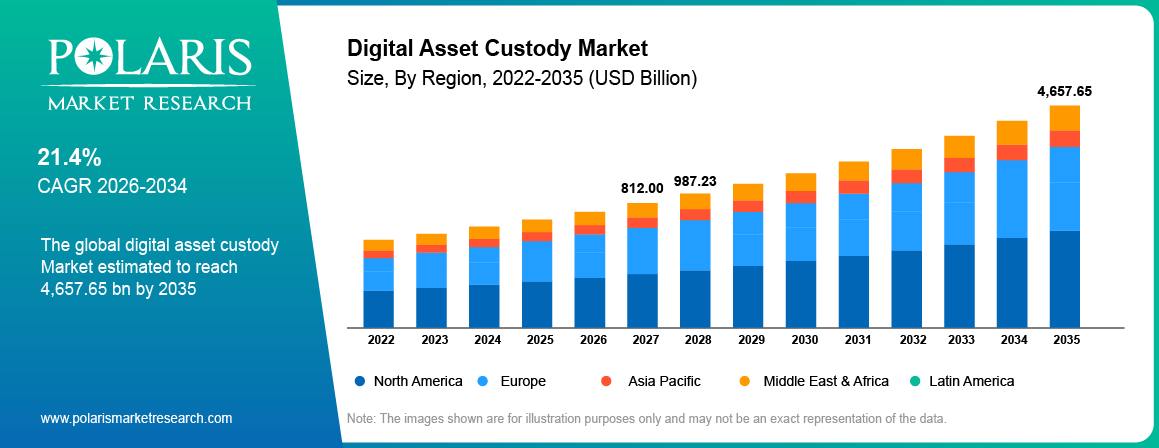
According to Polaris Market Research analysis, the digital asset custody market was valued at USD 812.00 Billion in 2026. It is projected to reach USD 4,657.65 Billion by 2035, growing at a CAGR of 21.4% from 2027 to 2035. Growth is supported by spot crypto exchange traded products, bank entry into safekeeping, and clearer licensing rules in the United States, Europe, and Asia. Cold Storage holds the largest share of storage type, while Tokenized Securities and Real World Assets expand quickest. The market measures the value of digital assets held with third party custodians, and it excludes assets kept in personal wallets. North America is the leading market. Asia Pacific is the fastest growing region.
Market Statistics
Key Takeaways
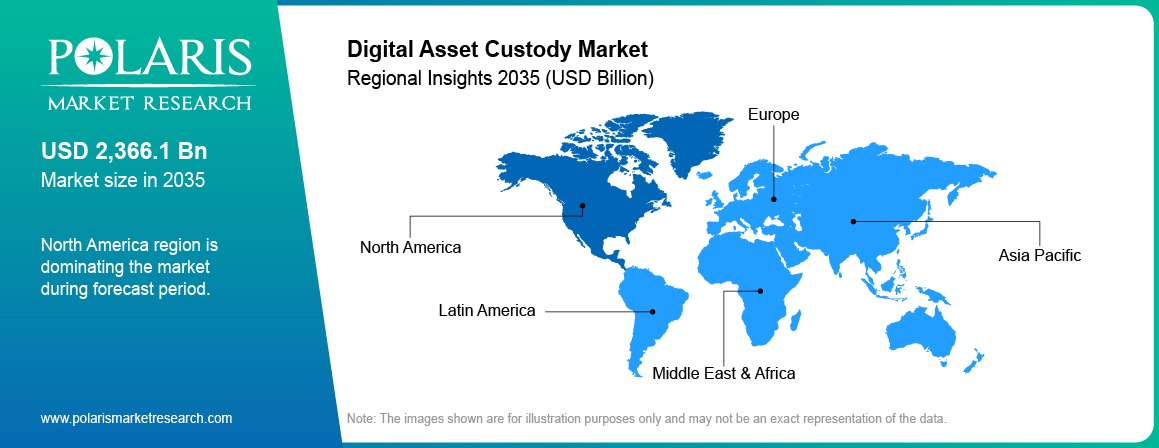
- North America commanded 39.9% of 2027 assets under custody, owing to the largest base of qualified custodians, spot exchange traded products, and institutional clients that prefer regulated safekeeping.
- Asia Pacific expands at 24.4% a year to 2035, the highest regional rate, driven by fresh licensing rules in Hong Kong and Japan plus tokenization work across the region.
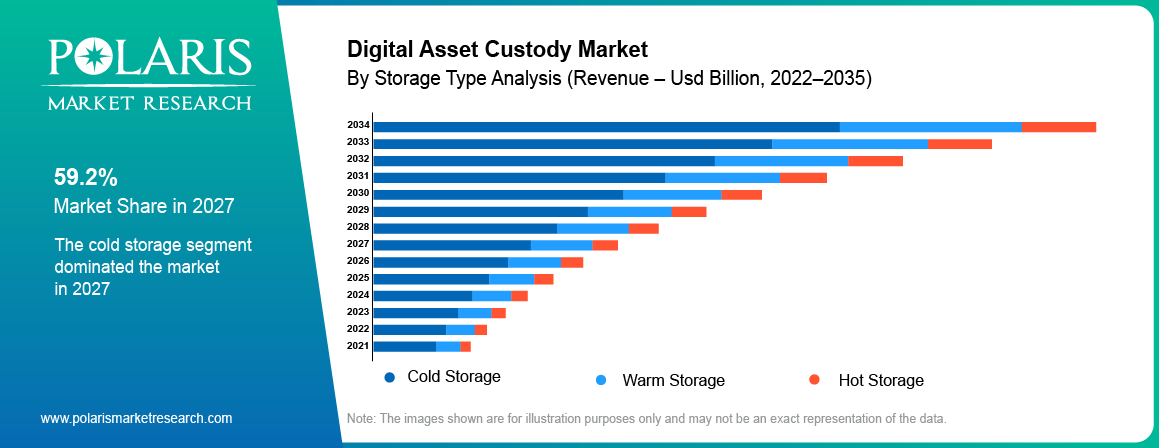
- Cold Storage accounts for 59.2% of 2027 storage type value, as institutions and regulators favor keys that stay offline.
- Warm Storage posts the highest storage CAGR, at 24.8% through 2035, since it combines offline signing with faster release of funds for trading and settlement.
- Cryptocurrencies led the asset type split with USD 565,966.1 Million held in 2027, due to large Bitcoin and Ether positions in exchange traded products.
- Banks and asset managers are moving funds and deposits onto blockchains, so Tokenized Securities and Real World Assets grow 27.8% a year to 2035.
- Safekeeping now sits inside existing bank custody platforms, supporting the 39.0% of 2027 value held by Financial Institutions and Institutional Investors.
- The fastest end user growth, at 26.0% a year to 2035, comes from Corporates and Public Sector Organizations, as treasuries add digital assets and stablecoin balances.
- In 2027, Crypto Native Firms and Exchanges held USD 373,077.8 Million, driven by exchanges and trading firms that keep reserves and client assets with outside custodians.
Note: Figures and projections outlined in this report are the result of Polaris Market Research’s proprietary analytical processes, grounded in the latest available datasets and market observations.
Digital Asset Custody Market Definition
The digital asset custody market covers the value of digital assets held for clients by third party custodians that safeguard private keys, record ownership, and process transfers. It includes cryptocurrencies, stablecoins, and tokenized securities, and it excludes assets that owners keep in their own wallets without a custodian.
Published market sizes for this field run in the hundreds of billions of dollars, a scale that only fits the value of assets under custody and not the fees that custodians earn. Polaris therefore measures the market as assets held, and it reads fee income as a small share of that amount. Wider token holdings, including coins and trading activity, are covered in the cryptocurrency market.
Custody rests on key control. A custodian holds the private keys that authorize transfers, and it protects them with hardware security modules (HSMs), multi party computation (MPC), and strict approval workflows. Underlying ledgers are described in the blockchain technology market, and clients rely on the custodian to prove that each balance is backed one for one.
Three storage types exist. Cold storage keeps keys on devices that never touch the internet, warm storage keeps them in controlled online systems that need approvals before use, and hot storage keeps them in live systems for fast movement. Each type trades safety against speed, and custodians usually blend them within one account.
Asset coverage is widening beyond Bitcoin and Ether. Dollar backed tokens, discussed in the stablecoins and CBDCs market, now sit in custody as reserves and settlement balances, while tokenized funds and deposits bring traditional securities onto blockchains, a trend followed in the tokenization market.
Digital Asset Custody vs Self Custody: Key Differences
| Attribute | Third Party Digital Asset Custody | Self Custody |
| Key control | Held by a licensed custodian under policy and audit | Held by the owner with a personal wallet or device |
| Typical users | Banks, asset managers, funds, exchanges, and corporates | Individual holders and some technical firms |
| Legal protection | Segregation, insurance, and regulatory capital rules apply | The owner bears the full loss if keys are lost or stolen |
| Growth outlook | 21.4% CAGR from 2027 to 2035 | Steady, with limited institutional adoption |
| Typical purchasing argument | Regulated safekeeping that satisfies auditors and investors | Direct control and no custody fee |
Source: Polaris Market Research Analysis
Institutions cannot hold client assets without a qualified custodian in many jurisdictions, so rules drive the choice more than cost does. A fund that offers a spot product, for instance, must show where its keys sit and who can move them.
Porter's Five Forces Analysis
| Force | Intensity | Rationale |
| Bargaining power of suppliers | Moderate | Hardware security module makers, cloud providers, and blockchain networks supply key inputs, yet custodians can switch among several vendors. |
| Bargaining power of buyers | High | Large asset managers and exchanges negotiate fees hard and can split holdings among two or more custodians. |
| Threat of new entrants | Moderate | Licenses, capital, and insurance raise entry costs, but banks and trust companies with existing clients can enter quickly. |
| Threat of substitutes | Moderate | Self custody tools and smart contract vaults compete for technical users, although institutions rarely accept them. |
| Competitive rivalry | High | Crypto native custodians, global banks, and exchanges compete for the same funds, tokenization mandates, and bank partners. |
Source: Polaris Market Research Analysis
Buyers hold the strongest position. Exchange traded product sponsors and large trading firms can move billions between custodians, and many already use more than one, so a provider that lags on security or reporting can lose a mandate within a quarter.
Market Dynamics
Driver Impact Analysis
| Driver | Impact on Market Growth | Time Horizon |
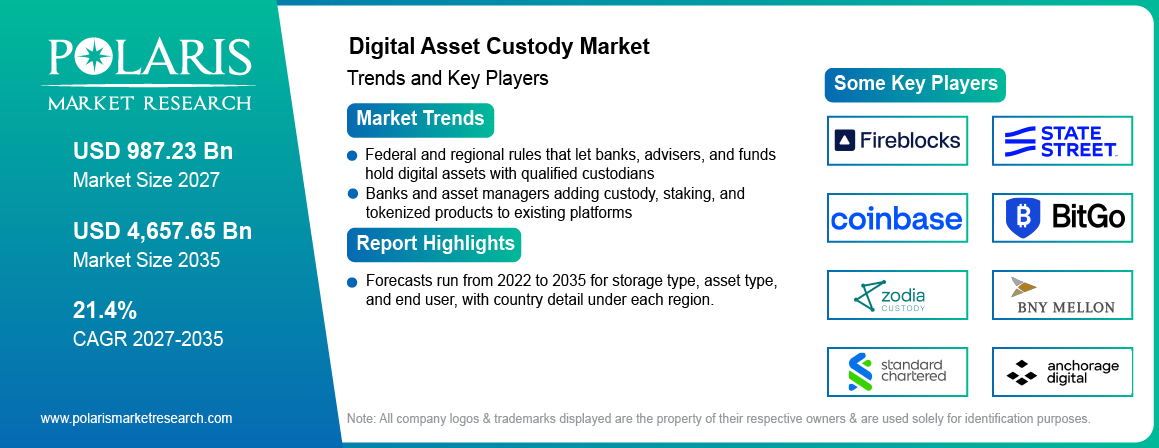
| Federal and regional rules that let banks, advisers, and funds hold digital assets with qualified custodians | High | Short to Medium Term |
| Banks and asset managers adding custody, staking, and tokenized products to existing platforms | High | Medium to Long Term |
Source: Polaris Market Research Analysis
Driver: Clearer Custody Rules for Advisers and Funds Are Widening Institutional Participation, Creating Market Demand
Advisers and funds need a qualified custodian for client assets, and the older United States custody rule was written for securities that sit in bank accounts. Crypto holdings fit poorly, so many advisers stayed out of the asset class. Rule changes that define how digital assets may be held remove that obstacle.
For example, in October 2026, the Securities and Exchange Commission (SEC) proposed new custody rules and amendments that cover how registered funds and registered investment advisers hold crypto securities and client crypto assets. The proposal also updates the related reporting and recordkeeping requirements, and public comments are due on December 7, 2026 (Source: SEC). A final rule would give advisers a clear route to custody providers.
Cold Storage should remain the default for these clients, with 59.2% of 2027 storage type value, since advisers and boards ask for offline keys when they approve a custodian. Warm Storage gains as funds need quicker settlement.
Driver: Banks and Asset Managers Are Adding Digital Asset Services, Creating Market Demand
Large banks already run custody for stocks, bonds, and funds, and their clients now ask for digital assets in the same account. Adding staking, stablecoin access, and tokenized funds lets a bank keep client relationships that might otherwise move to a crypto native firm.
For example, in August 2026, BNY and Galaxy announced that eligible institutional clients would be able to stake digital assets on proof of stake networks inside the BNY Digital Asset Custody platform, alongside fund accounting, tax reporting, and payments. BNY said the offering is subject to regulatory review, and the company reported USD 62.6 trillion in assets under custody and administration at June 30, 2026 (Source: BNY). The size of that base shows how large the pool of potential clients is.
Financial Institutions and Institutional Investors hold 39.0% of 2027 value, and their share should stay close to that level as banks bring existing clients onto digital platforms. Their growth rate of 20.4% is lower than the market, owing to a larger starting base.
Competition for these mandates is rising. Asset managers compare fee levels, insurance cover, and reporting detail, and they expect a custodian to support several networks, so providers must invest in connectivity and staff.
Restraint: Fragmented National Rules and Strict Key Control Requirements Are Raising Operating Costs
Rules differ sharply by country, and compliance teams must adapt systems to each one. Some regulators ask for keys to be generated and stored inside their borders, others require licensed local entities, and a few limit the delegates a custodian may use. Each rule adds engineering and audit cost.
For example, in May 2026, the Hong Kong Monetary Authority issued updated custody guidance for authorized institutions that hold digital assets. Seeds and private keys must be generated, stored, and backed up in Hong Kong, cold wallets must not rely on smart contracts on public blockchains, and security monitoring must run around the clock (Source: Gibson Dunn). A global custodian must therefore maintain a local key facility in addition to its home infrastructure.
Costs rise with each added jurisdiction. Custodians need local staff, separate signing environments, and independent audits, and smaller providers struggle to justify that spending, so the market tilts toward larger players over time.
Hot Storage grows at 23.8% a year to 2035, below Warm Storage, partly because strict key rules push regulated users toward offline and controlled systems. Custodians that offer a clear mix of storage types can still serve clients with different risk limits.
Opportunity: Tokenized Deposits and Stablecoin Balances Are Widening the Custody Base
Banks are testing tokenized deposits, meaning bank liabilities recorded on a blockchain, and stablecoins that settle around the clock. Both need secure key management and reserve safekeeping, so custodians gain new balances to hold that did not exist in the older crypto market.
For example, in June 2026, Anchorage Digital launched infrastructure that lets regulated banks issue and manage tokenized deposits on blockchain networks without replacing core systems. The company said the platform supports transactions at any hour and includes compliance and security controls that match existing banking rules, although it did not name initial clients (Source: PYMNTS).
Stablecoins grow 24.5% a year to 2035, ahead of the market, as payment firms, exchanges, and banks hold reserve balances with custodians. Tokenized Securities and Real World Assets rise faster, at 27.8%, since funds and bonds are moving onto shared ledgers.
Opportunity: Federal Trust Charters Are Giving Crypto Native Custodians Bank Like Standing
A national trust charter lets a crypto native firm operate as a federally supervised bank like entity, a status many institutional clients require before they place assets. Charters also reduce reliance on state by state approvals and give the custodian a single regulator to deal with.
For example, in November 2026, the Office of the Comptroller of the Currency (OCC) granted final conditional approval for Coinbase National Trust Company and authorized it to open on November 9. The approval covers fiduciary custody for institutional clients, requires at least USD 60 million of Tier 1 capital for three years, and allows the migration of custody business from Coinbase Custody Trust Company over a three year period (Source: OCC). The OCC first granted preliminary approval on April 2, 2026.
Crypto Native Firms and Exchanges gain from this change, since a federally chartered custodian can reassure their counterparties. Their share of 2027 value stands at 37.8%, and their growth rate of 19.1% a year is lower than the market because the segment starts from a large base.
Overall, the opportunity depends on supervision. A custodian that earns bank like status can win mandates from pension funds and insurers that cannot use unlicensed providers, but it must also hold the capital and liquidity that regulators require.
Trend: Banks Are Absorbing Crypto Custodians and Bringing Safekeeping In House
Global banks are buying or absorbing crypto custodians to add digital asset services quickly. Such deals bring licenses, technology, and clients, and they let a bank offer custody under its own brand without building every control from scratch.
For example, in May 2026, Standard Chartered said its offer for the custody business of Zodia Custody had been accepted by shareholders and holders of notes, subject to regulatory approvals and customary conditions. The bank plans to place the regulated custody activities inside its Financing and Securities Services unit, while the institutional infrastructure platform moves to a new entity called Zodia Solutions (Source: Standard Chartered). No price or asset figures were disclosed.
Cryptocurrencies still account for the largest asset type share, at 57.3% of 2027 value, so most bank custody mandates start with Bitcoin and Ether. Banks then add stablecoins and tokenized assets once control systems are in place.
Value Chain Analysis
| Stage | Activities | Representative Participants |
| Technology inputs | Supplying hardware security modules, key management software, and blockchain nodes | Security hardware makers, cloud providers, and network operators |
| Safekeeping and key control | Generating, storing, and using private keys under approval policies | Coinbase, BitGo, Anchorage Digital Bank, and Fireblocks |
| Banking and settlement | Linking custody accounts to fiat payments, funds, and trading venues | BNY, State Street Corporation, and Standard Chartered PLC |
| Compliance and assurance | Licensing, audit, insurance, and reporting to clients and regulators | Regulators, auditors, and insurers |
| Clients | Holding assets for investment, trading, treasury, and reserve purposes | Asset managers, exchanges, banks, and corporates |
Source: Polaris Market Research Analysis
Value concentrates in key control and in the compliance layer. A custodian that proves segregation of client assets, passes regular audits, and carries meaningful insurance can charge fees that clients accept, and those protections are expensive for new entrants to match.
Regulation touches every stage. Licensing shapes who may hold assets, key localization rules shape where infrastructure sits, and reporting rules shape what clients can see. Each new rule raises the value of providers that already operate with strong controls.
Fee models vary along the chain. Many custodians charge a fee on assets held, plus separate charges for transfers, staking, and reporting. Since fees scale with asset prices, revenue moves with the market, and that link explains why custodians also sell fixed fee services such as software licenses and compliance support.
Digital Asset Custody Market Segmentation Analysis
Segmentation rests on how keys are stored, what type of asset is held, and what kind of organization owns it. Each cut changes the risk controls, the fee level, and the regulatory path a custodian must follow.
Storage Type Insights
Cold Storage held 59.2% of storage type value in 2027, the biggest share in the dimension, as regulators and fund boards ask for keys that stay offline. Offline vaults also reduce the attack surface, so insurers offer cover on better terms for assets kept there.
Warm Storage is forecast to post a CAGR of 24.8% through 2035, the highest in the dimension, since it keeps signing keys in controlled systems that can release funds within minutes. Exchanges, market makers, and stablecoin issuers need that speed for settlement and collateral calls, and warm designs let them meet it without exposing every key.
Hot Storage recorded USD 161,650.4 Million in 2027, driven by trading desks and payment firms that need assets ready to move at any hour. Custodians cap these balances with strict limits and refill them from deeper reserves, so a breach of a live system cannot reach the full account.
Clients rarely pick one type. A typical institutional account keeps most assets offline, a layer in controlled online storage, and a small operating balance in live systems, and the custodian moves value among them under policy. Providers therefore compete on how well they manage the mix and not on a single vault.
Control design matters as much as the storage label. Hardware security modules, multi party computation, and approval quorums decide who can authorize a transfer, and clients now ask to see test results and incident histories before they sign a mandate.
Insurance is a further point of difference across storage types. Cover limits are usually larger for offline vaults, and policies often exclude losses from insider collusion or from faults in smart contracts. Clients therefore read policy terms closely and set the covered amount against the assets they plan to place.
Asset Type Insights
Cryptocurrencies accounted for 57.3% of asset type value in 2027, owing to the size of Bitcoin and Ether holdings placed with custodians by funds and corporates. The group is the base of every custody business, and growth in it follows market prices and fund inflows.
For example, in January 2026, State Street announced a digital asset platform that will develop and support money market funds, exchange traded funds, and cash products, including tokenized deposits and stablecoins. The bank said it plans to work with money managers, institutional clients, and its own asset management arm, and it had partnered with Galaxy Digital on a tokenized fund in the previous month (Source: Bloomberg).
Stablecoins held USD 156,273.6 Million in 2027, supported by payment firms, exchanges, and issuers that keep reserves and working balances with regulated custodians. These balances are large relative to their price risk, so custodians value them as a stable source of fee income.
Tokenized Securities and Real World Assets are projected to grow at a CAGR of 27.8% over the forecast period, the quickest in the dimension, as funds, bonds, and deposits are issued on shared ledgers. Each token still needs a custodian to record ownership and manage transfer rules, so the custody task grows more complex.
Other Digital Assets generated 7.6% of asset type value in 2027, covering network tokens, collectibles, and smaller coins. Custodians support them selectively, since each new asset adds software work and review.
Asset coverage has become a selling point. Large clients ask about the networks a custodian supports for staking, voting, and airdrops, and a provider that lacks a network can lose the whole account to a rival that offers it.
Pricing data matters for reporting. A custodian must value each holding at a fixed time every day, using agreed price sources, so that clients can reconcile balances with their own books. Thinly traded tokens are hard to price, and custodians often limit support for them until reliable sources exist.
End User Insights
Financial Institutions and Institutional Investors held 39.0% of end user value in 2027, driven by banks, asset managers, pension funds, and insurers that must use qualified custodians. Their mandates are large and slow to win, and once placed they rarely move.
For example, in November 2026, Komainu and First Abu Dhabi Bank completed two way transfers of a portfolio of digital assets through a custody framework the firms set up, and the transfers settled instantly. The framework is designed to support lending backed by assets held in regulated custody, and Komainu is regulated by the Jersey Financial Services Commission and by the Dubai Virtual Assets Regulatory Authority (Source: Business Wire).
Crypto Native Firms and Exchanges generated USD 373,077.8 Million in 2027, as exchanges, trading firms, and token issuers place client assets and reserves with outside custodians to show separation of funds. Customers now ask exchanges for proof of reserves, and independent custody is the simplest evidence.
Corporates and Public Sector Organizations are projected to grow at a CAGR of 26.0% through 2035, the fastest end user pace, as company treasuries, funds, and agencies add digital assets and stablecoin balances to their holdings. These clients lack in house security teams, so they depend on a custodian for controls and reporting.
Each group asks for different proof because its own auditors and regulators check different records. Banks want regulatory status and capital data, exchanges want proof of reserves, and corporates want insurance cover and clear accounting reports.
Public sector interest is still small but visible. Some agencies and sovereign funds are studying digital assets for treasury and reserve uses, and they tend to want local control of keys and clear audit rights. Those demands favor custodians that are willing to build dedicated infrastructure inside the client's own jurisdiction.
Digital Asset Custody Market Regional Analysis
Regional demand rests on licensing rules, the depth of local institutional investors, access to banking partners, and the presence of tokenization projects. North America keeps the largest base for now, while Asia Pacific narrows the difference as new frameworks take shape.
North America Market
In 2027, North America led with 39.9% of global assets under custody, driven by spot exchange traded products, the largest custodians, and a deep base of asset managers. Its CAGR of 19.4% over 2027 to 2035 is the lowest of the five regions, as a large base grows more slowly.
Canada has a CAGR of 20.2% over 2027 to 2035, above the United States rate of 19.3%, as provincial regulators and exchange traded product issuers draw new institutional clients. The United States held USD 330,350.2 Million in 2027.
For example, in October 2026, Coinbase reported third quarter net income of USD 719 million, reversing two quarters of losses, and said assets under custody and other assets on its platform equaled 12.5% of total crypto market capitalization. The company also reported that average USDC holdings across its products reached a record USD 22 billion (Source: Bitcoin.com News).
United States clients include exchange traded product sponsors, hedge funds, and corporate treasuries. Trust companies chartered by states and by the federal government compete for these mandates, and banks add their own offers.
Banking partners matter in this region. Custodians need accounts at regulated banks for fiat movement, and a bank that exits the sector can disrupt client settlement within days. Providers with several bank relationships, or with their own bank charter, face less of that risk.
Europe Market
Europe made up 26.8% of assets under custody in 2027 and is set to rise at 20.9% a year to 2035, owing to a single licensing framework and strong private banks. By country, the United Kingdom leads with USD 63,204.6 Million in 2027, followed by Germany with USD 49,975.8 Million.
For example, in June 2026, a statement from the European Securities and Markets Authority (ESMA) said that the transitional period under the Markets in Crypto Assets Regulation (MiCA) would end on July 1, 2026. It told unauthorized providers to stop onboarding clients and limit custody to the period needed for an orderly exit, and it noted that custody cannot be outsourced to unauthorized entities (Source: ESMA).
Switzerland recorded USD 37,334.8 Million in 2027, supported by banks and specialist custodians that hold licenses under Swiss financial rules. France added USD 23,812.0 Million, and the Netherlands contributed USD 10,877.1 Million.
European clients favor providers with a local license and a clear legal separation of client assets. The end of the transitional period will concentrate business among authorized firms, and unlicensed providers must move clients or close accounts.
Private banks and asset managers in Europe often favor custodians that already hold local approvals, since supervisors examine outsourcing arrangements closely. Cross border groups plan around a single authorization that can serve several member states, and they set that convenience against the cost of building local operations.
Asia Pacific Market
Asia Pacific leads regional growth, rising 24.4% a year to 2035, owing to new licensing in Hong Kong and Japan and to the rise of tokenization projects. Among its countries, India has the quickest pace, at 33.8% a year, while Singapore is the biggest market, at USD 54,991.4 Million in 2027.
For example, in July 2026, Japan completed passage of amendments that classify crypto assets as a distinct category of financial products under the Financial Instruments and Exchange Act, instead of treating them as a payment method. The law adds insider trading rules and issuer disclosure duties and raises penalties for unregistered operations, with detailed rules to follow through cabinet ordinances (Source: The Block).
Japan recorded USD 44,049.2 Million and China USD 40,121.3 Million in 2027. Hong Kong contributed USD 25,531.7 Million, helped by the stricter custody guidance for authorized institutions that took effect in May 2026.
Banks in the region face detailed rules on key location and staff training, and these push them toward local infrastructure. Global custodians partner with regional banks to meet them, and local champions gain from the guidance.
Market structure differs across the region. Singapore and Hong Kong run licensing regimes aimed at institutional providers, Japan has long supervised crypto custody through registered exchanges, and India is still developing its framework. Global custodians therefore plan country by country and rely on local partners for banking and compliance.
Latin America Market
Latin America sits third on growth, at a CAGR of 21.7% over 2027 to 2035, from a 4.1% share of 2027 assets under custody, due to heavy use of stablecoins for payments and savings. Brazil has the largest holdings, at USD 18,624.5 Million in 2027, and Mexico expands quickest, at 23.4%.
For example, in February 2026, resolutions of the Central Bank of Brazil entered into force that bring virtual asset service providers under central bank authorization, with separate categories for intermediaries, custodians, and brokers. Custodians must safeguard private keys and keep client positions current, and each category carries minimum paid in capital (Source: Chambers and Partners).
Mexico and Argentina record USD 6,178.1 Million and USD 6,854.5 Million in 2027. Local exchanges and payment firms hold stablecoin reserves with custodians, and the new central bank rules should push informal providers to seek authorization or hand clients to licensed firms.
Domestic clients focus on payments, remittances, and savings in dollar tokens, so custody demand is tied to stablecoin balances more than to investment funds. International custodians partner with local licensed entities to serve these clients.
Banking access shapes growth. Local exchanges need accounts for fiat settlement, and custodians that serve them must watch capital controls and foreign exchange rules. Argentina and Brazil differ sharply on both counts, so international providers adapt their offers country by country.
Middle East & Africa Market
The share of Middle East & Africa in global assets under custody was 3.6% in 2027, with a CAGR of 22.1% over 2027 to 2035. Saudi Arabia is the fastest country, at 26.0%, driven by national plans to build financial technology and tokenization capacity.
The United Arab Emirates stood at USD 12,952.9 Million in 2027, against USD 4,926.9 Million for South Africa. Abu Dhabi and Dubai license custodians under their own virtual asset regimes, and banks in the Gulf are building links to those providers.
Africa has a smaller institutional base, though stablecoin use for payments is growing. Licensing clarity and banking partners are the biggest constraints on growth in the near term.
Gulf financial centers court custodians with dedicated virtual asset rules and free zone licensing, and sovereign investors in the region show growing interest in regulated digital asset exposure. Providers with local entities can serve those clients without moving assets abroad, and that proximity is a selling point.
Digital Asset Custody Market Competitive Landscape
Providers fall into three groups. Crypto native custodians and exchanges built their businesses on digital assets and now seek bank like status. Global banks add custody to existing platforms for current clients. Infrastructure firms supply software and key management to banks and custodians.
Coinbase reported third quarter 2026 net income of USD 719 million on October 29, 2026, and it received final conditional approval from the OCC for a national trust bank on November 6, 2026. BitGo reported on November 9, 2026 that third quarter revenue fell 50.9% to USD 2,851.9 million as trading slowed, while net income rose to USD 44.1 million on gains in its own treasury, and that it served 6,640 clients.
BNY positions itself for institutions already inside its network. It added staking with Galaxy in August 2026, and on June 29, 2026 it made USDC the first stablecoin on its digital asset custody platform with minting and redemption for clients. State Street announced a digital asset platform in January 2026, and Standard Chartered agreed to absorb the custody business of Zodia Custody in May 2026.
Anchorage Digital, a federally chartered digital asset bank, launched tokenized deposit infrastructure for banks in June 2026. Komainu completed a first transfer program with First Abu Dhabi Bank in November 2026, and Fireblocks Trust Company operates as a New York regulated qualified custodian for exchanges and trading firms.
Few firms disclose assets under custody on a common basis, so market share data is thin. Platform assets, staking balances, and client counts stand in for share, and they favor providers with licenses, insurance, and strong bank partners.
Trust is the main competitive lever. A custodian that shows clean audits, clear segregation of client assets, and fast incident response wins mandates from cautious institutions, whereas providers with security failures or unclear legal structures lose clients quickly.
Pricing pressure is visible at the top of the market. Large asset managers negotiate fee schedules across several custodians, and providers respond with bundles that include staking, reporting, and settlement support. Smaller custodians compete on service and on coverage of newer networks rather than on price.
Vendor Landscape Snapshot
| Company | Vendor Positioning | Role |
| Coinbase Global, Inc. | Leader | Largest crypto native custodian by platform assets, with final conditional OCC approval for a national trust bank in November 2026 |
| BitGo Holdings, Inc. | Leader | Qualified custodian with 6,640 clients and USD 59.9 billion of assets on platform at the end of the third quarter of 2026 |
| The Bank of New York Mellon Corporation | Leader | Global custody bank adding stablecoin and staking services to its digital asset custody platform |
| Anchorage Digital Bank, N.A. | Challenger | Federally chartered digital asset bank that launched tokenized deposit infrastructure for banks in June 2026 |
| Fireblocks Ltd. | Challenger | Key management and custody technology provider, with a New York regulated trust company for qualified custody |
| State Street Corporation | Challenger | Global custody bank that announced a digital asset platform for tokenized funds and cash products in January 2026 |
| Standard Chartered PLC | Challenger | Bank absorbing the custody business of Zodia Custody, subject to regulatory approvals |
| Zodia Custody | Challenger | Bank backed digital asset custodian whose custody business is being acquired by Standard Chartered |
| Komainu | Challenger | Regulated custodian in Jersey and Dubai that completed transfers for First Abu Dhabi Bank in November 2026 |
| Fidelity Digital Assets | Challenger | Digital asset custody and trading arm of an asset manager |
| Gemini Trust Company, LLC | Niche Player | Trust company that offers custody services |
| Copper Technologies | Niche Player | Institutional custody and settlement firm |
| Hex Trust | Niche Player | Custodian with Asian and Middle Eastern licenses |
| Ledger Enterprise | Niche Player | Enterprise key management provider |
Source: Polaris Market Research Analysis
Digital Asset Custody Market Technology and Innovation Landscape
Innovation centers on three goals: stronger protection of keys, faster and safer movement of assets, and proof that client balances exist. Hardware security modules, multi party computation, policy engines, and independent attestations each change the risk profile of a custodian.
Hardware security modules are tamper resistant devices that generate and store keys and sign transactions inside the device. Custodians pair them with strict access controls and physical vaults, and regulators in some jurisdictions now ask for detailed due diligence on the module supplier.
Multi party computation splits a key into shares that never exist in one place, so no single person or machine can sign alone. The technique supports warm storage, because shares can sit in separate environments and still produce a valid signature within minutes.
Policy engines control who can approve a transfer, the addresses it may reach, and the limits that apply. Approved address lists, spending caps, and dual approval reduce the risk of fraud and of errors, and clients ask to see the rules written down before they place assets.
Staking and governance add new tasks. Custodians that stake assets for clients must run or choose the network nodes that confirm transactions, manage penalties for node faults, and report rewards for tax and accounting. Banks entering the field often partner with specialist firms for this work.
Proof of reserves and independent attestations give clients evidence that balances are backed. Auditors compare ledger holdings with customer records, and custodians publish reports on a regular schedule, and that record helps exchanges and funds answer questions from their own investors.
Cost curves differ between storage types. Offline vaults need staff, travel, and ceremonies for key handling, so they cost more per transfer but carry the lowest risk. Warm and hot designs cost less per transfer and scale with automation, though they need larger security teams and continuous monitoring.
Interoperability is a further focus. Custodians connect to many blockchains, trading venues, and bank payment systems, and each connection needs testing and monitoring. Providers that use common interfaces can add a new network faster than those with custom software.
Disaster recovery receives growing attention. Custodians keep backup key shares in separate locations, run recovery drills on a schedule, and write procedures for the loss of staff or sites. Clients ask for the results of those drills, and supervisors in some countries now require them.
Technology and Innovation Landscape Snapshot
| Area | Role | Status and Representative Developers |
| Hardware security modules | Generate and store keys inside tamper resistant devices | Widely deployed, with use by banks and crypto native custodians |
| Multi party computation | Splits keys into shares for signing without a single key holder | Widely deployed, with use by Fireblocks Ltd. and BitGo Holdings, Inc. |
| Policy engines and workflows | Control approvals, limits, and address lists | Standard feature in institutional platforms |
| Staking services | Let assets in custody earn rewards on proof of stake networks | Launching at banks, including The Bank of New York Mellon Corporation with Galaxy |
| Tokenization infrastructure | Records ownership and transfer rules for funds and deposits | Early commercial launches, including Anchorage Digital Bank, N.A. and State Street Corporation |
| Attestation and proof of reserves | Shows that client balances are backed | Growing use by exchanges and custodians |
Source: Polaris Market Research Analysis
Use Case Analysis
Exchange Traded Product Safekeeping
Sponsors of spot Bitcoin and Ether funds place the underlying coins with a qualified custodian that records holdings daily. These mandates are large, public, and closely audited, so winning one gives a custodian a strong reference.
Exchange Reserves and Client Asset Segregation
Exchanges and brokers hold client assets in separate accounts and prove balances to users and regulators. Using an outside custodian reduces the chance that an exchange failure harms client holdings, and it shortens the review that new partners require.
Bank Offered Custody for Wealth Clients
Private banks and wealth managers give high net worth clients access to digital assets inside the bank account. The bank relies on a custodian or its own platform for keys, and it adds reporting, tax documents, and advice on top.
Corporate Treasury and Stablecoin Balances
Companies that hold Bitcoin or stablecoin balances need controls that match their audit standards. A custodian offers approval workflows, insurance, and reports that finance teams can use, so management does not need its own security staff.
Tokenized Fund and Deposit Administration
Banks and asset managers issue tokenized funds and deposits on blockchains, and each needs a custodian to hold keys and record ownership. These tasks combine custody with transfer agent work, and providers that offer both can capture more of the process.
Buyer Needs and Decision Criteria
| Buyer Need | Decision Criteria | Why It Matters |
| Regulatory status | License type, capital, and supervisor | Many institutions may only use qualified or bank regulated custodians |
| Security and key control | Storage mix, approval design, audit reports, and incident record | A single breach can erase client trust and trigger legal claims |
| Insurance and legal protection | Cover limits, segregation of assets, and bankruptcy treatment | Clients want to know what happens if the custodian fails |
| Asset and network coverage | Supported coins, tokens, and staking options | Missing support forces clients to use a second provider |
| Integration and reporting | Links to trading venues, banks, and accounting tools | Operations teams need daily balances and clear transaction records |
Source: Polaris Market Research Analysis
Entry barriers are licensing, capital, insurance, and the scarcity of security talent. Comparing providers is difficult, since assets under custody are reported on different bases, and clients ask what counts, on what date, and at what prices.
Clients screen a new custodian on four points: the regulatory status, the security record, the insurance and legal protection, and the fee level. A provider that backs each of the four with documents can shorten a due diligence process that otherwise runs for months.
Mandates are changing shape. Early clients bought safekeeping alone, whereas newer clients buy a bundle that adds staking, settlement, lending support, and tokenized fund services. Bundles raise switching costs for clients and give providers more ways to earn from the same assets.
Premium Insights and Forward Outlook
Proof of Control Will Separate Leaders From the Rest
Clients and supervisors will favor custodians that publish independent audit reports, show test results for key controls, and disclose incident histories. Many providers still rely on marketing claims, and a firm that adds verifiable reporting gains trust before its rivals do.
Bank Charters Will Shape Who Wins Institutional Mandates
A federal or national trust charter signals capital strength and supervision, and many institutions limit their choices to chartered providers. Custodians without a charter may partner with banks or pursue licenses in friendlier jurisdictions to stay in the contest.
Tokenized Assets Will Add Complexity and Volume
Tokenized funds, deposits, and bonds will move through custody accounts at higher volumes than coins do. Each asset carries transfer restrictions and legal records, so custodians that connect token platforms with bank systems will hold an advantage.
Regional Rules Will Steer Infrastructure Location
Key localization and licensing rules in Hong Kong, Europe, and Brazil will push global custodians to build or rent regional infrastructure. Providers with local partners and flexible architecture will expand faster than those with a single central platform.
Consolidation is possible. Banks that want custody capacity may buy specialist firms, and smaller crypto native providers may seek partners to cover compliance costs, so the number of independent custodians could fall and market share could concentrate over the forecast period.
Key Players in the Digital Asset Custody Market
- Coinbase Global, Inc.
- BitGo Holdings, Inc.
- The Bank of New York Mellon Corporation
- Anchorage Digital Bank, N.A.
- Fireblocks Ltd.
- State Street Corporation
- Standard Chartered PLC
- Zodia Custody
- Komainu
- Fidelity Digital Assets
- Gemini Trust Company, LLC
- Copper Technologies
- Hex Trust
- Ledger Enterprise
Industry Developments
- November 2026: First Abu Dhabi Bank and Komainu finished two way transfers of a digital asset portfolio through a regulated custody framework.
- November 2026: The OCC cleared Coinbase National Trust Company to open on November 9, following final conditional approval.
- October 2026: The SEC proposed amendments to custody rules for registered investment advisers and funds that hold crypto assets.
- August 2026: BNY and Galaxy agreed to add staking support to the BNY digital asset custody platform, subject to regulatory review.
- June 2026: ESMA warned unauthorized providers to wind down EU client services as the MiCA transitional period ended.
- May 2026: Standard Chartered won shareholder acceptance of its bid for the Zodia Custody business, subject to approvals.
- January 2026: State Street unveiled a digital asset platform for tokenized funds and cash products.
Digital Asset Custody Market Report Segmentation
By Storage Type Outlook (Revenue, USD Billion, 2022 to 2035)
- Cold Storage
- Warm Storage
- Hot Storage
By Asset Type Outlook (Revenue, USD Billion, 2022 to 2035)
- Cryptocurrencies
- Stablecoins
- Tokenized Securities and Real World Assets
- Other Digital Assets
By End User Outlook (Revenue, USD Billion, 2022 to 2035)
- Financial Institutions and Institutional Investors
- Crypto Native Firms and Exchanges
- Corporates and Public Sector Organizations
By Regional Outlook (Revenue, USD Billion, 2022 to 2035)
- North America
- United States
- Canada
- Europe
- United Kingdom
- Germany
- Switzerland
- France
- Netherlands
- Rest of Europe
- Asia Pacific
- Singapore
- Japan
- China
- India
- Hong Kong
- Rest of Asia Pacific
- Latin America
- Brazil
- Mexico
- Argentina
- Rest of Latin America
- Middle East & Africa
- United Arab Emirates
- Saudi Arabia
- South Africa
- Rest of Middle East & Africa
Digital Asset Custody Market Report Scope
| Report Attribute | Details |
| Market Size in 2026 | USD 812.00 Billion |
| Market Size in 2027 | USD 987.23 Billion |
| Revenue Forecast by 2035 | USD 4,657.65 Billion |
| CAGR | 21.4% (2027 to 2035) |
| Base Year | 2026 |
| Historical Data | 2022 to 2025 |
| Forecast Period | 2027 to 2035 |
| Quantitative Units | Value of assets under custody in USD Billion and USD Million, and CAGR in percent |
| Report Coverage | Revenue Forecast, Growth Factors, Competitive Landscape, Industry Trends, and Strategic Analysis of the digital asset custody market |
| Segments Covered | By Storage Type, By Asset Type, By End User, and By Region |
| Regional Scope | North America, Europe, Asia Pacific, Latin America, Middle East & Africa |
| Competitive Landscape | Company Profiling, Product Benchmarking, Financial Analysis, Market Developments, and Strategic Initiatives |
| Report Format | PDF and Excel |
| Customization | Available by Country, Region, and Segment |
| Research Team | Polaris Market Research & Consulting, Inc. research team |
| Last Updated | 20 November 2026 |
Source: Polaris Market Research Analysis
Why Choose Polaris Market Research
Country models come first. Twenty two named lines, remainder groups included, were sized separately and rolled up to five regions, tying each regional figure to its storage, asset, and end user parts.
The study counts assets held with third party custodians instead of fee income. That choice matches how published sizes are built, and it lets a reader compare Polaris values with other publishers on the same footing.
Every outside fact carries its publisher and, where the page gives one, its date. Regulator filings, company releases, and publisher estimates stay distinguishable, so the evidence trail is easy to follow.
Custom work is available for a single country, one asset class, or a defined list of custodians. To buy this report or request customization, contact Polaris Market Research & Consulting, Inc.
Research Methodology
Research Approach
The boundary here is the value of digital assets that third party custodians hold for clients, including cryptocurrencies, stablecoins, and tokenized securities, with assets in personal wallets omitted. Figures are in USD, with 2026 as the base year, 2022 to 2025 as history, and 2027 to 2035 as the forecast. Segment and country values use USD Million, and headline sizes use USD Billion. Country lines number 22, and with three segment cuts they roll up to five regions.
Secondary Research
The desk review drew on 14 dated sources: 6 from regulators and public bodies, 8 from company releases and results. Source names and dates are listed where available.
Primary Research
Polaris follows its standard process of primary interviews. These interviews cover manufacturers, distributors and channel partners, and industry experts and consultants. They are used to validate secondary estimates, segment shares, regional trends, and growth drivers.
Data Structuring
All years were converted to a common USD basis, and each segment was defined before any sizing. An asset held through two custodians counted once, and balances in personal wallets or on exchange order books stayed outside the totals.
Market Size Estimation
Bottom up: country lines feed regional totals, and those feed the world value, so every dimension draws on the same lines.
Top down: Polaris sized 2026 at USD 812.00 Billion from the market boundary and then checked against outside estimates that anyone can read. The base lands inside the range of those estimates, and because boundaries differ from one estimate to the next, the check shows direction and not precision.
Forecasting
Growth was set to slow slightly each year while still landing on the stated CAGR. Drivers feeding the model include crypto asset prices, exchange traded product flows, bank entry, licensing rules, tokenization volumes, and stablecoin balances. Segment and regional weights shift gradually from 2026 to 2035.
Data Triangulation and Validation
The model was checked three ways. Shares within each segment set add to 100% for every forecast year, regional figures equal the sum of their countries, and annual steps near 2026 follow a smooth path. The 2026 base was placed against the published range named above.
Limitations
Market figures in this report are Polaris estimates. Custodians report assets on different bases and dates, and the segment and regional splits are modeled shares, not filings. Asset prices swing widely and can shift values between reporting dates.
Research Methodology Phases
| Phase | Focus | Evidence / Output |
| Scope and Setup | Market boundary, segments, and regions | Fixed scope and segment list |
| Secondary Data Collection | Regulator documents and company releases | 14 sourced facts with dates |
| Primary Research | Interviews with manufacturers, channel partners, and industry experts | Validated segment shares, regional trends, and growth drivers |
| Data Structuring | Common USD basis and single counting of assets | Inputs counted once |
| Bottom Up Estimate | Country and segment estimates | Regional and global totals |
| Top Down Estimate | Global base for 2026 and its segment mix | Base placed against published market sizes |
| Forecasting | Annual growth path to 2035 | Stated CAGR |
| Triangulation and Validation | Share sums, reconciliation, and growth path review | Checks that passed |
| Output | Report tables and text | One dataset feeding all tables |
Source: Polaris Market Research Analysis
Data Sources by Type
| Type of Source | Named Examples | Used For |
| Regulators and public bodies (6) | US Securities and Exchange Commission; Office of the Comptroller of the Currency; ESMA; Hong Kong Monetary Authority; Central Bank of Brazil | Custody rules, licensing, and charter decisions |
| Company announcements and results (8) | BNY; Coinbase; BitGo; Standard Chartered; State Street; Anchorage Digital; Komainu | Product launches, quarterly results, and partnerships |
Source: Polaris Market Research Analysis
Digital Asset Custody Market FAQ's
The market covers digital assets that custodians hold for clients, including coins, stablecoins, and tokenized securities, with keys safeguarded under licensed controls. Buyers include banks, asset managers, exchanges, and corporates.
The Polaris estimate for the 2026 digital asset custody market is USD 812.00 Billion, measured as assets under custody. Holdings are forecast to climb to USD 4,657.65 Billion by 2035.
Polaris projects USD 4,657.65 Billion for the digital asset custody market by 2035, a CAGR of 21.4% over 2027 to 2035, driven by bank entry and tokenization.
North America is the leading market, with 39.9% of assets under custody in 2027. Large custodians, spot crypto funds, and institutional demand support that lead.
Asia Pacific leads on growth, rising 24.4% a year, driven by licensing changes in Hong Kong and Japan and by tokenization projects across the region.
Cold Storage leads, with 59.2% of 2027 value, and Warm Storage follows at 24.4%. Warm Storage is the fastest riser, at 24.8% a year, as settlement needs speed.
The key players include Coinbase Global, BitGo Holdings, Anchorage Digital Bank, The Bank of New York Mellon Corporation, Fireblocks, and State Street. Standard Chartered, Komainu, and Fidelity Digital Assets complete the list.
Banks are adding staking and stablecoin services, custodians are seeking national charters, and tokenized funds and deposits are moving into custody accounts. Licensing rules in Europe and Asia are also shaping infrastructure choices.
Rules differ by country, and requirements such as local key storage raise cost. Security incidents, asset price swings, and uneven reporting of assets under custody also complicate growth and client choices.
A licensed custodian holds the keys under audit, insurance, and legal separation of client assets, whereas a self custody owner holds keys personally. Institutions often need the first option to meet rules.
Cryptocurrencies hold the most, at USD 565,966.1 Million in 2027, as funds and corporates place Bitcoin and Ether with custodians. The fastest growth, at 27.8% a year, belongs to Tokenized Securities and Real World Assets.
Corporates and Public Sector Organizations lead on growth, at 26.0% a year through 2035, as treasuries add digital assets. The largest group remains Financial Institutions and Institutional Investors, with 39.0% of 2027 value.
Many institutions may only place assets with qualified or bank regulated custodians, so a license decides who can compete. Clearer rules therefore open mandates for advisers, funds, and pension investors.
The United States holds the most, at USD 330,350.2 Million in 2027, due to large custodians, exchange traded products, and deep institutional demand across asset managers and corporates.
Spot crypto exchange traded products, bank entry, stablecoin balances, and licensing clarity lift demand. The SEC proposal of October 2026 and the Coinbase trust charter approval of November 2026 both support wider participation.

Download Sample Report of Digital Asset Custody Market
Please fill out the form to request a customized copy of the research report.


