
Tokenization Market Share, Size, Trends, Industry Analysis Report, 2026 - 2034
REPORT DETAILS
Tokenization Market Summary
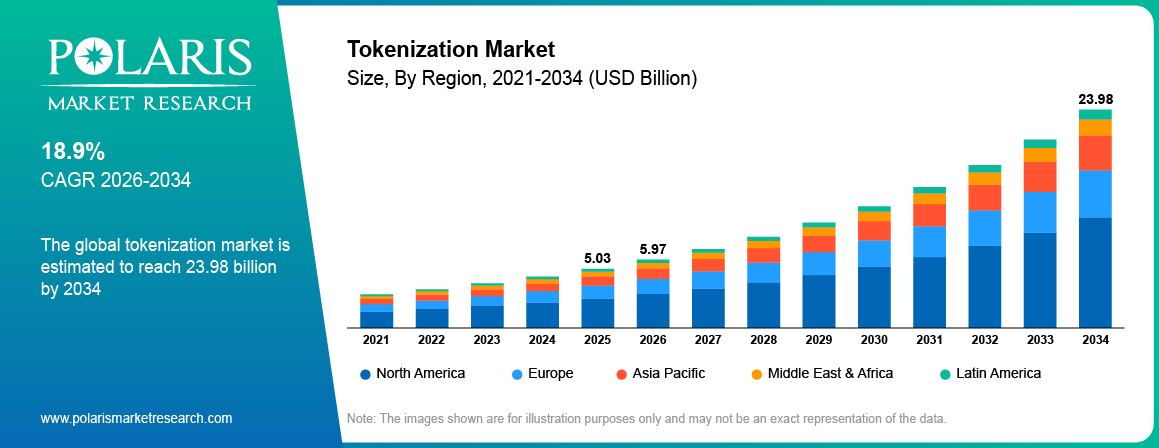
The global tokenization market is estimated around USD 5.03 billion in 2025,?the market is projected to grow at a CAGR of 18.9% during the forecast period 2026–2034. Growth is driven by rising digital payments and increasing cybersecurity concerns across digital financial ecosystems.
Market Statistics
Key Takeaways
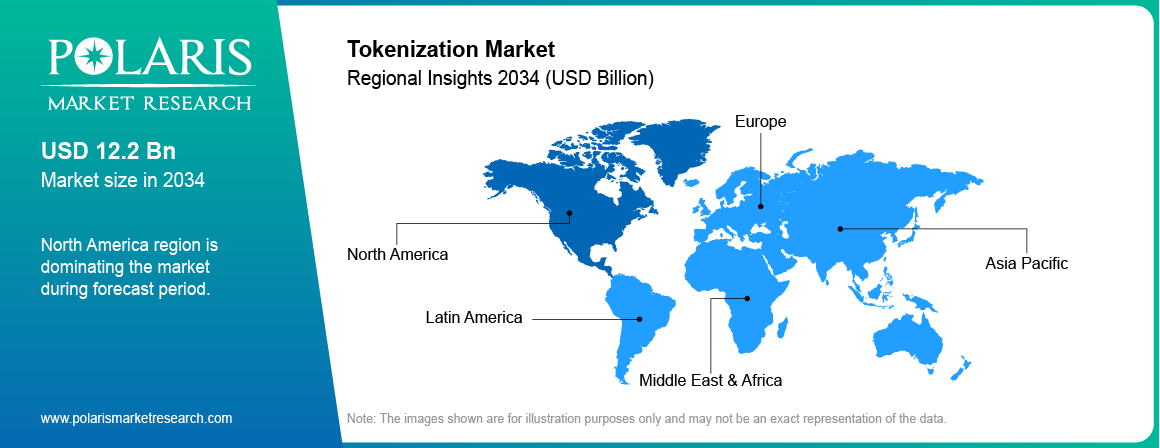
- North America accounted for the largest regional share of around 39.8% in 2025, driven by early digital asset adoption, strong venture capital investment, mature regulatory frameworks, advanced capital markets, and presence of major blockchain providers.
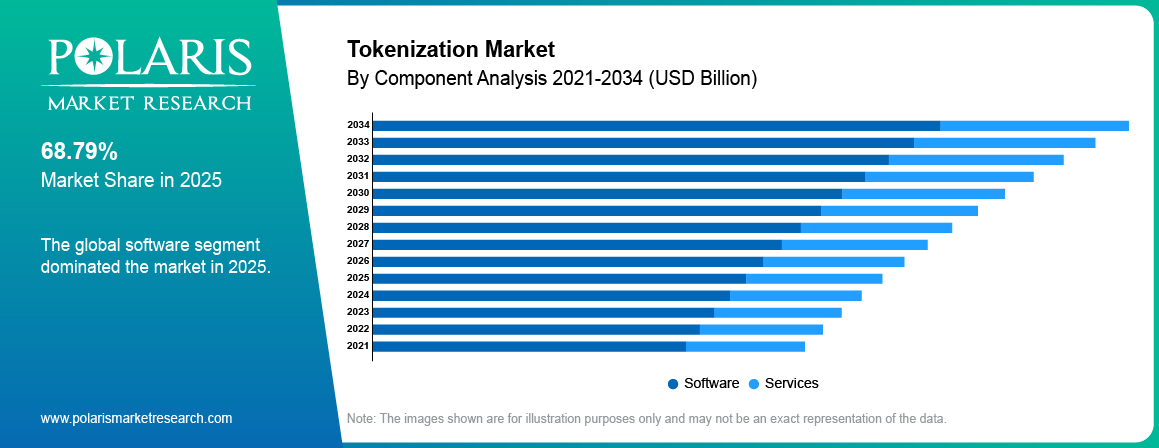
- By Component, Software segment accounted for the largest share of approximately 64.7% in 2025, supported by adoption of blockchain issuance platforms, smart contract management, automated compliance tools, and digital custody systems.
- By Application, Payment Security segment accounted for the largest share of around 28.9% in 2025, driven by rising digital transactions and increasing adoption of tokenization for securing sensitive payment data.
- By Enterprise Size, Large Enterprises segment accounted for the largest share of nearly 66.5% in 2025, supported by high blockchain investment capacity and deployment of enterprise-wide tokenization platforms.
- By End Use, BFSI segment accounted for the largest share of around 31.6% in 2025, driven by digital securities issuance, secure transaction processing, and integration of tokenization frameworks within financial systems.
Industry Dynamics
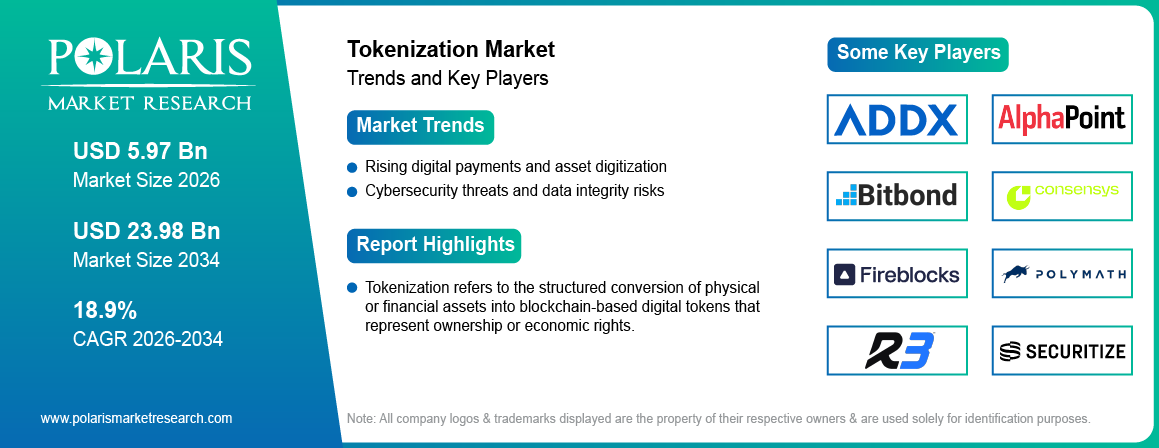
- Rising digital payments and asset digitization expand demand for secure blockchain-based tokenization platforms.
- Cybersecurity threats and data integrity risks accelerate adoption of encrypted asset tokenization infrastructure.
- High deployment and regulatory compliance costs restrict adoption among small and mid-sized enterprises.
- Expansion of Web3.0 tokenization models create long term opportunities across the global tokenization market.
What Is the Tokenization Market?
Tokenization refers to the structured conversion of physical or financial assets into blockchain-based digital tokens that represent ownership or economic rights. The tokenization industry includes asset tokenization platforms, smart contract infrastructure, digital custody, compliance systems, and trading ecosystems that convert traditional assets into transferable digital instruments. The tokenization market serves banks, asset managers, real estate firms, private equity players, and enterprises seeking improved liquidity and fractional ownership models. Enterprise-level tokenization solutions improve access to capital, transaction transparency, and asset management in a regulated setting.
It comprises solutions that target the digitalization of assets such as equities, bonds, real estate, commodities, and alternative investments. The solutions comprise blockchain networks, identity management systems, regulatory automation, and smart contracts that enable the safe creation and transfer of tokens. The tokenization services comprise legal structures, regulatory compliance, technology enablement, and support.
The tokenization industry differs from cryptocurrency exchanges, decentralized finance platforms, and crowdfunding systems in its core objective. Cryptocurrency platforms are centered on trading digital assets. DeFi platforms are centered on decentralized lending and yield farming. Crowdfunding platforms are centered on fundraising without structured asset digitization. On the other hand, asset tokenization platforms are centered on regulated asset representation, digitization of ownership, and programmable compliance. This makes tokenization platforms more of digital infrastructure solutions than trading tools.
How Tokenization Works?
This process involves converting data about sensitive or real-world assets into digital tokens, which are stored on a blockchain or another secure system. The data about the assets is converted into random tokens with no value outside this network and that do not reveal any sensitive information. The token merely refers to the asset. The transactions are processed using smart contracts that ensure the safe transfer of ownership, compliance, and transaction verification. This makes digital asset exchange more secure and efficient across industries
Source: Polaris Market Research Analysis
To Understand More About this Research:Download Sample Report
Drivers & Opportunities
Rising digital payments and asset digitization: The increasing use of digital payments and online financial transactions is leading to the adoption of blockchain-based asset infrastructure. Central banks and financial institutions are also focusing on digital asset settlement and programmable transactions. As per a report by Atlantic Council in June 2024, the e-CNY transaction volume reached USD 986 billion in 17 regions of China in the education, healthcare, and tourism sectors. This is almost quadruple the USD 253 billion of June 2023. Growth in cross-border payments and digital securities issuance is strengthening the need for secure asset tokenization platforms. Rising digital transaction volumes are driving adoption across the global tokenization industry.
Cybersecurity threats and data integrity risks: The rise in financial cyberattacks and cases of digital fraud is fueling the demand for secure blockchain tokenization solutions. Institutions require tamper-resistant transaction records and transparent ownership tracking. Enterprise tokenization platforms integrate encryption, digital identity verification, and smart contract validation to reduce fraud exposure. The rising cases of cybersecurity threats are also solidifying the demand in the asset tokenization market.
Restraints & Challenges
High deployment and compliance costs: The implementation of enterprise tokenization solutions requires the integration of blockchain technology, legal systems, and regulatory requirements. The development of infrastructure, digital security, and cybersecurity is increasing the initial investment costs. The operational costs are also increasing due to the need for platform maintenance and regulatory requirements. This is hindering the adoption of the solutions among small and medium-sized enterprises in the tokenization sector.
Opportunity
Web3 tokenization and decentralized asset ecosystems: The growing Web3 tokenization models are opening up new revenue streams for digital asset issuers. In February 2026, AGM Group Holdings made a strategic trifecta of RWA tokenization with Amber Premium, mass production of Kraken All-Flash AI servers, and a collaboration with MusicDog.ai to develop a full-stack AI and Web3 ecosystem. Decentralized infrastructure allows programmable ownership, secondary trading, and automated execution of compliance. Financial institutions are working on tokenized bonds, real estate, and private assets on blockchain platforms. The integration of Web3 tokenization with regulated financial systems is supporting long-term growth across the global tokenization market.
Tokenization: Benefits vs Risks
Benefits
- Helps enhance security by substituting confidential information with secure tokens
- Facilitates fast transaction processes due to automation and smart systems
- Permits the sharing of assets, including valuable assets such as real estate and equities
- Promotes higher liquidity by facilitating the trading of usually illiquid assets
- Boosts transparency and traceability within financial and digital systems
- Mitigates any risks of fraudulent activities during payment processing and data transfers
Risks
- Expensive and costly to implement and maintain infrastructure, especially for small businesses
- Uncertain regulatory framework across various countries and financial systems
- Complex technical issues involved in developing and maintaining tokenization platforms
Lack of standardized protocols across various blockchain networks
Types of Tokenization
| Token Type | Definition | Application Example |
| Asset Tokenization | Tokens used to represent physical assets as digital objects | Real estate, precious metals, securities |
| Payment Tokenization | Tokens used to replace card information with tokens for security purposes | E-commerce, mobile payments |
| Data Tokenization | Tokens that are utilized to protect sensitive information in the banking industry |
|
| Identity Tokenization | Token-based system used for identification purposes | User sign-in, KYC procedure |
| Security Tokenization | Tokens representing financial securities |
|
Source: Polaris Market Research Analysis
Key Use Cases of Tokenization
| Industries | Use Cases | Advantages |
| BFSI | Secure payments & digital assets | Tokenization minimizes fraud and programmable finance |
| Real estate | Tokenization of property | Fractional ownership increases liquidity |
| Retail & E-commerce | Tokenized payments | Safer credit card processing |
| Healthcare | Patient data protection | Guarantees safe transfer of data |
| Capital markets | Asset tokenization | Quick transactions |
Source: Polaris Market Research Analysis
Tokenization Technology Stack
| Layer | Components | Function |
| Blockchain Layer | Ethereum, Hyperledger, Polygon | Maintains ownership record of tokens |
| Smart Contracts | Rules and logic of transactions | Programmatically governs transactions |
| Security Layer | Encryption, token vaults, keys | Provides data security |
| API Layer | Payment gateways, banking APIs | Bridges disparate systems |
| Identity Layer | KYC/AML system, digital identities | Confirms user identity and compliance |
| Compliance Layer | Regulatory engines, auditing | Provides regulatory and financial compliance |
Source: Polaris Market Research Analysis
Source: Polaris Market Research Analysis
Segmental Insights
This report offers detailed coverage of the tokenization market by component, application, enterprise size, and end use industry to help readers identify the fastest expanding and most attractive demand segments.
By Component
-
Software
Software accounted for the highest revenue share in 2025 within the asset tokenization market. Adoption of blockchain tokenization platforms and smart contract management solutions helped in revenue concentration. Scalable issuance platforms with automated compliance and digital custody solutions are preferred by enterprises. Subscription-based licensing options improve revenue visibility in the enterprise tokenization solutions market.
-
Services
Services are expected to register the highest CAGR in the forecast period. The increasing need for legal structuring and technical implementation assistance is expected to drive the services market. Institutions need advisory services for regulatory alignment and asset structuring. Managed tokenization services enhance operational readiness.
By Application
-
Payment security
Payment security segment led the market in 2025, due to the growing number of digital payments. Financial institutions use tokenization to secure payment information. The payment security infrastructure boosts the segment’s market share.
-
Authentication
Authentication segment is projected to grow at the fastest CAGR during the forecast period, due to rising digital identity verification and access control requirements. Token validation improves user authentication systems. The growing number of online financial services drives the segment’s market growth.
By Enterprise Size
-
Large enterprises
The large enterprises segment dominated the market in 2025 due to the increasing investment capacity in blockchain and the structured digital transformation strategy. Large institutions use enterprise-level tokenization platforms for various assets. Multi-asset issuance programs help in leading the market.
-
SMEs
SMEs segment is expected to register the fastest CAGR growth rate during the forecast period due to the increasing availability of cloud tokenization solutions. The platform-based service model has simplified infrastructure. The increasing involvement of fintech companies has also helped in the adoption of the model by mid-sized businesses.
By End Use Industry
-
BFSI
The BFSI segment accounted for the largest market share in 2025 due to the digital issuance of securities and the need for secure transaction management. Banks have been incorporating asset tokenization platforms into their financial infrastructure. The increasing demand for programmable assets has helped in the growth of revenue.
-
Government
The Government segment is expected to register the fastest CAGR growth rate during the forecast period due to the expansion of digital identity infrastructure and the digitization of public assets. Blockchain-based registries have enhanced transparency and record integrity. Public sector digital transformation programs strengthen segment growth.
Source: Polaris Market Research Analysis
Regional Analysis
North America Market Assessment
North America tokenization market dominated in 2025, driven by early adoption of digital asset platforms across the US and Canada. The US accounts for a large share of global blockchain investment and tokenized asset pilots. PitchBook data stated that VC investment in US crypto companies surged 44% to USD 7.9 billion in 2025 after two slow years. Strong regulatory oversight and mature capital markets support enterprise tokenization deployment. Presence of leading technology providers strengthens regional revenue concentration.
Asia Pacific Tokenization Market Insights
Asia Pacific tokenization market is projected to grow at the fastest CAGR during the forecast period, driven by rapid fintech expansion across China, India, Singapore, and Japan. As per the Geo Semi-Annual India FinTech Report by Tracxn, the fintech sector in India was the third-largest globally in terms of funding for startups in H1 2025, with a total of USD 889 billion, and early-stage investments rose by 10% from H2 2024 to USD 361 billion. Blockchain initiatives and digital asset sandboxes by the government facilitate institutional investment. The growth of digital finance ecosystems fuels the adoption of tokenization.
Europe Tokenization Market Overview
Europe had the second-largest market share in the tokenization market, owing to the regulatory framework established by the Markets in Crypto-Assets regulation. Cross-border digital asset offerings are on the rise in Germany, France, and Switzerland. For example, Securitize received full EU regulatory approval from the Spanish CNMV to run the first blockchain-based Trading and Settlement System on Avalanche, connecting the U.S. and European capital markets, with plans for tokenized issuances in early 2026. Structured regulatory compliance enhances investor trust in tokenized securities.
Source: Polaris Market Research Analysis
Key Players & Competitive Analysis Report
The tokenization industry experiences moderate consolidation, with major players in the blockchain and fintech industries contributing to a substantial revenue stream. The competitive advantage lies in the strength of regulatory compliance, the security of smart contracts, and the scalability of platforms. The industry develops interoperable blockchain infrastructure and automated compliance solutions to improve differentiation. Collaborations with banks and custodians help in long-term market positioning in the asset tokenization space.
Major participants in the tokenization sector are tZERO Group, Inc., Securitize, Inc., Polymath Network Inc., Tokeny Solutions, ConsenSys, Fireblocks Inc., R3 LLC, AlphaPoint Corporation, The INX Digital Company, ADDX, Bitbond GmbH, Taurus SA, and others.
Competitive Matrix – Capability Comparison
The leading companies in tokenization market compete across platform scalability, regulatory compliance automation, smart contract security, and multi-asset issuance capability. Companies offering tokenization platforms vary based on blockchain interoperability, custody integration, and secondary market support. Companies with better institutional onboarding infrastructure and global compliance modules retain a larger market share in tokenization.
Major companies operating in the tokenization market concentrate on developing enterprise infrastructure, while tokenization startups target modular deployment and specific asset classes. Strategic partnerships tokenization initiatives with banks, custodians, and digital asset exchanges strengthen ecosystem reach and credibility. Companies with integrated compliance, identity management, and lifecycle asset management capabilities demonstrate stronger competitive positioning across the global tokenization industry.
Key Players
- ADDX
- AlphaPoint Corporation
- Bitbond GmbH
- ConsenSys
- Fireblocks Inc.
- Polymath Network Inc.
- R3 LLC
- Securitize, Inc.
- Taurus SA
- The INX Digital Company
- tZERO Group, Inc.
- Tokeny Solutions
Industry Developments
- December 2025: tZERO partnered with Polymath to enable regulated real-world asset tokenization on the Polymesh blockchain using tZERO's broker-dealer infrastructure. (Source: tzero.com)
- October 2025: AlphaPoint announced that POLYX, Polymesh's native token, and Polymesh native assets are now live on its platform, enabling exchanges and RWA tokenization via APEX and APAD. (Source: prnewswire.com)
- January 2025: Apollo and Securitize partnered to launch ACRED, a tokenized feeder fund providing access to Apollo's Diversified Credit Fund across multiple blockchains like Aptos, Avalanche, Ethereum, Ink, Polygon, and Solana. (Source: securitize.io)
Tokenization Market Segmentation
By Component Outlook (Revenue, USD Billion, 2021-2034)
- Software
- Services
By Application Outlook (Revenue, USD Billion, 2021-2034)
- Payment security
- Authentication
- Compliance management
- User authentication
- Data privacy protection
By Enterprise Size Outlook (Revenue, USD Billion, 2021-2034)
- SMEs
- Large enterprises
By End Use Industry Outlook (Revenue, USD Billion, 2021-2034)
- BFSI
- Healthcare
- Retail
- IT & telecom
- Government
By Regional Outlook (Revenue, USD Billion, 2021-2034)
- North America
- US
- Canada
- Europe
- Germany
- France
- UK
- Italy
- Spain
- Netherlands
- Russia
- Rest of Europe
- Asia Pacific
- China
- Japan
- India
- Malaysia
- South Korea
- Indonesia
- Australia
- Vietnam
- Rest of Asia Pacific
- Middle East & Africa
- Saudi Arabia
- UAE
- Israel
- South Africa
- Rest of Middle East & Africa
- Latin America
- Mexico
- Brazil
- Argentina
- Rest of Latin America
Tokenization Market Report Scope
| Report Attributes | Details |
| Market Size in 2025 | USD 5.03 Billion |
| Market Size in 2026 | USD 5.97 Billion |
| Revenue Forecast by 2034 | USD 23.98 Billion |
| CAGR | 18.9% from 2026 to 2034 |
| Base Year | 2025 |
| Historical Data | 2022–2024 |
| Forecast Period | 2026–2034 |
| Quantitative Units | Revenue in USD Billion and CAGR from 2026 to 2034 |
| Report Coverage | Revenue Forecast, Competitive Landscape, Growth Factors, and Industry Trends |
| Segments Covered |
|
| Regional Scope |
|
| Competitive Landscape |
|
| Report Format |
|
| Customization | Report customization as per your requirements with respect to countries, regions, and segmentation. |
Source: Polaris Market Research Analysis
Tokenization Market FAQ's
• The global market size was valued at USD 5.03 billion in 2025 and is projected to grow to USD 23.98 billion by 2034.
• North America dominates due to strong institutional adoption and advanced digital payment infrastructure.
• Major applications include payment security, authentication, compliance management, user authentication, and data privacy protection.
• A few of the key players in the market are tZERO Group, Inc., Securitize, Inc., Polymath Network Inc., Tokeny Solutions, ConsenSys, Fireblocks Inc., R3 LLC, AlphaPoint Corporation, The INX Digital Company, ADDX, Bitbond GmbH, Taurus SA, and others.
• Growth is driven by rising digital payments, increasing need for secure data handling, and expansion of blockchain-based asset infrastructure.
Download Sample Report of Tokenization Market
Please fill out the form to request a customized copy of the research report.


