
Digital Pharmacy Market Size, Share, Trends & Forecast, 2026–2034
REPORT DETAILS
Digital Pharmacy Market Summary
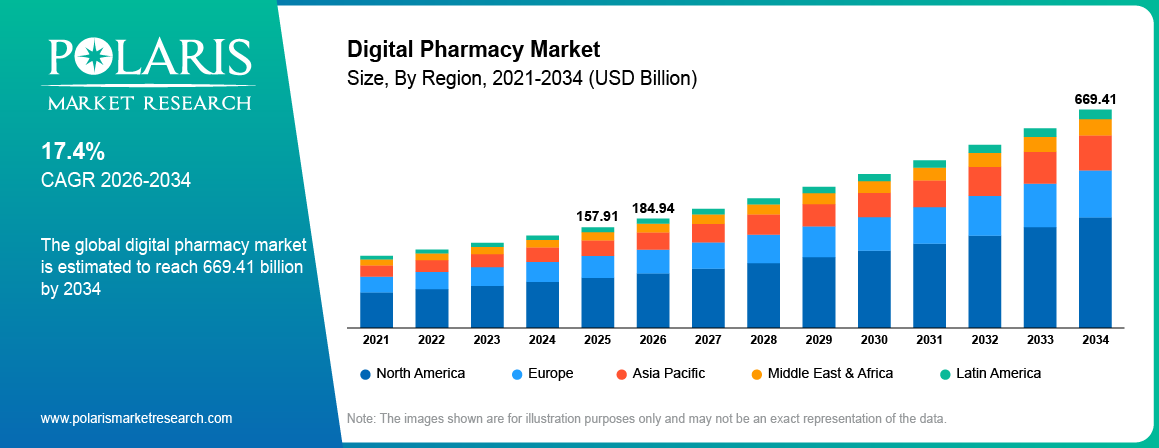
The digital pharmacy market size was valued at USD 157.91 billion in 2025. The market is projected to grow at a CAGR of 17.4% from 2026 to 2034. The rising consumer preference for online shopping and growing smartphone and internet penetration are a few of the key factors driving the digital pharmacy market growth.
Market Statistics
Digital Pharmacy Market Key Takeaways
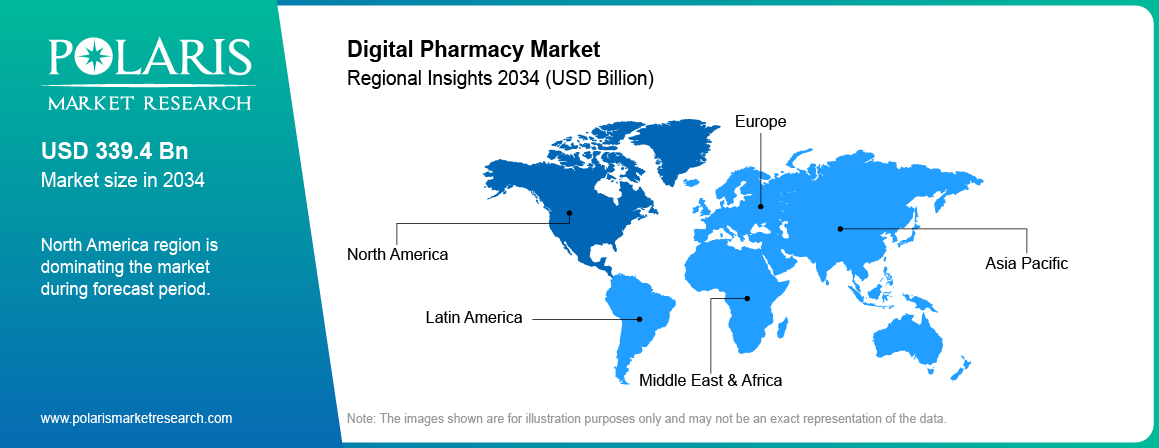
- North America led with an 39.80% digital pharmacy market share in 2025. This is owing to the rising adoption of healthcare e-commerce platforms across various sectors in the region.
- Asia Pacific is projected to account for a 20.60% CAGR. This is due to the expansion of stable internet connectivity in the region.
- The captive segment accounted for an 43.70% market share in 2025. This approach provides these companies with better control over medicine delivery and customer service.
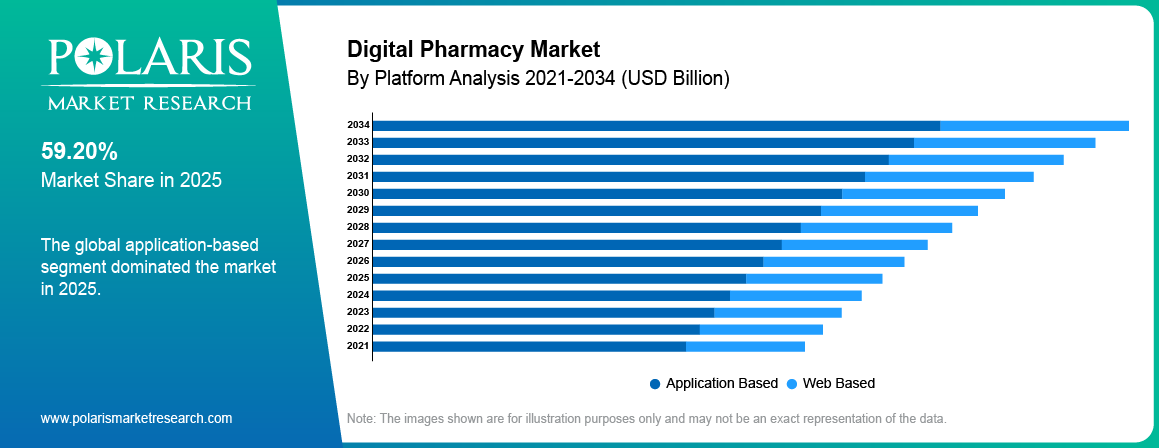
- The application-based segment accounted for a 59.20% share in 2025. The increasing number of smartphone users globally contributes to the segment’s leading position.
- The over-the-counter products segment is expected to grow at a 19.10% CAGR. Rising awareness about common acute diseases contributes to the segment’s rapid growth.
Note: Figures and projections outlined in this report are the result of Polaris Market Research’s proprietary analytical processes, grounded in the latest available datasets and market observations.
What is a Digital Pharmacy?
Digital pharmacy comprises online platforms and mobile applications whereby customers are able to buy prescription and non-prescription drugs, upload their prescriptions, consult health practitioners, and order delivery of the medicines. These digital healthcare platforms enhance the availability of medicines, simplify pharmacy services, and assist in managing health through secure digital technologies.
How Do Digital Pharmacies Work?
Digital pharmacies enable customers to order medicines and access pharmacy services online through the website and mobile apps. In most cases, online pharmacies use the following steps in the ordering process:
Account Registration: Customers register their account by providing personal and health information as required.
Medicines Search and Selection: Customers search and select the medicines and health products that they would like through the online pharmacy website.
Upload of Prescriptions: Customers upload their prescriptions in case of ordering prescription medicines.
Verification of Prescription: Pharmacists licensed to practice verify the prescriptions uploaded by customers and the medicines ordered.
Order Processing: The pharmacy staff processes the verified order by picking and packing the medicines requested.
Payment and Order Dispatching: Customers make payment via the methods available, and then the order is dispatched.
Delivery of the Order: The medicines are delivered to the address of the customer. Customers can monitor the order status.
Source: Polaris Market Research Analysis
Digital Pharmacy vs Traditional Pharmacy
Both digital and conventional pharmacies give customers access to medicines, although the method used by customers to order medicines from pharmacies is different. Digital pharmacies make use of either websites or mobile apps, whereas conventional pharmacies operate using physical stores. The key differences are given below:
| Feature | Digital Pharmacy | Traditional Pharmacy |
| Order Process | Ordering of medicines is done via online websites or mobile applications. | The medicines are bought from the store. |
| Availability | The services can be accessed anywhere that has an internet connection. | The customer needs to physically move to the store. |
| Prescription Process | The prescriptions are uploaded. | The prescriptions are brought physically to the pharmacy. |
| Delivery of Medicines | The medicines are sent to the customer’s place. | The customer picks up the medicines from the store. |
| Working Hours | Online pharmacies have no restrictions on when customers order. | The working hours depend on the pharmacy. |
| Convenience | Convenient way to buy medicines. | The traditional method takes more time. |
Source: Polaris Market Research Analysis
Digital Pharmacy Market Overview
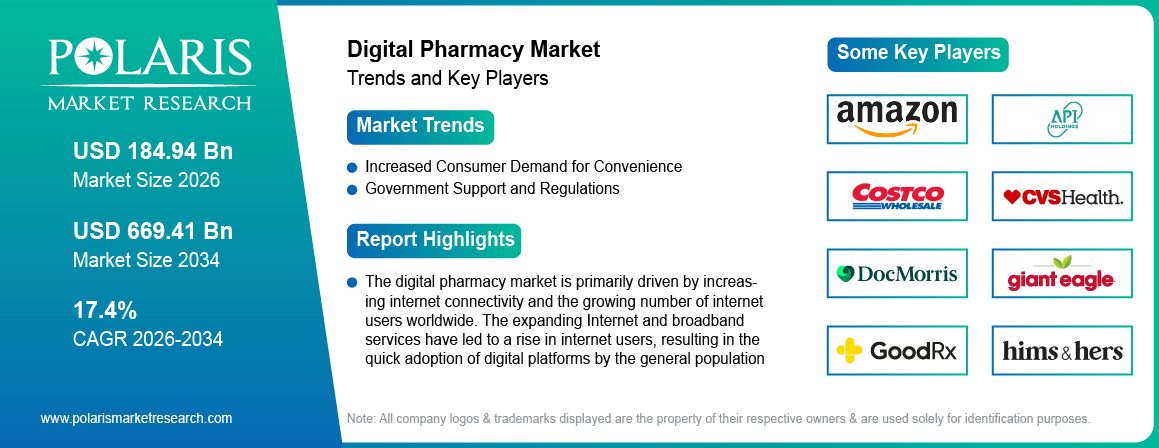
The digital pharmacy market is primarily driven by increasing internet connectivity and the growing number of internet users worldwide. The expanding Internet and broadband services have led to a rise in internet users, resulting in the quick adoption of digital platforms by the general population. For instance, according to the World Bank, the proportion of internet users in North America has significantly increased over the past decade, with 74% of the global population having internet access in 2025. The most recent data indicate that 95% of citizens in the United States and 94% of the total population in Canada have internet access (source: worldbank.org). This growing internet user base has led to the development and advancement of software in various domains that offers easy-to-understand user interfaces, increasing adaptability among the general population. This rapid digitalization is expected to have a positive impact on the digital pharmacy market growth during the forecast years.
The digital pharmacy market is expected to grow due to the increased adoption of telemedicine. The rising use of telemedicine has led to higher demand for remote prescription and medication management. For example, according to the National Center for Health Statistics June 2026 health e-stats, the percentage of office-based physicians using telemedicine in 2024 was 80.0%. In addition, Telemedicine usage in metropolitan statistical areas (MSAs) in 2024 was 81.0 (source: cdc.gov). As the adoption of telemedicine increases, the digital pharmacy market is expected to register a substantial CAGR in the study years.
Digital Pharmacy Market Dynamics
Increased Consumer Demand for Convenience
The growing emphasis on convenience among consumers globally is projected to substantially fuel the expansion of the digital pharmacy market. Consumers consider convenience an important factor in purchasing decisions. Many are willing to pay more for a simpler and more efficient shopping experience. The increasing need for convenient access to goods and services is driving the rise of digital pharmacies. These digital solutions enable consumers to purchase medicine online and have it delivered to their doorstep. Furthermore, digital pharmacies also offer consultations by pharmacists through digital means. The increase in both internet availability and digital literacy will lead to more people using digital pharmacies. This shift is anticipated to contribute positively to the growth of the market due to the need for convenience among consumers.
Government Support and Regulations
Increasing government support for the digitalization of multiple sectors is another factor shaping market development. Governments worldwide are imposing favorable regulations and initiatives to support the e-commerce industry and accelerate digitalization to reach the unmet population of the country. For instance, the Indian government has launched the Digital India Program to increase broadband connectivity in rural areas. India's telemedicine facility, eSanjeevani, is also playing an important role in making quality healthcare accessible to the country’s rural and remote. According to the August 2026 update, the facility has provided 47 crore consultations and has onboarded 2.34 lakh healthcare providers to date (source: ibef.org). Also, to benefit and increase the number of players in the e-commerce and quick commerce industry, the government has started providing tax benefits, easier compliance, and IPR fast-tracking for small and medium businesses. The foreign direct investment limit for the e-commerce and quick commerce industry has increased in order to expand the market. Similar supportive regulations and initiatives are provided by governments of major countries, which are expected to ease entry for new players.
Restraint : Complexity in Logistics
Logistics complexities can limit the growth in the digital pharmacy industry. Medicine needs proper storage and transport to preserve its quality through the process. Some medications require controlled temperatures; therefore, logistics can be a complex challenge. Reliable delivery channels are needed to ensure timely delivery of medicines. Prescription medicines are required to undergo more rigorous procedures before delivery and dispensing. The pharmacy needs to verify the prescription and ensure that the right medications get to the right recipient. This can complicate operations and add cost considerations. Growth in online orders could also increase pressure for more efficient inventory control and delivery capacity.
Opportunities : Expansion of Healthcare E-Commerce
With the growth of e-commerce in healthcare, digital pharmacies are presented with new opportunities. People are increasingly willing to buy healthcare products online. This is supported by increased internet availability and smartphone use. Digital pharmacies can reach people beyond their geographical boundaries. Moreover, these channels offer customers a variety of medicines, personal care products, and other healthcare products. Growing customer demand for product delivery is also driving this shift. It allows people to purchase products remotely and have them delivered to their desired destination point. E-commerce in healthcare also creates the chance to improve the online services offered by the pharmacy business. As healthcare purchases move online, pharmacies can grow their customer base online.
Opportunities : Expansion into Underserved and Rural Markets
Digital pharmacies make it easier to ensure access to pharmaceutical products in areas poorly served by physical pharmacies. Through digital platforms, pharmacies can serve customers without needing to set up a physical pharmacy in these areas. In addition, digital pharmacies could partner with healthcare facilities and delivery networks in these areas to improve access to pharmaceutical products. Entering under-served markets would enable companies to cater for different customer groups while at the same time broadening their geographical footprint. This is particularly relevant in developing countries, where access to health services differs between urban and rural areas. Digital connectivity will enable digital pharmacies to provide solutions to customers beyond urban areas.
Trends : Growing Adoption of Electronic Prescriptions
Electronic prescriptions make it easier for pharmacies to process prescriptions. Electronic prescriptions are prescriptions sent electronically instead of on paper. This can ease prescription processing by reducing the need to manually enter prescriptions into the system. Digital pharmacies can adopt such prescriptions in their systems for fast processing. Electronic prescriptions can improve the accuracy of prescription information because they reduce the risk of problems caused by unclear handwriting. The use of electronic medical records is increasing among health care providers, making electronic prescriptions increasingly important in online pharmacy operations.
Trends : Increasing Use of Automated Pharmacy Fulfillment
Modern pharmacies use automation as a way of improving their order fulfillment process. Automation can support operations such as inventory management, picking medicine, packaging, and sorting orders. An automated fulfillment process allows pharmacies to handle higher order volumes without increasing manual processing as much. Automation can be used as a way of enhancing consistency in the order fulfillment process. An efficient order fulfillment process is an issue of concern for digital pharmacies due to the increased number of orders and increased product lines. This makes the use of automated fulfillment systems a key trend in the marketplace.
Source: Polaris Market Research Analysis
Segment Insights
By Product
The medicine & treatment segment led with an 63.80% market share in 2025. The segment benefits from the continuous requirement for medications for both common diseases and chronic illnesses. Digital pharmacies offer an additional channel for customers to purchase these products. Prescription and non-prescription drugs play an important role in maintaining the segment's position. Repeat purchases are yet another crucial element, especially among those individuals who have the need for medication at regular intervals. E-commerce can make the process easier when making such purchases. The growing variety of products available through pharmacy websites means that medicine/treatment products will continue to contribute significantly to market revenue.
The vitamins & supplements segment is projected to account for an 20.20% CAGR. The growth of this segment is attributed to rising consumer interest in preventive health care and wellness products. Digital pharmacies offer a convenient platform for consumers to browse and purchase vitamins and supplements. The availability of diverse products enables consumers to choose the products that best suit their needs. Repeat buying can also support segment demand, since consumers utilize the products on a regular basis. With the increase in health and wellness products at digital pharmacies, vitamins and supplements will continue gaining importance in the product segment.
| Product Segments | Examples / Focus |
| Medicine & Treatment | Medicines used for the treatment and management of health conditions |
| Vitamins & Supplements | Vitamins, minerals, and dietary supplements |
| Personal Care Products | Personal hygiene, skincare, and related care products |
| Others | Other healthcare and pharmacy products |
Source: Polaris Market Research Analysis
By Platform
The application based segment led with an 59.20% market share in 2025. This segment’s leading position is attributed to the expanding internet connectivity and increasing number of smartphone users globally. For example, a 2025 MoSPI survey revealed that approximately 85.5 percent of households possessed at least one smartphone, and this number is expected to continue growing significantly in the coming years (source: pib.gov.in). The surge in global smartphone users is expected to lead to the development of various software applications across a wide range of domains, resulting in the growth of app-based platforms in the digital pharmacy market.
The web based segment is projected to account for an 14.50% CAGR. Web platforms enable customers to connect with digital pharmacy services using their computers, tablets, and mobile phones via internet browsers. These platforms can be used by customers to look for medicines, order products, upload prescriptions, and monitor deliveries. This segment continues to benefit from the already existing usage of pharmacy websites by customers. Moreover, web platforms can keep updating product details and services through their websites. With an increasing trend of accessing healthcare services online, the web platforms are likely to witness consistent demand in the digital pharmacy market.
By Drug Type
The prescription medicines segment led with an 58.40% share in 2025. This segment benefits from the recurring need for medicines to treat and manage patients' diagnosed illnesses. Online pharmacies can be a convenient way for consumers to order medicines with prescriptions. Prescriptions also help in verifying orders safely. There has been an increasing number of digital health services being utilized by patients. Refilling orders can also help generate more demand among those who need their medicines regularly. As prescription services expand on digital pharmacy platforms, prescription medicines are expected to dominate the market.
The over-the-counter segment is expected to experience significant growth at a 19.10% CAGR. This is due to increasing awareness and knowledge of common acute diseases among the general population. The rising preference for over-the-counter drugs among young people for minor inconveniences has resulted in growing demand for OTC drugs. Digital pharmacies make it easy to locate and purchase such products through online channels. The availability of these medications through these channels is forecasted to fuel segment growth even further.
By Business Model
The captive segment accounted for an 43.70% market share in 2025. The dominant position of this segment is supported by organizations that operate their pharmacies within their healthcare networks. This approach provides these companies with better control over medicine delivery and customer service. It also helps them manage inventory and deliveries according to their needs. An already existing client base and infrastructure of healthcare facilities are advantages for the captive segment. There might also be better cooperation between pharmacies and other healthcare facilities within this segment. All of these factors are expected to help the captive segment maintain its leading market position.
The aggregator segment is projected to account for an 20.10% CAGR. An aggregator platform serves to connect various pharmacies’ offerings on one digital platform. This way, customers are offered a wider range of products/services via the platform. In addition, participating pharmacies get the opportunity to reach out to a greater number of customers without having their own digital platform. Such an approach can support competition between various pharmacies and provide more options for customers to compare products/services from different pharmacies. With the growing digitization of pharmacies, the importance of aggregator platforms is likely to increase.
Source: Polaris Market Research Analysis
Regional Insights
North America
North America accounted for an 39.80% market share in 2025. North America's leading position in the digital pharmacy market stems from its developed healthcare sector and widespread use of online services. The popularity of internet-enabled devices has made digital pharmacy platforms more convenient for customers. At the same time, North America has an advanced pharmacy industry, both online and retail. The increasing consumer acceptance of digital healthcare services is expected to contribute to the adoption of online platforms for medicine purchases and pharmaceutical services. These factors are expected to ensure North America’s leading position in the digital pharmacy market.
Asia Pacific
Asia Pacific is projected to account for an 20.60% CAGR. The growth in the region is supported by rising internet penetration and increasing smartphone usage. An increasing number of consumers have been using digital platforms for their healthcare requirements. The growth of digital services has also encouraged pharmacies to strengthen their online presence. India, China, Japan, and South Korea have witnessed rising adoption of online platforms in healthcare. This development creates favorable conditions for the growth of digital pharmacies. Increased awareness about online purchases of medicines will provide additional opportunities for market development in the region.
Europe
Europe held an 24.70% market share in 2025. The utilization of online pharmacy websites has become widespread among various European countries. The trend of ordering medicines and other pharmacy products through the internet is gaining popularity. In addition, the provision of online services by pharmacies has become common as pharmacies are able to cater to customers through websites and applications. Prescription medicines, over-the-counter drugs, and other healthcare products offered through digital platforms will help meet market demand. These will help enhance the growth of digital pharmacies in the region. Europe is poised to continue being a key market for the expansion of digital pharmacies.
Latin America
Latin America accounted for an 6.50% market share in 2025. The growing penetration of internet connectivity enables more customers to seek out solutions for their medical requirements through internet-based platforms. There are also digital pharmacies, which are giving customers the choice to buy medicines without even going to a physical pharmacy. With the rise in smartphone usage, this is becoming easier throughout the region. As consumers become accustomed to buying medicines through digital platforms, digital pharmacies are finding increased acceptance within Latin America. This is likely to play a part in the region's contribution to the global digital pharmacy market.
Middle East & Africa
The Middle East & Africa is projected to account for an 18.80% CAGR. The adoption rate of digital platforms for healthcare services is increasing gradually in the region. Consumer access to online platforms for buying medicines and health-related products is rising. Smartphone adoption is contributing to access to digital pharmacy platforms. Pharmacies are adopting online platforms and reaching customers through these digital channels. As awareness of online pharmacy services grows, consumer use of digital platforms is expected to increase.
Source: Polaris Market Research Analysis
Use Cases of Digital Pharmacy Platforms
| Use case | Description |
| Delivery of Prescribed Medicines | Provides delivery of prescribed medicines right at the doorstep of customers. |
| Purchase of Over-the-Counter Medicines | Allows customers to buy non-prescribed medicines via the Internet. |
| Chronic Condition Medicines Management | Prescription management apps help in refill of medicines for health condition management. |
| Fulfillment of Telemedicine Prescriptions | Provides delivery of medicines prescribed during telemedicine consultation. |
| Sales of Health Care Products | Provides wellness products and medical devices. |
| Remote Pharmacy Services | Provides pharmacy services to customers residing in remote locations. |
| Medicine Refill Services | Helps in maintaining continuous treatment by providing timely refills and refill reminders. |
Source: Polaris Market Research Analysis
Supporting Chronic Disease Medication Management
Digital pharmacies are becoming more common platforms that help people get regular medicines. People suffering from chronic illnesses need to take certain medications at specific periods of time, requiring them to refill the prescriptions on a regular basis. Digital pharmacies can offer an online tool for ordering medicines and refills. Customers can get information about prescriptions as well as track their orders. It becomes much simpler for patients to keep the prescribed medicines in stock. Digital pharmacies can also enable communication between the patient and the pharmacist when there is a need for additional information about the medicine taken by the customer. Such services can prove to be helpful for those patients who cannot visit the pharmacies regularly. The ability to order recurring medicine on the Internet is driving the usage of online pharmacy services for chronic care.
Integration with Telehealth Services
Telehealth systems are incorporating digital pharmacies for a seamless healthcare process. Doctors, after performing a teleconsultation, can forward prescriptions to the connected pharmacy directly. In this way, medicines are quickly received, and there is less need for documentation. It saves patients the time of going to physical pharmacies to buy medicines. The telehealth system helps ensure better continuity of treatment. It is especially useful for those individuals who have difficulties traveling due to mobility issues or live in remote areas. As virtual health care becomes popular, telehealth systems will play a vital role in digital pharmacies.
AI and Personalization in Digital Pharmacy
The utilization of AI in pharmacy is becoming a useful approach for digital pharmacies to enhance customer services and operations. With the use of artificial intelligence, digital pharmacies are able to analyze user behavior and order information, which helps to recommend appropriate products. Additionally, with the help of artificial intelligence, digital pharmacies can use chatbots to answer frequently asked questions from users and direct customers to the pharmacist. Personalized medication recommendations and reminders assist customers in managing the purchase of their medicines regularly. AI in digital pharmacy technologies can be used to plan the inventory because they allow the pharmacy to estimate the demand for the product. These applications are expected to assist digital pharmacies in providing more personalized services and order management.
Rise of Mobile Health Applications
Mobile health (mHealth) applications are making it easy for patients to handle their healthcare needs via mobile phones. There are many digital pharmacies offering mobile applications through which users are able to order medicine, submit prescriptions, and monitor deliveries. There are some applications that provide medicine reminder services. They can look up their previous orders and make repeat purchases easily. With mobile applications, patients are able to access pharmacy services without visiting physical pharmacies. They also assist in maintaining connections with healthcare services anytime. The adoption of mobile phones is likely to contribute to the growth of mobile health applications.
Growth of Quick Commerce & Same-Day Medicine Delivery
Quick commerce healthcare is also becoming a significant trend in the digital pharmacy industry because customers increasingly expect fast order delivery. Delivery channels in digital pharmacies are being enhanced to ensure faster delivery from order placement until delivery of the medicines. The development of local fulfillment centers and pharmacies can facilitate a faster delivery process. Digital channels also facilitate real-time order tracking, thus enabling customers to track the status of their orders. Faster delivery service is also compelling pharmacies to enhance their inventory and order delivery processes. The quick commerce trend is increasing competition among digital pharmacy providers because delivery speed is now part of the online purchase process. With the development of quick commerce services, same day medicine delivery app usage is becoming more common in urban areas.
Regulatory & Compliance Landscape
The digital pharmacy industry is regulated by the healthcare and drug agencies that govern the process of medicine sale and distribution. In the U.S., the Food and Drug Administration (FDA) controls the regulation of drug safety and legal purchase of medicines, while pharmacy boards govern pharmacy practice. Controlled drugs and their distribution are governed by the Drug Enforcement Administration (DEA).
In India, the Central Drugs Standard Control Organisation (CDSCO) and state drug controlling agencies control the regulations relating to medicines and pharmacy practice. In Europe, the European Medicines Agency (EMA) plays a regulatory role in the European Union for medicines, while individual nations take care of the country-specific regulations. In addition to the relevant pharmaceutical regulations, data protection laws have to be taken into consideration with regard to the processing of the customer's data by digital pharmacies.
Key Players & Competitive Insights
The digital pharmacy industry is constantly changing, with many companies seeking ways to develop and distinguish themselves from others. Major multinational companies control the market through the use of extensive R&D, advanced software solutions, and capital. They seek to strengthen their business through mergers, acquisitions, joint ventures, and other collaborative projects.
The influence of new companies can be seen in the introduction of innovative medical devices and in fulfilling the demands of certain market segments. Competition in the industry is increasing through constant innovation in product development, drugs, and sustainability, as well as growing demand for custom single-use products across sectors.
Vendor Positioning
| Positioning Group | Representative Players | Primary Strength |
| Large Retail & E-commerce Platforms | Amazon.com, Inc. (Amazon Pharmacy); Walmart Inc.; Costco Wholesale Corporation | Large customer bases, established retail networks, and strong digital capabilities |
| Integrated Healthcare & Pharmacy Providers | CVS Health Corporation; UnitedHealth Group Incorporated (Optum Rx); The Cigna Group (Express Scripts) | Integrated pharmacy services and broad healthcare networks |
| Established Retail Pharmacy Chains | Walgreens Boots Alliance, Inc. (Operating under the Walgreens brand); The Kroger Co.; Giant Eagle, Inc. | Extensive physical pharmacy presence and established customer relationships |
| Digital Pharmacy Specialists | API Holdings Limited (PharmEasy / Axelia Solutions); DocMorris AG; Redcare Pharmacy N.V. | Online medicine ordering, digital pharmacy platforms, and home delivery |
| Digital Healthcare & Prescription Platforms | GoodRx Holdings, Inc.; Hims & Hers Health, Inc.; Ro (Zachariah Reitano, Inc.) | Digital healthcare access, prescription services, and direct-to-consumer platforms |
Source: Polaris Market Research Analysis
Digital Pharmacy Market Key Players
- Amazon.com, Inc. (Amazon Pharmacy)
- API Holdings Limited (PharmEasy / Axelia Solutions)
- Costco Wholesale Corporation
- CVS Health Corporation
- DocMorris AG
- Giant Eagle, Inc.
- GoodRx Holdings, Inc.
- Hims & Hers Health, Inc.
- Redcare Pharmacy N.V.
- Ro (Zachariah Reitano, Inc.)
- The Cigna Group (Express Scripts)
- The Kroger Co.
- UnitedHealth Group Incorporated (Optum Rx)
- Walgreens Boots Alliance, Inc. (Operating under the Walgreens brand)
- Walmart Inc.
Market Developments
- June 2026: Online pharmacy platform TelyRx Holdings Inc. announced surpassing one million prescriptions in the U.S. since inception. The company stated that the milestone reflects rising consumer demand for healthcare experiences that are more transparent and convenient. (source: prnewswire.com)
- June 2026: CVS Pharmacy announced its formal participation in the CMS Medicare GLP-1 Bridge program. The program ties digital and retail pharmacy workflows directly to support high-demand chronic-care and weight-management therapies. (source: cvshealth.com)
Market Segmentation
By Product Outlook
- Medicine & Treatment
- Diabetic Care
- Heart Care
- Oncology
- Other Medicine & Treatment
- Vitamins & Supplements
- Personal Care Products
- Others
By Drug Type Outlook
- Prescription Medicines
- Over-the-counter
By Platform Outlook
- Application Based
- Web Based
By Business Model Outlook
- Captive
- Franchise
- Aggregator
By Regional Outlook
- North America
- US
- Canada
- Europe
- Germany
- France
- UK
- Italy
- Spain
- Netherlands
- Russia
- Rest of Europe
- Asia Pacific
- China
- Japan
- India
- Malaysia
- South Korea
- Indonesia
- Australia
- Rest of Asia Pacific
- Middle East & Africa
- Saudi Arabia
- UAE
- Israel
- South Africa
- Rest of the Middle East & Africa
- Latin America
- Mexico
- Brazil
- Argentina
- Rest of Latin America
Report Scope
| Report Attributes | Details |
| Market Size Value in 2025 | USD 157.91 billion |
| Market Size Value in 2026 | USD 184.94 billion |
| Revenue Forecast by 2034 | USD 669.41 billion |
| CAGR | 17.4% from 2026 to 2034 |
| Base Year | 2025 |
| Historical Data | 2021–2024 |
| Forecast Period | 2026–2034 |
| Quantitative Units | Revenue in USD billion and CAGR from 2026 to 2034 |
| Report Coverage | Revenue Forecast, Market Competitive Landscape, Growth Factors, and Industry Trends |
| Segments Covered |
|
| Regional Scope |
|
| Competitive Landscape |
|
| Report Format |
|
| Customization | Report customization as per your requirements with respect to countries, regions, and segmentation. |
Source: Polaris Market Research Analysis
Future Outlook
The digital pharmacy market growth will be driven by the preference of consumers for easily accessible healthcare and online pharmacy services. An increase in the use of the Internet and smartphones will be a driving factor in the growth of the market. Integration of telehealth solutions and e-prescriptions will also receive increased attention, and it is expected that it will improve the patient experience. Advanced technology adoption by digital pharmacies will enable them to operate efficiently and provide a superior experience to customers. Regulatory compliance and data security will remain important considerations in the market. Due to the increasing digitization in the healthcare industry, pharmacy websites are likely to become important in making medicines accessible and providing better healthcare services.
Research Methodology
The digital health pharmacy market has been prepared using secondary research and primary validation. The sources of secondary research include company reports, regulatory information, healthcare initiatives by government bodies, industry sources, and Polaris Market Research studies on the market. The primary research was conducted with pharmacy platform providers, healthcare technology companies, telehealth providers, and distributors in key regions.
Market sizing was done using the triangulation methodology. The bottom-up approach involved an analysis of revenues and market activities at a company level. It was supported by the top-down approach based on the analysis of the entire digital health market and e-commerce market. Segment shares and growth rates were compared to industry information and results of primary research. The historical data from 2021 to 2024 was used to derive the base of the market. Further, the market forecast for 2026 to 2034 was derived using the market trends and growth drivers in the segments and comparison of data points from multiple sources. Finally, the results were validated using Polaris Market Research's internal research on the healthcare technology and digital health markets.
Digital Pharmacy Market FAQ's
The digital pharmacy market size was valued at USD 157.91 billion in 2025. The market is projected to grow to USD 669.41 billion by 2034.
The digital pharmacy market CAGR is projected to be 17.4% from 2026 to 2034.
North America had the largest share of 39.80% in 2025. This is due to the rising adoption of healthcare e-commerce platforms across various sectors in the region.
A few of the key market players include Amazon.com, Inc. (Amazon Pharmacy); API Holdings Limited (PharmEasy / Axelia Solutions); Costco Wholesale Corporation; CVS Health Corporation; DocMorris AG; Giant Eagle, Inc.; GoodRx Holdings, Inc.; Hims & Hers Health, Inc.; Redcare Pharmacy N.V.; Ro (Zachariah Reitano, Inc.); The Cigna Group (Express Scripts); The Kroger Co.; UnitedHealth Group Incorporated (Optum Rx); Walgreens Boots Alliance, Inc. (Operating under the Walgreens brand); and Walmart Inc.
The over-the-counter segment is anticipated to experience substantial growth at a 41.60% CAGR. This growth is due to an increasing preference for OTC drugs during minor inconveniences.
The application based segment accounted for the largest share of 59.20% in 2025. This is due to an increase in the number of smartphone users and growing internet connectivity.
Digital pharmacies and e-pharmacy platforms authenticate prescriptions through licensed pharmacists, who review the uploaded prescription before dispensing any prescription medicines. This is done to provide medicine safely and according to healthcare regulations.
It is convenient for patients since one can buy medicines online, upload the prescription, set up home delivery of the medicines, and access pharmacy services without being physically present at the store.
Through telehealth services, doctors can issue digital prescriptions after a consultation, making it easy for patients to purchase medicines online.
Online pharmacies can offer safe access to medicines as long as they are registered and abide by the pharmacy laws. The safety depends on prescription verification, pharmacist supervision, and correct medicine handling.
Download Sample Report of Digital Pharmacy Market
Please fill out the form to request a customized copy of the research report.


