
Digital Signage Market Size, Share Global Analysis Report, 2026-2034
REPORT DETAILS
What is Digital Signage Market Size?
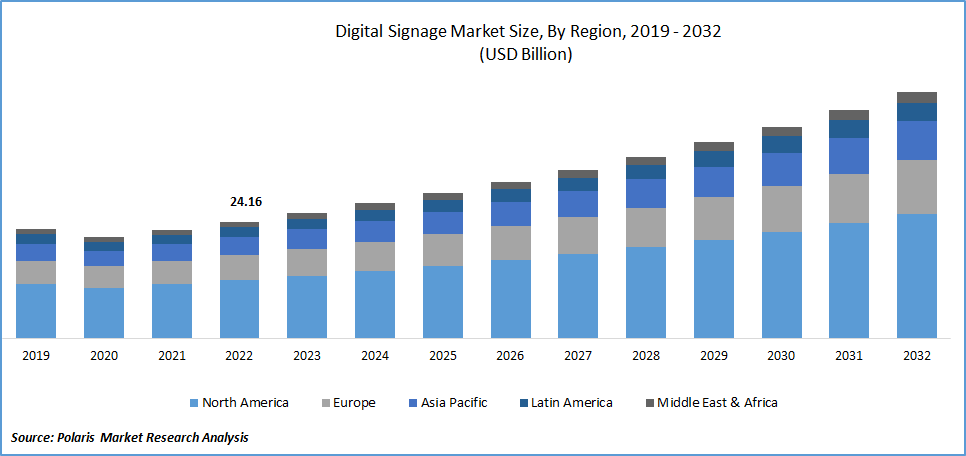
The global digital signage market was valued at USD 30.10 billion in 2025 and is expected to grow at a CAGR of 7.8% during 2026–2034. The growth is driven by rising demand from various industry verticals for effective marketing and information/content sharing.
Market Statistics
Key Takeaways
- North America dominated with largest share of 34.60% in 2025 due to the rising adoption rate of digital signage solutions in various sectors.
- The Asia Pacific digital signage market is projected to account for a significant growth rate of CAGR 8.1% during the projected period. The regional market growth is driven by rapid urbanization and infrastructure development.
- The hardware segment is expected to witness significant growth rate of CAGR 7.5% during the forecast period due to rising adoption by the retail sector.
- The LED segment dominated with the largest share of 42.30% in 2025 due to its high-quality display.
Industry Dynamics
- The rising penetration of digital signage in various sectors fuels the industry growth.
- Increasing adoption of cloud-based digital signage is driving the growth.
- The surging focus on technological advancements is boosting the industry growth.
- High initial installation and maintenance costs limit the demand for digital signage.
Impact of AI in Digital Signage
- Enables personalized content delivery by analyzing viewer demographics and behavior in real time.
- Integrates with external data sources (e.g., weather, traffic, sales) to dynamically update signage content.
- Monitors device health and predicts hardware failures, reducing downtime and maintenance costs.
Source: Polaris Market Research Analysis
What is Digital Signage?
Digital signage is a part of the larger ecosystem of the signage market. It comprises a combination of hardware and software. Companies use digital signage to reach out to potential customers. It helps them display and distribute their knowledge in multiple locations from a single source. Using this signage technique, enterprises can effectively eliminate the need for printing information. Also, they can save huge costs incurred in printing and distribution.
Digital signage uses large screens for displaying information. It enables companies to be as creative as possible in showcasing their products and services. This helps them target a large audience with creative publicity and promotions. For example, companies are using digital facades, a combination of LED lighting used on the exterior of buildings. These digital facades are controlled by software and can be used to create visuals and graphics on the front side of the buildings, thus giving a creative edge. These imaginative endeavors drive planners, specialists, and commercial organizations to increase their spending toward the computerized signage display. All these factors considered are anticipated to propel the digital signage market growth.
Indoor and outdoor digital signage differ significantly. They differ in terms of brightness, installation complexity, protection (IP ratings), and total cost of ownership (TCO).
Indoor vs Outdoor Digital Signage
|
Parameter | Indoor Digital Signage | Outdoor Digital Signage |
| Environment | Controlled environment, including temperature and lighting | Resistance to harsh conditions such as heavy rains, dust, sunlight, and extreme temperatures |
| Durability/Protection | Standard commercial displays | Rugged, weather-proof, and vandal-resistant (IP55–IP65) |
| Cost | Lower hardware and installation costs | Higher costs due to enclosure, cooling, brightness, and protection |
| Maintenance | Minimal. Indoor environment causes less wear | Higher. Exposure to elements can increase maintenance cycles |
| Content Type | Product promotions, branding, wayfinding, and corporate communication | Advertising, public information, transportation updates, and retail attraction |
| Installation Complexity | Easy. Simple mounts and power connections | Complex. It includes reinforced mounts, electrical protection, and cooling systems. |
| Power Consumption | Lower | Higher due to brightness and cooling |
| Audience Engagement | Longer dwell time and targeted messaging | High visibility. Effective for broad reach and impulse engagement |
| Approximate Lifecycle | 5–7 years | 3–5 years (depending on exposure and protection) |
Source: Polaris Market Research Analysis
What is the ROI of Digital Signage?
The digital signage ROI is strong. Use of digital signage boosts customer engagement and increases sales. Retailers recover initial investments within a year or two. ROI depends on content strategies and screen types. Use of digital signage reduces print logistics costs. It also minimizes promotional lag time. It enables targeted marketing that improves conversion rate. When combined with programmatic DOOH monetization, retailers can gain an additional recurring revenue stream. These factors improve overall ROI.
Digital Signage Cost vs. Benefits
| Parameter | Description |
| Cost Breakdown |
Recurring OpEx: content production, CMS licensing or cloud subscription, power consumption, connectivity, and maintenance The digital signage pricing model provides a rough per-screen and per-location cost baseline. |
| ROI Scenarios/Payback Estimates |
Motion Display reduces the time to notice a coupon by 8 times faster (from an average of 12.5 seconds to 1.6 seconds). |
| Comparison vs Static Signage/Print |
|
Source: Polaris Market Research Analysis
Industry Dynamics
What Factors are Driving the Digital Signage Market Growth?
Increasing Adoption of Digital Signage in Commercial Applications
Digital signage is used across various industries, such as retail, healthcare, transportation, and hospitality, to improve customer engagement and experience. It enables businesses to communicate effectively with their customers. It helps them promote their products and services. Enterprises use digital signage to create engaging experiences that help increase brand loyalty and customer satisfaction. Additionally, technological advancements in displays such as high-resolution, OLED, and LED displays improve the digital signage quality and effectiveness. Owing to these advancements, signage systems become more engaging and visually appealing. Thus, businesses can create dynamic, eye-catching displays to attract customers and increase engagement. Digital signage is increasingly used in the healthcare and transportation industries. Its major applications are for wayfinding, queue management, and real-time alerts. Thus, increasing adoption of commercial digital signage beyond pure advertising use cases drives the market growth.
Rising Demand for Programmatic DOOH & Retail Media Monetization
The rise in use of programmatic buying in out-of-home (DOOH) advertising creates a significant monetization potential, particularly for retail environments. Retail digital displays are used for in-store promotions. Installation of such displays leads to impulse buying. More screens can get connected and managed via demand-side platforms (DSPs). Thus, brands shift budget from static and traditional media to automated, data-driven retail media. It converts physical real-estate (in-store screens) into dynamic, revenue-generating media assets. Retailers are treating in-store screens as monetizable media inventory. It is supported by DSPs and measurement reporting. This strengthens budget allocation from brands. Thus, the growing DOOH advertising market and retail media monetization contribute to the digital signage industry growth.
Opportunities
Growing Preference for AI and Data-Driven Personalization & Audience Analytics
The AI in digital signage and data analytics transforms digital signage into a precise, context-aware advertising medium. Advanced signage systems leverage AI-enabled audience analytics. It helps end users infer viewer demographics such as age and gender. The systems use sensors, facial detection, and motion tracking. It provides data on dwell time, mood, or foot-traffic patterns. Digital signage analytics helps creators make advertisements more relevant and engaging. For instance, retail signage can show feminine products when girls pass by. Personalization and timely context-aware content boost engagement and conversion rates. Audience analytics adoption is rising. Thus, privacy-by-design approaches such as data minimization and consent workflows are becoming important for enterprise deployments. Thus, the surging preference for AI and data-driven personalization and audience analytics will propel market growth.
High Emphasis on Sustainability and Energy Efficiency Practices
There is a rising demand for energy-efficient LED displays, often combined with smart power-management, to significantly reduce power consumption. Additionally, some newer deployments use renewable energy. For instance, enterprises are preferring solar-powered screens, particularly for outdoor or remote installations. It helps them reduce dependency on the power grid and comply with sustainability goals. Further, AI-based scheduling and content optimization reduce unnecessary brightness levels and wasted “blank-screen” time. It lowers energy consumption. As regulatory and investor pressure grows on environmental, social, and governance (ESG), energy- and waste-saving benefits of digital signage are expected to offer lucrative opportunities in the coming years.
Restraints
Content Complexity & Operational Overhead
Retail media networks and enterprises lack in-house creative resources. There is a growing number of screens and the diversity in formats such as LED walls, interactive kiosks, and shelf-edge displays. This scenario creates a requirement to maintain updated/fresh, localized, and brand-compliant content, which increases operational overhead. Organizations are required to integrate real-time data, manage frequent updates, and synchronize campaigns across CMS platforms. It requires skilled content specialists, designers, and IT support. This complexity increases total cost of ownership (TCO) and slows deployment cycles. Thus, many SMBs delay or scale back investments in digital signage. Thus, the complexity in content creation, scheduling, and multi-location management hinders the digital signage market expansion.
Source: Polaris Market Research Analysis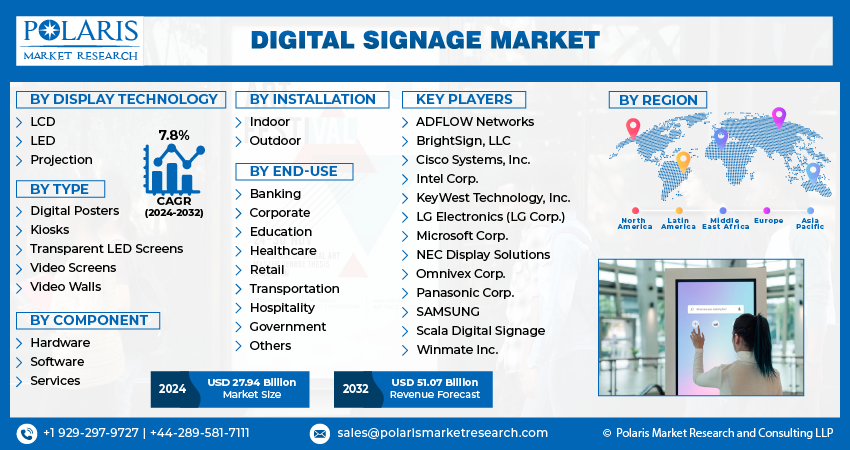
What are the Future Technology Trends in the Digital Signage Market?
Connectivity (5G/edge computing) and display innovation (MicroLED/e-paper) share Future digital signage trends. Also, stronger security and compliance requirements are among the key trends as signage becomes more networked.
| Trend | Description |
| Rising Integration of 5G, IoT, and Edge Compute | 5G and IoT digital signage can be connected to cameras, sensors, and crowd-monitoring systems. Their adoption delivers context-aware content. They are used as promotional displays based on footfall, wait-time displays in transit, and emergency alerts. |
| Emerging Display Technologies such as MicroLED and e-Paper Digital Signage | MicroLED digital signage and sustainable digital signage offer better energy efficiency. They also provide advantages such as higher brightness, longer lifespan, and lower maintenance. They are ideal for indoor and outdoor signage. |
| Increasing Concerns Related to Data Security, Privacy, and Digital Signage Compliance | With audience analytics, camera integrations, and programmatic DOOH, the risks of data privacy, unauthorized content changes, and content security rise. Therefore, there is a rising emphasis on imposing regulations on cybersecurity for digital signage, content approval workflows, and data compliance guidelines. |
Source: Polaris Market Research Analysis
Segmental Analysis
Why LED Segment Dominated the Industry in 2025?
The LED segment dominated with largest share in 2025 due to its high-quality display. Manufacturers use LED technology to create flat, larger, brighter, and slimmer presentations. The development of OLED displays has advanced LED technology. It is expected to drive its adoption in displays. Additionally, technological advancements improve the quality of LED screens. They reduce overall cost and life of product. LED adoption is especially strong in video walls and large-format installations. Brightness and modular scaling are key purchase criteria in these end uses. All these factors are driving the segment growth.
Which Segment by Component is Expected to Witness Significant Growth?
The hardware segment is expected to register significant growth during the forecast period due to rising demand for high quality display screens, media players, and interactive kiosks. This rise in demand is driven by expansion of major sectors such as retail, transportation, healthcare, and education. Moreover, advancement in LED and LCD technology are improving the appeal of the final product. These advancements are making digital signage hardware more cost effective, which in turn is driving the expansion among the businesses with limited budget. Furthermore, growing focus on smart cities development is further driving the demand for hardware, thereby driving the segment growth. Enterprises upgrade to higher-resolution screens. Thus, interactive formats such as kiosks and shelf-edge displays and higher refresh cycles boost the hardware segment growth.
Source: Polaris Market Research Analysis
Digital Signage Selection by Use Case
| Use Case | Recommended Display Type | Brightness (nits) | Typical Screen Size | CMS Needs |
| Retail Indoor Promotions | Commercial LED or LCD | 400–700 | 43–65 | Cloud CMS, multi-location control, scheduling |
| Outdoor Advertising | Outdoor LED/High-brightness LCD | 2,000–5,000+ | 55–98/Large LED walls | Remote monitoring, weather-proof content updates |
| QSR Menu Boards | Commercial LCD/LED | 500–1,000 | 32–55 | Menu templates, real-time updates, pricing sync |
| Corporate Lobby Branding | Video wall (LCD/LED) | 500–800 | 55–110+ | Playback automation, Content zoning, brand templates, |
| Transportation Hubs | High-brightness LCD/LED | 700–1,500 | 49–75 | Real-time data integration, API support |
| Healthcare Information | Commercial LCD | 400–600 | 32–55 | Role-based access, compliance-friendly CMS |
| Education & Campuses | Interactive flat panel/LCD | 350–600 | 55–86 | Multi-user access, emergency messaging |
| Control Rooms & Dashboards | LED walls/Professional LCD | 600–1,000 | 65–120+ | Live data feeds, low-latency updates |
| Hospitality & Events | LED walls/Large-format LCD | 600–1,200 | 65–150+ | Event scheduling, rapid content switching |
Source: Polaris Market Research Analysis
Regional Insights
How North America Captured Largest Market Share in 2025?
North America dominated with the largest share in 2025. It is attributed to the high adoption rate of digital signage solutions in various sectors, such as retail, healthcare, transportation, and hospitality. The region has a high level of technological advancements. The increasing demand for interactive displays and the growing need for digital advertising are driving the demand. Moreover, the region has one of the most advanced urban infrastructures, which further drives the North America digital signage market growth.
What are the Reasons for the Asia Pacific Digital Signage Market Growth?
The Asia Pacific digital signage growth is expected to witness significant growth during the forecast period. Rising urbanization and increasing investments in smart city projects in the region boost the market growth. Major countries in the region, such as India, China, and Japan, are witnessing an increase in urban migration. Rising urbanization is driving the demand for infrastructure such as commercial complexes, shopping malls, hospitals, and hotels. This increasing infrastructure development is driving the demand for digital signage in the region. Moreover, Asia Pacific has a large manufacturing base of various goods, including hardware used in digital signage. This local manufacturing of hardware lowers the price and makes signage more accessible, which fuels the industry growth in the region. Further, rising focus on ongoing smart city and infrastructure projects propels demand for digital public-space displays for transport, transit, and urban information. Thus, there is an increase demand for smart city digital signage across major countries such as China, Japan, India, and South Korea
Source: Polaris Market Research Analysis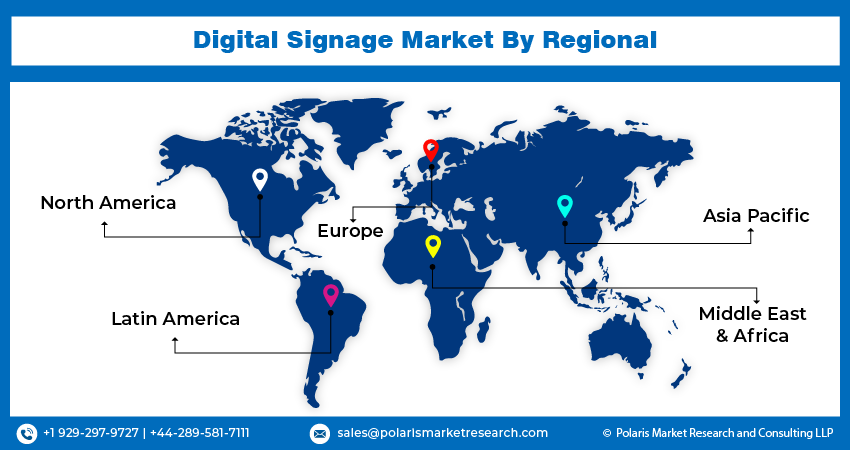
Competitive Landscape
Clear strategy themes such as strategic partnerships, product launches, and platform consolidation shape the digital signage competitive landscape. Leading digital signage vendors partner with CMS and cloud platform providers, and system integrators. It helps them offer end-to-end solutions and expand global reach. Frequent product launches emphasize high-brightness displays and fine-pitch LED video walls. AI-based content management solutions address transportation, retail, and smart city use cases. Players integrate hardware, software, analytics, and remote device management into unified ecosystems. Thus, platform consolidation is accelerating. A few of the major players operating in the global market include ADFLOW Networks, BrightSign, LLC, Cisco Systems, Inc., Intel Corp., KeyWest Technology, Inc., LG Electronics (LG Corp.), Microsoft Corp., NEC Display Solutions, Omnivex Corp., Panasonic Corp., SAMSUNG, Scala Digital Signage, and Winmate Inc.
Digital Signage Market Players
- ADFLOW Networks
- BrightSign, LLC
- Cisco Systems, Inc.
- Intel Corp.
- KeyWest Technology, Inc.
- LG Electronics (LG Corp.)
- Microsoft Corp.
- NEC Display Solutions
- Omnivex Corp.
- Panasonic Corp.
- SAMSUNG
- Scala Digital Signage
- Winmate Inc.
Recent Developments
-
June 2025: Allsee Technologies launched 4K Elite Outdoor Digital Signage Displays. The displays feature integrated Android 14, high brightness, and strong weather protection.
(Source: allsee-tech.com) - September 2025: Samsung Electronics expanded its partnership with Toyota Motor. The partnership will bring Samsung’s smart signage solutions to additional Toyota dealerships in key markets. (Source: samsung.com)
- June 2025: Samsung launched 32-inch Color E-Paper (EM32DX) globally. It is an ultra energy-efficient, lightweight digital signage solution. The solution offers vivid color, zero power usage on static content, and smart content management features. (Source: samsung.com)
Digital Signage Market Segmentation
By Display Technology Outlook (Revenue – USD Billion, 2021–2034)
- LCD
- LED
- Projection
By Screen Size Outlook (Revenue – USD Billion, 2021–2034)
- Less than 32 Inches
- 32–52 Inches
- More than 52 Inches
By Resolution Outlook (Revenue – USD Billion, 2021–2034)
- HD
- Full HD
- Quad HD/2K
- 4K Ultra HD
- 8K Ultra HD
By Type Outlook (Revenue – USD Billion, 2021–2034)
- Digital Posters
- Kiosks
- Transparent LED Screens
- Video Screens
- Video Walls
- Billboard
- Others
By Deployment Outlook (Revenue – USD Billion, 2021–2034)
- Cloud-Based
- On-premise
- Hybrid
By Component Outlook (Revenue – USD Billion, 2021–2034)
- Hardware
- Software
- Services
By Installation Outlook (Revenue – USD Billion, 2021–2034)
- Indoor
- Outdoor
By Content Category (Revenue – USD Billion, 2021–2034)
- Advertising, Branding, & Promotions
- Educational, Training, & Awareness Content
- Informational & Wayfinding Content
- Corporate Communications
- Menu Boards & Pricing Displays
- Public Announcements & Alerts
- Entertainment & Infotainment
- Interactive & Touch-Based Content
- Real-Time Data & Dashboards
By End-Use Outlook (Revenue – USD Billion, 2021–2034)
- Banking
- Corporate
- Education
- Healthcare
- Retail
- Transportation
- Hospitality
- Government
- Others
By Regional Outlook (Revenue – USD Billion, 2021–2034)
- North America
- U.S.
- Canada
- Europe
- Germany
- UK
- France
- Italy
- Spain
- Russia
- Netherlands
- Rest of Europe
- Asia Pacific
- China
- India
- Japan
- South Korea
- Indonesia
- Malaysia
- Rest of Asia Pacific
- Latin America
- Argentina
- Brazil
- Mexico
- Rest of Latin America
- Middle East & Africa
- UAE
- Saudi Arabia
- Israel
- South Africa
- Rest of Middle East & Africa
Future of Digital Signage Market
Future of digital signage market will grow with AI based personalization and real time content updates. Use of 5G, IoT and edge computing will increase and make content delivery faster and more connected. New display technologies like MicroLED and e-paper will improve display quality and reduce energy use. Adoption will increase in retail, healthcare, transport and smart cities for information, navigation and communication purposes
Digital Signage Market Report Scope
| Report Attributes | Details |
| Market Size in 2025 | USD 30.10 Billion |
| Market Size in 2026 | USD 32.41 Billion |
| Revenue Forecast by 2034 | USD 59.09 Billion |
| CAGR | 7.8% from 2026 to 2034 |
| Base Year | 2025 |
| Historical Data | 2022–2024 |
| Forecast Period | 2026–2034 |
| Quantitative Units | Revenue in USD billion, 2022–2034 and CAGR from 2026 to 2034 |
| Report Coverage | Revenue Forecast, Market Competitive Landscape, Growth Factors, and Trends– |
| Segments Covered |
|
| Regional Scope |
|
| Competitive Landscape |
|
| Report Format |
|
| Customization | Report customization as per your requirements with respect to countries, regions, and segmentation. |
Source: Polaris Market Research Analysis
Digital Signage Market FAQ's
The global digital signage market was valued at USD 30.10 billion in 2025 and is projected to reach USD 59.09 billion by 2034. It is expected to grow at a CAGR of 7.8% during 2026–2034.
The LED segment dominated with the largest market share in 2025. The dominance is attributed to superior brightness, energy efficiency, high-resolution displays, longer lifespan, and suitability for indoor and outdoor installations.
The retail, transportation, healthcare, hospitality, and corporate industries drive demand for digital signage. Demand is rising for various uses such as advertising, wayfinding, customer engagement, information sharing, and brand enhancement.
The Asia Pacific market is expected to register the highest CAGR during the forecast period. It is fueled by rapid urbanization, infrastructure development, manufacturing capabilities, and expanding retail and commercial sectors.
AI technology helps analyze external data and focuses on predictive maintenance. It provides demographic analysis, behavioral tracking, dynamic updates. Therefore, using AI, vendors can create personalized content for digital signage.
It provides clear information, interactive content, and reduces waiting confusion.
Digital signage are on-premise digital displays. They are used to deliver information and for promotions and brand messaging across various industries. DOOH (Digital Out-of-Home) is a media and advertising subset of digital signage. DOOH focuses on paid, networked advertising across large public venues such as billboards, transit hubs, and outdoor urban spaces.
It uses LED/LCD screens, cloud CMS, AI analytics, and IoT-based systems.
Easy content scheduling, real-time updates, and analytics are among the most important CMS features. These features ensure scalable control, measurable performance, and operational efficiency.
Digital signage performance is measured using audience reach, dwell time, and content engagement rates. It is also measured by conversion uplift such as sales or actions, uptime reliability, and analytics from sensors or CMS dashboards.
Digital signage is a hardware-software combination used to display content across multiple locations, helping companies reach potential customers from a single source without printing costs.
Key trends include rising cloud-based solutions, AI-powered personalized content delivery, advanced LED/OLED displays, smart city infrastructure adoption, and growing demand across retail, healthcare, and transportation sectors.
Yes, it is more adaptable, dynamic, and can be changed in real time.
Download Sample Report of Digital Signage Market
Please fill out the form to request a customized copy of the research report.


