
Dimethyl Carbonate Market Share, Size, Trends, Industry Analysis Report, 2026 - 2034
REPORT DETAILS
Dimethyl Carbonate Market Summary
The global dimethyl carbonate market is estimated around USD 1.90 Billion in 2025,?with consistent growth anticipated during 2026–2034. Expansion is driven by rising demand for green solvents, increasing adoption in lithium-ion batteries, and growing use across chemical manufacturing and fuel applications. The market is projected to grow at a CAGR of 9.9%during the forecast period.
Market Statistics
Key Takeaways
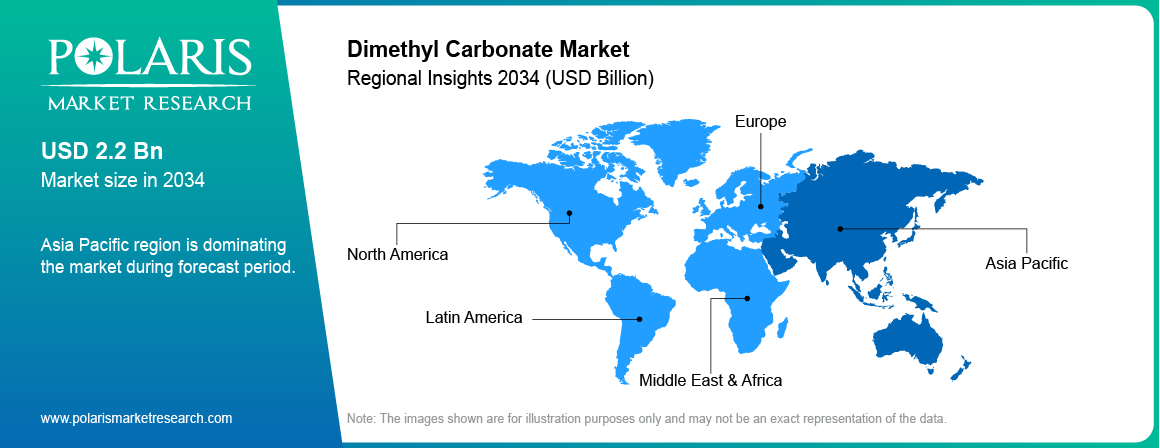
- Asia Pacific dominated with a market share of approximately 48.20% in 2025, driven by the presence of well-established battery manufacturing industries
- Lithium-ion battery segment held the largest share of nearly 34.10% in 2025, due to the increasing adoption of electric vehicles
- Chemical manufacturing accounted for a market share of approximately 29.35% in 2025, supported by extensive application in the manufacturing of polycarbonates
- Polycarbonate production segment held a share of nearly 27.25% in 2025, driven by rising demand in plastic manufacturing
- Industrial grade DMC captured a market share of approximately 31.40% in 2025, owing to its extensive use in bulk chemical processing
- Dimethyl carbonate as a green solvent is projected to grow at a CAGR of nearly 11.90% during 2026–2034, supported by favorable environmental characteristics
Industry Dynamics
- Increasing demand for electric vehicles are boosting the demand for DMC, which is used in the manufacturing of lithium-ion batteries.
- Rising regulatory hurdles for hazardous chemicals are fueling adoption rate for DMC as a green solvent.
- High manufacturing cost and energy-intensive process are hindering the DMC adoption.
- Expansion of sustainable chemistry and advanced material applications is creating new growth avenues for DMC.
What is included in the Dimethyl Carbonate market?
The dimethyl carbonate market reflects growing demand for safer and sustainable chemical solutions across multiple industries. Dimethyl carbonate is an organic low-toxicity chemical used as a solvent and intermediate. The main chemical properties of dimethyl carbonate include high oxygen content, low environmental impact, and good solvency.
The dimethyl carbonate industry overview points towards the growing importance of dimethyl carbonate as an emerging green solvent and eco-friendly building block for chemicals. It is utilized on a large scale in the production of pharmaceuticals, agrochemicals, coatings, and polycarbonate resins. Environmental concerns have boosted the demand for dimethyl carbonate as an alternative to phosgene and other poisonous reagents. The market scope covers production technologies, solvent applications, fuel additives, and chemical intermediates, while excluding unrelated carbonate derivatives.
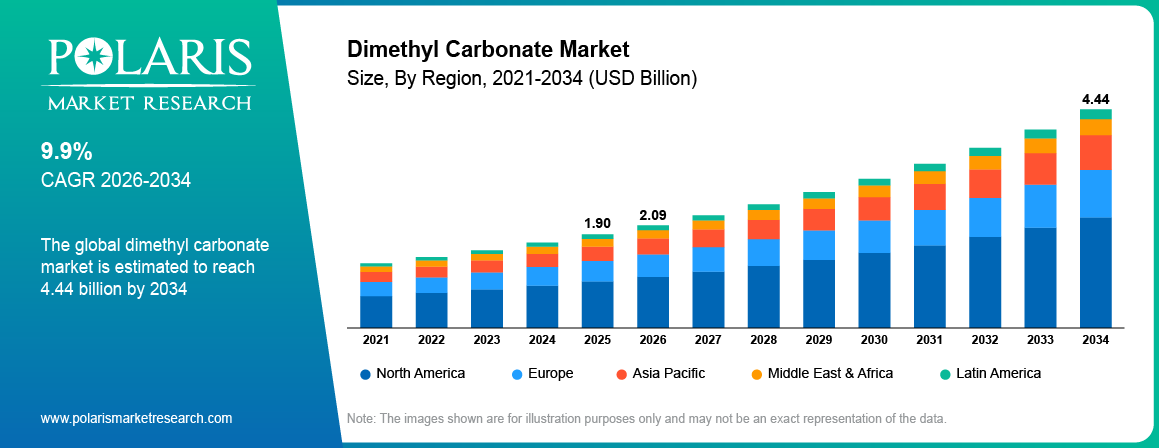
Source: Polaris Market Research Analysis
To Understand More About this Research:Download Sample Report
Dimethyl carbonate plays an important role in modern industry. It is widely used in lithium-ion battery electrolytes to improve safety and performance. It also has the function of oxygenated fuel additive to enable clean combustion. There has been growth in the use of electric vehicles and eco-friendly chemicals. These factors further sustain the dimethyl carbonate market growth.
Drivers & Opportunities
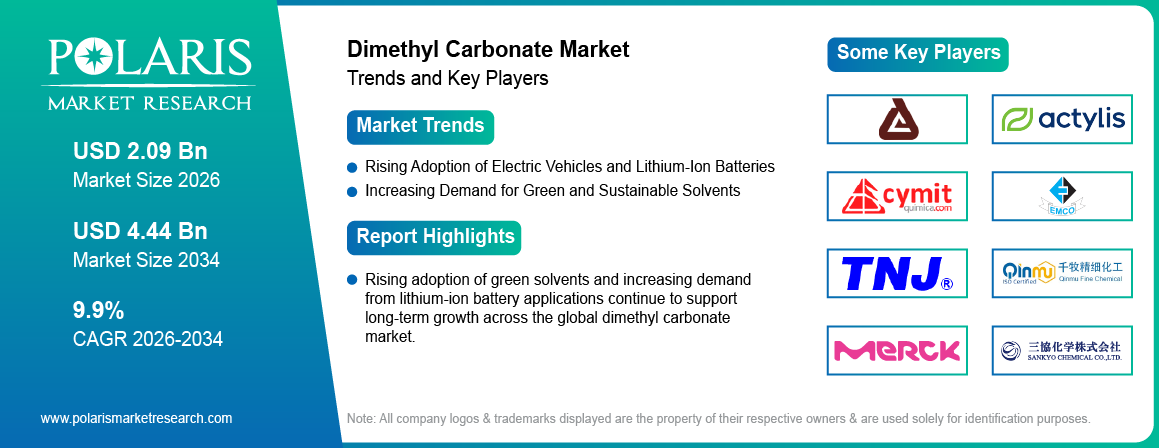
Rising Adoption of Electric Vehicles: Electric vehicle expansion is increasing demand for lithium-ion batteries, where dimethyl carbonate (DMC) is used as a key electrolyte solvent. Higher EV production directly raises consumption of battery-grade DMC due to its role in improving ionic conductivity and battery stability. As per the International Energy Agency, electric car sales crossed 17 million units in 2024, growing more than 25% year-over-year. This surge is growing battery manufacturing capacity, particularly in Asia Pacific and Europe, thereby increasing procurement of high-purity DMC in these gigafactories.
Growing Emphasis on Green Solvents: Growing regulatory scrutiny against toxic solvents is creating an ecosystem for green solvents like DMC to gain increased traction. This green solvent is utilized in coatings, adhesives, and pharmaceutical manufacturing. The green solvent has better environmental and safety profiles compared to traditional solvents like DMF and NMP. MilliporeSigma, a business of Merck, has recently launched its green solvent, Cyrene, which is derived from renewable cellulose. This development are highlighting the increasing industry focus on green chemical manufacturing. The green solvent is creating a rising need for substitution, as DMC is substituting traditional solvents.
Restrain
High Production Cost: The production of DMC requires energy-intensive processes. The reaction conditions must be tightly controlled. These conditions increase the production cost of DMC. The selection and purification of the feedstock materials affect the cost efficiency of the production process. These conditions affect the pricing competitiveness of DMC in conventional solvents.
Opportunity
Sustainable Chemistry and Advanced Applications: Expansion of sustainable chemicals and advanced materials in DMC-based polycarbonates, fuel additives, and pharmaceuticals are creating new opportunities for the market. DMC has also emerged as a significant chemical in the development of new-generation battery technologies due to the importance of the next-generation electrolyte. New application in coatings and agrochemicals, are also driving the DMC market. Sustainable chemistry has thus established DMC as a multifunctional solvent and intermediate.
Source: Polaris Market Research Analysis
Segmental Insights
This report offers detailed coverage of the dimethyl carbonate market by grade, application, and end-use industry to help readers identify the fastest expanding and most attractive demand segments.
By Grade
-
Industrial grade
Industrial grade held the largest share in the dimethyl carbonate market due to its extensive use across bulk chemical processing and solvent applications. The industrial grade DMC is extensively used in the manufacturing process of polycarbonate, and DMC in coatings and paint industries, where cost efficiency and high volume usage are a prime concern.
-
Battery grade
Battery grade dimethyl carbonate projected to grow at fastest rate due to increasing demand for dimethyl carbonate in lithium-ion batteries. This high-grade dimethyl carbonate finds application in the formulation of the electrolyte in lithium-ion batteries.
By Application
-
Polycarbonate production
Polycarbonate production registered leading market share, as it is used on a large scale as an important intermediate in polymer production. The chemical industry uses dimethyl carbonate as a raw material for producing high-performance polymers used for automotive parts, electronics, and construction applications.
-
Lithium-ion batteries
Lithium-ion battery technology exhibits the highest growth rate among applications, driven by strong growth in electrification. The role of dimethyl carbonate in lithium-ion battery technology is a significant electrolyte solvent, facilitating efficient ion transport for battery technology.
By End-use Industry
-
Chemical manufacturing
Chemical manufacturing dominated the market in terms of share due to the versatile nature of dimethyl carbonate as an intermediate in various chemical synthesis processes. DMC is used in polycarbonate production, solvents, and fuel additives.
-
Automotive & EV
Automotive & EV is the fastest-growing segment in the dimethyl carbonate market due to the increasing dependency on lithium-ion battery technology. The rising rate of electric vehicles has a direct correlation with the demand for battery grade dimethyl carbonate.
Source: Polaris Market Research Analysis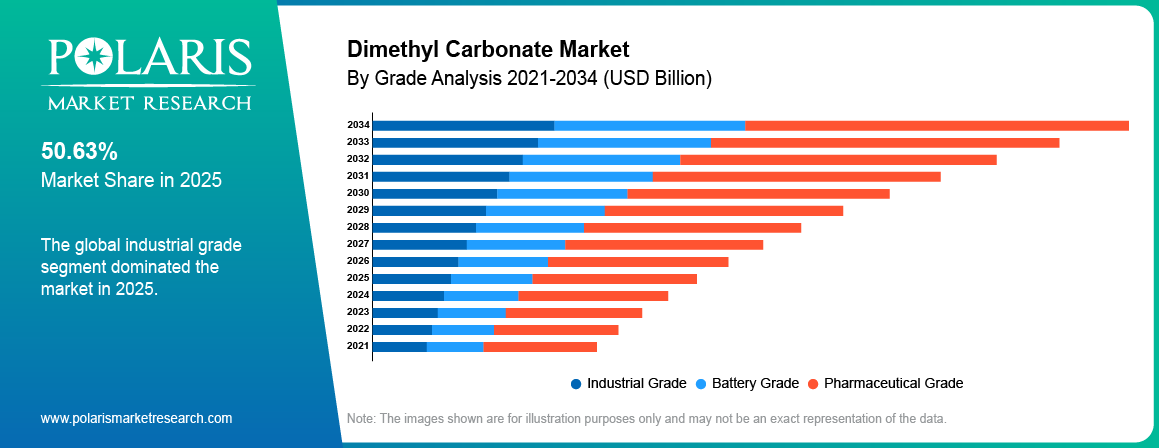
Regional Analysis
Asia Pacific Dimethyl Carbonate Market Assessment
Asia Pacific dominated the dimethyl carbonate market in 2025, owing to the high manufacturing capabilities in China, Japan, and South Korea. The region has a presence of well-established battery industry. According to the International Energy Agency, the Korean industry had access to almost 400 GWh of battery manufacturing capacity in other countries in 2024, much higher than in Japan and China. China’s dimethyl carbonate market is growing propelled by high volume of lithium-ion batteries produced in the country. Japan and South Korea also contributed to the dimethyl carbonate market by virtue of the high processing capabilities in the region and the export-oriented manufacturing industry.
North America Dimethyl Carbonate Market Assessment
North America DMC market witnessed steady growth supported by technological advancements and increasing adoption of green chemicals across the US. The growing demand for battery-grade solvents from electric vehicles and energy storage has fueled the momentum of domestic production initiatives. In February 2025, UBE Corporation started building a DMC and EMC facility in Louisiana. This is the first domestic production facility with a planned capacity of 100,000 tons per year. This facility employs a low-emitting process, highlighting the trend towards sustainable chemical production.
Europe Dimethyl Carbonate Market Overview
Europe dimethyl carbonate market is growing due to the implementation of environmental regulations. Europe chemical regulations are forcing industries to replace hazardous chemicals with low-toxicity chemicals. Germany is the major contributor to the market due to its chemical industry and green chemistry. DMC adoption is increasing across coatings, pharmaceuticals, and fuel applications. Regulatory pressure continues to support substitution trends and strengthens regional DMC market trends.
Rest of the World Dimethyl Carbonate Market Assessment
Regional DMC market trends in Latin America and the Middle East show moderate growth. Industrialization and expansion of chemical sectors are supporting demand. In Latin American countries, there is slow growth in industrial and fuel segments. The Middle East is focusing on developing its chemical industry. Petrochemical investments are creating opportunities. These are some of the factors contributing to steady growth in emerging markets for dimethyl carbonate.
Source: Polaris Market Research Analysis
Key Players & Competitive Analysis Report
The competitive scenario for the market for dimethyl carbonate shows active participation from chemical manufacturers worldwide, specialty chemical suppliers, and regional DMC manufacturers. Key players focus on innovative production technology for efficient and sustainable production processes. Companies in the dimethyl carbonate market are competitive in terms of innovative production processes, such as the development of phosgene-free processes and carbon dioxide-based processes for DMC production.
Dimethyl carbonate market key players include Aarsha Chemicals Private Limited, Actylis, Cymit Química S.L., Dongying City Longxing Chemical Co., Ltd., Emco Dyestuff Pvt Ltd, Hefei TNJ Chemical Industry Co., Ltd., Jinan Qinmu Fine Chemical Co., Ltd., Merck KGaA, SANKYO CHEMICAL CO., LTD., SHANTI CHEMICAL WORKS, SMC Global, Thermo Fisher Scientific Inc., Tokyo Chemical Industry Co., Ltd., UBE Corporation, and Jigs Chemical Limited. These DMC manufacturers leverage regional production advantages, integrated supply chains, and innovation-led product differentiation to strengthen their presence across industrial and specialty chemical segments.
Value Chain, Production Process & Pricing Insights
-
Dimethyl Carbonate Production Process (phosgene-free, etc.)
The process for the production of dimethyl carbonate has changed to phosgene-free processes. The major methods for the production of DMC include oxidative carbonylation, transesterification of ethylene carbonate, and synthesis with CO₂. The most preferred methods for DMC production, based on reduced toxicity and sustainability, are transesterification and synthesis with CO₂, which are in line with green chemistry principles.
-
Raw Materials & Cost Structure
The major raw materials required for DMC production are methanol, carbon monoxide, and ethylene carbonate. The major factor affecting the cost structure is the price of methanol. The energy consumption and efficiency of catalysts also play an important role in DMC production. The cost structure is better controlled for integrated players.
-
Pricing Trends & Supply Chain Dynamics
The price trends of dimethyl carbonate are linked with the fluctuating methanol prices. In addition, the supply-demand pattern and capacity addition in different regions influence the pricing trends of Dimethyl Carbonate. The supply chain of Dimethyl Carbonate in Asia Pacific makes it dependent in other regions.
Future Outlook, Trends & Strategic Insights
-
Future Demand Outlook (2034 perspective)
The dimethyl carbonate market has a favorable outlook in the future, with increasing demand from lithium-ion battery markets, coatings, and fuel additives. Long-term growth in energy storage will drive the demand.
-
Emerging Trends (green chemistry, EV scaling)
The major trends in the dimethyl carbonate market include the increasing use of green chemistry technology and sustainable solvent markets. Dimethyl carbonate is used as a component in the manufacture of battery chemicals for electric vehicles.
-
Strategic Recommendations for Stakeholders
The major recommendations for the stakeholders in the dimethyl carbonate market include sustainable production, supply chain development, and partnerships in the battery and specialty chemical industries.
Premium Insights
- The demand for battery-grade dimethyl carbonate is growing at a rapid rate with the rise in the production of lithium-ion batteries.
- Asia Pacific market is the largest in the dimethyl carbonate market propelled by the presence of large-scale production capacity.
- Shift in the market towards phosgene-free and CO2-based technologies is changing the market landscape in alignment with the principles of green chemistry.
- Methanol price volatility is one of the key factors affecting the market price of dimethyl carbonate.
- Growing demand for low-toxicity solvents in coatings, pharmaceuticals, and agrochemicals is driving the market.
- The capacity expansion and vertical integration strategy of the key market players is enhancing the efficiency of the supply chain.
Key Players
- Aarsha Chemicals Private Limited
- Actylis
- Cymit Química S.L.
- Dongying City Longxing Chemical Co., Ltd.
- Emco Dyestuff Pvt Ltd
- Hefei TNJ Chemical Industry Co., Ltd.
- Jinan Qinmu Fine Chemical Co., Ltd.
- Merck KGaA
- SANKYO CHEMICAL CO., LTD.
- SHANTI CHEMICAL WORKS
- SMC Global
- Thermo Fisher Scientific Inc.
- Tokyo Chemical Industry Co., Ltd.
- UBE Corporation
- Jigs Chemical Limited
Industry Developments
December 2024: Jiangsu Sailboat Petrochemical began commercial production of high-purity dimethyl carbonate (DMC) and ethylene carbonate (EC) using a CO₂-based process technology licensed from Asahi Kasei. (Source: asahi-kasei)
Dimethyl Carbonate Market Segmentation
By Grade Outlook (Revenue, USD Billion, 2021-2034)
- Industrial Grade
- Battery Grade
- Pharmaceutical Grade
By Application Outlook (Revenue, USD Billion, 2021-2034)
- Lithium-ion Batteries
- Polycarbonate Production
- Solvents (Paints & Coatings)
- Fuel Additives & Agrochemicals
By End-Use Industry Outlook (Revenue, USD Billion, 2021-2034)
- Automotive & EV
- Electronics
- Pharmaceuticals
- Chemical Manufacturing
By Regional Outlook (Revenue, USD Billion, 2021-2034)
- North America
- US
- Canada
- Europe
- Germany
- France
- UK
- Italy
- Spain
- Netherlands
- Russia
- Rest of Europe
- Asia Pacific
- China
- Japan
- India
- Malaysia
- South Korea
- Indonesia
- Australia
- Vietnam
- Rest of Asia Pacific
- Middle East & Africa
- Saudi Arabia
- UAE
- Israel
- South Africa
- Rest of Middle East & Africa
- Latin America
- Mexico
- Brazil
- Argentina
- Rest of Latin America
Dimethyl Carbonate Market Report Scope
| Report Attributes | Details |
| Market Size in 2025 | USD 1.90 Billion |
| Market Size in 2026 | USD 2.09 Billion |
| Revenue Forecast by 2034 | USD 4.44 Billion |
| CAGR | 9.9% from 2026 to 2034 |
| Base Year | 2025 |
| Historical Data | 2022–2024 |
| Forecast Period | 2026–2034 |
| Quantitative Units | Revenue in USD Billion and CAGR from 2026 to 2034 |
| Report Coverage | Revenue Forecast, Competitive Landscape, Growth Factors, and Industry Trends |
| Segments Covered |
|
| Regional Scope |
|
| Competitive Landscape |
|
| Report Format |
|
| Customization | Report customization as per your requirements with respect to countries, regions, and segmentation. |
Source: Polaris Market Research Analysis
Dimethyl Carbonate Market FAQ's
The global market size was valued at USD 1.90 Billion in 2025 and is projected to grow to USD 4.44 Billion by 2034.
Asia Pacific dominates due to strong battery manufacturing capacity, integrated chemical supply chains, and high EV production.
Chemical manufacturing accounts for the largest share due to extensive use of DMC in polycarbonate production and chemical synthesis.
Key players include Merck KGaA, Thermo Fisher Scientific Inc., UBE Corporation, Tokyo Chemical Industry Co., Ltd., and others.
Growth is fueled by the rise in EV adoption, demand for green solvents, expansion in the lithium-ion battery market, and the push towards sustainable chemicals.
Trends include battery-grade dimethyl carbonate, expansion of green chemistry, and application in advanced materials and fuel additives.
Chemical manufacturing, automotive & electric vehicles, pharmaceuticals, and coatings use the most dimethyl carbonate.
DMC offers lower toxicity, reduced environmental impact, and safer handling compared to conventional solvents.
Download Sample Report of Dimethyl Carbonate Market
Please fill out the form to request a customized copy of the research report.


