
Field Service Management Market Size, Share, Trends and Forecast, 2026–2034
REPORT DETAILS
Field Service Management Market Summary
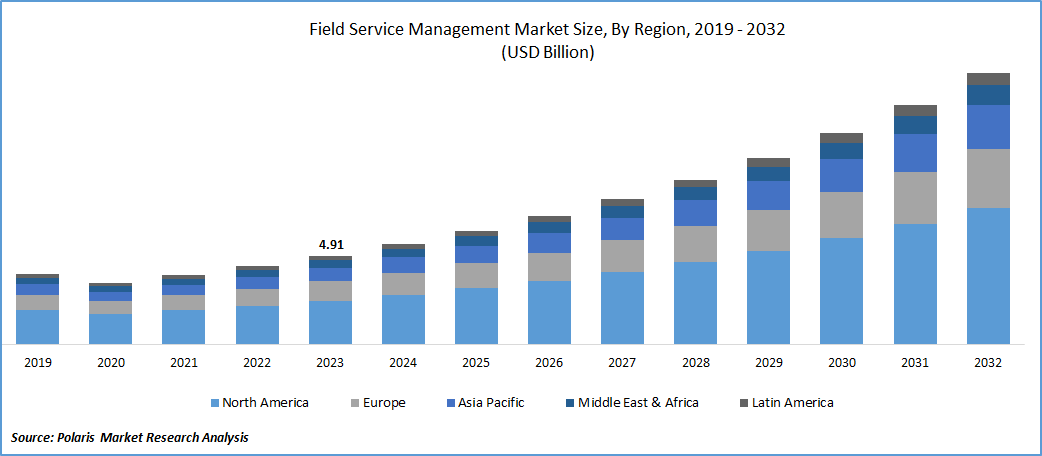
The global field service management market size was valued at USD 5.08 billion in 2025. The market is projected to grow at a CAGR of 12.2% from 2026 to 2034. Increasing workforce digitization and growing cloud adoption are a few of the key factors driving market growth. The shift towards predictive maintenance and agentic AI is expected to shape the market landscape in the coming years.
Market Statistics
Key Takeaways
- North America leads the global market. The regional field service management market share was 37.89% in 2025. The widespread rollout of smart grids contributes to the region’s leading market position.
- Asia Pacific is projected to witness rapid growth. The region’s field service management market growth rate is projected to be 15.80%. The regional development is driven by the expansion of 5G networks in emerging economies.
- By component, the solution segment accounted for the largest market share of 80.90% in 2025. Field service management solutions enable effective communication between employees.
- By deployment, the cloud segment dominated with an 64.29% share in 2025. This is because cloud offerings eliminate overhead and allow for automatic feature releases.
- By application, the customer management segment held an 12.35% share in 2025. This is due to the rising focus on customer experience and retention.
- By end use, the energy and utilities segment is projected to grow at an 11.78% CAGR. The rising adoption of mobile-driven field service management solutions contributes to the segment’s rapid growth.
Note: Figures and projections outlined in this report are the result of Polaris Market Research’s proprietary analytical processes, grounded in the latest available datasets and market observations.
What Is Field Service Management?
Field service management (FSM) entails the coordination and management of staff who perform work at customer sites or other locations that are not within the company’s premises. This involves planning and conducting fieldwork such as installation, maintenance, inspection, and repair of machines. The primary aim is to facilitate effective completion of the designated tasks by the field workers.
Companies utilize field service management software to schedule work orders, assign personnel, track job progress, and manage service requests. Technicians have the ability to get information about their jobs and make service record updates through mobile devices as they conduct their business at customers’ sites. The increasing demand for coordination of the field workers is prompting companies to implement digital solutions. This is contributing to the growth of the field service management market globally in the various industries relying on field services.
How Does Field Service Management Work
Field service management starts with the submission of the installation, maintenance, or repair request by the customer. The service providers record the request, as well as the place of work and task.
Creation of Work Order: The request turns into a work order. Work order management allows tracking and recording of job requirements and assignments.
Assignment of Technician: The software assigns a technician depending on their skills and availability. It also takes into account the place where the technician works.
Scheduling and Dispatch: The managers set the schedule of jobs and distribution of tasks. Scheduling and dispatch tools help organize work and avoid scheduling conflicts.
Planning of Route: Route optimization allows finding the most suitable route to the client. It minimizes additional costs connected with traveling.
Mobile Task Access: The technicians access the job details through mobile applications. They can view the instructions and update the information during the job.
Service Performance and Live Updates: The technicians perform the assigned job and update the job status. The managers monitor the performance through software.
Job Assessment: Finished job reports allow companies to assess the quality of their service and understand what should be changed.
Key Field Service Management Market Trends
The field service management market is evolving as companies seek more efficient means of managing their on-site operations. Software vendors are introducing smart capabilities to make the process easier. The industry is also growing due to the rise of connected devices and mobile technology, which has changed the way services are performed. Below are some of the trends shaping the market.
Agentic AI and Autonomous Dispatch
The use of agentic AI is emerging as an important development in field service processes. Unlike regular automation, agentic technology is capable of analyzing new conditions and making recommendations or performing actions according to pre-set business objectives. In field services, this technology is implemented in the planning and dispatch of technicians. An agent can analyze work orders and available technicians and propose schedule amendments to the current schedule.
AI scheduling becomes especially relevant in cases when a company needs to respond to changes in its activity. If an appointment is canceled, a technician may have some extra time. An intelligent solution can find nearby service requests and propose a new schedule. It also takes into consideration the priorities of jobs and the qualifications of technicians.
The development of agentic AI field service software is also contributing to the rise of intelligent dispatching. Such technology is helpful in responding to the changes in workload throughout the day. Certain systems allow dispatchers to look at proposed schedules before any changes are made. This keeps human oversight in the process.
The technician shortage in field service is increasing the need for these competencies. Staffing needs can be predicted using workforce forecasting, which will allow managers to foresee potential issues. Moreover, workforce forecasting can highlight moments when more technician capacity might be needed.
AI copilots have started providing such skills to frontline employees. Technicians can utilize them to pull up details related to work orders and service information. An AI copilot for field technicians will save time on looking for relevant data. It will also help employees gain insight into less familiar repair processes.
Recent product developments highlight the way the market is evolving. IFS introduced the Agent Studio through its IFS Loops solution, which includes ready-to-use Digital Workers for planning and dispatch in April 2026 (source: ifs.com). These examples highlight the development of AI dispatch systems into more complex automation systems.
Predictive Maintenance and IoT-Connected Assets
Field service providers are shifting from the conventional maintenance approach based on a service interval to the new model of maintenance that focuses on the condition of equipment. Data on the condition of assets collected through IoT-connected devices when they are in use allows service teams to detect any issues at an early stage. Technicians can then perform the inspection of the asset before the minor problem evolves into a bigger failure.
Predictive maintenance works by making predictions about the need for services based on the historical and current data on equipment. This model can detect any changes in vibration and temperature that are not normal. It can also recognize the decreasing performance of equipment, giving the service teams more time to arrange the maintenance activity and prevent unexpected breakdown.
IoT asset monitoring is especially helpful for businesses managing equipment located in multiple places. This technology allows service managers to monitor the condition of equipment without performing regular inspections. It also helps prioritize maintenance activities and gives the technician more information on the reported problem.
Another growing area is asset lifecycle management. Companies need to manage their equipment through installation, service schedules, and eventual replacements. Through field service software, companies can have an account of the service history and link maintenance information with asset information. This helps in determining the frequency of repairs as well as the performance of the equipment. This strategy enables better decisions regarding maintenance investments. Increased use of connected equipment has strengthened the link between field service software and predictive maintenance solutions.
Mobile Workforce, Remote Assistance and Digital Service Models
With mobile technology, there have been changes in the way field technicians access their work information. With mobile applications, employees can get assignments and record service information from the client's premises. In addition, they are able to get equipment information without having to go back to the office. This minimizes delays in communication between field technicians and the service manager.
Remote assistance has expanded these possibilities. Through video-based remote assistance, experts can coach field technicians on how to repair an item that they may not be familiar with. Further advancements in remote assistance include augmented reality remote assistance, whereby the expert gives visual instructions over the view of the machine for the technician.
Digital twins are also being used in complex service environments. Digital twins offer a virtual model of the physical equipment. It enables technicians to understand the status of the assets and analyze information related to the equipment before they perform any maintenance tasks. Equipment associated with Industry 4.0 is facilitating such uses.
Real-time location systems enable service managers to know the location of their field personnel while on the job. This knowledge can be useful for allocating emergency tasks. It is also useful for handling situations that may arise unexpectedly in which the technician is delayed. These factors are helping to create new service delivery models where remote assistance is closely related to on-site work.
Cloud, SaaS and Enterprise Integration
Cloud deployment is gaining importance with regard to field service software usage. Businesses have access to service applications without having to invest in IT infrastructure locally. Cloud-based field service software enables users to have access to operational data regardless of where they are located. This is of particular benefit to businesses that have dispersed field service personnel.
The subscription-based approach is well-suited to small and medium-sized enterprises. Pricing through subscriptions eliminates the requirement of making a huge software investment initially. Businesses can pick service offerings depending on their needs. They can also expand usage as their field workforce grows.
Integration with enterprise applications is another important consideration. Field service software can integrate with customer relationship management systems to gain access to customer data. ERP integration allows the service teams to coordinate their activities with the finance and inventory activities. Integration with the billing systems simplifies the creation of invoices.
Integration with IoT technology adds another dimension of visibility to the process. Equipment data can be integrated with the field service platform and enables managers to detect maintenance needs. Dashboards provide business users with better insights on service activities. Such characteristics make cloud-based and SaaS platforms a valuable choice.
Market Dynamics
Driver : Growing Need for Workforce Digitisation in Field Service Operations
Many service businesses still depend on spreadsheets, paper records, or different systems to track daily activities. This becomes increasingly difficult to implement as the service operation grows. Omission of vital information and delays in updates may have an adverse effect on the responsiveness of the teams. The field service management software provides companies with a more efficient tool to handle all service records and administrative tasks. In addition, this makes the task of handling documentation less time-consuming for technicians. As a result, it allows them to focus on completing customers' jobs and improves technician productivity.
Driver : Rising Technician Shortages and Pressure on Existing Field Teams
Recruiting and retaining qualified field technicians has become a challenge for many service organizations. The problem of the lack of skilled technicians has become especially topical in those industries that need certain technical expertise. If companies cannot fill vacant spots, then employees who are already working in the company may have to deal with extra work. It is not always possible to hire new employees, particularly for small service organizations. Implementing field service management software can help companies use their employees' potential more effectively.
Driver : Increasing Customer Expectations for Faster Service Response
Consumers now expect prompt responses in case there is any equipment failure or maintenance needs. Any delays may disrupt businesses' operations. This is especially true for businesses that have signed agreements with specific response times. Such agreements require better management of their service requests and job completion process. Businesses are embracing field service management solutions in order to be able to follow up on pending jobs and SLA compliance. There is also a growing expectation from service providers to resolve issues during the first visit, as repeated visits are costly and inconvenient.
Driver : Expansion of Industrial Automation and Equipment Maintenance Needs
The use of automation in manufacturing processes is leading to higher demand for maintenance and technical support. Industrial facilities rely on automated machines in order to operate. The failure of such machinery can disrupt their operations and lead to expensive downtime. Service providers thus need to address maintenance needs promptly with the right expertise. With the rising complexity of industrial systems, the management of service operations becomes more difficult using manual approaches. Businesses are therefore using field service management solutions to manage support operations for their industrial clients.
Challenges and Restraints : High Implementation Costs and Integration Challenges
The cost of implementing FSM software may become an obstacle, especially for smaller and medium-sized service companies, as it involves costs of software license fees, customization, training, and system maintenance. The integration process with the current ERP, CRM, and billing systems may add extra expenses and take some time. Moreover, there is still a large number of companies that use older systems that may be incompatible with new FSM software. In addition, the process of migrating data from legacy systems may be time-consuming.
Challenges and Restraints : Data Security, Skills and Organizational Resistance
The field service software manages customer information, employee information, services, and company data. Data breaches and concerns about security issues have kept many companies wary of implementing such cloud-based technology. Resistance from employees who are used to working in certain ways might also slow down the implementation process. A lack of skilled people makes it difficult for organizations to manage the software. Awareness is another constraint in developing countries. Many small service companies operate manually and do not fully understand the benefits of using field service management software.
Field Service Management Market Segmentation
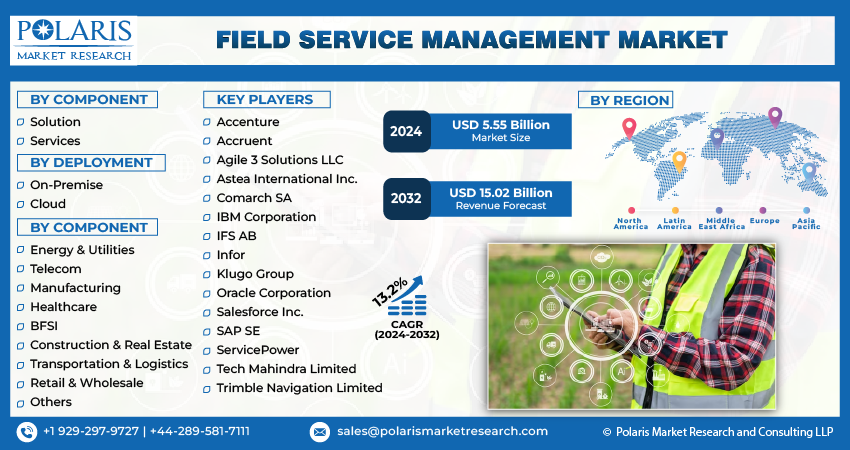
The field service management market segmentation includes component, deployment, enterprise size, application, end use, and region. These segments help in understanding the software and services utilized in different sizes of enterprises based on various industry needs.
| Segmentation Axis | Segments |
| Component | Solution · Services (Implementation, Training and Support, Consulting) |
| Deployment | Cloud · On-premises |
| Enterprise Size | Large Enterprises · SMEs |
| Application | Work Order Management · Scheduling, Dispatch and Route Optimization · Customer Management · Asset and Inventory Management · Service Contract Management · Reporting and Analytics |
| End use | Energy and Utilities · Telecom · Manufacturing · Healthcare · BFSI · Construction and Real Estate · Transportation and Logistics · Retail and Wholesale · Others |
| Region | North America (U.S., Canada) · Europe (Germany, UK, France, Italy, Spain, Netherlands, Russia, Rest of Europe) · Asia Pacific (China, Japan, India, South Korea, Malaysia, Indonesia, Australia, Rest of Asia Pacific) · Latin America (Brazil, Mexico, Argentina, Rest of Latin America) · Middle East & Africa (Saudi Arabia, UAE, Israel, South Africa, Rest of Middle East & Africa) |
Source: Polaris Market Research Analysis
By Component
The solution segment led with an 80.90% field service management market share in 2025. Field service management solutions assist enterprises in managing their service activities from a central platform. They assist organizations in generating work orders, allocating technicians, scheduling visits, and tracking job status. They are also useful for managers to monitor pending service requests and record completed tasks. The solutions are widely used by businesses to maintain customers' and assets' data in one place. This enables them to coordinate their service activities. The demand for field service management solutions is driven by the requirement to automate the process and better manage their field activities. Enterprises with large service teams depend on these solutions to manage a high volume of daily jobs.
The services segment is projected to grow at an 13.62% CAGR. Many organizations need outside assistance when implementing the FSPM software and integrating it with their current system. Implementation services enable the organization to customize the FSPM software. These services include data migration and integration. Training and support services allow employees to understand the FSPM software and troubleshoot problems in case they arise. The consulting services enable organizations to select the right products and assess their current service processes. These services are especially important for those organizations that have an old system or have been using manual processes. As the adoption of FSPM software increases, the service providers are likely to see demand for technical services and software optimization.
By Deployment
The cloud segment accounted for an 64.29% field service management market share in 2025. Its primary advantage is the lower implementation cost compared to alternatives. Cloud computing makes adoption possible without the need to purchase and maintain servers. This allows organizations to access this system irrespective of the size and budget constraints of IT. Moreover, the model provides organizations with an opportunity to spread software costs through subscriptions. Other advantages include the availability of services from leading software vendors and the ability for organizations to choose platforms.
The on-premises segment is anticipated to grow at an 10.25% CAGR. Some businesses may not want to transfer their field service management activities into the cloud. These businesses may already have software solutions that fit their processes, making a full switch expensive or difficult. This is also true for large enterprises that already have specific IT infrastructure and policies for managing business information. In such cases, on-premises software allows businesses to control access, configuration, and storage internally. This option gives more flexibility with regard to configuration of the solution and makes it compatible with other business processes. The on-
By Enterprise Size
The large enterprises segment led with an 57.55% field service management market share in 2025. Large corporations often manage service facilities at many locations and deal with many customers at the same time. Their field staff may consist of specialists with diverse skills working in many regions. Running such facilities in different ways or using manual methods complicates management. Field service management software is useful for large companies to maintain better control over their service operations. These firms have more financial means to use special software and integrate it into their existing systems. Their demand for uniform service processes in various regions supports demand in the segment.
The SMEs segment is projected to grow at an 13.75% CAGR from 2026 to 2034. Small service businesses do not have a large number of people in the administration, as the same people are engaged in communicating with clients and coordinating the work. The task becomes difficult for such organizations when they receive more orders or provide a variety of services. Unlike big companies, small-sized businesses may not have dedicated personnel for managing field operations. The needs of such companies are mostly concerned with managing incoming orders and tracking assigned tasks. Small-sized businesses typically begin with a few core software functions and upgrade to more advanced features later when needed. The phased approach enables smaller firms to introduce more structure into their service process without having to make a large investment upfront.
By Application
The customer management segment accounted for an 12.35% share in 2025. Field service companies often deal with repeat customers who maintain an ongoing service agreement or are in need of repair work. Having a record of previous services provides field service providers with insight into the needs of the client prior to sending a service person. The software stores details such as service history, contact details, complaints, and any other relevant information related to agreements. This is helpful for organizations that have a lot of service requests and need to keep track of their previous interactions. This can assist customer representatives in dealing with customer complaints and identifying issues.
The work order management segment is projected to grow at an 11.82% CAGR. The number of requests can range from general inspections to urgent repair work. Every task should be clearly described for technicians to understand what kind of work is to be done and which tasks have already been accomplished. Business organizations are starting to use work order management software to minimize the use of paper documents and additional information. This software also helps in managing unfinished tasks as well as in checking if work has been completed. The demand for such software has been growing rapidly in service organizations that process many repair and maintenance requests.
By End Use
The manufacturing segment led with an 22.00% field service management market share in 2025. Factories rely on machines and manufacturing equipment that need constant maintenance to function effectively. Failure of any machine could disrupt manufacturing processes, thus affecting schedules. Many companies have multiple manufacturing plants in diverse locations. Field service management software helps them keep track of service calls concerning equipment and scheduling of technicians who will be required to repair the equipment. The requirement of maintaining production schedules as well as managing services within large industrial facilities supports the segment’s leading position.
The energy and utilities segment is projected to grow at an 11.78% CAGR. Utility companies have wide-ranging networks consisting of power lines, substations, pipelines, and more. In many cases, the work is conducted in inaccessible areas, where managing field teams can pose a challenge. The service companies are under constant pressure to respond to faulty equipment as well as unforeseen outages. Field management software allows the dispatch team to allocate tasks to field crews and keep track of their work from various sites. The increased investment in the development of the energy grid is also adding to the demand for better field workforce coordination.
Regional Analysis
Field service management software has varied adoption trends in different regions, depending on industrial activities and digital infrastructure investments. North America is well-positioned due to the presence of adopted software in service sectors. Asia Pacific has been gaining traction owing to increased manufacturing activities and the modernization of field operations. Europe also constitutes a notable market due to demand for equipment maintenance and service management.
North America
North America accounted for an 37.89% field service management market share in 2025. There is a strong foundation of software usage in the areas of manufacturing, utilities, telecommunications, and other service sectors. Companies are upgrading their legacy software with software that helps them gain control over their field operations. Some providers also need software to manage technicians across several customer sites for service providers. In October 2026, Planon released the Field Services Solution in North America. This offering leverages the building management capabilities by expanding into field management, thus enabling companies to manage their assets, technicians, subcontractors, and service activities in one solution (source: platonsoftware.com). This release is indicative of the vendors' response to the demands of businesses that have distributed workforces and facility service needs.
Asia Pacific
Asia Pacific is projected to witness rapid growth at an 15.80% CAGR. Industrialization in China and India is leading to an increase in factories, infrastructure projects, and industrial assets that require servicing on a consistent basis. Companies involved in both manufacturing and services need improved ways of coordinating their field teams with the growth of their operations in various locations. There is also an emerging change in the way businesses handle their maintenance and customer services because of digital transformation. Interest is also increasing in India due to the transformation of industrial processes and investments in digital infrastructure by companies. The field service management market India is expanding as there is a requirement to automate the maintenance of service records and coordinate office employees and field engineers. An announcement was made in June 2026 by AVEVA regarding new industrial intelligence capabilities for its CONNECT platform in India. It was done along with the signing of contracts with Indian industrial customers (source: aveva.com). This is an indication of the broader trend towards interconnected industrial processes in the region.
Europe
Europe accounted for an 25.10% share of the field service management market in 2025. Germany, the UK, and France are key target markets due to well-developed manufacturing and industrial services industries. Manufacturers have to provide service and maintenance after the equipment has been installed, hence creating the need for proper synchronization of maintenance personnel and clients' requests. Utilities and telecommunication companies also have to handle assets that are geographically dispersed. Such businesses require proper documentation and quick response. European businesses are also adopting digital technology to replace traditional service methods to reduce labor costs. Europe’s emphasis on modernization of industry and energy is increasing demand, especially for companies that provide maintenance for renewable energy sources and smart grids.
Latin America
Latin America held an 6.05% market share in 2025. Brazil and Mexico make up a large portion of demand in the region. This is due to their well-established manufacturing, telecommunications, and utility industries. The service providers in the region control equipment and infrastructure over large territories, requiring a more coordinated approach to managing field personnel. Telecommunications and energy network expansion contribute to further service needs. Companies are also shifting away from paper job tracking and manual scheduling practices. This is increasing demand for software that would help with assigning technicians to tasks. Increased adoption of digitization by medium-sized service companies broadens the pool of potential customers.
Middle East & Africa
The Middle East & Africa is projected to grow at an 13.40% CAGR. The investments being made in the development of infrastructural facilities in the Gulf nations have been fueling the need for FSM software. The energy companies require the facility to manage the maintenance activities in their oil and gas facilities, pipelines, and power grids. Similarly, there is a demand for the technology in South Africa from the utility service companies and the industrial service providers who manage equipment in multiple locations. Business expansion creates difficulties in coordinating activities manually. This has resulted in service providers shifting to software for managing field teams.

Traditional vs Digital vs Agentic Field Service Operations
With the transition from manual methods to digital solutions, field service operations have evolved in tandem with newer forms of agentic systems. The key difference between these approaches is seen in the scheduling and information-sharing process.
| Dimension | Traditional (phone, spreadsheet) | Digital FSM (rules and optimization) | Agentic FSM (AI dispatch) |
| Scheduling and dispatch | Dispatcher assigns jobs manually | Engine proposes or assigns by skill, location, and SLA | AI agents book, reschedule and fill schedule gaps; dispatcher reviews options |
| Workforce visibility | Status by phone call | GPS tracking and live job status | Context-aware reallocation as conditions change |
| Customer communication | Call-back windows | Automated notices and arrival estimates | Customers schedule or change visits in natural language, around the clock |
| Data tracking | Paper forms, delayed entry | Mobile forms, real-time updates | Job summaries drafted automatically for technician review |
| Maintenance planning | Reactive or calendar-based | Preventive schedules, some condition triggers | Sensor-triggered service offers handled by agents |
| Operational cost | High admin effort, repeat visits | Lower travel and admin effort | Targets fewer truck rolls and less admin; outcomes are vendor-reported and await independent validation |
| Human role | Executes every assignment | Supervises the optimizer | Handles exceptions and approvals |
Source: Polaris Market Research Analysis
Field Service Management Use Cases
Field service management is deployed in various industries that have equipment, infrastructure, or facilities that need servicing. The nature of the task differs depending on the industry. In the utility industry, the firm arranges for field personnel to maintain the network or address service problems. In the healthcare industry, the systems are employed to manage maintenance requirements and equipment availability. In the construction equipment industry, companies rely on the services of field workers to conduct repairs at the client's premises, thus ensuring that there is minimal downtime in machines. This indicates how technology can assist an organization in arranging for work that is done outside its premises.
| Industry | Use Case | Named Example |
| Utilities | Managing field work orders, scheduling crews, coordinating contractors, maintaining asset records, and tracking compliance. | Sysco Software launched a utilities platform in May 2026, built on Microsoft Dynamics 365 for gas and infrastructure organizations. (source: sysco-software.com) |
| Healthcare | Monitoring medical devices and coordinating maintenance to reduce device downtime in hospitals. | GE HealthCare launched ReadyFix in February 2026 to support remote monitoring, diagnosis, and maintenance of its MAC VU360 ECG workstations. (source: gehealthcare.com) |
| Construction | Managing equipment repair requests, technician assignments, and parts availability at construction sites. | HCLTech published a case study in May 2026 on a road construction equipment manufacturer using its Aftermarket Cloud field service management solution. The company reported a 72% reduction in direct customer calls to field engineers. |
Source: Polaris Market Research Analysis
Competitive Landscape
The field service management market is highly competitive, as software is provided by different vendors for various organizations in different sectors. Competitiveness is driven by product functionalities, level of integration capability, price levels, and the complexity of service management. There are vendors who offer software focusing on basic functionalities such as work order management and technician scheduling. Others provide comprehensive solutions linking field activities with customer care and enterprise systems. Furthermore, the field service management companies are also expanding their offerings to meet the new requirements of customers and industries. Product development and partnerships continue to be important strategies for field service management key players to enhance their market positions. Distinctiveness in terms of clientele and products contributes to field service management market share across the industry.
List of Key Companies
- Accruent, LLC
- Comarch S.A.
- IFS AB
- Infor
- International Business Machines Corporation (IBM)
- Microsoft Corporation
- Oracle Corporation
- OverIT S.p.A.
- Praxedo SAS
- PTC Inc. (ServiceMax)
- Salesforce, Inc.
- SAP SE
- ServiceNow, Inc.
- ServicePower
- ServiceTitan, Inc.
- Trimble Inc.
- Zinier, Inc.
Vendor Positioning
| Vendor | FSM Offering | Positioning |
| Salesforce, Inc. | Salesforce Field Service | CRM-led field service platform connecting customer records with work orders, technician scheduling, dispatch, and mobile workforce management. |
| Microsoft Corporation | Dynamics 365 Field Service | Field service solution integrated with Microsoft 365, Teams, Power Platform, and Azure for work order management, scheduling, and technician support. |
| Oracle Corporation | Oracle Field Service | Cloud-based platform focused on workforce planning, appointment booking, scheduling, route optimization, and integration with enterprise operations. |
| SAP SE | SAP Field Service and Asset Management | Connects service planning and dispatch with asset maintenance, mobile execution, and enterprise business processes. |
| ServiceNow, Inc. | ServiceNow Field Service Management | Workflow-based platform connecting field teams with service operations, asset information, work planning, dispatch, and maintenance processes. |
| IFS AB | IFS Cloud Field Service Management | Asset-focused solution for industrial operations, with workforce scheduling, contractor management, service parts logistics, and service lifecycle management. |
| IBM Corporation | IBM Maximo Application Suite | Combines enterprise asset management with field work planning, crew scheduling, mobile execution, and maintenance workflows. |
| Infor | Infor Service Management | ERP-connected solution supporting work orders, technician scheduling, mobile field operations, warranty claims, and service contracts. |
Source: Polaris Market Research Analysis
Industry Developments
- October 2026: ServiceTitan, Inc. made further announcements on the next step of product improvements on its FieldRoutes platform. This included improvements to dispatch and routing, mobility features, and sales. The improvements are aimed at helping field service companies handle operations and customer accounts better. (source: fieldroutes.com)
- September 2026: Commusoft introduced several updates to its field service platform. These include an integrated business phone system developed with Dialpad and a redesigned job record screen. The company also expanded API access. The changes improve communication management and give service businesses more options for connecting their existing systems. (source: commusoft.com)
- September 2026: Overstory and Fulcrum announced an integration for utility field operations. The connection links risk-based infrastructure planning with field dispatch and completed work records. Utility companies can use the combined information to track mitigation activities and assess the results of field work. (source: fulcrumapp.com)
Future Outlook
The future of the market will depend on how effectively companies handle their field teams and schedules. AI-based dispatch is forecasted to become increasingly crucial as software begins to match technicians with jobs based on the skill set, geographical proximity, and availability. This can reduce manual work in scheduling as well as help field teams attend to critical service calls. The field service management market forecast 2034 reflects the scope for greater adoption as companies adopt automated service scheduling systems.
Research Methodology
Scope and definition. The field service management market is defined as revenue from field service management software and associated services (implementation, training and support, consulting) covering scheduling, dispatch, work orders, asset and inventory, contracts and customer management. Base year is 2025; forecast period is 2026 to 2034.
Secondary research. Company filings and annual reports, investor presentations, press releases, vendor product documentation, trade bodies, government statistics and paid databases establish vendor revenue and segment baselines.
Primary research. Interviews with vendors, integrators and enterprise buyers in telecom, utilities and manufacturing validate adoption, pricing, deployment mix and AI-feature uptake. State interview counts only if they match records.
Sizing and forecasting. A bottom-up build from vendor revenue by component, deployment and region is cross-checked top-down against IT-services spend and field-workforce size. Forecast assumptions (cloud shift, AI adoption, technician supply, macroeconomics) are stated.
Validation and refresh. Figures are triangulated across sources, peer-reviewed by a second analyst, and logged against third-party estimates. Data is re-verified quarterly, and the update date changes only with the data.
Field Service Management Market Report Scope
| Report Attributes | Details |
| Market Size Value in 2025 | USD 5.08 billion |
| Market Size Value in 2026 | USD 5.70 billion |
| Field Service Management Market Forecast 2034 | USD1 4.37 billion |
| CAGR | 12.2% from 2026 to 2034 |
| Base Year | 2025 |
| Historical Data | 2021–2024 |
| Forecast Period | 2026–2034 |
| Quantitative Units | Revenue in USD billion and CAGR from 2026 to 2034 |
| Report Coverage | Revenue Forecast, Market Competitive Landscape, Growth Factors, and Industry Trends |
| Segments Covered |
|
| Regional Scope |
|
| Competitive Landscape |
|
| Report Format |
|
| Customization | Report customization as per your requirements with respect to countries, regions, and segmentation. |
Source: Polaris Market Research Analysis
Field Service Management Market FAQ's
Field service management is a term used to describe the process through which companies manage their workforce whose services take place at the location of their customers. These services include installation or repair of equipment. They also cover inspection and maintenance. Companies use field service management to schedule these services.
The field service management software begins with the logging of a customer’s request. The request is then transformed into a work order. The work is assigned to a technician by a manager. The technician gets the information about the job via a mobile app. After the completion of the work, the job status is updated.
The field service management market size was valued at USD 5.08 billion in 2025. The market is projected to grow to USD 14.37 billion by 2034.
The market is projected to account for a CAGR of 12.2% from 2026 to 2034.
Agentic AI includes software systems that are capable of analyzing data and initiating activities with minimal involvement from humans. Agentic AI systems can analyze the availability of technicians before assigning tasks to them. These systems are able to respond to scheduling changes and assist in managing emergencies.
Field service management software is used by manufacturing firms, energy and utility firms, and telecommunication firms. Field service management software is also used by healthcare organizations for managing medical equipment maintenance. Construction companies make use of such software to coordinate equipment repair at construction sites.
North America led with an 37.89% share in 2025. This is due to the widespread rollout of smart grids in the region. Asia Pacific is projected to witness rapid growth at an 15.80% CAGR. The rapid expansion of 5G networks in emerging economies drives the regional market growth.
Key market players include Accruent, LLC; Comarch S.A.; IFS AB; Infor; International Business Machines Corporation (IBM); Microsoft Corporation; Oracle Corporation; OverIT S.p.A.; Praxedo SAS; PTC Inc. (ServiceMax); Salesforce, Inc.; SAP SE; ServiceNow, Inc.; ServicePower; ServiceTitan, Inc.; Trimble Inc.; and Zinier, Inc.
Predictive maintenance involves the use of equipment information to detect potential problems. This gives teams more time to arrange repairs in case of a breakdown. Technicians can be dispatched to the site according to the needs of the equipment. Businesses can therefore reduce some of their unscheduled dispatches.
It may be challenging to assign a task manually when there are changes in service requests in the course of the day. AI dispatch helps management assign the right technician to a task. AI dispatch can take into consideration the distance and requirements of the job.

Download Sample Report of Field Service Management Market
Please fill out the form to request a customized copy of the research report.


