
Genotyping Assays Market Size, Share, and Forecast 2026 to 2034
REPORT DETAILS
Genotyping Assays Market Summary
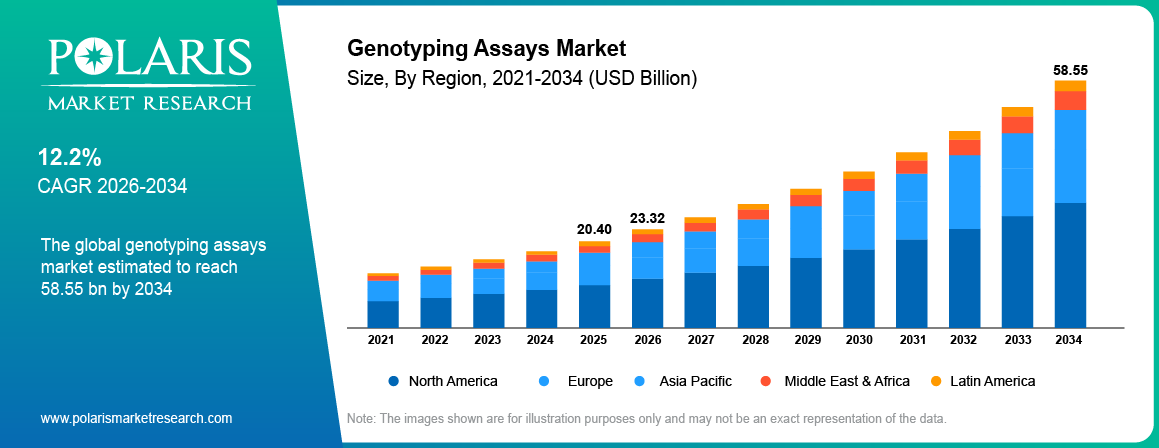
According to Polaris Market Research analysis, the genotyping assays market was valued at USD 20.40 Billion in 2025. It is projected to reach USD 58.55 Billion by 2034, growing at a CAGR of 12.2% from 2026 to 2034. Demand is driven by pharmacogenomic testing, population genomics programs, and the move of clinical laboratories toward multiplexed panels. Reagents and kits earn the largest product revenue, while sequencing-based methods are gaining ground on polymerase chain reaction (PCR) and microarrays. Supply spans the kits, instruments, software, and services that read inherited variants in human, animal, and plant DNA. North America is the leading market, while Asia Pacific is the fastest-growing region.
Market Statistics
Key Takeaways
- North America brought in 40.0% of 2026 revenue, led by drug developers, clinical laboratories, and federal genomics programs in the United States.
- Asia Pacific is the fastest-growing region, at a CAGR of 14.6% from 2026 to 2034, owing to national genome programs and expanding clinical testing capacity in China and India.
- Polymerase Chain Reaction retained 35.7% of 2026 technology revenue, attributed to its speed, low cost per sample, and presence in almost every clinical laboratory.
- Sequencing is anticipated to register the fastest growth among technologies, at a CAGR of 18.2% from 2026 to 2034, as falling cost per genome lets laboratories swap single marker assays for broad panels.
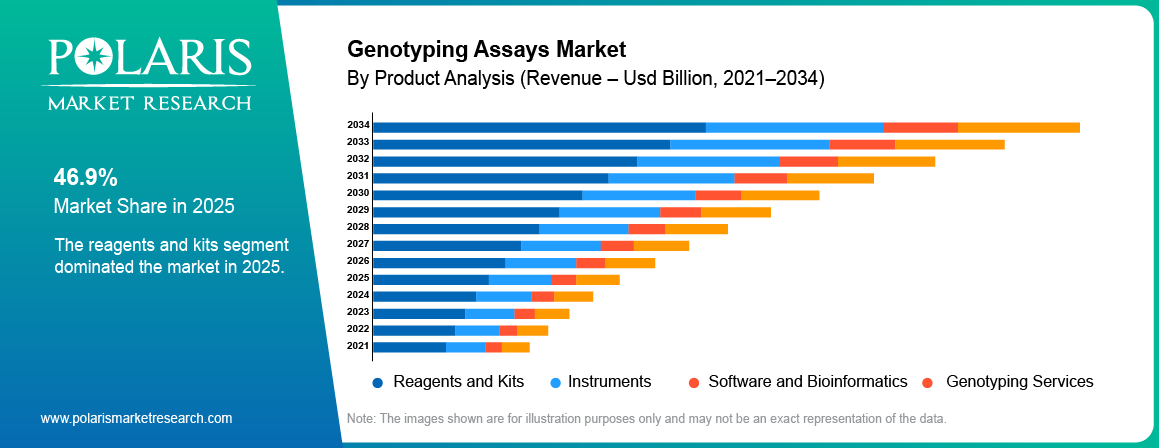
- Revenue from Reagents and Kits reached USD 10,943 Million in 2026, the largest product total, since every sample consumes fresh enzymes, probes, and plates.
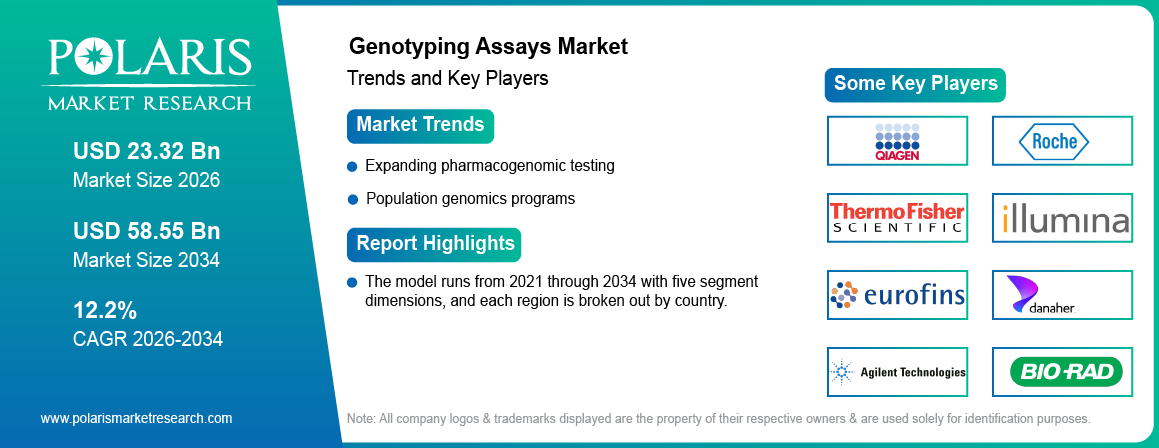
- Pharmacogenomics is projected to grow at a CAGR of 14.1% from 2026 to 2034, because health systems increasingly test patients before prescribing.
- Diagnostic and Research Laboratories led end-user revenue with 32.2% in 2026, due to routine clinical testing and contract work for drug developers.
- Copy Number Variations are anticipated to register the fastest growth among variant types, at a CAGR of 15.7% from 2026 to 2034, owing to rare disease and oncology teams that now study gains and losses of DNA segments.
- Software and Bioinformatics is anticipated to register the fastest growth among product groups, at a CAGR of 17.5% from 2026 to 2034, since variant calling and interpretation now take more effort than the bench steps.
Note: Figures and projections outlined in this report are the result of Polaris Market Research’s proprietary analytical processes, grounded in the latest available datasets and market observations.
Genotyping Assays Market Definition
The genotyping assays market covers the kits, instruments, software, and services used to detect inherited or acquired DNA variants in human, animal, and plant samples. It spans polymerase chain reaction, microarray, sequencing, capillary electrophoresis, and mass spectrometry methods that read single markers or whole panels of variants.
Counted products include genotyping reagents and kits, arrays, analyzers sold for genotyping work, analysis software, and contract genotyping services. Whole genome sequencing is counted only where it is used to call variants inside a genotyping workflow, while sequencers bought for general research are excluded. Forensic identity testing, infectious disease detection, and tumor profiling for acquired mutations sit outside the boundary.
A genotyping assay moves through four stages. Samples of blood, saliva, tissue, or leaf are extracted, the DNA is amplified or bound to probes, a reader turns the signal into allele calls, and software compares the calls with a reference. Different vendors often serve each step, and therefore a single laboratory may buy from four or five suppliers before analysis begins.
Scale shows how far array-based genotyping has moved. Our Future Health, a United Kingdom research program, released genotype data for 755,000 participants in May 2026, covering 686,416 variants measured on a custom Illumina beadchip. Eurofins runs the genotyping laboratory for the program.
Targeted Genotyping Assays vs Whole Genome Sequencing: Key Differences
| Attribute | Targeted Genotyping Assays | Whole Genome Sequencing |
| Question answered | Which known variants a sample carries | Every variant, including new ones |
| Typical use | Pharmacogenomic panels, cohort studies, breeding, and screening | Rare disease diagnosis and discovery research |
| Cost per sample | Low, and stable at high volume | Higher, and falling each year |
| Data volume | Small files that are simple to store | Very large files that need compute and storage |
| Turnaround | Hours to a few days | Several days with analysis |
| Growth direction | Steady, with panels getting broader | Fast, as cost per genome drops |
Source: Polaris Market Research Analysis
Targeted assays stay popular because the question is often narrow. A clinician choosing a statin dose requires a handful of gene results, and a breeder ranking bulls requires a fixed marker set. Many laboratories use both, with arrays or panels for volume and sequencing for the cases that require a wider look.
Porter's Five Forces Analysis
| Force | Intensity | Rationale |
| Bargaining power of suppliers | Moderate | Enzymes, probes, and plastics come from several makers, while array fabrication and instrument design rest with a few firms. |
| Bargaining power of buyers | Moderate to High | Large laboratories, health systems, and national programs buy in volume and negotiate multiyear reagent contracts. |
| Threat of new entrants | Low | Regulatory clearance, proven content, and installed instrument bases make it costly for newcomers to win clinical accounts. |
| Threat of substitutes | Moderate | Falling sequencing costs let broad panels replace some targeted assays, although cost and speed still favor targeted tests at volume. |
| Competitive rivalry | High | Large life science groups compete on platform reach, consumable pricing, and content for the same laboratories. |
Source: Polaris Market Research Analysis
Substitution deserves the closest attention, as sequencing prices keep dropping and software now handles the data that once held laboratories back. Instrument makers respond by selling both array and sequencing systems, and therefore a switch between methods often stays inside one supplier.
Market Dynamics
Driver Impact Analysis
| Driver | Impact on Market Growth | Time Horizon |
| Expanding pharmacogenomic testing | High | Short to Medium Term |
| Population genomics programs | High | Medium Term |
Source: Polaris Market Research Analysis
Driver: Expanding Pharmacogenomic Testing Is Moving Genotyping Into Routine Prescribing, Creating Market Demand
Prescribing decisions for statins, antidepressants, and blood thinners depend on how a patient metabolizes each drug, and a genotype panel gives that answer before the first dose. Health systems that test at the point of prescribing require panels that run on common platforms, and that lifts demand for arrays and polymerase chain reaction kits. The pharmacogenomics market study follows the same shift from the testing side.
For example, in October 2025, Thermo Fisher Scientific launched the Applied Biosystems SwiftArrayStudio Microarray Analyzer with two new arrays, Axiom PharmacoPro and Axiom PangenomePro, aimed at genome-wide association studies and pharmacogenomic work. The company said the platform returns results in as little as 30 hours and cuts hands-on time by up to 40%, a gain that matters to laboratories processing large sample batches.
Pharmacogenomics is projected to grow at a CAGR of 14.1% from 2026 to 2034, since payers increasingly accept tests that prevent adverse drug reactions. Hospital pharmacy teams are adding genotype results to the patient record, and that creates repeat demand for consumables.
Driver: Population Genomics Programs Are Genotyping Hundreds of Thousands of Participants, Creating Market Demand
National programs genotype volunteers at a scale that earlier cohort studies never reached, and each program buys arrays, reagents, and laboratory services in bulk. Arrays remain the lower-cost route for very large cohorts, since one chip reads several hundred thousand variants at a fraction of the price of a whole genome. Data releases then feed target discovery at pharmaceutical firms, keeping laboratories busy after the first genotyping round.
For example, in June 2026, the United States National Institutes of Health released a dataset from its All of Us Research Program that includes 553,000 genotyping arrays and more than 535,000 whole genome sequences, drawn from over 747,000 participants. The release also added proteomics data for nearly 10,000 participants, and therefore researchers can link inherited variants to measured proteins.
Clinical and research testing sites are projected to grow at a CAGR of 13.2% from 2026 to 2034, as program samples and clinical referrals pass through the same facilities. Contract laboratories gain most, since they can absorb cohort work without buying new instruments.
Restraint: Uneven Reimbursement and Regulatory Uncertainty Are Slowing Clinical Test Adoption, Restraining Market Growth
Payers cover genotyping tests only where evidence of clinical use is strong, and coverage rules differ by insurer and country. Laboratories that build their own tests also face rules that have changed several times, making it hard to plan investment in new assays. Smaller laboratories often wait for clearer reimbursement before they add panels.
For example, in March 2025, a federal court in Texas vacated the rule that would have let the US Food and Drug Administration (FDA) regulate laboratory developed tests as medical devices. The agency signaled in August 2025 that it would rescind the rule. Laboratories remain under the Clinical Laboratory Improvement Amendments, and therefore the immediate burden eased, yet the path to uniform reimbursement is still unsettled.
Academic and Research Institutes is projected to register the slowest growth among end users, due to grant budgets that rise more slowly than clinical spending. The restraint therefore weighs most on research buyers and on smaller clinical laboratories.
Opportunity: Falling Sequencing Costs Are Creating Openings for Low-Pass and Targeted Sequencing Assays
Sequencing-based genotyping reads variants that arrays were not designed to detect, including rare and population-specific changes, and low-pass sequencing combined with imputation reaches array-like cost. Laboratories that adopt it can keep one workflow for research and clinical samples. Suppliers of library preparation kits and variant-calling software stand to gain.
For example, in June 2025, Mission Bio unveiled a single-cell genotype and targeted gene expression solution on its Tapestri platform, and Devyser launched a genomic blood typing assay in the same month. Both products read targeted variants with sequencing chemistry, a sign that the line between genotyping and sequencing is thinning.
Sequencing is projected to grow at a CAGR of 18.2% from 2026 to 2034, well ahead of Polymerase Chain Reaction, as consumable cost per sample keeps falling. Software and Bioinformatics gains alongside, since each sequencing run produces data that requires calling and annotation.
Opportunity: National Genome Programs in Asia and the Gulf Are Creating Demand for Locally Supplied Genotyping Capacity
National programs in India, China, and the Gulf states are building reference datasets of their own populations, because variant frequencies seen in European cohorts do not carry over. Arrays and panels tuned to these populations require local content design, giving regional suppliers and service laboratories an opening. Capacity built for sequencing programs often extends to genotyping.
For example, in February 2026, the Emirati Genome Programme published a study using genomic data from more than 500,000 citizens, and the program has sequenced more than 850,000 people toward a goal of one million genomes. India reported in May 2026 that its GenomeIndia Project had sequenced 10,074 people from 83 population groups and found about 44 million variants missing from global databases.
India is projected to grow at a CAGR of 20.7% from 2026 to 2034, the highest of any country in the study, and Saudi Arabia is projected to grow at 15.1%. Their starting revenue is small, and therefore these programs add little to the global total yet lift regional growth rates.
Trend: Suppliers Are Bundling Genotyping With Sequencing, Proteomics, and Analysis Software Into Single-Vendor Workflows
Suppliers want laboratories to buy genotyping, sequencing, and analysis from one source, and therefore portfolios are being redrawn through purchases and disposals. Buyers prefer fewer contracts and shared data formats, and smaller suppliers respond by narrowing to specialties where they can still win on content or price.
For example, in January 2026, Illumina completed its purchase of SomaLogic from Standard BioTools. The seller later agreed to sell its microfluidics business to Biomark Scientific for about USD 5.0 million, a deal completed on November 3, 2026. QIAGEN, meanwhile, finished its acquisition of Parse Biosciences in December 2025 and began an artificial intelligence collaboration with NVIDIA in May 2026.
Software and Bioinformatics is projected to grow at a CAGR of 17.5% from 2026 to 2034, since bundled workflows add analysis and interpretation to every kit sold. Mergers among large groups make life harder for small suppliers when the next round of laboratory contracts is awarded.
Value Chain Analysis
| Stage | Activities | Representative Participants |
| Raw materials and oligonucleotides | Enzymes, primers, probes, plastics, and array substrates | Integrated DNA Technologies, Merck KGaA, and New England Biolabs |
| Assay design and manufacturing | Panels, arrays, and cartridge kits built for defined variant sets | Thermo Fisher Scientific, Illumina, and Agilent Technologies |
| Instruments and readers | Thermal cyclers, scanners, analyzers, and sequencers | Thermo Fisher Scientific, Roche, Bio-Rad Laboratories, and QIAGEN |
| Testing services | Contract genotyping for cohorts, clinics, and breeders | Eurofins Scientific, Laboratory Corporation of America Holdings, and NeoGenomics |
| Software and interpretation | Variant calling, annotation, reporting, and records integration | Illumina, QIAGEN Digital Insights, and laboratory software vendors |
Source: Polaris Market Research Analysis
Value sits in the assay design and consumable layers, since each placed instrument pulls through kits for years. Instrument makers earn from installations and service contracts, while enzyme and plastics suppliers depend on volume and face price pressure from large buyers.
Margins differ by stage, with software and interpretation carrying recurring revenue and testing services depending on throughput. Laboratories that own their instruments buy reagents directly, and those that outsource pay a service fee that bundles consumables, labor, and analysis.
Genotyping Assays Market Segmentation Analysis
The five dimensions below are read one at a time, since buyers pick a product type, a method, an application, and a variant class for separate reasons.
Product Insights
Reagents and Kits accounted for 46.9% of product revenue in 2026, owing to the fresh enzymes, probes, plates, and cartridges that every sample consumes. A placed instrument pulls through consumables for years, and laboratories reorder on a fixed schedule. Kits built for pharmacogenomic and cardiovascular panels now sell into hospitals as well as research centers.
Instruments is expected to record steady growth, as laboratories replace older cyclers and scanners with systems that automate array and panel workflows. For example, in July 2026, Illumina raised its full-year revenue guidance after growth in the second quarter.
Software and Bioinformatics is anticipated to register the fastest growth among product groups, at a CAGR of 17.5% from 2026 to 2034, due to variant calling, interpretation, and reporting tools that laboratories now license for each platform. Cloud pipelines let small laboratories run analyses that once needed in-house servers. Genotyping Services is also expected to expand, as pharmaceutical firms and cohort programs outsource large batches to contract laboratories.
Demand for service work shows a pattern of its own. Pharmaceutical sponsors outsource large screening batches during trial startup, and breeders send samples in seasonal waves, and therefore contract laboratories plan staffing and reagent stocks months ahead. Those with strong sample tracking and fast turnaround keep customers over many seasons.
Pricing differs sharply across these four groups. Consumables are bought repeatedly at negotiated unit prices, instruments are bought once and serviced for years, software is licensed by the seat or by the run, and services are billed per sample. Suppliers that combine all four in one contract earn steadier revenue and make switching harder for the buyer.
Technology Insights
Polymerase Chain Reaction accounted for 35.7% of technology revenue in 2026, owing to quick turnaround, a low price per result, and a place in nearly every hospital laboratory. Real-time and digital formats read single variants within hours, and ready-to-run kits suit laboratories without bioinformatics staff. The digital PCR market study covers the high-precision end of this method.
Microarrays is expected to grow at a moderate pace, as large cohort studies keep choosing arrays for their cost per sample. One chip can read several hundred thousand variants, and imputation extends the result to millions more. For example, in October 2026, Thermo Fisher Scientific showed its SwiftArrayStudio analyzer, QuantStudio 7 Pro real-time PCR system, and QuantStudio Absolute Q digital PCR system at the annual human genetics conference in Montreal.
Sequencing is anticipated to register the fastest growth among technologies, at a CAGR of 18.2% from 2026 to 2034, attributed to low-pass whole genome and targeted panel methods that now rival arrays on price for some projects. Laboratories also value the ability to find rare and new variants in the same run. The next generation sequencing market report sizes the wider sequencing business.
Capillary Electrophoresis retains a niche role, driven by fragment analysis in microsatellite typing and by its use as a confirmation step in clinical laboratories. Mass Spectrometry remains a specialist option, since matrix-assisted laser desorption panels suit multiplexed variant screening at a low cost per marker.
Reagent supply chains also deserve attention, since enzymes, probes, and plastic plates come from a small group of makers and a shortage in one input can slow many laboratories. Buyers increasingly ask for second sources and for stock held close to their sites, and suppliers with regional warehouses benefit.
Application Insights
Diagnostics and Personalized Medicine accounted for 31.6% of application revenue in 2026, driven by inherited disease screening, carrier testing, and companion diagnostic work that guides therapy choice. Clinical laboratories favor proven kits that fit existing instruments, and established reimbursement keeps volumes predictable. The molecular diagnostics market study covers the wider testing business.
Pharmacogenomics is anticipated to register the fastest growth among applications, at a CAGR of 14.1% from 2026 to 2034, due to the growing number of drug labels and guidelines that refer to a gene result. For example, in August 2026, QIAGEN reported that sales of consumables tied to pharmaceutical co development agreements rose at a double-digit rate in the second quarter, led by companion diagnostics for targeted therapies.
Agricultural Biotechnology is expected to expand steadily, as breeders use marker panels to select crops for yield and stress tolerance. Animal Genetics is a smaller but established application, attributed to genomic selection in dairy and beef herds, where one test can rank an animal before it breeds.
Drug Discovery and Development is a growing application, owing to the genotyping of trial participants to select likely responders and to study safety. Sponsors run these tests early, and therefore the revenue arrives well before any product reaches the market.
End User Insights
Diagnostic and Research Laboratories contributed 32.2% of end-user revenue in 2026, driven by everyday patient testing and outsourced studies for drug developers. Reference laboratories buy in large volumes and push suppliers for lower prices per sample. Spending moves with test volumes, and therefore seasonal and reimbursement shifts show up quickly.
Pharmaceutical and Biopharmaceutical Companies is expected to record strong growth, as trial sponsors genotype participants to stratify patients and to study safety. Companion diagnostic agreements also bring these buyers into long-term supply contracts with kit makers.
Agricultural and Animal Breeding Organizations form a smaller but steady buyer group, owing to herd and seed programs that genotype thousands of animals or lines each year. For example, in December 2025, the Global Institute for Food Security at the University of Saskatchewan and the Canadian Beef Improvement Network launched a Canadian-based DNA testing platform, and therefore producers no longer have to ship samples abroad.
Academic and Research Institutes remain a steady buyer group, due to cohort studies, core facilities, and training programs that buy arrays and reagents under grants. Grant cycles make orders lumpy, although long-running consortia provide a steady base.
Variant Type Insights
Single Nucleotide Polymorphisms accounted for 60.6% of variant type revenue in 2026, because most pharmacogenomic markers, array content, and breeding panels target single base changes. Low-cost, well-characterized assays exist for these variants. For example, in May 2025, Almac Diagnostic Services launched a PNPLA3 genotyping kit for liver disease research, a single variant assay of the kind laboratories add to existing panels.
Copy Number Variations is anticipated to register the fastest growth among variant types, at a CAGR of 15.7% from 2026 to 2034, as rare disease and cancer laboratories look beyond single base changes. Arrays and sequencing can both measure gains and losses of DNA segments, and software has made the calls easier to read.
Insertions and Deletions is a smaller but expanding variant class, due to sequencing-based panels that detect small insertions and deletions that older array designs miss. Short Tandem Repeats retain a steady role, attributed to capillary electrophoresis-based typing in breeding, parentage, and cell line authentication.
Other Variants covers structural rearrangements, methylation marks, and haplotype calls, and these are small in revenue but are the focus of new product work. Laboratories that already run arrays or sequencers can add such calls through software updates, because analysis tools reuse existing raw data, so the barrier to entry is lower than for new hardware.
Genotyping Assays Market Regional Analysis
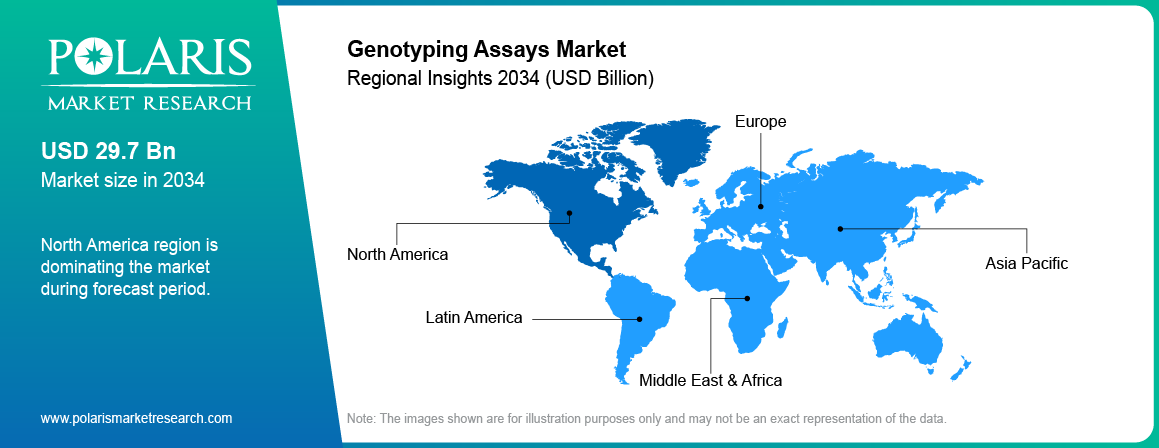
Regional demand follows research funding, clinical testing capacity, and breeding industries. North America holds the largest share of revenue, Europe and Asia Pacific follow with similar shares as national programs narrow the gap, while Latin America and Middle East & Africa start from smaller bases.
North America Genotyping Assays Market Trends
Revenue in North America reached 40.0% of the genotyping assays market total in 2026, driven by drug developers, large reference laboratories, and federal research programs in the United States. Mexico is expected to register the fastest growth in the region, as contract laboratories and breeding programs expand there. For example, in August 2025, the US Food and Drug Administration signaled its intent to rescind its laboratory developed test rule, leaving test oversight with the existing Clinical Laboratory Improvement Amendments framework.
Canada is expected to expand steadily, as provincial programs and the new domestic beef testing platform build local capacity. Supplier headquarters sit mostly in the United States, and therefore regional demand and company results move closely together.
Large reference laboratories dominate clinical volumes and negotiate hard on price, while academic centers buy arrays and reagents through grants and consortium contracts. Several states also fund agricultural genomics, and therefore breeding programs add a second source of steady demand.
Europe Genotyping Assays Market Trends
Europe held one of the largest regional shares in 2026, owing to academic cohort programs, strong breeding industries, and established reimbursement for clinical genetic tests in Germany, France, and the United Kingdom. Germany is the biggest country market, while the Netherlands registers the fastest growth of the six. For example, in May 2026, Our Future Health released imputed genotypes covering 159.6 million variants, built against a UK Biobank whole genome reference panel and offered with inferred genetic ancestry.
Europe is projected to grow steadily over the forecast period. Data protection rules and public funding for biobanks shape purchases, and laboratories often prefer kits that carry European conformity marking. Agrigenomics adds steady demand in the Netherlands, France, and Germany.
Procurement in Europe often runs through public tenders, and therefore price and local service coverage weigh heavily. Several national health systems are also building pharmacogenomic programs, and their buying rules favor suppliers with European conformity marking and local technical support teams.
Asia Pacific Genotyping Assays Market Trends
Asia Pacific is the fastest-growing region, with a CAGR of 14.6% from 2026 to 2034, driven by national genome programs in China, India, South Korea, and Australia and by expanding clinical laboratory networks. China holds the biggest national market in the region, and India registers the fastest growth. For example, in November 2026, Illumina announced that it had been selected to help bring precision medicine into everyday healthcare in Singapore.
Manufacturing capacity in the region is growing as well. BGI Group and its sequencing unit MGI Tech supply platforms from within Asia, and therefore domestic buyers have a local alternative to imported systems. Japan keeps a mature base in pharmacogenomics and arrays, while Australia leads in animal and crop genetics.
Contract laboratories in South Korea, Taiwan, and Singapore serve both domestic hospitals and overseas drug developers, and their volumes rise with every new trial. India adds a large base of academic laboratories and growing diagnostic chains, which makes it the most closely watched country in the region.
Latin America Genotyping Assays Market Trends
Latin America is projected to register healthy growth over the forecast period. Growth is attributed to Brazil and Mexico adding testing capacity for rare disease, oncology, and breeding work. Brazil has the biggest national market and also grows faster than Argentina. For example, in February 2026, the Brazilian laboratory NeoGenomica and MGI Tech described a partnership to widen rare disease diagnosis, while the Genomas Raros program aims to scale toward 100,000 genomes nationally.
Public hospitals and private laboratory chains buy different products. Hospital programs favor low-cost panels and screening kits tied to national lists of reimbursed tests, while private chains buy sequencers and arrays for wider menus. Currency swings and import duties raise prices, and therefore local distributors with service teams hold a strong position.
Middle East & Africa Genotyping Assays Market Trends
Middle East & Africa is projected to register strong growth over the forecast period. Growth is driven by national genome programs in the Gulf, led by Saudi Arabia and the Emirates. Saudi Arabia is both the biggest and the fastest-growing country there. For example, in April 2025, the Emirati Genome Programme reported 815,000 samples, up from 600,000 in June 2024, and the Emirates Genome Council found more than five million novel variants in a study of 50,000 samples.
High rates of inherited disease linked to consanguinity give these programs a clear clinical purpose, and governments fund them as part of wider health reform. Africa south of the Sahara is much smaller in revenue, although South Africa hosts research centers and several breeding programs, and international consortia are building genotyping capacity there.
Genotyping Assays Market Competitive Landscape
The field splits into three layers, as large life science groups sell instruments, consumables, and software as one platform, specialist firms sell panels and single-cell or targeted solutions, and service laboratories sell testing capacity. A supplier usually wins a laboratory once and then supplies it for the life of the instrument.
Illumina supplies the custom array used by Our Future Health, while Thermo Fisher Scientific has answered with a new analyzer and two arrays aimed at the same population studies. Company results show demand holding up unevenly, since Thermo Fisher Scientific revenue rose 9% in its third quarter and Illumina revenue rose 9.5% in its second, but QIAGEN net sales were flat in the second quarter.
Portfolio moves continue to shift positions. Standard BioTools exited proteomics and then microfluidics within ten months, and its former assets now sit inside larger groups. Market share moves slowly, and companies that hold proven content, installed instrument bases, and clinical approvals are best placed to gain it, as laboratories rarely change platforms once a workflow-passes audit.
Vendor Landscape Snapshot
| Company | Vendor Positioning | Role |
| Thermo Fisher Scientific Inc. | Leader | Axiom arrays, real-time PCR, and the SwiftArrayStudio analyzer |
| Illumina, Inc. | Leader | Infinium arrays and sequencing, including a custom array for Our Future Health |
| Danaher Corporation | Challenger | Oligonucleotides and diagnostics through Integrated DNA Technologies and Cepheid |
| QIAGEN N.V. | Challenger | PCR systems, QIAstat Dx, and companion diagnostic partnerships |
| F. Hoffmann-La Roche Ltd | Challenger | Molecular diagnostics instruments and PCR-based tests |
| Agilent Technologies, Inc. | Challenger | Microarray scanners and sample preparation |
| Bio-Rad Laboratories, Inc. | Challenger | Droplet digital PCR and real-time PCR systems |
| Eurofins Scientific SE | Challenger | Contract genotyping laboratories, including work for Our Future Health |
| Revvity, Inc. | Challenger | Reagents and screening products for genetic testing |
| BGI Group | Challenger | Sequencing platforms and genomic services through MGI Tech and BGI Genomics |
| Merck KGaA | Niche Player | Oligonucleotides and reagents through its life science business |
| Standard BioTools Inc. | Niche Player | Microfluidic genotyping tools until the 2026 sale of that business |
| Mission Bio | Emerging Player | Single-cell genotyping on the Tapestri platform |
Source: Polaris Market Research Analysis
Genotyping Assays Market Technology and Innovation Landscape
Innovation centers on shorter turnaround, wider content, and lower cost per sample. Newer analyzers combine scanning, hybridization, and staining steps in one device, while low-pass sequencing with imputation extends array-like results to larger variant sets.
Population specific content is the second theme. Arrays and panels designed around European cohorts miss variants that are common elsewhere, and therefore suppliers now build content for particular regions and drug-gene pairs. The PharmacoPro and PangenomePro arrays that Thermo Fisher Scientific introduced in October 2025 follow that approach.
Single-cell genotyping adds a further layer, as products such as the Tapestri platform read variants in thousands of individual cells at once, helping researchers study how cell populations change over time. Data tools are moving in parallel, with artificial intelligence now used to rank variants and to reanalyze older cases when new evidence appears.
Technology and Innovation Landscape Snapshot
| Area | Role | Status and Representative Developers |
| Pharmacogenomic arrays | Read drug response variants across diverse populations | Production, with Thermo Fisher Scientific and Illumina |
| Integrated array analyzers | Combine four genotyping steps in one instrument | Launched in 2025 by Thermo Fisher Scientific |
| Digital and real-time PCR | Read single variants quickly and at low cost | Production, with QIAGEN, Bio-Rad Laboratories, and Thermo Fisher Scientific |
| Low pass sequencing with imputation | Match array content at lower cost for large cohorts | Scaling, with Illumina and MGI Tech |
| Single-cell genotyping | Read variants in individual cells | Early commercial use, with Mission Bio |
| Cloud variant analysis | Call, annotate, and report variants without local servers | Expanding, with QIAGEN Digital Insights and Illumina |
Source: Polaris Market Research Analysis
Use Case Analysis
Pharmacogenomic Panels in Hospitals and Pharmacies
Health systems order panels that cover genes involved in the metabolism of common drugs, and results are stored so that later prescriptions can draw on them. Pharmacists often manage the workflow, and therefore suppliers that integrate with hospital records win repeat orders. One test can inform many prescriptions over a patient's lifetime.
Adoption is slowed by the need to train prescribers and by uneven payment for tests that are ordered before any illness appears. Hospitals that publish their own outcome data find it easier to win budget, and suppliers increasingly help by offering reporting software and clinical support staff.
Population Cohorts and Biobanks
Biobanks genotype hundreds of thousands of volunteers on arrays and then share the data with researchers. Orders are large and planned years ahead, and therefore suppliers compete on price per sample and on custom content. The same data later supports drug target discovery at pharmaceutical firms.
Quality control matters as much as price here, since an error in one plate can touch thousands of participants. Biobanks therefore ask suppliers for plate-level reports, consistent chemistry across years, and support for sample tracking, and these requirements favor large vendors with proven scale.
Animal and Plant Breeding
Breeders genotype animals and seed lines with marker panels, and therefore selection can happen before traits show. Dairy and beef programs run thousands of samples a year, and national testing platforms are appearing to keep data and sample flows inside a country. Low cost per sample and sample tracking decide most contracts.
Seasonal demand shapes ordering, as sample collection peaks around breeding and planting cycles. Producers also want results that plug into herd or crop management software, and therefore suppliers that provide data in standard formats gain an edge over those that deliver only raw files.
Rare Disease and Cancer Research Laboratories
Laboratories of this kind use genotyping to follow known variants and to confirm findings from sequencing. Copy number and structural variant calls matter more here, as does the ability to analyze single cells. Turnaround and clear reporting count as much as price.
Many of these laboratories sit inside universities and children's hospitals, where grants and philanthropic funds set the budget. Orders arrive in bursts after funding rounds, and suppliers that offer flexible reagent rental or shared instrument access keep these accounts through the gaps.
Clinical Trial Stratification
Sponsors genotype participants at screening to select patients who are likely to respond or to avoid those at risk of side effects. Contract laboratories run the work to a defined protocol, and therefore suppliers that offer proven kits and audit trails earn trust. Companion diagnostics grow out of the same work.
Timelines are fixed by trial schedules, and therefore late delivery of kits or results is costly for the sponsor. Contract laboratories therefore keep safety stock of reagents and prefer suppliers with reliable shipping, documented lot histories, and regulatory support for later submissions.
Premium Insights and Forward Outlook
Single-Gene Orders Will Give Way to Multi-Gene Panels
Laboratories that test one drug-gene pair today will add more genes once results sit in the patient record, since the marginal cost of an extra marker is small. Suppliers of arrays and flexible panels benefit, and reimbursement for broader panels will decide how fast the change happens.
Early signs are visible in pharmacy programs that test for several drug-gene pairs at once and store the results for later use. Payers will want evidence that broader panels lower the cost of adverse reactions, and suppliers that fund such studies stand to gain preferred status.
Population-Specific Content Will Decide Array Wins
Buyers outside Europe and North America now ask whether content matches the people they test. Suppliers that design arrays with regional programs, or license data from them, will hold an edge over those selling one global design. National programs in Asia and the Gulf are likely to shape these specifications.
Licensing arrangements with national programs may become a source of competitive advantage, since access to local reference data speeds array design. Smaller suppliers can partner with universities and public institutes to build content that large vendors do not offer.
Sequencing Will Absorb Arrays Mainly at the High End
Falling sequencing cost will move rare disease and discovery work away from arrays, yet large cohorts and routine panels will keep using arrays and polymerase chain reaction because cost per sample and speed still favor them. Instrument makers selling both methods are well placed in either case.
The pace of this shift depends on laboratory budgets and on how quickly interpretation software matures. Where results feed directly into patient care, many laboratories will keep the cheaper and faster method for routine work and reserve sequencing for hard cases.
Bundled Workflows Will Concentrate Spend
Large suppliers are assembling genotyping, sequencing, proteomics, and software into single contracts, and that raises the value of installed bases. Small firms without distinct content or clinical approvals will face pressure to partner or to sell.
Recent portfolio moves show how quickly positions can change, since a business that was bought for growth can be sold within months. Buyers of bundled contracts should therefore ask suppliers how long product lines will be supported before they commit.
Key Players in the Genotyping Assays Market
- Thermo Fisher Scientific Inc.
- Illumina, Inc.
- Danaher Corporation
- QIAGEN N.V.
- F. Hoffmann-La Roche Ltd
- Agilent Technologies, Inc.
- Bio-Rad Laboratories, Inc.
- Eurofins Scientific SE
- Revvity, Inc.
- BGI Group
- Merck KGaA
- Standard BioTools Inc.
- Mission Bio
Industry Developments
- June 2026: The National Institutes of Health opened All of Us data release CDRv9, adding long-read genomes from more than 14,500 participants and RNA sequencing from nearly 9,000 (Source: National Institutes of Health).
- May 2026: Our Future Health opened its fourteenth data release, linking 755,000 participants to array genotypes and inferred kinship (Source: Our Future Health).
- January 2026: Illumina closed its acquisition of SomaLogic, bringing the SomaScan proteomics business inside the company (Source: Illumina).
- October 2025: Thermo Fisher Scientific introduced an analyzer that combines four genotyping processes in one device and said the platform can expand to methylation, epigenetics, reproductive health, and agrigenomics (Source: Thermo Fisher Scientific).
Genotyping Assays Market Report Segmentation
By Product Outlook (Revenue, USD Billion, 2021 to 2034)
- Reagents and Kits
- Instruments
- Software and Bioinformatics
- Genotyping Services
By Technology Outlook (Revenue, USD Billion, 2021 to 2034)
- Polymerase Chain Reaction
- Microarrays
- Sequencing
- Capillary Electrophoresis
- Mass Spectrometry
- Others
By Application Outlook (Revenue, USD Billion, 2021 to 2034)
- Pharmacogenomics
- Diagnostics and Personalized Medicine
- Agricultural Biotechnology
- Animal Genetics
- Drug Discovery and Development
- Others
By End User Outlook (Revenue, USD Billion, 2021 to 2034)
- Pharmaceutical and Biopharmaceutical Companies
- Diagnostic and Research Laboratories
- Academic and Research Institutes
- Agricultural and Animal Breeding Organizations
- Other End Users
By Variant Type Outlook (Revenue, USD Billion, 2021 to 2034)
- Single Nucleotide Polymorphisms
- Insertions and Deletions
- Copy Number Variations
- Short Tandem Repeats
- Other Variants
By Regional Outlook (Revenue, USD Billion, 2021 to 2034)
- North America
- United States
- Canada
- Mexico
- Europe
- Germany
- United Kingdom
- France
- Italy
- Spain
- Netherlands
- Rest of Europe
- Asia Pacific
- China
- Japan
- India
- South Korea
- Australia
- Taiwan
- Rest of Asia Pacific
- Latin America
- Brazil
- Argentina
- Rest of Latin America
- Middle East & Africa
- Saudi Arabia
- United Arab Emirates
- Israel
- South Africa
- Rest of Middle East & Africa
Genotyping Assays Market Report Scope
| Report Attribute | Details |
| Market Size in 2025 | USD 20.40 Billion |
| Market Size in 2026 | USD 23.32 Billion |
| Revenue Forecast by 2034 | USD 58.55 Billion |
| CAGR | 12.2% (2026 to 2034) |
| Base Year | 2025 |
| Historical Data | 2021 to 2024 |
| Forecast Period | 2026 to 2034 |
| Quantitative Units | Revenue in USD Million and USD Billion, and CAGR in percent |
| Report Coverage | Revenue Forecast, Growth Factors, Competitive Landscape, Industry Trends, and Strategic Analysis of the genotyping assays market |
| Segments Covered | By Product, Technology, Application, End User, Variant Type, and Region |
| Regional Scope | North America, Europe, Asia Pacific, Latin America, Middle East & Africa |
| Competitive Landscape | Company Profiling, Product Benchmarking, Financial Analysis, Market Developments, and Strategic Initiatives |
| Report Format | PDF and Excel |
| Customization | Available by Country, Region, and Segment |
| Research Team | Polaris Market Research & Consulting, Inc. research team |
| Last Updated | November 5, 2026 |
Source: Polaris Market Research Analysis
Why Choose Polaris Market Research
Each number in this study comes from a single country by segment model, letting a reader trace any regional figure down through its countries and segments.
Besides the standard categories, the report splits revenue by variant type, showing spending move from single base changes toward copy number variation, and it tracks the shift from arrays to sequencing inside each application.
Four principal sources are credited by name, with a date wherever the source gives one. Planning teams can then see whether a claim comes from company releases or public research programs.
Polaris can tailor the study to a single country, segment, or set of companies. To buy this report or request customization, contact Polaris Market Research & Consulting, Inc.
Research Methodology
Research Approach
Sizing starts from the supplier side. It covers the assays, kits, reagents, instruments, software, and contract services that read known genetic variants in human, animal, and plant samples. Standalone discovery sequencing services, newborn screening programs, and general laboratory equipment are left out. The model spans 2021 to 2034 with 2025 as the base year, reports USD Million and USD Billion, and holds five segment dimensions across 25 countries and country groups in five regions. See the research methodology page for the wider Polaris framework.
Secondary Research
The secondary evidence base draws on four principal sources: the National Institutes of Health and Our Future Health among public research programs, and Thermo Fisher Scientific and Illumina among company releases. Most were published during the past year, and the remainder carry their own dates in the text. Each source is credited by name, and other public disclosures were used only to cross-check scope and context.
Primary Research
The research combines primary interviews with secondary research, and Polaris follows its standard interview process. The interviews cover manufacturers, distributors and channel partners, and industry experts and consultants. They are used to validate secondary estimates, segment shares, regional trends, and growth drivers.
Data Structuring
All inputs were expressed in USD for each year, and segment boundaries were frozen ahead of sizing. A product serving several technologies is placed under its main use to prevent double counting, and standalone discovery sequencing was removed to keep totals inside the scope.
Market Size Estimation
Bottom-up work begins in each national market, where supplier revenue, laboratory test volumes, and consumable content per platform feed every segment figure. Country figures then add into regions, and regional figures into the global total.
The top-down view places the 2025 base at USD 20.40 Billion and compares it with company disclosures and third-party size estimates. Those sizes diverge since each analyst firm sets its own scope, and the Polaris base sits more than six percent from each comparable figure.
Forecasting
Projections follow clinical test volumes, cohort enrollment, and breeding program output. Growth eases from one year to the next along a single path that yields the stated CAGR, while segment and regional mixes shift slowly between 2025 and 2034 as sequencing and digital methods take share.
Data Triangulation and Validation
The model passed four consistency tests. Shares add to 100% in each year. Country figures sum to regional totals and then to the global figure, and history and forecast follow one easing growth rate. The 2025 base was also set against the range of comparable third-party estimates.
Limitations
Genotyping, sequencing, and general molecular diagnostics overlap at the edges, which is why third-party sizes differ from the figures here. Suppliers that are privately held report little revenue, and their regional shares are therefore estimates. Market figures in this report are Polaris estimates.
Research Methodology Phases
| Phase | Focus | Evidence / Output |
| Scope and Setup | Market boundary, segments, and regions | Fixed scope and segment list |
| Secondary Data Collection | Public research program notices and company releases | Four credited sources with dates |
| Primary Research | Talks with manufacturers, distributors, and domain experts | Checked shares, trends, and drivers |
| Data Structuring | Annual USD figures with fixed boundaries | Inputs with no double counting |
| Bottom-Up Estimate | Country and segment estimates | Regional and global totals |
| Top-Down Estimate | Global base for 2025 and its segment mix | Base compared with public estimates |
| Forecasting | Annual growth path to 2034 | Stated CAGR |
| Triangulation and Validation | Share, total, and range checks | Four passed checks |
| Output | Report tables and text | A single data set behind every table |
Source: Polaris Market Research Analysis
Data Sources by Type
| Type of Source | Named Examples | Role in the Estimates |
| Government and public research programs | National Institutes of Health, Our Future Health | Cohort data releases and genotyping scale |
| Company releases | Illumina, Thermo Fisher Scientific | Launches and portfolio moves |
Source: Polaris Market Research Analysis
Genotyping Assays Market FAQ's
Genotyping assays read known genetic variants in a DNA sample using methods such as polymerase chain reaction, microarrays, sequencing, and mass spectrometry. Laboratories use them in clinical testing, drug development, research, and breeding.
The genotyping assays market size was valued at USD 20.40 Billion in 2025, according to Polaris Market Research analysis. Reported revenue rose to USD 23.32 Billion in 2026, as pharmacogenomic testing and cohort programs added volume.
The genotyping assays market is projected to reach USD 58.55 Billion by 2034, growing at a CAGR of 12.2% from 2026 to 2034, according to Polaris Market Research analysis.
North America is the leading market, with 40.0% of revenue in 2026. Drug developers and the biggest reference laboratories, mostly in the United States, send most of its orders.
Asia Pacific is the fastest-growing region, at 14.6% a year from 2026 to 2034. Among its countries, India registers the fastest growth.
Polymerase Chain Reaction holds the largest share, at 35.7% of 2026 revenue, though Sequencing follows closely. Sequencing is anticipated to register the fastest growth, at a CAGR of 18.2% from 2026 to 2034.
The key players include Thermo Fisher Scientific Inc., Illumina, Inc., Danaher Corporation, QIAGEN N.V., F. Hoffmann-La Roche Ltd, Agilent Technologies, Inc., Bio-Rad Laboratories, Inc., Eurofins Scientific SE, Revvity, Inc., and BGI Group. Leadership is split, since instrument makers, kit makers, and service laboratories each dominate a different layer.
Suppliers are bundling genotyping with sequencing and software, arrays are being redesigned around population-specific content, and low-pass sequencing is competing with arrays for large cohorts. Single-cell genotyping is also reaching commercial use.
Uneven reimbursement, regulatory uncertainty for laboratory developed tests, and falling sequencing prices hold back some assay categories. Laboratories must also repeat their performance checks when they change platforms.
Arrays read a fixed list of known variants on a chip at a low cost per sample. Sequencing reads the DNA itself and can find new variants, but costs more per sample and requires heavier data analysis.
Reagents and Kits earns the most, at USD 10,943 Million in 2026, because every sample consumes fresh chemistry. Software and Bioinformatics is the fastest-growing product, at a CAGR of 17.5% from 2026 to 2034.
Pharmacogenomics is anticipated to register the fastest growth, at a CAGR of 14.1% from 2026 to 2034. Diagnostics and Personalized Medicine remains the largest application.

Download Sample Report of Genotyping Assays Market
Please fill out the form to request a customized copy of the research report.


