
Industrial Fasteners Market Size, Share Global Analysis Report, 2026-2034
REPORT DETAILS
Industrial Fasteners Market Summary
The global industrial fasteners market size was valued at USD 101.83 billion in 2025. It is projected to account for a CAGR of 4.40% between 2026 and 2034.
Market Statistics
Key Takeaways
- In 2025, the nuts & bolts segment held the largest market share. The use of nuts and bots has become widespread because they serves multiple industrial applications.
- The aerospace segment is projected to witness the fastest growth. This is due to increased need for lightweight and high-strength fasteners in aircraft manufacturing.
- In 2025, the Asia Pacific led the global industrial fasteners market in terms of revenue share. This is due to the presence of an improved automotive manufacturing base in countries such as China, Japan, and India.
- Europe represented the second-largest market share in 2025. This is because Europe has a robust automotive and construction sector.
Industrial fasteners function as mechanical elements that connect or secure components in industrial settings. The industrial fasteners market includes threaded and non-threaded products such as bolts, screws, rivets, anchors, and washers. These products are used in OEM manufacturing and maintenance, repair, and operations (MRO) activities. A clear industrial fasteners market scope definition helps differentiate the market from consumer-grade or light-duty fastening products.
The industrial fasteners market is driven by the growing industrialization in developing nations and by the construction and aerospace industries' demand for more fasteners. Manufacturers now produce custom fasteners because consumers want lighter vehicles and aircraft. The market is also expanding as various industries, including the automotive and heavy engineering sectors, require high-performance fastening solutions.
The industrial fasteners industry outlook from a buyer perspective requires assessing total ownership costs while evaluating performance requirements, including corrosion resistance, vibration tolerance, temperature stability, and installation convenience. The fastener selection process now carries greater importance for procurement teams and engineers, as they need to meet both reliable performance and safety standards.
Industry Dynamics
- Growing demand for fasteners from the automotive and construction industries is contributing to the expansion of the industrial fasteners market.
- The market is benefiting from the demand for advanced engineered fasteners in the aerospace industry.
- The development of fasteners equipped with sensors is expected to present several market opportunities.
- Raw material price volatility may present challenges to market growth.
Sustainable development and energy-efficient solutions are the primary market trends in industrial fasteners, driving the development of new fastener materials and design innovations. The growing use of prefabricated and modular building construction methods has made industrial fasteners essential for modern building projects. Construction projects require specialized fasteners that engineers design to provide optimal assembly and disassembly capabilities, thereby enhancing construction speed and reducing workforce costs.
Source: Polaris Market Research Analysis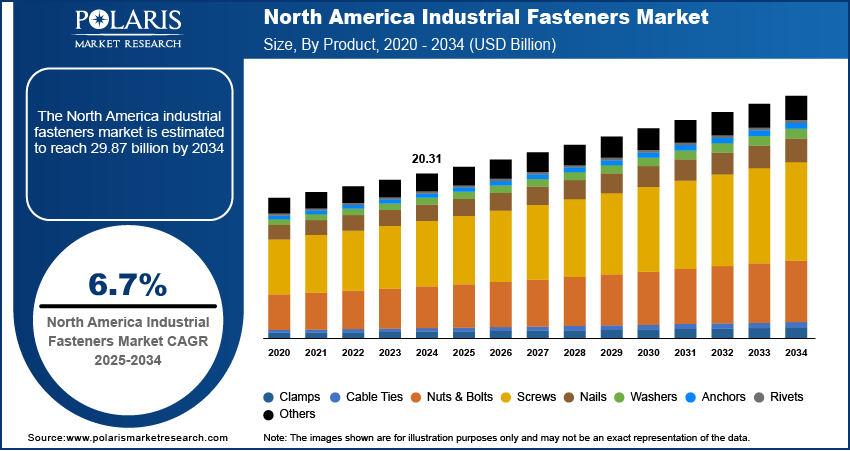
The current market trends show a preference for lightweight industrial fasteners, which manufacturers achieve most effectively through multi-material and optimized design solutions. The enhanced corrosion protection provided by advanced coatings and alloy materials offers solutions that meet the growing need for better product traceability and quality control in regulated industries. Modular construction projects require fasteners that enable repetitive assembly while providing disassembly capabilities in line with design-for-disassembly standards and rapid project execution.
Industries such as automotive and aerospace constantly seek lightweight components to reduce the weight of vehicles and spacecraft. The engineering process now uses plastic and metal together to develop fasteners, including screws, nuts, bolts, anchors, rivets, and washers. The aerospace industry is witnessing increased demand for plastic fasteners because they withstand ultraviolet radiation better than other materials. Space agencies such as NASA have been using re-engineered plastic fasteners to design spacecraft and various space-based observatories. As material science advances, plastic fasteners are expected to gain traction in the industrial fasteners market.
The aerospace industry requires advanced engineered fasteners that use specific high-performance polymers and composite-compatible designs to meet specialized application needs and rigorous performance requirements. The use of polymer-based fasteners can be limited when applications reach extreme load and temperature conditions. So, the need for high-strength industrial fasteners continues to grow, as structural integrity requires advanced metals and superalloys as base materials.
Industrial Fasteners Market Dynamics
Growing Demand for Fasteners in Automotive Industry
The automotive industry requires fasteners for component assembly. The proper functioning of vehicles depends on fasteners that provide the necessary structural strength. Connecting different vehicle parts requires passenger and commercial vehicles to use multiple components, including anchors and panel fasteners such as studs, screws, rivets, nuts, and bolts. The growing demand for fuel-efficient vehicles, including electric vehicles (EVs), drives additional revenue for the industrial fastener market.
Passenger vehicles and commercial vehicles need high-performance fasteners because they operate in extreme conditions. The environmental conditions, including extreme wind speeds, high pressure, and varying temperatures, require new fastener design and material solutions. Manufacturers are allocating resources to research and development to create high-quality fasteners that can withstand extreme environmental conditions. Therefore, the focus on innovation has led to the development of better materials to enhance the operational efficiency and safety of the vehicles.
Electric vehicle platforms require vibration-resistant fasteners and materials that withstand multiple thermal cycling tests. Manufacturers are focusing on product durability and noise, vibration, and harshness control. This has created a need for custom-engineered fasteners that meet specific assembly requirements while maintaining safety standards.
Increased Usage in Construction Sector
The expansion of the construction industry, mostly in Asia, is driving the demand for industrial fasteners. Countries such as China and India are witnessing increased demand from the construction sectors due to rising disposable incomes and government investments in infrastructure projects. China's ongoing demand for residential, industrial, and commercial expansion has created numerous opportunities for new construction ventures. Further, the US residential sector is supported by favorable regulatory policies and accessible home loan programs. According to a report by the Composite Panel Association, construction spending in the US in April 2024 reached USD 2.1 trillion, up 10% from the same month in the previous year. The growing use of industrial fasteners in modern infrastructure and industrial development is driving demand. Thus, the growing demand for fasteners in the automotive and construction industries, coupled with increased construction activity and rising consumer spending power, is driving the industrial fasteners market.
The growth of prefabricated and modular construction has led contractors and fabricators to favor precision-engineered fasteners, as they improve their work while maintaining consistent quality throughout installations. The fasteners offer an advantage by simplifying equipment maintenance. Contractors now consider load distribution, corrosion resistance, and compatibility with mixed building materials as key selection criteria.
Rising Application of Industrial Fasteners in Healthcare Industry
The healthcare sector is now using advanced fastening solutions in medical electronic devices. These include threaded inserts for plastics, blind rivets, and self-locking thread systems. Industrial fasteners are present in surgical lasers, MRI scanners, pacemakers, and stethoscopes. They allow medical devices to operate accurately and dependably. The industrial fasteners market is also expanding due to increasing demand for self-locking fasteners in medical applications, which enhance device safety and stability. The medical electronics sector in India will experience substantial growth due to two factors: greater healthcare awareness and higher government spending. The India Brand Equity Foundation projected that Indian healthcare spending will reach USD 638 billion by 2025. The country's aging population will lead to higher consumer health spending, as consumers will also demand more healthcare products. The healthcare sector will require more industrial fasteners because of this shift.
Fasteners used in medical device manufacturing need to perform reliably under extensive use. They also need to withstand sterilization and cleaning processes. As a result, consistent quality, secure locking performance, and application-specific fastening solutions are key growth drivers in the market.
Market Restraints and Challenges
The industrial fasteners market faces multiple challenges that hinder its development. The market faces challenges because raw material prices, particularly for steel and specialty alloys, fluctuate frequently. The supply chain experiences challenges due to delays and unpredictable timelines. The global sourcing market faces risks because counterfeit and non-compliant fasteners pose quality and safety issues. These issues together created a more complex procurement process for OEMs and MRO teams, while making supplier qualification, traceability, and compliance with industry standards more important.
Source: Polaris Market Research Analysis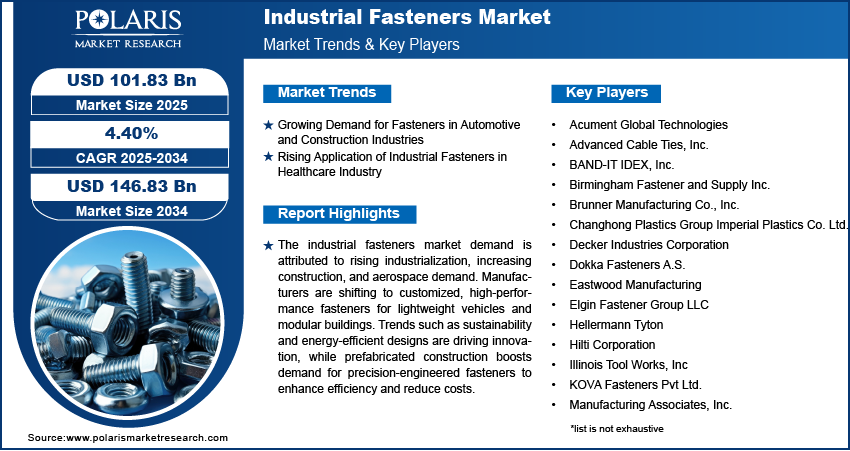
Industrial Fasteners Market Segment Insights
Industrial Fasteners Market Assessment by Product Outlook
The global industrial fasteners market segmentation, by product, includes clamps, cable ties, nuts & bolts, screws, nails, washers, anchors, rivets, and others. In 2025, the nuts & bolts segment held the largest market share. The product has become widespread because it serves multiple industrial applications in automotive, aerospace, construction, machinery, and medical device manufacturing sectors.
Various industries rely on nuts and bolts because these fasteners offer both versatility and durability. Nuts come in different types, including hex nuts, T-nuts, and flange nuts, which have internal threads and connect to bolts to create secure connections. Bolts come in various sizes and head designs, including toggle bolts and U-bolts, and manufacturers produce these products from steel, titanium, and plastic materials. Construction activities in both developed and emerging economies are driving an increasing demand for nuts and bolts. The European Commission report shows that Germany made major progress in its 5G network construction, with 98.1 percent completed according to the 2023 assessment. The telecommunications industry needs nuts and bolts to secure its communication equipment and establish network links. The rise in infrastructure investment from countries across various industrial sectors will generate ongoing demand for nuts-and-bolts throughout the forecast period.
Buyers select fasteners from different product categories according to their load requirements, installation difficulty, maintenance needs, and environmental exposure. The selection of threaded or non-threaded fasteners depends on the maintenance requirements of the joint, the presence of vibration, and the automation level of the assembly process. The need for custom fasteners arises when original equipment manufacturer designs require specific tolerance levels, distinct head designs, and increased resistance against loosening.
Industrial Fasteners Market Evaluation by Material Outlook
The global market, based on material, is bifurcated into plastic and metal. The metal segment accounted for a major market share in 2025 because of its features such as durability, strength, heat resistance, and corrosion resistance. Metal fasteners are manufactured from materials such as stainless steel, bronze, aluminum, copper, and titanium for their large-scale application across various industries such as manufacturing, construction, and industrial applications. Among these, stainless steel fasteners are the top choice because they offer recyclability, cost-effectiveness, and exceptional performance in extreme conditions, including underwater environments. The development of new metal alloys that provide anti-corrosion, superconducting, and ultra-lightweight properties has further increased their demand in automotive, industrial, and infrastructure projects.
Material selection is now based on lifecycle costs. This is because companies face difficulties with corrosion and replacement requirements in extreme outdoor conditions. Stainless steel fasteners offer durability and corrosion resistance, making them a common choice. Plastic fasteners are gaining popularity in low-load applications where users need lightweight materials that provide insulation and ultraviolet protection.
Industrial Fasteners Market Outlook by Industry Outlook
The global market, based on industry, is segregated into automotive, aerospace, building & construction, industrial machinery, home appliances, lawn & garden, motors & pumps, furniture, plumbing, and others. The aerospace segment is expected to witness the highest growth rate during the forecast period. This is due to increased need for lightweight and high-strength fasteners in aircraft manufacturing.
The aerospace sector will experience increased demand for industrial fasteners due to rising aircraft production, advancements in materials science, and the need for high-performance fastening solutions. Aircraft structural integrity depends on aerospace fasteners, including bolts and nuts, as well as high-strength alloys. The market expansion gains additional momentum as consumers prefer lightweight materials that also resist corrosion. Various aerospace applications use clamps to support vital systems, including ventilation and air management, and water and waste evacuation systems.
The lightweight, cost-effective nature of aluminum fasteners drives their use in industrial applications, thereby fueling market growth. As the aerospace sector moves toward high-performance superalloys, demand for metal fasteners in this segment is projected to grow rapidly during the forecast period.
OEM vs MRO Lens
Demand patterns vary based on OEM manufacturing and MRO. OEM customers are interested in production speed, standardized specifications, and building long-term industrial fasteners suppliers agreements. MRO customers are interested in fast availability, compatibility, and fast replacement. These conditions provide opportunities for fastener suppliers with good distribution networks and application-based product lines.
Source: Polaris Market Research Analysis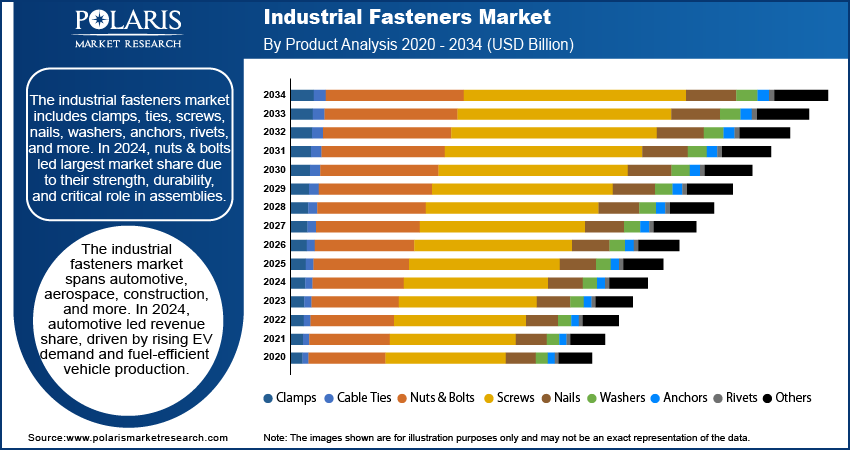
Industrial Fasteners Market Regional Analysis
By region, the study provides industrial fasteners market insights into North America, Europe, Asia Pacific, Latin America, and the Middle East & Africa.
In 2025, the Asia Pacific led the global industrial fasteners market in terms of revenue share. This is due to the presence of an improved automotive manufacturing base in countries such as China, Japan, and India, which is increasing the demand for industrial fasteners. The region is also witnessing an increase in sales of passenger and commercial vehicles for Mid-Range & Compact SUVs and Light Commercial Vehicles (LCVs), respectively, driving growth in the automotive industry. In addition, the favorable FDI policies and the “Make in India” policy introduced by the Government of India are creating opportunities for the country's automobile industry, which will help expand the industrial fastener industry.
The China industrial fasteners market is experiencing growing momentum. This is due to government encouragement and rising investments in the manufacturing industry. Encouraging policies, such as China's 13th Five-Year Plan (2016-2020), have spurred infrastructure development. Such policies are adding to the demand for fasteners across the residential and commercial sectors. China’s leadership role in the global automotive industry has also boosted demand for fasteners. Volkswagen’s entry and the rise in domestic car sales, which increased by 7.4% in October 2022 (CEIC Data), have also added to the growth prospects of the industry. In addition, the low production costs and availability of raw materials have attracted foreign direct investment, thus making the automotive industry in China stronger.
The Indian industrial fasteners market is expanding at a fast pace due to favorable government policies and the development of end-use industries. The “Make in India” campaign in India has encouraged investments in the automotive, energy, and metals industries. This has resulted in increased production. The automotive industry in India emerged as the fourth-largest in the world in 2022. The automotive industry in the country is expanding, thus increasing the demand for fasteners. The decentralization of government-owned metal companies such as BALCO and HINDALCO is expected to enhance the availability of raw materials. Additionally, the fast growth of urbanization, population, and disposable income has led to an increase in automobile production, thus driving the demand for industrial fasteners in India.
The European industrial fasteners market represented the second-largest market share in 2025. This is because the European market is home to a robust automotive and construction sector. Europe is a leading automotive manufacturing region, with top brands such as Audi, BMW, Volkswagen, and Ferrari. The European Commission's efforts to attract foreign direct investments from Asian automobile manufacturers such as Honda and Toyota will also boost the market in the coming years. Germany, a leading market, produces more than six million cars per year and accounts for 29% of the European automobile market. This further contributes to the demand for fasteners.
Source: Polaris Market Research Analysis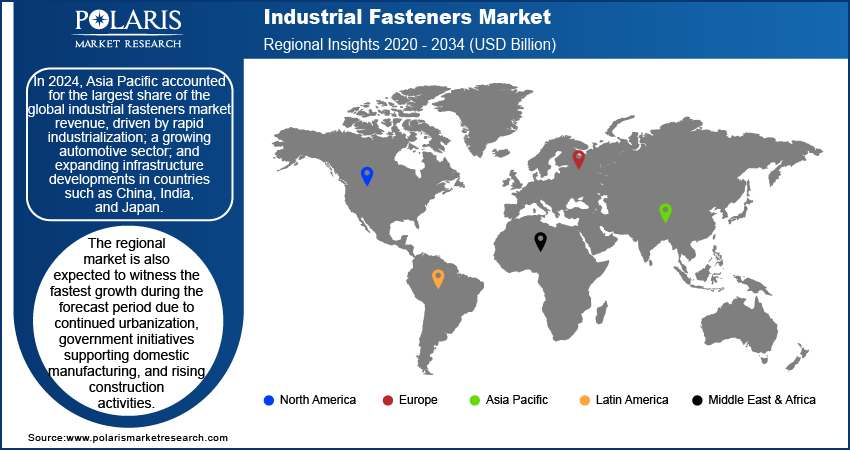
Industrial Fasteners Market – Key Players and Competitive Analysis Report
The competitive environment in the industrial fasteners industry is marked by the presence of both established firms and new entrants attempting to gain market share in the growing industry. The high level of competition leads to price competition, which affects overall profitability. Established companies focus on innovation, collaboration, and research and development to gain a competitive advantage. The presence of local manufacturers of industrial fasteners, offering cheaper substitutes, enhances competition. Building brand loyalty, economies of scale, and marketing are essential in sustaining a competitive advantage in the market. The companies are employing growth strategies such as diversification, marketing, and collaboration.
When selecting a supplier, buyers consider factors such as quality systems, certifications, and engineering support. Buyers also take into account lead times and the availability of standard and custom fasteners. Suppliers with proper documentation, traceability, and quality are more suited to regulated markets. This also enhances their market standing in the industrial fasteners market.
Acument Global Technologies is a fastening and assembly solutions provider. As a subsidiary of Fontana Gruppo, it caters to customers in 35+ countries. The company operates through the brands Delta PT, Fastite 2000, and MagnaSeal. They offer a broad product portfolio. These include blind fastening solutions, lock bolts, break-stem fasteners, and installation equipment. Acument is an industrial fastener supplier to the automotive, aerospace, defense, and rail sectors. The fasteners are made of high-performance materials such as A286, 8740, titanium, and Inconel. The company also provides other services such as supply chain management, engineering, and logistics.
Birmingham Fastener is an industrial fastener manufacturer and distributor catering to various industries like structural steel, waterworks, utilities, OEMs, transportation, MRO, and construction. The company has multiple locations spread across the US. Birmingham Fastener is a niche player in non-standard fasteners, providing T-head bolts, B7 studs, bracing hardware, sealants, and pipe flashing. The company has a massive distribution network that gives customers constant access to the products through retail stores and distribution centers. The company offers customized solutions, including fasteners for metal building production, precast concrete, and industrial distribution.
List of Key Companies in Industrial Fasteners Market
- Acument Global Technologies
- Advanced Cable Ties, Inc.
- BAND-IT IDEX, Inc.
- Birmingham Fastener and Supply Inc.
- Brunner Manufacturing Co., Inc.
- Changhong Plastics Group Imperial Plastics Co. Ltd.
- Decker Industries Corporation
- Dokka Fasteners A.S.
- Eastwood Manufacturing
- Elgin Fastener Group LLC
- Hellermann Tyton
- Hilti Corporation
- Illinois Tool Works, Inc
- KOVA Fasteners Pvt Ltd.
- Manufacturing Associates, Inc.
- MW Industries, Inc.
- Nippon International
- NORMA Group
- Panduit
- Penn Engineering & Manufacturing Corp.
- Sesco Industries Inc.
- SHUR-LOK (Precision Castparts Corp.)
- Slidematic Precision Components
- Standard Fasteners Ltd.
- Stanley Black & Decker
- Wenzhou Longhua Daily Electron
Industrial Fasteners Industry Developments
July 2025: Gabriel India expanded into the industrial fastener market through a joint venture with Korea’s JINHAP. The company invested about USD 3.2 million for a 51% stake. The partnership aims to achieve USD 24 million in revenue by 2030 while strengthening OEM localisation initiatives.
Industrial Fasteners Market Segmentation
By Raw Material Outlook (Revenue, USD Billion, 2021–2034)
- Plastic
- Metal
By Product Outlook (Revenue, USD Billion, 2021–2034)
- Clamps
- Cable Ties
- Nuts & Bolts
- Screws
- Nails
- Washers
- Anchors
- Rivets
- Others
By Type Outlook (Revenue, USD Billion, 2021–2034)
- Externally Threaded Fasteners
- Internally Threaded Fasteners
- Non-threaded Threaded Fasteners
- Aerospace Grade Fasteners
By Industry Outlook (Revenue, USD Billion, 2021–2034)
- Automotive
- Aerospace
- Building & Construction
- Industrial Machinery
- Home Appliances
- Lawn & Garden
- Motors & Pumps
- Furniture
- Plumbing
- Others
By Regional Outlook (Revenue, USD Billion, 2021–2034)
- North America
- US
- Canada
- Europe
- Germany
- France
- UK
- Italy
- Spain
- Netherlands
- Russia
- Rest of Europe
- Asia Pacific
- China
- Japan
- India
- Malaysia
- South Korea
- Indonesia
- Australia
- Vietnam
- Rest of Asia Pacific
- Middle East & Africa
- Saudi Arabia
- UAE
- Israel
- South Africa
- Rest of Middle East & Africa
- Latin America
- Mexico
- Brazil
- Argentina
- Rest of Latin America
Industrial Fasteners Market Report Scope
| Report Attributes | Details |
| Market Size in 2025 | USD 101.83 billion |
| Market Size in 2026 | USD 106.25 billion |
| Revenue Forecast by 2034 | USD 146.83 billion |
| CAGR | 4.40% |
| Base Year | 2025 |
| Historical Data | 2021–2024 |
| Forecast Period | 2026–2034 |
| Quantitative Units | Revenue in USD billion, and CAGR from 2026 to 2034 |
| Report Coverage | Revenue Forecast, Market Competitive Landscape, Growth Factors, and Trends |
| Segments Covered |
|
| Regional Scope |
|
| Competitive Landscape | Industrial Fasteners Trend Analysis (2025) Company profiles/industry participants profiling include company overview, financial information, product/service benchmarking, and recent developments |
| Report Format | PDF + Excel |
| Customization | Report customization as per your requirements with respect to countries, regions, and segmentation. |
Source: Polaris Market Research Analysis
Industrial Fasteners Market FAQ's
The industrial fasteners market size is expected to reach USD 146.83 billion by 2034. The market is projected to account for a CAGR of 4.40% between 2026 and 2034.
The market is driven by the expansion of the automotive sector and infrastructure development in emerging economies. It is also benefiting from technological advancements in lightweight materials.
Asia Pacific leads the industrial fasteners market. This is due to the region’s robust automotive manufacturing and infrastructure development in China and India.
Industrial fasteners include nuts and bolts, screws, rivets, washers, cable ties, clamps, anchors, and nails. These fasteners are used across sectors such as automotive, construction, aerospace, and manufacturing.
Plastic fasteners offer lightweight properties and UV radiation resistance. These can also resist corrosion and are durable. All these properties contribute to their high popularity.
Download Sample Report of Industrial Fasteners Market
Please fill out the form to request a customized copy of the research report.


