
Industrial Pumps Market Share, Size, Trends, Industry Analysis Report, 2026 - 2034
REPORT DETAILS
Industrial Pumps Market Summary
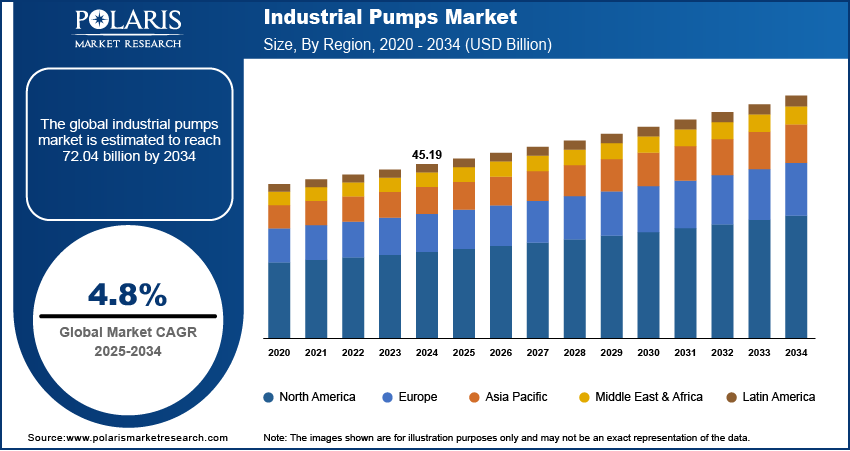
The global industrial pumps market was valued at USD 47.16 billion in 2025 and is expected to grow at a CAGR of 4.8% during the forecast period. The growing application of industrial pumps across several industries is expected to accelerate the growth of the market. The fiber and textile industry requires pumping solutions for accurately measuring color pigments, dye, bleach, etc., and also handling abrasive chemicals like latex, wastewater, sludge, etc. which can be extremely tough to handle.
Market Statistics
Key Takeaways
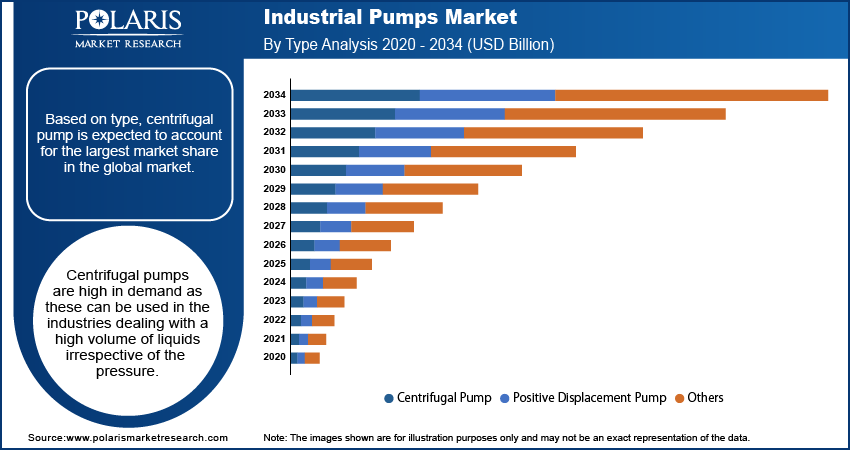
- By type, the centrifugal pump segment held the largest share of 66.5% in 2025 due to the inherent advantages of centrifugal pumps, such as their simple design, relatively lower maintenance needs, and high efficiency in handling large flow rates.
- By end-use, the water & wastewater treatment segment held the largest share of 25.2% in 2025 due to the increasing global focus on water scarcity and pollution control.
- Rotary pumps accounted for the leading share of 58.5% because of their superior handling of viscous fluids, oils, slurries, and chemical liquids across industrial processing environments.
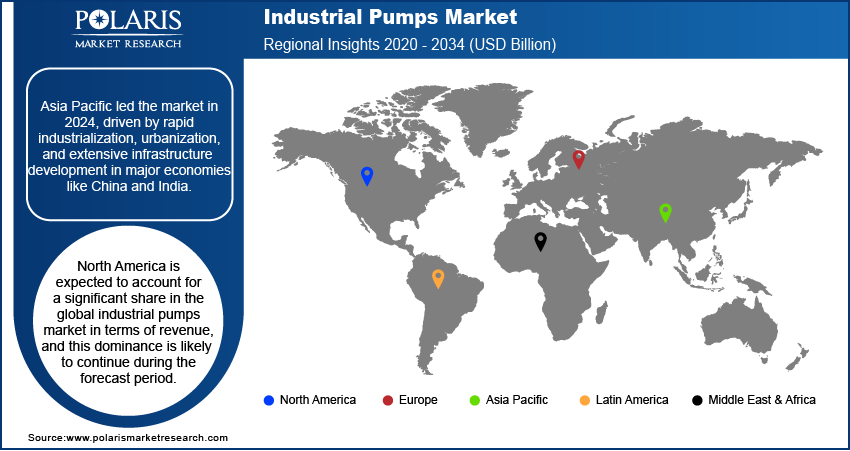
- By region, the Asia Pacific region held 43.02% share in 2025. The regional growth is largely propelled by rapid industrialization and urbanization across key economies like China and India, which fuels massive infrastructure development and expansion across multiple end-use sectors.
- North America held a substantial 25.75% revenue share of the global industrial pumps market in 2025 owing to strong investments in water and wastewater infrastructure
Note: Figures and projections outlined in this report are the result of Polaris Market Research’s proprietary analytical processes, grounded in the latest available datasets and market observations.
Industry Dynamics
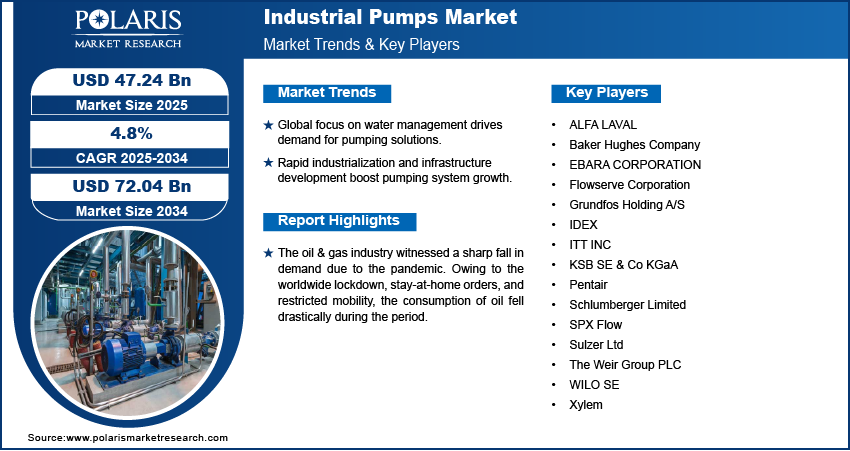
- The rising global focus on water and wastewater management drives the need for pumping solutions to support treatment, recycling, and safe disposal.
- Rapid industrialization and extensive infrastructure development, particularly in emerging economies, are significant growth factors for pumping systems.
- A strong push toward energy-efficient technologies is a key driver, as industries aim to lower operational costs and meet growing sustainability goals.
Source: Polaris Market Research Analysis
To Understand More About this Research: Download Sample Report
AI Impact on the Market
- AI is driving the shift from scheduled or reactive repairs to predictive maintenance by analyzing real-time data from smart sensors on the equipment.
- The technology is significantly optimizing pump performance and energy efficiency by continuously monitoring factors like flow rate, pressure, and power consumption.
- AI enables remote monitoring and control through the integration of the Internet of Things (IoT), allowing operators to oversee and manage equipment from any location.
What are industrial pumps?
Industrial pumps are mechanical devices that transfer liquids, chemicals, slurries, wastewater, oil, and other fluids in industrial operations. They use centrifugal or positive displacement mechanisms. These pumps play a key role in industries such as water treatment, oil & gas, chemicals, power generation, mining, agriculture, and manufacturing. They ensure efficient fluid handling, pressure management, and process automation.
Textile fibers are produced and processed using large quantities of water and energy in the textile industry, which demands innovative and efficient pumping solutions. For example, a pump can transport crude oil from a storage tank to a pipeline, and mud pumps can circulate drilling mud into the annulus of a drill bit and back to a storage tank for re-purification. Process fluids in oil and gas operations can be simple or complex which leads to the requirement of an appropriate pump for the subsequent need.
Furthermore, the chemical industry has perhaps the greatest demand for industrial pumps that could both perform and offer protection to employees and the surrounding work environment. A chemical producer handles aggressive acids which are not only toxic, but also highly flammable and explosive.
The oil & gas industry witnessed a sharp fall in demand due to the pandemic. Owing to the worldwide lockdown, stay-at-home orders, and restricted mobility, the consumption of oil fell drastically during the period. Furthermore, as COVID-19 caused unprecedented declines in demand, The pricing war between Saudi Arabia and Russia induced crude oil prices to fall.
Source: Polaris Market Research Analysis
Industry Dynamics
Growth Drivers
The pump industry has a wide range of applications in oil & gas, agriculture, metal & mining, water & wastewater treatment, textile, chemical, construction, manufacturing, and many other sectors. In the oil & gas industry, every aspect of oil & gas production necessitates the use of industrial pumps. They basically facilitate the transfer of process fluids from one place to another.
The increasing strict rules and regulations regarding wastewater treatment are necessitating the demand for industrial pumps. The government of several economies present across the globe is coming up with new laws and guidelines for wastewater discharge. Effluent guidelines are the regulatory standards for wastewater discharged to surface waters and municipal sewage treatment plants.
An industrial pump is vital to industrial existence and is extensively used in the various industries, that accounts for 30% of total energy consumption on an average industrial site. However, 90% of pumps across the globe are inefficient and operating at low efficiencies at the same time, wasting millions of dollars in energy and generating millions of tons of carbon dioxide each year.
Report Segmentation
The market is primarily segmented on the basis of type, end-use, and region.
| By Type | By End-Use | By Region |
|
|
|
Source: Polaris Market Research Analysis
Insight by Type
By type, the centrifugal pump segment held the largest share of 66.5% in 2025 in the global market. Centrifugal pumps are high in demand as these can be used in the industries dealing with a high volume of liquids irrespective of the pressure. Centrifugal pumps are usually used for the liquids that are low in viscosity as well as low in solid concentration.
These pumps are currently in use across a vast array of domestic and industrial processes. From supplying the water used in residential buildings to industrial applications such as food, beverage, and chemical manufacturing, different types of centrifugal pumps are required to effectively meet pumping requirements.
Comparison Matrix: Centrifugal Pumps vs Positive Displacement Pumps
| Parameter | Centrifugal Pumps | Positive Displacement Pumps |
| Flow Rate Capability | Preferred for high-flow industrial operations with continuous fluid movement | Ideal for controlled, precise, and constant flow applications |
| Viscosity Handling | Best for low-viscosity fluids such as water, solvents, and light chemicals | Handles highly viscous fluids, including oils, slurries, adhesives, and syrups |
| Pressure Generation | Suitable for low-to-medium pressure industrial systems | Delivers high-pressure output for demanding processing operations |
| Energy Consumption | More cost-effective for large-scale, high-volume pumping requirements | Higher efficiency in high-pressure and viscous fluid transfer environments |
| Maintenance & Downtime | Lower maintenance costs and easier servicing reduce operational downtime | Requires more frequent maintenance due to wear-sensitive internal components |
| Capital & Operating Costs | Lower upfront investment and widely adopted across utilities and infrastructure sectors | Higher initial cost but offers better accuracy and process control in specialized industries |
| Industrial Use Cases | Common in water treatment, HVAC, power plants, agriculture, and general manufacturing | Widely used in oil & gas, chemical processing, food & beverage, pharmaceuticals, and mining |
| Procurement Preference | Preferred for bulk fluid movement and cost-sensitive industrial projects | Chosen where dosing accuracy, pressure stability, and viscous fluid handling are critical |
Source: Polaris Market Research Analysis
Source: Polaris Market Research Analysis
Insight by End-Use
By end-use, the water & wastewater treatment segment held the largest share of 25.2% in 2025 due to the increasing global focus on water scarcity and pollution control. The textile segment is anticipated to register the highest growth rate of 5.5% during the forecast period of the industrial pumps. This is largely driven by the increasing need for water management and the expansion of manufacturing activities globally, especially in emerging economies. Pumps are vital in numerous processes within the textile industry, such as dyeing, finishing, and wastewater treatment, which is critical due to the large volumes of water and chemicals involved.
Industrial Pump Maintenance & Aftermarket Services
Industrial pump maintenance and aftermarket services are crucial to ensure operational reliability. They minimize downtime and extend equipment lifespan across industrial facilities. Manufacturers and service providers generate recurring revenue through annual maintenance contracts and predictive maintenance solutions. They also gain benefits from replacement parts supply, repair services, and system retrofits. Growing adoption of condition monitoring, IoT-enabled diagnostics, and energy-efficiency upgrades strengthens aftermarket demand. Industries such as oil & gas, water treatment, chemicals, mining, and power generation increasingly rely on aftermarket support. It helps maintain continuous operations, optimize pump performance, and reduce long-term operating costs.
Geographic Overview
Asia Pacific region held 43.02% share in 2025 and is expected to account largest market share over the forecast period. Asia Pacific is one of the world's largest agricultural producers and plays a vital role in the overall region's GDP growth. Since industrial pumps have a wide range of applications in the agriculture sector, from irrigation to the movement of fluid from one place to another, the market demand for the industrial pumps market is expected to grow over the forecast period.
An increase in demand for power & electricity across the region is likely to drive the growth of the market over the forecast period. Countries present across the region are switching to a cleaner source of energy with the government's new rules and standards. With this, the increased adoption of renewable sources of energy for power generation is projected to push the market demand.
North America held a substantial 25.75% revenue share in the global industrial pumps market in terms of revenue, and this dominance is likely to continue during the forecast period. The oil & gas industry is one of the largest consumers of industrial pumps across the region as they are extensively used in the production and extraction of oil & gas. However, fluctuation in prices of oil impacted the upstream and downstream activities of the industry over the years, which hindered the growth of the market.
Source: Polaris Market Research Analysis
Competitive Insight
Some of the major players operating in the global market include Xylem, Grundfos Holding A/S, EBARA CORPORATION, Flowserve Corporation, WILO SE, KSB SE & Co. KGaA, Sulzer Ltd, Schlumberger Limited, The Weir Group PLC, ALFA LAVAL, Pentair, IDEX, Baker Hughes Company, ITT INC., and SPX Flow.
Industrial Pumps Industry Developments
- January 2026: KSB SE & Co. KGaA launched the Omega 2, a next-generation axially split volute casing pump engineered for efficient handling of water and similar fluids. The series offers improved hydraulic performance, higher energy efficiency, and simplified maintenance, making it ideal for water supply, irrigation, and industrial water transport applications. (Source: worldpumps.com)
- March 2025: Honeywell announced its acquisition of Sundyne, strengthening its portfolio of critical flow equipment and expanding its global aftermarket services platform. (Source: honeywell.com)
- January 2024: SABIC approved a USD 6.4 billion investment for the Fujian Petrochemical Complex in China, a large-scale joint venture with Fujian Energy Petrochemical aimed at expanding ethylene and downstream chemical production capacity to meet rising demand for high-end petrochemical products across Asia. (Source: oilandgasmiddleeast.com)
- May 2024: Grundfos reached an agreement to acquire Culligan’s Commercial and Industrial business in Italy, France, and the UK for over EUR 100 million (USD 113 million), enhancing its water treatment and commercial solutions footprint across Europe. (Source: grundfos.com)
- April 2024: Saudi Aramco awarded USD 7.7 billion in EPC contracts for the Fadhili Gas Plant expansion, a large-scale project that will significantly increase requirements for specialized pumping systems. (Source: aramco.com)
Industrial Pumps Market Report Scope
| Report Attributes | Details |
| Market size value in 2025 | USD 47.16 Billion |
| Market size value in 2026 | USD 49.25 billion |
| Revenue forecast in 2034 | USD 71.91 Billion |
| CAGR | 4.8% from 2026 - 2034 |
| Base year | 2025 |
| Historical data | 2021 - 2024 |
| Forecast period | 2026 - 2034 |
| Quantitative units | Revenue in USD Billion and CAGR from 2026 - 2034 |
| Segments covered | By Type, By End-Use, By Region |
| Regional scope | North America, Europe, Asia Pacific, Latin America, Middle East & Africa |
| Key companies | Xylem, Grundfos Holding A/S, EBARA CORPORATION, Flowserve Corporation, WILO SE, KSB SE & Co. KGaA, Sulzer Ltd, Schlumberger Limited, The Weir Group PLC, ALFA LAVAL, Pentair, IDEX, Baker Hughes Company, ITT INC., and SPX Flow. |
Source: Polaris Market Research Analysis
Industrial Pumps Market FAQ's
The global market size was valued at USD 47.16 billion in 2025 and is projected to grow to USD 71.91 billion by 2034.
The global market is projected to register a CAGR of 4.8% during the forecast period.
Asia Pacific region held 43.02% share in 2025.
The centrifugal pump segment held the largest share of 66.5% in 2025.
North America, Europe, Asia Pacific, Latin America, Middle East & Africa.
Download Sample Report of Industrial Pumps Market
Please fill out the form to request a customized copy of the research report.


