
Industrial Starch Market Demand, Industry Share & Forecast, 2026-2034
REPORT DETAILS
Industrial Starch Market Summary
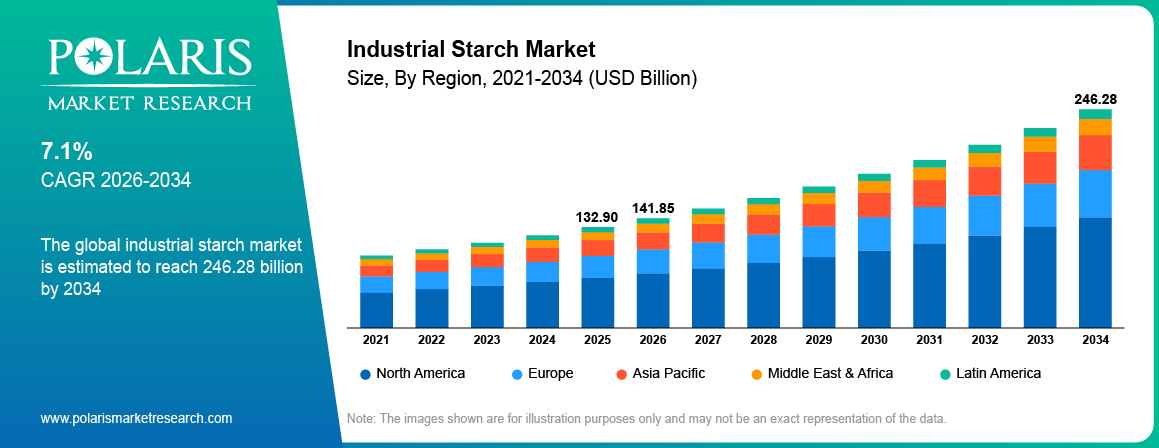
The global industrial starch market size was valued at USD 132.90 billion in 2025. The market is projected to grow at a CAGR of 7.1% from 2026 to 2034. This market is gaining traction due to rising demand from the food processing and textile industries. The shift toward biodegradable materials and clean-label ingredients supports growth.
Market Statistics
Industrial Starch Market Key Takeaways
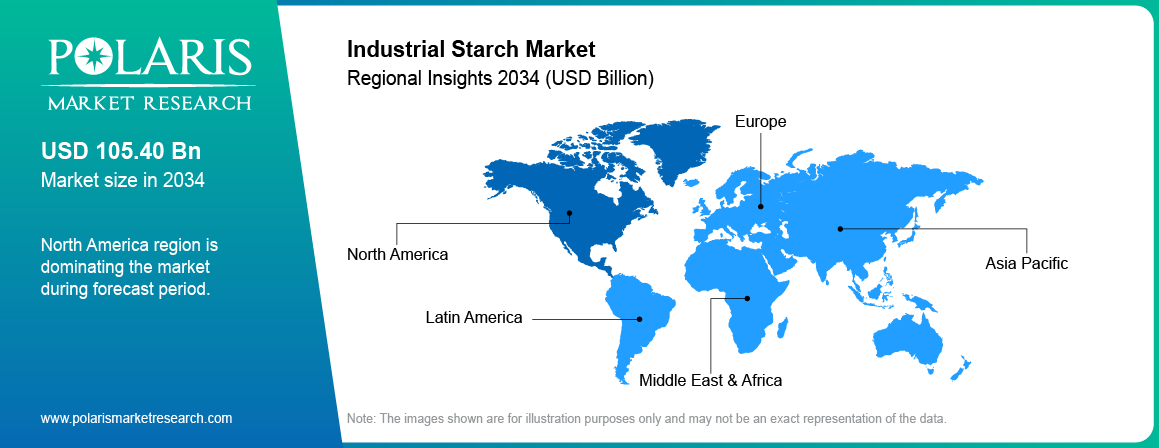
- North America accounted for the largest share of 42.8% in 2025. This is due to the high demand for industrial starch from various industries.
- The U.S. led with a 75.4% revenue share in 2025. This is owing to the strong presence of major food and beverage and textile manufacturing companies.
- Asia Pacific is expected to witness the highest CAGR of 7.7%. Rising disposable incomes and urbanization in emerging economies drive the regional market growth.
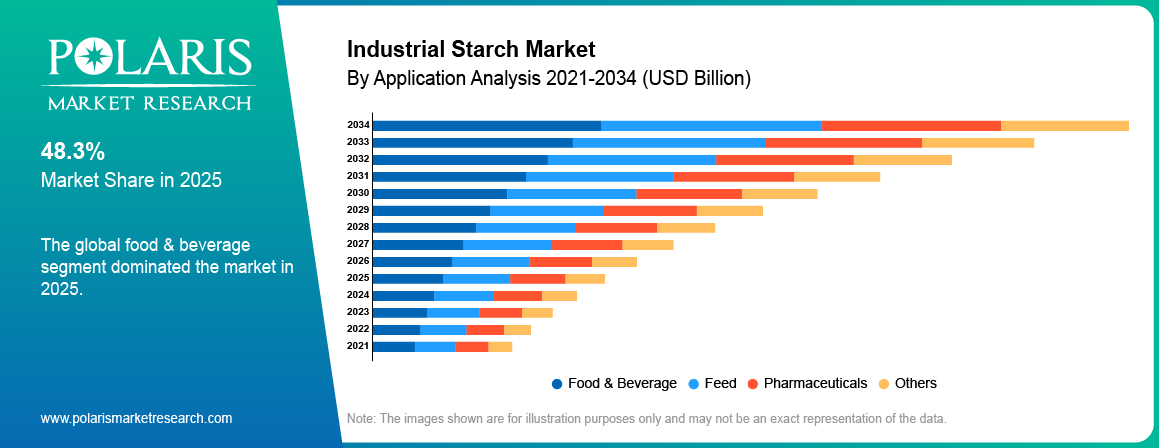
- The food & beverage segment held the largest share of 48.3% in 2025. This is due to the growing demand for starch as a key ingredient in various food products.
- The wheat starch segment is expected to witness the highest CAGR of 8.0%. The versatility and cost-effectiveness of wheat starch contribute to the segment’s growth.
Note: Figures and projections outlined in this report are the result of Polaris Market Research’s proprietary analytical processes, grounded in the latest available datasets and market observations
AI Impact on Industrial Starch Market
- The use of AI aids in improving the manufacture of industrial starches as it provides optimal processing techniques, resource usage, and effective operations.
- AI plays an important role in the development of new products as it examines the required characteristics of industrial starches for their applications, such as food, paper, textile, adhesive, and bioplastic industries.
- The use of artificial intelligence increases the efficiency of quality management systems in that it enables continuous monitoring of starch characteristics.
- Artificial intelligence is useful for optimizing logistics, predicting market demand, and cutting down operational costs.
Industrial starch is a versatile carbohydrate derived from agricultural sources, primarily from corn, potatoes, wheat, rice, and cassava. It is widely used across industries due to its ability to thicken, stabilize, bind, and texturize products. Industrial starch has two main molecular components, amylose and amylopectin, that determine its functionality and application, which vary depending on the source. The increasing demand across various sectors, including food, paper, and pharmaceuticals, is significantly contributing to the growth of this industry.
The food and beverage sector is also one of the largest consumers, which is used for thickening, gelling, stabilizing, and enhancing the texture of a wide range of products. The increasing consumption of processed foods, ready meals, snacks, and bakery items is a significant driver. Additionally, as consumers increasingly prefer clean-label, natural, and minimally processed ingredients, starches, especially native and modified varieties, are in high demand. Moreover, the trend towards plant-based and gluten-free diets is also boosting the consumption of starch-based ingredients, thereby contributing to the market demand.
To Understand More About this Research: Download Sample Report
Native Starch vs Modified Starch
| Factor | Native Starch | Modified Starch |
| Processing | In its natural state | Altered physically, chemically or enzymatically |
| Heat Resistance | Low | High |
| Storage | Limited | Extended |
| Control Over Viscosity | Basic | Advanced |
| Performance in Industry | Average | Tailored to applications |
| Use/Application | Simpler food uses | Advanced food, drug and packaging uses |
Market Dynamics
Driver: Growth in Paper and Packaging
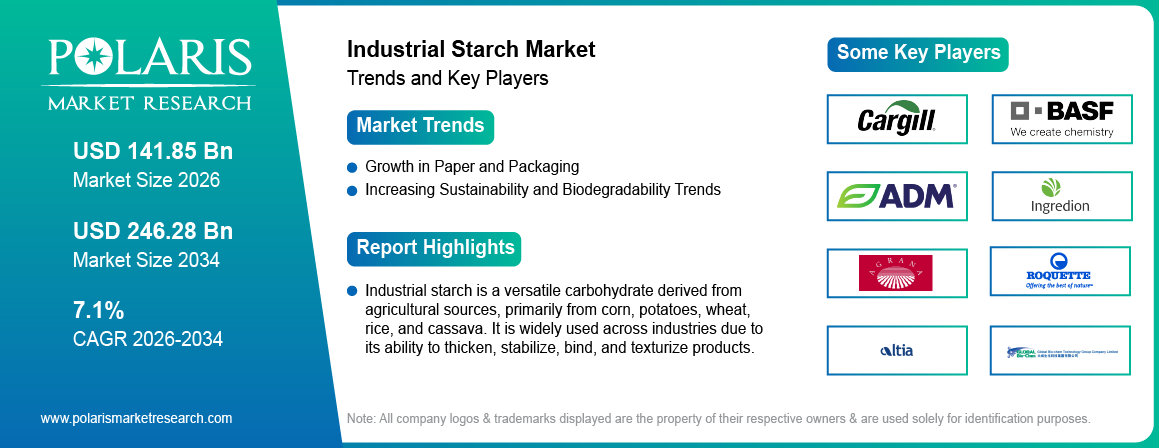
The demand for industrial starch in the paper and packaging industry is growing due to its ability to improve the quality and strength of paper products. Starch is widely used in paper coating, sizing, and adhesives. Furthermore, the exponential growth of the e-commerce industry has led to a surge in packaging requirements as products are shipped to consumers globally. Packaging for e-commerce needs to be durable, protective, and cost-effective.
For instance, according to the International Trade Administration, global B2B e-commerce sales have shown consistent year-over-year growth over the past decade, with the market expected to reach a valuation of USD 36 trillion by 2026. Thus, the trend, particularly in packaging for e-commerce, has further accelerated the market for industrial starch.
Driver: Increasing Sustainability and Biodegradability Trends
Industries are increasingly adopting sustainable practices, which is driving demand for biodegradable and eco-friendly materials. Industrial starch, a renewable and biodegradable resource, has emerged as a key alternative to synthetic polymers and chemicals. The shift toward environmentally friendly products, particularly in packaging, automotive, and textiles, has led to a growing reliance on starch-based solutions, further propelling market growth. Additionally, governments worldwide are implementing stricter regulations and offering incentives to promote the use of sustainable materials, further driving the adoption of starch-based alternatives in various industries.
For instance, according to the European Commission, the European Union has taken an initiative, namely the European Green Deal, which seeks to eliminate wasteful packaging by promoting reuse and recycling methods. The initiative is being promoted to encourage the adoption of sustainable, biodegradable materials such as starch-based solutions across industries.
Trend: Clean-Label and Natural Ingredient Trends
The growing demand for natural, minimally processed ingredients among consumers is driving the production of food products that use starches as active ingredients in many formulations. Industrial starch aids the clean label approach through its capability of acting as a substitute for some artificial ingredients without affecting the product's quality or functionality. As customers seek clear labeling and natural products, the use of starch-based formulations is becoming increasingly common among food producers.
Trend: Emerging Innovations in Industrial Starch
Technological innovations have led to more uses and improvements in the functions of industrial starch in different sectors. The emergence of advanced products such as high-performance modified starches, resistant starches, nanostarches, biodegradable plastics, and special functional starch products opens up many new areas of business in food production, packaging, pharmaceuticals, and manufacturing. These technological breakthroughs will help to enhance product performance, processing capabilities, sustainability, and functionality amid the rising demand for green products. Continuing R&D efforts will enable industrial starch to contribute more to food product development, sustainable packaging, and future generation industrial products.
Segment Insights
Application Outlook
Based on application, the report is segmented into food & beverage, feed, pharmaceuticals, and others. The food & beverage segment held the largest share of 48.3% in 2025 due to the growing demand for starch as a key ingredient in various food products. Starch is widely used in the food industry as a thickening agent, stabilizer, and texture enhancer in products such as sauces, soups, bakery items, snacks, and beverages.
The shift toward clean-label, natural ingredients, along with an increasing preference for gluten-free and plant-based diets, has further boosted the demand for starch in food processing. Additionally, starch’s role in improving food shelf life and enhancing the consistency of processed foods contributes to its prominent application in the food & beverage industry.
Source Outlook
Based on the source, the report is segmented into corn, wheat, cassava, potato, and others. The wheat starch segment is expected to witness the highest CAGR of 8.0% over the forecast period. Wheat starch, known for its versatility and cost-effectiveness, is increasingly used in a variety of industries, including food and beverages, pharmaceuticals, and textiles. The food industry, in particular, drives demand for wheat starch, as it is widely used as a thickening agent, stabilizer, and emulsifier in processed foods, sauces, and soups.
Wheat starch is gaining traction in the pharmaceutical industry as a binder and disintegrant in tablet formulations, spurred by its natural and safe profile. The increasing awareness of health-conscious consumers and the shift towards natural ingredients across multiple sectors are expected to propel the demand for wheat starch further.
Regional Insights
North America accounted for the largest share of 42.8% in 2025 due to high demand from key industries such as food and beverages, pharmaceuticals, and biodegradable packaging. The growing trend towards healthier and sustainable food products has significantly increased the usage in processed foods, as it is an essential ingredient in food formulations such as sauces, dressings, and snack foods. Additionally, the growing digital transformation within the F&B industry, such as the rise of e-commerce, virtual restaurants, and food traceability through blockchain, further fuels the demand for industrial starch as manufacturers adapt to meet evolving consumer preferences.
For instance, according to the US Department of Agriculture (USDA), consumers, businesses, and government entities have collectively spent approximately USD 2.6 trillion on food and beverages in 2023. Therefore, the rising trend towards spending on packaged food products is generating the demand for industrial starch across the globe.
The U.S. led with a 75.4% revenue share in 2025 due to the strong presence of major food and beverage, paper, and textile manufacturing companies. The high demand for environmentally sustainable materials and starch-based bioplastics has further stimulated market growth in the country.
Asia Pacific is expected to witness the highest CAGR of 7.7% over the forecast period due to rising disposable incomes and urbanization in countries such as China, India, and Southeast Asian nations. These factors are driving the demand for packaged foods, which rely heavily on starch for its texturizing, thickening, and stabilizing properties. Moreover, the region’s expanding paper and packaging industry is pushing the adoption of industrial starch for use in adhesives and paper coating applications. This trend aligns with the global shift toward eco-friendly and biodegradable packaging materials, which is being actively supported by government policies promoting sustainable production.
The China industrial starch market is expected to witness the highest CAGR over the forecast period due to the expanding packaging sector, combined with increasing environmental awareness, is pushing the demand for starch-based, biodegradable materials to replace synthetic alternatives. For instance, according to the Pacific Environment, China has implemented crucial measures to address food and beverage packaging waste, including the 2018 ban on importing plastic recyclables to strengthen domestic recycling.
Competitive Analysis Report
The competitive landscape of the industrial starch industry is marked by strategic development initiatives, collaborations, and mergers among key players. Companies are expanding their portfolios and production capacities to capture growing demand, particularly in food, beverage, and biodegradable packaging sectors. Market leaders are also engaging in collaborations with local producers to strengthen their supply chains and leverage regional growth opportunities.
Mergers and acquisitions are further reshaping the industry, with major firms consolidating resources to enhance R&D capabilities, innovate in starch-based bioplastics, and improve production efficiencies. These strategies support a diversified product offering, enabling companies to stay competitive in an evolving market driven by sustainability and eco-friendly material preferences. A few key major players are Cargill, Incorporated; BASF; Archer Daniels Midland Compan; Ingredion Incorporated; Tate & Lyle PLC; AGRANA Beteiligungs-AG; Grain Processing Corporation; Roquette Frères; Tereos Group; Royal Cosun; Altia Industrial; Global Bio-chem Technology Group Company Limited; General Starch Limited; Eiamheng, Coöperatie Koninklijke Avebe U.A.; and Galam Group.
Cargill, Inc. offers agriculture-related products. It has a presence in more than 125 countries and is a trusted partner for customers in the food, agriculture, finance, and industrial sectors. The company has a geographic presence in regions including North America, Europe, the Middle East & Africa, Asia Pacific, and Latin America. In February 2024, Cargill financed USD 100 million in its PT, a Sorini Agro Asia Corporindo sweetener plant in Pandaan, Indonesia. The funds will support the development of a corn wet mill and a starch dryer to enhance production capacity for sweeteners, corn-based starches, and animal feed ingredients.
BASF SE is a chemical manufacturing company that operates all over the world. It operates through seven segments, including chemicals, industrial solutions, materials, surface technologies, nutrition & care, and agricultural solutions, and others. The nutrition & care sector provides nutrition and care ingredients for pharmaceutical as well as food and feed producers, detergent, cleaner industries, and cosmetics. The agricultural solutions segment offers seeds and crop protection products, such as insecticides, herbicides, fungicides, biological crop production products, and seed treatment products. BASF plant science has engineered Amflora, a genetically modified potato that exclusively produces amylopectin starch, optimized for industrial applications.
Key Companies
- Cargill, Incorporated
- BASF
- Archer Daniels Midland Company
- Ingredion Incorporated
- Tate & Lyle PLC
- AGRANA Beteiligungs-AG
- Grain Processing Corporation
- Roquette Frères
- Tereos Group
- Royal Cosun
- Altia Industrial
- Global Bio-chem Technology Group Company Limited
- General Starch Limited
- Eiamheng
- Coöperatie Koninklijke Avebe U.A.
- Galam Group
Market Developments
- May 2026: Ingredion announced a strategic partnership with Sanstar Limited. The partnership aims to combine global formulation and innovation capabilities with local expertise. It focuses on serving high-growth food ingredients and pharma verticals in India. (source: globenewswire.com)
- July 2025: Brenntag Specialties and Royal Avebe expanded their starch distribution partnership into the U.S., introducing Dutch potato starches and derivatives to North America to serve bakery, dairy, meat-alternative, and confectionery markets. (Source: foodingredientsfirst.com)
- February 2024: Ingredion Incorporated launched NOVATION Indulge 2940, the first non-GMO functional native corn starch in their clean-label texturizers line. (Source: ingredion.com)
Industrial Starch Market Segmentation
By Source Outlook (Revenue, USD Billion; 2021–2034)
- Corn
- Wheat
- Cassava
- Potato
- Others
By Product Outlook (Revenue, USD Billion; 2021–2034)
- Native Starch and Starch Derivatives & Sweeteners
- Cationic Starch
- Ethylated Starch
- Oxidized Starch
- Acid Modified Starch
- Unmodified Starch
By Application Outlook (Revenue, USD Billion; 2021–2034)
- Food & Beverage
- Feed
- Bakery & Confectionery
- Dairy & Frozen Desserts
- Beverages
- Convenience Foods
- Others
- Pharmaceuticals
- Others
By Regional Outlook (Revenue, USD Billion; 2021–2034)
- North America
- US
- Canada
- Europe
- Germany
- France
- UK
- Italy
- Spain
- Netherlands
- Russia
- Rest of Europe
- Asia Pacific
- China
- Japan
- India
- Malaysia
- South Korea
- Indonesia
- Australia
- Vietnam
- Rest of Asia Pacific
- Middle East & Africa
- Saudi Arabia
- UAE
- Israel
- South Africa
- Rest of Middle East & Africa
- Latin America
- Mexico
- Brazil
- Argentina
- Rest of Latin America
Industrial Starch Report Scope
| Report Attributes | Details |
| Market Size Value in 2025 | USD 132.90 billion |
| Market Size Value in 2026 | USD 141.85 billion |
| Revenue Forecast by 2034 | USD 246.28 billion |
| CAGR | 7.1% from 2026 to 2034 |
| Base Year | 2025 |
| Historical Data | 2021–2024 |
| Forecast Period | 2026–2034 |
| Quantitative Units | Revenue in USD billion and CAGR from 2026 to 2034 |
| Report Coverage | Revenue Forecast, Market Competitive Landscape, Growth Factors, and Industry Trends |
| Segments Covered |
|
| Regional Scope |
|
| Competitive Landscape |
|
| Report Format |
|
| Customization | Report customization as per your requirements with respect to countries, regions, and segmentation. |
Source: Polaris Market Research Analysis
Industrial Starch Market FAQ's
The global industrial starch market size was valued at USD 132.90 billion in 2025 and is projected to grow to USD 246.28 billion by 2034.
The global market is projected to register a CAGR of 7.1% during the forecast period.
North America accounted for the largest share of 42.8% in 2025 due to high demand from key industries like food and beverages, pharmaceuticals, and biodegradable packaging.
A few key players in the market are Cargill, Incorporated; BASF; Archer Daniels Midland Company; Ingredion Incorporated; Tate & Lyle PLC; AGRANA Beteiligungs-AG; Grain Processing Corporation; Roquette Frères; Tereos Group; Royal Cosun; Altia Industrial; Global Bio-chem Technology Group Company Limited; General Starch Limited; Eiamheng; Coöperatie Koninklijke Avebe U.A.; Galam Group.
The food & beverage segment held the largest share of 48.3% in 2025 due to the growing demand for starch as a key ingredient in various food products.
The wheat starch segment is expected to witness the highest CAGR of 8.0% due to its versatility and cost-effectiveness, which is increasingly used in a variety of industries.
Download Sample Report of Industrial Starch Market
Please fill out the form to request a customized copy of the research report.


